



Education Content Expert
Unit of Mass in the International System (SI) is the kilogram (kg). Mass is known as the quantity of matter in any object. Mass is one of the most basic and fundamental properties of a physical body. When some force is applied to an object due to acceleration, the measurement of resistance is known as mass.
- Mass of an object or a body is constant, i.e. it doesn’t change over time.
- Mass is the product of the Density and Volume of the object. Mass = Density x Volume.
- Mass is a scalar quantity as it has only magnitude.
Mass and weight are two terms that are used interchangeably, however, it must be noted that mass is different from weight. The fundamental difference between mass and weight is that Mass is constant and does not change while Weight changes due to gravitational acceleration.
| Table of Content |
Key Terms: Mass, Unit of Mass, Kilogram, Gram, Acceleration due to Gravity, Weight, SI Unit, Atomic Mass Unit, Atomic Number
What is Mass?
[Click Here for Sample Questions]
Mass is the amount of matter or substance that makes up an object or a body.
- It is a measure of the resistance of a physical body to acceleration when a net force is applied.
- Mass is also a quantitative measurement of inertia in Physics.
- The mass of an object determines the strength of its gravitational attraction to other bodies.
- It is a combination of the total number of atoms, the density of the atoms, and the type of atoms in an object.
Units and Measurements Video Lecture
Read More:
| Relevant Concepts | ||
|---|---|---|
| Unit of Time | Unit of Voltage | Unit of Volume |
| Unit of Electricity | Unit of Length | Unit of Momentum |
SI Unit of Mass
[Click Here for Previous Years' Questions]
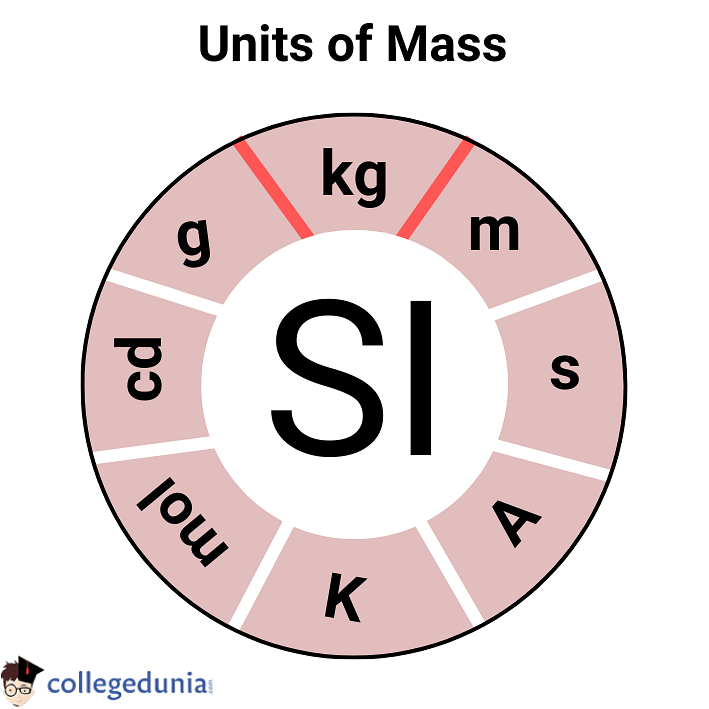
SI units are the standard units of measurement laid out by the international system of units (SI).
| The SI unit of Mass is Kilogram (kg). |
Mass is commonly measured in two units including Kilograms:
- Grams (g)
- Kilograms (Kg)
The mass of an object must include these units. For example, 5 Kg, 100g, etc.
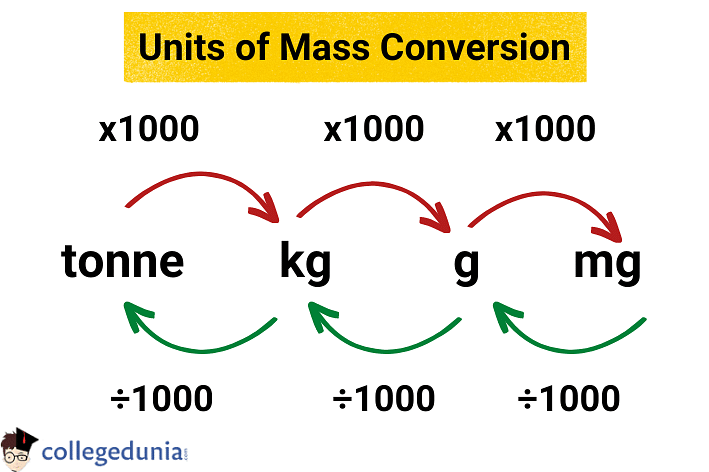
| 1 Kg = 1000 g |
Read More: Unit of Frequency
Other Units of Mass
[Click Here for Sample Questions]
There are various other units of mass that can be used for measurement. The other accepted units of mass are:
- Gram (g) and its multiples and submultiples
- Tonne (t) or metric ton
- Electron volt (eV)
- Atomic Mass Unit (AMU) (Most convenient for denoting the masses of atoms and molecules.)
Other common units of mass are as follows:
| Common Units of Mass | |
|---|---|
| Milligram (mg) | 0.001 gram or 1/1000 gram |
| Centigram (cg) | 0.01 gram or 1/100 gram |
| Decigram (dg) | 0.1 gram or 1/10 gram |
| Gram (g) | 1,000 milligrams |
| Decagram (dag) | 10 grams |
| Hectogram (hg) | 100 grams |
| Kilogram (kg) | 1,000 grams |
| Metric ton (t) | 1,000 kilograms |
Atomic Mass Unit
[Click Here for Previous Years' Questions]
Atoms are the constituents of every element, each of which has a unique atomic number and mass.
- The atomic number of an element is determined by the number of protons in the nucleus of an atom.
- Atomic mass is the total number of neutrons and protons inside the atom of an element.
- Atomic mass is expressed in terms of Dalton (Da) or AMU.
Atomic Mass Unit (AMU) is the average of the neutron and the proton rest mass. Atomic Mass Unit is expressed as a multiple of one-twelfth the mass of the carbon-12 atom. 1 atomic mass unit (AMU) corresponds to 1.660539040 × 10⁻²⁴ grams.
Measurement of Mass
[Click Here for Sample Questions]
The mass of an object remains the same even if we change the position of the object. We can measure mass with various tools such as mass scales, balance scales, simple scales, mass balance, weight scales, weight balance, and many more.
The common methods to measure the mass are as follows:
Balances and Scales
These types of objects include beam balances and digital scientific balances which are required to calculate the mass of an object in daily use. One of the most common balances is the triple beam balance.
However, inertial balance is used to measure mass in space.

Read More: Unit Conversion
Measurement Transducer
It is used to measure the mass of a liquid in a calibrated tank because they are not measured by balances sometimes. When the properties of the liquid are in a static state, transducers are used.
Space Linear Acceleration Mass Measurement Device (SLAMMD)
It is generally used to measure the mass of humans in orbit stationed on the International space station. It is one of the most sophisticated devices which calculate mass via force and acceleration.
Also Check:
| Related Topics | ||
|---|---|---|
| Measurement of Mass and Weight | Atomic And Molecular Masses | Difference between Molar Mass and Molecular Mass |
| Neutron Mass | Electron Mass | Proton Mass |
Difference Between Mass and Weight
[Click Here for Previous Years' Questions]
Mass and weight are two terms that are often used interchangeably. However, mass and weight are two different terms in Physics. The difference between mass and weight is tabulated below:
| Mass | Weight |
|---|---|
| Mass is the amount of matter in a substance. | Weight is the amount of force acting on the mass of an object due to gravitational acceleration. |
| Mass is denoted by “M”. | Weight is denoted by “W". |
| Mass is calculated as Mass = Density x Volume. | Weight is calculated as Weight = Mass × Acceleration due to Gravity. |
| Mass is always constant for an object. | Weight changes due to the gravitational force acting on the object. |
| The SI unit of mass is kilogram (Kg). | The SI unit of weight is Newton (N). |
| Mass is a base quantity. | Weight is a derived quantity. |
| Mass is a scalar quantity with only magnitude. | Weight is a Vector quantity as it has both magnitude and direction. |
Things to Remember
- Mass is the quantity of matter present in a given object.
- Mass is a measure of the resistance of an object to acceleration when force is applied.
- The most commonly used units of measurement are Gram and Kilogram.
- The SI Unit of mass is Kilogram (kg).
- Other commonly used SI units are gram (g) and its multiples and submultiples, tonne (t) or metric ton, electronvolt (eV), and the atomic mass unit (u).
- CGS system of units is based on centimeters as the unit of length, grams as the unit of mass, and seconds as the unit of time.
Previous Years’ Questions (PYQs)
- A man of mass of 100 kg is standing on a platform… (BITSAT 2012)
- A boy of mass 50kg is standing at one end of the boat of… (CBSE Class XII)
- Two particles of mass 5 kg and 10 kg respectively are… (NEET 2020)
- Four particles of masses m, 2m, 3m, and 4m are arranged… (AMUEEE 1999)
- The center of mass of three particles of masses 1 kg, 2 kg… (JCECE 2010)
- Four identical particles each of mass ''m'' are arranged…
- Three particles of masses 1 kg, 2 kg, and 3 kg are situated at the corners…
- What is the distance of the center of mass of a half ring from the center…
- The motion of the center of mass is the result of… (JKCET 2007)
- A uniform disc of radius R is put over another uniform disc of...
Sample Questions
Ques. What is the SI unit of Mass? (1 Mark)
Ans. The SI unit of Mass is Kilogram (kg).
Ques. Who introduced the modern concept of Mass? (1 Mark)
Ans. The modern concept of Mass was introduced by Issac Newton.
Ques. What is Mass? (1 Mark)
Ans. Mass is defined as the amount of matter in an object. It represents the total number of atoms or particles in an object.
Ques. Are weight and mass the same? (2 Marks)
Ans. No, weight and mass are not the same concepts. Weight refers to the amount of force acting on a body whereas mass is the amount of matter in a body. Weight can be changed depending on the force acting upon the object while mass is constant.
Ques. Name some measurement devices used to calculate the mass of an object. (2 Marks)
Ans. Some measurement devices used to calculate the mass of an object are balances and scales, measurement transducers, Newtonian mass measurement devices, vibrating tube sensors, and the use of gravitational interaction between objects.
Ques. What is the largest practical unit of mass? (3 Marks)
Ans. Chandrasekhar limit (CSL) is the largest practical unit of mass. Mass is independent of physical conditions like pressure, temperature, or location. Like length, the mass of many entities in this universe can vary from as light as 10-31 kg (electron) to as massive as the universe of the order of 1055 kg. Some of the units, such as Quintal = 100 kg,1 metric ton = 1000 kg, and Slug = 14.57 kg, are commonly used. Nuclear or atomic masses are made in terms of a unit called AMU (atomic mass unit).
1 CSL=1.4 time the mass of the sun.
Ques. How to convert 90 kilograms to milligrams? (3 Marks)
Ans. The conversion of kilograms to milligrams is as follows:
1 kilogram = 1000000 milligrams
Thus, 90 kilograms= 90×1000000= 90000000 milligrams
Ques. An object has a mass of 80 kilograms. What is the weight of the object if it is on the surface of the earth? (3 Marks)
Ans. The formula to calculate weight is F = mg, where, F is weight, m is mass, and g is the gravitational force.
Gravitational Force on earth is 9.8m/s2. The mass is given as 80 Kg.
We will calculate the weight by following steps:
- F = mg
- F = 80*9.8
- F =784 Newton
Ques. What is the relationship between mass and weight? (3 Marks)
Ans. The quantity of matter within an object is known as mass. This is a constant scalar quantity measured in kilograms. Weight is the force with which an object gets pulled towards the earth. Weight is not a constant quantity and is a vector quantity. It is measured in Newtons.
Mass doesn't change regardless of the amount of pull of gravity. Weight should not be confused with mass, which is a measurement of how heavy matter is when subject to the force of gravity.
So, Weight = (Mass) x (Force of Gravity), or W = mg.
Ques. What do you mean by derived units and supplementary units? (3 Marks)
Ans. Derived units are those units that are derived from the fundamental units. They are the products and ratios of the fundamental units. Some of examples of derived units are units of velocity and acceleration. Supplementary units are the dimensionless quantities that are used for the derivation of derived physical quantities along with fundamental units.
Ques. The mass of an object is given as 6,000 pounds. What will be the mass of the object in tons? (1 Mark)
Ans. As we know that
1 ton = 2000 pounds
6000 pounds = 6000/2000 = 3 tons
Ques. Neha has a notebook that has a mass of 2.2 kg. Calculate the weight of the book on the Earth. (3 Marks)
Ans. According to the question,
- Mass of notebook = 2.2 kg
- Acceleration due to gravity = 9.8 m/s2.
Now, Weight = mass × acceleration due to gravity
Weight of given notebook =2.2kg × 9.8m/s2 = 2.2kg × 9.8 m/s2 = 21.56 N
Thus, the weight of the given notebook on earth is 21.56 N.
Ques. Tiffany weighs 1000 lbs on earth. The weight of Tiffany on some other planet would be 38% of that on Earth. Calculate what will be the weight of Tiffany on that planet. (3 Marks)
Ans. Given that,
- Weight of Tiffany on earth = 1000 lbs
- Weight of Tiffany on another planet = 38% of that on Earth.
Weight of Tiffany on another planet= 38% × Weight on the Earth = 0.38 × 1000 lbs = 380 lbs.
Check-Out:



Comments