



Content Writer
Velocity of an object is the rate of displacement that a certain object or particle undergoes within a specific interval of time. The unit of velocity and speed is m/s. Velocity has both magnitude and direction, which is why it is known as a vector quantity.
- The speed of an object and its direction of motion can be found using the velocity of an object.
- Velocity of an object gives information about the speed of the object and its direction.
- Speed indicates the fastness of a moving object.
- Velocities are of different types, namely, Linear Velocity, Angular velocity, Average velocity, and Instantaneous velocity.
- The unit of velocity is the ratio of the unit of distance to a unit of time.
Read More: Standard Measurement Units
Key Terms: Unit of Velocity, Velocity, Speed, Unit of Speed, Kinematics, Distance, Displacement, Vector quantity
What is Velocity?
[Click Here for Sample Questions]
The velocity of any object in motion is the ratio of displacement of the object to the time taken for the same.
- It is important to note that in the case of velocity, displacement is used and not distance.
- Velocity is a vector quantity which means that velocity has both magnitude and direction.
- It is important to specifically remember that speed and velocity will not be the same in all cases.
The velocity is represented by the letter “v” and the formula is given by,
| Velocity, V = \({Displacement \over Time\ taken} = {s\over t}\) |
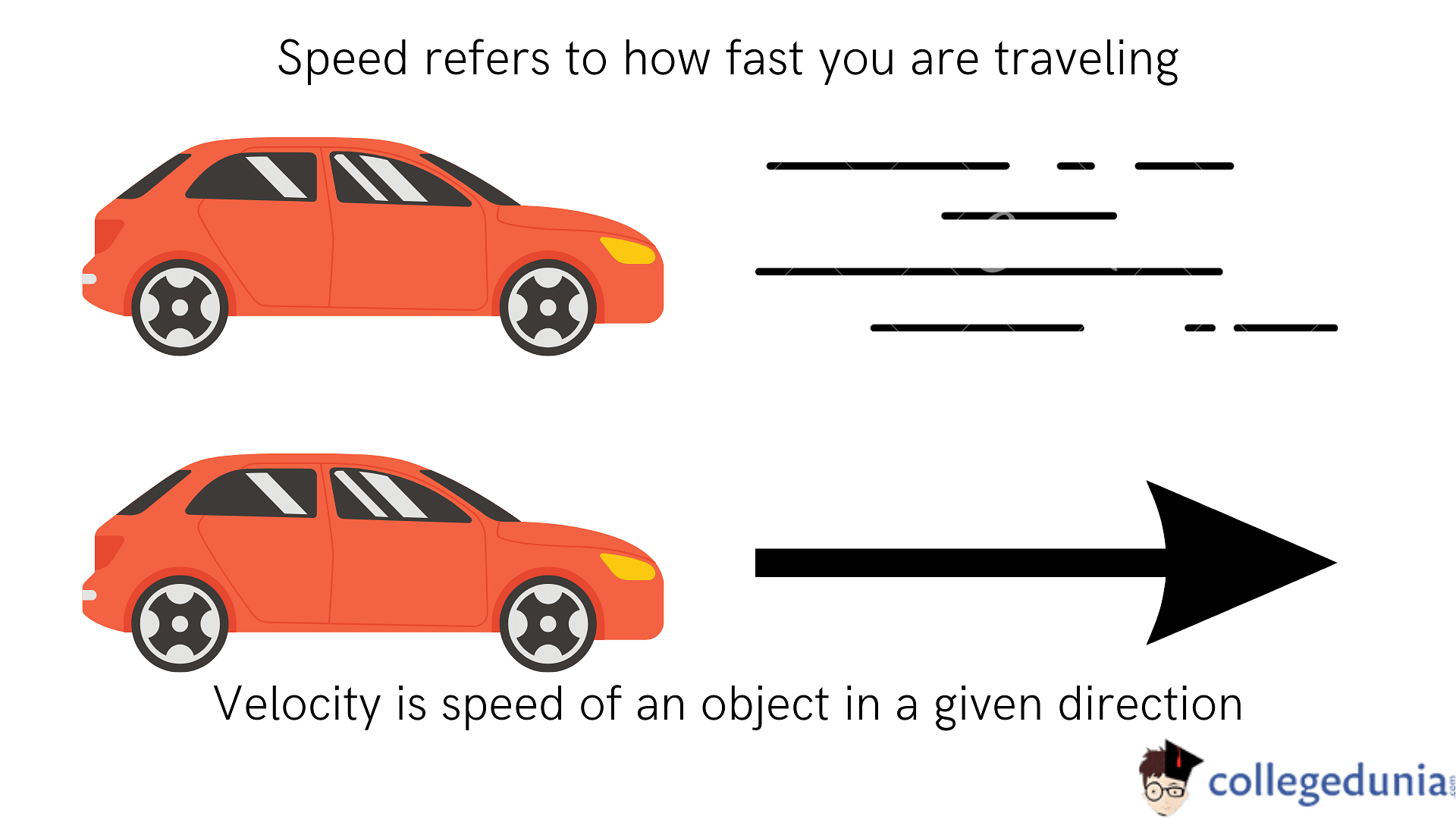
Alternatively, the velocity can also be expressed in unit – centimeters per second (cm/s).
Read More: Unit of Acceleration
Unit of Velocity
[Click Here for Previous Year Questions]
The unit of velocity can be derived from the velocity formula.
| Velocity = Displacement/Time taken |
The dimension of velocity can be written as M/T.
- The SI unit of velocity is m/s. It is the same as the unit of speed.
- The unit of average velocity, and instantaneous velocity is m/s since they are no different from linear velocity
Dimensional Analysis Video Lecture
Unit of Angular Velocity
The unit of angular velocity can be determined from its equation:
| ω = \(\Delta \theta \over \Delta t \) |
The unit of angular displacement, \(\theta\) is radian and the unit of time is seconds in SI standards. Therefore, the unit of angular velocity is rad/s.
Other Units of Velocity
There are various kind of velocity such as:
- Kilometers per hour
- Meter per hour
- Knot (unit)
- Feet per minute
- Inch per second
- Foot per second
- Miles per hour
- Speed of light
Read More:
Types Of Velocity
[Click Here for Sample Questions]
The different types of velocity are as given below –
Uniform Velocity
When an object covers equal displacement in equal intervals of time, it is said to be in uniform velocity. It should be noted that the magnitude and direction of displacement should be the same in all considered intervals.
Variable Velocity
An object is said to be moving in variable velocity when it covers equal displacement in unequal intervals of time, or it covers unequal displacement in equal time intervals or both.
Average Velocity
It is defined as the ratio of total displacement covered to the total time taken. Average velocity is calculated in the case of variable velocity.
Instantaneous Velocity
It is the velocity of an object at any instant of time during its motion or at any particular point on the path covered by it. This is also calculated in the case of variable velocity.
Read More: Unit of Moment of Inertia
Relative Velocity
[Click Here for Previous Year Questions]
Consider two objects A and B in motion with velocities Va and Vb, the relative velocity is defined as the velocity of A with respect to the velocity of B.
When they are moving in the same direction, the relative velocity is,
| Vab = Va – Vb |
When they are moving in the opposite direction, the relative velocity is,
| Vab = Va + Vb |

Relative Velocity
Read More: Unit of Viscosity
Angular Velocity
[Click Here for Sample Questions]
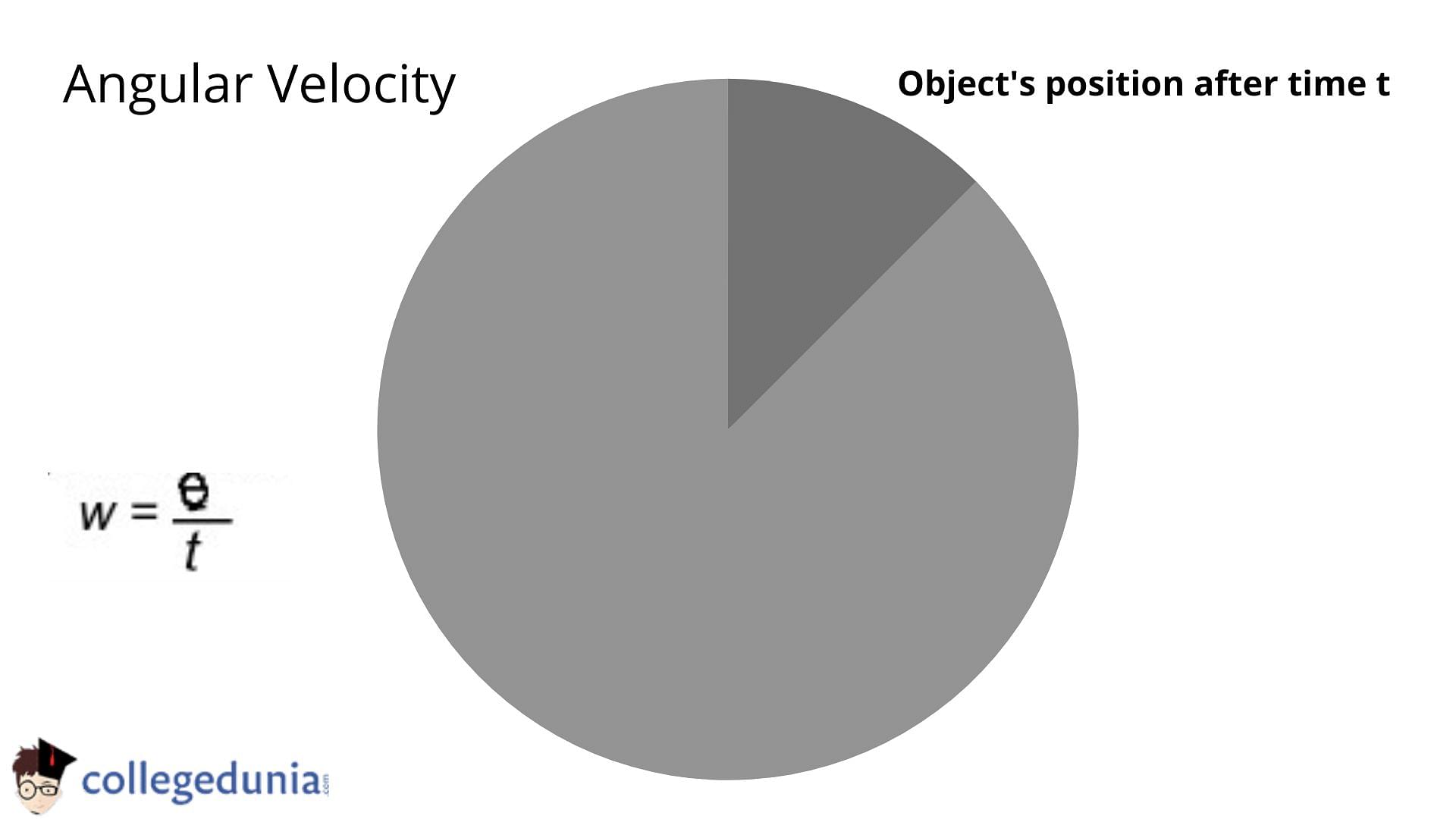
Angular Velocity is defined as the change in angular position or angular displacement per unit of time.
Angular velocity = Angular displacement/ time
| ω =\(\Delta\)θ/\(\Delta\)t |
Where,
- θ = Angular displacement
- ω = Angular velocity
NOTE:
- An object traveling in a straight line without changing its direction will have an average speed that equals the magnitude of its average velocity.
- In an infinitesimally small interval, average speed becomes instantaneous speed.
- Instantaneous speed will always be equal to the magnitude of instantaneous velocity.
Angular Velocity
Read More: Unit of Resistance
What is Speed?
[Click Here for Previous Year Questions]
Speed is the distance traveled by an object in a given interval of time. As in the case of distance, speed is also considered a scalar quantity.
| Speed = Distance/Time |
The unit of speed like the unit of velocity is m/s.
Average Speed and Instantaneous Speed
Average speed is used for calculating the speed of an object during the entire journey. Instantaneous speed is calculated for measuring the speed of an object at a particular instant of the journey. The unit of both the average speed and Instantaneous speed is m/s.
Consider an object traveling with speed S1, for a given time t1.
Similarly, consider the same object traveling with a speed S2 for a given time t2.
Now,
Total distance covered by the object = S1t1 + S2t2
Total time taken for the travel = t1 + t2
Therefore,
Average speed = (S1t1 + S2t2)/( t1 +t2)
If t1 = t2, Average speed = (S1 + S2)/2

Average and Instantaneous Velocity
Read More: Unit of Displacement
Displacement and Distance
[Click Here for Sample Questions]
Displacement and distance are two basic concepts of Kinematics.
- Distance is defined as the total path length covered by an object during its journey. The SI unit of distance is the meter. It is a scalar quantity.
- Displacement is measured as the path length between the final point and the initial point of an object during its journey. Displacement has a meter as its SI Unit. It is a vector quantity.

Read More:
Things to Remember
- The Velocity of any object or entity in motion is defined as the ratio of displacement of the object to the time taken for the same.
- Displacement is considered over distance while calculating velocity
- Velocity is a vector quantity, whereas, speed is a scalar quantity.
- The relative velocity and velocity of an object are not the same.
- A change in angular position or angular displacement per unit of time is referred to as angular velocity.
- The SI unit of linear velocity is m/s.
- The angular velocity has rad/s as its SI Unit.
Previous Years’ Questions
- Two electrons one moving in the opposite direction with speeds… [VITEEE – 2007]
- An eagle flies at constant velocity horizontally across the sky… [UPSEE – 2018]
- Consider a ship traveling due east along the equator with velocity… [TS EAMCET – 2018]
- The numerical value of the density of the material is… [JEE Main – 2019]
- In a simple pendulum experiment for determination of acceleration… [JEE Main – 2019]
- In an experiment to measure the speed of sound by a resonating… [JEE Advanced – 2018]
- K is a positive constant and v is the instantaneous velocity… [AMUEEE – 2016]
- Acceleration of the particle when it is 2m away from the… [AMUEEE – 2016]
- Consider an expanding sphere of instantaneous radius…[JEE Advanced – 2017]
- A new unit of length is chosen such that the speed of light… [AMUEEE – 2012]
Sample Questions
Ques. Is it essential that the speed and magnitude of the velocity of an object should always be the same? (1 mark)
Ans. No, because while calculating the speed of an object distance is considered, whereas, in the case of velocity, displacement is considered.
Ques. What is the unit of average velocity, instantaneous velocity, and angular velocity? (1 mark)
Ans. The unit of average velocity and instantaneous velocity is m/s. The unit of angular velocity is rad/s.
Ques. What is the formula for velocity? (3 Marks)
Ans. The formula for velocity is given by,
Velocity, V = \({Displacement \over Time\ taken} = {s\over t}\)
where,
V = velocity,
s = displacement
t = time taken
Ques. What is displacement? (2 Marks)
Ans. The distance traveled by an object on its journey between its initial point and final point is the object's displacement. The SI unit of distance is the meter. It is a scalar quantity.
The formula of displacement is given by,
\(\Delta\)x = xf – x0
where,
xf = Final Position
x0 = Initial Position
\(\Delta\)x = Displacement
Ques. Why is the instantaneous velocity for an object moving with uniform velocity not calculated? (1 mark)
Ans. For an object moving with uniform velocity, at any given instant the value of velocity will be the same.
Ques. What is the unit of velocity? (1 mark)
Ans. The unit of velocity is m/s.
Ques. What quantity is measured by the speedometer of a car? (1 mark)
Ans. A speedometer measures the instantaneous speed of a vehicle.
Ques. Calculate the velocity of car A with respect to another car B moving in the same direction. Va = 5m/s, Vb = 3m/s. (2 marks)
Ans. Since both cars are moving in the same direction,
Vab = Va – Vb
= 5 – 3
= 2m/s.
Ques. Calculate the speed and the velocity of an object moving from point A to point B within a given time of 4 seconds. AB = 20m. (2 marks)
Ans. In this case, the distance is equal to the displacement, AB = 20m.
Now,
Velocity = displacement/time taken = 20/4 = 5m/s
Speed = distance / time = 20/4 = 5m/s.
Ques. An object travels with a speed of 4m/s for a time interval = 2s. Also, it travels with a speed of 12m/s for another time interval of 2s. Calculate the average speed of the object. (3 marks)
Ans. Given values: S1 = 4m/s, S2 = 12m/s, t1 = t2 = 2s
We know that when time intervals are equal,
Average speed = (S1 + S2)/2
= 12+4/2
= 8m/s
Check-out:



Comments