



Content Curator
Unit of Light is measured in numerous physical quantities, including Watts (W), Lumens (lm), Watts per steradian (W/sr), Candela (cd), Watts per square meter (W/m²), and Candela per square meter (cd/m²). Measuring light does not sound practical as light is not a physical quantity.
- But light has various physical properties like wavelength, intensity, and speed which can be measured in terms of lux, lumens, candela etc.
- Thus, the measure of light can be estimated using its physical properties.
- In physics, light is a form of electromagnetic radiation visible to the human eye.
- It is a vital part of the electromagnetic spectrum, which also includes radio waves, microwaves, infrared radiation, ultraviolet radiation, X-rays, and gamma rays.
- Light travels through space as both a particle (called a photon) and a wave, and its behaviour is governed by the principles of both particle and wave theories.
| Table of Content |
What is Light?
[Click Here for Sample Questions]
Light or visible light refers to one of the parts of the electromagnetic spectrum that falls between radio waves and gamma radiation.
- Light is a sort of electromagnetic radiation which is visible to the human eye.
- Light is a form of energy travelling via space in the form of waves, with each wave having a certain frequency and wavelength.
- Light is able to travel through a vacuum.
- In addition to being visible, light can also be detected by other norms, such as through the use of cameras, telescopes, and other scientific instruments.
- It plays a fundamental role in the natural world and is used in a wide range of applications, from lighting and communications to medicine and materials science.
- Electromagnetic radiations are the fluctuations of magnetic and electric fields that transport energy from one location to the other.
Units and Measurements Detailed Video Explanation
- Visible light is not very different from other parts of the electromagnetic spectrum except that it can be detected by the naked human eye.
- Electromagnetic spectrum radiation is defined as a stream of photons – particles that have no mass travelling with wavelike properties at the speed of light.
- Photons are the smallest quantity of energy that can be transported.
- Visible light has wavelengths that range from 400-700 nm (nanometers) or 4.00 x 10⁻⁷m to 7.00 x 10⁻⁷ m, between the infrared waves that have longer wavelengths and the UV rays that have shorter wavelengths.
- Wavelength of 400-700 nm means a frequency range of around 430-750 Terahertz (THz).
Read More:
| Learn more about Light and its properties | ||
|---|---|---|
| White Light | Laws of Reflection | Reflection of Light |
| Refraction of light | Power of lens | Refractive index formula |
Properties of light
[Click Here for Previous Year Questions]
The primary properties of light are as follows:
- Light has a direction of propagation.
- There are various levels of intensity to light.
- Light has a specific frequency or wavelength spectrum.
- Light can be polarized.
- The speed of light in a vacuum is 3 X 10⁸ m/s.
- The frequency of light remains unchanged at all times when travelling from one medium to another.
Measuring light
[Click Here for Sample Questions]
Light is measured with two sets of units which are given as follows:
- Radiometry: It emphasizes the measurements of light power at all wavelengths.
- Photometry: It measures light with wavelength weighted for a standardized model of human brightness perception. It is useful in quantifying illumination (lighting) which is intended for human use.
Units of Light
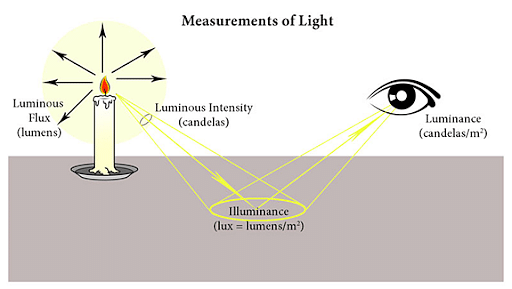
The three main types of units of light are:
- Candela: To measure Luminous intensity
- Lumen: To measure Luminous Flux
- Lux: To measure Illuminance
What is Candela?
[Click Here for Previous Year Questions]
Candela (cd) is the SI unit of luminous intensity, which is a measure of the amount of light emitted in a particular direction by a light source. Simply, Candela can be defined as a measure of how much light is emitted in a particular direction by a source of light, considering the sensitivity of the human eye to different wavelengths of light.
- Candela is the SI unit of luminous intensity.
- It is the luminous power per unit solid angle emitted by a point light source in a specified direction.
- Candela is represented in terms of cd/m2.
- Luminous intensity is comparable to radiant intensity.
- The contribution of each wavelength is weighted by the standard luminosity function rather than adding up the contributions of each wavelength of light in the spectrum of the sources.
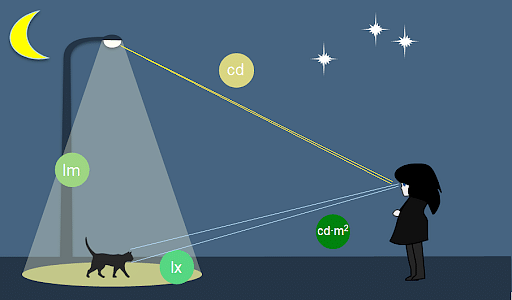
The frequency chosen in the visible spectrum is corresponding to the wavelength of around 555 nm. The human eye is most sensitive near this specific frequency if adapted for bright conditions. But at other frequencies, a significantly more radiant intensity is required to reach the same luminous intensity, according to the human eye’s frequency response. The luminous intensity for light with wavelength λ is given as follows:
| \(lv (λ) = 683.002\ lm/W. \bar{y}\ (λ). le (λ)\) |
Where,
- Iv (λ) → Luminous intensity
- \(\bar{y}\)(λ) → Photopic luminosity function
- Ie (λ) → Radiant intensity
If there is more than one wavelength, then one must integrate over the wavelength spectrum to achieve the total luminous intensity.
What is Lumen?
[Click Here for Sample Questions]
Lumen is the SI unit of luminous flux, which refers to the rate at which visible light is emitted from a source.
Luminous flux differs from radiant flux (power) in such a way that the radiant flux is inclusive of all the emitted electromagnetic waves, while flux is weighed as a luminosity function of the sensitivity pertaining to various wavelengths visible to the human eye.
The lumen, in relation to the candela, is defined as:
| 1 lm = 1 cd x sr |
Where,
- Lm → Lumen
- cd → Candela
- sr → Steradian
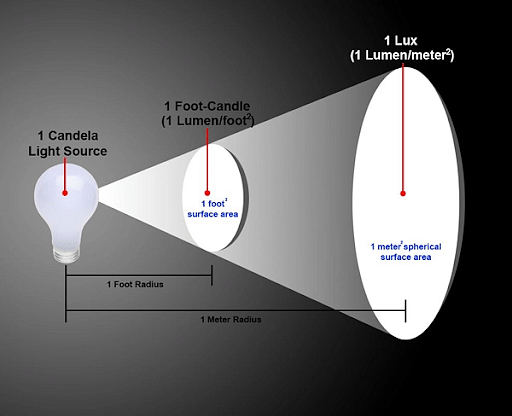
A complete sphere has an angle of 4π steradians, a light source that radiates one candela in all directions holds a total luminous flux of, 1 cd x 4 π sr = 4 π cd x sr = 12.57 lumens
Lumen measurement
What is Lux?
[Click Here for Previous Year Questions]
Lux is the SI unit of illuminance and luminous emittance. It measures flux per unit area, and it is equal to one lumen per square meter.
- In photometry, the lux is a measure of the intensity of light that passes or hits a surface.
- When a particular amount of light is spread over a comparatively larger area, it will illuminate the surface more dimly.
- Thus, we can say that the illuminance, if the luminous flux is kept constant, is inversely proportional to the area.
- Lux is related to the lumen in such a way that one lux is equivalent to lumen per square meter and it is given as: 1 lx = 1 lm/m2 = 1 cd x sr/m2
Lux Measurement
Read More:
Things to Remember
- Light can be measured in a variety of units depending on the quantity of light being measured and the context in which it is being measured.
- The visible spectrum of light is what is perceived as light by humans and has a wavelength of 400nm to 700nm.
- Light travels with a speed of 3 x 10⁸ m/s. The only reason light moves at the speed it does is because photons, the quantum particles that make-up light, have a mass of zero.
- Light does not have a standard unit of measurement. But its physical properties can be measured.
- Candela is the SI unit of luminous intensity. It is represented as cd/m2.
- Lumen is the SI unit of luminous flux. It is given by cd x sr
- Lux is the SI unit of illuminance and luminous emittance. It measures flux per unit area, and it is equal to one lumen per square meter.
Sample questions
Ques. What is the basic unit of light? (2 marks)
Ans. The behavior of light can be seen in the behavior of waves and photons, the basic unit of light. A wavelength, which varies inversely with frequency, manifests itself as color, whilst wave amplitude is seen as luminous intensity or brightness; it is measured by the standard unit of a candela.
Ques. Which instrument is used to measure light? (2 marks)
Ans. A photometer is an instrument that measures intensity of light. A photometer can be defined as an instrument that measures visible light. While luminance measurements are used for products like traffic lights and automobile tail lights.
Ques. What is a light intensity unit? (2 marks)
Ans. The fundamental light intensity unit is the candela, technically the light given off by one candle, or more precisely, it is “a source that emits monochromatic radiation of frequency 540 x 1012 hertz and that has a radiant intensity in that direction of 1/683 watt per steradian.
Ques.A new unit of length is chosen such that the speed of light in vacuum is unity. What is the distance between the Sun and the Earth in terms of the new unit if light takes 8 min and 20 s to cover this distance? (2 marks)
Ans. Distance between Sun and Earth
→ Speed of light in vacuum x time taken by light to travel from Sim to Earth
→ 3 x 10⁸ m/ s x 8 min 20 s
→ 3 x 10⁸ m/s x 500 s
→ 500 x 3 x 108 m
In the new system, the speed of light in a vacuum is unity. So, the new unit of length is 3 x 10⁸ m.
.•. distance between Sun and Earth = 500 new units.
Ques. Define Candela. (1 mark)
Ans. Candela is the SI unit of luminous intensity. It is the luminous power per unit solid angle emitted by a point light source in a specified direction. It is represented as cd/m2.
Ques. Define Lux. (2 marks)
Ans. Lux is the SI unit of illuminance and luminous emittance. It measures flux per unit area, and it is equal to one lumen per square meter. Lux is the International System of Units (SI) derived unit of illuminance. It measures the amount of luminous flux (light energy) per unit area falling on a surface. Particularly, one lux is equal to one lumen per square meter (lm/m²).
Ques. A luminaire producing a luminous intensity of 1500 candela in all directions below the horizontal, is suspended 4m above a surface. Calculate the illuminance produced on the surface immediately below the luminaire. (2 marks)
Ans.

E = I/dxd
→ 1500/ 4x4
→ 93.75 lux
Ques. If the luminaire in from the above question is raised by 1m, what would the new illuminance be at the point immediately below the surface? (2 marks)
Ans. E = 1500/ (4+1)²
→ 1500/ 5x5
→ 60 lux
Ques. A light source producing 1500 candela is suspended 2.2 m above a horizontal surface. Calculate the illumination produced on the surface 2.5 m away ( at Q). (3 marks)
Ans. Calculate h² by using pythagoras theorem
h² = d² + x²
→ 2.2² + 2.5²
→ 11.09
Calculate h
√h² = 3.33
Calculate cosΘ using Pythagoras theorem
→ d/h
→ 2.2 / 3.3
→ 0.66
Eq = 1500/ 11.09 x 0.66
→ 89.26 lux
Ques. Two lamps are suspended 10m apart and at a height of 3.5 m above a surface. Each lamp emits 350cd. Calculate the illuminance on the surface midway between the lamps. (2 marks)
Ans.


The illuminance from two lamps is double that due to one lamp, since the conditions for both lamps are identical. Thus total illuminance at Q = 2 × 5.388 = 11.8 lx
Do Check Out:



Comments