



Education Content Expert
Factors of 17 are the natural numbers that divide 17 completely without leaving any remainder. 17 is a prime number, which means that has only two factors namely 1 and the number itself. Thus, the factors of 17 are 1 and 17. The sum of the factors of 17 is 18. When two numbers are multiplied together and gives the product as 17, then, that set of numbers is called the pair factor of 17. The pair factors of 17 can be positive as well as negative. The pair factors of 17 are (1, 17) or (-1, -17).The prime factorization of 17 is 1 x 17, with 17 being the only prime factor of itself.
Read More: NCERT Solutions for Class 6 Maths Playing With Numbers
| Table of Content |
Key Terms: Factors of 17, Remainder, Prime Factorization, Factors, Pair Factors, Whole Number, Prime Number, Factor Tree
What Are the Factors of 17?
[Click Here for Sample Questions]
Factors of 17 are whole numbers 17 completely and leave the remainder as zero. In other words, if two numbers are multiplied together and give the value 17, then, they are the factors of 17. 17 is a prime number, thus, it has only two factors which are 1 and 17. 17 has no factors other than 1 and itself.
Factors of 17: 1 & 17
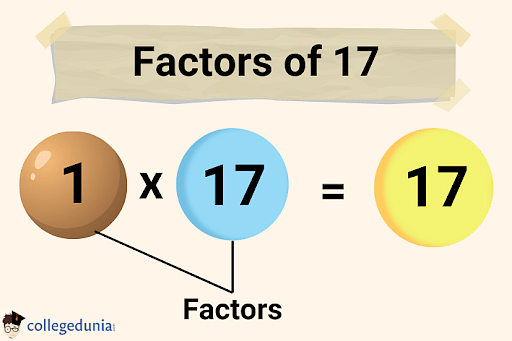
Factors of 17
Also Read:
| Relevant Concepts | ||
|---|---|---|
| Factors of 25 | Factors of 12 | Factors of 28 |
| Factors of 16 | Factors of 18 | Factors of 24 |
| Factors of 48 | Factors of 72 | Factors of 15 |
Factors of 17 in Pairs
[Click Here for Sample Questions]
Pair factors of 17 are the pairs of numbers that on being multiplied together, give the value of 17. As we know, 17 is a prime number and it has one positive pair factor and one negative pair factor. The positive and negative pair factors of 17 are as follows:
| Factors of 17 | Pair Factors of 17 |
|---|---|
| 1 × 17 | (1, 17) |
| -1 × -17 | (-1, -17) |
Thus, the positive and negative pair factors of 17 are (1, 17) and (-1, -17) respectively.
How to Calculate Factors of 17?
[Click Here for Sample Questions]
Factors of 17 can be found through various methods such as the divisibility test, prime factorization, and the upside-down division method. Here we will be calculating the factors of 17 using two easy methods:
- Factors of 17 By Division Method
- Factors of 17 By Prime Factorization
Both these methods of calculating the factors of 17 are explained below in detail.
Read More: Is '1' a Prime Number?
Factors of 17 by Division Method
[Click Here for Sample Questions]
Through the division method, the factors of 17 are calculated by dividing 17 by different integers. If a number divides 17 completely without leaving any remainder, then that number is a factor of 17.
Start dividing 17 by 1 and continue with the same:
- 17/1 = 17 (Factor is 1; Remainder is 0)
- 17/17 = 1 (Factor is 17; Remainder is 0)
Now, if we divide 17 by any other number other than 1 and 17, it leaves a remainder value. Thus, the only two factors of 17 are 1 and 17.
Factors of 17 by Prime Factorization
[Click Here for Sample Questions]
Prime Factorization of 17 is a method of expressing the number 17 as the product of its prime factors. The prime factorization of 17 can be done through two methods:
- Factors of 17 by Upside-Down Division
- Factor Tree of 17
Read More: Prime Number Formula
Factors of 17 by Upside-Down Division
- Take a factor pair of 17 which is (1, 17).
- Check whether the numbers in the pair factors are prime numbers or composite numbers.
- If a number is a prime number, leave the number as it is and move on with the other number.
- If the numbers in the pair factor are composite numbers, factorize them further into their prime factors.
- In the case of 17, both 1 and 17 can not be factorized further.
- Hence, 17 is written as the product of 1 and 17. 17 = 1 × 17.
Thus, the prime factorization of 17 is 1 x 17.
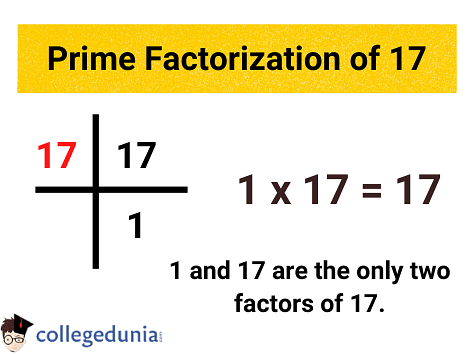
Prime Factorization of 17
Factor Tree of 17
The factors of 17 can also be represented with the help of a factor tree depicting the prime factors of 17:
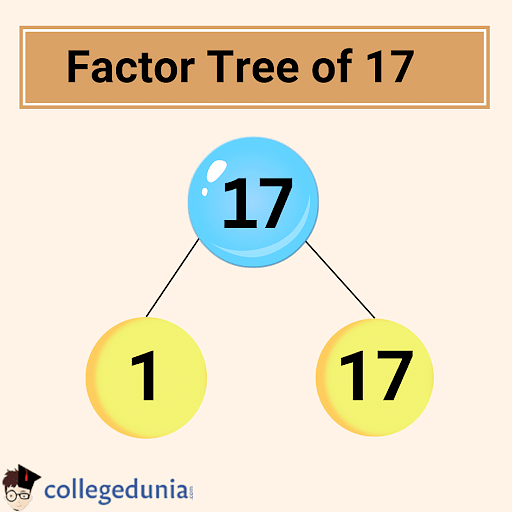
Factor Tree of 17
Solved Examples on Factors of 17
[Click Here for Sample Questions]
Example 1: What are the common factors of 17 and 16?
Solution: The factors of 17 and 16 are:
- Factors of 17 are 1 and 17.
- Factors of 16 are 1, 2, 4, 8, and 16.
Thus, there is only one common factor of 17, and 16 which is 1.
Example 2: Anjali placed 17 plates on the dining table. In how many ways she can stack them such that each stack has equal plates?
Solution: For this situation, we need to know the factors of 17 which are 1 and 17.
The factor pairs would help us to solve the given problem,
Factor pairs of 17 = (1, 17), (17, 1).
- According to the first pair, she can keep 1 stack of 17 plates.
- According to the second pair, she can keep 17 stacks of 1 plate.
Thus, there can be two possible arrangements in the given situation.
Also Read:
| Related Topics | ||
|---|---|---|
| Co Prime Numbers | Relation Between HCF and LCM | Properties of LCM and HCF |
| LCM of Two Numbers | HCF | Twin Primes |
Things to Remember
- There are only two factors of 17 which are 1 and 17.
- Factors of 17 are the numbers that divide 17 completely leaving no remainder.
- 17 is a prime number which is the reason it has only two factors.
- The prime factorization of 17 is 1 x 17.
- The factor pairs of 17 are (1,17) and (-1, -17).
- The sum total of the factors of 17 is 18.
Sample Questions
Ques. What are the common factors of 17 and 18? (2 Marks)
Ans. The factors of 17 and 18 are:
- Factors of 17 = 1, 17
- Factors of 18 = 1, 2, 3, 6, 9 and 18.
Thus, the common factor of 17 and 18 is 1.
Ques. What are the common factors of 17 and 11? (2 Marks)
Ans. Listing all the factors of 17 and 11, we get
- Factors of 17 are 1 and 17.
- Factors of 11 are 1 and 11.
Both the numbers 17 and 11 are prime numbers, thus, the only common factor of 17 and 11 is 1.
Ques. What is the prime factorization of 17? (1 Mark)
Ans. 17 is a prime number which means that it has only two factors 1 and itself. Thus, the prime factorization of 17 is 1 x 17.
Ques. List the positive and negative pair factors of 17. (2 Marks)
Ans. 17 has only one pair of factors which are as follows:
- Positive Pair Factor of 17: (1, 17)
- Negative Pair Factor of 17: (-1, -17)
Ques. Check if 7 is a factor of 17. (2 Marks)
Ans. To check if 7 is a factor of 17 or not, we need to divide 17 by 7.
17 / 7 = 2.428
We can see that 7 does not divide 17 completely, so 7 is not a factor of 17.
Ques. List down the factors of 17 and write its factor pairs. (2 Marks)
Ans. 17 = 1 × 17
Thus, the factors of 17 are 1 and 17. Since there are only two factors of 17, thus, there is only one-factor pair of 17 which is (1, 17).
Ques. What is the product of all the prime factors of 17? (2 Marks)
Ans. We know that since 17 is a prime number thus it has only one prime factor which is 17 itself. Thus, the product of all the prime factors of 17 is 17 only.
Ques. Find the sum of all the Factors of 17. (2 Marks)
Ans. The factors of 17 are 1, and 17, thus, adding both these factors
1 + 17 = 18
Thus, the sum of the factors of 17 is 18.
Ques. Find the Greatest Common Factor of 17 and 3. (2 Marks)
Ans. We know that both 17 and 3 are prime numbers. Thus, the factors of 17 are 1, and 17 and the factors of 3 are 1, and 3. We can clearly see that 17 and 3 have only one common factor which is 1. It means that 17 and 3 are co-prime. Thus, the greatest common factor of 17 and 3 is 1.
Ques. How many factors of 17 are common to the factors of 4? (2 Marks)
Ans. We know that
- Factors of 17 are 1, and 17.
- Factors of 4 are 1, 2, and 4.
Thus, 17 and 4 have only one common factor which is 1 which means 17 and 4 are co-prime.
Check-Out:



Comments