



Content Curator
The Factors of 27 are the numbers that give 27 when 2 numbers are multiplied together,
- The pair factors of 27 are the whole numbers that could be positive or negative. However, it cannot be a fraction or decimal number.
- Any number which can be divided by another number, leaving no remainder is known as a “Factor”.
- In case the factors of a number are prime numbers, then the factors are called Prime Factors.
- The numbers that divide 27, leaving zero as the remainder, are the factors of 40.
Key Terms: Factors, Decimal Numbers, Prime Factorization, Fraction, Prime Factors
Factors of 27
[Click Here for Sample Questions]
Factors of 27 are the numbers that give the numbers 27 when they are multiplied together in a couple of 2 numbers.
- There are 4 factors of the number 27 of which 27 is the biggest factor.
- The positive factors of 27 are 1, 3, 9 and 27.
- The twin factors of 27 are whole numbers that either could be a positive number or negative number but not a fractional or decimal number.
- For example, the factors of 5 are 1, 5 & -1, -5.
![Factor of 27]()
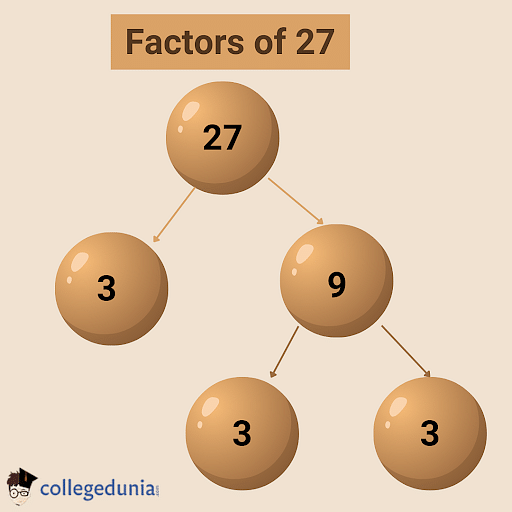
Factors of 27
If we multiply both negative factors, then the resultant factor will be a positive number, such as if we multiply -1 and -5, we will get the number 5. Thus,
- Unique Factors of 27: 1, 3, 9 and 27
- Prime Factorization of 27: 3×3×3 = 33
- Sum of Factors of 27: 40
- Prime Factors of 27: 3
- Negative Factors of 27: -1, -3, -9 and -27
Solved ExamplesExample 1: Identify the common factors of 27 and 26? Solution: The unique factors of 27 are 1, 3, 9 and 27. The factors of 26 are 1, 2, 13 and 26. Hence, The common factors of 26 and 27 are number 1. Example 2: Identify the common factors of 27 and 30? Solution: The unique factors of 27 are 1, 3, 9 and 27. The factors of 30 are 1, 2, 5, 10, 15 and 30. Hence, The common factors of 27 and 30 are number 1. Example 3: Identify the common factors of 20 and 27? Solution: The unique factors of 27 are 1, 3, 9 and 27. The factors of 20 are 1, 2, 4, 5, 10 and 20. Hence, the common factors of 20 and 27 are number 1. |
Types of Factors
[Click Here for Sample Questions]
There are two types of factors in mathematics:
- Prime Factors: If any positive number greater than 1 should have only 2 factors, namely 1 and that number itself, then it is called as prime factors. It means that the number is not fully divisible by other numbers.
- Composite Factors: If any positive number is greater than 1 and has more than 2 factors, then it is known as composite factors.
How to Calculate Factors of 27?
[Click Here for Sample Questions]
There are many possible ways for calculating the factors of 27. Some of them are:
Prime Factorization Method
In this method, we can identify the factors of 27 by getting the factors that can give 27 as a result when numbers are multiplied together.
For example, if we multiply 3 and 9, we will get the number 27 as a result. The number 27 is a composite number, so let’s find out the factors of 27 by the prime factorization method.
- The first step is that we have to divide the number 27 by the smallest prime number, i.e. 2. Thus, 27÷2 = 13.5.
- But, the factors can not be in fractional numbers. Hence, 2 is not a prime factor of 27.
- Now, divide the number 27 by the next prime numbers which are 3, 5, 7 and so on. Thus, 27÷3 = 9.
- Here, we get the positive number which means that 3 is a prime factor of 27.
- Now, Divide 9 with the prime factor of 27 which is 3. Thus, 9÷3 = 3.
- So, 3 is again a prime factor of the number 27.
- Again, divide 3 with the prime factor of 27, that is 3. Thus, 3÷3 = 1.
As we have got number 1 at the end, so we can not proceed further with the division method.
So, the prime factorization of 27 is 3×3×3 or 33 where 3 is a prime number.
Read More:
| Topic Relevant Concepts | ||
|---|---|---|
| Factors of 25 | Factors of 16 | Factors of 72 |
| Factors of 15 | Factors of 48 | Factors of 12 |
| Factors of 18 | Factors of 28 | Factors of 24 |
Simple Division Method
Simple Division means that, we can simply start dividing the number 27 by any number which is greater than number 1. The number which will not leave any remainder will be considered as the factors of 27.
| Simple Division Method | |
|---|---|
| 27÷1 = 27 | 27 |
| 27÷2 | Cannot be Divided |
| 27÷3 = 9 | 9 |
| 27÷4 | Cannot be Divided |
| 27÷5 | Cannot be Divided |
| 27÷6 | Cannot be Divided |
| 27÷7 | Cannot be Divided |
| 27÷8 | Cannot be Divided |
| 27÷9 = 3 | 3 |
| 27÷10 | Cannot be Divided |
| 27÷11 | Cannot be Divided |
| 27÷12 | Cannot be Divided |
| 27÷13 | Cannot be Divided |
| 27÷14 | Cannot be Divided |
| 27÷15 | Cannot be Divided |
| 27÷16 | Cannot be Divided |
| 27÷17 | Cannot be Divided |
| 27÷18 | Cannot be Divided |
| 27÷19 | Cannot be Divided |
| 27÷20 | Cannot be Divided |
Therefore, by the simple division method we get the factors of 27 are 1, 3, 9 and 27.
Pair Factors of 27
[Click Here for Sample Questions]
The pair factors of number 27 are those numbers which are multiplied with each other to get the number 27. The pair factors of number 27 can be either positive or negative.
Positive pair factors of 27:
| Positive Factor of number 27 | Positive Pair Factors of number 27 |
|---|---|
| 1 × 27 = 27 | (1, 27) |
| 3 × 9 = 27 | (3, 9) |
| 9 × 3 = 27 | (9, 3) |
| 27 × 1 = 27 | (27, 1) |
Negative pair factors of 27:
| Negative factor of number 27 | Negative pair factors of number 27 |
|---|---|
| -1 × -27 = 27 | (-1, -27) |
| -3 × -9 = 27 | (-3, -9) |
| -9 × -3 = 27 | (-9, -3) |
| -27 × -1 = 27 | (-27, -1) |
Basic Tips & Tricks to identify factors:
- Always consider 1 is the smallest factor of every number.
- Every number whose factor has to be identified will have two minimum factors, i.e. 1 and the number itself.
- Every even number will always have number 2 as one of their factors.
- The numbers which will end with number 5 will always have 5 as one of their factors.
- Every number which will end with 0 will always have 1, 2, 5, and 10 as their main factors.
Read More:
Things to Remember
- Factors of 27 are numbers which give 27 when multiplied together in a couple of 2 numbers.
- The positive factors of 27 are 1, 3, 9 and 27.
- There are two types of factors: Prime Factors and Composite Factors.
- The Negative Factors of 27 are -1, -3, -9 and -27
Sample Questions
Ques: There were three friends who plucked 27 oranges from a tree and distributed them among themselves equally. How many oranges each of them will get? (2 marks)
Ans: 27 oranges to be divided equally among three friends.
So, we will use a simple division method to solve this problem.
We will divide 27 by 3 and then we will get the correct answer for this problem.
27÷3 = 9
Hence, 9 oranges will be divided among each of them.
Ques: Calculate the mean of the factor of 27? (2 marks)
Ans: The unique factors of number 27 are 1, 3, 9 and 27.
Now, Calculate the sum of all the factors, i.e.
1+3+9+27 = 40
Now, divide the sum of the factors by the total number of factors.
40 ÷ 4 = 10
Therefore, the mean of the factor of 27 is 10.
Ques: What is the Greatest Common Factor (GCF) of 4 and 27? (2 marks)
Ans: The unique factors of 27 are 1, 3, 9 and 27 and the factors of 4 are 1, 2 and 4.
There is only one common factor between 4 and 27 is the number 1. It also implies that the number 4 and number 27 are co-prime.
Thus, The Greatest Common Factor (GCF) of 4 & 27 is 1.
Ques: How many factors of 20 are also the factors of 27? (2 marks)
Ans: The unique factors of 27 are 1, 3, 9 and 27 whereas the factors of 20 are 1, 2, 4, 5, 10 and 20.
And, the common factors between 20 and 27 are number 1. Hence, the number 1 is the only number in factor of 20 which is there in the factor of 27.
Ques: Find out all the prime numbers less than 27? (2 marks)
Ans: There are many prime numbers that lie between number 1 to number 27. They are as follows:
Prime Number: 2, 3, 5, 7, 11, 13, 17, 19, and 23.
These are the prime numbers that exist between numbers 1 to 27.
Ques: Identify the smallest prime number and greatest prime number between the number 1 to 100? (2 marks)
Ans: There are many prime numbers between the number 1 to 100, they are shown below:
Prime Number - 2, 3, 5, 7, 11, 13, 17, 19, 23, 19, 31, 37, 41, 43, 47, 53, 59, 61, 67, 71, 73, 79, 83, 89 and 97.
So, the smallest prime number is number 2 and the greatest prime number is number 97.
Ques: What are the factors of 27 and 108. Also Identify the common factors between them? (2 marks)
Ans: The unique factors of 27 are 1, 3, 9 and 27.
The factors of 108 are 1, 2, 3, 4, 6, 9, 12, 18, 27, 36, 54 and 108.
Hence, the common factors between 27 and 108 is the number 1.
Ques: There were 9 friends on a trip in a car. In the middle of the trip, they bought fruits. If each of them had taken 3 fruits, identify the total number of fruits they bought? (2 marks)
Ans: There were a total of 9 friends and each of them would take exactly 3 fruits, then according to the question, we will use a simple multiplication method.
9 × 3 = 27
Hence, they bought a total of 27 fruits from the fruit shop.
Ques: Check how many common factors are there in between the number 27 and 54? (2 marks)
Ans: The unique factors of 27 are 1, 3, 9 and 27.
The factors of 54 are 1, 2, 3, 6, 9, 18, 27 and 54.
The common factors between 27 and 54 are 1, 3, 9 and 27.
Hence, there are 4 common factors between the number 27 and 54.
Ques: What are the first 5 multiples of the number 27? (3 marks)
Ans: The first five multiples of the number 27 are as follows:
27 × 1 = 27
27 × 2 = 54
27 × 3 = 81
27 × 4 = 108
27 × 5 = 135
Therefore, the first five multiples of the number 27 are 27, 54, 81, 108 and 135.
Also Read:



Comments