



Education Content Expert
Factors of 50 are the numbers that divide 50 completely, without leaving any remainder. The factors of 50 are the numbers that give the value when multiplied together in pairs. 50 is an even composite number and has more than two factors. The factors of 50 are 1, 2, 5, 10, 25, and 50. The factors of 50 in pairs are (1, 50), (2, 25), and (5, 10). All the pair factors of 50 give the value 50 on multiplication with each other. 2 and 5 are the two prime factors of 50. The prime factorization of 50 is 2 x 5 x 5.
| Table of Content |
Key Terms: Factors of 50, Whole Numbers, Pair Factors, Prime Factors, Prime Factorization, Division, Multiplication, Remainder
What are Factors of 50?
[Click Here for Sample Questions]
Factors of 50 are the list of numbers which on dividing 50 leave no remainder. There are 6 factors of 50 in total. 1, 2, 5, 10, 25, and 50 are the factors of 50. It means that on dividing 50 by these numbers, there would be no remainder at the end of the division process.
Factors of 50: 1, 2, 5, 10, 25, and 50
Read More:
| Relevant Concepts | ||
|---|---|---|
| Greatest Common Divisor | Factors of 24 | Relation Between HCF and LCM |
| HCF | Factors of 18 | Factors of 72 |
Factors of 50 in Pairs
[Click Here for Sample Questions]
Pair factors of 50 are whole numbers that give the original number 50 when multiplied. It means that when two numbers give the value 50 on multiplication, then, they are the pair factors of 50. Pair factors can be either positive or negative, however, they cannot be a fraction or a decimal number.
The positive and negative pair factors of 50 are listed below:
| Positive Factor Pairs | Negative Factor Pairs |
|---|---|
| 1 × 50; (1, 50) | -1 × -50; (-1, -50) |
| 2 × 25; (2, 25) | -2 × -25; (-2, -25) |
| 5 × 10; (5, 10) | -5 × -10; (-5, -10) |
How to Calculate Factors of 50?
[Click Here for Sample Questions]
Factors of 50 can be calculated through division as well as prime factorization. If a number divides 50 completely without leaving any remainder, then that number is a factor of 50, else not. Through the process of division, we can calculate the factors of 50 as follows:
| Division | Result |
|---|---|
| 50 ÷ 1 | Remainder = 0; Thus, 1 is a factor. |
| 50 ÷ 2 | Remainder = 0; Thus, 2 is a factor. |
| 50 ÷ 5 | Remainder = 0; Thus, 5 is a factor. |
| 50 ÷ 10 | Remainder = 0; Thus, 10 is a factor. |
| 50 ÷ 25 | Remainder = 0; Thus, 25 is a factor. |
| 50 ÷ 50 | Remainder = 0; Thus, 50 is a factor. |
Prime Factorisation of 50
[Click Here for Sample Questions]
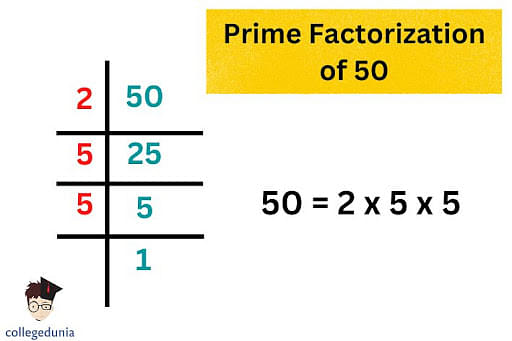
50 is a composite number which means that it has more than 2 factors. The prime factors of 50 can be calculated with the help of the given steps:
Prime Factorization of 50
- Step 1: Divide the number 50 by the smallest prime number which is 2.
50 ÷ 2 = 25
- Step 2: Now, if we divide 25 by 2, we will get a fraction number 12.5. Thus, we will proceed with the next prime numbers 3, 5, 7 and so on
25 ÷ 3 = 8.33
So, 3 is not a factor of 50
- Step 3: Dividing 25 by 5.
25 ÷ 5 = 5
Thus, 5 is a factor of 50.
- Step 4: Dividing 5 by 5 we get,
5 ÷ 5 = 1
- Step 5: The division can not be continued further as we have got 1 at the end.
Thus, the prime factors of 50 are 2 and 5. The prime factorization of 50 can be written as 2 × 5 × 5 or 2 × 52.
Exponential Form of 50
[Click Here for Sample Questions]
Exponential form refers to the alternate method of representing repeated multiplication of a number. The exponential notation is represented in the form of xⁿ, where x denotes the number which is multiplied by itself n time. Here, x is the base, and n is known as the power, exponent, or index.
The prime factorization of the 50 is 2 x 5 x 5, thus, the prime factorization of 50 in exponential form is written as 2¹ x 5².
Factors Tree of 50
[Click Here for Sample Questions]
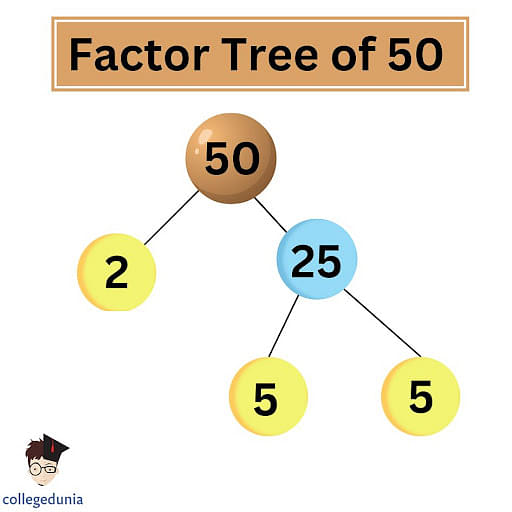
A factor tree refers to a special branching diagram where the factors are represented step-by-step. The ends of the branches of the factor tree give the prime factors of the original number.
The factor tree of 50 is as follows:
Factor Tree of 50
Solved Examples on Factors of 50
[Click Here for Sample Questions]
Example 1: List the common factors of 50 and 100.
Solution: All the factors of 50 and 100 are:
- Factors of 50: 1, 2, 5, 10, 25, and 50.
- Factors of 100: 1, 2, 4, 5, 10, 20, 25, 50, and 100
Thus, the common factors of 50 and 100 are 1, 2, 5, 10, 25, and 50.
Example 2: A teacher has 50 chocolates. She wants to distribute equally among her 10 students. What will be the number of chocolates per student in this case?
Solution: Given that,
- Number of Chocolates = 50
- Number of Students = 10
Number of chocolates per person = 50/10 = 5
Thus, each student will get 5 chocolate.
Things to Remember
- Factors of 50 are the integers that leave no remainder on dividing 50.
- There are 6 factors of 50 which are 1, 2, 5, 10, 25, and 50.
- The prime factorization of 50 is 2 x 5 x 5 where 2 and 5 are its prime factors.
- The sum of all the factors of 50 is 93.
- There are three pair factors of 50 which are (1, 50), (2, 25), and (5, 10).
Read More:
Sample Questions
Ques. List the common factors of 50, 125, and 150. (3 Marks)
Ans. The factors of 50, 125, and 150 are as follows:
- Factors of 50 = 1, 2, 5, 10, 25, and 50
- Factors of 125 = 1, 5, 25, and 125
- Factors of 175 = 1, 2, 3, 5, 6, 10, 15, 25, 30, 50, 75, and 150
Thus, the common factors of 50, 125 and 175 are 1, 5 and 25.
Ques. What is the sum of factors of 50? (2 Marks)
Ans. We know that the factors of 50 are 1, 2,5,10, 25, and 50.
Adding up all the factors of 50, we get
1 + 2 + 5 + 10 + 25 + 50 = 93
Thus, the sum of all the factors of 50 is 93.
Ques. List the common factors of 50 and 450. (2 Marks)
Ans. We will first write down all the factors for 50 and 450,
- Factors of 50: 1, 2,5,10, 25, and 50.
- Factors for 450: 1, 2, 3, 5, 6, 9, 10, 15, 18, 25, 30, 45, 50, 75, 90, 150, 225, and 450.
Thus, the common factors of 50 and 450 are 1, 2, 5,10, and 25.
Ques. What are the common factors of 50 and 70? (2 Marks)
Ans. The factors of 50 and 70 are
- Factors of 50: 1, 2, 5,10, 25, and 50.
- Factors of 70: 1, 2, 5, 7,14, 10, 35, and 70.
Hence, the common factors of 50 and 70 are 1, 2, 5, and 10.
Ques. What are the factors of 50? (2 Marks)
Ans. The factors of 50 are the natural numbers that divide 50 completely leaving no remainder.
The six factors of 50 are 1, 2, 5, 10, 25, and 50.
- 50 ÷ 1 = 50
- 50 ÷ 2 = 25
- 50 ÷ 5 = 10
- 50 ÷ 10 = 5
- 50 ÷ 25 = 2
- 50 ÷ 50 = 1
Ques. Are the factors and multiples of 50 the same? (2 Marks)
Ans. No, the factors of 50 are different from multiples of 50. Factors are those numbers that divide the original number into equal parts whereas multiples are the product form of numbers when multiplied by different natural numbers.
Factors of 50 include 1, 2, 5, 10, 25, and 50, whereas the multiples of 50 are 50, 100, 150, 200, 250, and so on.
Ques. List the multiples of 50. (3 Marks)
Ans. The multiples of 50 are the numbers obtained when 50 is multiplied by any other natural number. The first 10 multiples of 50 are 50, 100, 150, 200, 250, 300, 350, 400, 450, and 500.
- 50 × 1 = 50
- 50 × 2 = 100
- 50 × 3 = 150
- 50 × 4 = 200
- 50 × 5 = 250
- 50 × 6 = 300
- 50 × 7 = 350
- 50 × 8 = 400
- 50 × 9 = 450
- 50 × 10 = 500
Ques. Name the highest prime factor of 50. (1 Mark)
Ans. The prime factorization of 50 is 50 = 2 x 5 x 5. We can see that 2 and 5 are the only two prime factors of 50. Thus, the greatest prime factor of 50 is 5.
Ques. What are the common factors of 35 and 50? (2 Marks)
Ans. The factors of 35 and 50 are
- Factors of 35: 1, 5, 7, and 35
- Factors of 50: 1, 2, 5, 10, 25, and 50
Thus, the common factors of 35 and 50 are 1 and 5.
Ques. Mention the common factors of 50 and 60. (2 Marks)
Ans. Listing all the factors of 50 and 60:
- Factors of 50: 1, 2, 5, 10, 25, and 50
- Factors of 60: 1, 2, 3, 4, 5, 6, 10, 12, 15, 20, 30, and 60
Thus, the common factors of 50 and 60 are 1, 2, 5, and 10.
Read More:



Comments