



Education Journalist | Study Abroad Lead
Factors of a number, in mathematics, is a divisor of a given number that divides it completely without leaving any remainder. In other words, a factor is the remainderless division of one integer by another number. If multiplying two whole numbers results in a product, then the numbers multiplied are factors of the quotient, since they are divisible by the quotient.
Different methods can be used to find the factors of a number, like the division method and the multiplication method.
- Factors are applied in real-life cases when we need to compare prices, divide something into equivalent rows and columns, exchange money, etc.
- Factors of an algebraic expression are values that can divide a given expression. For example, the factors of 5xyz are x, y, z, 5, 5x, 5y, 5z, xyz, and 5xyz.
| Table of Content |
Key terms: Factors of Numbers, Prime Factors, Factors of Prime Numbers, Division Method, Prime Factorization.
What is a Factor?
[Click Here for Sample Questions]
A factor is a number dividing another number and leaving no remainder. In other words, if multiplying two whole numbers gives us a product, the numbers we multiply are factors of the quotient because they are divisible by the quotient.
There are two methods to identify factors. multiplication and division. Apart from this, the rules of divisibility can also be applied.
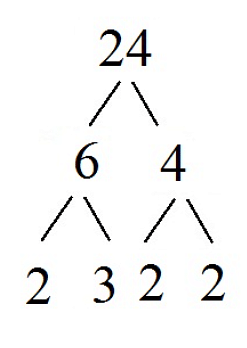
Factors of 24 = 6, 4, 3, 2.
Example: Let us consider the number 8. 8 can be a multiple of 1 and 8, and 2 and 4. Consequently, the factors of the number 8 will be 1, 2, 4, and 8. Thus, when finding or solving factors-related problems, just whole numbers, positive numbers, and fractional numbers are counted.
An ordinary formula to remember is that a and b are factors of the product of ab.
- 2 X 3 = 6. So, 2 and 3 are factors of the number 6. When 6 is divided by 2 or 3 there is no remainder.
- 9 X 3 = 27. So, 9 and 3 are factors of the number 27. When 27 is divided by 9 or 3 there is no remainder.
- 7 X 5 = 35. So, 5 and 7 are factors of the number 35. When 35 is divided by 5 or 7 there is no remainder.
Factors of Prime Numbers
[Click Here for Sample Questions]
A prime number contains just two factors, 1 and the number itself. We cannot divide a prime number by any other number which can give a whole number. Number 1 is not prime as it has just one factor.
These prime numbers are as follows: 2, 3, 5, 7, 11, 13, 17, 19, 23, 29, 31, and so on.
Also Read:
| Related Links | ||
|---|---|---|
| Prime Number Formula | Natural Numbers and Whole Numbers | Difference Between Fraction and Rational Numbers |
Factors of Composite Numbers
[Click Here for Sample Questions]
Composite numbers are those numbers that contain more than 2 factors. Prime factors of composite numbers are factors that are prime numbers such as 2, 3, 5, 7, 11, etc.
| Composite Numbers | Factors |
|---|---|
| 4 | 1, 2 and 4 |
| 8 | 1, 2, 4 and 8 |
| 14 | 1, 2, 7 and 14 |
| 20 | 1, 2, 4, 5, 10 and 20 |
| 35 | 1, 5, 7 and 35 |
| 90 | 1, 2, 3, 5, 6, 9, 10, 15, 18, 30, 45 and 90 |
Factors of Square Numbers
[Click Here for Sample Questions]
Square numbers are those produced when a number is multiplied by itself. It is expressed as n x n = n2, where n is any integer.
- 2 x 2 = 22 = 4
- 3 x 3 = 32 = 9
- 5 x 5 = 52 = 25
- 10 x 10 = 102 = 100
The above examples demonstrate that one of the factors of a square number is the value, which is squared to make the original number.
How to Find Factors of a Large Number?
[Click Here for Sample Questions]
To calculate the factors of a large number, first, divide the number by 2, which is the lowest prime number.
If the number is not divisible by 2, go for the number that is not prime. Check whether it is divisible or not. Repeat this procedure until you find the final value as 1.
Example: Factors of the number 1230.
Here are the steps to find the factors of the number 1230:
- Step 1: First, we divide it by 2, so we get 615. Now, this number is not divisible by 2.
- Step 2: In this case, we go for the next divisible number which is 3. After dividing the number 615 by 3, we will have the number 25.
- Step 3: Now, 25 is not divisible by 3. Now the next prime number is 5. The result we get is 5 (25/5) which can be divided by 5 again giving us the expected result of 1 at last.
So, the factors of the number 1230 will be 1, 2, 3, 5, 10, 25, 123, 246, 410, 615, and 1230.
Factors Formulas
[Click Here for Sample Questions]
Basically three types of formulas are considered for factors. They are:
- Number of Factors
- Product of Factors
- Sum of Factors
Let us suppose that N is a natural number, for which we have to find the factor. If we convert N to a multiple of prime numbers by the prime factorization method, we can represent it as;
N = Xa × Yb × Zc
Where,
- X, Y, and Z = prime numbers
- Their respective powers are a, b, and c.
Number of Factors
The formula to find the total number of factors for the asked number is;
The total number of factors for N = (a + 1) (b + 1) (c + 1).
The sum of Factors
To find the sum (total) of all elements, use the following formula:
Total of N's factors equals [(Xa+1-1)/X-1]. × [(Yb+1-1)/Y-1] × [(Zc+1-1)/Z-1]
Product of Factors
The product of all factors is given by the formula;
Product of factors of N = NTotal No. of Factors/2
Example: Find the total number of factors of 90 by summing and multiplying all the factors.
Solution: First write the prime factorization of 90.
90 = 2 × 45
= 2 × 3 × 15
= 2 × 3 × 3 × 5
= 21 × 32 × 51
Where,
X = 2, Y = 3, Z = 5,
a = 1, b = 2, c = 1
Thus, the total number of factors of 90 = (a +1)(b+1)(c+1) = (1+1)(2+1)(1+1) = 2 × 3 × 2 = 12
Sum of factors of 90 = [(21+1-1)/2-1] × [(32+1-1)/3-1] × [(51+1-1)/5-1] = (3/1) × (26/2) × (24/4) = 3 × 13 × 6 = 234
Product of factors of the number 90 = 90Total factors of 90/2
= 9012/2 = 906
How to Find Factors of a Number?
[Click Here for Sample Questions]
Follow the below-mentioned steps to find factors of a number:
- Pick a number.
- Note all the common factors of the picked number.
- Factor the numbers we got in step 2 until we get prime numbers.
- Note down all the factors you have found.
- List all the unique factors you have found.
To find all the factors of a number, suppose we have the number 18.
- The factors we will get in step 2 are (1×18), (2×9), and (3×6).
- Remark that we will only take positive factors and not negative ones.
- From step 3 (2×9) becomes (2×3×3) and (3×6) becomes (3×2×3).
- Therefore, the unique factors of the number 18 are 1,2,3,6,9,18.
Shortcut Technique for Finding Factors of a number
Let's look at an example, finding factors of a number using the shortcut method.
Consider the number 40.
40 = 10×4
= (5×2)×4 = (5×2) × (2×2)
Now, the factors of 40 will include all combinations of 5 × 2 × 2 × 2 and 1 itself (as 1 × 40 = 40). So, the positive factors of the number 40 will be 1, 2, 4, 5, 8, 10, 20, and 40. It should be noted that there will also be negative factors that should be calculated equally.
How to Find Factors of a Large Number?
To calculate the factors of a large number, first, divide the number by 2, which is the lowest prime number.
If the number is not divisible by 2, go for the number that is not prime. Check whether it is divisible or not. Repeat this procedure until you find the final value as 1.
Example: Factors of the number 1230.
Here are the steps to find the factors of the number 1230:
Step 1: First, we divide it by 2, so we get 615. Now, this number is not divisible by 2.
Step 2: In this case, we go for the next divisible number which is 3. After dividing the number 615 by 3, we will have the number 25.
Step 3: Now, 25 is not divisible by 3. Now the next prime number is 5. The result we get is 5 (25/5) which can be divided by 5 again giving us the expected result of 1 at last.
So, the factors of the number 1230 will be 1, 2, 3, 5, 10, 25, 123, 246, 410, 615, and 1230.
Prime Factors of a Number
[Click Here for Sample Questions]
Using the prime factorization method, we can determine the prime factors of a number.
Example: Prime factorization of 144.
| Steps | Prime factors | Division |
|---|---|---|
| Divide 144 by 2 | 2 | 144 ÷ 2 = 72 |
| Divide 72 by 2 | 2 | 72 ÷ 2 = 36 |
| Divide 36 by 2 | 2 | 36 ÷ 2 = 18 |
| Divide 18 by 2 | 2 | 18 ÷ 2 = 9 |
| Divide 9 by 3 | 3 | 9 ÷ 3 = 3 |
| Divide 3 by 3 | 3 | 3 ÷ 3 = 1 |
Thus, 2 × 2 × 2 × 2 × 3 × 3 = 144
Things to Remember
- A factor is a number dividing another number and leaving no remainder.
- A factor is never a decimal or a fraction; they are just whole numbers or integers.
- Every number which is greater than 0 and ends in 0 contains 2, 5, and 10 as factors.
- A prime number contains just two factors, 1 and the number itself.
- The total number of factors of the given number is always finite(limited).
- A factor is never a decimal or a fraction; it must always be a whole number or an integer.
Sample Questions
Ques Define the factors of 8. [2 marks]
Ans. By definition of factors of a number, we know that 1 and the number itself have two common factors.
8 is an even number and is divisible by 2. So, 8/2 = 4, and also, 8/4 = 2
Additionally, 8 cannot be evenly divided by any other number.
Therefore, 1, 2, 4, and 8 are demanded factors.
Ques Find all the factors of 20. [3 marks]
Ans. Step 1: Note all the numbers from 1 to 20.
1, 2, 3, …., 20
Step 2: Now check which of these numbers can be divided by 20 without leaving remainders.
- 20/1 = 20
- 20/2 = 10
- 20/3 = not divisible.
Keep dividing 20 by each number up to 20.
Step 3: The factors of 20 will be,
1,2,4,5, 10, and 20.
Ques Find all the factors of the number 31. [1 mark]
Ans. 31 is a prime number. The only two numbers that are perfectly divisible by 31 are 1 and 31. Therefore, 1 and 31 will be the factors of the number 31.
Ques Find the prime factors of 144. [3 marks]
Ans. As the name suggests, prime factorization is a method of obtaining prime factors of any number. Prime factors are prime numbers. Factors of prime numbers are 1 and the asked number itself. For instance, 13 is a prime number, as the factors of the number 13 are 1 and 13.
Consider the number 144. Start by considering the smallest possible factor, that is, 2.
144 = 2 x 72
= 2 x 2 x 36
= 2 x 2 x 2 x 18 = 2 x 2 x 2 x 2 x 9 = (2 x 2 x 2 x 2) x (3 x 3)
Thus, the prime factors of 144 are 2 and 3 because these factors are prime numbers.
Ques. How is factoring applied in real life? [2 marks]
Ans. In real life, factoring is a valuable skill. Typical applications include dividing something into equal parts, exchanging money, comparing prices, understanding time, and calculating while travelling.
Ques. What is the significance of learning about prime factors? [3 marks]
Ans. Prime factors are important for people who try to make (or break) secret codes based on numbers and need to know about factorization. This is known as cryptography or encryption. Because of the difficulty of factoring very large numbers, which can take a computer a long time to do.
Ques. Find the positive factors of 64. [4 marks]
Ans. Let us find the factors of 64 with the help of the multiplication technique.
- To find the factors of 64 with the help of the multiplication technique, we need to check which pairs of numbers are multiplied to give us 64, so we need to divide 64 by natural numbers starting from 1 to 9, so we get 1 × 64 = 64 and 2 × 32 = 64, 4 × 16 = 64, 8 × 8 = 64.
- After noting the list, we find all the factors of 64 starting from 1, and then we go up to 64 again. This gives us a complete list of all 64 elements.
- So, 64’s positive factors = 1, 2, 4, 8, 16, 32, 64.
Ques. Which of the two statement(s) is/are correct? [5 marks]
a.) A factor of the asked number can be greater than that number.
b.) Some numbers can have infinite factors.
Ans. a.) The statement, 'A factor of the asked number can be greater than that number.', is false. We know that factors are divisors of numbers that leave 0 as a remainder. Therefore, they are always less than the number. So, the answer is wrong.
b.) The statement, 'Some numbers can have infinite factors', is false. The total number of factors of the asked number is finite (limited). So, the answer is wrong.
Ques. Find the number of positive integral solutions of the equation, x2 – y2 = 840. [4 marks]
Ans. The algebraic expression can be written as x2 – y2 = (x+y) (x-y).
So, to get the solution of x and y, we need to find pairs whose product is 840.
Prime factorization of 840 = 23 × 3 × 5 × 7. Therefore, the number of factors of 840 = (3+1)(1+1)(1+1)(1+1) = 32.
The number of pairs that will give unique positive integral solutions to this equation = Number of factors /2 = 32/2 = 16. Since, for each pair, say, 4 x 210, we get unique solutions for x and y.
Ques. Can the Factors of a number be negative? [3 marks]
Ans. Yes, the factors of a number can be negative, as we are aware that the product of two negative numbers is a positive number. For instance, if we multiply (-2) × (-3), we get the number 6. Likewise, (-1) × (-6) = 6. This indicates that -1, -2, -3, and -6 are the negative factors of 6. This shows that numbers can be positive and negative factors. In this case, the positive factors of the number 6 can be mentioned as 1, 2, 3, and 6; and the negative factors of the number 6 can be mentioned as -1, -2, -3, and -6.
For Latest Updates on Upcoming Board Exams, Click Here: https://t.me/class_10_12_board_updates
Also Check:



Comments