



Content Writer
Fischer indole synthesis, first invented by Fischer in 1883, is one of the oldest and most effective methods of indole development. Various indoles are synthesized from aryl hydrazines and substituted ketones or aldehydes in acidic conditions.
- The choice of acid catalyst is important. Bronsted acids like HCl, H2SO4, polyphosphoric acid, and p-toluenesulfonic acid can be used as catalysts.
- Lewis acids such as boron trifluoride, zinc chloride, iron chloride, and aluminum chloride are also useful catalysts for this reaction.
Indole is an extensively explored heterocyclic ring system. It has applications in various pathophysiological conditions like cancer, inflammation, depression, migraine, emesis, and hypertension. Every year, thousands of indole derivatives are made for a breakthrough in various life-threatening conditions.
Read more: Types of alcohols
| Table of Content |
Key terms: Tautomer, hydrazone, hydrazine, Aromatization.
Fischer Indole Synthesis Reaction
[Click Here for Sample Questions]
Fischer Indole Synthesis is the most useful route for indole formation. The reaction involves the cyclization of an arylhydrazone, which is prepared from aryl hydrazine and aldehyde/ ketone by treating with an acid catalyst or thermally affected for the formation of an indole nucleus. The closure of the ring involves a cyclic rearrangement process.
The process has been under intensive investigation for over a century. Many useful intermediary products have been isolated and characterized. Many routes are available for indole formation, as this area has been extensively researched. Other processes like the ring synthesis of benzofurans and benzo thiophenes have been much less studied.
The process is a multi-step sequence that involves:
- An aryl hydrazone is heated with an acid.
- Ammonia is lost.
- Indole formation.
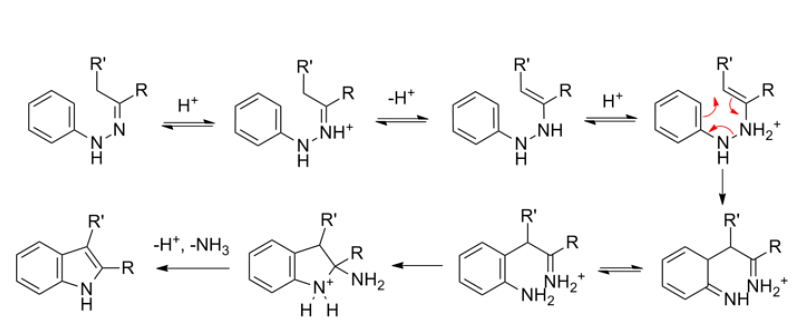
Fischer Indole Synthesis Reaction
- An equimolar mixture of aryl-hydrazine and aldehyde/ ketone is directly subjected to the indolization conditions, without isolating hydrazone.
- Aryl hydrazone is prepared by reducing the corresponding aryldiazonium salt or N-nitro arylalkylamine or by a palladium-mediated coupling reaction, in the presence of carbonyl moiety without isolation of aryl hydrazone. These methods are useful if aryl hydrazone intermediaries are unstable or toxic.
Fischer Indole Synthesis Mechanism
[Click Here for Sample Questions]
Fischer Indole Synthesis mechanism are as follows:
- Fischer Indole Synthesis converts hydrazines to hydrazone in the presence of an acid catalyst.
- Protonation and isomerization of arylhydrazone to the receiver of enamine.
- The protonated enamine tautomer then experiences a 3,3-sigmatropic rearrangement in which the N-N bond is broken, which is an irreversible electrocyclic rearrangement.
- A cyclic amino acetal (or aminal) forms the resulting imine, which removes NH3 under acid catalysis, resulting in an energetically favorable aromatic indole.
- The hydrazine molecule behaves as an amine towards a carbonyl compound and forms hydrazone.
- The enamine tautomer of the hydrazone undergoes cyclic rearrangement as the cyclic flow of electrons for a strong C-C bond while cleaving a weak N-N bond. The resultant di-imine is formed.
- One of the products participates in re-aromatization and forms non-aromatic amine. It further attacks other imine functions and forms a nitrogen equivalent of hemiketal.
- Removal of ammonia in the presence of acid results in the formation of an aromatic indole system.
Fischer Indole Synthesis Features
[Click Here for Sample Questions]
The properties of Fischer Indole Synthesis are as follows:
- Unsymmetrical ketones produce two region-isomeric 2,3-disubstituted indoles with region-selectivity based on medium acidity, hydrazine substitution, and steric effects.
- Both mono and bis-indoles can be obtained from 1,2-diketones, and mono-indoles are typically formed when refluxing alcohols with potent acid catalysts.
Read more: Conformational isomers
Fischer Indole Synthesis Advantages
[Click Here for Sample Questions]
Fischer Indole Synthesis advantages includes:
- The Fischer Indole Synthesis enables the use of a wide range of alcohol instead of their oxidized equivalents.
- The reaction can be performed in one pot. It tolerates the substitution of both hydrazine and alcohol.
- It gives moderate to excellent yields to the indoles.
- Convergent.
- Mild.
- Easy to operate.
- Broad in reach.
- Accessing enantio-enriched goods.
Fischer Indole Synthesis Drawback
[Click Here for Sample Questions]
The Fischer Indole synthesis drawbacks includes:
The reaction fails with acetaldehyde and cannot be used to synthesize an indole itself. It is possible to use keto acid, and pyruvic acid instead, and decarboxylate the product to yield indole.
Fischer Indole Synthesis Process
[Click Here for Sample Questions]
Fischer Indole Synthesis processes include as follows:
- Indole is of considerable significance to biological systems.
- The redox-active Indole side-chain of tryptophan 1,2 is one of the main charge carriers involved in electron transfer.
- The optical properties of indole make tryptophan one of the principal intrinsic fluorophores in the study of protein fluorescence.
- Indole is formed by the intermediate molecule indole pyruvic acid by reductive deamination of tryptophan.
- Tryptophanase catalyzes the deamination mechanism from which the amine (-NH2) group of the tryptophan molecule is removed. The final components are Indole, pyruvate, ammonium, and water.
- The Fischer indole synthesis in which an aromatic phenylhydrazone is heated in acid is the most useful route to the indoles.
- An achiral molecular unit is the parent indole; the creation of chiral products using a FIS is done by applying alpha-branched carbonyl molecules.

Fischer Indole Synthesis
Things to Remember
- The Fischer Indole Synthesis involves the formation of a hydrazone, loss of ammonia, and Indole formation. It is a multi-step process.
- An aryl hydrazone is prepared by reducing the aryldiazonium salt or N-nitro arylalkylamine or through a palladium-mediated coupling reaction.
- Protonation, isomerization, and aromatization occur to form the desired product.
- The Fischer Indole Synthesis can be performed in one pot as it tolerates substitution on both hydrazine and alcohol.
- The Fischer Indole Synthesis gives moderate to excellent yields to the indoles.
- One of the drawbacks of Fischer Indole Synthesis is that indole cannot be produced from acetaldehyde.
Sample Questions
Ques. Where is Indole found? (2 marks)
Ans. Indole occurs naturally in human feces and coal tar. It has a strong fecal odor; however, at very low concentrations it has a floral scent. It is a component of many floral scents and perfumes. It is solid at room temperature.
Ques. What is the Indole test and what do you mean by being Indole Positive? (2 marks)
Ans. An indole test is conducted on bacterial organisms to assess their ability to transform tryptophan into indole. It is a biochemical test and is done with the help of various intracellular enzymes commonly referred to as “tryptophanase”
Ques. How is indole detected? (2 marks)
Ans. The indole test is conducted to assess the ability of the body to break down tryptophan to form the indole compound. Indole is detected by Kovac or Ehrlich’s reagent containing 4 (p)-dimethylamino benzaldehyde, which interacts with indole to create a red-colored compound.
Ques. What is the material used for Indole synthesis? (2 marks)
Ans. The Fischer indole synthesis is an organic reaction. An acid catalyst is required in the reaction to convert phenyl hydrazine and an aldehyde or ketone to an indole. With the acid catalyzed reaction of the hydrazine with the carbonyl, the cycle starts with the formation of a phenylhydrazone.
Ques. Do bacteria produce Indole? (2 marks)
Ans. Indole is produced in amino acid catabolism, inhibition of cell division, biofilm formation, and stress tolerance. Escherichia coli tryptophanase produces indole from tryptophan and exports it through the AcrEF pump. Indole acts as an autoinducer to guide transcription.
Ques. Indole acidic or basic? (1 mark)
Ans. Indole basically consists of a pyrrole ring fused to benzene to form 2, 3-benzopyrrole. They are compounds forming an indole moiety. Indole is a solid, partially soluble compound (in water) and an extremely weak acidic compound (essentially neutral).
Ques. How is Indole produced? (2 marks)
Ans. Indole is produced by reductive deamination of tryptophan via the intermediate molecule indole pyruvic acid. Tryptophanase catalyzes the deamination process from which the tryptophan molecule group amine (-NH2) is extracted. The final reaction products are indole, pyruvate, ammonium ( NH4+), and water.
Ques. What are the uses of Indole? (1 mark)
Ans. Indoles has a wide range of applications in pathophysiological conditions like cancer, microbial and viral infections, inflammation, depression, migraine, emesis, and hypertension,
Ques. What are Bronsted-Lowry acids? (2 marks)
Ans. Bronsted Lowry acids have ionizable protons which they donate to bases. They are written as HA. where H+ is a donatable proton and A- is the anion.
Examples HCl, H2SO4, HNO3, and CH3COOH.
Ques. What is a tautomer? (2 marks)
Ans. Tautomerism is functional isomerism in which the isomers are readily interchangeable and maintain a dynamic equilibrium with each other. The molecules exhibiting this nature are called tautomers.
Check out:



Comments