



Education Journalist | Study Abroad Lead
Hydrazine is also called Diamine or Diazane or Nitrogen hydride and is a strong base.It is an azane and dangerously unstable. The N-N bond gap between each pyramidal H2N-N subunit is 1.45.
- In its anhydrous state, diamine is a colorless, flammable, oily liquid with an ammonia-like odor.
- The flash point of it is 99 °F.
- If any air is detected during the distillation process, it explodes.
- It damages tissues and is poisonous.
- Hydrazine burns and releases dangerous nitrogen oxides into the air.
| Table of Content |
Key terms: Hydrazine, Ammonia, ketazine, Pesticides, Anhydrous compound, Nitrogen oxides
What is Hydrazine?
[Click Here for Sample Questions]
Hydrazine or N2H4 is an inorganic substance. It is also called Diamine or Diazane or Nitrogen hydride. It is a solid base that is derived by substituting hydrogen atoms in the Hydrazine with an organic group. Furthermore, it is an anhydrous form, it is colorless, fumes and also smells like ammonia.
Also Read:
| Related Articles | ||
|---|---|---|
| Oxidation and Reduction | Nucleophilic Addition Reaction | Etard Reaction |
| Decomposition Reaction | Displacement Reaction | Physical properties of Aldehydes, Ketones and Carboxylic acids |
Properties of Hydrazine
[Click Here for Sample Questions]
The properties of Hydrazine are as follows:
- Hydrazine is colorless but has an oily look to it with an ammonia like smell.
- The boiling point of this inorganic compound is 114°C while the melting point is 2°C.
- Hydrazine (N2H4) is soluble in water, ethanol and methanol.
- While the molar mass of hydrazine is 32.0452 g/mol the density of the substance is 1.021 g/cm3
- The compound is thermally unstable and can also be stored for a long time in a sealed glass container
Properties of Hydrazine
Structure of Hydrazine
[Click Here for Sample Questions]
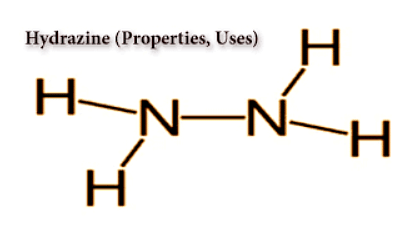
The chemical formula for hydrazine is NH2NH2 while its molecular formula is N2H4. The structure of hydrazine is as below.

Structure of Hydrazine
Chemical structure of Hydrazine
It has two NH2 groups attached covalently. Each group is in a pyramid shape.
Production of Hydrazine
[Click Here for Sample Questions]
Hydrazine is derived by combining hydrogen peroxide and ammonia together. The process of combination is called ketazine or Pechiney-Ugine-Kuhlmann process. The reaction is as below.
2NH3 + H2O2 → H2NNH2 + 2H2O
Chloramine creates a reaction when it comes in contact with ammonia. It generates nitrogen-nitrogen single bonds and hydrogen chloride. These are by-products of the reaction and it is as follows.
NH2Cl + NH3 → H2NNH2 +HCl
Uses of Hydrazine
[Click Here for Sample Questions]
Hydrazine is used in various ways and in different industries. Some of the major uses are stated as below.
- The most common usage of hydrazine is as a jet propellant. Specifically, it is used in space vehicles like fighter jets and space shuttles.
- Hydrazine is also used in large industrial processes where boilers are used. Hydrazine reduces the concentration of oxygen in the boilers and also helps with regulating the pH balance of water.
- Hydrazine is also frequently used in the manufacture of pharmaceuticals. The way these are done is to convert hydrazine to heterocyclic rings such as pyridazines and pyrazoles.
- Pesticide manufacture also requires hydrazine. Both active and inactive hydrazine compounds are combined with agricultural chemicals to make pesticides.
Adverse Health Effects
[Click Here for Sample Questions]
The acute and chronic exposure to hydrazine causes adverse effects on health.
- Typically targeted organs like the central nervous system (CNS), respiratory system, eyes, and skin become affected.
- Prolonged exposure can harm the liver and kidneys
- Corrosive, poisonous, and unpleasant gasses will be produced by fire. Its vapors can make you feel faint or suffocate you.
Things To Remember
- Hydrazine, a chemical compound, is used in cooling water reactors as a corrosion prohibitor.
- One of the newer ways of using hydrazine is in fuel cells. It replaces hydrogen in the fuel cells.
- One big benefit of doing this is that hydrazine produces 200mW/cm2 more than a similar hydrogen cell.
- Hydrazine also finds use in plastic production factories. In detail, the production of vinyl flooring and foam cushions require hydrazine.
- Airbags in cars contain a powder called sodium azide. The powder is manufactured from hydrazine along with sodium nitrite.
Also Read:
Sample Questions
Ques. What is hydrazine? (1 mark)
Ans. Hydrazine is an inorganic chemical compound that is used as rocket fuel and as a reducing agent. In addition, it is used for chemical synthesis and to manufacture pesticides.
Ques. What is the molecular formula of hydrazine? (1 mark)
Ans. The molecular formula of hydrazine is N2H4.
Ques. What are the properties of hydrazine? (1 mark)
Ans. Hydrazine is colorless but has a strong ammonia-like smell to it. It is soluble in water. While its boiling point is 114°C, the melting point is 2°C. Hydrazine is also unstable in thermal nature.
Ques. Is hydrazine a base? (1 mark)
Ans. Hydrazine is a quite moderate base. As an azane, hydrazine is unstable.
Ques. Why is hydrazine unstable? (1 mark)
Ans. Hydrazine is unstable because of the N-N single bond between the electrons on the atom. Since there is such a small amount of nitrogen, there are repulsions between the electrons making hydrazine unstable.
Ques. Why is hydrazine used as rocket fuel? (2 marks)
Ans. When talking about hydrazine, the common usage is as rocket fuel. Hydrazine when mixed with dinitrogen tetroxide which is an oxidizing agent, creates a hypergolic mix. The resultant mix is very explosive and requires no ignition. Hydrazine reacts exothermically with oxygen to form nitrogen and water vapor.
Ques. Why is hydrazine used in boiler water treatment? (2 marks)
Ans. Hydrazine is used for boiler water treatment purposes. The reason why it is used is that it is highly soluble in water and a strong reducing agent. In addition, it also reacts with the hematite layers on the boiler tubes to form a hard magnetite layer. This helps in preventing corrosion in boiler water treatments.
Ques. Which products have hydrazine? (1 mark)
Ans. Hydrazine is used in several products and industries. Insecticides and herbicide production also requires hydrazine. Additionally, hydrazine is used as jet or rocket fuel along with as a boiler water treatment.
Ques. What is the pH of hydrazine? How should the pH of 0.15 M aqueous solution of Hydrazine be? (5 marks)
Ans. The pH of hydrazine is 10.6. To derive this, the following calculation is done. When hydrazine is mixed in water, the following reaction takes place.
H2N - NH2 + H2O ⇌ H3N + -NH2 + OH-
The equilibrium constant for the above reaction and its value is as follows.
Keq=[N2H+5][OH−] / [N2H4] = 1.0 x 10⁻⁶
Since the molarity is 0.15 M, after equilibrium, x moles form which makes the concentration, 0.15-x. The equilibrium constant now is as follows.
Keq=(x) x (x) / 0.15−x = 1.0 x 10−6
x2 / 0.15−x = 1.0 x 10⁻⁶
x = 3.87 x 10⁻⁴ mol /L
The ions in the reaction is [N2H+5] = [OH−] = 3.87 x 10⁻⁴ mol /L.
Now, since pH+pOH = 14, the calculation of pOH is,
pOH = −log10[OH−]
Substituting the values and after calculation for pH is as below,
pOH = −log10(3.87 x 10⁻⁴)=3.41
pH = 14 – 3.41 = 10.6
Ques. The Lassaigne test for nitrogen cannot be performed on hydrazine. Why? (1 mark)
Ans. There is no carbon atom in hydrazine. As a result, it does not produce any NaCN upon fusion with Na+ metal, which is the main condition of Lassaigne's test.
For Latest Updates on Upcoming Board Exams, Click Here: https://t.me/class_10_12_board_updates
Check-Out:



Comments