



Education Journalist | Study Abroad Lead
Tryptophan is classified as an α-amino acid used in the biosynthesis of proteins. Tryptophan is denoted as Trp or W. The chemical formula of Tryptophan is C11H12N2O2. It consists of an α-amino group, α-carboxylic acid group, and a side chain indole, hence, making it a non-polar aromatic amino acid. Since the human body is unable to produce it, it must be received through diet or supplements. The body produces various essential chemicals, including the neurotransmitter serotonin, with the help of tryptophan.
| Table of Content |
Key Terms: Tryptophan, Amino Acids, Human Body, Serotonin, Carboxylic Acid, Metabolism, Melatonin, Proteins
What is Tryptophan?
[Click Here for Sample Questions]
Tryptophan, abbreviated Trp or W, is a protein-building amino acid that is used in the process. Tryptophan is a polar molecule with a non-polar aromatic beta carbon substituent because it has a side chain indole, an α-amino group, and an α-carboxylic acid group.
The codon UGG is used to encode it. Tryptophan is a necessary amino acid since it cannot be produced by humans or many animals; therefore, they must consume it through their food.
Read More: Polar Compounds
Structure of Tryptophan
[Click Here for Previous Year's Questions]
The chemical structure of Tryptophan is C11H12N2O2. The symbol for it is Trp or W. It is a nonpolar aromatic amino acid because it has an α-carboxylic acid group, α-amino group, and side chain indole.
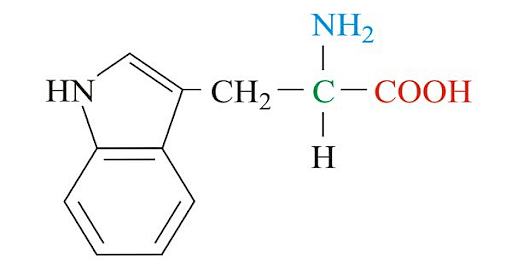
Structure of Tryptophan
Physical and Chemical Properties of Tryptophan
[Click Here for Sample Questions]
The physical and chemical properties of Tryptophan are as follows:
Physical Properties of Tryptophan:
It has a uniform colour that leans slightly yellowish-white, with no flavour, and has no smell.
Chemical Properties of Tryptophan:
- Its chemical formula is C11H12N2O2, and its molar mass is 204.229 g.mol-1.
- It is insoluble in chloroform and ethyl ether but soluble in hot alcohol, alkali hydroxides, ethanol, and acetic acid.
- Trp's melting point is 290.5 °C and has a pKa value that is equal to 25 °C at 7.38.
D-tryptophan, also known as [(R)-2-Amino-3-(3-indolyl)propionic acid], and L-tryptophan, also known as [(S)-2-Amino-3-(3-indolyl)propionic acid], are its two optical isomers. The amino acid precursor of serotonin and melatonin is called L-tryptophan.
Read More:
| Related Links | ||
|---|---|---|
| Aldehydes, Ketones, and Carboxylic Acids | Vitamins and Minerals | Carboxyl Group |
| Glycosaminoglycans | Hormones in Animals | Androgen Hormone |
| Cortisol Hormone | Norepinephrine | Gibberellins |
Sources of Tryptophan
[Click Here for Previous Year's Questions]
Tryptophan is majorly found in dietary or food-based proteins. Particularly plentiful foods include chocolate, oats, dried dates, milk, yoghurt, cottage cheese, red meat, eggs, pork, poultry, sesame, chickpeas, almonds, and sunflower seeds, pumpkin, buckwheat, and spirulina.

Sources of Tryptophan
Read More: Proteolytic Enzymes
Production Of Tryptophan
[Click Here for Sample Questions]
In humans and animals, it is not created from simpler compounds. Because it is an important amino acid, tryptophan-containing proteins must be included in the diet. Tryptophan is often produced by microbes and plants from anthranilate or shikimic acid.
- Anthranilate and PRPP (phosphoribosylpyrophosphate) condense, producing the byproduct pyrophosphate.
- The ribose moiety's ring is opened, exposing it to reductive decarboxylation, which produces indole-3-glycerol phosphate.
- In addition, it is changed into indole.
- Tryptophan synthase catalyzes the last step, which involves forming tryptophan from indole and serine (an amino acid).
Functions of Tryptophan
[Click Here for Previous Year's Questions]
The functions of Tryptophan are as follows:
- Tryptophan residues, which are found in the cell membrane's proteins, serve special functions in the "anchoring" of the membrane.
- Along with other aromatic amino acids, tryptophan is crucial in the interactions between glycans and proteins.
- Tryptophan serves as a metabolic precursor for the following substances, which we will describe below:
- Tryptophan hydroxylase is a key enzyme in the synthesis of neurotransmitters like serotonin.
- Serotonin is converted into neurohormones like melatonin.
- Niacin, often known as vitamin B3, is created from tryptophan using the acids kynurenine and quinolinic.
- Tryptophan is converted into auxins, a type of phytohormones.
Tryptophan Depression
[Click Here for Sample Questions]
Using tryptophan supplements makes you feel sick, sleepy, headachy, euphoric, have involuntary eye movements, have diarrhoea, feel lightheaded, have a dry mouth, and make you drowsy. Depression and anxiety are brought on by low tryptophan levels.
It is said that tryptophan or 5-HTP ingestion might lower the symptoms of depression by raising the amount of serotonin in the brain as tryptophan is transformed into 5-hydroxytryptophan (5-HTP), which is then turned into serotonin as a neurotransmitter. Tryptophan is sold as an over-the-counter dietary supplement for use as an antidepressant, anxiolytic, and sleep aid in the United States and the United Kingdom. Additionally, it is marketed as a prescription drug for the treatment of severe depression in a number of European nations.
Read More: Hormonal Imbalance
Things to Remember
- Tryptophan serves as an essential component of protein synthesis in humans.
- Tryptophan is a necessary amino acid and it cannot be produced by humans or many animals.
- Tryptophan is a polar molecule with a non-polar aromatic beta carbon substituent because it has a side chain indole, alpha-amino group, and alpha-carboxylic acid group.
- The chemical formula of Tryptophan is C11H12N2O2 and it is symbolized by Trp or W
- It is insoluble in chloroform and ethyl ether but soluble in hot alcohol, alkali hydroxides, ethanol, and acetic acid..
- L-tryptophan is crucial for many metabolic processes and is a vital part of the human diet. It has been extensively utilized in several studies and clinical trials.
Important PYQs Based On Tryptophan
- Identify Z In The Sequence C H 3 Coon H 4 X P 2 O
- The Amino Acid Tryptophan Is The Precursor For The
- The Non Essential Amino Acid Among The Following I
- The Process Of Separation And Purification Of Expr… [NEET 2017]
- The Process By Which Protein Synthesis Takes Place… [KCET 2003]
- The Amino Acid Which Is Not Optically Active Is… [KCET 2007]
- Read The Statements Regarding Muscle Proteins I Ac… [KEAM]
- Sangers Reagent Is Used For The Identification Of… [KEAM]
- The Rbc Deficiency Is Deficiency Disease Of…. [NEET 2021]
- Night Blindness Is Caused By The Deficiency Of
- Which Of The Following Is Not A Water Soluble Vita
- Which Of The Vitamins Given Below Is Water Soluble… [JEE Main 2015]
- The Disease That Occurs In Mature Adult Human Bein
- The Chemical Name Of Vitamin B 1 Is… [JCECE 2010]
- Two Vitamins Absorbed From Intestine Along With Fa
- The Metal Present In Vitamin B 12 Is
- Which Is More Basic Oxygen In An Ester
- Which Of The Following Will Not Form A Yellow Prec
- Which One Of The Following Compounds Has The Most
- Which One Of The Following On Oxidation Gives A Ke
Sample Questions
Ques. Which neurotransmitter is produced by Tryptophan? (1 Mark)
Ans. Tryptophan produces the serotonin neurotransmitter.
Ques. Is the amino acid tryptophan aromatic? (2 Marks)
Ans. Tryptophan is an aromatic amino acid, thus yes. An amino acid with an aromatic ring is referred to as an aromatic amino acid. It has an indole group as a sidechain. It is made up of a pyrrole ring fused to a benzene ring.
Ques. Which products are synthesized by Tryptophan precursors? (3 Marks)
Ans. A precursor amino acid is an amino acid that, when subjected to a process, produces a distinct molecule. Tryptophan is an alpha-amino acid with an indole side chain, an alpha-carboxylic acid group, and an alpha-amino group.
The precursors of tryptophan synthesize serotonin which is well known as a neurotransmitter, melatonin, and vitamin B3, which are useful for the human body.
Ques. Even though its side chains include an electronegative atom, why is tryptophan non-polar? (3 Marks)
Ans. Remember that although tryptophan has an indole function, its single nitrogen pair participates in the aromatic system. Thus, it only creates weak H-bonds, which are insufficient to qualify as "polar." The side chains or R groups determine their polarity. The amino acid is polar if its R groups are. The side chain of tryptophan contains nitrogen. Compared to the carbon that makes up the majority of the molecule, it has a high electronegativity.
Ques. What is the main use of tryptophan? (3 Marks)
Ans. The human body is unable to synthesize tryptophan, thus it must be acquired from food, typically from sources of animal or plant-based proteins.
- Tryptophan contributes to the synthesis of the mood-stabilizing hormone serotonin, the sleep-regulating hormone melatonin, the vitamin B-3 niacin, and the vitamin B-3 nicotinamide.
- The least abundant amino acid in the body, tryptophan is nonetheless essential for a range of metabolic processes that impact your mood, cognition, and behaviour.
Ques. What is a product of tryptophan conversion? (3 Marks)
Ans. Tryptophan is a building block for serotonin and melatonin in the body. Serotonin is known to assist control mood, pain, sleep, and hunger, and melatonin aids in regulating the sleep-wake cycle.
Niacin, which is vitamin B3 required for DNA synthesis and energy metabolism, may also be produced by the liver with the help of tryptophan. The body needs the following things for tryptophan in the diet to convert to niacin like B6 vitamin, riboflavin, and iron.
Ques. What results in a lack of tryptophan? (3 Marks)
Ans. A tryptophan shortage can be attributed to insufficient dietary protein consumption. Its conversion to serotonin can be influenced by other variables. Low dietary vitamin B6 levels, high sugar intake, binge drinking, cigarette smoking, hypoglycemia, and diabetes are a few of these all responsible for the lack of tryptophan in the human body.
Ques. What is tryptophan metabolism? (5 Marks)
Ans. The metabolism of tryptophan (Trp) is linked to ageing and generates metabolites that suppress inflammation, manage energy balance, and influence behaviour. Three metabolic routes are involved in the breakdown of L-tryptophan (L-Trp), including the indole pathway in bacteria and the kynurenine and serotonin pathways in mammalian cells.
- L-Trp metabolism is an interesting therapeutic target because it is found to be disrupted in a number of disorders.
- Controlling L-Trp metabolism is a promising therapeutic approach.
- Inhibitors are being tested in clinical studies for cancerology, dermatology, and gastrointestinal on important L-Trp metabolism enzymes.
Ques. What impact does tryptophan have on sleep and drowsiness? (5 Marks)
Ans. 40 controlled research on the effects of L-tryptophan on human drowsiness and/or sleep has been reported in the last 20 years. According to the overwhelming body of research, L-tryptophan dosages of 1 g or more result in an increase in assessed subjective tiredness and a decrease in sleep latency (time to sleep).
In patients with moderate insomnia or in healthy subjects who reported a longer-than-average sleep latency, the best outcomes (in terms of beneficial effects on sleep or tiredness) have been seen. Additionally, those with severe medical or psychological conditions and chronic insomnia sufferers have reported conflicting outcomes.
Ques. Is tryptophan a true hypnotic substance? (5 Marks)
Ans. A dosage of 1 gram of tryptophan administered 45 minutes before bedtime will speed up sleep onset for people with moderate insomnia and lengthy sleep latency. No effects on sleep architecture or alertness the following day have been noticed at this dosage.
Tryptophan is not as effective as conventional hypnotics in people with moderate to severe insomnia. Given that a 1-gram amount eaten at bedtime would be entirely digested before the end of the night, tryptophan's effect is unlikely to vary over time, despite the fact that its impact on sleep has only been investigated over the short term.
Do Check Out:



Comments