



Content Curator
Fructose is a monosaccharide. Sucrose, or table sugar, is created when the monosaccharide fructose bonds with another one, glucose.
- Additionally, fructose is a naturally occurring sugar that is abundant in fruits and less prevalent in tuber foods like onions and potatoes.
- About 40–60% of a person's total consumption of fructose comes from these sources alone.
- The hydrolysis of starch into glucose and subsequent conversion of the glucose to fructose is the main source of fructose as an element in food, nevertheless.
Read More: NCERT Solutions For Class 12 Chemistry Chapter 14: Biomolecule
| Table of Content |
Key Terms: Fructose, Glucose, Monosaccharides, Carbohydrates, Disaccharide, Hydrolysis, Crystallised.
What is Fructose?
[Click Here for Sample Questions]
Simple ketonic monosaccharide fructose is. The basic building blocks of carbohydrates are monosaccharides, which cannot be further broken down into more basic substances. They are categorized according to the functional group that is connected to the carbohydrate. A carbohydrate with an aldehyde group is called an aldose, and a carbohydrate with a ketonic group is called a ketose. Additionally known as fruit sugar. Three monosaccharides, galactose, glucose, and fructose, are crucial components of the human diet.
- Among the group of carbohydrates known as simple sugars, or monosaccharides, is fructose.
- Along with glucose, fructose can be found in honey, syrups, certain vegetables, and fruits.
- It is a part of the disaccharide sucrose, also known as regular table sugar, along with glucose.
- The metabolism of carbohydrates depends on fructose phosphate derivatives (such as fructose-1-phosphate and fructose-1,6-diphosphate).
- Disaccharides, such as sucrose, or "table sugar," are created when monosaccharides bind together.
- Fructose and glucose make up half of the sucrose. Despite having an identical chemical formula (C6H12O6), fructose and glucose have different molecular structures.
- As a result, fructose is 1.2–1.8 times sweeter than sucrose. Fructose is actually the sweetest carbohydrate that occurs naturally.
- Most frequently, fructose occurs in nature as a component of sucrose.
- Plants also contain fructose as a monosaccharide, but they always contain other sugars as well.
- Fruit sugar was initially identified by the French chemist Augustin-Pierre Debrunfaut.
- Trees, berries, honey, flowers, vine and tree fruits, and the majority of root vegetables all contain it.
- It frequently forms a disaccharide with sucrose.
- Fructose, often known as "fruit sugar," is a type of naturally occurring sugar that can be found in a variety of foods, including honey, sugar beets, sugar cane, and a variety of fruits and vegetables, including artichokes, asparagus, mushrooms, onions, and red peppers.
- Fruits and vegetables that include fructose include apples, dates, figs, pears, and prunes.
- Commercially produced pure fructose is made from corn or sucrose and crystallized for usage as a component in packaged meals and drinks.
- Crystalline fructose should not be mistaken with high fructose corn syrup, despite the fact that it contains fructose (a 55:45 blend of the monosaccharides fructose and glucose).
Read More: Noble Gases
Structure of Fructose
[Click Here for Sample Questions]
Hexose is the name given to fructose because it is a monosaccharide with six carbons. It falls within the category of ketoses since it has a ketone(-CO) functional group at the second carbon of the parent chain.
- Linear structure– The Fischer projection demonstrates the linear structure of fructose.
- Without altering their symmetry or locations, it displays the atoms' exact alignment.
- It is dextrorotatory, which is rarely frequently encountered when the fructose molecule rotates the polarised light in the right direction.
- Levorotatory, which is primarily present in commercial and natural foods, occurs when the fructose molecule spins the polarised light leftward.
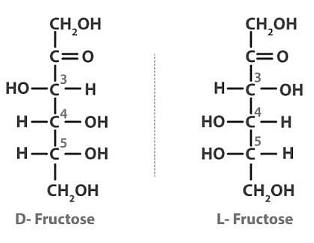
Linear structure
- Ring structure– Haworth projections reveal fructose's ring structure.
- The resulting pyranose ring, formed by the six-membered carbon chain, gives the molecule a crystalline structure.
- Furanose, the most prevalent form of fructose in solutions, is a five-membered ring formed by the six-carbon molecule known as fructose.
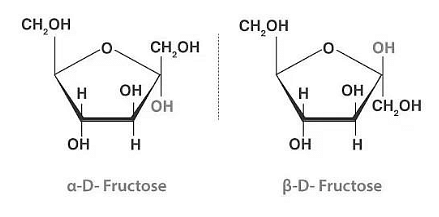
Ring structure
Read More: Periodic Table
Properties of Fructose
[Click Here for Sample Questions]
The chemical and physical properties of fructose are–
- Chemical properties of fructose
- Since it has several hydroxyl groups coupled to the six parent carbons with one keto functional group, it is typically a polyhydroxy ketone.
- The fructose linear chain crystallizes as a ring of furanose. Given that it rotates the plane-polarized light in a leftward direction, it is levorotatory.
- When fructose loses water molecules, hydroxymethylfurfural is created. Dimethylfuran, which can be used as a substitute for petrol and diesel, is created when the product is transformed into a liquid.
- The Maillard process, which it experiences, causes the exteriors of the bread to brown as it is baking. Since it occurs more frequently in an open chain than the other dietary monosaccharides, fructose is a simple candidate for this reaction.
- Due to the existence of the free ketone group in its open chain, it functions as a reducing sugar.
- Physical properties of fructose
- It is the sweetest monosaccharide that we utilize as sweeteners in commerce.
- The maximum sweetness of fructose sugar occurs between 5 and 50 °C; above this point, the sweetness decreases when fructose's six-carbon ring is broken down into a five-carbon ring. In this process, the fructose structure's significance is revealed.
- The freezing point of a molecule is lowered by fructose molecules. As a result, it aids in minimizing water crystallization in fruit cells.
- It takes in moisture easily and holds onto it for a longer time.
- Fructose has a melting point of 103 °C. 180.16 g/mol is roughly its molecular weight of it.
Read More: Surface Chemistry
How is Fructose Used Commercially?
[Click Here for Sample Questions]
The fructose molecules are highly significant and are used commercially for a variety of purposes. The food and beverage sectors are important employers in this area.
- It increases sweetness, improves flavor, acts as a good humectant, lowers compounds' freezing points, and offers osmotic stability.
- The major components include beverages, baking techniques, dairy items, and canned sweet foods like fruits and preserves.
- The nectars of the flowers are also used to make fruit sugar.
- The nectar from the blooms is sucrose, which the bees hydrolyze into fructose.
Read More: Electrophoresis
Things to Remember
- In the commercial world, fructose, a ketohexose monosaccharide, is used as a sweetener.
- Due to the free carbonyl group at its second carbon, the six-carbon molecule acts as a reducing sugar. Levo-fructose predominates as its primary form.
- Since fructose is an isomer of glucose, its structure is more comparable to that of glucose.
- Fructose has a melting point of 103 °C. 180.16 g/mol is roughly its molecular weight of it.
- Fructose possesses a functional group called a ketose at its second carbon, except for that. It also differs from aldohexose, and glucose, by occasionally creating a five-membered furanose ring.
- Honey, berries, and vine fruits all contain fructose in their natural forms.
- The fructose sugar is sweetest between 5 and 50 °C; above that point, the sweetness decreases as the fructose's six-carbon ring transforms into a five-carbon ring.
Also Read:
| Related Articles | ||
|---|---|---|
| Cellulose properties | Sugar Formula | Glycolysis |
| Lipoproteins | Sucrose | Aldoses, ketoses |
Sample Questions
Ques. What is the difference between glucose and fructose? (2 Marks)
Ans. The two types of basic sugars are glucose and fructose. There are two categories for simple carbs. Both monosaccharides and disaccharides only contain one unit of sugar, monosaccharides are the most fundamental kind of sugar. Basic sugars generated from monosaccharides include glucose and fructose. When digested, starch and sugar, whether sucrose or high- (HCFS), include significant amounts of glucose.
Ques. What is the molecule fructose? (2 Marks)
Ans. In many plants, fructose, often known as fruit sugar, is a straightforward ketonic monosaccharide that is frequently linked with glucose to form the disaccharide known as sucrose. It is one of the three dietary monosaccharides, along with glucose and galactose, that are directly absorbed into the blood following digestion.
Ques. What are the properties of fructose? (1 Mark)
Ans. In contrast to other sugars like glucose, which has a melting point of 146°C, fructose has a lower melting point. The fructose compound has a density of 1.69 g/cm2 and a molar mass of 180.16 mol/g. Pure and powdered fructose has been crystallized and refined.
Ques. What is the use of fructose? (1 Mark)
Ans. A fundamental natural sugar, fructose can be found in fruits, honey, and vegetables. Pure fructose has been used as a sweetener since the mid-1850s and offers benefits for some populations, such as individuals with diabetes and those trying to manage their weight.
Ques. What are the natural sources of fructose? (1 Mark)
Ans. Here are some well-known foods that contain fructose. Sugar, Honey, Nectar, Fruit juices, Corn syrup, Candy, and baked foods.
Ques. Why is fructose added to foods and beverages? (5 Marks)
Ans.
- High fructose corn syrup and sucrose are the main sources of fructose that we ingest.
- Pure fructose is mostly used for sweetness when it is added as a component to packaged foods and beverages.
- Fructose can be used to reduce lingering sweetness in some products since it is noticed and loses its sweetness more quickly than sucrose.
- Pure fructose is occasionally seen in low-calorie foods since it requires less of it to have the same sweetness as sucrose.
- Foods may include fructose for purposes other than simple sweetness.
- Fructose, for instance, is one of the most soluble carbohydrates and mixes well with liquids.
- Hygroscopic indicates that fructose has a high capacity for absorbing moisture.
Ques. Where does fructose come from? (3 Marks)
Ans. Fructose, often known as "fruit sugar," is a type of naturally occurring sugar that can be found in a variety of foods, including honey, sugar beets, sugar cane, and a variety of fruits and vegetables, including artichokes, asparagus, mushrooms, onions, and red peppers. Fruits and vegetables that include fructose include apples, dates, figs, pears, and prunes. Commercially produced pure fructose is made from corn or sucrose and crystallized for usage as a component in packaged meals and drinks. Crystalline fructose should not be mistaken with high fructose corn syrup, despite the fact that it contains fructose (a 55:45 ratio of the monosaccharides fructose and glucose).
Ques. Is fructose soluble in water? (1 Mark)
Ans. The monosaccharide that is most soluble in water is fructose.
For Latest Updates on Upcoming Board Exams, Click Here: https://t.me/class_10_12_board_updates
Check-Out:



Comments