



Content Curator
Hydroelectricity is produced by using kinetic energy in flowing water or potential energy stored in the dam. There are different ways in which electricity can be produced. Hydroelectricity is one of them. It is generated from hydro power plants which are water reservoirs on the river i.e., dams. Dam is usually built in such an area where there is ample amount of flowing water. Water is taken to the turbines in the hydropower plant which then generates electricity. Hydroelectricity is a non-conventional source of energy and is a widely used electricity generating technique.
Also read: Density of Water
| Table of Content |
Key Terms: Water turbine, Generator, Kinetic energy, Potential energy, Non-conventional source, Hydropower plant, Hydroelectricity, Power generation
Different Stages in Hydroelectric Power Plant
[Click Here for Sample Questions]

Stages in Hydroelectric Power Plant
The above diagram shows different components of Hydroelectric power plant. By this diagram, we can understand the whole process of how electrical energy gets generated. The basic and foremost need for any hydropower plant is a reservoir.
In this process, potential energy in water stored in the reservoir gets converted into kinetic energy of water. Then, flowing water received from reservoir is brought to the turbine at the bottom of the dam. Turbine is driven by kinetic energy of flowing water. Water turbine then drives the generator to generate electrical energy.
Elements of Hydroelectric Power Plant
- Reservoir: Storage where water is stored for the electricity generation purpose.
- Turbine: A pipe-like structure used to generate kinetic energy when water falls from the height.
- Sluice gates: Sliding gates which allow the stored water to pass through the dam.
- Generator: Converts mechanical energy into electrical energy which in turn generates the electricity i.e., the final product.
- Powerhouse: Storage house for the generated electricity. Later, the electricity will be distributed through the power lines.
Read more: Types of Generators and Applications
Energy Transformation in Hydroelectric Power Plant
[Click Here for Sample Questions]
In Hydropower plant, a dam is built on the height to stop the flow of river water to generate electricity. When the reservoir gets enough water, the level of water in the dam rises to a great height. So, in this process the kinetic energy of water gets converted into potential energy.
Sliding gates of the dam, which are also called sluice gates, get open at the half of the height of the dam to allow stored water to pass on. Then this water is taken to turbines which are situated at the bottom of the dam. As the water flows from the high-rise, it puts pressure on the blades of turbines which makes turbines rotate with high speed. When turbines rotate, they trigger the generator. Then, in the final step, the generator produces electricity. Post this, the water level in the reservoir falls down.
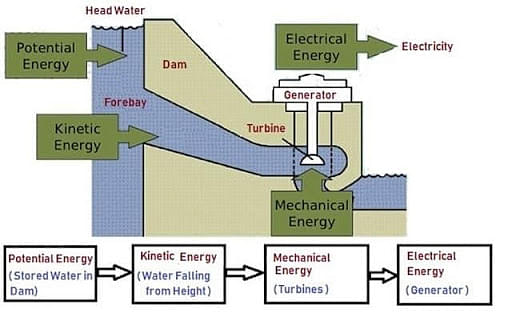
Energy Transformation in Hydroelectric Power Plant
Benefits of Using Hydroelectric
[Click Here for Sample Questions]
- There is no fuel burning the hydropower plants resulting in no air pollution at all. Hence, it is also known as green energy. But the pollution does happen while constructing these huge dams.
- It is even possible to produce the electricity as and when needed if there is ample amount of water in the reservoir.
- Hydroelectricity is a renewable source of energy which means we can produce it again and again.
- There are not many fluctuations when it comes to producing electricity from hydropower. So, hydroelectricity is a very reliable option for energy consumption.
- The flow of water and electricity generated can be adjusted as per the requirement of electricity consumption. For example, if the energy consumption is low, the flow of water can be reduced which leads to more water storage.
Things to Remember [Click Here for Sample Questions]
- Hydroelectricity converts the potential energy into kinetic energy to produce electricity.
- It is a widely used method for generating electricity. Though it is expensive and has certain limitations, Hydroelectricity is pretty flexible and safe for electricity production.
- Hydroelectricity is a clean energy source because it does not produce any toxic substances or gases which can lead to pollution. It is also called green energy.
- Hydroelectric power plants have adverse effects on marine life, farms, forests and many other ecological factors.
- Sufficient amount of rain is needed to run the Hydropower plants. India has a total 197 hydropower plants which generate more than 25 megawatts (MW) electricity.
- Tehri Dam in Uttarakhand which is the biggest hydropower project in India, produces 2400 MW electricity.
Sample Questions
Ques. What do you mean by water turbines? (2 Marks)
Ans. Water turbines are the pipe-like structure which is situated at the bottom of the dam. It is the alternator which changes the direction of the water and converts it into mechanical energy which then gets converted into electrical energy using a generator. It is also called head race tunnels. Water turbines play an important role during the power generation process.
Ques. In India, what can be the main causes of balancing the Hydro-thermal mix? (2 Marks)
Ans. The working of a hydropower plant is completely dependent upon rainfall. During monsoon season, the power production in Hydropower plants gets high. The load on the system is high due to heavy agricultural load. On the other hand, during winters the thermal power stations work at the peak. Therefore, hydro-thermal mixes are complementary to each other and balancing them both will be beneficial to complete the electricity requirements for the country.
Ques. Why is hydropower called a renewable source of energy? (2 Marks)
Ans. Like other energy sources hydropower does not consume the primary source i.e., water rather it uses it for the production of electricity. It is also environment friendly as no fuel is burnt during the entire process.
Depending upon the rainfall and the need of power consumption the hydropower plant can be controlled. Since the most rainfall happens every year (exception when there is drought) the water which is the primary source of energy gets refilled every year. Because of this reason hydropower is called a renewable source of energy.
Ques. Distinguish between thermal power plant and hydro power plant on the basis of energy generation. (3 Marks)
Ans.
| Thermal Power Plant | Hydro Power Plant |
|---|---|
| Electricity in this type of power plant is generated through fossil fuels. | Electricity in hydropower plants is produced by using flowing water. |
| The chemical energy of fossil fuels gets converted into electrical energy. | The potential energy gets converted into kinetic energy of the flowing water. This water is sent to turbines which later produce electrical energy. |
| It is not a renewable source of energy. | It is a renewable source of energy. |
Ques. What are the major elements of a Hydropower plant? (3 Marks)
Ans. The important elements of a Hydropower plant are as given below-
- Dam: The store room for water from where the water is fetched for power intake.
- Head race tunnels/ Turbines: A structure which is situated at the bottom of the dam to send the water power generation.
- Sluice Gates/ Sliding gates: The gates which are half opened which allows the water to pass through it.
- Penstock: It is an intake structure which controls the flow of water.
- Underground and Surface powerhouse: Stores the electrical energy and then distributes it through various transmission lines.
- Generator: Generates the electricity produced by the water.
Ques. What are the different parameters needed to take into consideration while selecting a site for the Hydroelectric power plant? (3 Marks)
Ans. Following are the different parameters used while selecting a site for the construction of Hydroelectric power plant: -
- Huge amount of flowing water should be available at the site to produce a great amount of electricity. Because the potential energy of falling water or kinetic energy of flowing water is used to generate electricity in hydropower plants.
- The topographical conditions of the site should be suitable for the construction of a dam.
- The rivers which are the main source to produce electricity should have a large catchment area so that the water levels in the reservoirs won’t fall down to the lowest.
- As the construction of dams can cause many ecological problems, one must take into consideration that not many elements of nature can get affected.
- The land should be rocky to bear the weight of large dam constructions.
- Farm lands and forests near the site should not get affected adversely.
Ques. Hydropower projects lead to huge destruction of forests and affect the marine life present in the water bodies. Give a reason. (3 Marks)
Ans. Hydropower projects are usually located in hilly areas where the forests are more dense than the forest in plain areas. During the construction of hydropower plants large parts of forests get exploited and many species come into danger. However, the government of India has passed a law called Forest (Conservation) Act, 1980 which has certain provisions which need to be fulfilled before building any project.
When the dam is constructed, a lot of river water is used for hydropower generation which leads to inadequate flow of water in the river. Because of this the marine animals like fishes did not get enough nutrients and thus died.
Ques. Based on the installed capacity what are the classifications of Hydro projects? (3 Marks)
Ans. Following are the classifications of Hydropower projects: -
- Micro – Up to 100 KW (Kilowatts)
- Mini – From 101 KW to 2 MW (Megawatts)
- Small – 2 MW to 25 MW
- Mega – Hydropower plants with installed capacity >= 500 MW
Hydropower produces electricity with great capacity and thus is used worldwide. In India, 90% of the electricity is supplied through hydropower projects. Tehri Dam in the state of Uttarakhand is the highest Hydropower project in the country. It produces about 2,400 MW electricity.
Also read:



Comments