



Content Curator
Wind vane is a device that aids in determining the direction of the wind. Wind vane or weather vane is usually placed at the top most point of tall buildings. The term "vane" is derived from the word "fana," which means "flag." A wind vane has a practical purpose of determining the direction of the wind. Wind wanes are also used for decoration purposes. Ships, arrows, horses, and cockerels are some of the most prevalent motifs for wind vanes. The wind is often blowing in the direction that the theme faces.
| Table of Content |
Key Takeaways: Wind vane, Weather, Wind Sock, Direction of Wind, Wind Speed, Weather vane
What is a Wind Vane?
[Click Here for Previous Year Questions]- A wind vane (also known as a weathervane) is a device that indicates the direction of the wind.
- A wind vane, for example, can tell you which way the wind is blowing.
- In other words, a "southwest" reading on a wind vane indicates that the wind is coming from the southwest and is traveling northeast.
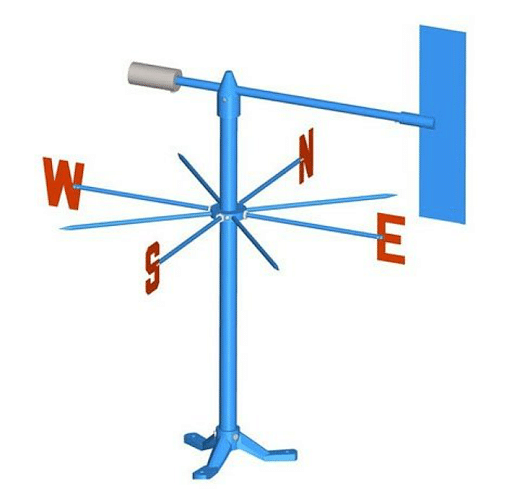
Wind Vane
Working of Wind Vane
[Click Here for Previous Year Questions]- It is critical to carefully mark the wind vane to read it accurately.
- The wind vane must be marked with the directions of north, south, east, and west.
- This allows us to precisely interpret the wind vane even from a distance.
- The height at which the wind vane is mounted is another aspect that influences its performance.
- It should ideally be put on the building's tallest point.
- Although the shape of the building can be uneven, the weight must be equal on both sides of the vertical axis.
- The wind vane spins freely on the axis because it rotates on it. This prevents any other tall structure from changing the direction of the wind and influencing the wind vane's reading.
- It's easier to grasp how a wind vane works if we can correctly observe and follow its model.
- On one end, the fin will have a tip, while on the other, it will have a long and broad shape. This will ensure that the fin always points in the direction of the wind.
Also Read:
| Read More Concepts Related to Wind and Pressure | ||
|---|---|---|
| Anemometer | Wind Speed | Velocity |
| Cyclone | Fluid Flow | Fluid Pressure |
Types of Wind Vanes
[Click Here for Previous Year Questions]The most common wind vanes include the conventional weathervane, windsock, and digital wind vane are the three main types of wind vanes.
Weathervane
- These have been used for years and can be found on top of barns, cathedrals, and a variety of other structures.
- Typically, behind the fin, four horizontal posts with the letters "N," "S," "E," and "W" (north, south, east, and west) are positioned to assist the spectator in determining the wind direction.
- It is simple to read a weathervane.
- Whichever way the fin is pointing, that's the direction the wind is coming from.
Wind Sock
- This style of wind vane is most commonly found near runways in airports.
- While a windsock detects the direction of the wind, it does not always indicate north/south/east/west.
- The observer may, however, determine the severity of the wind depending on how much the sock is inflated.

Wind Sock
Digital Wind Vane
- A digital wind vane is frequently seen as part of a weather station, which will also measure wind speed, temperature, humidity, barometric pressure, and occasional rainfall.
- A digital wind vane will either hang from the underside of a weather station sensor or sit atop a pole or housing and spin on a spindle.
- An optical sensor located at the end of the spindle allows a digital processor to determine the wind direction in up to 16 places.
- The data is delivered to a digital display, which displays the wind direction as a circular image known as a wind rose.
- The current wind direction, as well as the previous two readings, are frequently displayed on the wind rose (in the shape of arrows).

Digital Wind Vane
Benefits of Wind Vane
[Click Here for Previous Year Questions]A wind vane has a wide range of applications. These can include increased enjoyment of leisure activity, safety, property protection, and general weather observation enjoyment.
Safety – During severe weather occurrences the wind vane can help you decide whether a storm is traveling toward you or away from you if there is one in your region. With this knowledge, you will have more time to act and get your loved ones to a safe area.
Protection of Property – Wind vane can help decide whether your personal property is in danger. This can provide an opportunity to make preparations for your home, car, yard, and other items to avoid damage.
Boating, Remote Control Aircraft, Golf, Etc. – Knowing which way the wind is blowing might help you fine-tune a tee shot down a lengthy fairway or modify the sailboat's angle.
Storm Spotting and Chasing – During severe weather occurrences, storm spotters and chasers collaborate with organizations such as the National Weather Service and SKYWARN to give crucial, real-time information. This aids local governments in keeping their areas safe.
Watching the Weather – A weather vane adds yet another important data point to weather observation.
Making a Wind Vane
[Click Here for Previous Year Questions]The wind vane has two ends, one of which is formed like an arrow and points in the direction of the wind, and the other of which is wider and catches the air. If the wind-vane arrow points to the east, the wind is blowing from that direction. Follow the procedures outlined here to make your wind vane.
Materials Required for Wind Vane
- Straw
- Pin
- Skewer
- Marker
- Scissors
- Food container lid
Procedure
- With a marker, draw a triangle on the container lid and cut out the paper piece. Then, using the container lid as a template, cut out a rectangle.
- On both sides of the straw, cut a hole and attach the triangle on one side and the rectangle on the other.
- Place a pin in the center of the straw and on the skewer's right end. Your wind vane is now operational.
- Keep the wind vane in an open area where you can see it from inside so you can tell which way the wind is blowing without having to go outside.

How to make Wind vane
Also Read:
| Read More Topics from Mechanical Properties of Fluids | ||
|---|---|---|
| Hydrostatic Pressure | Properties of Fluids | Pascal’s law |
| Hydraulic Machines | Bernoulli’s Principle | Venturi meter |
| Viscosity | Stoke’s law | Surface tension |
| Surface energy | Barometer | Buoyant Force |
Things To Remember
- Wind vanes are used to determine the direction and speed of wind.
- Wind vanes are essential for forecasting weather patterns.
- It is increasingly utilized for decorative reasons in many nations.
- Wind vane is helpful for air traffic controllers to know which way the wind is blowing.
- Storm strength can be predicted using wind vanes.
- In the past, wind vanes were frequently employed as compasses.
Sample Questions
Ques. What Are Some Disadvantages of Using a Wind Vane? (2 maks)
Ans. It's possible that a handcrafted wind vane won't be very accurate. Furthermore, the weight balance is the fundamental premise, and it must be highly precise for a reading to be accurate. If the wind is affected by nearby trees and structures, it may not indicate the true direction of the wind. It may be unreliable if the principles are not strictly followed. When it comes to determining the speed of the wind, wind vanes can often be unreliable.
Ques. How does a Windvane work? (2 marks)
Ans. A wind vane spins and points in the direction of the wind to determine wind direction. It usually has two pieces or ends, one that is shaped like an arrow and rotates towards the wind, and one that is wider and catches the breeze. As a result, the wind is blowing from the west.
Ques. Why are roosters on weathervanes? (3 marks)
Ans. Pope Nicholas made the rooster official in the 9th century. As a sign of Peter's betrayal of Jesus, he decreed that all churches must display a rooster on their steeples or domes. Churches began utilizing rooster weathervanes in compliance with the ordinance. Weather vanes must be positioned high enough to minimize wind interference from other objects, buildings, and trees to reliably depict wind direction. That is why they are normally perched atop poles or towers erected at the highest point on a building's roof.
Ques. Which way do weathervanes point? (2 marks)
Ans. Because the balancing weight is at the point of the arrow, the weather vane points toward the source of the wind. The airflow is uniformly distributed on both sides of the arrow because the surface area near the back of the arrow is lighter and catches the breeze.
Ques. What is weathervane in aviation? (2 marks)
Ans. Weathervaning, sometimes known as weathercocking, is a phenomenon that occurs while aircraft and rotorcraft are on the ground or hovering. The phrase also refers to a similar phenomenon that occurs with fin-guided tiny rockets that, when launched vertically, prefer to divert into an upwind flight path.
Ques. Why do farmers have weather vanes? (2 marks)
Ans. Farmers use weathervanes to determine how to plant their crops and ensure proper pollination of their fields by gathering information about prevailing winds. They were also able to forecast weather changes by studying the weather patterns in their area.
Ques. Do weathervanes get struck by lightning? (2 marks)
Ans. Because a single piece of metal on your roof isn't grounded, it won't "tend" to attract lightning, therefore there's no need to be concerned. The great majority of weather vanes, finials, metal roofs, church steeples, barns, and other structures are not lightning-resistant, and it has never mattered.



Comments