



Education Journalist | Study Abroad Lead
Intersecting lines and non-intersecting lines are lines on the same plane that either meet or don’t meet respectively. Lines in general are a series of infinite points going on for an unspecified distance in two directions. It is always straight and barely has a width. It generally has no end, but if it does, it’s called a line segment.
Key Terms: Intersecting lines, Non-intersecting Lines, Angles, Lines, Line Segment.
What are Intersecting Lines?
[Click Here for Sample Questions]
Intersecting lines are any number of lines that meet at a specific point. The point of meeting is called the point of intersection. In the diagram below, the two lines are PQ and BA, and F is the point of intersection.
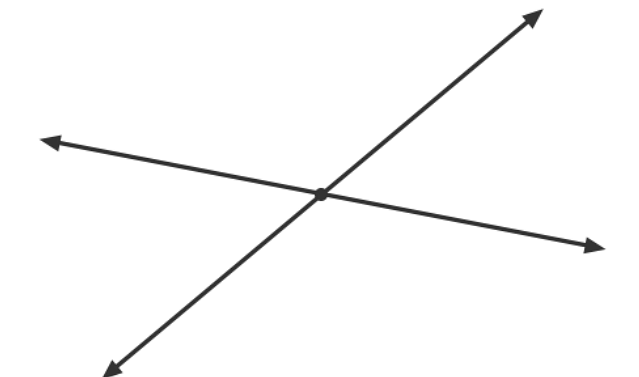
Intersecting Lines
Read More:
Properties of Intersecting Lines
[Click Here for Sample Questions]
Intersecting lines have a set of properties that help distinguish them:
- Intersecting lines meet at only one point, they can’t meet more than once. If they do, at least one of them is a curve, not a line.
- The angle at which intersecting lines meet can be any angle between 0° and 180°.
Read More: Line Segment and Ray
What are Non-intersecting Lines?
[Click Here for Sample Questions]
Intersecting lines are those that don’t meet. In the diagram below, PQ and RS are two non-intersecting lines that are parallel to each other.

Non-Intersecting Lines
Properties of Non-intersecting Lines
[Click Here for Sample Questions]
Non-intersecting lines also have specific properties that set them apart:
- They never meet and don’t have even one point of intersection.
- They are always parallel to each other.
- The perpendicular distance between non-intersecting lines remains the same at any point.
Read Also:
Things to Remember
- Intersecting lines meet at one point and no more.
- Intersecting lines meet at any angle between 0 and 180.
- Non-intersecting lines never meet and are always parallel to each other.
- The distance between non-intersecting lines is the same at every point.
Read Also:
| Related Topics | ||
|---|---|---|
| Pythagoras Theorem | Trigonometry Values | Introduction to Constructions |
Sample Questions
Ques 1: What is the value of x in the diagram below? [2 marks]
Ans: The figure above shows several lines meeting at the same point of intersection. To find x, use the rule of angles.

Suppose, ∠1 = 440 and ∠2 = 510
x=440 (Vertically opposite angles)
and ∠2 = ∠z, z = 510 (Vertically opposite angles)
∠1 = ∠x
But x+y+z = 1800 (Angles on one side of a line)
⇒440 + 510 + y = 1800
⇒950 + y = 1800
⇒y = 1800 − 950 = 850
y = 850 ,z = 510
Therefore, x = 440, y = 850, z = 510.
Ques 2: Find the value of x below. [2 marks]
Ans: POS is a straight line, so angle POS is 180°.
60 + 4x + 40 = 180
4x = 180 -100
4x = 80
x = 20°
Ques 3: Find the value of x below. [2 marks]
Ans: All the lines meet at one point of intersection, at an angle of 360°.
2x + x + 3x + 2x = 360
8x = 360
x = 360/8
x = 45°
Ques 4: Find the values of x,y, and z in the diagram below. [2 marks]
Ans: Using the rule of vertically opposite angles, we know that:

2x + 150 =3x−100 (Vertically opposite angles)
⇒3x−2x=150+100
⇒x=250
Now, y + 2x + 150 = 1800 (Linear pair)
y + 2∗ 250 + 150= 1800
⇒y+500+150 = 1800
⇒y+650 = 1800
⇒y = 1800−650 = 1150
and z = y = 1150 (Vertically opposite angles)
x=250 , y=1150, z=1150
Ques 5: Find the values of x,y and z in the diagram below. [3 marks]
Ans: Since angles on a straight line add up to 180°,
x + 40 + 25 = 180
x + 65 = 180
x = 180-65
x = 115°
x + 25 + z = 180°
115 + 25 +z = 180
140 + z = 180
z = 180 - 140
z = 40°
y + z = 180
y + 40 = 180
y = 180 - 40
y = 140°
Ques 6: Find the values of all the unknown angles below, given that c = 110°. [3 marks]
Ans: We can solve this using several angle rules.
Due to the rule of vertically opposite angles, a=c. So,
a = 110°
Since a and d are on a straight line and add up to 180,
d = 180 - a
d = 180 - 110
d = 70°
b and d are vertically opposite angles and hence equal, so,
b = 70°
Dude to the rule of alternate angles being equal, a = f. So,
f = 110°
Using the same set of rules used to solve the other set of angles,
e = 180 - 110 = 70°
h = 110°
g = 180 - 110 = 70°
Ques 7: What are the properties of non-intersecting lines? [3 marks]
Ans:
- They never meet at any point.
- They are always parallel to each other.
- The perpendicular distance between them at any point is always the same.
Ques 8: What are the properties of intersecting lines? [2 marks]
Ans:
- They only meet at one point, no more no less.
- The angle at which they meet is more than 0° and less than 180°.
Ques 9: Which of the lines in the diagram below are parallel? [2 marks]
Ans: For lines FE and AC, their alternate interior angles are the same. This makes them parallel to each other. So, FE is parallel to AC.
Ques 10: Are lines AC and DE below non-intersecting lines? [2 marks]
Ans: The corresponding angles are not equal, which means that the two lines are not parallel. Since they are not parallel, they are bound to intersect at some point. This means that lines AC and DE are not non-intersecting lines.
Ques 11: Below are functions for two intersecting lines. What is their point of intersection? [3 marks]
Ans: Since they are intersecting lines, they meet at just one common point. This allows us to equate the two to find that point.
3x + 7 = (-?)x + 7
3x + (?)x = 0
3? x = 0
x = 0
Now that we know x, we just need to input it into one of the equations above to find y.
y = 3(0) +7
y = 0 + 7
y = 7
Point of intersection: (0,7)
Ques 12: What is the angle at which the two lines below intersect? [2 marks]
Ans: Above are two intersecting lines, and their point of intersection is marked by the symbol for right angles. Therefore, their angle of intersection is 90°.
Ques 13: Find the value of x below. [2 marks]
Ans: AE and CD are two intersecting lines meeting at the point shown above. The intersection forms two angles which are vertically opposite to each other, and therefore equal. So, to find x, we just have to equate the two.
2x + 7 = 4x - 14
-2x = -21
x = 21/2
x = 10.5
For Latest Updates on Upcoming Board Exams, Click Here: https://t.me/class_10_12_board_updates
Check More:



Comments