



Content Curator
Laser is an optical device that produces a very narrow beam of light through a process of amplification based on the stimulated emission of electromagnetic radiation. The letter in the word LASER stands for
Light Amplification by Stimulated Emission of Radiations
- A laser produces coherent, monochromatic, and polarized beams of light.
- Based on theoretical work by Charles H. Townes and Arthur Leonard Schawlow, the first laser was built in 1960 by Theodore Maiman at Hughes Research Laboratories.
- Since the light emitted by a laser is coherent, therefore it is different from other sources of light.
- Lasers are used in laser printers, optical disc drives, barcode scanners, optical fiber, cutting and welding materials, etc.
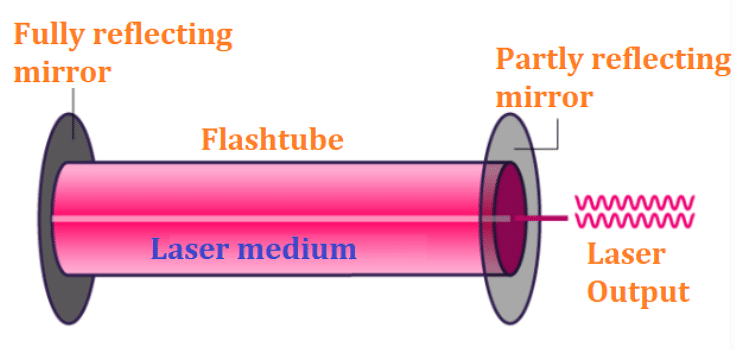
A LASER
Very Short Answers Questions [1 Mark Questions]
Ques. What is the full form of LASER?
- Light Absorption by Stimulated Emission of Radiation
- Light Amplification by Stimulated Emission of Radiation
- Light Alteration by Stimulated Emission of Radiation
- Light application by Stimulated Emission of Radiation
Ans. The correct option is b. Light Amplification by Stimulated Emission of Radiation
Explanation: A laser is an optical instrument that emits a monochromatic and coherent beam of light by stimulated emission. The full form of LASER is Light Amplification by Stimulated Emission of Radiation.
Ques. What is the disadvantage of LED lights over LASER lights?
- Non-coherent light source
- Hardly available
- Costlier than LASER
- Consuming more power
Ans. The correct option is c. Costlier than LASER.
Explanation: LED (light-emitting diode) is a semiconductor device that emits light when an electric current flows through it. It is costlier than laser lights.
Ques. Which of the following is a unique property of a laser?
- Directional
- Speed
- Coherence
- Wavelength
Ans. The correct option is c. Coherence
Explanation: Coherence is an important unique property of laser beams in which the light waves maintain a constant phase relationship over time. High coherence results in extremely high power.
Ques. Which of the following is an example of optical pumping?
- Helium-Neon laser
- Dye laser
- Ruby laser
- Semiconductor laser
Ans. The correct option is c. Ruby laser
Explanation: The technique called optical pumping is used in ruby laser to supply energy to the laser medium, in which light is used as a source of energy to excite electrons from a lower energy state to a higher energy state.
Ques. What is the full form of MASER?
Ans. The full form of MASER is Microwave Amplification by Stimulated Emission of Radiation.
Short Answers Questions [2 Marks Questions]
Ques. What is a LASER?
Ans. A laser is a device that produces light through the process of amplification by stimulated emission of radiation. The word LASER is an acronym for Light Amplification by Stimulated Emission of Radiation.
Ques. Define optical pumping in a laser.
Ans. In the active medium (gas, solid, or semiconductor) of a laser energy is supplied to achieve population inversion by exciting electrons of the medium to a higher energy level from a lower energy level.
Ques. Why a ruby maser is preferred to an ammonia maser for microwave amplification?
Ans. Maser stands for microwave amplification by stimulated emission of radiation and is a device that produces and amplifies electromagnetic radiation in the microwave region of the electromagnetic spectrum. A ruby maser is preferred to an ammonia maser for microwave amplification because it has better frequency stability than an ammonia maser.
Ques. Why laser is different from other sources of light?
Ans. A laser produces monochromatic, coherent, and unidirectional beam light, while the other sources of light may contain light of different wavelengths and spread while traveling. Therefore laser is different from other sources of light.
Read Also:
Long Answers Questions [3 Marks Questions]
Ques. What are the characteristics of a laser?
Ans. The following are the characteristics of a laser
- Coherence: The wavelength of all the photons emitted from a laser is in phase. Therefore, the light produced by a laser is coherent in nature.
- Directionality: All the photons emitted by a laser travel in the same direction. Therefore, a laser emits light in only one direction. This is called the directionality of laser light.
- Monochromatic: The light waves emitted by a laser are of a single wavelength or color, that’s why it is monochromatic in nature.
- High intensity: The beam of a laser light does not spread in all directions, therefore the intensity of laser light is very high.
Ques. What are the different types of lasers?
Ans. Lasers are classified on the basis of the principle of operation, materials used, and output characteristics. Some main types of lasers are
- Gas lasers
- Solid-state lasers
- Fiber lasers
- Semiconductor lasers
- Dye lasers
- Excimer lasers
- Chemical lasers
Ques. Why laser is considered a hazard?
Ans. Due to the intense and concentrated beam of light laser is considered a hazard.
- The intense beam of a laser can cause eye injuries, burn, or other harmful effects.
- As the laser beam remains focused and does not spread can cause unintentional exposure and affects the individual or objects.
- Some laser light has a wavelength that is not in the visible range which increases the risk of accidental exposure.
Ques. What are the main uses of lasers?
Ans. Laser technology has many applications in various fields. Some common uses of lasers are
- Lasers are used in medical applications such as laser eye surgery, surgical procedures, skin treatments, and tattoo removal.
- They are used in industrial processes for precise welding and cutting.
- They are used in spectroscopy for studying the properties of materials.
- They are used in barcode scanners and laser printers.
- They are used in defense and security systems.
Very Long Answers Questions [5 Marks Questions]
Ques. Write the working principle of laser.
Ans. The working principle of a laser involves
- Energy is provided to the active medium of the laser (i.e. solid, gas, or semiconductor) to achieve population inversion.
- This process is known as pumping.
- The active medium absorbs energy and excites the electron to a higher energy level from a lower energy level.
- The photon passing through the active medium hits the exited electrons resulting in the emission of additional photons, this process is known as stimulated emission.
- The additional emitted photons are of the same phase and energy as that of the photons that hit the excited electrons.
- The active medium is placed between the two mirrors.
- One mirror is partially reflective that allows the photon to pass through it and form the laser output. the second mirror is highly reflective which causes the photons to oscillate within the cavity.
- These oscillating photons in the cavity undergo amplification while passing through the active medium through the process of stimulated emission.
- This results in high-intensity light.
- This process continues and hence, a coherent beam of light is obtained as output.
Ques. What is the difference between lasers and masers?
Ans. The difference between a laser and a maser is
| LASER | MASER |
|---|---|
| LASER stands for Light Amplification by Stimulated Emission of Radiation | MASER stands for Microwave Amplification by Stimulated Emission of Radiation. |
| In the laser, a photon comes in the form of visible light. | In the case of a maser, a photon comes in the form of a microwave. |
| LASER uses infrared, ultraviolet, and visible portions of the electromagnetic spectrum. | MASER uses the microwave portion of the electromagnetic spectrum. |
| Common types of lasers are Liquid LASER, Solid LASER, Gas LASER, Semiconductor LASER, and Chemical LASER. | Common types of masers are Solid State MASER, Dual Noble Gas MASER, Atomic Beam MASER, and Gas MASER. |
Ques. The total efficiency of an injection laser with a GaAs active region is 18%. The voltage applied to the device is 2.5 V and the bandgap energy for GaAs is 1.43 eV. What is the external power efficiency of the device?
Ans. Given
- Total efficiency of the device, ƞTotal = 18% = 18/100 = 0.18
- Bandgap energy, EG = 1.43 eV
- Applied voltage, V = 2.5 V
The external power efficiency is given by
ƞext = ƞTotal \((\frac{E_G}{V})\) x 100%
Where
- ƞext = External power efficiency of the device
- ƞTotal = Total efficiency
- EG = Bandgap energy
- V = Applied voltage
On substituting the values, we get
ƞext = 0.18 x ( \(\frac{1.43}{2.5}\) ) x 100% = 10 %
Hence, the external efficiency of the device is about 10%.
For Latest Updates on Upcoming Board Exams, Click Here: https://t.me/class_10_12_board_updates
Check-Out:



Comments