



Education Journalist | Study Abroad Lead
A laser is a device that causes atoms or molecules to emit light at specific wavelengths, resulting in a highly narrow beam of radiation.
- The emission usually only covers a small spectrum of visible, infrared, and ultraviolet wavelengths.
- When electrons especially (glasses, crystals, or gases) absorb energy from an electrical current or another laser, they become excited.
- Being excited, they shift from a lower-energy orbit to a higher-energy orbit around the atom's nucleus, creating a laser.
- The electrons emit photons when they return to their normal or "ground" states.
The first practical laser was created by Theodore H. Maiman at the Hughes Research Laboratories in the year 1960. The characteristics of laser beams can be further divided into four major categories,
- Superior Monochromatism
- Superior Directivity
- Superior Coherence
- High Output
| Table of Content |
Key Terms: Laser, Laser Light, Coherence, Directionality, Monochromatic, Solid-State, Gas, Liquid, Semiconductor Laser, Radiation, Wavelength
What is Laser?
[Click Here for Sample Questions]
A laser is a device which stimulates atoms or molecules to emit light at various wavelengths.
- It helps to amplify the light, producing a narrow beam of radiation.
- The emission covers a limited range of visible, infrared, or ultraviolet wavelengths.
- Laser is an acronym for “Light Amplification by the Stimulated Emission of Radiation.”
- Lasers not only help to increase the light’s intensity but also to generate light.
- Lasers emit light with the help of stimulated emission of radiation
- It helps to increase the intensity of radiation.
- While some lasers produce visible light, a few others produce ultraviolet or infrared rays.
| The various states and emissions of lasers are: Metastable StateIn a three-level laser, the material is initially excited to a short-lived high-energy state, which then spontaneously descends to a slightly lower-energy state, known as a metastable state, with an unusually long lifetime. Spontaneous EmissionThe direction and phase of spontaneous emission are random, and there is no interaction with other photons. After a period of time, it may spontaneously decay into a lower energy level, releasing energy in the form of a photon, which is emitted in an unpredictable direction. Stimulated EmissionWhen an atom or molecule in a higher energy level interacts with a photon with the same energy as the difference between the atom or molecule's present energy level and a lower energy level. When an excited electron interacts with another photon, it produces stimulated emission. Population InversionThe rearrangement of atomic energy levels in a system that allows laser activity to take place is called population inversion. |
Read Also:
| Physics Related Links | ||
|---|---|---|
| Dual Nature of Radiation and Matter | Relativity | Radioactive Decay |
| Particle Nature of Light | Spectral Series | Energy of Orbitals |
Lasers Working
[Click Here for Previous Year Questions]
A laser’s output is a coherent electromagnetic field. All the waves, in a coherent beam of electromagnetic energy, possess the same frequency and phase.
- A basic laser comprises a chamber called the cavity especially developed to reflect infrared, visible or ultraviolet waves so that they reinforce one another.
- The cavity can comprise solids, liquids or gases.
- The type of cavity material helps to determine the wavelength of the output.
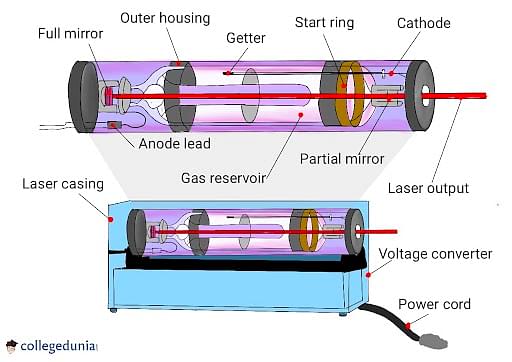
Laser Working Principle
- Here, the mirrors are set at every end of the cavity, where one of them is totally reflective, allowing no energy to pass via them.
- The other mirror is partially reflective, thus enabling only 5% of the energy to pass through them.
- With the help of a process called pumping, energy is introduced into the cavity via an external source.
- An electromagnetic field, due to the pumping activity, is seen to emerge inside the laser cavity at the natural frequency of the atoms of the material which then fills the cavity.
Thus, the waves are then reflected back and forth between the given mirrors. The cavity’s length is such that the reflected waves are observed to reinforce one another. The electromagnetic waves, which are in phase with one another, arise from the cavity’s end with a partially reflective mirror. The output is seen to be in a continuous beam, or a chain of brief, and intense pulses.
Difference between a Flashlight and Laser
The differences between a Flashlight and Laser are:
| Flash Light | Laser Light |
|---|---|
| A flashlight generates a white light, which can be defined as a mixture of different colours of varying frequencies. | A laser generates a monochromatic light that has a single colour and frequency. |
| Flashlight scatters via a lens into a fuzzy, short cone. | Lasers scatter a narrower beam over a longer distance. |
| Light waves, in the case of a Flashlight, are all jumbled up (the crests of a couple of beams are combined with the troughs of others.) | In a laser beam, the light waves are aligned (where the crests of each wave are lined with the crest of every other wave.) |
Characteristics of Lasers
[Click Here for Sample Questions]
Theodore H. Maiman of Hughes Research Laboratories created the primary laser in 1960, and supported theoretical work by Charles Hard Townes and Arthur Leonard Schawlow. Thus, the characteristics of a laser beam can be divided into four categories:
Superior Monochromatism
Monochromatic light can be defined as light beams which have a single wavelength. Photons are seen to originate from natural sources of light that consist of a range of energies, colours and wavelengths. The various properties of laser which are similar to Monochromatic light include:
- Frequency
- Wavelength
- Color
Superior Directivity
In certain conventional sources of light such as, Lamps and Torchlights, the photons typically move at random points. Thus, these sources help scatter light in all directions. Lasers, herein, emit light in a distinct direction.
Superior Coherence
Visible light is observed to receive emission from excited electrons (which are of higher energy levels) and are then shifted to a lower energy level (ground state).
High Intensity
The intensity of a wave is the energy that flows via a unit of normal area per unit time. The light that originates from an ordinary source scatters in all directions. The laser light is focused in one direction.
| Principles Essentials of LASER The constraints of quantum mechanics influence laser emission, limiting atoms and molecules to finite amounts of stored energy that vary depending on the nature of the atom or molecule.
|
Laser Uses
[Click Here for Previous Year Questions]
The various uses of laser light are:
Tools
It is used in form of tools.
- Cutting tools which help to employ CO2 lasers. These are typically precise, and also simple to automate. It does not require sharpening, unlike that of knives.
- The use of robot-guided lasers to cut pieces of cloth is now widely used.
- They are used in the medical field to improve eyesight during corneal surgery, restore a detached retina of the eye, and remove kidney stones.
Communication
It is used in communication.
- Barcode scanners use lasers in order to convert a printed barcode into a number.
- In a CD or a DVD, a semiconductor laser beam helps to convert the printed pattern of data into numbers.
- Lasers, in fibre optic cables, are used in a technology called “Photonics” which uses photons of light to communicate.
Defence
It is used by the military.
- The military employs laser-guided guns and missiles in the defence field.
Properties of Laser
[Click Here for Sample Questions]
LASER possess three properties:
- Monochromatic: LASER produces light of single wavelength/ colour.
- Directionality: LASER emits the amplified light in a specific direction.
- Coherency: LASER has zero phase difference with space and time.
Advantages and Disadvantages of Laser
[Click Here for Previous Year Questions]
There are several Advantages and Disadvantages of Lasers.
Advantages of Laser
- Along with its huge ability to support information, it is employed for information transmission in the field of communication.
- As laser radiation is free of electromagnetic interference, this technique is used in wireless communication systems via free space for both telephony and computer networking.
- There is virtually little signal leakage in laser radiation.
- Laser-based fibre optic wires are utilized in fibre optic networks because they are exceedingly light.
- Because lasers are less dangerous than X-rays, they are extensively employed in the medical field for cancer diagnostics.
Disadvantages of Laser
- Lasers are costly, thus patients who require laser-based treatment choices will have to spend a lot of money.
- Maintenance costs for lasers are significant, resulting in high costs for doctors and hospital administrators.
- Based on laser equipment, lasers increase convolution and treatment time.
Read Also:
Things to Remember
- “LASER” stands for Light Amplification by Stimulated Emission of Radiation.
- A laser is an electromagnetic device that emits light at a particular wavelength and amplifies it.
- The amplified light resulting from a laser is a narrow beam of electromagnetic radiation.
- Some characteristics of lasers include: Superior Monochromatism, Superior Directivity, Superior Coherence and High Intensity.
- Lasers are used in modes of communication, tools and also in defence.
Previous Year Questions
- A beam of cathode rays is subjected to crossed electric (E) and magnetic fields (B).….. [NEET 2010]
- A beam of electron passes undeflected through mutually perpendicular electric….[NEET 2007]
- In the nuclear reaction, 72X180−>[−α]Y−>[−β]Z−>[−α]A−>[−γ]P the ...
- γ− rays are originated ...
- As the electron in Bohr’s orbit of hydrogen atom passes from state n = 2 to, n=1, the Kinetic energy (K) and...
- What is size of gold nuclei?
- How the linear velocity v of an electron in the Bohr orbit is related to its quantum number n?
- Sharp peak point A represents
- When light of wavelength 300 nm (nanometer) falls on a photoelectric emitter, photoelectrons….. [NEET 1999]
- The de-Broglie wavelength of a neutron in thermal equilibrium….. [NEET 2017]
Sample Questions
Ques. How does laser differ from other sources of light? (1 Mark)
Ans. A laser is distinguished from other light sources by the fact that it produces coherent light.
Ques. What does the term "laser" mean to its full extent? (1 Mark)
Ans. LASER: Light Amplification by Stimulated Emission of Radiation.
Ques. What is “stimulated emission”? (1 Mark)
Ans. The process by which an incoming photon of a given frequency interacts with an excited atomic electron (or other excited chemical state), causing it to descend to a lower energy level is known as stimulated emission.
Ques. Which is one of the unique properties of laser? (1 Mark)
Ans. Coherence is a crucial characteristic of a beam because, in laser beams, the wave trains of an equivalent frequency are in phase/ thanks to high coherence it leads to extremely high power.
Ques. What is Superior Directivity? (1 Mark)
Ans. In several conventional sources of light including, Lamps and Torchlights, the photons are seen to move at random points. Therefore, these sources help scatter light in all directions. Lasers, herein, emit light in a distinct direction.
Ques. What is the process which is used to diffuse a laser beam? (1 mark)
Ans. When we want to diffuse a laser beam it should be passed through an Opal glass diffuser or a ground glass diffuser. In simpler ways, the laser beam can also be diffused when it's passed through a white painted surface. This process makes the laser beam scatter in a wide range of directions.
Ques. What is the difference between a flashlight and laser light? (3 marks)
Ans. The difference between a flashlight and a laser light are:
| Flashlight | Laser light |
|---|---|
| Produces white light which is composed of a mixture of colors. | Produces a monochromatic light of singular frequency and single color. |
| Spreads into a short fuzzy light | Shoots a narrower and tighter beam over a longer distance |
| Light waves are jumbled. | Light waves are aligned |
| These are non-directional | These are directional |
Ques. What are the correct characteristic properties of laser light? (3 marks)
Ans. The following are the characteristic properties of a laser beam. There are four major categories:-
- Laser beams possess superior monochromatism.
- Laser beams are highly directive.
- Laser beams have the property of showcasing superior coherence.
- Laser beams give high output.
Ques. What are the disadvantages of laser? (3 Marks)
Ans. The various disadvantages of laser include:
- Lasers are costly, thus patients who require laser-based treatment choices will have to spend a lot of money.
- Maintenance costs for lasers are significant, resulting in high costs for doctors and hospital administrators.
- Based on laser equipment, lasers increase convolution and treatment time.
Ques. What are the advantages of laser? (3 Marks)
Ans. The various advantages of laser are:
- Because of its huge ability to support information, it is employed for information transmission in the field of communication.
- Because laser radiation is free of electromagnetic interference, this technique is used in wireless communication systems via free space for both telephony and computer networking.
- There is virtually little signal leakage in laser radiation.
Ques. Define Monochromatic Light. (3 marks)
Ans. Monochromatic Light can be defined as a light beam that comprises a single wavelength. Photons which come from natural light sources usually contain a range of wavelengths, energies and colors.
The several properties of laser are:
- Frequency
- Wavelength
- Color
Ques. What are the types of lasers? (4 marks)
Ans. The different types of lasers include:
- Solid-state Lasers: These lasers are composed of solid media. These have a flash tube wrapped around them in order to excite the electrons.
- Gas Layers: Gas layers are typically made of helium-neon or helium alone. These are utilised to generate red laser light.
- Liquid-Dye layer: Substances like Rhodamine are used in a liquid solution as their medium.They usually generate a broader brand of light as opposed to solid-state or liquid lasers.
- Semiconductor Lasers: These are often known by the name “Diode Lasers” since they use LEDs to produce light in a monochromatic pattern.
Ques. How is laser light important in the field of medicine? (4 marks)
Ans. A few uses of lasers in the medical field are listed here Fermi Energy
- Treat the varicose veins.
- Helping the improvement of vision during the surgery of the eye on the cornea.
- Help in the removal of kidney stones.
- Help in the removal of the tumor.
- Help with the issue of the prostate.
- These also help to repair the detached retina of the eyes.
Ques. What are the important applications of laser light in science and technology? (5 marks)
Ans. Some of the applications of lasers in science and technology are mentioned below:
- Laser beam helps us in the study of the Brownian motion of particles. They also help in the counting of the number of atoms present in the substance.
- Laser beam helps us in the study of the nature of the plasma state of the matter.
- Laser beams are also used in astronomy.
- Laser beams help us in the D extraction of information from compact discs or DVDs.
- Lasers also help in the fiber optic communication department.
- These are used in holographs also.
Ques. Name some laser types and their wavelengths. (5 marks)
Ans. Some laser types and their wavelengths are:
| Type of Laser | Wavelength (nm) |
|---|---|
| Argon Flouride | 193 |
| Krypton Flouride | 248 |
| Xenon Fluoride | 308 |
| Nitrogen | 337 |
| Argon (blue) | 488 |
| Argon (green) | 514 |
| Helium-neon (green) | 543 |
For Latest Updates on Upcoming Board Exams, Click Here: https://t.me/class_10_12_board_updates
Read Also:



Comments