



Content Curator
Luminosity is the measure of the amount of light energy emitted by various celestial bodies like stars and galaxies in a given unit of time. It is generally expressed in Joules Per Second or in Watts in the SI units system.
| Table of Contents |
Key Terms: Luminosity, Bolometric Luminosity, Neutrinos, Apparent Magnitude, Apparent Brightness, Parallax
What is Luminosity?
[Click Here for Sample Questions]
Luminosity is the measurement of light energy emitted by celestial bodies, like stars and galaxies, at a given unit of time. In other words, it is the absolute measure of the radiated electromagnetic power produced by a light-emitting object.

Luminosity Spectrum of Different Elements
For example, the luminosity of the Sun is calculated as 3.846 × 1026 watts (or, 3.846 × 1033 ergs per second). Objects, including candle flames, electric bulbs and stars, emit light energy every second in all directions.
Read Also: Earth Satellites
Factors Determining Luminosity
[Click Here for Sample Questions]
The two major factors which determine luminosity are:
- The Size of the Star: The larger a star is, the more energy it should emit. Due to the emission of more energy, the star can become more luminous.
- The Temperature of the Star: If two stars have the same size, but with different temperature, then the one with the higher temperature will be more luminous than the star having lower temperature.
The formula determining the exact relationship between the factors that determine luminosity is:
| L = σAT4
|
For stars, which are usually a sphere,
- Surface area = 4r2 π
- Temperature = Kelvin
- Stefan-Boltzmann constant, σ = 5.6704×10⁻⁸ W/m2K
One nominal solar luminosity is defined by the International Astronomical Union as 3.828 × 1026 W. Solar Neutrino is the most common type of neutrino originating from nuclear fusion in the Sun's core, and passing through any source observed on Earth at any particular moment.
Also Read: Orbital Velocity Formula
Measurement of Luminosity
[Click Here for Sample Questions]
The term luminosity, when it is not qualified, means Bolometric Luminosity. It can be measured either in SI units, watts, or in terms of solar luminosities (L☉) using a bolometer.
A bolometer is an instrument used to measure radiant energy covering a wide band by the process of absorption and measurement of heat. The measurement of luminosity of a star using brightness is:
| L = 4 x 3.14 x d2 x b Here,
|
The luminosity value is expressed either in terms of the luminosity of the sun or the magnitude, which is called the absolute bolometric magnitude of the object.
Units of Luminosity
[Click Here for Sample Questions]
Luminosity is measured in Joules per second or Watts in the SI units system. Values for luminosity are often given within the terms of the luminosity of the Sun.

Luminosity
For example, the luminosity of the Sun is calculated as 3.846 × 1026 watts (or 3.846 × 1033 ergs per second).
Check Out: Difference between Stars and Planets
Luminosity Theory
[Click Here for Sample Questions]
Luminosity is dependent upon the surface area of the star. If the radius of a star is R then, the surface area of the star is given by 4PR2. For example, if two stars have the same temperature and if one has the radius of 2R, then it will have 4 times greater luminosity than the star which has radius R.

Brightness of Stars and Other Luminous Objects
The luminosity of a star is also dependent on its temperature. If we consider a star to be a complete black body, then the radiation emitted per second will be according to the Stefan Boltzmann law.
Energy emitted per second (E) = sAT4
- Where, s= Stefan’s constant with a value of
- A= Surface Area of the Star
- T = absolute temperature of the star
Calculate the energy output for a star which has the same size as that of the sun:
R = 6.96 × 10⁸ m, T = 6000 K
Thus, surface area of the sun = surface area of star = A = 4πr2
⇒ 4 x π x ( 6.96 x 10⁸ π )
⇒ 6.08 x 10¹⁸
Hence, E= 5.7 x 10-8 x 6.08 x 1018 x 60004
⇒ 4.5 x 1026J
This means that the star having twice the temperature of the Sun would emit 16 times greater energy output than that of the sun.
What is a Parallax?
[Click Here for Sample Questions]
Parallax is the difference in direction of a celestial object as seen by an observer from two widely separated points. It is measured in seconds of arc. To determine the celestial distance by parallax measurement, the baseline is taken as long as possible in order to derive the greatest precision of measurement.
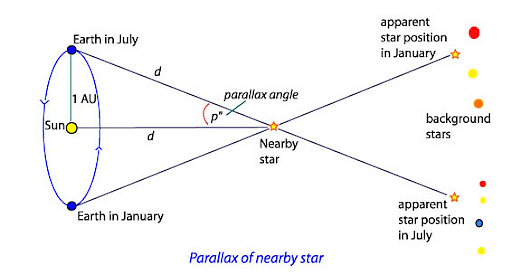
Parallax of a Nearby Star
In case of the Sun and Moon, the baseline is used to determine the distance between two widely separated points on Earth. For all bodies outside the solar system, the baseline is taken as the axis of Earth’s orbit. The largest measured stellar parallax for the nearest star, Alpha Centauri till now is 0.75″. The smallest which can be directly measured for a celestial body is about 25 times smaller.
Also Read: Some Natural Phenomena due to Sunlight
Things to Remember
- A bolometer is an instrument which is used to measure radiant energy covering a wide band by the process of absorption and measurement of heat.
- Luminosity is expressed in joules per second or in watts in the SI units system.
- Parallax is the difference in direction of a celestial object as seen by an observer from two widely separated points and is measured in seconds of arc.
- The luminosity of a star is the total amount of energy produced per unit time and is measured in joules per second or watts in SI units.
- The larger a star has more surface area which means that it puts out more energy, therefore it is more luminous.
Check Out: Unit Conversion
Sample Questions
Ques. What is the difference between luminosity and luminous flux? [3 Marks]
Ans.The differences between Luminosity and Luminous Flux are:
| Luminosity | Luminous Flux |
|---|---|
| Luminosity is the total amount of visible light emitted by a light-emitted source, but not weighted by the sensitivity of the human eye. | Luminous flux is the same, but is weighted by the sensitivity of the human eye to different wavelengths. |
| It is measured in Joules per second, or Watts (W) | It is measured in the lumen (lm) |
| Luminosity is dimensionally equivalent to power. | Luminous Flux is equivalent to the candela-steradian (cd⋅sr). |
Ques. How do we calculate the luminosity of a distant star and its apparent brightness without even knowing the distance? [5 Marks]
Ans. We calculate the apparent brightness (m) of a star by just observing how bright it is shining when compared to other visible stars.
- The absolute magnitude (M) of a star is the apparent magnitude that stars would have if they were 10 parsecs (32.6 light years) away.
- Deneb, a far-away star, which is approximately 1600 light years away, could appear bright like Sirius, the brightest star in the night sky, which is just 8.6 light years away.
- Deneb has an apparent magnitude (m) of 1.25 magnitude, its absolute magnitude (M) is around -7. Sirius has an apparent magnitude of -1.46 magnitude, its absolute magnitude (M) is 1.42 magnitudes.
- If you know a star’s parallax you know its distance. Once the star's distance and apparent magnitude are determined, the calculation of its absolute magnitude (M) can be performed.
- Formula used to determine M is: M = m + 5 - 5 (log d), where d is the distance in parsecs (1 parsec = 3.26 light years).
Ques. How do we calculate the luminosity of a star? Given that the Distance Modulus = 8, Apparent Magnitude = 11 and 1 solar luminosity = magnitude +4.83, find Absolute Magnitude, Distance and Luminosity. [4 Marks]
Ans. We can find out the Distance using the formula:
10 ((m − M + 5)/5) = d
⇒ 10 ((m − M + 5)/5) = d
⇒ 10((11 − 3 + 5)/5) = d
⇒ 10((11−3+5)/5)=d
⇒ d = 398.11 parsecs
Next let us find out the Absolute Magnitude:
⇒ m − M = dm − M = d
⇒ 11 − M = 811 − M = 8
⇒ M = 3M = 3
In order to find Luminosity, we assume n to represent the 5th root of 100, because of the fact that magnitude scales are based on a 5 point difference which represents a 100-fold increase.
⇒ l = (n) (4.83−M) l= (n) (4.83 − M)
⇒ I = (n) (4.83 − 3) l= (n) (4.83−3)
⇒ l = 5.3951
Therefore, luminosity equals 5.4 approximately.
Ques. Does the ability to produce luminosity differ between direct and reflected sunlight? [2 Marks]
Ans. When the total visible light flux becomes equal to the reflected sunlight due to the sky, environment or shading/light redirecting surfaces, they have a smaller total energy per luminous flux which then results in heat gain than the direct sunlight which is Possibly caused by a larger ability to produce luminosity that is more visible radiation compared to ultraviolet and infrared light which are cooler light.
Ques. How do astronomers express luminosity? [2 Mark]
Ans. Astronomers express the luminosity of an object in terms of solar luminosities. The most luminous stars present in the universe emit several million solar luminosities, with the most luminous supernovae shining with 1017 solar luminosities and the dim brown dwarfs have luminosities which is a few millionths when compared to that of the Sun.
Ques. How do we measure the luminosity of a distant star? [5 Marks]
Ans. First, measure the bolometric flux across all wavelengths and if we are unable to do this then we need to measure the flux in as many wavebands as possible or we can also obtain a flux-calibrated spectrum over as wide a wavelength as possible.
There is one other way to measure a star’s luminosity is to calculate its apparent brightness about how it appears to the eye and compare that to its distance. We can convert a flux when in specified wavebands to a bolometric flux with the help of bolometric corrections or you can extend the application and then integrate it from a fit to the observed part of the spectrum for the bolometric flux to work out.
We can then multiply the bolometric flux that we observed from the star by 4πD2, where D is the distance to the star. We can then correct it for absorption and scattering by extending material if it is necessary.
Ques. What is Absolute Magnitude? [3 Marks]
Ans. The measure of the luminosity of a star means how bright the star would be if it is viewed from a distance of 10 parsecs or 32.58 light years is called absolute magnitude. Generally, 10 parsecs is taken as the standard distance by the Astronomers and it is referred to the intrinsic brightness of the star as its absolute visual magnitude.
The apparent magnitude of the star appears to be if it were 10 parsecs or 32.58 light years away. Absolute magnitude holds a relationship to the intrinsic luminosity of the star. If we put this in simple terms, it is expressed as the apparent magnitude at a distance of 10 parsecs from the star and its symbol is “Mv”.
Ques. What is Apparent Magnitude? [2 Marks]
Ans. The measure of how bright the star appears when viewed from Earth is Apparent magnitude. In this case, Magnitude and apparent magnitude are the same thing which is namely how bright a celestial object appears to us on Earth ranked on the historic logarithmic magnitude system. The apparent magnitude usually depends on three things such as how big the celestial body is, how far away it is from Earth and finally how much light it produces per diameter of the star. It is related to the observed energy flux from the star. The symbol for absolute magnitude is “mv”.
Ques. What is spectroscopy? [2 Marks]
Ans. By taking the incoming light, astronomers study the different wavelengths of light from celestial objects using a spectrometer or spectroscope to break or partition the light into its component wavelengths. This method used here is called spectroscopy.
Ques. What are variable stars? What are its types? [3 Marks]
Ans. Variable stars are whose brightness as seen from Earth can change over the short term or over the long term which may be caused by a change in emitted light or by something partly blocking the light.
They are of two types: One is intrinsic variable stars which means that their luminosity changes due to expansion, contraction, eruption or pulsation. The second is extrinsic variable stars, which means that a star or planet passes in front of the star and blocks the light or it changes due to stellar rotation.
Check-Out:



Comments