



Education Journalist | Study Abroad Lead
Here are the quick notes for Class 10th Magnetic Effects of Electric Current. The notes have been prepared from reliable sources and as per the updated syllabus. Important topics and questions from last year’s examinations are also added. Prepare for your boards with the notes of essential topics from this article.
| Table of Contents |
Keyterms: Electric current, Magnetic effects, Magnet, Iron, Magnetic field, Magnetic field lines, Loops
Read Also: Magnetic Field and Field Lines
Magnetic Effects of Electric Current
[Click Here for Sample Questions]
Any substance that attracts iron and iron-related objects is defined as a magnet. When a wire carries an electric current, it has the same properties as that of a magnet.
The fundamental properties of a magnet include:
- Every magnet has a North and South pole. Because of the bipolar nature, the existence of two poles is necessary and cannot be suspended.
- Alike or similar poles repel each other, and opposite poles attract each other. This is similar to the charges.
- A freely suspended magnet will align itself in the north-south direction, i.e. north of the magnet facing north and south of the magnet facing the south direction. The magnet’s north pole is a side that points to the earth’s geographical north when freely suspended.
Read Also: Magnetism and Matter
Magnetic field and Field lines
[Click Here for Sample Questions]
The region around the magnet where the other magnetic element feels the influence is known as a magnetic field. The magnetic field can be measured in Tesla or Weber / sq m.
Magnetic field lines come out of the North pole of a magnet externally and get to the South pole forming closed loops. Field lines are closest at the poles, with the magnetic field strength at its maximum. No new magnetic field lines intersect each other; the tangent indicates the direction at that point (South to North).
Right-hand thumb rule
Hold the index finger, middle finger, and the thumb of the right hand at right angles to each other. If the forefinger is in the direction of the magnetic field, some points in the direction of the motion of the conductor are induced, and the middle finger indicates current. The magnetic field through a straight conductor direction of the field is given by the right-hand thumb rule.

Right-hand thumb rule
Maxwell corkscrew rule
As per the Maxwell corkscrew rule, if the direction of current is shown by the direction of forward movement of a screw, the direction of rotation of the screw shows the direction of the magnetic field.

Maxwell corkscrew rule
Magnetic field produced in a circular loop by current
[Click Here for Sample Questions]
Towards the center of the circular loop, the field lines become straight. They also become perpendicular to the coil. One can use the right-hand thumb rule to find out the direction of the magnetic field.
Factors that affect the strength of a magnetic field of a circular conductor carrying current
The strength of the magnetic field is
- Directly proportional to the current that passes through the conductor
- Inversely proportional to the distance from the conductor.
- Directly proportional to the number of turns in coils.
Check Out:
Magnetic field due to current in a Solenoid
A solenoid can be understood as a coil of multiple circular turns of insulated copper wire wrapped closely in a form of a cylinder. A solenoid’s magnetic field is similar to a bar magnet. When the current passes through a solenoid, one end of the solenoid behaves as the North or South poles. The field lines act as parallel straight lines indicating the uniformity inside the solenoid.
Read Also: Discovery of Electron
Electromagnet and Electromagnetism
[Click Here for Sample Questions]
- A temporary magnet that can easily be demagnetized and whose polarity can be reversed is called an electromagnet.
- The strength of an electromagnet can be varied, but it is much stronger than the regular magnet.
- An electromagnet is an artificial magnet producing a magnetic field on an electric current through a conductor.
- As soon as the current is turned off, the magnetic field also disappears.
- This phenomenon of inducing and producing a magnetic field due to the passage of electric current is called electromagnetism.
Fleming's left-hand rule
Fleming's left-hand rule states that if the left hand is stretched in a way that the thumb, the index finger, and the middle finger are in mutually perpendicular directions and the index finger represents the direction of the field, the middle finger represents the direction of the current, then the thumb gives us the direction of the force
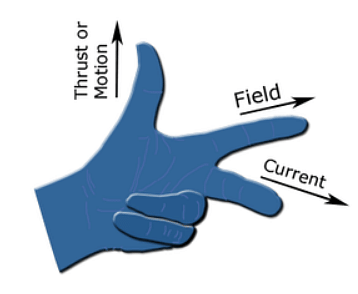
Fleming's left-hand rule
The directions of the electric current, the magnetic field, and force are similar to the three mutually perpendicular axes that are x, y, and z axes. Devices such as electric motor, electric generator, loudspeaker, etc., are based on Fleming's left-hand rule.
Electric motor
[Click Here for Sample Questions]
A Rotating device that converts electrical energy to mechanical energy is called an electric motor. The electric motor functions on Fleming's left-hand rule.
When a current is passed through a rectangular coil that is placed into a magnetic field, a force acts on the coil which rotates continuously. With the continuous rotation of the coil, the shaft attached to it also rotates.
Components for the construction of an electrical motor
- Rectangular coil(Armature) suspended between the two poles of the magnetic field.
- Split ring or commutator that reverses the direction of the flow of the electric current through a circuit. It refers to two halves of the same metallic ring.
- Magnet (permanent) through which the magnetic field is applied.
- Sliding contacts of brushes that are fixed.
- A battery consisting of a few cells.
Working of an Electric Motor

Working of an Electric Motor
The Electric motor has a rectangular coil of insulated copper wire. It is placed perpendicular to the magnetic field. The two conducting brushes are present. The current enters through brush 1 and flows back to the battery through brush 2. The split ring acts as a commutator (commutator is a device that reverses the direction of the current floor through a circuit), reversing the direction of flow of the current in it.
In a commercial motor, an electromagnet instead of a permanent magnet is used. The armature refers to a soft iron core with a large number of conducting wire turns. The magnetic field is enhanced with a large number of turns of conducting wire.
An electric motor is used in electric fans, for pumping water, etc.
Check Out: Quantum Theory of Light
Electromagnetic induction
Electricity produced as a result of magnetism or induced current is called electromagnetic induction. When a conductor is said to move inside a magnetic field or a magnetic field is set to be changing around the conductor, the electric current is induced in it. This action is opposite to the exertion of force by the current-carrying conductor inside of a magnetic field. In other words, as a conductor is brought in relative motion via a magnetic field, a potential difference is induced, which is known as electromagnetic induction.
The Electric Generator
[Click Here for Sample Questions]
A mechanical device that converts mechanical energy into electrical energy is called an electric generator. It works on the principle of electromagnetic induction. It consists of an insulated copper wire, magnetic poles, split rings, axel brushes, and galvanometer.
The 2 types of electric generators are AC(Alternative Current) generators and DC (Direct Current) generators.
- An alternate current is a current in which the direction of the induced current is periodically changed. Most of the power stations generate alternate current. It is transmitted a long distance without much loss of energy.
- Current flowing in only one direction is called a direct current. Electrochemical cells produce direct current. Transferring direct current can lead to a loss of energy as it involves much more power to convert than an alternate current.
Structure and Working of an Electric Generator
The structure of the electric generator is similar to that of an electric motor. Within the magnetic field of a permanent magnet, a rectangular armature is placed. The ammeter is attached to a wire and positioned in a way that it can move around the axle. As the armature moves within the magnetic field, an electric current is induced. The current’s direction changes as the armature crosses the halfway mark of its rotation. Hence, the direction of current changes one time in every rotation. This leads to the generation of AC or alternate current.

Structure and Working of an Electric Generator
Domestic electric circuits
The Electric supply that we receive through the mains is supported through poles for the cables. We generally receive the alternate current electric power of 220 V with a frequency of 50 Hz. Three wires are used for domestic electric circuits:
- A positive red insulated live wire
- A negative black insulated neutral wire
- Green insulated earth wire
Electric Fuse
A fuse is a protective device in an electrical circuit in times of overloading. An electric fuse is made up of material that is highly resistive and has a low melting point. It prevents electrical appliances from being damaged. In simpler words, it is a safety device to limit the current in an electric circuit.
Short circuit
When the neutral and the live wire come in contact due to insulation damage or a fault overloading is caused. Sometimes when the overloading increases, it can become hazardous. Resistive or ohmic heating on the passage (Joule's heating) of current in the fuse device melts the circuit and breaks down the current flow.
Sample questions
Ques: Define earthing. Why should electrical appliances be earthed? (1 mark)
Ans: The metal body of appliances such as a cooler, mixer, or fridge is connected to an earth wire. It prevents the leakage of current into the body of the appliance to avoid electric shock. This process is called earthing.
Ques: Define electromotive force. (1 mark)
Ans: The motion of a magnet concerning the coil producing an induced potential difference is known as electromotive force. This force sets up an induced electric current in the circuit.
Ques: How can you convert an alternate current into a direct current generator? (1 mark)
Ans: An alternate current generator can be converted into a direct current generator by replacing the solid ring arrangement with the split ring arrangement.
Also Read:



Comments