



Content Curator
Metamorphic rocks are made from a substance called Protolith. The mineral content and texture of the protolith change due to the changes in the physical and chemical environment of the rock during metamorphism. Metamorphic rocks form about 12% of the total earth's land surface. They are classified as per their protolith, chemical, mineral makeup, and their texture.
Read Also: Mineral and Energy Resources
| Table of Content |
Key Terms: Metamorphic Rocks, Igneous Rocks, Minerals, Protolith, Sedimentary Rocks
What are Metamorphic Rocks?
[Click Here for Sample Questions]
Metamorphic means “change shape”, as these rocks were once igneous or sedimentary rocks,
Here are some important points about Metamorphic Rocks:
- They changed due to intense heat & pressure, hot mineral-rich fluids, or chemical activity within the earth surface, a process called metamorphism,
- Metamorphic rocks are always presented as another kind of rock, usually sedimentary rock such as shale, limestone, chalk, or sandstone,
- They have crystalline & have banded or foliated texture,
- These rocks are buried inside the earth’s surface with the rock layers above it.
- Examples of metamorphic rocks are gneiss, slate, marble, schist, and quartzite, etc.
- Slate and quartzite tiles are the most commonly used metamorphic rocks in building construction.
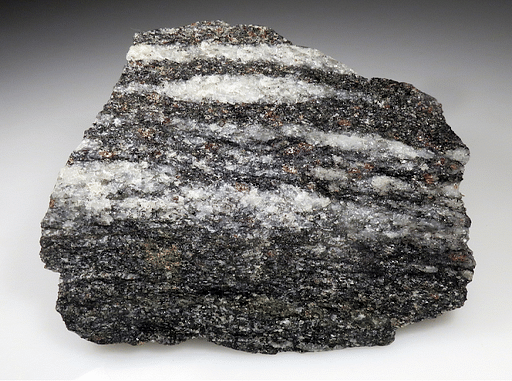
Metamorphic Rocks
How to Distinguish Metamorphic Rocks?Metamorphic rocks are mainly characterized by their formation that occurs with great heat and pressure. The following traits are all related to that:
|
Types of Metamorphic Rocks
[Click Here for Previous Year Questions]
There are two types of metamorphic rocks:
Foliated Metamorphic Rocks
Foliated basically means, “the parallel arrangement of certain mineral grains that causes the striped appearance of a rock”. Foliation happens when a rock is put under pressure, squeezes the flat or elongates minerals, and became aligned.
These kinds of rocks developed a platy or sheet-like appearance, after the pressure application. For example: granite gneiss & biotite schist.
Non-foliated Metamorphic Rocks
Non-foliated metamorphic rocks are not flat or elongated, such as limestone. They do not have platy or sheet-like structure like foliated rocks as no matter how much pressure is applied the grains will not align. There are many ways for producing non-foliated rocks.

Foliated vs Non-Foliated Rocks
Also check:
Characteristics of Metamorphic Rocks
[Click Here for Sample Questions]
Following are the characteristics of metamorphic rocks:
- Heat
Rocks tend to change chemically when the temperature is above 200° Celsius. The crystalline structure of minerals, present in the rocks is broken down at this temperature and transformed using different combinations & as a result, new minerals are created.
If the rocks are heated to a specific point, they become magma, & when the magma is cooled down it creates new igneous rocks.
When magma comes in contact with an already existing body of rock, contact metamorphism occurs. In this type of metamorphism, the rocks changes, mainly because of the high heat & when the texture of the rock is changed by the excessive heat and pressure it is called regional metamorphism.
- Temperature
The rock also changes its texture mainly because of mechanical deformation with little long temperature change, it is called Dynamic metamorphism. Dynamic metamorphism is also known as cataclasis & the rocks also change their texture when they are in extensive interaction with high-temperature fluids, this is called hydrothermal metamorphism.
- Pressure
Rocks are buried under the earth’s surface. They are subjected to pressure because of the weight of the overlying materials. Under extreme pressure rocks became plastics & the most obvious effect of pressure on rocks is a reorientation of mineral crystals.
- The chemical action of fluids
In the pore spaces of rocks, water and carbon dioxide are often found in small amounts. When these are mixed with dissolving ions by chemical reactions and result in fluid, it enhances metamorphism.
- Directed stress
Directed stress, also called differential or tectonic stress. Directed stresses are generated by the movement of lithospheric plates. It is an unequal balance of forces on a rock in one or more directions.
Unlike putting pressure on rocks for metamorphism, directed stress puts much lower pressure on a rock so that it does not generate chemical reactions & does not change the structure of the rocks.
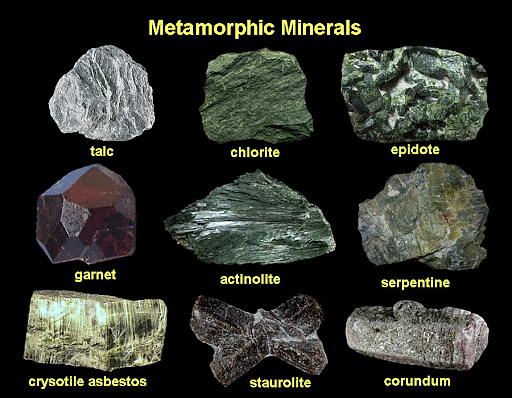
Types of Metamorphic Rocks
Examples of Metamorphic Rocks
[Click Here for Previous Year Questions]
There are hundreds of metamorphic rocks present on the surface of the earth with different compositions and textures. Some are as follows:
- Hornfels
It is a non-foliated metamorphic rock which is a fine-grained metamorphic rock formed by the action of heat on clay rocks,
- Amphibolite
It is also a non-foliated metamorphic rock that is composed frequently with very little quartz. It is formed by putting on direct pressure and high viscosity. This process is called the process of recrystallization,
- Gneiss
It is a foliated metamorphic rock that is made up of granular mineral grains. It has a banded appearance sometimes similar to granite, & contains a lot of feldspar minerals and quartz or mica.
- Novaculite
It is a non-foliated metamorphic rock, which is hard, fine-grained, dense & siliceous. It forms in marine environments where organisms like diatoms – the single-celled algae exist.
- Marble
It is the non-foliated metamorphic rock that is produced from the metamorphism of dolostone or limestone. Marble is mainly composed of calcium carbonate, & is mainly used in making buildings.
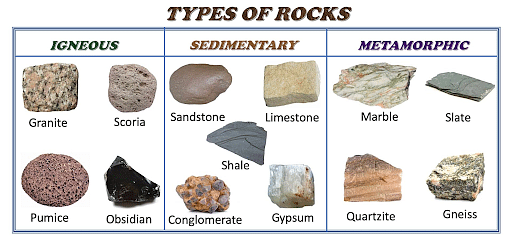
Different Types of Rocks
- Phyllite
It is a foliated metamorphic rock, which is made up of very fine-grained mica. Its surface is generally lustrous
- Lapis Lazuli
It is considered one of the rarest metamorphic rocks, because of its blue color especially. It is mainly used for decoration and to make beads.
- Quartzite
It is a non-foliated metamorphic rock that is hard and consists of interlocking quartz crystals. It is produced by the metamorphism of sandstone.
- Slate
It is a foliated metamorphic rock which is a low-grade and fine-grained metamorphic rock. It can be easily separated into thin pieces.
- Schist
It is a foliated metamorphic rock that contains substantial amounts of mica. It can split into thin layers because of mica.

Rock Cycle
Is Glacier Ice a Kind of Rock?Glacier ice, like limestone (for example), is a type of rock. Glacier ice is a mono-mineralic rock (made of only one mineral, like limestone, composed of mineral calcite). The mineral ice is the crystalline form of water (H2O). Most glacier ice forms through the metamorphism of tens of thousands of individual snowflakes into crystals of glacier ice. Each snow flake is a single, six-sided (hexagonal) crystal with a central core and six projecting arms. The metamorphism process is driven by the weight of overlying snow. In metamorphism, at least hundreds of individual snowflakes recrystallize into much larger and denser individual ice crystals. |
Things to Remember
- Metamorphic means “change shape”, as these rocks were once igneous or sedimentary rocks.
- The metamorphosed rock contains; serpentine group minerals, & it includes asbestos that is hazardous to human health.
- The metamorphic rocks are of two types: foliated and non-foliated metamorphic rocks.
- Most of the metamorphic rocks are made of layers that can easily be split apart.
- Marble is the only metamorphic rock, which contains veins & is durable, and can be easily dissolved by lemon juice or other acids.
- When magma comes in contact with an already existing body of rock, contact metamorphism occurs.
Also check:
Sample Questions
Ques. What are the uses of metamorphic rocks in everyday life? (3 marks)
Ans. Metamorphic rocks can be used in everyday life:
Being the oldest rock, metamorphic rocks such as; Quartzite and marbles are most commonly used in day-to-day life, for making floors, houses, etc marble is itself the most used rock in daily life.
Ques. What minerals are found in metamorphic rock? (3 marks)
Ans. There are many different types of minerals that are found in metamorphic rocks such as;
- Qualtz,
- feldspar,
- mica,
- calcite,
- hornblende, etc
Ques. What are the 3 main types of metamorphism? (2 marks)
Ans. The three types of metamorphism are contact, regional, and dynamic metamorphism, where Contact Metamorphism occurs when magma comes in contact with an already existing body of rock.
Ques. Which metamorphic rock is used widely in artistic work? (1 mark)
Ans. Soapstone is the kind of metamorphic rock that is most widely used in artistic work,
Ques. What is metamorphism? (2 marks)
Ans. Metamorphism is a process that changes preexisting rocks into new forms because of increases in temperature, pressure, and chemically active fluids.
Ques. Where do most metamorphic rocks form? (3 marks)
Ans. Most metamorphic rocks are found from deep below the Earth's surface. These rocks are formed from either igneous or sedimentary rocks, making them a changed form of rock as the name metamorphic suggests.
Ques. How is magma formed? (3 marks)
Ans. Magma can be created when hot, liquid rock intrudes into Earth's cold crust. As the liquid rock solidifies, it loses its heat to the surrounding crust. Much like hot fudge being poured over cold ice cream, this transfer of heat is able to melt the surrounding rock into magma.
Ques. Elaborate on the relationship explained by rock cycle between the major type of rocks. (3 Marks)
Ans. Rocks do not remain in their original form for long but may undergo transformation. Rock cycle is a continuous process through which old rocks are transformed into new ones. Igneous rocks are primary rocks and other rocks (sedimentary and metamorphic) form from these primary rocks. Igneous rocks can be changed into metamorphic rocks. The fragments derived out of igneous and metamorphic rocks form into sedimentary rocks.
Sedimentary rocks themselves can turn into fragments and the fragments can be a source for formation of sedimentary rocks. The crustal rocks (igneous, metamorphic and sedimentary) once formed may be carried down into the mantle (interior of the earth) through subduction process (parts or whole of crustal plates going down under another plate in zones of plate convergence) and the same melt down due to increase in temperature in the interior and turn into molten magma, the original source for igneous rocks.
Ques. Differentiate between Igneous and Metamorphic Rocks. (4 Marks)
Ans. Key differences between igneous and metamorphic rocks are:
| Igneous rocks | Metamorphic rocks |
|---|---|
| Magma cools and solidifies. | Igneous and sedimentary rocks and are changed into metamorphic rock due to heat and temperature. |
| Igneous rocks are normally crystalline and are of two types- Intrusive and Extrusive. | Metamorphism can be of two types contact metamorphism and regional metamorphism. |
| Hard, Impermeable in nature. | They are also hard but have formed due to change in igneous and sedimentary rocks for e.g. Limestone changes into marble, sandstone into quartzite and coal into graphite. |
| In igneous rocks no bands are seen. | In metamorphic rocks banding is a normal. |
| In the intensive igneous rocks the cooling and solidification decides the size of the particles. | The arrangement of the minerals of granules is called lineation. |
Previous Year Questions
- Steps taken by the Government of India to control air pollution include… [NEET 2009]
- Which of the following is NOT a green house gas… [KCET 2020]
- The photochemical smog can be suppressed by… [KEAM]
- Rachel Carson's famous book 'Silent Spring ' is related to… [NEET 2015]
- Sounds above what level are considered hazardous noise pollution… [NEET 1994]
- Dobson units are used to measure thickness of… [NEET 2021]
- Gas released during Bhopal tragedy was… [NEET 1990]
- Global agreement in specific control strategies to reduce the release of… [NEET 2009]
- Global warming can be controlled by… [NEET 2013]
- High value of BOD (Biochemical Oxygen Demand) indicates that… [NEET 2015]
- Kyoto Protocol was endorsed at… [NEET 2013]
- MAB stands for… [NEET 1997]
- Major aerosol pollutant in jet plane emission is… [NEET 1990]
- Snow blindness is caused due to… [KCET 2018]
- Which of the following is NOT a green house gas… [KCET 2020]
- The photochemical smog can be suppressed by… [KEAM]
- Biological Oxygen Demand (BOD) is a measure of…
- Eutrophication is the natural ageing of lake by...
Check out:



Comments