



Education Journalist | Study Abroad Lead
Motion and Time are two different terminologies in Physics that are usually correlated with one another in many aspects. In our everyday lives, we see many things moving or in motion, for example, automobiles on the road, birds flying, animals walking, fish swimming etc. All these activities of these things are perceived as motion since these objects are changing their position with respect to time.
Key Terms: Motion, Time, Speed, Acceleration, Uniform Motion, Non-Uniform Motion, Periodic Motion, Time Period
What is Motion?
[Click Here for Sample Questions]
Motion can be defined as the change in the position of an object with respect to time. On the other hand, if an object is not perceived to be changing its position with respect to time, then it is said to be at rest.

Motion
Some of the important terms related to motion are described below:
- Distance: Distance can be defined as the total path covered by an object in a particular interval of time. For example, if a car starts moving from around A point and stops at point B, then the total distance covered by the car is equal to the distance between the two points A and B. Mathematically, Distance = Speed x Time
- Displacement: Displacement can be defined as the shortest route or path covered by an object in a given time interval. Also, if the starting and end points of the route taken are the same, then the displacement is said to be zero.
- The standard unit of distance is in metres whereas the standard unit of time is in seconds.

Distance and Displacement
Also Check:
Types of Motion
[Click Here for Sample Questions]
Mentioned below are the types of motion:
- Rectilinear/Translatory Motion: Translatory/ Rectilinear motion can be defined as the motion of an object in a straight line without a change in direction. For example, if a car is moving along a straight road without any change in its direction, then the movement of that car is said to be rectilinear or translatory.
- Circular Motion: Circular motion can be defined as the motion or movement of an object along a fixed circular path with a fixed radius. In this case, if the moving object comes back to its initial position, then its displacement is said to be zero. For example, the movement of wheels of an automobile, planetary motion etc.
- Rotational Motion: This type of motion can be defined as the movement of an object around a fixed axis. For example, spinning top, blades of a moving fan etc.
- Periodic or Oscillatory Motion: Periodic or Oscillatory motion can be defined as the motion in which the moving object repeats its movement after a fixed interval of time. For example, the to and fro movement of the bob of a pendulum, the motion of planets around the sun etc.

Types of Motion
Read More: Simple Harmonic Motion
Oscillations of a Simple Pendulum
[Click Here for Sample Questions]
We all know that the bob of the simple pendulum follows oscillatory or periodic motion since it repeats its movement after a fixed time interval.
- The bob of the pendulum is said to complete one oscillation when it moves from its mean position B to A and back to B again, then from B to C and back to B again.
- The time period of a simple pendulum in this case can be defined as the total time taken by the pendulum to complete one oscillation.

Oscillations of a Pendulum
Uniform and Non-Uniform Motion
[Click Here for Sample Questions]
The definitions for uniform and non-uniform motion are as follows:
- Uniform Motion: An object moving along a straight line with a constant speed is said to be in uniform motion. For example, the motion of a car with a constant speed in a straight line.
- Non-Uniform Motion: An object moving along a straight line with a variable speed is said to be in non-uniform motion. For instance, the motion of a train/bus.
Read More: Motion in a Straight Line
Speed and Time
[Click Here for Sample Questions]
- Speed
The speed of an object can be defined as the distance travelled by the object per unit of time. An object in motion can have a variable speed depending upon the distance covered by it in a particular interval of time. The standard unit of speed is metres per second. Mathematically,
Speed = Distance Covered by the Object / Time Taken to Cover the Distance
For example, if a moving car covers a distance of 100 km in 2 hours, then its speed can be calculated by using the above formula, which is equal to 50km/h.
- Time
Time in physics can be defined as the duration over which change occurs. The time taken by the object to cover a particular distance also depends upon its speed. The standard unit of time is seconds. Mathematically,
Time = Distance Covered by the Object / Speed of the Object
For example, if a car is moving with a speed of 50 km and covers a distance of 100 km, then the time taken by the object can be calculated by using the above formula, which is equal to 2 hours.
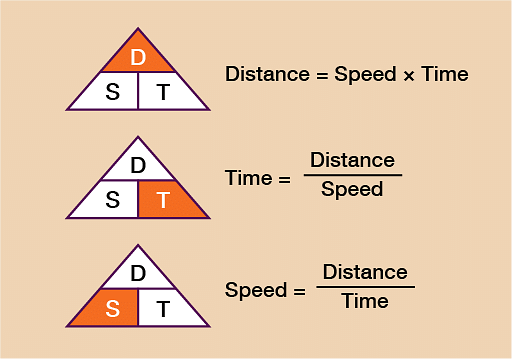
Speed, Distance and Time Formulas
Also Check:
Things to Remember
- An object is said to be in motion if the position of the object changes with reference to time.
- The motion of a freely falling body is said to be linear motion.
- The time period of a simple pendulum also depends upon its length and acceleration due to gravity.
- Slow and fast objects can be differentiated from each other by looking at the time taken by each object to cover a particular distance.
- The distance-time graph for a non-uniform motion is a curved line.
- The distance-time graph for a uniform motion is presented as a straight line.
- Speedometer is a speed measuring device that is usually seen on the dashboard of automobiles. It measures the speed of automobiles in motion.
- Odometer is an instrument used for measuring the distance travelled by the object.
Sample Questions
Ques. A simple pendulum takes 32s to complete 20 oscillations, what is the time period of the pendulum? (3 Marks)
Ans. Time taken by the pendulum to complete 20 oscillations = 32 s
Time taken by the pendulum to complete 1 oscillation = 32/20 s = 1.6 s
We know that, Time period of a pendulum is the time taken by it to complete 1 oscillation.
Therefore, the time period of the pendulum is 1.6 seconds.
Ques. The distance between the two stations is 240 km. A train takes 4 hours to cover this distance. Calculate the speed of the train. (2 Marks)
Ans. Distance = 240 km
Time taken = 4 hours
Speed = Distance covered/time taken = 240km/4 hammer = 60 km/h
Speed of train =60 km/h
Ques. The odometer of a car reads 57321.0 km when the clock shows the time 08:30 AM. Calculate what will be the distance moved by car, if, the odometer reading has changed to 57336.0 km at 08:50 AM? Calculate what will be the speed of the car in km/min during this time. Express the speed in km/h also. (3 Marks)
Ans. Distance = 57336.0 km – 57321 km =15 km
Speed in km/min =15km/20 min = 3/4 km/min
Speed in km/hr =15 km/1/3 hr
=(15 x 3) km/hr
=45 km/hr.
Ques. Salma takes 15 minutes from her house to reach her school on a bicycle. If the speed of the bicycle is given as 2 m/min, what will be the distance between her house and the school? (3 Marks)
Ans.Time taken =15 min
Speed = 2 m/min .
Distance = speed x time
Distance = 2 x 15 = 30 m
Hence, the distance between Salma’s school and her house is 30 m.
Ques. A car moves with a speed of 40 km/h for 15 minutes and then with a speed of 60 km/h for the next 15 minutes. The total distance covered by the car is? (3 Marks)
Ans. Case I:
Speed of the car = 40 km/h
Time taken = 15 min = Distance covered, d1 = Speed × Time taken = 40 × 0.25 = 10 km
Case II:
Speed of the car = 60 km/h
Time taken = 15 min =
Distance covered (d2) = Speed × Time taken = 60 × 0.25 = 15 km
Thus, the total distance covered by the car (d) = d1 + d2 = 10 + 15 = 25 km
Therefore, the total distance covered by the car is 25 km.
Ques. Below shows the distance-time graph for the motion of two vehicles A and B. Which one of them is moving faster? (3 Marks)

Ques. Which of the following distance-time graphs shows a truck moving with a speed which is not constant? (2 Marks)
Ans. 
Option (iii) because the slope of the graph is not a straight line and hence it does not show a uniform motion.
Ques. What will be the shape of the distance-time graph for the motion in the following cases:
(i) A car which is moving at a constant speed.
(ii) A car parked on a side road. (3 Marks)
Ans. A car moving at a constant speed covers equal distance in equal time. So it is represented by the given straight line.

A car is parked on a side road So it is not moving and no distance is being covered by it. So distance remains constant with time.

Ques. Which of the following are not correct?
(i) The basic or standard unit of time is a second.
(ii) All objects move at a constant speed.
(iii) Distances between two cities are measured in kilometres.
(iv) The time period of a pendulum isn’t constant.
(v) A train’s speed is usually expressed in m/h. (5 Marks)
Ans. (i) Correct, the SI unit of time is seconds.
(ii) Incorrect. It is not compulsory for an object to move at a constant speed. Some objects are accelerating too.
(iii) Correct. The distance between two cities is too much, thus, km is used to measure the same as km is a big unit of distance.
(iv) Incorrect. The time period of a pendulum is constant as it depends on the length of the pendulum.
(v) Incorrect. Since the train covers large distances, the speed is measured in Km/h or in m/s.
Also Check:



Comments