



Education Journalist | Study Abroad Lead
Measurement of the speed of how fast we travel can really help us in saving our time. Speedometers are used for the measurement of speed in vehicles. To measure the distance covered, odometers are useful. Speed can also be calculated with the help of a graph. Measuring the speed in advance and before the journey will assist you in formulating a schedule that will be time-efficient.
Read Also: Derivation of Equation of Motion
| Table of Content |
Key Terms: Speed, Velocity, average speed, relative speed, instantaneous speed, uniform speed, non-uniform speed, variable speed
What is Speed?
[Click Here for Sample Questions]
The pace at which an entity or an object's placement changes in any direction is called speed. Speed can be explained as the ratio of distance traveled to the time it took to move from one point to another and cover that distance. Because speed has just one direction and no magnitude, it is a scalar number.
As a result, the speed equation is as follows:
s = d/t
Where, The speed in m.s-1 is denoted by s.
The symbol d is used to denote the distance traveled by the body in meters.
t is the amount of time spent in s.
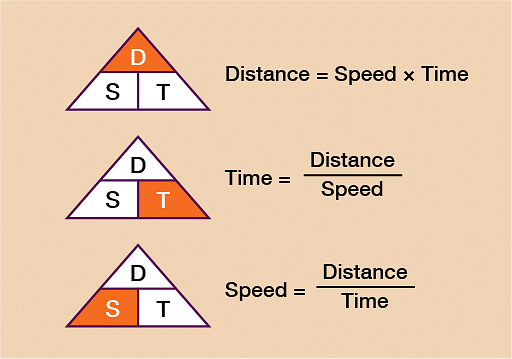
Distance, Speed, and Time Relation
Also read:
Units of Speed
[Click Here for Sample Questions]
The measurement of speed is measured in meters per second (m/s). The unit of speed in the CGS (Centi-Gram-Second) system is cm/s. The procedures for determining the dimensional formula for speed are as follows:
T = Time’s dimensional formula
L = Distance’s dimensional formula in meter
The equation of speed is based on the distance covered per unit of time, hence, the dimensional speed formula is [LT-1].

Different kinds of Speed
[Click Here for Sample Questions]
There are different kinds of speeds are as follows:
- Variable speed
- Uniform speed
- Average speed
- Relative Speed
- Instantaneous speed
Speed is a scalar quantity. It does not indicate the body’s direction; however, it does indicate the magnitude.
Uniform Speed
If an item travels the same distance in the same amount of time, we can say that the body is traveling at a uniform speed, regardless of how short the periods are.

Uniform Speed
Non-Uniform Speed or Variable Speed
When a body travels in irregular lengths or time intervals, the object is stated to move at different speeds. A car's speed is considered to be non-uniform.

Non-Uniform Speed
Check Also: Average Velocity Formula
Average Speed
While an item moves at a non-uniform pace, the average speed is the constant speed at which it travels the same magnitude of distance in the same time interval as it does when traveling at a continuously varying speed. As a result, we define average speed as the fraction of the vehicle's total distance traveled to the entire time taken.
Average speed is calculated by multiplying the overall distance covered by the entire time spent.
If a vehicle travels at distinct speeds (v1, v2, v3) and at uneven time intervals (t1, t2, t3), then,
As a result, the average speed calculated will be: (v1t1 + v2t2 + v3t3)/(t1 + t2 +t3)
Assuming that the time intervals are identical, the formula becomes: t1 = t2 = t3 = n.
v = (v1+v2+v3)/n
The average speed in this situation is the arithmetic average of all the speeds.
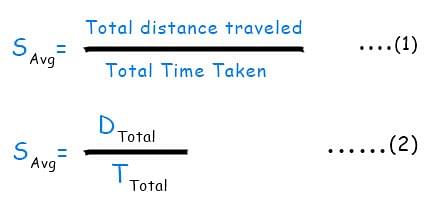
Average Speed
Read Further: Average Speed Formula
Instantaneous Speed
An item travels the same distance at uneven time intervals. The idea of instantaneous speed may be used to determine various speeds at different times.
Let's say an item travels a distance of s in a short period t. Thus, the instantaneous speed is calculated as follows: Instantaneous speed = limΔt → 0 Δs/Δt
If the 1st derivative of the given equation is found, the equation is rewritten as:
= limΔt→0 (ds/dt)
It's important to remember that the instantaneous speed equals the uniform speed with uniform motion.

Instantaneous Speed
Check Further: Speed Distance Time Formula
Relative Speed
If two objects move in the same direction, their speeds are summed, i.e., vREV = v1 + v2.
If they are traveling together in the direction, the difference in their speeds is the relative speed, i.e.
vREV = v1 - v2

Relative Speed
Applications of Speed
[Click Here for Sample Questions]
In our daily lives, we watch the movement of human beings, animals like cats and dogs, motor vehicles, turbine spinning, and many other items, all of which have a speed connected with them, allowing them to traverse a specific distance in a given period of time.
The pace at which anybody travels some distance in some period of time is referred to as speed. However, it is possible to calculate the distance traveled or the speed at which a car or other vehicle may traverse a certain distance.
Also Read: Displacement Formula
Measurement of Speed
[Click Here for Sample Questions]
Speedometers are used to measure the speed of vehicles. Odometers track the distance traveled by the vehicle. A graph can help in calculating the speed as well like the distance-time graph. It aids in determining an object's speed. Some instrument that helps in the measurement of speed are as follows –
Speedometers
Traveling speed of land vehicles is measured via speedometers. They're utilized to assist drivers in determining their driving speed and keeping it safe and realistic. The pace of travel is determined by magnets and a series of rotating wires attached to the transmission, which is displayed on an analog screen on the vehicle's panel.

Speedometer
Tachometers
The motor speed is measured in revolutions per minute using tachometers (rpm). This device measures the rotational speed and shows the result on an analog dial screen on the dash of a car or any other vehicle. The rpm range shown by the display is a safe range, which is intended to assist the driver in determining the appropriate gear settings, as well as the proper cruising speeds.

Tachometers
Check More: Difference between Kinetics and Kinematics
Accelerometers
Accelerometers are used to assess a vehicle's acceleration and deceleration rates to see if the drive brake and train systems are working properly. This device is used to demonstrate a vehicle's engine power by displaying how fast it can go from zero to sixty miles per hour. They may come in handy in tracking animals from afar.

Accelerometers
Things to Remember
[Click Here for Sample Questions]
- Speed can be explained as the ratio of distance traveled to the time it took to move from one point to another and cover that distance.
- It is calculated by dividing distance by time.
- m/s is the SI unit of speed.
- Distance – time graph can a used to calculate the speed of anybody.
- Speed tells only the magnitude.
- Speed does not give any information about the direction of the body.
- Speedometers are used to measure the speed of vehicles.
- Odometers track the distance traveled by the vehicle.
Also Check:
| Average Acceleration Formula | Micrometer | Equations of Motion |
| Unit of force | Screw Gauge Measurement | Unit of Acceleration |
| Difference between Speed and Velocity | Screw Gauge | Motion in a Straight Line |
Sample Questions
Ques. Kanpur is 350 kilometers from Lucknow. A train arrives in Lucknow at 30 kmph, while another train departs Kanpur at 40 kmph. When do these two trains meet? (3 marks)
Ans. In this case, the relative speeds of the given two trains are 30 - (- 40) = 70 kmph.
350/70 = 5 hours is the time it takes to travel 350 kilometers.
As a result, they will meet after 5 hours.
Ques. A rocket traveling at 600 kilometers per hour ejects its combustion products at 1800 kilometers per hour relative to the rocket. What is the projection speed in relation to the observer? (5 marks)
Ans. Given data: vREV = 1800 kmph
vA = 600 kmph
We need to find:
vp =?
Solution:
vREV = vp - vA
= 600 - 1800
⇒ vp = - 1200 kmph
The negative indication indicates that the ejection is happening in the direction opposite to each other.
Ques. Is it possible for an object to have a constant velocity while changing speed? (2 marks)
Ans. No, a body can't have a constant velocity while altering its speed, because
Velocity = Direction + Speed
Ques. Define velocity. (2 marks)
Ans. An object's velocity is defined as the rate at which its location changes in relation to a point of reference and is time-dependent. A definition of an entity's speed and the direction in which the body travels are identical to velocity.
Ques. What are the SI units for velocity and speed? (3 marks)
Ans. An object's speed is measured as the rate of change in its location in any direction. The rate of an object's location changes with time is called velocity. m/s is the SI unit for both speed and velocity.
Ques. State the main differences between Speed and Velocity? (5 marks)
Ans. The major differences between velocity and scalar are -
| S.No | Property | Velocity | Speed |
|---|---|---|---|
| 1 | Definition | An object's velocity is the rate at which its location changes in relation to a point of reference and is time-dependent. | The pace at which an entity's placement changes in any direction is called speed. |
| 2 | Quantity | Vector | Scalar |
| 3 | SI Unit | m/s | m/s |
| 4 | Change of direction | Changes with the change of direction | Does not change with the direction |
| 5 | Interrelation | The object may have the same speed but not the same velocity | Speed can be either equal to velocity or not |
| 6 | Magnitudes | Can be positive, zero and negative | Cannot be zero or negative |
| 7 | Equation | = displacement/time | = distance/time |
Ques. Find the speed when the distance traveled by a car is 160km in 4 hrs. (5 marks)
Ans. Distance traveled by car is 1600 km
= 160 x 1000 m
= 160000m
Time taken = 4hrs
= 4 x 60 x 60 s
= 14400 s
Speed = travelled distance/time
= 160000 / 14400
= 11.11 m/s
Ques. Jenny commutes 9 kilometers from her home to the office by metro at 18 kilometers per hour and returns by car at 15 kilometers per hour. Calculate the average speed of the entire voyage. (5 marks)
Ans. Jenny's time to go to work = distance/speed = 9/18 hr = 1/2 hour
Jenny's time to get home from work is 9/15 = 3/5 hours.
Total trip time = (1/2 + 3/5) hr
= (5 + 6)/10 = 11/10 hours
9 + 9 km = 18 km total distance covered
The overall average speed = distance/speed
= 18/(11/10) km/hr
= 18/1 x 10/11
= (18/10) /(1/11) km/hr
= 180/11 km/hr
= 16.3 km/hr (approximately)
Ques. A train with a length of 340 metres is moving at 45 kilometres per hour. How long will it take you to cross a 160-meter tunnel? (5 marks)
Ans. The tunnel is 160 metres long.
The length of the train is 340 m.
The train's length plus the tunnel's length equals (340 + 160) m = 500 m.
The train's speed is 45 km/hr.
The train's speed is 45 x 5/18 m/sec = 25/2 m/sec = 12.5 m/sec.
The train's time to pass the tunnel is
= 500 m/12.5 m/sec
= 40 seconds.
Ques. Two ships are departing from the same location with speeds of 6 km/hr and 4 km/hr, respectively. If they are travelling in the same direction, calculate the distance between them after 20 minutes. (5 marks)
Ans. Both the ships are covering their journey in the same direction, then their relative speed equals (6 – 4) km/hr = 2 km/hr.
Total Taken time: 20 minutes
Distance covered = speed x time
= (2 x 20/60) km
= 2/3 km
= 2/3 x 1000 m
= 666.67 m
Do Check Out:



Comments