



Content Curator
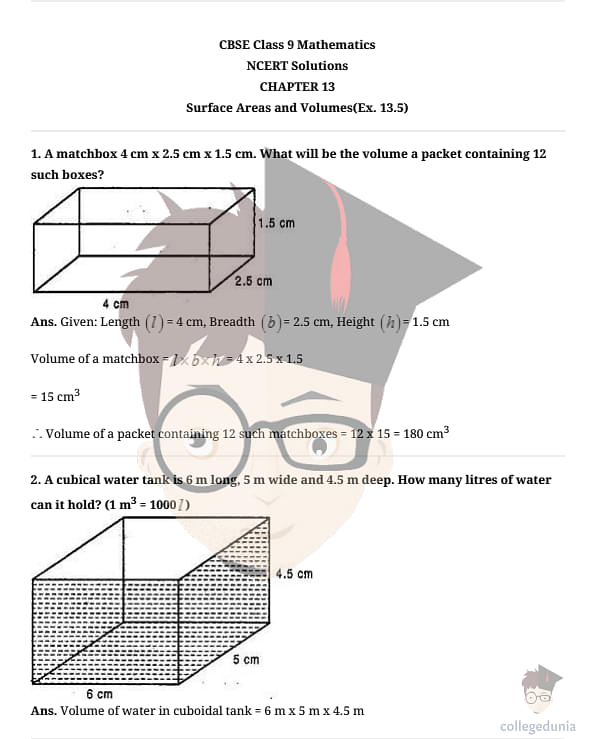
NCERT Solutions for Class 9 Maths Chapter 13 Exercise 13.5 Solutions are based on the Volume of a cuboid.
Download PDF: NCERT Solutions for Class 9 Maths Chapter 13 Exercise 13.5 Solutions
Check out NCERT Solutions for Class 9 Maths Chapter 13 Exercise 13.5 Solutions


Read More: NCERT Solutions For Class 9 Maths Chapter 13 Surface Areas and Volumes
Exercise Solutions of Class 9 Maths Chapter 13 Surface Areas and Volumes
Also check other Exercise Solutions of Class 9 Maths Chapter 13 Surface Areas and Volumes
- NCERT Solutions for Class 9 Maths Chapter 13 Surface Areas and Volumes Exercise 13.1 Solutions
- NCERT Solutions for Class 9 Maths Chapter 13 Surface Areas and Volumes Exercise 13.2 Solutions
- NCERT Solutions for Class 9 Maths Chapter 13 Surface Areas and Volumes Exercise 13.3 Solutions
- NCERT Solutions for Class 9 Maths Chapter 13 Surface Areas and Volumes Exercise 13.4 Solutions
- NCERT Solutions for Class 9 Maths Chapter 13 Surface Areas and Volumes Exercise 13.6 Solutions
- NCERT Solutions for Class 9 Maths Chapter 13 Surface Areas and Volumes Exercise 13.7 Solutions
- NCERT Solutions for Class 9 Maths Chapter 13 Surface Areas and Volumes Exercise 13.8 Solutions
- NCERT Solutions for Class 9 Maths Chapter 13 Surface Areas and Volumes Exercise 13.9 Solutions
Also Check:
| Important Chapter Related Topics | ||
|---|---|---|
| Surface Areas And Volumes | Cuboid | Area of Prism |
| Surface Area of a Cylinder | Area of Hollow Cylinder | Surface Area of a Cone Formula |
| Surface Area of a Cylinder Formula | ||
Also Check:



Comments