



Content Curator
Osteoblasts are the main cellular components of bones. They are formed by the mesenchymal cells (MSC). MSC gives rise to adipocytes, monocytes, osteoblasts, etc.
- Osteoblasts are present in abundance in the periosteum which is the outermost layer of the bone.
- They form a densely packed layer on the periosteum and their cellular processes spread throughout the growing bone.
- Osteoblast formation requires a regular blood supply devoid of which chondrocytes (cartilage-forming cells) are formed.
- The primary purpose of osteoblast is bone formation and mineralization both during the initial and later stages.
Read More: Joints
| Table of Content |
Key Terms: Hydroxyapatite, Collagen, Organic matrix, bone remodeling.
Bone Structure
[Click Here for Sample Questions]
The growth and development of bone is called osteogenesis or ossification. Our bone continues to repair and remodel itself throughout adulthood.
- Our skeleton system consists of bones that provide support and equilibrium of calcium, phosphate, and acid-base.
- The matrix of bone is entirely extracellular.
- It is under constant repair and consists of minerals and protein.
- The protein part forms the organic matrix and thereafter minerals are added.
- The organic matrix mainly contains collagen that contributes to tensile strength.
- The matrix is mineralized by hydroxyapatite deposition.
- Hydroxyapatite is a hard mineral that provides compressive strength to the bone.
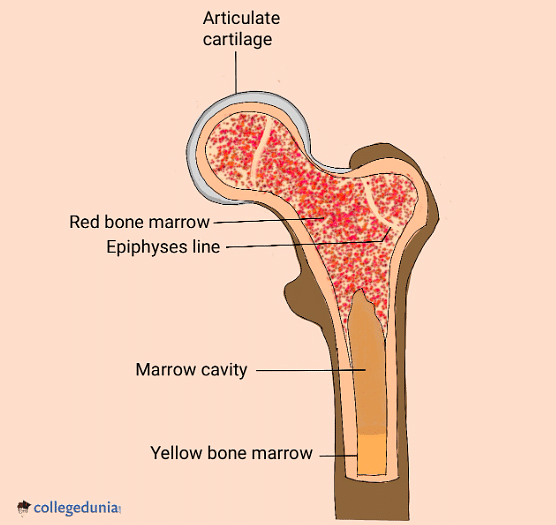
Bone Structure
Read More: Human Body
Osteogenesis
[Click Here for Previous Year Questions]
The process of bone formation is called osteogenesis. Skeletal bone formation begins by the first week of conception itself and a skeletal framework is formed after eight weeks of conception by the cartilage and connective tissue; ossification starts at this point.
- The bone formation and development continue throughout adulthood to repair and remodel the fractured bones.
- The osteogenesis can be of two types intramembranous ossification and endochondral ossification.
- Intramembranous ossification: It is the direct ossification of the mesenchyme.
- In this type of bone formation, the connective tissue membranes are replaced with bony tissue to form bones.
- The osteoblasts migrate to the area of connective tissue and deposit the matrix.
- A few examples are Clavicle and mandible.
- Endochondral ossification: In this type of ossification bone formation occurs from the cartilage.
- This is the usually followed process of bone formation and is more complex.
- The hyaline cartilage is replaced with bony tissue.
Read More: Bones
Osteoblast Formation
[Click Here for Sample Questions]
Osteoblast arises from the mesenchymal cells of the bone periosteum (outer covering of the bone) and the endosteum (inner covering of the bone) of the marrow cavity.
- They form a closely packed sheet on the bone surface and cellular processes extend from it.
- The formation of osteoblast requires a regular blood supply.
- If the cell differentiation is devoid of the blood supply chondroblasts are formed.
- Chondroblasts are cartilage-forming cells.
- Osteoblast also produces alkaline phosphatase, collagenase, growth factors, and hormones like osteocalcin, collagen, and osteoid (an organic unmineralized component of the bone).
- The osteoblast is eventually surrounded by a growing bone matrix; calcification occurs, and the cell is trapped in a space called a lacuna.
- Hence, an osteocyte is nothing but an osteoblast entrapped in a lacuna.
- An osteocyte communicates with the adjacent osteocytes through cytoplasmic processes occupying meandering channels (canaliculi) through the bone matrix.
Read More: Nerves
Osteoclasts
[Click Here for Previous Year Questions]
They are multinucleated cells that act as a precursor for monocytes.
- They arise in the bone marrow.
- Their main function is to break down the cell matrix.

Osteoclasts
Read More: Leg Muscles
Bone Remodeling
[Click Here for Sample Questions]
Bone remodeling is the process of bone destruction and bone reformation.
- It is also called as reshaping of the bone.
- The function is performed both by osteoclasts and osteoblasts.
- The osteoclast breakdown the tissue matrix and the osteoblast transport the mineral through the matrix.
Read More: Pelvic Bones
Functions of Osteoblast
[Click Here for Previous Year Questions]
Osteoblast secrete Type I Collagen, Osteocalcin, Osteonectin, and Osteopontin. The functions of which are given as under:
Bone Morphogenetic Proteins
They are secreted by the osteoblasts and are crucial for endochondral skeletal differentiation. They help to determine where the chondrocyte differentiation takes place and where the spaces must be left within the bone.
Steroid and Protein Hormones
The parathyroid hormone plays a crucial role in bone-related metabolism.
- It is secreted by the parathyroid gland in response to serum calcium balance.
- Its primary responsibility is keeping serum calcium concentration constant regardless of the calcium intake.
- The hormone is bi-functional; it stimulates bone formation at intermittent levels and bone degeneration at higher concentrations.
Type I Collagen
Osteoblasts secrete type I collagen and it is the most abundant type found in the body.
- They are present in almost all connective tissue and are components of the interstitial membrane.
- It has several cross-links and modifications. Type I collagen is predominantly modified at the post-transitional phase.
- Their mutation plays an important role in a range of diseases. Example: Osteogenesis Imperfecta and Ehlers-Danlos Syndrome.
- Several biomarkers of Type I Collagen have been developed.
- It is also associated with fibrogenesis.
Osteocalcin
Osteocalcin is a protein hormone produced by osteoblasts. The function of osteocalcin is to bind the calcium in the bones and maintain and regenerate the bone tissue. Osteocalcin is also released in the blood.
Other Functions:
- Adjust blood glucose level.
- Stimulate testosterone production.
- Increases muscle strength.
- Improves brain function.

Osteocalcin
Osteonectin
Osteonectin is a glycoprotein produced by osteoblasts during bone formation and mineralization. It binds to calcium and collagen.
Osteopontin
It is also secreted by the osteoblasts and has diverse biological functions. It is involved in the physiological processes and pathogenesis of diseases like atherosclerosis, cancer, etc.

Osteopontin
Also Read:
Things to Remember
- Osteoblasts are bone-producing cells.
- They are present in abundance in the bone periosteum.
- Osteoblasts help in both bone formation and bone remodeling.
- Their differentiation requires a regular blood supply.
- The osteoblasts entrapped in matrix lacuna are called osteocytes.
- Bone has a totally extracellular matrix.
- It is constantly being repaired and contains minerals and protein.
Previous Year Questions
- Which of the following is correct?...[JIPMR 2009]
- Fusion reaction takes place at high temperature because...[NEET UG 2011]
- Trien is...[AIIMS 2018]
- Sucrose on hydrolysis gives...[NEET UG 2020]
- Which of the following has zero dipole moment?...[NEET UG 1996]
- A disc of mass 2kg and diameter 2m is performing rotational motion. Find the work done, if the disc is rotating from 300rpm to 600rpm.
- The angle between two diagonals of a cube is….[KCET 2014]
- The electric field at a point is..
- Extraction of zinc from zinc blende is achieved by...[JEE Advanced 2007]
- The nucleic acid base having two possible binding sites is...[AIIMS 2004]
Sample Questions
Ques. Discuss osteoblast, osteocyte, and osteoclast. [5 marks]
Ans. Osteoblast: Osteoblasts are required for bone formation, mineralization, and remodeling. They are present on the bone surface forming a compact sheet. The osteoblastic processes extend from the body through the developing bone.
Osteocyte: The osteocytes are enclosed in a small chamber called a lacuna. Lacuna is made up of a calcified matrix. They are derived from osteoblasts and are involved in bone turnover.
Osteoclast: Osteoclasts are responsible for the dissolution and absorption of bone. They occupy a small depression on the bone surface called Howship lacunae. They are formed by the fusion of many cells derived from the circulating monocytes.
Ques. What is the difference between osteoblasts and osteocytes? [5 marks]
Ans.
| Osteoblast | Osteocyte |
|---|---|
|
|
Ques. What is the difference between osteoblast and osteoclast? [5 marks]
Ans.
| Osteoblast | Osteoclast |
|---|---|
|
|
Ques. What are Howship Lacunae? [2 marks]
Ans. The osteoclasts are the bone-destroying cells that are located on the small depressions of the bone surface. These small depressions are called “Howship Lacunae”. They are caused due to bone erosion by osteoclastic enzymes. They can also be called tiny depressions, pits, or irregular grooves in the bone that is resorbed by osteoclasts.
Ques. What is the difference between endochondral and intramembranous ossification? [5 marks]
Ans.
| Endochondral Ossification. | Intramembranous Ossification. |
|---|---|
|
|
Ques. What is bone remodeling and why is it necessary? [2 marks]
Ans. Bone remodeling is the process wherein old bone is gradually replaced by new bone to meet changing mechanical needs. It also helps to repair micro damage to bone and prevents the accumulation of older, fragile bones.
It also helps in maintaining plasma calcium homeostasis, micro-damage repair, and shaping the skeleton during growth.
Ques. What causes bone fractures? [3 marks]
Ans. The bone mineral (hydroxyapatite) and collagen together form a composite material that provides excellent compressive and tensile strength; due to this, bone can bend under strain and recover its shape. This is called elastic deformation. If the forces exceed the tolerable capacity of the bone it can cause a fracture.
Ques. Discuss in detail about bone matrix, cells, and its structure. [5 marks]
Ans. Extracellular matrix: The extracellular matrix of bone consists of organic and inorganic components
- Organic: Type I collagen provides tensile strength to the bone
- Inorganic: Hydroxyapatite, calcium, and phosphate. Hydroxyapatite provides compressive strength to the bone.
Cells: There are 3 main cell types in bone:
- Osteoblast for bone formation and remodeling.
- Osteocytes are inactive osteoblasts that are present in the lacuna. They communicate with other bone cells and help in metabolic functions within the bone.
- Osteoclasts are large multinucleated cells. They are responsible for bone breakdown or resorption.
Structure of bone: The structure of bone is made up of 2 types of tissue:
- Compact (cortical) bone: This is the hard outer layer that is dense, strong, and durable. It is 80% of the adult bone mass.
- Cancellous (trabecular or spongy) bone: This type consists of a trabecular network and rod-like structures. It forms the remaining 20% of the bone mass. This type of bone is lighter, less dense, and more flexible.
Ques. Discuss 2 functions of hydroxyapatite, osteocalcin, osteopontin, osteonectin, collagen, and bone morphogenic proteins. [5 marks]
Ans.
Hydroxyapatite:
- Contributes to bone repair and regeneration.
- Provides structural strength to the bones.
Osteocalcin:
- Plays a role in glucose homeostasis.
- Helps in brain development and cognition.
Osteopontin:
- Biomineralization.
- Increase in cell migration in cancer.
Osteonectin:
- Adhesion of osteoblast and platelets to the extracellular matrix.
- Helps in early stromal mineralization.
Collagen:
- Provides strength, support, and elasticity to the tissues.
- Contributes to proper cell alignment for cell proliferation and differentiation.
Bone morphogenic proteins:
- It plays a role in tooth development.
- Bone inductions and fracture repair.
Ques. What are bone tumor markers? [3 marks]
Ans. Tumor markers are substances that indicate signs of cancer or benign conditions. Many markers are proteins made of normal and cancer cells; however, the proportion of cancer cells is higher. The genetic changes in tumor tissue like gene mutation can also be used as a tumor marker. It can be used with other tests to diagnose cancer. Bone tumor markers increase the accuracy of a cancer diagnosis. For example, alkaline phosphatase might act as a bone tumor marker.
For Latest Updates on Upcoming Board Exams, Click Here: https://t.me/class_10_12_board_updates
Check-Out:



Comments