



Content Writer
Pectoralis muscles are the muscles that form the connection between the front part of the human chest and the bones that are present in the upper arm, rib cage, and shoulders.
- There are four muscles in the pectoral region, namely pectoralis major, pectoralis minor, serratus anterior and subclavius.
- Two of the muscles (pectoralis major and pectoralis minor) are present on each side of the sternum (also known as the breastbone).
- Pectoralis muscles are also known as pecs.
- These muscles help you move your upper limbs or ribs.
- Pectoralis major is a thick, fan-shaped convergent muscle that lies under the breast.
- On the other hand, the pectoralis minor is a triangular muscle located below the pectoralis major.
Key Terms: Pectoralis muscles, Pectoralis major, Pectoralis minor, Muscle, Human Chest, Bones, Scapula, Subclavius, Sternum, Ribs, Axilla, Human Body
Pectoralis Muscle
[Click Here for Sample Questions]
The pectoral regions are present in the anterior chest wall. They contain four major muscles that can be employed to exert any force on the upper arm: the pectoralis major muscle, the pectoralis minor muscle, the serratus anterior muscle, and the subclavius.
- Pectoralis muscles connect the front walls of the chest with the upper arms and shoulders.
- The subclavius muscle, along with the pectoralis major and pectoralis minor muscles, forms the axilla (or armpit).
- The serratus anterior is present on the front part of the chest, which helps move the scapula forward.
- Pectoralis muscles are also known as chest muscles.
- For breathing there are various intercostal muscles between the ribs.

Pectoral muscles
Read:
Pectoralis Major and Minor Muscle
[Click Here for Sample Questions]
The complete description of pectoralis major and minor muscle are as follows:
Pectoralis Major Muscle
Pectoralis Major Muscle is a thick, fan-shaped muscle that forms the bulk of the chest muscle. It serves the purpose of flexing, extending or rotating the humerus (the long bone of the upper arm).
- This is the biggest and powerful muscle.
- Its origin is at the clavicle (or collarbone), the sternum (or breastbone), the ribs and a tendinous extension of the external oblique abdominal muscle.
- Those that appear from the clavicle go obliquely downwards and laterally outwards.
- Those that originate from the lower sternum and the cartilages of true ribs travel upwards and laterally while the middle fibres go horizontally.
- This muscle ends in a flat tendon that is inserted into the lateral lip of the bicipital groove of the humerus.
- The function of the pectoralis major muscle is to facilitate the movement of the shoulder joint.
- Its actions include flexion, adduction or depression and rotation.
- The pectoralis major muscle also helps in the attachment of the arm to the trunk of the body.
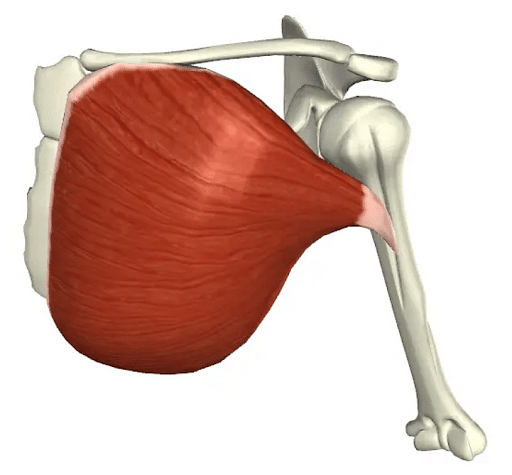
Pectoralis Major Muscle
Pectoralis Minor Muscle
Pectoralis Minor Muscle is a small, flat, triangular-shaped muscle that is present underneath the pectoralis major muscle. It originates from the middle of the rib i.e., from the upper and outer part of the third, fourth and fifth ribs, from the region near the cartilages.
- The pectoralis minor muscle is also located at the aponeuroses that cover the intercostalis.
- It gets inserted into the scapula (or the shoulder blade).
- This muscle facilitates the movement of the shoulder in the forward and downward direction, physiologically opposing the trapezius muscle.
- It also pushes the point of the shoulder down and brings the scapula superior towards the thorax.
- The muscle pushes its inferior angle posteriorly.
- Most chest-building exercises in the gym involve activating the pectoral muscles.

Pectoralis minor muscle
Read:
Things to Remember
[Click Here for Sample Questions]
- Pectoralis muscle is a type of muscle that will help you pull your arm across the front of your body.
- The pectoralis major muscle helps in the movement of the shoulder joint.
- Chest building exercises are aimed to activate these muscles.
- Pectoralis minor muscle helps in the movement of the ribs as well as the shoulder blades.
- The pectoral fascia is a thin layer of tissue extending toward the latissimus dorsi muscle on the back.
Sample Questions
Ques. How many pectoralis muscles are present in the human body? (2 marks)
Ans. There exists 4 pectoralis muscles in the human body, namely:
- Pectoralis major muscle
- Pectoralis minor muscle
- Serratus anterior
- Subclavius
These are all located in the pectoral region which is in the anterior part of the chest wall. They all can be employed to exert any force of the upper arm.
Second Answer
Ans: The human chest is a group of four muscles that are all located in the pectoral region, at the front of your chest wall:
- Pectoralis Major
- Pectoralis Minor
- Serratus Anterior
- Subclavius:
Ques. What is the location of the pectoralis major muscle? (2 marks)
Ans. The pectoralis major muscle is present on both sides of the upper chest. It extends from the breastbone or the sternum that is present in the middle of the chest and goes till the humerus that is the long bone of the human arm. It has 2 portions or heads, namely: clavicular head and the sternocostal head.
Second Answer
Ans. The pectoralis major is a prominent muscle on the front of your upper chest, present on both sides. It originates from two areas: sternum that is located in the middle of your chest. Clavicle also called the collarbone. The muscle then inserts (attaches) to the humerus, the long bone of your upper arm.
Ques. What is the origin of the pectoralis major muscle? (3 marks)
Ans. Pectoralis muscle has 2 heads: the clavicular head and the sternocostal head. The clavicular head finds its origin in the clavicle i.e., the collar bone. More precisely, its origin is in the anterior part of the medial half of the clavicle.
- The sternocostal head finds its origin in 3 different sites: the surface of the anterior region of the sternum, the cartilage belonging to the upper 6 ribs, and the aponeurosis of the external oblique muscle.
Second Answer
Ans. The pectoralis major boasts two distinct portions, known as heads: the clavicular head and the sternocostal head. Clavicular head which originates at a precise location: the anterior (front) part of the medial half (inner side) of the clavicle, also known as the collarbone. In contrast, the sternocostal head has a broader origin. The surface of the anterior (front) region of the sternum (breastbone). The cartilage attached to the upper six ribs. The aponeurosis (a tough, flat sheet of connective tissue) of the external oblique muscle (a muscle on the side of the abdomen).
Ques. What type of injuries can be caused to the pectoralis major muscle? (4 marks)
Ans. Injuries to pectoralis major muscle can be seen among men aged between 20-40. Tears to the muscle can be caused due to high impact exercises including weightlifting, rugby, football and wrestling.
- Tears can occur during a sharp or a violent action. Rupture of the tendons of the humerus can be detected with pain and a pop in the shoulder.
- This gives rise to a deformed muscle and also swelling and bruising in its surrounding areas. Severe tears can only be fixed via surgeries.
Second Answer
Ans. Pectoralis major tears are a relatively common injury among men aged 20-40, particularly those who participate in high-impact activities like weightlifting, rugby, football, and wrestling.
- These tears often occur during sudden forceful movements.
- The most common symptom is a sharp pain or popping sensation in the shoulder, accompanied by a visibly deformed chest muscle.
- Swelling and bruising around the injury are also common.
- In severe cases, the tendons connecting the muscle to the humerus bone (upper arm bone) may rupture.
- In some cases, physical therapy can be sufficient for recovery. However, surgery may be necessary for complete repair, especially in the case of tendon ruptures.
Ques. Explain about the insertion and the innervation of pectoralis major muscle? (2 marks)
Ans. The pectoralis major muscle gets inserted into the humerus which is the long bone of the human arm and at the crest of the greater tubercle. This muscle also passes through both heads of the biceps muscle before getting inserted. Motor innervation is supplied to the pectoralis major muscle with the help of the medial as well as the lateral pectoral nerve.
Second Answer
Ans. The pectoralis major muscle has a specific attachment point. It inserts (attaches) to the upper arm bone (humerus), specifically at the crest of the greater tubercle. The path of this muscle takes it through both heads of the biceps muscle before reaching its insertion point. For movement, the pectoralis major relies on signals from the nervous system. These nerves work together to deliver instructions from the brain, allowing the pectoralis major to contract and relax to perform various movements.
Ques. Explain the function of the pectoralis minor muscle? (3 marks)
Ans. Pectoralis minor muscle is a thin, triangular muscle that helps in the following ways:
- It helps in the depression of the point of the shoulder.
- Pectoralis minor musclehelps in drawing the scapula superior towards the thorax and also throwing its inferior angle posteriorly.
- It helps in the movement of the shoulder in the forward and downward direction.
- Additionally, it helps rotate the lower tip of the shoulder blade (inferior angle) backwards (posteriorly).
Second Answer
Ans. The pectoralis minor plays a significant role in shoulder movement. This thin, triangular muscle works in several ways:
- It helps depress the point of the shoulder, essentially lowering the shoulder blade and flattening it against the rib cage.
- The pectoralis minor also assists in drawing the entire shoulder blade (scapula) upwards towards the spine (superiorly) and inwards towards the chest (thorax).
- By influencing the position of the shoulder blade, the pectoralis minor contributes to the overall movement of the shoulder in the forward and downward direction.
Ques. What is Serratus Anterior and Subclavius? (2 marks)
Ans. Serratus Anterior: This fan-shaped muscle lies deeper than the pectoralis muscles and plays a crucial role in various arm movements, including pushing and pulling motions.
Subclavius: The smallest of the four, the subclavius muscle helps support the collarbone and contributes to some arm movements.
Second Answer
Ans. Serratus Anterior: Deeper than the pectoralis muscles lies the serratus anterior, a fan-shaped muscle that plays a vital role in various arm movements, including pushing and pulling motions.
- Subclavius Muscle: The subclavius, the smallest of the four pectoral muscles, helps support the collarbone and contributes to some arm movements.
Ques. What are two distinct parts of pectoralis major? (2 marks)
Ans. The pectoralis major has two distinct parts, often referred to as heads:
- Clavicular Head: This originates from the clavicle (collarbone).
- Sternocostal Head: This originates from the sternum (breastbone) and ribs.
These two heads work together to provide strength and control for various upper body movements.
Second Answer
Ans. The pectoralis major boasts two distinct sections, known as heads:
- Clavicular Head: This head originates at the clavicle, also known as the collarbone.
- Sternocostal Head: In contrast, the sternocostal head originates from a broader area, encompassing both the sternum (breastbone) and the ribs.
These two heads work together seamlessly to provide the strength and control needed for various upper body movements.
Ques. What is pubis? (2 marks)
Ans. Pubis refers to the area of the hip bone that is located on the anterior or the front side. The superior ramus of the bone is the upper portion of the pubis. There is a ridge located on the superior border of this ramus which is called the pectineal line. It allows for the attachment of various muscles and ligaments.
Second Answer
Ans. The pubis, located at the front of the hip bone, plays a crucial role in movement. The upper portion of the pubis is called the superior ramus. Running along the superior border of this ramus is a prominent ridge known as the pectineal line. These muscles and ligaments work together to provide stability and movement to the hip and pelvis.
Ques. What are the function of pelvic grindle? (2 marks)
Ans. The pelvic girdle supports the posterior part of the trunk and soft organs of the pelvic cavity, including the uterus and urinary bladder. It is also responsible for providing a surface for the attachment of the leg muscles.
Second Answer
Ans. The pelvic girdle, also known as the pelvis, serves multiple important functions:
- It acts as a strong foundation, supporting the lower back (posterior part of the trunk) and the soft organs housed within the pelvic cavity.
- The pelvic girdle provides a crucial attachment surface for the muscles of the leg.
- These muscles are essential for movement and stability of the lower body.
Ques. What treatments are prescribed for pectoralis major pain? (3 marks)
Ans. Physiotherapy is the most simple treatment prescribed for pectoralis major pain. According to analysis, physical trainer can spot the tissue that is damaged.
- This is quite advantageous when you are dealing with complete tear of pectoralis major muscle.
- If the case is more severe then individual should be referred to an orthopedic surgeon or radiologist.
- Some pain management therapy include mobilization, hydrotherapy, soft tissue treatment and electrotherapy.
- Other precautionary steps include avoiding hot shower, hot compress, massage, alcohol consumption, and excessive arm movement.
Second Answer
Ans. Physiotherapy is often the first line of treatment for pectoralis major pain. A skilled physical therapist can assess the injury and identify the damaged tissue. This is particularly beneficial for diagnosing minor strains.
- For more severe cases, such as a complete tear of the pectoralis major muscle, a referral to an orthopedic surgeon or radiologist may be necessary for further evaluation and potential surgery.
- Techniques like massage to improve blood flow and reduce muscle tension.
- Application of electrical currents to manage pain and promote healing.
Do Check Out:
| Class 11 Biology Study Guides | ||
|---|---|---|
| Biology MCQs | Biology Study Notes | Class 11 Notes |
| Comparison Topics in Biology | NCERT Solutions for Class 11 Biology | NCERT Class 11 Biology Book |



Comments