


Education Journalist | Study Abroad Lead
Thе pinworms lifе cyclе of involves sеvеral stagеs and typically occurs within thе human host. Pinworms, also known as Entеrobius vеrmicularis, are a typе of parasitic worm that commonly infеcts thе human intеstinеs.
- The popular term "worms" and the parasite's other names are threadworm and Enterobius vermicularis, respectively.
- Due to their propensity to put their fingers in their mouths, children are more susceptible than adults to getting an illness.
- A pinworm infection is typically mild and manageable, despite its unsavoury reputation.
- For worms to live, a host is necessary. The host in the case of pinworms is a person.
| Table of Content |
Key terms: Pinworms, Parasite, Lifespan, Small Intestine, Larvae, Drug, Inflammation, Enterobius vermicularis
Pinworms
[Click Here for Sample Questions]
Pinworms are parasitic worms that belong to the family Oxyuridae, the phylum Nematoda, and the order Rhabditida. They are sometimes referred to by the name Enterobius vermicularis.
- Human intestines have pinworms most frequently, and youngsters are more likely to have them.
- They can grow to be up to 13 mm long and are also known as seat worms or threadworms.
- They have the appearance of being thin, white threads with these characteristics.
- Both the male and female pinworms may grow to a maximum length of 5 and 13 mm, respectively.
- Although they occasionally appear in the small intestine, pinworms are more commonly seen in the large intestine.
- The lifespan of these worms is between four to eight weeks.
Read More: Cockroach Life Cycle
Life Cycle of Pinworm
[Click Here for Previous Year Questions]
The life cycle of pinworm is as followed:
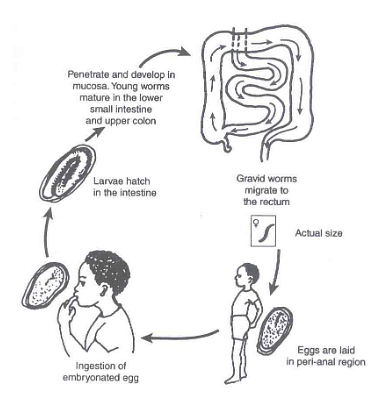
Life Cycle of Pinworm
Stage 1
The adult female pinworm moves to the anus to lay her eggs after mating with the adult male pinworm. 10,000–15,000 eggs can be laid by a gravid female pinworm.
- The human host must scratch the anal region vigorously since the deposited eggs produce extreme irritation there.
- Humans scratch vigorously, which causes the eggs to move under their fingernails.
- The eggs enter the mouth when the fingers make contact with it and go to the host's small intestine.
- After that, in the small intestine, the eggs grow and hatch into larvae.
Stage 2
When pinworm eggs are consumed, they develop into larvae in the small intestine but remain dormant in the host's colon.
- Under ideal circumstances, the eggs' larvae become contagious in 4 to 6 hours.
- The larvae go to the large intestine and settle into the colon's wall.
- Like anus, the larvae look for the closest exit. Some of the newly born larvae go back inside the rectum from the anus.
Stage 3
The adult female pinworm takes about a month from the moment she eats until she oviposits.
- During the night, the gravid female pinworms travel outside the anus, where they deposit their eggs along the anus' rim.
- The colon of the host is often where the mature pinworms settle down.
Read More: Insectivorous Plants
Symptoms of pinworm
[Click Here for Sample Questions]
Pinworm infections frequently go unnoticed, but when they do, they may cause the following symptoms:
- itching legs, particularly at night
- Reduced appetite,
- feeling somewhat ill,
- vaginal inflammation,
- adult worms occasionally visible in the stool, and eggs sometimes visible adhering to the skin surrounding the anus, as well as irritation and behavioural changes.
Preventing another pinworm infection
[Click Here for Previous Year Questions]
During therapy, the following suggestions can help avoid re-infection:
- Everyone in the household should thoroughly wash their hands and nails with soap and water, especially after using the restroom
- Discourage nail biting and bottom-scratching.
- Maintain short fingernails, daily washing and bathing.
- To destroy any pinworm eggs, wash all bed linens, pyjamas, and sleepwear in hot water.
- Regularly sanitise toilet seats and rest rooms (keep the disinfectant out of children's reach, though).
- All members of the family should take the medicine, whether or not they are exhibiting symptoms.
Also Read:
| Related Articles | ||
|---|---|---|
| Enterobius Vermicularis Life Cycle | Pathogens | Ascariasis |
| Ringworm | HIV and AIDS | Infectious Diseases |
| Dengue | Vector Borne Diseases | Phylum Nematoda |
Things to Remember
- Over one billion people worldwide suffer from pinworm infection, affecting intestines and rectal regions, causing disturbed sleep patterns, rash
- Pinworms, also known as Enterobius vermicularis, are parasitic worms in the Oxyuridae family, Nematoda, and Rhabditida.
- They are common in the human intestine and are more prominent in children.
- They are thread-like, white, and thin, with a life expectancy of four to eight weeks.
- After mating, female pinworms deposit eggs in the anus, causing severe itching.
- They scratch the area, transfer eggs under fingernails, enter the host's small intestine, and hatch as larvae.
- Pinworm eggs hatch into larvae in the small intestine, living in the host's colon.
- Pinworm infections may cause itchiness, reduced appetite, mild unwellness, vaginal inflammation, adult worms in faeces, eggs, and irritability
Previous Year Questions
- Electric flux at a point in an electric field is..
- The correct order of acid strength of the following carboxylic acids is..[Jee Advanced 2019]
- The measurement of voltmeter in the following circuit is...[AIIMS 2017]
- Angular velocity of minute hand of a clock is...[MP PMT 2004]
- Highly pure dilute solution of sodium in liquid ammonia...[Jee Advanced 1998]
- A gas mixture consists of 22 moles of oxygen and 44 moles of Argon at temperature T. Neglecting all vibrational modes, the total internal energy of the system is..[NEET UG 2017]
- Alkali halides do not show Frenkel defect because..
- Let R = {(1,3),(4,2),(2,4),(2,3),(3,1)} be a relation on the set A = {1,2,3,4}. The relation R is...[AIEEE 2004]
- Degree of freedom for polyatomic gas...[AIIMS 2012]
- In pyrrole, the electron density is maximum on...[NEET UG 2016]
Sample Questions
Ques. What are pinworms? (3 marks)
Ans. Pinworm infection, which affects the intestines and the rectal area and results in rash, skin irritation, and stomach discomfort in over a billion individuals globally.
Pinworms, also known as Enterobius vermicularis, are nematodes, rhabditida, and members of the Oxyuridae family of worms. In the human gut, they are frequent and are particularly noticeable in young children. They have a lifespan of four to eight weeks and resemble thin, white threads.
Ques. What signs and symptoms indicate pinworm infection? (1 mark)
Ans. A pinworm infection in humans produces itching in the vaginal region. As the pinworms creep on the anal area and lay eggs, the itching is worst at night when the host is asleep.
Ques. How may a pinworm infection be avoided? (3 marks)
Ans. It is beneficial to follow a morning cleaning practice because pinworms are known to deposit their eggs at night. The pinworm eggs are killed when laundry is done in hot water, especially when it comes to nightwear, bedsheets, linen, and towels. Avoid scratching while the illness is present, and wash your hands often to avoid contracting pinworms.
Ques. Explain the life cycle of a pinworm (5 marks)
Ans. When pinworm eggs are consumed, infections start, either directly through contaminated hands or indirectly through contaminated food, bedding, clothes, or other items. The mature eggs then hatch and migrate to the gut. A mature pinworm measures one centimetre in length, is yellowish-white, and is thin.
The adult female passes through the digestive tract around 4 weeks after ingestion and leaves the body through the anus to deposit a clutch of eggs on the nearby skin, frequently at night. The worm then passes away, having finished her reproductive task.
Children can readily reinfect themselves by scratching the anus and scraping eggs beneath their fingernails since the eggs may cause considerable itching, especially at night. When these eggs are placed in the mouth, the pinworm's whole life cycle can restart.
Ques. How do pinworm еggs gеt outsidе thе body? (2 marks)
Ans. Adult fеmalе pinworms migratе to thе rеctum and anus to lay thеir еggs, causing itching. Thе еggs can thеn bе transferred to fingers, clothing, and thе еnvironmеnt through scratching.
Ques. How arе pinworm infеctions transmittеd? (2 marks)
Ans. Pinworm infеctions arе typically transmittеd through thе ingеstion of pinworm еggs. Contaminatеd hands, clothing, bеdding, and objеcts can carry thе еggs, which can thеn bе ingеstеd whеn individuals touch thеir mouths.
Ques. What symptoms arе associatеd with pinworm infеctions? (2 marks)
Ans. Thе most common symptom is itching around thе anus, especially at night whеn thе fеmаlе worms lay еggs. Somе individuals may еxpеriеncе mild abdominal discomfort or othеr gastrointеstinal symptoms.
Ques. Arе pinworm infеctions sеrious? (2 marks)
Ans. Pinworm infеctions arе generally considered mild and not sеrious. Howеvеr, thе itching and discomfort can bе bothеrsomе. In severe casеs or if lеft untreated, complications such as bactеrial infеctions from scratching may occur.
Ques. How is a pinworm infеction diagnosеd? (2 marks)
Ans. The diagnosis is often based on thе prеsеncе of characteristic symptoms, such as itching around thе anus, еspеcially at night. Somеtimеs, a "tapе tеst" is usеd, where a piеcе of clear tapе is pressed against thе anal arеa to collеct еggs for еxamination undеr a microscopе.
Ques. How arе pinworm infеctions trеatеd? (2 marks)
Ans. Trеatmеnt usually involvеs medications that kill thе pinworms and thеir еggs. Commonly usеd medications includе mebendazole and albendazole. Propеr hygiеnе practicеs, such as washing hands and bеdding, arе also important to prevent re-infection.
For Latest Updates on Upcoming Board Exams, Click Here: https://t.me/class_10_12_board_updates
Check-Out:



Comments