



Content Curator
The roots of plants are the altered or modified organs that help to provide anchoring for the plant & in consuming the nutrients and water right through the plant body and also, allowing it to grow higher & quicker. Roots are usually found below the surface of soil, but they can also be aerial or aerating, meaning they grow up above the earth or especially above water. The main responsibilities of the root include water absorption & plant nourishment, as well as holding the plant body to the ground.
Read Also: Difference Between Monocot and Dicot System
| Table of Content |
Key Terms: Root system, Modification of roots, Functions of roots, Plants, Types of roots, Soil
What are Plant roots?
[Click Here for Sample Questions]
Plant root function & structure, as well as their interactions with the particles of soil, are intriguing research frontiers that will eventually disclose a lot about our natural systems, worldwide water, mineral, & carbon cycles, and help ensure future food supplies.
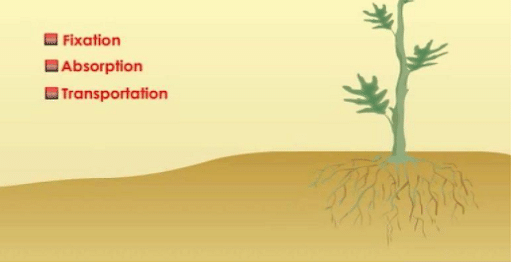
Primary Functions of a root
- The absence of leaf scars & buds, the existence of a root cap, and the presence of internal tissue branching rather than buds distinguish the root from the plant stem.
- It is a modified organ that transports nutrients & water to the entire plant body by taking from the soil.
- A plant's root system continually supplies water & dissolved minerals to the leaves & stems.
- To achieve this, the roots must expand into new areas of the soil. The photosynthetic mechanism in the leaves aids the development and metabolism of the root system of the plant.
- The phloem transports photosynthate from the leaves to the root system.
Check Important Notes for Types of Plant Cell
The following is the anatomy of a plant's root. There are four types of root morphology:
Roto Cap
The root cap is a kind of tissue found close to the root's tip. The root cap of young roots aids in the penetration of the plant root into the soil. As the root grows deeper, they are sloughed off, leaving a slimy surface that acts as lubrication. In plants, it shields the developing tip and secretes mucilage to help the root travel through the soil more easily, and it may also communicate with the soil bacteria.
Apical Meristem
The root & shoot tips of plants have an apical meristem, which is an area of cells capable of division & development. They are important for the expansion of the roots & shoots and give rise to the basic plant body. Behind the protective root cap, the root apical meristem emerges.
Elongation Zone
The elongation zone is freshly created cells that become longer, resulting in root growth. The zone of cell maturation, which begins at the first root hair, is where plant root cells differentiate and are shown into specialized cell types. The initial centimetre of the root tip is home to all three zones.
Root Hair
Root hair cells are solitary tubular root cells with a lateral extension that enhances the exchange surface between the plant's root system as well as the soil. The intake of water & nutrients from the rhizosphere is the primary function of root hairs.
Also Read:
Different Types of Roots
[Click Here for Sample Questions]
The taproot is more conspicuous than the other roots in most trees and plants. It normally has a wide diameter and reaches deeper than the plant's other roots, and it often contains lateral roots as well. The primary root and secondary root make up the real root system. The roots have become more specialized to perform more adaptive roles. The following are the different types of roots.
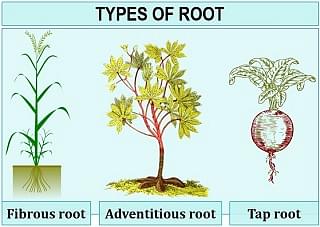
Types of Roots
- Taproot - The main root of a major root system that grows vertically downward is called a taproot. They are produced by most dicotyledonous plants, including dandelions, and some, such as the edible roots of carrots and beets, are specialized for food storage e.g. sunflower, mustard, carrot, mango.
- Fibrous root - The inverse of a taproot system is a fibrous root system and It is frequently generated by the stem's thin, modestly branched roots. Monocotyledonous plants and ferns all have a fibrous root structure. When the tree has achieved full age, the fibrous root systems resemble a root mat.
- Adventitious Root - They are plant roots that grow from non-root tissue during normal development as well as in reaction to stress events including floods, nutrient shortage, and injury. During floods, it facilitates gas transfer as well as water and nutrient intake.
Also Check:
Modifications in roots
[Click Here for Sample Questions]
For varied functions, plants have different root systems. There are many distinct forms of specialized roots, but aerial roots and store roots are two of the most well-known. Aerial roots are roots that grow above the ground and provide structural support. For food storage, storage roots are changed as taproots.
- Stilt Roots - Extra roots grow obliquely downwards from nodes at the base of the stem, penetrating the soil & providing strong anchoring such as Sugarcane & Screwpine.
- Climbing Roots - Weak climbers use climbing roots that grow from their nodes to loop around and grab the support.
- Clinging Roots - Special clinging roots emerge, enter support fissures, and anchor the epiphyte. epiphytes & orchids are examples of clinging roots.
- Assimilatory Roots - Assimilatory roots, such as Taeniophyllum, Trapa, and Tinospora cordifolia, are modified adventitious roots that turn green & perform photosynthesis.
- Parasitic Roots - All parasitic plants contain haustoria, which are modified roots that pierce the host plant and attach it to the conductive system called sucking or Parasitic roots.
- Epiphytic or Aerial Roots - Aerial roots are roots that grow above the soil and are usually always adventitious. They're present in a wide range of plants, including epiphytes like orchids.
- Floating Roots - Spongy, air-filled floating roots emerge from the nodes of some aquatic plants and aid in flotation and respiration like Jussiaea.
- Reproductive Roots - Propagating adventitious roots are another name for reproductive roots. They create new plants by forming adventitious buds that grow into shoots above ground. for example - Dahlia, Dalbergia, and sweet potato.
Read More: Vegetative Propagation in Plants
Things to Remember
[Click Here for Sample Questions]
- Most plants have a taproot, which is the main root from which lateral roots emerge.
- Taproots and fibrous roots are the two basic forms of root systems that originate from root tips.
- A fibrous root system is one that is made up of several roots of roughly equal size. Fibrous roots are usually found in the soil's higher strata.
- Aerial roots come in a variety of forms, but they all serve the same purpose as structural support for the plant.
Read Further: Sexual Reproduction in Flowering Plants
Sample Questions
Ques. Why do some plants have aerial roots? (2 Marks)
Ans. many of the plants have weak stems that require aerial root support to keep them upright. Plants that thrive in swampy environments don't obtain enough oxygen through their roots. Aerial roots emerge from the earth to obtain fresh air from the atmosphere.
Ques. How do plant roots come to know where is nutrient available in soil? (2 Marks)
Ans. plants get their nutrients from the ground soil, although soil fertility varies even within the same area. However, plants in areas where nitrogen is scarce tended to expand their roots toward areas where sufficient nutrients are available.
Ques. What are Plant Roots? Write the Difference Between Taproot and Fibrous Root? (3 Marks)
Ans. In vascular plants, the roots are the organs that enable them collect water & mineral nutrients from the soil.
Taproots reach deep into the earth, whereas fibrous roots are shallow and do not reach as far. The fibrous root is not the plant's differentiated major root, although the taproot is. Monocots have a fibrous root, whereas dicots have a taproot.
Ques. Mention & Explain the Types of Roots? (3 Marks)
Ans. The main types of roots include:
- Taproot - It is a big, dominating root that sprouts additional roots laterally from it. A taproot is often straight and thick, with a tapering form that develops directly downward.
- Fibrous root - They are thin and have root hairs, and their primary job is to absorb plant nutrients and water from the soil.
- Adventitious root - They are those that do not originate from the plant root's organ. They mostly come from the stem and leaf.
Ques. What is the function of roots? (5 Marks)
Ans. Roots serve the following purposes:
- Water and nutrients are absorbed by the roots from the soil.
- They provide a solid foundation for the plant.
- They aid in the storage of food and nutrients.
- Water and minerals are transported to the plant through the roots.
- Roots help to keep the plant in place and support the aerial shoot system.
- Mineral salts are absorbed by the roots from the soil.
- Soil Erosion Prevention
Ques. What are the differences between monocot and dicot roots? (5 Marks)
Ans. The primary distinction between monocot and dicot roots is that dicot roots have xylem in the centre and phloem around them. The xylem and phloem of monocot roots are organised in a circular pattern. Monocot roots are fibrous, which means they generate a large network of thin roots that emerge from the stem and stay near to the soil's surface. Dicots, on the other hand, have "taproots," which are strong roots that grow deep into the earth and contain smaller, lateral branches.
Ques. What are the primary and secondary roots? (5 Marks)
Ans.Primary root - When a seed germinates, the major root, or radicle, is the first organ to develop. It anchors the seedling by growing downward into the earth. To build a taproot system, it grows downward and secondary roots sprout laterally from it. The taproot of some plants, such as carrots and turnips, also functions as food storage.
Secondary root - A side branch of the main root, a root, or a fine rootlet that develops from the major root is referred to as a secondary root or lateral root. An adventitious root that forms on a stem or leaves is referred to as a secondary root.
Ques. Why are roots important to plants? (3 Marks)
Ans. The roots of a plant serve a variety of purposes. The root system absorbs oxygen, water, and nutrients from the soil and transports them to the stems, leaves, and blossoms of the plant. The energy generated by the plant via photosynthesis is frequently stored in the roots and made accessible to the plant as needed.
Ques. What is the structure of plant roots? (3 Marks)
Ans. The primary root, lateral roots, the apical meristem, a root cap, & root hairs are all main parts of a root. The epidermis, cortex, endodermis, pericycle, and vascular tissues are visible in a cross slice of a herbaceous dicot root. A taproot system or a fibrous root system are two types of plant root systems.
Ques. Which are characteristics of root? (5 Marks)
Ans. The following are the Root's Characteristics
- The root is the lower half of the plant's axis.
- It has a geotropic inclination.
- It is generally dark or non-green in colour.
- Nodes and internodes are not distinguished from the root.
- The root, as a rule, does not bear leaves or tree buds.
Biology Related Links:



Comments