



Content Curator
Poisson’s Ratio of a material is defined as the ratio of the transverse contraction of a material to the longitudinal extension strain in the direction of the stretching force. The effect of Poisson’s Ratio can most commonly be observed in the rubbers. When a piece of rubber is compressed from the middle, some changes in its dimensions can be observed.
As a result of strain, the ratio of change in the width per unit width of a material, to the change in its length per unit length is the poisson’s ratio. It is called so due to its propagator Simeon Poisson who was a famous French mathematician and physicist. The ratio is denoted by “nu”.
Key Terms: Poisson's ratio, Poisson's Ratio Formula, Poisson Ratio of Steel, Poisson Ratio of Concrete, Range of Poisson Ratio
Define Poisson’s Ratio?
[Click Here for Sample Questions]
Poisson’s ratio is defined as the negative of the transverse strain ratio to lateral and axial strain. In the materials science, poisson’s ratio (\nu) implies the measure of the poisson effect and its value is the negative of the ratio of transverse strain to axial strain.

Highlights of Poisson’s Ratio
[Click Here for Sample Questions]
A piece of cuboid rubber, when pulled along its sides, gets compressed in the middle. Here, “L” and “B” denote the length and breadth of the rubber respectively. When it is pulled longitudinally, there is a lateral compression. There is an increase in the length of the rubber denoted by “dL” and breadth denoted by “dB”.
εt = −dB/B
εl= dL/L
Read More: Bulk Modulus
So, we can write the formula for Poisson’s ratio to be,
μ = −εt/εl
εt is the Lateral or Transverse Strain.
εl is the Longitudinal or Axial Strain.
μ is the Poisson’s Ratio
Read more : Hooke’s Law
Poisson’s Ratio Definition for a Material
The Poisson’s ratio for a material can be termed as the ratio of the transverse contraction of material towards the longitudinal extension strain. We can create stress by using force on the material by the body.
Poisson’s ratio is found to be positive for the tensile deformation. It is negative for the compressive deformation. Having a negative Poisson’s ratio implies that positive strain lies in the transverse direction. For most of the materials, the range of the Poisson’s ratio lies between 0 and 0.5.
The Poisson’s ratio for plastics lies between f 0 and 0.5. If the Poisson’s ratio is 0, one can see no fall in the diameter value or, in other words, there can be no lateral contraction when one is elongating the material. The value 0.5 shows that the volume of the material will remain fixed in the elongation process.
Given below is the Poisson’s ratio for various materials :
Rubber = 0.49
Aluminium = 0.32
Concrete = 0.2
Cork = 0
Because most of the common materials become narrower when they are stretched in the opposite direction, Poisson’s ratio is usually positive. The change in volume is resisted by most of the materials. It is determined by “K” or “B” as they resist change in shape that is denoted by “G”.
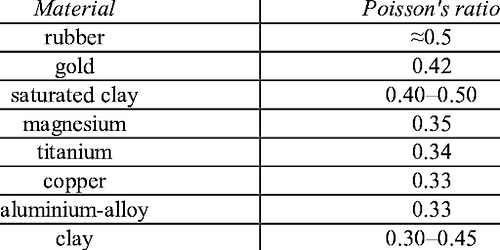
Poisson's Ratio and Anisotropy
[Click Here for Sample Questions]
As far as anisotropic solids, i.e, honeycomb, single-crystal, etc, are concerned, the physical properties of this material are determined by the direction in which they are stretched. We can find that the Poisson’s ratio can be either positive or negative for the large magnitude of such anisotropic materials.

Poisson's Ratio in Viscoelastic Materials
[Click Here for Sample Questions]
The effect of the context of the transient tests such as creep and stress relaxation can be noticed on the Poisson’s ratio of the viscoelastic material. If the nature of the deformation executed is sinusoidal, the frequency and the phase angle form the basis of Poisson’s ratio.

Primarily, in the case of viscoelastic solid, the transverse strain can be found to be out of phase with the longitudinal strain.
Poisson's Ratio and Phase Transformations
[Click Here for Sample Questions]
The Poisson’s ratio of a material can be greatly impacted by the phase transformation. Whereas the bulk modulus becomes soft near a phase transformation, the shear modulus does not reflect much impact. The Poisson’s ratio registers a fall along with the vicinity of the phase transformation. It is even known to go to negative values.

Poisson's Ratio, Waves, and Deformation
[Click Here for Sample Questions]
The Poisson’s ratio of the various materials influences the speed of propagation and reflection of the stress waves. The compression ratio to shear wave holds importance because the nature of a deep rock in the earth can be concluded. The wave speed ratio is also based on Poisson’s ratio. The distribution of stress around the cracks and the decay of the stress get affected by Poisson’s ratio.
Read More: Poisson’s Ratio
The Role of the Poisson’s Ratio
[Click Here for Sample Questions]
The properties of a material can be judged with the help of Poisson’s ratio. The material that remains uncontracted is brittle whereas the contracted one is ductile. The material with a high Poisson ratio can be pulled more easily than the one with a low Poisson ratio. The material with no elongation breaks when pulled. The Poisson’s ratio facilitates the task of deciding materials for a particular task, e.g, choosing an elastic rubber as a stopper for Champagne can end up having leakage of the champagne.
The Expression for Poisson’s Ratio
[Click Here for Sample Questions]
Factors like temperature, density, and young's modulus decide the Poisson’s ratio in various objects.
Still, there is a unified expression for the ratio, that is the negative ratio between strain in the load direction and strain at the right angle to the load. We can represent it as follows:
Poisson's Ratio= - (Transverse / Lateral strain)/ Axial strain

As given in the formula above, whereas the Poisson’s ratio of an object is proportional to lateral strain, it’s inversely proportional to axial strain. Further calculations are done based on Poisson’s ratio equation.
Read More: Elastic Limit
Poisson’s Ratio Values for Different Material
[Click Here for Sample Questions]
The purpose of the material can be figured out by understanding Poisson’s ratio for different materials. There can be 2 types, i.e, Tensile Deformations (positive) and Compressive deformations (negative) in the deformations of Poisson’s effect. A positive strain in the transverse direction is exhibited by the negative Poisson’s ratio.

The deformations in Poisson’s effect are of 2 types namely, Tensile Deformations (Poisson’s Ratio is positive) and Compressive Deformation (Poisson’s Ratio is negative). The negative Poisson’s Ratio suggests that the material will exhibit a positive strain in the transverse direction.
Things to Remember Based on Poisson’s Ratio
- Poisson’s ratio is the negative ratio of transverse strain to axial or lateral strain.
- It is also defined as the ratio of the amount of transversal expansion to the axial compression amount for small values of such changes.
- Poisson’s ratio (ν) can mathematically be expressed as: ν = - εl/εa
- Strain is the dimensional change of the object shape divided by the original dimension.
- For tensile deformation, the Poisson’s ratio remains positive.
- For compressive deformation, Poisson’s ratio is negative.
- If we stretch an object in only one direction then it will get compressed in the direction perpendicular to the applied force
Poisson’s Ratio Sample Questions
Ques: Is Poisson’s ratio determined by temperature? (2 marks)
Ans: Both the strains are increased in case of high temperature and decreased in case of a low one. As the change in both the strains is almost of a similar amount, the effect on Poisson’s ratio is small.
Ques: Describe Poisson’s ratio for concrete? (1 marks)
Ans: The Poisson’s ratio for concrete falls between 0.1 to 0.2.
Ques: What does Poisson’s ratio 5.0 reflect? (1 marks)
Ans: It means elastic deformations of perfectly in-compressible material at small strains.
Ques: What are the units of Poisson’s ratio? (2 marks)
Ans: It doesn’t have any unit as Poisson’s ratio is the unitless scalar quantity.
Read More: Shearing Stress
Ques: Define poisson’s ratio? (2 marks)
Ans: Poisson’s ratio is defined as the ratio of relative contraction, that is lateral strain to relative expansion, that is longitudinal strain. It is symbolized by µ.

Ques: For a given material, the rigidity modulus is (¹⁄³)rd of Young’s modulus. Its Poisson’s ratio will be: (2 marks)
i. 0
ii. 0. 25
iii 0. 3
iv 0. 4
Ans: d) 0. 4
Explanation- The relationship of Poisson’s ratio, rigidity and Young’s modulus is:

Ques: For a given material the Young’s modulus is 2.4 times that of rigidity modulus. What will be the poisson’s ratio? (2 marks)
i 2. 4
ii 1. 2
iii 0. 4
iv 0. 2
Ans: d) 0. 2
Explanation-
Given: Y = 2. 4η
As Y = 2η (1 + σ)
Thus, 2. 4η = 2η (1 + σ)
Therefore, 1.2 - 1 = σ
σ = 0. 2
Ques: What does it mean if Poisson’s ratio is zero? (1 Mark)
Ans: If Poisson’s ratio of an object is zero, then the material is defined as rigid. Also, it is perfectly plastic and there is no longitudinal strain in the object
Ques: Which material has the lowest Poisson’s ratio? (1 Marks)
Ans: Beryllium has the lowest Poisson's ratio compared to any polycrystalline metal. The Poisson's ratio of beryllium is surprisingly low. The values range from 0.01 to 0.085.
Ques: What is the range of the Poisson’s ratio? (1 Mark)
Ans: Poisson's ratio is defined as a dimensionless state and ranges between 0.1 and 0.45. Low Poisson's ratio, such as 0.1–0.25, means rocks fracture easier and high Poisson's ratio, like 0.35–0.45, implies that the rocks are harder to get fractured. The Poisson's ratio changes from layer to layer.
Ques: How is Poisson’s ratio of cork zero? (2 Marks)
Ans: Poisson’s ratio is formally defined as the negative ratio between the transverse & axial strain. Therefore, an object with a zero Poisson ratio should essentially be displaying no transverse strain. Since cork displays zero transverse strain that is why its Poisson’s ratio is zero.
Ques: How does temperature affect Poisson’s ratio? (2 Marks)
Ans: Temperature change in solid mostly causes a change in the elasticity of the material. The temperature has the capacity to change the matter’s state of being (change from gel smoothness to solid touch). The Poisson’s ratio value of an object is observed directly proportional to temperature. Hence:
- Less temperature= lateral & axial strain decrease
- High temperature= lateral & axial strain increase
Ques: What does Poisson’s ratio of 0.5 mean? (2 Marks)
Ans: Poisson’s Ratio of 0.5 means it is at the origin. Poisson’s ratio is the measurement of the Poisson effect, the occurrence where the object has a tendency to expand in the directions perpendicular to the compressional direction. An incompressible Isotropic material flawlessly deformed elastically at little strains will have a Poisson’s ratio of exact 0.5.
Ques: What is Poisson’s ratio of steel? (2 Marks)
Ans: The Poisson’s ratio of steel is 0.28. The average value of Poisson’s ratio for aluminum-alloys is 0.33. The material volume having Poisson’s ratios less than 0.50 has a tendency to increase its dimensions under longitudinal tension & decrease its dimension under longitudinal compression.
Ques: Why does Poisson’s ratio become less than -1? (2 Marks)
Ans: If the Poisson ratio is larger than ½, it will correspond to the object that has expanded volume when compressed. A Poisson ratio less than -1 will tend to correspond to an object that is when it is compressed in a focused direction, it will shrink more in the transverse direction than in the focused direction.
Ques: What are some possible applications of the Poisson effect in the real world? (2 Marks)
Ans: These are some examples of how the Poisson effects are used in the real world.
Using “Cork” as a bottle stopper: Due to its extremely low Poisson ratio, cork is the most suited material for use as a bottle stopper. This means that even when heavy compression is applied on both sides of the cork, the cork does not change much. When rubber is employed as a bottle stopper, however, it will stretch laterally if subjected to axial compression, causing the stopper to become trapped in the bottle.
Ques: Give the Poisson’s Ratio Values for Steel, Brass, and Copper. (3 Marks)
Ans: Here are the poisson’s ratio values for Steel, Brass, and Copper:
| Material | Poisson’s Ratio |
|---|---|
| Steel | 0.27-0.3 |
| Brass | 0.33 |
| Copper | 0.35 |
Also check:



Comments