



Content Curator
Potassium thiocyanate is considered to be a chemical compound that includes potassium, sulfur, carbon, and nitrogen atoms. The molecular formula of potassium thiocyanate is KSCN. Potassium thiocyanate is an important salt of the thiocyanate anion and it is also considered as one of the pseudohalides. As compared to the other inorganic salts, potassium thiocyanate has a very low melting point. It is an inorganic salt. To form potassium thiocyanate, a fusion of sulfur and potassium cyanide is made after the extraction with hot aqueous alcohol, evaporating and cooling. KSCN is a colorless and odorless chemical and is saline in taste.
| Table of Content |
Read More: Specific Heat of Water
Potassium Thiocyanate Meaning
Potassium thiocyanate is an inorganic potassium salt with a formula KSCN. Potassium thiocyanate has a density of about 1.89 grams per cubic centimeter. It appears as a crystalline powder or between colorless to white-colored crystals. It has a molecular weight of about 97.181 grams per molecule.
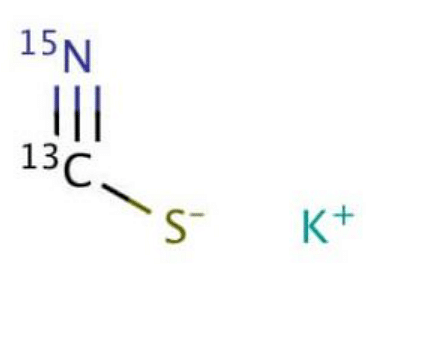
Potassium thiocyanate
Potassium thiocyanate has a very high boiling point but the melting point is relatively low. So, the boiling point of potassium thiocyanate is 500oC and the melting point is only 173o C. Nevertheless, this chemical is not soluble in water. Potassium thiocyanate is also known as potassium rhodanide or potassium rhodanine.
Also Read:
Physical Properties of Potassium Thiocyanate
Potassium thiocyanate is an odorless and colorless chemical. Potassium thiocyanate appears similar to a solvent crystal. The heat capacity of potassium thiocyanate is 298.15 KJ/mol.k and the solubility of potassium thiocyanate in the water is 177 g/100ml.
Read More: Degree of Unsaturation Formula
The physical properties of the potassium thiocyanate are mentioned in a table that is given below:
| Chemical Formula | KSCN |
| Density | 1.89 g/cm3 |
| Molar Mass | 97.181 g/mol |
| Boiling Point | 500oC |
| Melting Point | 173oC |
| Odor | No odor (odorless) |
| Appearance | Colorless solvent crystal |
| Covalently-bonded unit | 2 |
| Heat capacity | 298.15 k, J/mol. K |
| Complexity | 34.5 |
| Solubility | 177 g/100mL (it is soluble in water) |
Chemical Properties of Potassium Thiocyanate
Potassium thiocyanate quickly reacts with metals to form a thiocyanate as it is a very high reactive chemical. For instance, when the reaction of nitrate and potassium thiocyanate takes place in the presence of water, then iron thiocyanate, potassium oxide, and nitric acid are produced through the reaction.
Read More: Antidepressant Drugs
Another instance for the chemical reaction, when the reaction of iron chloride and potassium thiocyanate takes place forms iron thiocyanate and potassium chloride. The chemical reaction for both the examples are mentioned below-
3H2O + 2Fe (NO3)3+ 6KSCN → 2Fe (SCN)3+ 3K3O + 6HNO3
FeCl3 + 3KSCN → Fe (SCN)3 + 3KCl
Health Hazards of Potassium Thiocyanate
Potassium thiocyanate is a chemical that causes irritation to the eye and skin. It is highly toxic when it gets ingested into the body. If potassium thiocyanate causes redness and a lot of pain when coming directly in contact with the eye, it is advisable to immediately take medical attention.
Direct contact of potassium thiocyanate with the skin causes irritation in the local areas. Dizziness, faintness, headache, nausea, and vomiting will cause due to the ingestion in the body.
Read More:
Treatments for Potassium Thiocyanate Infections
Potassium thiocyanate causes many diseases when it directly comes in contact with some of the body parts like- eye, skin, and so on. So, some treatments which a person can adopt for thiocyanate infections are mentioned below:
- Eyes
When potassium thiocyanate comes directly in contact with the eyes it causes redness and a lot of pain, so it is important to wash your eyes properly. Wash your eyes by using a large quantity of water until all the amount of the chemical has been removed.
One should wash their eyes for 10 to 15 minutes. Although, if the pain or irritation remains as it is even after washing the eye, then it is necessary to seek immediate medical treatment.
- Skin
It is advised to immediately remove all the clothes you are wearing if your skin comes directly in contact with the potassium thiocyanate. After removing all the contaminated clothes, wash the affected area by using a large amount of water with the help of soap or any mild detergent until all the evidence of the chemical has been removed.
Read More:
It is important to wash the affected area for at least 10 to 15 minutes. Before starting to use the clothes you were wearing when your skin gets affected by potassium thiocyanate, it is important to wash them properly.
- Inhalation
If you inhale potassium thiocyanate then it becomes necessary to leave the room for fresh air. If any difficulty occurs during breathing, then use any respiration device like inhalers. It is important to keep the body warm and also it is necessary to take sufficient rest. Yet, if the irritation continues then you must take medical attention immediately.
- Body Ingestion
Firstly, wash your mouth thoroughly with a large amount of water. Secondly, drink water in large quantities or as much as you can. In this case, you must seek medical attention immediately.
Read More:
Uses of Potassium Thiocyanate
Potassium thiocyanate is very useful in various industries, for example- textile, fiber, agriculture, metal, steel, and construction. In most cases, potassium thiocyanate is an analytical reagent. The chemical is used by many industries in the process of synthesis of antibiotics and also as a major pharmaceutical product. Moreover, for electroplating of different metals and surfaces, the usage of thiocyanate is made.
Read More: Solvent Examples
Some of the diverse uses of potassium thiocyanate are mentioned below:
- Potassium thiocyanate is used as a reagent in analytical chemistry.
- It is used in the field of water treatment industry as a corrosion inhibitor.
- The chemical serves as a perfect intermediate in pesticide manufacturing.
- In the photographic field, potassium thiocyanate is used as a stabilizer and sanitizer also.
- For the extraction of rare elements like thorium, hafnium, zirconium, potassium thiocyanate is used in the metallurgy industry.
Read More:
Points to Remember
- Potassium thiocyanate is considered to be a chemical compound that includes potassium, sulfur, carbon, and nitrogen atoms.
- Potassium thiocyanate is an important salt of the thiocyanate anion and it is also considered as one of the pseudohalides.
- The molecular formula of potassium thiocyanate is KSCN.
- Potassium thiocyanate is an inorganic salt.
- KSCN is a colorless and odorless chemical.
- Potassium thiocyanate is also known as potassium rhodanide or potassium rhodanine.
Read More:
Sample Questions
Ques 1. Is potassium thiocyanate a toxic substance? (2 marks)
Ans. Yes, potassium thiocyanate is toxic in its consumption. This chemical causes irritation in the eyes and skin also. When the potassium thiocyanate comes directly in contact with the eyes, it causes redness and pains. Similarly, the chemical causes localized irritation when it comes directly in contact with the skin. If the chemical gets ingested into the body, it causes dizziness, headaches, faintness, and vomiting, etc. It is advised to keep the chemical away from the kids and it is also important to use the chemical with precautions.
Read More:
Ques 2. Explain the method of preparing the potassium thiocyanate solution. (2 marks)
Ans. By making a fusion of 46 grams of anhydrous potassium ferrocyanide, 17 grams of potassium carbonate, and 32 grams of sulfur, you can prepare the potassium thiocyanate solution. After mixing all the chemicals together, you need to transfer the mixture into an iron pan. Now put the pan on the flame and you’ll get a residue during the process.
Ques 3. What color is formed when the potassium thiocyanate solution reacts with ferric chloride? (1 mark)
Ans. To give blood-red color the potassium thiocyanate solution reacts with ferric chloride.
Read More:
Ques 4. An organic compound containing 6 carbon atoms in the ring system, along with the three double bonds and the nitro group as the substituent is? (1 mark)
Ans. The substituent is Homocyclic and aromatic.
Ques 5. Mention different treatments for potassium thiocyanate. (2 marks)
Ans. Some treatments for potassium thiocyanate are mentioned below-
- It is advised to immediately remove all the clothes when the potassium thiocyanate comes directly in contact with the skin.
- If the potassium thiocyanate comes directly in contact with the eyes then it is advisable to quickly wash the eyes with a large amount of water for about 10 to 15 minutes or until all the evidence of the chemical has been removed.
Read More:
Ques 6. Explain the effects of the chemical on health. (2 marks)
Ans. Direct contact of the potassium thiocyanate with the eyes causes redness and a lot of pain. Similarly, when the potassium thiocyanate comes directly in contact with the skin, it causes irritation to a localized area. Potassium thiocyanate is highly toxic when ingested.
Ques 7. How is potassium thiocyanate formed? (1 mark)
Ans. By combining sulfur and potassium cyanide together after the extraction with hot aqueous alcohol, evaporating, and cooling the potassium thiocyanate is formed.
Ques 8. Why does inhaling in the presence of Potassium thiocyanate become very difficult? (1 mark)
Ans. The reason behind the difficulty in breathing in the presence of Potassium Thiocyanate becomes difficult is because it causes irritation to the windpipe and after inhaling it, then it becomes difficult to inhale in fresh air for avoiding the problem.
Also Read:



Comments