



Education Content Expert
Prime Numbers from 1 to 1000 are a list of natural numbers which have only two factors. There are 168 prime numbers from 1 to 1000.
- Prime Numbers are natural numbers with only two factors, 1 and the number itself.
- Examples of prime numbers include 2, 3, 5, 7, 11, etc.
- 2 is the smallest prime number while 997 is the largest prime number from 1 to 1000.
- Numbers with more than two factors are called composite numbers.
Read More: NCERT Solutions for Class 6 Maths Playing With Numbers
| Table of Content |
Key Terms: Prime Numbers, Composite Numbers, Factors, Coprime Numbers, Prime Factorization, Maths Table, Even Number
What are Prime Numbers?
[Click Here for Sample Questions]
Prime numbers are numbers that have only two factors. The numbers that have 1 and the number itself as its factors are called prime numbers.
Example: 7 is a prime number.
The prime factorization of 7 can be written as 7 = 1 x 7.
Thus, the number 7 has only two factors which are 1 and the number itself (7). Therefore, 7 is a prime number.
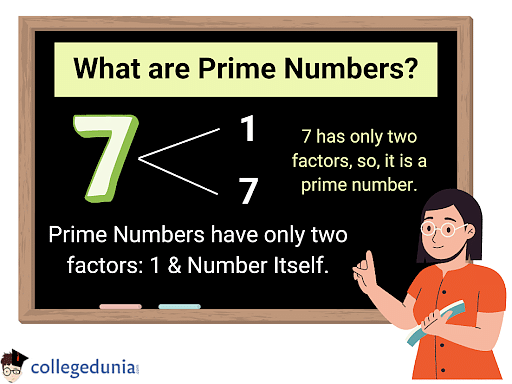
Prime Numbers
Read More:
List of Prime Numbers from 1 to 1000
[Click Here for Sample Questions]
There are 168 prime numbers between 1 and 1000. The list of Prime Numbers From 1 to 1000 is as follows:
| Numbers | Number of Prime Numbers | List of Prime Numbers |
|---|---|---|
| 1 to 100 | 25 Prime Numbers | 2, 3, 5, 7, 11, 13, 17, 19, 23, 29, 31, 37, 41, 43, 47, 53, 59, 61, 67,71, 73, 79, 83, 89, 97 |
| 101 to 200 | 21 Prime Numbers | 101, 103, 107, 109, 113, 127, 131, 137, 139, 149, 149, 151, 157, 163, 167, 173, 173, 179, 181, 191, 193, 197, 199 |
| 201 to 300 | 16 Prime Numbers | 211, 223, 227, 229, 233, 239, 241, 251, 257, 263, 269, 271, 277, 281, 283, 293 |
| 301 to 400 | 16 Prime Numbers | 307, 311, 313, 317, 331, 337, 347, 349, 353, 359, 367, 373, 379, 383, 389, 397 |
| 401 to 500 | 17 Prime Numbers | 401, 409, 419, 421, 431, 433, 439, 443, 449, 457, 461, 463, 467, 479, 487, 491, 499 |
| 501 to 600 | 14 Prime Numbers | 503, 509, 521, 523, 541, 547, 557, 563, 569, 571, 577, 587, 593, 599 |
| 601 to 700 | 16 Prime Numbers | 601, 607, 613, 617, 619, 631, 641, 643, 647, 653, 659, 661, 673, 677, 683, 691 |
| 701 to 800 | 14 Prime Numbers | 701, 709, 719, 727, 733, 739, 743, 751, 757, 761, 769, 773, 787, 797 |
| 801 to 900 | 15 Prime Numbers | 809, 811, 821, 823, 827, 829, 839, 853, 857, 859, 863, 877, 881, 883, 887 |
| 901 to 1000 | 14 Prime Numbers | 907, 911, 919, 929, 937, 941, 947, 953, 967, 971, 977, 983, 991, 997 |
How to Find Prime Numbers from 1 to 1000?
[Click Here for Sample Questions]
Prime Numbers have only two factors- 1 or the number itself. To find prime numbers from 1 to 1000, we need to cross-check the numbers that come in the maths table of 1 and the number itself.
For instance:
- 67 = 1 x 67 (Only Two Factors- 1 and 67)
- 911 = 1 x 911 (Only Two Factors- 1 and 911)
- 401 = 1 x 401 (Only Two Factors- 1 and 401)
In this manner, we can check whether a given number is prime or not.
Properties of Prime Numbers
[Click Here for Sample Questions]
The important properties of prime numbers are as follows:
- 2 is the only even prime number among all other prime numbers.
- All even numbers greater than 2 are the result of the product of two or more prime numbers.
- Two prime numbers are always co-prime numbers.
Solved Examples on Prime Numbers 1 to 1000
[Click Here for Sample Questions]
Example 1: Is 437 a prime number?
Solution: To check whether 437 is a prime number, we need to find its factors.
- 437 ÷ 23 = 19
- 437 ÷19 = 23
Thus, the factors of 437 are 1, 19, 23, and 437. Therefore, 437 is not a prime number since it has more than two factors.
Example 2: Check whether 223 is a prime number or not.
Solution: On the prime factorization of 223, we get
1 x 223 = 223
Thus, there are no other factors of 223 apart from 1 and 223. Hence, 223 is a prime number.
Check More:
Difference between Prime Numbers and Composite Numbers
Prime Numbers and Composite Numbers are the two types of numbers based on factors. The difference between Prime Numbers and Composite Numbers is as follows:
| Prime Numbers | Composite Numbers |
|---|---|
| Prime numbers have only two factors which are 1 and the number itself. | Composite Numbers have more than two factors. |
| Prime Numbers can only be written as a product of only two numbers. | Composite Numbers can be written as the product of two or more numbers. |
| 227 is a prime number because it is only divided by 1 and the number itself, which is 227. | 12 is a composite number because it is divisible by 1,2, 3, 4, 6, and 12. |
| Examples of Prime numbers are 2, 3, 5, 7, 11, 13, 17, 19, 23, etc. | Examples of composite numbers are 4, 6, 8, 10, 12, 14, 15, 16, 18, 20, etc. |
Read More: Difference Between Whole Numbers and Natural Numbers
Things to Remember
- Prime Numbers are numbers that are divisible only by 1 and the number itself.
- There are a total of 168 prime numbers from 1 to 1000.
- Prime numbers can be calculated using the method of prime factorization.
- 2 is the smallest and the only even prime number.
- All prime numbers except 2 are odd numbers.
- Numbers with more than two factors are called composite numbers.
- The number 1 is neither prime nor composite.
Sample Questions
Ques. Name the largest and smallest prime number between 1 to 1000. (2 Marks)
Ans. The largest and smallest prime number between 1 to 1000 are
- Largest Prime Number from 1 to 1000: 997
- Smallest Prime Number from 1 to 1000: 2
Ques. How to find out Prime Numbers from 1 to 1000? (2 Marks)
Ans. Prime Numbers from 1 to 100 can easily be identified by finding the factors of a number. If a number has only two factors, 1 and the number itself, then it is a prime number else not. If there are more than two factors of a number, then it is a composite number.
Ques. What are Prime numbers between 201 to 300? (2 Marks)
Ans. There are 16 prime numbers between 201 and 300. 211, 223, 227, 229, 233, 239, 241, 251, 257, 263, 269, 271, 277, 281, 283, and 293 are prime numbers between 201 to 300.
Ques. What are co-prime numbers? (2 Marks)
Ans. The numbers that have no common factor other than 1 are called coprime numbers. A set of two pairs of numbers is called co-prime when they have the highest common factor as 1.
For example, 15 and 8 are coprime numbers as
- 15 has 4 factors which are 1, 3, 5, and 15.
- 8 has 4 factors which are 1, 2, 4, and 8.
Since their common factor will be 1, thus, 15 and 8 are co-prime numbers.
Ques. Find out if 863 is a prime number or not. (1 Mark)
Ans. There are only two factors of 863 which are 1 and 863 itself. Thus, it is a prime number.
Ques. Find out if 224 is a prime number or not. (2 Marks)
Ans. The number 224 has a total of 12 factors which means the number comes in multiples of 12 numbers which are 1,2, 4, 7, 8, 14, 16, 28, 32, 56, 112, and 224.
Since it has more than 2 factors, 224 is not a prime number but a composite number.
Ques. What are Composite Numbers? (2 Marks)
Ans. Natural numbers that have more than two factors are called composite numbers.
For example, 8 is a composite number as
- 1 x 8 = 8
- 2 x 4 = 8
The factors of 8 are 1, 2, 4, and 8. It means that it has more than two factors which makes it a composite number.
Ques. Why is 827 a prime number? (2 Marks)
Ans. When we factorize 827, we get only two factors which are 1 and 827. According to the definition of prime numbers, the numbers with two factors are prime numbers. Hence 827 is a prime number.
Ques. Why is 15 not a prime number? (2 Marks)
Ans. The factors of 15 are
- 1 x 15 = 15
- 3 x 5 = 15
Thus, 15 has more than two factors which are 1,3, 5, and 15. Since it has more than four factors, 15 is not a prime number. It's a composite number.
Ques. Do we consider 0 as a prime number? (1 Mark)
Ans. No zero will not be considered a prime number because any prime number must be greater than 1. Since zero is less than 1, so, it is not a prime number.
Ques. How to find prime numbers? (2 Marks)
Ans. If a number is not divisible by more than 2 numbers, then, it's a prime number. For example, 3 is divisible by only two numbers which are 1 and 3. Therefore, 3 is a prime number.
Check-Out:



Comments