



Content Curator
Relation between calorie and joule is proportionate. Joule and Calorie are units of energy. The equivalent value in joule will change if any change in calories. The relation between calories and joule can be stated as
1 Calorie = 4.2 Joule
Key Terms: Joule, Calorie, Work and Energy, Thermal Equilibrium, SI Unit, Units of Heat, Energy, Heat, Mechanical Energy, Chemical Energy
Heat Energy
[Click Here for Sample Questions]
Heat is a form of energy that is produced by doing any kind of work. Like when we rub our palms, then our palms warm up due to mechanical energy produced due to rubbing. When the current is passed in the metallic wire, heat is produced from electric energy, and while burning coal, heat is produced from chemical energy.
Each body is made up of tiny particles called atoms, molecules, or ions. These tiny particles are in random motion and each particle exerts a force of attraction on other molecules. The molecules possess energy and the heat energy of a body is the internal energy of its molecules. Therefore they transfer energy among each other and produce heat.
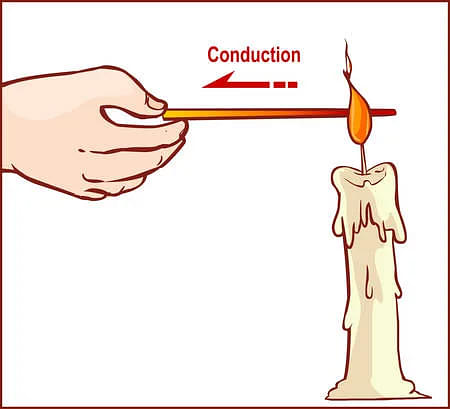
Heat Conduction
Also Check: Difference Between Work and Energy
Units of Heat
[Click Here for Sample Questions]
The SI unit of heat is the same as that of energy i.e, Joules. It is abbreviated as (J). The other units are calories and Kilocalories.
Joule
Joule is the unit of energy. Kilojoule is the unit of energy = 1000 joules
- Joule is a unit of work or energy in the SI unit.
- It is defined as the work done at a distance of 1 meter, by a force of 1 newton.
- In electrical terms, Joules is defined as the energy released by a current of one ampere in one second when the resistance of one ohm is provided.
1 Joules = 107 ergs
1 Joules = 1 Watt-second
Calorie
A calorie is a unit of measurement. Calorie or kilocalorie is the unit of energy = 1000 calories.
- It is the CGS unit of energy or heat.
- The amount of energy or heat required for raising the temperature of 1 gram of water to 1° Celsius at a pressure of 1 standard atmosphere is called a calorie.
Read More:
| Chapter Related Topics | ||
|---|---|---|
| What is the Unit of Energy? | Difference Between Force and Pressure | Latent Heat of Water |
Relation Between Calorie And Joule
[Click Here for Sample Questions]
Calorie is defined in terms of joules. One calorie equals 4.2 joules. At different temperatures, heat differs and therefore it becomes necessary to define a specific temperature at which the heat of the water can be considered as 1 calorie. And 15 calories is the amount of heat required to raise the temperature of 1g of water which equals 4.1855 joules.
1 Calorie = Approximately 4.2 Joules
Joules and Calories are directly proportional to one another. If there is any change in calories then there will also be a change in the value in Joules. When the value in calories increases, then the corresponding value in joules also increases at the rate of 4.2 and vice versa.
Conversion of Calories to Joules
Conversion of Calories to Joules has been listed below:
| Calorie | Joules |
|---|---|
| 1 | 4.2 |
| 20 | 84 |
| 30 | 126 |
| 40 | 168 |
| 50 | 210 |
| 100 | 420 |
| 500 | 2,100 |
| 1,000 or 1kcal | 4,200 |
| 5,000 or 5kcal | 21,000 |
| 10,000 or 10kcal | 42,000 |
Conversion from Joules to Calories
Conversion of Joules to Calories has been listed below:
| Joules | Calories |
|---|---|
| 1 | 0.239006 |
| 20 | 4.78012 |
| 30 | 7.17018 |
| 40 | 9.56024 |
| 50 | 11.9503 |
Things to Remember
- Heat is a form of energy, entry or exit which in a body increases the temperature of the body.
- Heat is a scalar quantity and is measured in Joule and Calories.
- 1 Calorie equals 4.2 Joules.
- 1000 calories make 1 Kilocalorie and equals 4200 Joules.
- 15 Calories or 4.1855 Joules of heat is required to raise the temperature of 1g of water.
Sample Questions
Ques. A single serving of bread provides an energy of 70.0 Cal. What is the energy content in Joules? (1 Mark)
Ans. Since 1 Cal = 4.2 Joules
70 Cal = 4.270 = 294 Joules.
Ques. What is meant by 1-joule energy? (2 Marks)
Ans. Joules is the SI unit of heat and energy. It is defined as a measure of capacity to do work. 1 Joule energy is equal to the work done by 1 Newton force acting over a body displacing it by 1 m.
Ques. State the difference between Calories and Joules. (1 Mark)
Ans. Joules and Calories are units of energy but they differ because they represent two different quantities. Joule is the SI unit of heat, whereas Calorie is the CGS unit.
Ques. Convert 1 Calorie into Joules. (1 Mark)
Ans. 1 calorie means 4.2 joule
Hence; 1 Calorie equals 4.2 Joules.
Ques. Convert 16,736 joules to calories? (2 Marks)
Ans. Since 4.2 Joules = 1 cal
So, 16,736 joules = 16,736/ 4.2
= 0.3786 Cal.
Ques. What is the SI unit of work and energy? (1 Mark)
Ans. Joule is the SI unit of work and calories are for energy.
Ques. Write down the difference between calories and joules. (2 Marks)
Ans. The major difference between joule and calorie is
1 Calorie = 4.186 J
1 Kcal = 4186 J = 4.186 KJ
Ques. Is there a relation between joule and calorie? (1 Mark)
Ans. The relation between joule and calorie can be stated as:
1 cal = 4.18 J
Ques. What is called heat as energy? (1 Mark)
Ans. Tiny particles in solids, liquids, and gasses are always in motion. It is the motion of particles that creates a form of energy called thermal (heat) energy that is present in all matter.
Ques. State the relation between calories and joule. (1 Mark)
Ans. The Relation between calories and joule is proportionate. Joule and calories are units of energy. This mentions that the equivalent value in joule will change if there is any change in calories.
Check-Out:



Comments