



Education Journalist | Study Abroad Lead
The principle of conservation of mechanical energy is that energy can neither be created nor be destroyed but it can only be transformed from one form to the other. Mechanical energy refers to the sum of potential energy and kinetic energy in an object that is used to do a particular work. The principle of conservation of mechanical energy states that if an isolated subject in a system is subjected to conservative forces only, then the mechanical energy remains constant.
| Table of Contents |
Key Terms: Mechanical Energy, Principle of Conservation of Mechanical Energy, Potential Energy, Kinetic Energy, Mechanical Energy
What is Mechanical Energy?
[Click Here for Sample Questions]
Mechanical Energy is the sum of kinetic and potential energy in an object employed to perform a specific task. To put it another way, it explains an object's energy because of its motion, position, or both.
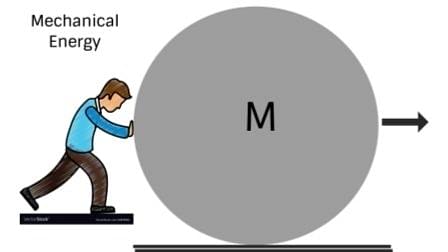
Mechanical Energy
In the case of a perfect simple frictionless pendulum. The mechanical energy of this system is a mix of its kinetic and gravitational potential energy. A continual interchange of kinetic energy and potential energy occurs as the pendulum swings back and forth.
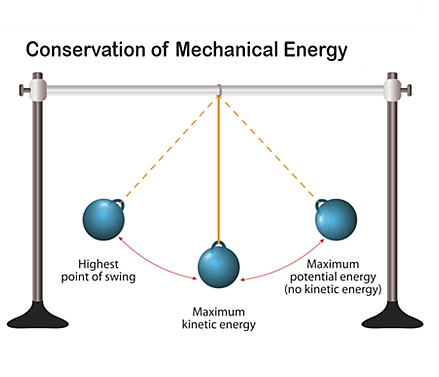
Conservation of Mechanical Energy
- The potential energy of the system is highest when the bob reaches its maximum height, whereas the kinetic energy is zero.
- The kinetic energy is the largest at the mean position, whereas the potential energy is zero.
- The system has both kinetic and potential energy, the sum of which is constant, between these two extremes.
Read More:
| Topics Related to Conservation of Mechanical energy | ||
|---|---|---|
| Mechanical Advantage Formula | Work and Energy | Energy and Classification Of Energy |
| Potential Energy Formula | Kinetic and potential energy difference | Work formula |
Conservation of Mechanical Energy
[Click Here for Previous Year Questions]
The core principle of the conservation of mechanical energy lies in the fact that the entire mechanical energy of a system is conserved. This means energy cannot be created or destroyed. It can only be internally transformed from one form to another if the forces working on the system are conservative.
Let us consider an example of the one-dimensional motion of a system to better comprehend this assertion. If a body is displaced by Δx under the influence of a conservative force F, we can deduct from the work-energy theorem that the network created by all the forces operating on the system is equal to the change in the system's kinetic energy.
ΔK.E = F(x)Δx
Where,
ΔK → System's change in kinetic energy.
Wnet = Wc if only conservative forces are acting on the system.
As a result,
WC = ΔKE
Furthermore, when conservative forces perform work in a system, the system loses potential energy equivalent to the work performed.
As a result, WC = – PE
This means that if the process solely comprises conservative forces, the total kinetic and potential energy of the system remains constant.
KE + PE = constant
KEi+ PEi = KEf+ PEf
Where,
i → Starting values of KE and PE
f → Final values of KE and PE
This law applies only to the extent that the forces are conservative in nature. Each force in a system with only conservative forces relates to a type of potential energy, and the energy only varies between kinetic energy and other types of potential energy, keeping the total energy constant.
Read More: Types of Generators
Example of Total Mechanical Energy of the System
[Click Here for Sample Questions]
Assume a ball of mass m is thrown from a height H cliff, as depicted above.
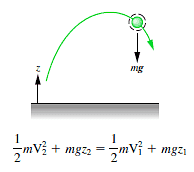
Total Mechanical Energy of the System
At H (height): PE (potential energy) = m x g x H
K.E. (kinetic energy) = 0
mgH = total mechanical energy
At h (height h): PE (potential energy) = m x g x h
Kinetic energy (K.E.) =1/2(mv²)
The velocity v1 at a height h for an object of mass m falling from a height H may be represented as Conservation of Mechanical Energy using the equations of motion.
V1 = \(\sqrt{2g(H - h)}\)
As a result, the kinetic energy can be expressed as,
\({1\over2}(m\sqrt{2g(H - h)})^2 = mgH - mgh\)
Total mechanical energy = (mgH – mgh) - mgh = mgH
At ground level: Energy (potential): 0
KE (kinetic energy): 1/2(mv²)
We can show that the velocity v near the bottom of the cliff, just before striking the ground, is Conservation of Mechanical Energy using the equations of motion.
V = \(\sqrt{2gH}\)
As a result, the kinetic energy can be expressed as,
Kinetic Energy (KE) = ½ m \(\sqrt{2gH}\)2 = mgH
We saw that the system's total mechanical energy remains constant throughout.
Read More :
Things to Remember
- The sum of kinetic and potential energy in an object employed to perform a specific task is known as mechanical energy.
- Conservation of mechanical energy happens in a system.
- Energy can neither be created nor destroyed. But it can only be transformed from one form to the other.
- The whole kinetic energy + the total potential energy equals the mechanical energy of the system.
- Each force in a system with only conservative forces relates to a type of potential energy, and the energy only varies between kinetic energy and other types of potential energy, keeping the total energy constant.
Sample Questions
Ques. What does the principle of mechanical energy conservation imply? (2 marks)
Ans. Energy conservation can be used inside minor system boundaries as well as within equipment units. Mechanical energy has no single source outside of the universe's primary energy sources, such as gravity, electricity, magnetism, and pressure. Because mechanical energy is rapidly dissipated into heat, it is not a permanent entity that can be conserved indefinitely (another form of Kinetic Energy). As a result, 'Mechanical Energy' must be recognized as a system entity that must be preserved but not conserved.
Ques. Is it possible to conserve mechanical energy? (2 marks)
Ans. If all the forces acting on the system are conservative forces, the mechanical energy of the system (potential and kinetic energy) will be conserved (affect the system in a very stable manner regardless of the path of travel). Friction, on the other hand, is not a conservative force and can cause part of the kinetic energy to be converted into heat. So, if you had a pendulum swinging through the air, converting potential energy to kinetic energy and back, you'd notice that the potential energy (height) that the pendulum swings are decreasing with each swing, and if you could measure velocity (kinetic energy), it would be decreasing as well, because friction converts some of the mechanical energy to heat.
Ques. What are three examples of mechanical energy saving that you can find at home? (2 marks)
Ans. Water tap- Potential energy in water is converted to kinetic energy.
Refrigerator- The rotational energy of the compressor compresses the refrigerant, resulting in cooling inside the refrigerator.
Fan-The rotational energy of the fan is transformed into kinetic energy, which causes air to move.
Ques. When frictional forces are present, why does the theory of mechanical energy conservation fail? (2 marks)
Ans. Conservative forces try to keep the total amount of energy in the system as low as possible. Because gravity is a conservative force, and the path has no effect on the changes in kinetic/potential energy, you can transport something up and down on a roller coaster and the total energy stays constant, ignoring friction. When it comes to friction, it's a non-conservative force whose work is often path dependent. As a result, the amount of work done by the friction force, which acts to prevent slippage, is subtracted from the total energy seen.
Ques. In projectile motion, is mechanical energy conserved? (2 marks)
Ans. If we mean mechanical energy as the energy generated by its motion, then it isn't conserved. This is due to a force acting on the vertical component of velocity (gravity). As a result, at the highest point in its route, the horizontal component is the only source of kinetic energy. As a result, no net kinetic energy is conserved. However, the overall energy is clearly preserved.
Ques. Let's start by drawing a circle on the whiteboard. The chalk decreases in size. Is the work W=0 (because I returned to the same location)? Is the law of energy conservation (including mechanical energy conservation) followed? (2 marks)
Ans. There is no conservation of mechanical energy. There are non-conservative factors at work (e.g., friction). Friction force and inversely proportional to relative motion. Because that direction changes so that it continually opposes the relative motion, it always drains energy from the mechanical system, hence there is no mechanical energy conservation. Overall energy is conserved, as it usually is, but energy has been converted to heat and other forms that are difficult to quantify.
Ques. Are there ever any non-conservative forces that cause the Earth's mechanical energy to drop in its orbit around the Sun? (2 marks)
Ans. Yes, but only a tiny bit. Gravitational waves are emitted by the Earth, which disperse energy. However, the energy content of these waves is so small that they are impossible to detect. When the sun becomes a red giant in 4 billion years, the earth will still be orbiting it. Collisions with space junk lose a small amount of energy, and cosmic radiation may be lost if you want to be very arcane. However, the amplitude of these forces is zero in the first order approximation (and possibly in the second and third).
Ques. When an electric motor runs without a load, how does the rule of conservation of energy apply? In a motor, electrical energy is converted to mechanical energy, but what happens after this? (2 marks)
Ans. Energy supplied to mechanical load connected to shaft+energy lost due to Bearing Friction+energy lost due to Windage+energy lost due to Iron Losses) = total electrical energy drawn by my motor. Because the motor is not under load, the electrical energy it draws is only needed to overcome friction, iron losses, and windage.
Ques. When a ball is tossed, how is mechanical energy preserved? (2 marks)
Ans. If the Earth is included in the system with the ball, the change in the ball's height above the Earth corresponds to a change in the system's gravitational potential energy. The energy of the system fluctuates between kinetic and gravitational potential energy as the ball moves freely in the gravitational field, while the total mechanical energy remains constant.
The ball has kinetic energy when thrown up and let's assume, zero gravitational potential energy at the height flung. The kinetic energy of the ball drops as it rises, while the gravitational potential energy rises at the same time, and vice versa on the way down. The overall mechanical energy is unaffected.
Ques. Is the sum of thermal and mechanical energy conserved in a control volume? (2 marks)
Ans. The complete amount of energy is preserved. This can be confined to "thermal energy" and "mechanical energy" for simple thermodynamic systems, but there are more energy terminologies that can be used.
If antimatter is present in the enclosed volume, mass must be included in the energy terms. Internal energy is also present in some systems as a result of interactions between atoms and molecules.
Do Check Out:



Comments