



Education Journalist | Study Abroad Lead
Silver is a chemical element that is represented by the symbol Ag. It is lustrous white in appearance and is a good conductor of electricity. Silver can be found in the periodic table between Copper of Period 4 and Gold of Period 6. It is located in the eleventh group and fifth period of the periodic table. Therefore, its physical and chemical properties are intermediate of both of these elements. Silver is abundantly available in soils that are minerally rich. It has the highest conductivity of heat and electricity out of all the metals. In this article, we will learn more about silver by exploring its elemental, physical and chemical properties.
| Table of Content |
Keyterms: Silver, Element, Electricity, Periodic table, Copper, Gold, Metal, Soil
Read more: Periodic Classification of Elements Important Question
What is Silver?
[Click Here for Sample Questions]
Silver is a chemical element. Its symbol is 'Ag' and its Atomic Number is 47. It is a soft and white metal. Moreover, Silver is a lustrous transition metal. Silver has the highest electrical conductivity as compared to other metals. It also has the highest thermal conductivity and reflectivity of any metal.
- Silver metal is found in the earth's crust in its pure, free elemental form.
- It is an alloy with gold and other metals and minerals such as chlorargyrite and argentite.
- Most of the silver is produced as a by-product of the refining of copper, lead, gold, and zinc.
- Silver lies between copper (Period 4) and gold (Period 6) in group 11 and Period 5 of the periodic table.
- Its physical and chemical properties are intermediate between these two metals.
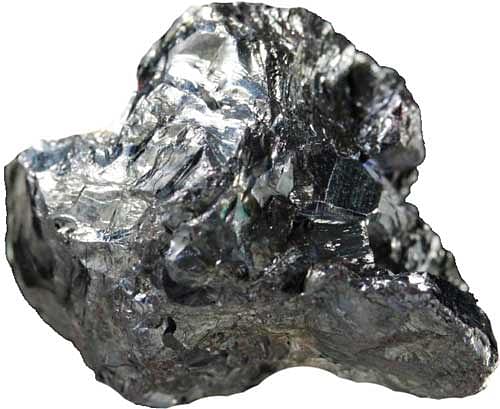
Silver Element
Facts about Silver
[Click Here for Sample Questions]
Some of the important characteristics of silver element is summarized in the table below:
| Symbol | Ag |
| Group | 11 |
| Period | 5 |
| Block | D Block |
| Atomic Number | 47 |
| State at 20oC | Solid |
| Atomic Mass | 107.8682 g/mol |
| Density | 10.49 g/cm3 |
| Crystal Structure | Face-centered cubic (fcc) |
| Melting Point | 1763.2°F, 961.78°C, 1234.93 K |
| Boiling Point | 3924°F, 2162°C, 2435 K |
| Key Isotopes | 107Ag, 109Ag |
| Electronic Configuration | [Kr]4d105s1 |
| CAS Number | 7440-22-4 |
Read more: Difference between Electrolytic and Galvanic Cells
Elemental Properties of Silver
[Click Here for Sample Questions]
- The Atomic No. of silver is 47.
- The atomic mass of silver is 107.8682 g/mol.
- Its melting point is 961.78°C (1763.2°F).
- The boiling point of Silver is 2162°C (3924°F).
- Silver has a specific gravity, approximately 10.5 (20°C/68°F).
- The oxidation states of silver are +1, + 2, +3.
- Its heat of vaporization is 254 kJ/mol.
- The Natural occurrence of silver is primordial.

Silver Element
Physical Properties of Silver
[Click Here for Sample Questions]
- Silver (Ag) is a white, soft, shiny, very ductile, and malleable metal. It is a good conductor of heat and electricity as compared to other metals.
- Silver crystallizes in an fcc (face-centered cubic) lattice with the mass coordination number 12.
- Silver has the lowest contact resistance of all metals.
- Silver is also a very popular metal. It is a rare metal like gold and has great value, and is also traded in similar markets.
- Silver is also a base metal which is used to make jewelry due to its rarity and malevolence.
- Silver has also been used in dentistry for some time, although it had to be mixed with mercury because it is not malleable like gold.
- Silver is used for galvanizing. It is also used in the production of batteries and as a catalyst.
- It has the highest electrical conductivity of all metals, but its high cost has prevented us from using it in all electrical devices.
Also Read:
Chemical Properties of Silver
[Click Here for Sample Questions]
- Silver is a highly inactive metal. It does not react with oxygen in the air under normal conditions.
- However, silver reacts slowly with sulfur compounds in the air. The product of this reaction is Ag2S (Silver Sulfide), a black compound.
- The oxidation that forms across time on silverware and another silver object is silver sulfide.
- Silver does not react easily with acids, water, or any other compounds. It does not burn, if not like the silver powder.
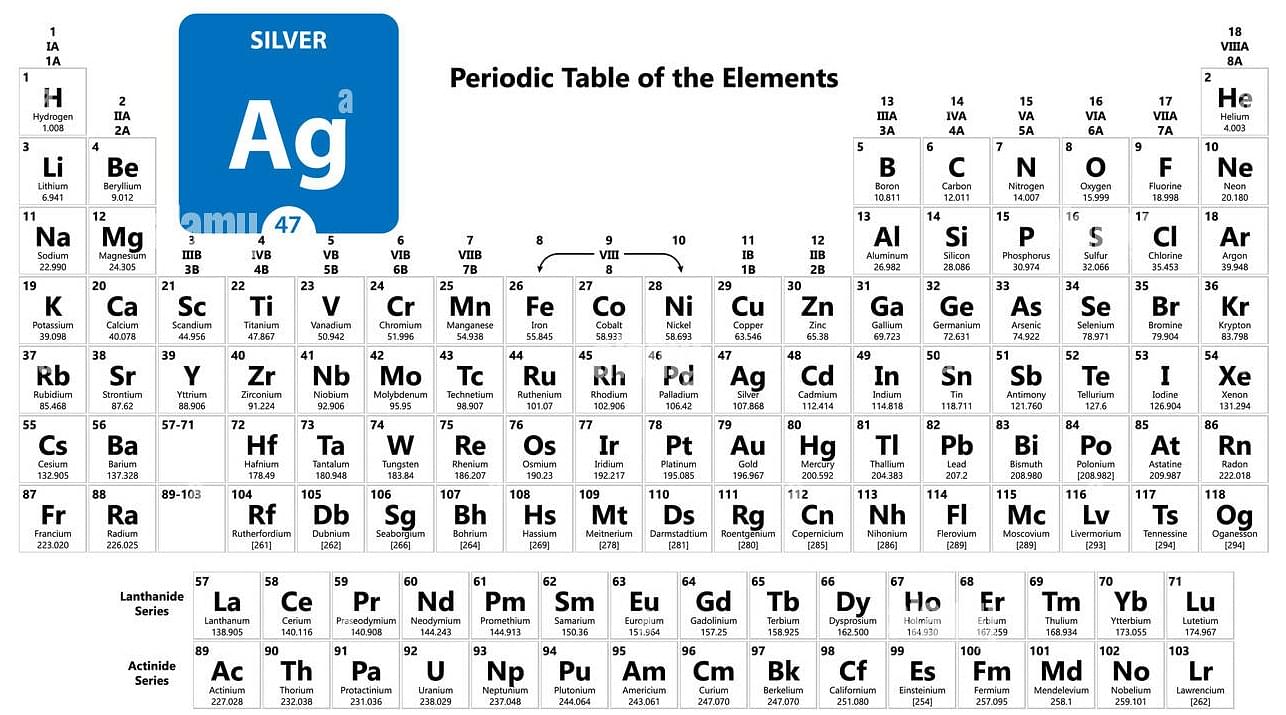
Silver Element in the Periodic Table
Preparation of silver
[Click Here for Sample Questions]
Silver can be prepared by extraction through the cyanide process. Let us understand about the process in more detail:
Extraction of silver by the cyanide process
- Silver is also found in the combined and free states. The most important silver-ore minerals are argentite (Ag2S), copper-look silver, ruby silver, horn silver. Silver ores are found next to gold ores.
- Rock Argentite (Ag2S) extracts from gold. The gold mining process is called the cyanide process because a sodium cyanide solution is used. The ore is compressed, crushed. After that, it is treated with a solution of sodium cyanide. This reaction forms sodium cyanide Silver.
- The solution of silver cyanide and sodium combines with the zinc powder. It forms tetrasodium cyanozicate and precipitated silver. Precipitated silver is called spongy silver.
- To get pure silver, spongy silver melts with potassium nitrate. The silver obtained is then extracted by an electrolytic process.

Extraction of silver by cyanide process
Applications of Silver
[Click Here for Sample Questions]
Silver can be used for a variety of applications like:
As an Element
- Silver has been used for thousands of years by people in the world, for jewelry, money, and more.
- Even though it looks black, it is known as white metal. Besides, the term silver is used to refer to this color or shade of gray.
- Silver is also used in tools. In dentistry, it can be used as an amalgam to fill teeth. Silver acts as a catalyst.
Medicine
- Silver is incorporated into dressings in medicine. It is also used in medical devices as an antibiotic coating.
- External infections are treated with dressings containing silver sulfadiazine or silver nanomaterials.
- Silver is also used in some medical applications which include endotracheal tubes and urinary catheters.
Electronics
- Silver is very important for conductors and electrodes in electronics because of its high electrical conductivity even when oxidized.
- Bulk silver and silver foil was used to make vacuum tubes.
- It is used today in the production of semiconductor devices, circuits, and their components.
Brazing alloy
- Silver is used for brushing metallic materials, in particular cobalt, nickel, and copper-based alloys, tool steels, and precious metals.
- The basic components are silver and copper with other elements selected depending on the specific application.
- Examples include tin, zinc, palladium, cadmium, manganese, and phosphorus.
- Silver offers greater workability and greater resistance to corrosion during use.
Catalysis
- Silver is a good catalyst for oxidation reactions.
- Divided silver tends to cause complete oxidation of organic compounds to carbon dioxide and water. Thus, it is preferred to use coarser-grained silver.
Photograph
- The photosensitivity of silver halides has allowed their use in traditional photography.
- Although digital photography is now dominant, it does not use silver.
Jewelry and silverware
- The primary use of silver throughout most of history has been in the manufacture of jewelry.
Chemical Equipment
- Silver is useful in the production of chemical equipment.
- Because of its low chemical reactivity, high thermal conductivity, and ease of machining.
- Silver crucibles are used to perform alkaline melting.
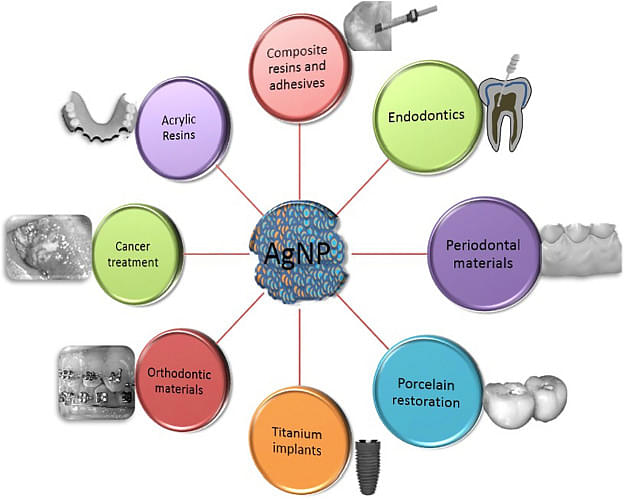
Applications of Silver
Things to Remember
- Silver is a chemical element. Its symbol is 'Ag' and its Atomic Number is 47.
- The atomic mass of silver is 107.8682 g/mol.
- Silver (Ag) is a white, soft, shiny, very ductile, and malleable metal. It is a good conductor of heat and electricity as compared to other metals.
- The oxidation that forms across time on silverware and another silver object is silver sulfide.
- Silver lies between copper (Period 4) and gold (Period 6) in group 11 and Period 5 of the periodic table.
- Silver is also a very popular metal. It is a rare metal like gold and has great value, and is also traded in similar markets.
Also Read:
Sample Questions
Ques. What is Ag? (1 mark)
Ans. The symbol of silver is Ag. It is derived from the Latin Argentum meaning "white" or "shiny" and its atomic number is 47.
Ques. What are the three interesting facts about silver? (3 marks)
Ans. Some interesting facts about silver are as follows:
- Silver is a very ductile and malleable metal.
- It is a very transparent and smooth, white and shiny metal.
- Silver has all the elements with the highest electrical conductivity. The electrical conductivity is much higher than that of copper.
Ques. Is silver antibacterial? (2 marks)
Ans. The antibacterial action of silver increases by the presence of an electric field. It is used as a topical antiseptic and incorporated into the bacteria that it kills. Dead bacteria can be the source of silver that could destroy other bacteria.
Ques. Does silver react with gold? (1 mark)
Ans. Gold and silver atoms react with each other to form strong metallic bonds. But, they have no chemical interaction with the atmosphere.
Ques. What is the harmful effect of silver? (2 marks)
Ans. In addition to Argyros and Argyria, exposure to soluble silver compounds may produce other toxic effects, including kidney and liver damage, irritation of the skin, eyes, intestinal and respiratory tract, and changes in blood cells. Metallic silver appears to pose a minimal health risk.
Ques. What is silver made of? (2 marks)
Ans. Silver is made from the sulfur compounds heated in the earth's crust. It was one of the top five metals which are discovered and used by humans. The other metals were gold, copper, iron, and lead. You will always find it in coins and jewelry for electrical conductors and antibiotics.
Ques. What happens in the decomposition reaction of Ag2CO3 (silver carbonate)? (3 marks)
Ans. Silver carbonate Ag2CO3 is a chemical compound. Silver carbonate is yellow, but standard samples are grayish due to the ubiquity of elemental silver. It is poorly soluble in water, similar to most transition metal carbonates.
We should understand the thermal decomposition of silver carbonate. Unlike other metal carbonates, which generally break down into metal oxides releasing carbon dioxide, silver carbonate on heating decomposes into elemental silver, releasing a mixture of carbon dioxide and gaseous oxygen.
Ag2CO3 → 2Ag + CO2 + 12O2
Ques. What are the industrial uses of silver? Explain it briefly. (5 marks)
Ans. Silver is the best thermal and electrical conductor. So, it is used in industrial manufacturing, including electrical utilization such as conductors, switches, fuses, and contacts.
In electronics, industrial silver is used in multilayer ceramic capacitors, the manufacture of membrane switches, electrically heated automobile windshields, silver foil, conductive adhesives, and the mixture of pastes of a thick film.
Silver is basically used in:
- Solar Panels- The use of silver in the manufacture of photovoltaic cells, more commonly known as solar panels or solar cells for solar power, is considered to be a rapidly growing area for use of silver.
- Automotive Industry: Basic functions of automotives such as starting the engine, opening the power windows, adjusting the power seats, and closing the power trunk are all activated via a silver membrane switch.
- Soldering and Brazing: The addition of silver to the welding or brazing process helps produce smooth, tight, corrosion-resistant joints when combining metal parts.
Ques. How is silver sulfide obtained by reaction with silver? (2 marks)
Ans. Silver reacts with sulfur or hydrogen sulfide to produce silver sulfide (Ag2S), a dark-colored compound known as tarnishing of silver coins and other objects.
4Ag + O2 + 2H2S → 2Ag2S + 2H2O
Ques. How to remove tarnish from silver? (3 marks)
Ans. Tarnish of silver can be extracted with commercial silver polishes. This method generally eliminates oxidation by abrasion. As a result, each time the oxidation or tarnish is removed, some of the silver is lost. Oxidation can also be removed chemically by reacting aluminum with tarnishing. Therefore, it reacts with tarnish to chemically change the tarnish back to silver. The reaction is as follows:
3Ag2S + 2Al → 6Ag + Al2S3
For Latest Updates on Upcoming Board Exams, Click Here: https://t.me/class_10_12_board_updates
Check-Out:



Comments