



Education Journalist | Study Abroad Lead
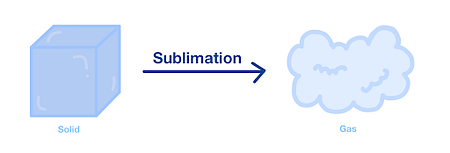
Sublimation refers to the transition from solid to the gaseous phase. It is the process of transferring a specific colorant to a substrate using heat. In this article, we will understand what sublimation is, its examples, and look at some methods for the purification of organic compounds.
| Table of Content |
Key Terms:Sublimation, Dye Sublimation, Desublimation, Applications of Sublimation
What is Sublimation?
[Click Here for Sample Questions]
If you fill the ice trays with water; place them in the freezer, the next day you will observe that the ice had formed cubes as it froze. If you drop those cubes on the floor, they will quickly turn into a puddle of ice. Freezing and melting are two common phase transitions or changes in the state of a substance from a solid to liquid, gas, plasma, or vice versa.
Sublimation
Sublimation is one such phase transition. Except that in sublimation, we have a solid that converts directly to gas. When a material sublimes from a solid to a gas, it never goes into a liquid state. Sublimation is just one way of how water or some other substance can switch between its potential phases.
For example, some sublimation compounds are iodine, ammonium chloride, naphthalene, camphor, etc.
Examples of Sublimation
[Click Here for Previous Year Questions]
- One of the best examples of sublimation is dry ice, a frozen form of carbon dioxide. Dry ice has a direct solid to gaseous phase transition when dry ice is exposed to air, it can be seen as fog. The gaseous state of frozen carbon dioxide is more stable than the solid-state.
- The organic compound naphthalene is also an example of sublimation. It is found in pesticides. The presence of polar molecules sublimates this organic compound, supported by intermolecular van Der Waals forces. It dehydrogenates at low temperatures and forms needle-like crystals.
- Sublimation is the transformation between the solid and gas state of a substance without an intermediate liquid phase. In the water cycle, sublimation is often used to describe how ice and snow turn into water vapor in the air but do not dissolve in water at first.
- Frozen burns are the result of the sublimation of ice into steam.
- At the right temperature, the elements iodine and arsenic change from a solid to a gaseous state
- Water ice sublimes, although more slowly than dry ice. The effect can be seen in snowy fields when the sun rises, but the temperature is low or cold.

Sublimation of Ice
Applications of Sublimation
[Click Here for Sample Questions]
- Naphthalene balls undergo sublimation to keep the moths and insects away.
- Camphor sublimes to release a pleasant fragrance.
- In the textile industry, sublimation is used for the T-shirt printing process.
- In the food industry, freeze-drying of food items for preservation for a longer duration is due to the process of sublimation.
- Dye sublimation printers are now widely used for the printing process.
Read More:
| Related Topics | ||
|---|---|---|
| Enthalpy Change | Applications of Thermodynamics | Heat Capacity |
| First Law of Thermodynamics | Standard Enthalpy of Formation | Phase Transition |
Purification of Organic Compounds
[Click Here for Previous Year Questions]
Organic compounds are obtained from natural resources. When they are obtained; they are in an unpurified form, therefore, various methods of purifying organic compounds are sublimation, crystallization, distillation, extraction, and chromatography.
The sublimation process is usually used to separate sublimated compounds from non-sublimation impurities. In this process, the organic compound with non-sublimation impurities is heated. After a certain period of time, the sublimation of the organic compound begins to evaporate, so it is precipitated in a conical flask. The volatile impurities stay at the bottom of the flask.
Dye Sublimation Transfer
[Click Here for Sample Questions]
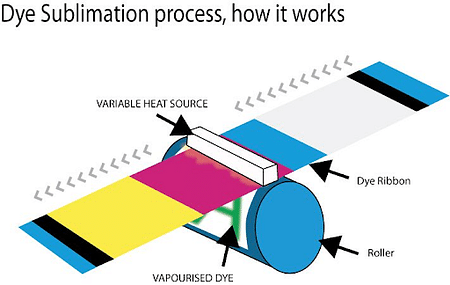
Dye sublimation transfer is the process of capturing an image that is created digitally by scanning, downloading from a digital camera, and created on the computer. Images can be printed on a printer using special ink that sublimates onto copy paper. When heated to a high temperature, the sublimation ink turns into gas.
The pores of the polymer-coated material open and allow gas to pass through. When removed from the heat, the pores of the polymer matrix close, holding the ink inside. The whole image will be smooth to the touch. Thus, it is a transfer process in which the image becomes part of the actual object. Sublimation requires specialty ink, paper, and resin-coated substrates. Thus, this is also known as sublimation printing.
Dye Sublimation Transfer
Read More:
| Relevant Articles | ||
|---|---|---|
| Spontaneity | Hess's Law of Constant Heat Summation | Entropy Change |
| Enthalpy | Enthalpy of Dilution | Heat Input Formula |
Things to Remember on Sublimation
- The term ‘sublimation’ refers to a change in the physical state, and not to the transformation of a solid into a gaseous state as a result of a chemical reaction.
- The reverse process of sublimation, in which a gas undergoes a phase transition to a solid, is known as precipitation or desublimation.
- When the candle wax is lit, the paraffin wax evaporates and reacts with oxygen to form carbon dioxide and water. This is not sublimation.
- The process is used in the purification of organic compounds.
- The efficiency of the process of sublimation depends on the vapor pressure of the solid that is to be cleaned, as well as the impurities that need to be removed.
- Evaporation is different from the sublimation process as there is no heat involved in the removal of the water.
Previous Year Questions
- If enthalpies of formation for C2H4(g)...[NEET 1995]
- A gas is allowed to expand in a well insulated container against a constant external pressure…..[NEET 2017]
- A reaction having equal energies of activation for forward and reverse reactions has [NEET 2013]
- A reaction occurs spontaneously if : [NEET 1995]
- Bond dissociation enthalpy of H2,Cl2, and HCl….[NEET 2008]
- Cell reaction is spontaneous when [NEET 2000]
- Consider the following liquid-vapour equilibrium….[NEET 2016]
- Consider the following processes…..[NEET 2011]
- During isothermal expansion of an ideal gas, its [NEET 1994]
- Enthalpy change for the reaction,….[NEET 2011]
- Transition state 2(TS2) is structurally most likely as:[UPSEE 2016]
- The enthalpy of the formation of CO2 and H2O are …...[UPSEE 2017]
- A process is spontaneous at a given temperature if…..[COMEDK UGET 2007]
- Which of the following is an intensive property? [COMEDK UGET 2009]
- A reaction is spontaneous at all temperatures when [COMEDK UGET 2009]
- An endothermic reaction is found to have….[COMEDK UGET 2015]
Sample Questions on Sublimation
Ques. How is sublimation different from evaporation? (1 mark)
Ans. During sublimation, the transition is from the solid phase to the gaseous phase, and during evaporation, the transition is from the liquid phase to the gaseous phase.
Ques. Is sublimation or heat transfer better? (2 marks)
Ans. If one’s business is primarily focused on white and light polyester clothing, sublimation is a great choice. The prints will be the lightest, strongest, and most washable. However, if one wants to print on any color or type of media, thermal transfer paper is best.
Ques. Where is sublimation used in nature? (2 marks)
Ans. Sublimation is the transition between the solid and gas phases of a substance without an intermediate liquid phase. Sublimation is often used to describe the process of snow and ice. Ice is converted to water vapor in the air without first being dissolved in water.
Ques. Is burning is an example of the Sublimation process? (2 marks)
Ans. Sublimation is a type of reaction in which a solid directly changes its state from a gaseous state, bypassing a liquid state. Hence, no burning is not a sublimation process.
Ques. How does sublimation printing work on T-shirts? (2 marks)
Ans. T-shirt dye sublimation is a special printing process that first prints on special paper and then transfers the image to another material (usually polyester or a polyester blend). The ink is heated to dissolve in the fabric.
Ques. Why is slow heating required for sublimation? (2 marks)
Ans. Although sublimation can take place at atmospheric pressure, the process is rather slow because the gas molecules in the ice must find their way through the atmospheric gases that bombard the surface of the ice. Water molecules leaving the ice surface are called "diffusion".
Ques. Give some practical applications of Sublimation? (3 marks)
Ans. Applications of Sublimations
- Sublimation and erosion cause abrasion, a process that breaks down glaciers.
- Freeze-dried iodine can be used to detect hidden fingerprints on paper.
- Sublimation is used to purify compounds and is especially useful for organic compounds.
- Since dry ice is easy to sublimate, this compound is used to create a foggy effect.
Do Check Out:



Comments