



Content Curator
Isochoric process in thermodynamics is defined as the process that takes place at constant volume (V). The science that studies the behavior of parameters like temperature, pressure, heat, work, and energy in a system at equilibrium is Thermodynamics. A system in thermodynamics can be defined by closed, isolated or open based on the nature of these parameters.
A closed system is one in which there is no exchange of matter between the system and surroundings, but heat exchange occurs. Isochoric process is thus an idealized interaction of a closed system. The isochoric process is also known as the isovolumetric process, isometric or constant-volume process. Adding or removing heat from a closed system causes the contents of the system to get isolated from the surroundings. The system can no longer undergo deformation causing a constant volume condition. This is also called a quasi-static process. For example, if we heat gas confined in a rigid cylinder, the volume of the gas will not change.
Read More: Thermodynamic Processes
| Table of Content |
Key Terms: Isochoric Process, Isochoric Process Formula, Thermodynamics, Ideal Gas Constant, Constant Volume, Internal Energy
Isochoric Process
[Click Here for Sample Questions]
Isochoric process describes the movement of the gas or molecules inside an object. Isochoric process gets its name from the greek word ‘iso’ meaning constant or equal and ‘choric’ meaning volume. Mathematically an Isochoric process can be represented as
Vf -Vi (ΔV=0, dv=0)
where,
Vf- final volume
Vi- initial volume
ΔV, dv – change in volume
From the First Law of thermodynamics, for a constant volume process, the work done W is zero. This is because the difference in the work dW = PdV is zero for a constant volume process.
This can be depicted easily by the area under the P-V curve which shows a Zero value. This means, no work is done.

P-V Graph for an Isochoric Process
Read More: Zeroth Law of Thermodynamics
Isochoric Process Formula
[Click Here for Sample Questions]
One of the most fundamental properties of the Isochoric process is that the volume in the matter remains unchanged or constant. So, this is unique because the systemic process remains paused during this process.
In the Isochoric Process △v=change of volume remains zero. That is
△v = 0 or △v=constant
This can be understood better as we learn about the ideal gas law.
Here, PV = nRT
P= Gas pressure
V= Volume,
n= gas amount
R= ideal constant gas
T= temperature.
- In the case of the Isochoric process, the volume is constant or unchanging.
- So, this formula continues as \(\frac{P}{T}\)= constant.
- Gay-Lussac, the popular French chemist came up with the idea of this ratio.
- A subpart of the ideal gas law is the Pressure Law.
- This related the pressure and temperature of ideal gases going through the Isochoric process in thermodynamics.
\(\frac{P_1}{T_1}= \frac{P_2}{T_2}\)
Here, P1 and T1are the beginning pressure and temperature respectively and P2 and T2 are the final values. The graph of the P-V diagram for the Isochoric process is shown as a vertical line. This is because the volume is constant and pressure increases.
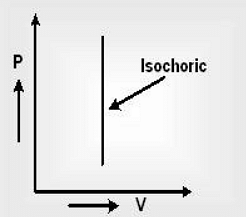
P-V Plot for Isochoric Process
Check Out:
First Law of Thermodynamics in Isochoric Process
[Click Here for Sample Questions]
First law of Thermodynamics concludes that energy cannot be created or destroyed. Energy can only be changed from one form to another. Hence, the heat transfers from one body to the other. But for Isochoric process, it becomes a constant-volume process. There is very little loss or gain of energy in the process.
△U=q+W.
Here, U is the change of internal energy in the matter,
q = heat transfer between the matter
W is work done
So, for an Isochoric process, the formula becomes d W = PdV
In the process dV = 0.
Now, when the First Law of Thermodynamics applies here, the formula can be written as
dU= dq+ dW.
For an isochoric process, this becomes
dU = dq + 0.
dU = dq.
So, here the volume is the only thing that remains unchanged. Every other variable changes.
△T ≠0.
Read More: Difference between Isothermal and Adiabatic Process
Work done by Gas in Isochoric Process
[Click Here for Sample Questions]
The Work done by any gas during the Isochoric process is always zero. According to the system in Thermodynamics, internal energy increases as heat is provided to a thermodynamic system. The remaining energy of heat transforms to work done by the Thermodynamic system.
Compression and expansion take place due to the heat energy. This happens due to the pressure caused by the heat in the Thermodynamic system. So, a volume change takes place.
The formula of work done in any Thermodynamic system is given by
∫P ×dV
But, in the Isochoric Process where Volume remains unchanged, there is no work done by the gas in the system.
V=Volume
P= pressure
dV= inexact differential or small change in volume
So, work done by any gas in the Isochoric system is 0.
∴∫P ×0=0
Read More: Enthalapy of Dilution
Examples of Isochoric Process
[Click Here for Sample Questions]
Some of the important example of Isochoric process are:
Otto Cycle
- This thermodynamic cycle is applicable in car engines.
- It depicts the transfer of heat during the ignition process.
- The first and the last process in the Otto cycle are the Isochoric processes.
- The heat and pressure change takes place without any change in the volume of gas.
- The mixture of gas used is gasoline and air.
- This is during the compression and power steps.
- This is an irreversible process.
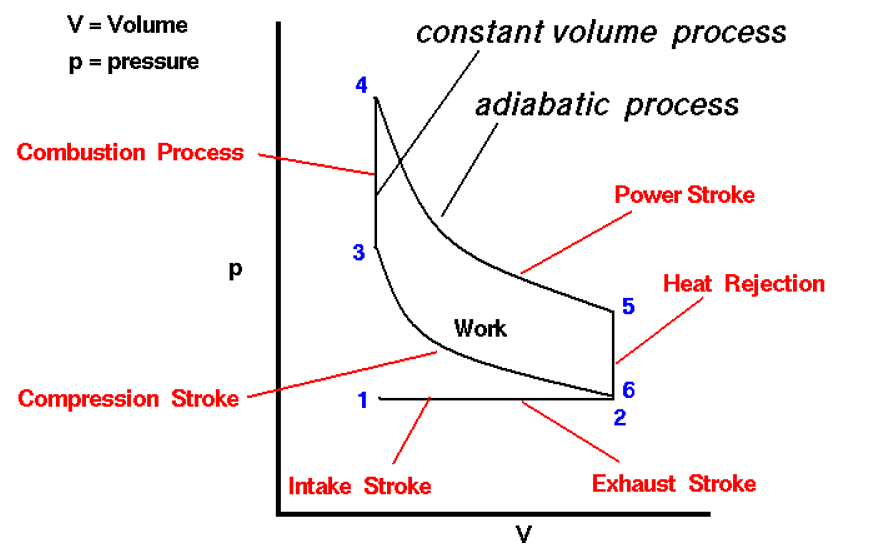
Ideal Otto Cycle
Ideal Gas Enclosed in a Closed Container
- When the heat is applied to the container, the volume cannot be altered.
- The internal energy either increases or decreases.
Solved ExamplesQues: Consider an ideal gas enclosed in a piston. Are the following situations examples of an isochoric process?
Soln:
Ques: A gas in a 10 L volume cylinder is subjected to a pressure of 1 atm. The gas experiences a rise in temperature from 34 0C to 60 0C in an isochoric process. If molar specific heat Cv= 2.5 x R where R = 8.31 J/mol K. Calculate the change in Internal energy. Soln: We know that Qv= nCv ΔT Using the ideal gas equation PV=nRT n= PV/RT substitution for temperature, pressure and Volume we get, n= 0.39 moles Therefor, ΔU= Qv= nCv ΔT = 0.39 x 2.5x 8.31x 26 = 210.65 J |
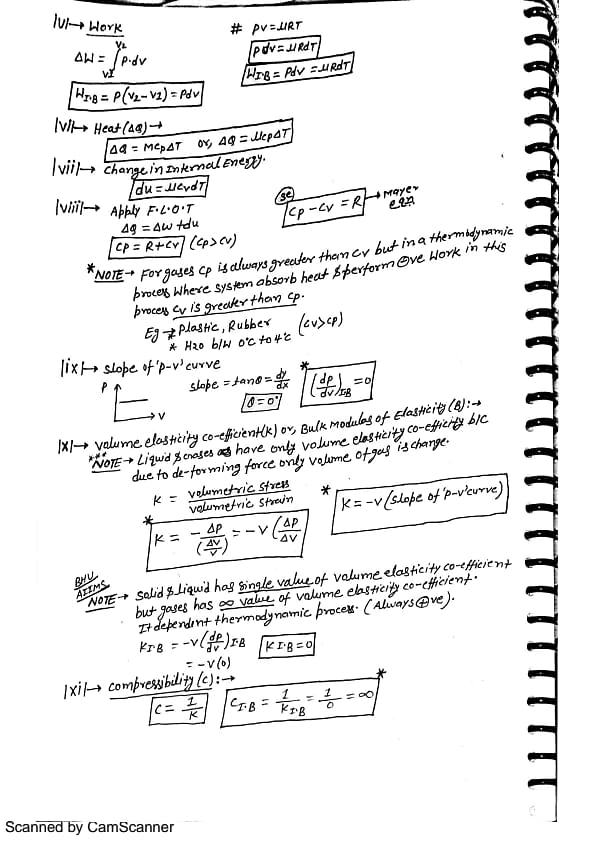
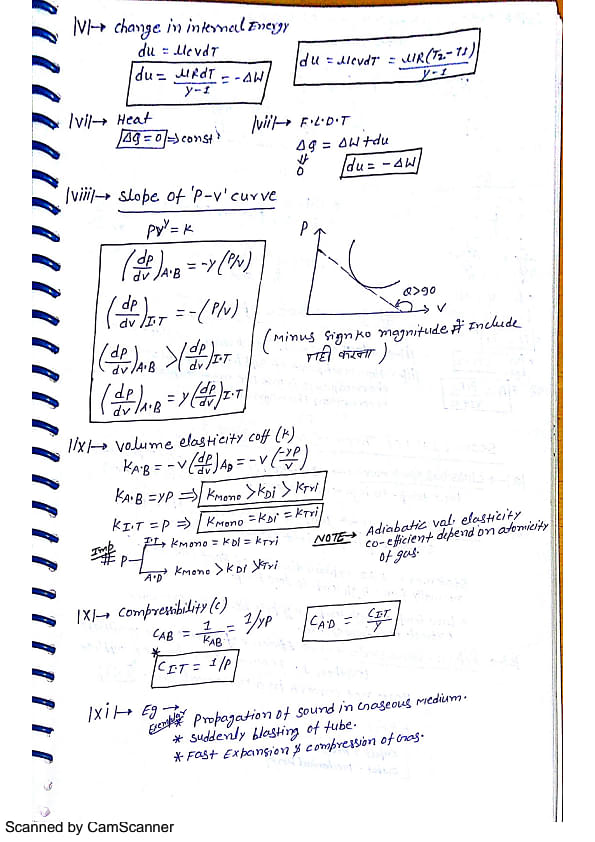
Handwritten Notes on Thermodynamics
[Click Here for Sample Questions]
Provided below are some importnat handwritten notes on Thermodynamics.






Things to Remember
[Click Here for Sample Questions]
- The isochoric process is a thermodynamic process.
- The volume in an isochoric process remains constant.
- The formula of the Isochoric process is △v = 0.
- From the first law of thermodynamics applied to an isochoric system, dU= dq+ dW.
- Work done is zero for an isochoric process, d U = dq + 0.
- Important examples of the Isochoric process are the Otto Cycle.
Check Out:
| Important Concepts From Thermodynamics | ||
|---|---|---|
| Kelvin Planck Statement | Clausius Statement | Born-Haber Cycle |
| Enthalapy Formula | Ionization Energy Formula | NCERT Solutions Thermodynamics |
| Thermodynamics MCQs | Four-Stroke Engine | Two Stroke Engine |
Previous Year Questions
- Calculate the heat liberated in the reaction. [KCET 2004]
- What is the maximum work done by the ideal gas? [VITEEE 2006]
- What is the work done by the ideal gas expanding in vacuum. [VITEEE 2006]
- Boyle’s law is applicable for? [JEE Advanced 2019]
- Name the quantity that remains constant in the thermodynamic system? [BITSAT 2007/ 2013]
- Which PV diagrams best represent an isothermal process? [KEAM 2004]
- Calculate the final pressure of the gas? [KEAM 2004]
- Calculate the change in the internal energy. [KCET 2016]
- What is the state of super-cooled water. [MET 2013]
- Calculate the density of the hydrogen gas in the cylinder. [NEET 2020]
- Identify the type of thermodynamic process. [NEET 2020]
- What is the work done the three moles of an ideal gas that expands into vacuum. [NEET 2010]
- Calculate the vaule for change in the enthalpy for the following reactions. [NEET 2010]
- Calculate the change in the enthalpy of the sample. [NEET 2018]
- Match the thermodynamic processes. [NEET 2017]
Sample Questions
Ques: 500 g of water is heated. The temperature rises from 30° to 60°. Calculate the water's internal energy. Ignore the expansion of water taking place in a small amount. (2 marks)
Ans. As the expansion of water (volume) takes place negligently; it is an Isochoric process. So, the △U=Q=msv △T
Water’s mass= 500 g =0.5 kg
Temperature change= 30 K
The Heat / Q = 0.5*4184*30= 62.76 kJ
Ques: Gas is expanding in constant pressure. It expands from V1 to V2. So, what is the work done by the gas? (CBSE 1990) (1 mark)
Ans. P V = P (V2 –V1)
Ques: Explain the Isochoric process (2 marks)
Ans: Isochoric process is a thermodynamic process. This takes place when the volume is constant.
Ques: Mention the first law of thermodynamics applied in the Isochoric process (2 marks)
Ans: The first law of Thermodynamics applies here; the formula can be written as
d U= dq+ D W.
For the Isochoric process
d U = dq + 0.
So, it ultimately comes down to
d U = dq
Ques: What is the amount of work done in the Isochoric process (1 mark)
Ans: In an isochoric process there is no energy transfer to the surroundings. This is because the process is close. So, the work done is zero
Ques: Point out the difference between the processes of Isobaric and Isochoric (2 marks)
Ans:
| Isochoric Process | Isobaric process |
| It’s a chemical process that occurs in unchanged volume. | It’s a chemical process that takes place when the pressure is constant |
| There's no volume change. It's shown as V= 0 | There’s no pressure change. It’s depicted as △=0 |
Ques: Provide an example to show the Isochoric process (2 marks)
Ans: The Otto Cycle is a good example of the Isochoric process. This is a thermodynamic cycle applicable in car engines. It depicts the transfer of heat during the ignition process. The first and the last process in the Otto cycle are the Isochoric processes.
Ques: Is the Isochoric process reversible? (1 mark)
Ans: Yes, the Isochoric process is reversible. However, there are exceptions. The Otto Cycle is an example of an irreversible Isochoric process.
Ques: What is the result of work done by the gas in the Isochoric method? (2 marks)
Ans: The amount of work done is always zero in the Isochoric process.
This we can prove by work done through Thermodynamic equation
= ∫P ×d V
So, in Thermodynamics’ Isochoric process where the volume never changes, the equation is
= ∫P ×0=0
Ques: What is the correct relation for the Isochoric process? Is it △Q= △U, △W=△U, or △Q=△W? (2 marks)
Ans: According to the Isochoric method,
△V=0, ∴ △W=0
△Q=△U+=△W
As work = 0
→ △Q= △U
(Q= Heat, V=Volume, W=Work)
Do Check Out:



Comments