



Education Journalist | Study Abroad Lead
Water cycle or the hydrological cycle is the continuous process of movement of water above and below the Earth’s surface. In the water cycle, water evaporates from the surface of the Earth, rises into the atmosphere, cools and condenses into rain or snow in clouds, and then falls to the ground as precipitation.
- The Hydrological cycle is a vital biogeochemical cycle for the survival of life on Earth.
- The water cycle is essential as it ensures the availability of water to all living organisms, including plants, animals, people, and other species.
- Water is an important natural resource on our planet as it can neither be created nor destroyed.
- The water existing on the earth today is the same water existing thousands of years ago and it will continue to exist for years in the future.
Key Terms: Water Cycle, Evaporation, Condensation, Precipitation, Transpiration, Hydrological Cycle
What is Water Cycle?
[Click Here for Sample Questions]
The water cycle shows a continual flow of water on Earth and in the atmosphere. It is a complex process involving many different processes. Liquid water evaporates into water vapour, condenses into clouds, and then precipitates rain and snow on the ground.
- The water cycle deals with the flow of water through different levels of the ecosystem.
- It is a natural process which recycles water in the atmosphere continuously.
- It is also regarded as the hydrologic cycle or the hydrological cycle.
- During the water cycle, the water goes through the 3 states of matter – solid, liquid, and gas.
Water Cycle Diagram
During this process, the total number of water particles stays the same while the water changes its phase. The state of water particles is changed through evaporation, melting, and freezing by the application of energy to sublimation, condensation, and deposition.
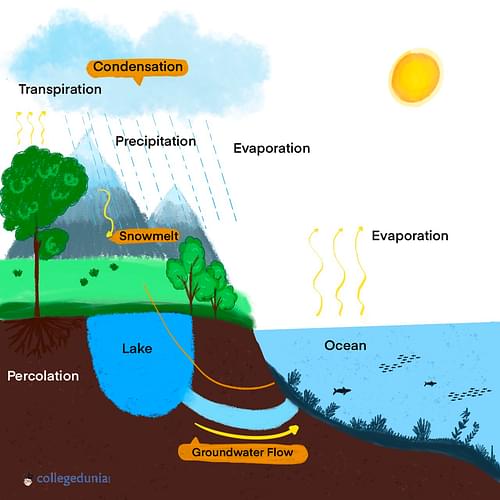
Stages of Water Cycle
[Click Here for Sample Questions]
The water cycle is the continuous movement of water from the Earth to the atmosphere and back to the Earth through evaporation, condensation, and precipitation. Evaporation, transpiration, condensation, precipitation, and surface run-off are all parts of the water cycle.
-
Evaporation
Evaporation is the process of converting water from a liquid state to a gaseous state. Sun which is the ultimate source of energy powers evaporation on Earth. Oceans, seas, fields, ponds, lakes, and rivers all contribute to evaporation.
- When water molecules present at the surface of water bodies rise in the air, they cause evaporation.
- The molecules having the highest kinetic energy are collected as water vapor in the clouds.
- Evaporation in the water cycle takes place below the water's boiling point.
- When evaporation occurs through the plant’s leaves, it is known as evapotranspiration.
- This process leads to the presence of a large percentage of water in our atmosphere.
-
Sublimation
When ice or snow directly changes to water vapor without becoming water, the process is known as sublimation. The sublimation process in the water cycle occurs as a result of humidity and dry winds
- It occurs on peaks of mountains where the air pressure is low which helps to sublimate snow into vapor.
- On Earth, sublimation mainly occurs from the ice sheet on the poles.
-
Condensation
Condensation is the process in which water vapour in the atmosphere cools down due to low temperatures at high altitudes, turning into liquid. It is the reverse of evaporation, where liquid water becomes a vapor.
- The vapors transform into tiny droplets of ice or water.
- They eventually come together forming clouds.
-
Precipitation
Precipitation is water that falls back to the surface of the earth upon condensing in the atmosphere. In other words, any form of water which falls, whether it is in liquid or frozen form, falls as precipitation only.
- On a temperature above 0oC, the water vapours transform into droplets in the water cycle.
- The vapors attach themselves to the surface of the particles.
- When enough droplets are combined, they fall out of clouds to the ground in form of precipitation or rainfall.
- When the temperature and the air pressure are extremely low, the water droplets freeze to form as hail or snow.
-
Infiltration
The rainwater is absorbed into the ground through infiltration in the water cycle. The level of absorption of the rain in the ground varies on the basis of the material the water is seeping into.
- Rocks retail less water as compared to soil.
- Groundwater sometimes sinks deeper to form aquifers.
-
Surface run-off
Some quantity of rainwater in the water cycle is absorbed by the soil and settles down as groundwater following gravity. Most of the rainwater flows down the hills and mountains to gather into rivers, lakes or streams.
- Rain additionally washes away the top layer of the soil into water bodies.
- In cold regions, icecaps are formed when snowfall is faster than the rate of sublimation or evaporation.
This circulation of water through various phases is named the water cycle.
Read More:
| Chapter Related Topics | ||
|---|---|---|
| Cloud Formation | Forms of Water | Evaporation |
| Condensation | Properties of Water | Importance of Water |
Uses of water
[Click Here for Sample Questions]
Water makes up nearly 70% of our body weight and is required for the regular operation of biological processes. Some other vital uses of water derived through the water cycle are-
- It is utilized for a variety of reasons, including agriculture, industry, and residential consumption.
- Irrigation of agricultural crops consumes 70% of freshwater. Industries use 22% of the water available. Domestic use accounts for 8% of total water use.
- Cooking, cleaning utensils, bathing, washing clothing, and, most importantly, drinking are all domestic activities.
- Drinking water can be found in ponds, wells, streams, lakes, and rivers. Potable water is water that can be consumed.
The water cycle transports water from the oceans and seas to other bodies of water. Saline water contains a range of beneficial salts such as sodium chloride, calcium, magnesium, and potassium.
Implications of Water Cycle
[Click Here for Sample Questions]
The greenhouse effect leads to a rise in temperature in the atmosphere. Without the cooling effect of the water cycle, Earth’s temperature will rise drastically.
- The water cycle affects all the life processes on Earth.
- It also helps to clean the air. During the precipitation process, water vapours attach themselves to dust particles.
- In polluted cities, the raindrops also pick up gas and pollutants that are water-soluble.
- The precipitation phase of the water cycle picks up bacteria and industrial soot particles.
States of water
[Click Here for Sample Questions]
Water in the water cycle is found in three distinct states-
- Water may exist in solid form. Ice, snow, and hail are examples of the solid state.
- Water can exist in a liquid form. Rivers, rain, and the sea all depict the liquid condition of the water.
- Water may exist in a gaseous form. Water vapour represents the gaseous condition of the water.
Read More:
| Important Chapter Related Topics: | ||
|---|---|---|
| Water Pollution | Carbon Cycle | Nitrogen Cycle |
| Ecology and Environment | Respiration | Ozone Layer |
Things to Remember
- Water cycle is the constant movement of water from the earth to the atmosphere as water vapor and back again to the earth.
- The sun and the water bodies such as the oceans, seas, rivers and lakes are the components of the water cycle.
- Evaporation is the process in the water cycle where the water converts into water vapour due to heating.
- The release of the remaining water into the air by the plants is known as transpiration.
- The condensation process of the water cycle includes the return of water back to the earth in the form of rain, snow or hail.
- When the size of these droplets increases, they fall on the earth as rainfall is known as precipitation.
Sample questions
Ques. What do you understand by the term water cycle? Give an example. (2 Marks)
Ans. The constant movement of water from the earth to the atmosphere as water vapour and back again to the earth in the form of rain is known as the water cycle. An example of a water cycle is when water evaporates from oceans and then returns to the land in the form of rain.
Ques. What are the stages of the water cycle process? (2 Marks)
Ans - The water cycle takes place in 5 stages, namely.
- Evaporation
- Transpiration
- Condensation
- Precipitation
- Surface run-off
Ques. Define evaporation. (2 Marks)
Ans. Evaporation is the process by which water changes from a liquid to a gas or vapour. Evaporation is the primary pathway that water moves from the liquid state back into the water cycle as atmospheric water vapor.
Ques. What is condensation? (2 Marks)
Ans. Condensation is the process by which water vapour in the air is changed into liquid water. Condensation is crucial to the water cycle because it is responsible for the formation of clouds.
Ques. What is the difference between evaporation and condensation? (2 Marks)
Ans. Evaporation is a process by which water changes into water vapour. Condensation is an opposite process by which water vapour is converted into tiny droplets of water.
Ques. Why is the water cycle important? (2 Marks)
Ans. The water cycle has a huge impact on determining the global climate. It is also an important part of other biogeochemical cycles. It affects all life processes on Earth either directly or indirectly.
Ques. What keeps the water cycle going? (2 Marks)
Ans. The sun is what makes the water cycle work. The sun provides heat or energy that almost everything on Earth needs. Heat causes liquid and frozen water to evaporate into water vapor gas, which rises high in the sky to form clouds. And further clouds move over the Earth and drop rain and snow.
Ques. How are plants involved in the water cycle? (2 Marks)
Ans. Plants absorb water from the soil. The water moves from the roots through the stems to the leaves. Once the water reaches the leaves, some of it evaporates from the leaves, adding to the amount of water vapor in the air. This process of evaporation through plant leaves is called transpiration.
Ques. Can humans live without the water cycle? (2 Marks)
Ans. A human can't live without water, nor can earth survive without it. The water cycle recycles not only water itself but also some nutrients that humans need too. After which, it will then again be evaporated from the ground to water vapour in the cycle.
Ques. Where does the water cycle begin? (2 Marks)
Ans. The water cycle begins with evaporation. It is a process where water at the surface turns into water vapors. Water absorbs heat energy from the sun and turns into vapors. Water bodies like the oceans, seas, lakes and river bodies are the main source of evaporation.
Also Check:



Comments