



Education Journalist | Study Abroad Lead
Surface area of a pyramid is the sum of the area of all its faces. There are different kinds of pyramids like the square pyramid, triangular pyramid, etc. It is a three-dimensional shape whose base is a polygon (triangle, square, etc) and the other faces of the pyramid are triangular. The top vertex is called the apex of the pyramid. The perpendicular distance between the apex and the base is the height of the pyramid.
The different types of pyramids are:
- Triangular pyramid
- Square pyramid
- Pentagonal pyramid
- Hexagonal pyramid
Each of them has a different formula for surface area. Let us find out the formula for each kind of pyramid and solve some questions from the surface area of pyramids.
| Table of Content |
Key Takeaways: Pyramids, polygonal pyramid, Square Pyramid, Triangular Pyramid, Pentagonal Pyramid, Hexagonal Pyramid, Surface area of the pyramid
Read More: NCERT solutions for class 10 mathematics chapter 13
What is a pyramid?
[Click Here for Sample Questions]
A pyramid is a solid object that contains the following features:
- The triangles on the sides meet at the top (the apex).
- The foundation is a polygon (a flat shape with straight sides)

Square pyramid
This is a square pyramid; however, there are also triangular, pentagonal, and other types of pyramids. It's a polyhedron, too.
A pyramid is a polyhedron made by joining a polygonal base with a point, known as the apex, in geometry. A lateral face is a triangle formed by each lateral face's base edge and apex. There are n + 1 vertices, n + 1 faces, and 2n edges in a pyramid with an n-sided base. The Great Pyramids of Egypt come to mind when we think of pyramids. Because their foundation is square, they are Square Pyramids.
Also read: Surface area of cone
Types of Pyramids
[Click Here for Sample Questions]
The pyramid's faces are connected to its base. Because each triangular face will be different in size and shape, we'll need to use the formula to calculate the area of each.
The following are the various types of pyramids:
-
Square Pyramid
A square pyramid is a pyramid with a square base with 4 triangular faces and 1 square base. The surface area of a square pyramid is given by
Surface area of a square pyramid, A = 2 x b × s + b2

Square pyramid
-
Triangular Pyramid
A triangular pyramid is a pyramid with a triangular base with 3 triangular faces and the base. The surface area of a triangular pyramid is given by
Surface area of a triangular pyramid, A =1⁄2(a × b) + 3⁄2(b × s)
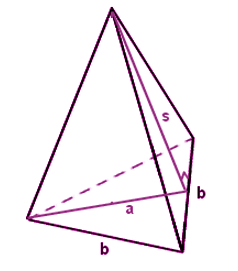
Triangular pyramid
-
Pentagonal Pyramid
A pentagonal pyramid is a pyramid with a pentagon base with 5 triangular faces and 1 pentagonal base.

Pentagonal pyramid
The surface area of a pentagonal pyramid is given by
Surface area of pentagonal pyramid, A =5⁄2(a × b) + 5⁄2(b × s)
-
Hexagonal Pyramid
A hexagonal pyramid is a pyramid with a hexagonal base with 6 triangular faces and 1 hexagonal base.

Hexagonal pyramid
The surface area of a hexagonal pyramid is given by,
Surface area of hexagonal pyramid, A =3(a × b) + 3(b × s)
Surface Area of Pyramid formula
[Click Here for Sample Questions]
The surface area of a pyramid is computed by adding the surface areas of its faces. A pyramid is a three-dimensional shape having a polygonal base and triangular side faces that meet at the tip (or vertex). The perpendicular distance between the peak and the center of the base is the altitude or height of a pyramid. The length of the perpendicular traced from the apex to the base of a triangle is known as the "slant height" (side face). Let's learn more about the surface area of a pyramid, including the formula, a few examples, and some practice questions.
Surface area of square pyramid = 2 x b × s + b2
Surface area of triangular pyramid = 1⁄2(a × b) + 3⁄2(b × s)
Also read: Surface area of a cuboid.
How to calculate the surface area of a pyramid?
[Click Here for Sample Questions]
Adding the surface area of the base to the surface area of the lateral faces yields the surface area of any pyramid. If you know how to find the area of the pyramid's base, you can find the surface area using a formula when working with ordinary pyramids. Because the base can be any polygon, knowing how to find the area of forms like pentagons and hexagons is useful. Calculating the total surface area of a regular square pyramid, on the other hand, is an easy calculation if you know the slant height of the pyramid and the side length of the square base.
Also read: Surface area of a cone
Things to Remember
- A pyramid is a polyhedron formed by linking a polygonal base to a point in geometry known as the apex. The base edge and apex of each lateral face combine to form a triangle.
- The surface area of any pyramid is calculated by adding the surface area of the base to the surface area of the lateral faces. When working with conventional pyramids, you can use a formula to get the surface area if you know how to find the area of the pyramid's base.
- A pyramid must have at least three exterior triangle surfaces plus the base, but the four-sided pyramid plus base, as seen in the famous ancient Egyptian Pyramids, is the most prevalent version.
- A pyramid is called acute if its apex is above the interior of the base, and obtuse if its apex is above the exterior of the base, similar to acute and obtuse triangles.
- The apex of a right-angled pyramid is higher than the base's edge or vertex. These qualifiers change in a tetrahedron depending on which face is designated the base.
Sample Questions
Ques: What is the surface area of a pyramid? How can LSA and TSA be calculated? [2 marks]
Ans: The total area occupied by the surface of a pyramid is measured by its surface area. In other words, it's the sum of its faces' areas, and it's measured in square units like m2, cm2, in2, ft2, and so on. The lateral surface area (LSA) and the total surface area (TSA) of a pyramid are two different types of surface areas.
- The lateral surface area is the sum of the areas of the pyramid's side faces (triangles) (LSA).
- The total surface area (TSA) of a pyramid is equal to the pyramid's LSA plus the base area.
Ques: Calculate the lateral surface area of a square pyramid whose base has a side length of 24 cm and a slant height of 20 inches. [2 marks]
Ans: The side length of the base, x = 24 cm
Then, the perimeter of the base (square) is, P = 4x = 4(24) = 96 cm
Slant height, s = 20 cm
The LSA of a square pyramid is
Lateral surface area (LSA) = (1/2) Perimeter x Slant height
= (1/2) × (96) × 20
= 960 cm2
Therefore, the LSA of the given pyramid is 960 cm2
Ques: Calculate the total surface area of a square pyramid if the base side is 6 metres long and the height (altitude) is 4 meters high. [3 marks]
Ans: Given, the side of the base is, x = 6 m
the height of the pyramid is, h = 4 m
Let its slant height be 's'.
By Pythagoras theorem, s2 = (x/2)2 + h2
s2 = (6/2)2 + (4)2
= 9 + 16
= 25
Thus, s = 25 m
The perimeter of the base is, P = 4x = 4(6) = 24 m
The base area is, B = (4)2 = 16 square m
The TSA of the square pyramid is,
TSA = (1/2) P x s + B
TSA = (1/2) × 24 × 25 + 16 = 316 square m
Therefore, the TSA of the given pyramid = 316 Sq. m
Ques: Find out the Surface area of the square pyramid with side of 15 cm and base 24 cm. [2 marks]
Ans: Surface area of a square pyramid = 2 x b x s + b2
Here, using the formula= 2 x 24 x 15 + (24)2
= 720 + 576
= 1296 cm2
Ques: If each edge of the base is 6 inches, the slant height of a side is 7 inches, and the altitude is 15 inches, calculate the total surface area of a normal pyramid with a square base. [2 marks]
Ans: The perimeter of the base is 4s since it is a square.
Perimeter = 4 x 6 = 24 inches
The area of the base is (side)2
B = (6)2 = 36 inches2
T.S.A. =1/2 x (24) x (7) + 36
= 84 + 36
= 120 inches2
Ques: In a square pyramid, describe the base, vertex, and height. [2 marks]
Ans: A pyramid is a solid structure with numerous triangular lateral faces and a polygonal base. A shared vertex connects the lateral faces. The number of lateral faces is determined by the number of base sides. The perpendicular distance between the base and the vertex determines the pyramid's height.
Ques: Determine the difference between a rectangle and a triangular pyramid. [2 marks]
Ans: A regular pyramid has a regular polygon base and a vertex that is above the polygon's centre. The shape of a pyramid's base gives it its name.

- A triangular pyramid's net is made up of four triangles. The pyramid's base is a triangle, and the lateral faces are triangles as well.
- A rectangular pyramid's net is made up of one rectangle and four triangles. The pyramid's base is a rectangle, while the lateral faces are triangles.
- A triangular pyramid is a geometric solid with a triangle base and triangles having a common vertex on all other faces.
Ques: Identify the difference between a pyramid and a prism. [2 marks]
Ans: A prism is a three-dimensional polyhedron similar to a pyramid, however it does not have the same appearance. The ends of a prism are identical, while the sides are all flat. The sides or faces of the base are perpendicular to the base faces, forming a right angle with the base. An oblique prism is one with sides that are not perpendicular to the base.
The prism is distinct from the pyramid in that it lacks an apex. Instead, it can be stated that it is built on two foundations. The sides connect the bases together. Check whether the prism's cross-section is the same all the way down its length to differentiate it.
Ques: Describe a hexagonal pyramid. [2 marks]
Ans: A hexagonal pyramid has a hexagonal base and six isosceles triangular faces that meet at a geometry point (the apex). The base of a right regular pyramid is a regular polygon, and the apex is "above" the center of the base, producing a right triangle with the apex, the base's center, and any other vertex.
Ques: Write the facts about a triangular pyramid. [3 marks]
Ans: The facts about a triangular pyramid are:
- It has four different faces.
- The 3 side faces are triangles
- The base is a triangle as well.
- It is made up of four vertices (corner points)
- It has 6 edges
- It's a tetrahedron, too.
Related links



Comments