



Education Journalist | Study Abroad Lead
A cylinder is a three-dimensional structure with interlocking circular foundations. It has no vertices. Generally, a three-dimensional structure refers to a surface area. The top of the cylinder is the area above it in a three-dimensional shape. The cylinder can look like a set of circular discs packed with one another. As a solid three-dimensional cylinder, it has both more space and volume. In this article, we will read more about the curved surface area, lateral surface areas, base surface area of a right circular cylinder.
| Table of Contents |
Key Terms: Cylinder, Volume, Total Surface Area, Lateral Surface Area, Curved Surface Area
What is a Right Circular Cylinder?
[Click Here for Sample Questions]
A right circular cylinder is also known as a right cylinder as it has a closed surface area and two parallel bases with elements perpendicular and equal radius. The cylinder area is a complete circuit covered by a cylinder in a three-dimensional space.
- The area of the cylinder is equal to the total area of the two circular foundations and the upper curved surface.
- In the right cylinder, the two circular bases are directly above each other and the axis line produces the right angle at the base.
- Between the two circular bases, there is a curved area, which when opened represents a rectangular shape. This curved area is also called the lateral surface.
- The different parameters used to calculate cylinder area include base, length, radius, axis, and side. Cylinder radius is defined as the radius of a circular base.
- The height of the cylinder is calculated by measuring the perpendicular distance between the two circular foundations, and the line joining the centre base is called the axis.
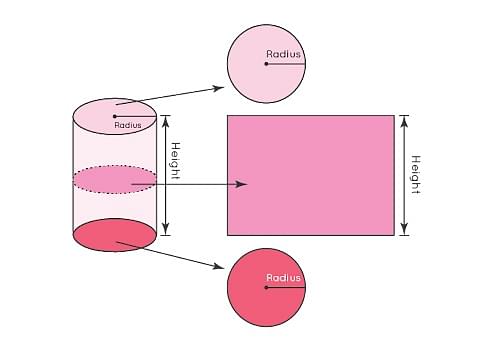
Parts of Right Circular Cylinder
Curved Surface Area of Right Circular Cylinder
[Click Here for Sample Questions]
The upper curved area of the cylinder (CSA) is defined as the curved area of any given cylinder with base radius 'r', and length 'h', also called the Lateral Surface Area (LSA). Mathematically, it is represented as,
Lateral or Curved Area = 2 πrh square units
The unit of lateral or curved surface area of a right circular cylinder is measured in square units.
Read More:
Base Area of Right Circular Cylinder
[Click Here for Sample Questions]
The base of the cylinder is in a circular motion. Therefore, by the formula of the circle, we know,
Area of Round Cylinder Bases = 2 (πr²)
where, r is the radius of the circular base.
Total Area of Right Circular Cylinder
[Click Here for Sample Questions]
The total area with radius ‘r’, and the length ‘h’ is equal to the sum of the curved area and circular areas of the cylinder. Mathematically,
Total Surface Area = 2π × r × h + 2πr²= 2πr (h + r) square units
where, r is the radius of the circular base and h is height of the cylinder.
Derivation of Surface Area of Right Circular Cylinder
[Click Here for Sample Questions]
Now, imagine a situation in which we need to paint the surface of a cylindrical container. Before we start painting, we need to know the amount of paint needed to paint all the walls. Therefore, we need to find the location of the entire surface of this container to calculate the amount of paint required. We define this term as a whole.
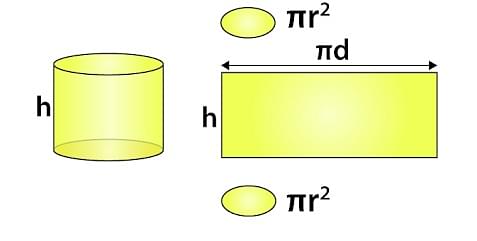
Let's take a cylinder of basic radius units 'r' and length 'h'. The curved area of this cylinder, when opened with a diameter (d = 2r) of a circular base, can be converted into a rectangle of ‘2πr’ length and width of ‘h’ units.
According to the formula of the circle, we know,
Area of the Cylinder Base = π.r²
As there are two circular foundations, so the total area of both circular foundations will be,
πr² + πr² = 2πr² ………………. (1)
Now, in the picture you can see, when we open the cylinder at the two sides, make a rectangle. Therefore, the height and circumference of the circular foundations are the size of the rectangle on which they are built. Therefore,
Curved Area = Length x Circle
Over Curved Surface = h x πd = h x 2πr (from d = 2r)
CSA = 2πrh……………. (2)
By adding equation 1 and equation 2, we get a whole place, that;
Total Core Area = Upper Curved Area + Circular Base Area
TSA = 2πrh + 2πr²
By taking 2πr as a standard on RHS, we find;
TSA = 2πr (h + r)
This is the universal formula of the cylinder area given its r position and the length is h.
Solved Examples
[Click Here for Sample Questions]
Example 1: The diameter of the base of a cylinder is 12 cm and the height is 8 cm. Find the total surface area of the solid cylinder.
Solution: Given,
Radius = 6 cm
We know that, surface area of cylinder = 2πr (r + h)
Therefore, substituting the values of r and h in above equation, we get:
2 x 22/7 x 6 x (6+8) = 528 cm2.
Example 2: The internal radius of the pipe is 1 cm, the external radius is 1.4 cm and the length of the pipe is 10 cm. Find the total surface area of the pipe.
Solution: Given,
Inner radius, r = 1 cm
Outer radius, R = 1.4cm
Height, h = 10
Total surface area of pipe
= area of internal surface + area of external surface + area of the two rings
= 2πrh + 2πRh + 2(πR2– πr2)
= (2π × 1 × 10) + (2π × 1.4 × 10) + (2 × (1.96π – 1π))
= 20π + 28π + 1.92π
= 49.92π
= 49.92 × 3.142
= 156.84 cm2
Example 3: A solid right circular cylinder has a radius of 21 cm and height of 8 cm. Find its CSA.
Solution: Given,
Radius of the cylinder, r = 21 cm
Height of the cylinder, h = 8 cm
Curved surface area of cylinder = 2Πrh
= 2 x (22/7) x 21 x 8
= 1056 cm2
Example 4: CSA and circumference at the base of a solid right circular cylinder are 2200 sq.cm and 110 cm respectively. Find its height and radius.
Solution: CSA of cylinder = 2200 cm2
Circumference of the base = 110 cm
2Πr = 2 x (22/7) x r = 110
r = 110 x (1/2) x (7/22)
r = 17.5 cm
2 Π r h = 4400
110 x h = 2200
h = 2200/110
h = 20 cm
Hence, Height = 20 cm
Radius of the cylinder = 17.5 cm
Read More:
Things to Remember
- The area of a cylinder is defined as the sum of lateral surface area and the area of its two circular bases.
- A right circular cylinder has three parts, namely, top circular base, curved lateral face and bottom circular face
- In the event that one of the circular foundations of a right circular cylinder is removed and the axis does not produce the correct angle to the base, then it is called an oblique cylinder.
- The total area of the cylinder is equal to the total area of its entire surface.
- Volume of a right circular cylinder is equal to πr2h.
Sample Questions
Ques. Calculate the cost required to paint a container which is in the shape of a right circular cylinder having a base radius of 5 m and height 15 m. If the painting cost of the container is INR 1.5/m². (Take π = 22/7) (3 mark)
Ans. Given,
Total surface area of aquarium = 2πr (h + r)
= 2 x 22/7 x 5 x 20
= 628.57 m2
Total cost of painting the container = 1.5 × 628.57 = INR 942.855
Ques. Find the total surface area of a container in cylindrical shape whose diameter is 10 cm and height is 10 cm. (5 marks)
Ans. Given, Diameter = 10cm
Height = 10 cm
Formula for total surface area is given by:
TSA = 2πr (h + r)
= 2 x 22/7 x 5 x (10 + 5)
TSA = 2 x 22/7 x 5 x 15
TSA = 471.428 cm2
Hence, the total surface area of the container is 471.428 cm2.
Ques. Find the height of a cylinder whose total surface area is 1068.14 sq.ft and base radius is 10 ft. (3 marks)
Ans. Formula for total surface area is given by:
TSA = 2πr (h + r)
1068.14= 2 x π x 10 x (h+10)
H + 10=(1068.14)/(2 x π x 10)
H = 17 -10
H = 7 ft.
Height of cylinder = 7 ft.
Ques. The base of a cylinder has an area of 9π and the cylinder has a height of 12. What is the surface area of this cylinder? (5 marks)
Ans. Formula for total surface area is given by:
TSA = 2πr (h + r)
Area = πr²
We know that, area of cylinder = 9π
Therefore, πr² = 9π
Hence, r = 3
TSA = 2π x 3 x (12 + 3)
TSA =18π + 72π
TSA = 90π
Ques. Find the surface area of the following cylinder. (3 marks)
Ans.

Formula for total surface area is given by:
TSA = 2πr (h + r)
According to the given fig.
R = 7m and h = 11m
TSA = 2π (7) (11) + 2π (7)
TSA = 154 π + 98 π =252πm²
Ques. A house has 12 right cylindrical pillars each having radius 40 cm and height 4.2 m. Find the cost to paint the curved surface of pillars at Rs.20 per square metre. (3 marks)
Ans. The pillars of the house are in the shape of a cylinder. Hence,
Radius = 50 cm= 0.4 m
Height = 2 m
CSA of one pillar = 2 x (22/7) x 0.4 x 4.2
= 2 x 22 xx0.4 x 0.6
= 10.56 m2
CSA of 12 pillars = 12 x (10.56)
= 126.72 m2
Cost to paint per m2 = INR 20
Total cost = 20 x (126.72) = INR 2535.40
Hence, total cost of painting 12 pillars is INR 2535.40
Ques. The total surface area of a solid right circular cylinder is 147 cm². Its curved surface area is one thirds of the total surface area. Find the curved surface area of the cylinder. (3 marks)
Ans. Curved surface area = (1/3)
Total surface area,
2 Π r h = (1/3) x147
2 Π r h = 49
Formula of curved surface area = 2 Π r h
Hence, the curved surface area of the cylinder is 154 cm2.
Check Out:



Comments