



Education Journalist | Study Abroad Lead
Terminal velocity, a fundamental concept in fluid dynamics, is the maximum speed attained by an item when moving through media such as air or liquid.
- This velocity represents the moment at which an object's acceleration reaches zero, hence stabilising its speed.
- Surface area, viscosity, density, and mass are all elements that influence terminal velocity.
- Skydivers use this idea to guide their descent, aligning their bodies in order to achieve a steady fall.
| Table of Content |
Key terms: Terminal Velocity, Highest Speed, Velocity,, Buoyancy, Constant Speed, Fluid, Cross-Sectional Surface Area
Terminal Velocity: Definition
[Click Here for Sample Questions]
Terminal velocity refers to the highest speed an object can reach when moving through a medium, such as air or liquid. It is attained when a moving object's speed is no longer increasing or decreasing.
- Hence, the speed of its acceleration becomes zero.
- Since the force of air resistance is approximately equivalent to the falling object's speed, air resistance increases for an object that accelerates after being dropped from rest
- At terminal velocity, air resistance equals the weight of the falling object in magnitude.
- The two forces are oppositely oriented, the overall force on an object is zero, and the object's speed has become constant.
- Terminal velocity depends on an object's cross sectional surface area, coefficient of viscosity of the medium, object density, density of the medium and mass of the object.
Read More: Bernoulli’s Principle
Applications of Terminal Velocity
[Click Here for Previous Year Questions]
Applications are mentioned below:
- Raindrops have a considerably lower terminal velocity, while a mist of tiny oil droplets has an even lower terminal velocity.
- An item dropped from rest will accelerate until it achieves terminal velocity
- An object pushed to go faster than terminal velocity will slow down to this constant velocity upon release.
- Skydivers use terminal velocity during the free fall from the aircraft.
- The terminal velocity is the downward speed achieved during freefall despite the resistance of the air.
- Skydivers properly gear themselves and practice to modify their body posture so that they can go at the same pace.
- When they depart an airplane, their bodies accelerate until air resistance equals gravity, resulting in a steady rate of descent.
Read More: Properties of Fluids
Terminal Velocity: Derivation
[Click Here for Sample Questions]
Suppose the density of an object as ρo, which attains terminal velocity Vt, while falling through the liquid of density ρ. The net force exerted on the item at terminal velocity is zero.
The drag force and buoyant force cancel out the gravitational force, leading to no acceleration.
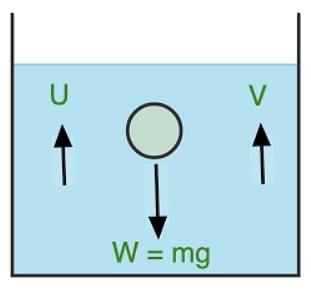
Terminal Velocity
Where,
W= weight of the ball,
⇒ W= mg
⇒ W= vρog (v= volume)
FV = Viscous force
⇒ FV=6πηrv
Fd = buoyant force,
⇒ Fd = vρg
In Equilibrium,
W= FV + Fd
⇒ FV = W - Fd
⇒ 6πηrv = vρog – vρg (v= 4/3πr3)
⇒ 6πηrv = 4/3πr3 (ρo−ρ) g
⇒ v= 2r2 (ρo−ρ) g / 9η
hence, the terminal velocity acquired by the ball of radius r, when dropped through a liquid of viscosity η and density ρ is Vt = 2r2 (ρo−ρ) g / 9η
Solved Examples
[Click Here for Previous Year Questions]
Example 1: Calculate the terminal velocity of a raindrop with a radius of 0.2 mm falling through air. The density of air is 1.2 kg/m3, and the viscosity of air is 1.8×10⁻⁵N s/m2.
Ans: Using the terminal velocity formula:
Vt = 2r2 (ρo−ρ) g / 9η
Substitute the given values:
Vt = 2 × (0.20*10-3 )2 × (1.2-1.2) × 9.81 / 9 × 1.8×10−5
Vt = 0 m/s
Example 2: A small plastic ball with a radius of 2 cm and a density of 900 kg/m3 is dropped from rest in a pool of water. The viscosity of water is 1.0×10⁻³N s/m2. Calculate the terminal velocity of the ball.
Ans: Using the terminal velocity formula:
Vt = 2r2 (ρo−ρ) g / 9η
Substitute the given values:
Vt = 2 × (0.02)2 × (900-1000) × 9.81 / 9*1.0×10−3
Vt = 0.087 m/s
Read More:
| Relevant Concepts | ||
|---|---|---|
| Relative Speed | Unit of Speed | Displacement Formula with Examples |
| Drift Velocity | Difference between Speed and Velocity | Equation of Motion |
Things to Remember
- Terminal velocity is the maximum constant velocity obtained by a body while falling through a thick material.
- The maximum velocity of a body travelling through a viscous fluid is called terminal velocity.
- The formula of terminal velocity is, Vt = 2r2 (ρo−ρ) g / 9η
- Objects dropped from rest accelerate until they reach terminal velocity due to gravity and drag.
- Objects pushed beyond terminal velocity slow down to the terminal velocity when released, as drag counters their speed.
- At terminal velocity, air resistance equals the weight of the falling object in magnitude.
- Raindrops have a considerably lower terminal velocity, while a mist of tiny oil droplets has an even lower terminal velocity.
Previous Year Questions
- Extraction of metal from the ore cassiterite involves...[JEE Advanced 2011]
- Commonly used vectors for human genome sequencing are...[NEET UG 2014]
- Interfascicular cambium and cork cambium are formed due to..
- Pneumotaxic centre is present in...[UP CPMT 2007]
- Reaction of HBr with propene in the presence of peroxide gives….[NEET UG 2004]
- Assuming the expression for the pressure exerted by the gas on the walls of the container, it can be shown that pressure is...[MHT CET 2016]
- Which among the following is the strongest acid?...[TS EAMCET 2017]
- Isopropyl alcohol on oxidation forms..
- A vector is not changed if..
- Which of the following arrangements does not represent the correct order of the property stated against it?...[JEE Main 2013]
Sample Questions
Ques. What are the factors affecting an object’s Terminal Velocity? (1 mark)
Ans: The fluid characteristics expected cross-sectional surface area, and mass of an item may all be used to affect the terminal velocity of an object.
Ques. What forces determine terminal velocity of an object? Why does an object stop accelerating when it reaches terminal velocity? (2 marks)
Ans. When this object has obtained terminal velocity, the object weight gets balanced by the force of upward buoyancy, and the drag force. The net force exerted on the item at terminal velocity is zero. The drag force and buoyant force cancel out the gravitational force, leading to no acceleration.
Ques. A small metal sphere with a radius of 2 mm is released from rest in water. Calculate its terminal velocity. The density of the sphere is 4500 kg/m3, and the viscosity of water is 1.0×10⁻³ N s/m2. (Take Density of water=1000 kg/m3, Take g =10m/s2) (3 marks)
Ans: Using the terminal velocity formula:
- Vt = 2r2 (ρo−ρ) g/ 9η
Substitute the given values:
- 2 × (0.002m)2× (4500-1000) × 9.81/ 9× 1.0 × 10−3
- 1.54 m/s
Ques. An object with a mass of 0.1 kg is dropped in air. Calculate its terminal velocity. The radius of the object is 5 cm, the density of air is 1.2 kg/m3, and the viscosity of air is 1.8×10⁻⁵ N s/m2. (Take Density of water=1000 kg/m3, Take g =10m/s2) (5 marks )
Ans: The volume of the object:
V= 4/3 πr 3
V= 4/3 π (0.05m)3
V= 5.24 × 10 −4 m 3
Object density is:
ρ object = mass/ volume
= 0.1kg / 5.24 × 10 −4 m3
- 190.84kg/m3
Using the terminal velocity formula:
- Vt= 2r2 (ρo−ρ) g / 9η
- Vt= 49.37m/s
Ques. Find the terminal velocity of a raindrop of radius 0.01mm. Coefficient of viscosity of air is 1.8×10⁻⁵ and its density is 1.2kg/m3. (Force of buoyancy due to air is neglected). Take Density of water=1000kg/m3, Take g =10m/s2 (3 marks )
Ans: Using the terminal velocity formula:
Vt = 2r2 (ρo−ρ) g/ 9η
Substitute the given values:
Vt = 2 × (0.5×10 −3 )2 × (1000−1.2) × 9.81 / 9 × 1.8×10−5
Vt= 1.69m/s
Ques. An iron ball of radius 4 cm is dropped in a container filled with oil. Calculate its terminal velocity if the density of the oil is 800 kg/m3 and its viscosity is 0.12N s/m2. (Take Density of water=1000kg /m3 , Take g =10m/s2) (3 marks)
Ans: Using the terminal velocity formula:
Vt = 2r2 (ρo−ρ) g / 9η
Substitute the given values:
Vt = 2 × (0.04m )2 × (7800-800) × 9.81 / 9 × 0.12
Vt= 12.18m/s
Ques . A steel ball of radius 6 mm falls through glycerin. Calculate its terminal velocity given the density of the ball is 7850 kg/m3, the density of glycerin is 1260 kg/m3, and the viscosity of glycerin is 1.5N s/m2. (Take Density of water=1000kg/m3 Take g =10m/s2) (3 marks)
Ans: Using the terminal velocity formula:
Vt = 2r2 (ρo−ρ) g / 9η
Substitute the given values:
Vt = 2 × (0.006m)2 × (7850−1260) × 9.81 / 9 × 1.5
Vt= 0.151 m/s
Ques. Derive the formula for Terminal Velocity using Force of Buoyancy and Gravitational Force. (5 marks)
Ans. Let’s assume the density of an object as ρo, which attain terminal velocity Vt, while falling through the liquid of density ρ.
The net force exerted on the item at terminal velocity is zero. The drag force and buoyant force cancel out the gravitational force, leading to no acceleration.
So,
W= weight of the ball,
- W= mg
- W= vρog (v= volume)
FV = Viscous force
- FV=6πηrv
Fd = buoyant force,
- Fd = vρg
In Equilibrium,
W = FV + Fd
- FV = W - Fd
- 6πηrv = vρog – vρg (v= 4/3πr3)
- 6πηrv = 4/3πr3 (ρo−ρ) g
- v = 2r2 (ρo−ρ) g / 9η
Hence, the terminal velocity acquired by the ball of radius r, when dropped through a liquid of viscosity η and density ρ is Vt = 2r2 (ρo−ρ) g / 9η.
For Latest Updates on Upcoming Board Exams, Click Here: https://t.me/class_10_12_board_updates
Check-Out:



Comments