



Education Content Expert
Living Organisms are those organisms that are capable to reproduce, feed, respire, and grow. Living organisms exist in most places on the earth in both extremely hot and extremely cold regions. They adapt to a specific habitat and some characteristics and show adaptation. The habitat of an organism refers to its immediate surroundings. Habitat refers to the home of an organism where it can find food, shelter, and favorable conditions for breeding. The habitat of an organism includes both living and non-living components. Living organisms, i.e. plants and animals both possess special characteristics that help them to survive in their own habitat.
Read More: NCERT Solutions for Class 6 Science The Living Organisms- Characteristics and Habitats
| Table of Content |
Key Terms: Living Organisms, Habitat, Adaptation, Biotic Components, Abiotic Components, Living Things, Stimuli, Respiration
Living Organisms
[Click Here for Sample Questions]
Living organisms are any kind of creatures that feed, grow, respire, show movement, and have the ability to reproduce.
- Living organisms can range from microscopic bacteria to large elephants and everything in between.
- They are found everywhere in this world from the water, air, and soil to even at the openings of volcanoes.
- For example, deserts have camels and cacti as plants whereas beaches have coconut trees and crabs.
- There are some specific ecosystems in which organisms reside or sometimes they adapt to any other ecosystem to fulfill their basic necessities of food, shelter, mates, or a better environment.
Read More:
| Relevant Concepts | ||
|---|---|---|
| What are Living Organisms Made Up Of? | Diversity In Living Organisms | Characteristics Of Organisms |
| Living and Non-Living Thing | Terrestrial Ecosystem | Importance of Ecosystem |
Characteristics of Living Organisms
[Click Here for Sample Questions]
There are certain characteristics that differentiate living things from nonliving things. The key features of Living Organisms are:
- Cells are the structural units of living organisms.
- They are able to produce new offspring.
- They show growth and development.
- Living Organisms feed or use any kind of sources for energy. For example, rats feed on grains and plants take sources from the sun to gain energy.
- They are sensitive toward nature and stimuli.
- They show adaptation to their environment.
The characteristics of living organisms are elaborated in detail below:
Movement
- Living organisms move from one place to another for various purposes.
- They also show other body movements.
- Plants are generally attached to the soil, so, they do not move from one place to another.
- However, there is a movement of various substances like water, minerals, and food synthesized by the plants from one part to another.
- Plants also display various other types of movements such as the opening and closing of flower buds.
Nutrition
- Nutrition refers to the process by which animals obtain food and utilize it for all their life activities.
- Living organisms require nutrition for obtaining energy and function properly.
Growth
- Living organisms grow and exhibit growth in different ways.
- The body cells of different organisms divide and grow and thus overall growth is attained.
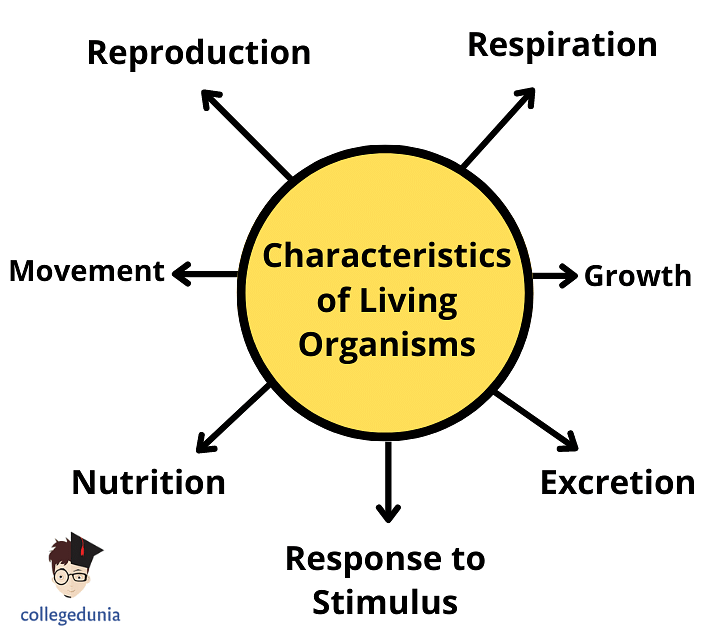
Characteristics of Living Organisms
Respiration
- Respiration is the most essential life process for all living organisms.
- The body of a living organism obtains energy from the food it takes through the process of respiration only.
- Certain mechanisms such as the exchange of gases are a part of the respiration process.
- Humans respire by breathing in oxygen and breathing out carbon dioxide.
Response to Stimulus
- Stimuli refer to the changes in our surroundings that make us respond to them.
- Living organisms react to changes in their surroundings.
- For instance, we wear open and airy clothes on hot summer days.
Read More: Immediate Response to Stimulus
Excretion
- When living organisms eat food, the unused or remaining food becomes waste and needs to be excreted.
- This process of throwing out unused food or waste from the body is called excretion.
Reproduction
- Reproduction refers to the process of giving birth to a new organism of one’s own kind.
- There are different modes of reproduction in different animals and plants.
- Some animals produce their young ones through eggs while other animals give birth to the young ones.
- Plants reproduce through the seeds which germinate into new plants.
- Some plants also reproduce through various other parts other than seeds.
Read More: How do Organisms Reproduce?
Habitat of Living Organisms
[Click Here for Sample Questions]
The specific place where an organism can live and make its home is called its habitat. Organisms mostly reside in their natural habitat. A habitat has all the essential requirements of the organism living in it. They provide them with plenty of food, shelter, mates, air and a favorable environment to reside. Different plants and animals can choose to live in the same habitat.
For example, the Forest is the natural habitat of lions and deer, etc. Water is the natural habitat of fishes and trees are the natural habitat of birds.
There are two main types of habitats which are mentioned below-
- Terrestrial Habitat: All the organisms living on land are known as terrestrial organisms and the habitat is known as terrestrial habitat. Grasslands, mountains, deserts, and forests are some examples of terrestrial habitats.
- Aquatic Habitat: All the organisms living in the water are known as aquatic organisms and the habitat is known as the aquatic habitat. Lakes, rivers and oceans are a few examples of aquatic habitats.
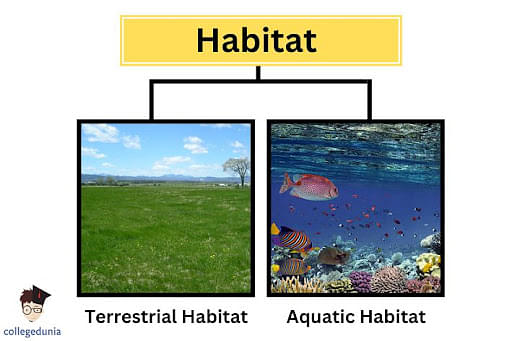
Habitat
Read More: Aquatic Ecosystem
Biotic and Abiotic Components
[Click Here for Sample Questions]
All the organisms living in a particular habitat under the same environmental conditions. The ecosystem includes both biotic and abiotic components.
- Biotic Components: They are the living components of habitats such as plants, and animals.
- Abiotic Components: They are the non-living components of a habitat such as rocks, soil, air, water, etc.
In a grassland, lions, deers, frogs, grasses, trees, and all other living organisms are biotic components while non-living things such as rocks, soil, and water are abiotic components.

Biotic and Abiotic Components
Read More: Difference between Biotic and Abiotic Factors
Adaptation in Living Organisms
[Click Here for Sample Questions]
All the organisms have the ability to survive in favorable and unfavorable conditions. The ability to survive in unfavorable conditions is known as adaptation. Adaptation takes plenty of time and various periodic changes. Adaptations are essential to deal with environmental changes and growing needs.
- Some animals adapt to live in severe climatic conditions such as penguins and polar bears have adapted to survive in very low temperatures.
- Some organisms adapt structural changes as giraffes have adapted long necks to feed on the leaves of longer trees and birds have adapted wings to fly.
- Some animals adapt camouflage (a phenomenon in which organisms adapt to blend them with the habitat) in order to protect themselves from the predators.
Read More:
| Related Topics | ||
|---|---|---|
| Components of Ecosystem | Difference between Biome and Ecosystems | Ecology and Environment |
| Tropism in Plants | Difference Between Breathing and Respiration | Excretion in Human Beings |
Things to Remember
- Living Organisms are those organisms that are made up of cells.
- They perform various life processes such as nutrition, movement, growth, reproduction, respiration, excretion, and stimulation.
- Habitat is the place or environment where a plant or animal lives and grows.
- A habitat includes all living and nonliving factors or conditions of the surrounding environment.
- Habitat can be classified into two types namely terrestrial habitat and aquatic habitat.
- Adaptation is the process of adjusting or changing which enables a plant or an animal to live in its surroundings.
Sample Questions
Ques. What are the Characteristics of Living Organisms? (5 Marks)
Ans. There are various characteristics shown by a living organism that distinguish it from non-living things. Some important characteristics of living organisms are listed below-
- Nutrition: Nutrition is an essential activity of the living organism. They need to feed to derive energy so that they can perform various activities.
- Show Growth and Movement: Living organisms grow. The cells divide and the body shows growth. Living organisms move from one place to another or their body parts show moments except for plants as their roots are fixed in the soil.
- Respiration: The process of exchange of gases in living organisms is known as respiration. Organisms respire to derive energy from the food they feed. Humans and other animals like dogs, cats, lions, etc. breathe by their noses to take in oxygen and release carbon dioxide. Some organisms like frogs use their skin to breathe and fishes respire through their gills.
- Excretion: When organisms feed, a small part gets used by the body to derive energy from it while the other part which is not needed is processed out of the body with some other substances like urea in the form of excretion.
- Adaptation: The behavior and physical appearance of the organism which helps them to survive in a specific environmental condition is known as adaptation. Example - Penguins are well adapted with a thick layer of fat under the skin to survive in extreme cold.
Ques. Why habitats are important? (3 Marks)
Ans. Habitats are very essential for the survival of living organisms. They need a secure background where they can live peacefully, reproduce and feed. Growing organisms and hatching eggs need a safe place where they can protect from predators and the habitat is such a safe place for them. For instance, we humans need our home to be safe, birds need nests and lions need a den.
Ques. Do all forms of living organisms have a fixed environment? (3 Marks)
Ans. Every kind of organism is different in its own way. Some of them prefer a permanent habitat to spend their whole life while some keep migrating in the search of a new habitat where there is plenty of food, shelter, and a favorable environment.
Example: Siberian cranes, sea turtles, and zebras keep migrating and do not live in a permanent habitat while Lions and humans, etc stay in a permanent habitat.
Ques. How do Living Organisms identify their habitat? (3 Marks)
Ans. All living organisms choose their habitat according to their safety and comfort level. A habitat is a place for the organism where all its needs get fulfilled. As all organisms are different in their own way similarly their needs and concerns are also different. Some organisms choose to live in groups, some choose to build a safe home while some give priority to their safety.
Example: A lion's habitat is a den for its comfort zone as they are not concerned for its security but birds build nests for safety from predators and rabbits choose burrows for safety.
Ques. What do you mean by ‘Response to stimuli’? (2 Marks)
Ans. Response to stimuli refers to any process that results in a change in the state or activity of a cell or an organism in terms of movement, secretion, enzyme production, gene expression, etc. as a result of a stimulus.
Ques. What are the different types of habitats? (3 Marks)
Ans. The different types of habitats are as follows:
- Terrestrial Habitats: The plants and animals who live on land are said to be living in terrestrial habitats. For example, forests, deserts, grasslands, mountains, and coastal regions are all terrestrial habitats.
- Aquatic Habitats: The habitats of the plants and animals who live in water are known as aquatic habitats. Ponds, lakes, rivers, swamps, and oceans are examples of aquatic habitats.
Ques. What is meant by adaptation? Give an example for the same. (3 Marks)
Ans. Adaptation refers to the presence of certain features or habits that enable plants or animals for living in their surroundings. Different animals adapt to their surroundings in many different ways.
One example of adaptation is fish. Fishes have slippery scales located on their bodies. These scales are there on their body to protect them and also help in the easy movement through the water.
Ques. What is reproduction in living organisms? (3 Marks)
Ans. Living organisms produce offspring of their own kind and this process is known as reproduction. The mode of producing new offspring is not similar in all organisms. Plants reproduce by seeds or stems, birds lay eggs and mammals give birth to the young ones. Reproduction is a very essential phenomenon to ensure the continuity of life.
Ques. Explain how camels are adapted to live in the desert. (3 Marks)
Ans. The various features that make it possible for a camel to live in deserts are as follows:
- The feet of the camels have thick, flat large soles that help them to move on the sand.
- Camels can live without water for a long time and whenever water is available, they drink a large amount of water at a time.
- Camels release very little urine in order to prevent loss of water.
- The long legs of the camel help to keep their body away from the heat of the sand.
Ques. What all movements can be seen in plants? (3 Marks)
Ans. The various types of movement that can be seen in plants are as follows:
- Opening and closing of flowers.
- Growth of stems and leaves.
- Movement of water, minerals, and food from one part to another.
- Movement of the stem towards sunlight and root towards the water in the soil.
Read More:



Comments