



Content Curator
Triangular prism is a polyhedron with two triangular bases and three rectangular sides. The two bases of a triangular prism are equal and corresponding to each other. It has 9 edges, 6 vertices, 5 faces and its height is the perpendicular distance between two parallel bases and center. Apart from triangles, prisms can also be in the shape of a square or of a polygon.
| Table of Content |
Key Takeaways: Triangular prism, Triangular pyramid, Rectangular side, Triangular bases, Prism, Edges and vertices, Prism net
What is a Triangular Prism?
[Click Here for Sample Questions]
A triangular prism is a three-dimensional figure having three rectangular faces and two triangular faces. The three edges that meet at a point known as vertex and two faces meet to form a line segment known as the edge. The three rectangular sides join the edges and vertices of the bases with each other.
The bases and sides of a triangular prism are either oblique or congruent. The edges of the prism connect the corresponding sides. The edges of these triangles are equivalent to each other and the equilateral triangles are the two bases of this prism. A triangular pyramid is different from that of a triangular prism as it has four triangular bases corresponding to each other.
The video below explains this:
Triangular Prism Detailed Video Explanation:
Right Triangular Prism
A right triangular prism has two triangular faces that are congruent and parallel to each other. It has three rectangular sides congruent. In the right triangular prism, the three rectangular faces are perpendicular to the triangular bases. The rectangular sides are either oblique or in the shape of a rectangle because prisms are not only just restricted to triangles. The shape of the right triangular prism has 9 edges, 6 vertices, and 5 faces.
Triangular Prism Net
[Click Here for Sample Questions]
In a triangular prism net, we will get a net, if we open each of the faces of a triangular prism. Triangular Prism Net comprises two triangles and three rectangles. The rectangle shape is the lateral face and the triangle shape is the basis of the prism.
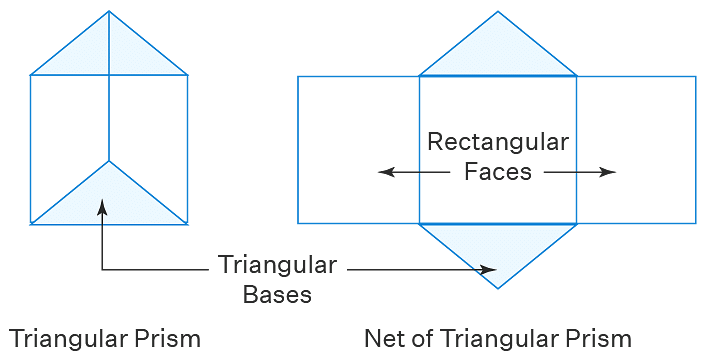
Triangular Prism and Net of Triangular Prism
Volume of Triangular Prism
[Click Here for Sample Questions]
The volume of a triangular prism is equivalent to the triangular base area and the height of the prism. To calculate the volume of a prism, the formula is given below:
Volume= Area of the Base x Height.
We know that the triangular prism base is in a triangular shape, the area of the base is similar to that of a triangle.
Area= ½ Base x Height
Thus, the volume of a triangular prism= ½ x b x h x l
where,
b = base length,
h = height of a triangle,
l = length between triangular bases.
Surface Area of a Triangular Prism
[Click Here for Sample Questions]
The surface area of a triangular prism is equivalent to the sum of the lateral surface area and two times the base area of a triangular prism. Surface Area can be measured in square units. The formula of the surface area is given below:
SA = 2A + PH
Where,
SA = Surface Area
A = Area of triangular bases,
P = Perimeter of the base,
H = Height of prism.
Now, If we consider the sides of the triangular bases as a, b, c.
Perimeter (P) of the base will be:
P = a + b + c
Now, if we put the value of area and perimeter in the above formula, i.e surface area of a triangular prism, we will find:
Surface Area of the triangular prism (SA) = 2(½ x b x h) + ( a + b + c)H
Thus, from this, we will find out the equation of the area of a triangular prism, i.e
Surface Area of any Triangular Prism = (bh + (a + b + c)H)
Properties of Triangular Prism
[Click Here for Sample Questions]
The properties of Triangular Prism are mentioned in the below points:
- Triangular Prism comprises a total of five faces, six vertices, nine sides that are together joined by rectangular sides.
- Its five faces include three rectangular sides and two triangular bases or it can be said as rectangular lateral faces.
- A line segment is created known as an edge when two faces of a triangular prism connect.
- A triangular prism is a polyhedron with parallel bases and congruent.
- If the bases of the triangular prism are equal and the shape of the faces are square, instead of the shape of a rectangle, then that type of triangular prism is known as semiregular.
Points to Remember
[Click Here for Sample Questions]
- Triangular Prism is a polyhedron that is composed of two triangular bases and three rectangular sides.
- It has 9 edges, 6 vertices, 5 faces in total.
- Three edges meet at a point known as a vertex and two faces meet to form a line segment known as the edge.
- Triangular Prism Net comprises two triangles and three rectangles.
- The surface area of a triangular prism is equivalent to the sum of the lateral surface area and two times the base area of a triangular prism.
- A right triangular prism has two triangular faces that are congruent and parallel to each other.
- The sides of the rectangular base connect side by side with each other.
Sample Questions
Ques: Find the volume of a triangular prism with a base that is 6 cm, height is 9 cm, and length is 12 cm. (2 marks)
Ans: Given, Base = 6 cm, Height = 9 cm, and length = 12 cm
Therefore, Volume of a triangular prism (V) = ½ x b x h x l
V = ½ x 6 x 9 x 12
V = 324 cm3
Ques: Find the area of the prism, if the length of the equilateral triangular base is 4 cm and the height of the prism is 2 cm. (3 marks)
Ans: Given, Base = 6 cm, height of the base = 9 cm, length of the base = 12 cm, and Height of the prism = 2cm
All sides will be equal, as the base is an equilateral triangle
Therefore a = b = c= 4 cm
From the formula, we will get
Area of any Triangular Prism (A) = (bh + (a + b + c)H)
A = (6 x 9 + (4 + 4 +4)2)
= (54 + (12)2)
= 54 + 24
= 78 cm2
Ques. Find the length of the base of the triangle if the triangular prism volume has a length of 7 units and the height of the base triangle 4 units is 35 units. (2 marks)
Ans. Given, the length of the prism (l) = 7 units (height of the base)
H = 4 units and volume is = 35 units. By the substitution of the given values in the volume of a triangular prism formula we get:
Volume = ½ * b * h * l
35 = ½ * b * 4 * 7
35 * 2 = b * 28
B = 70/28 units
B = 2.5 units
Hence the measurement of the base of the triangle = 2.5 units
Ques: Find out the volume of the triangular prism containing the length of the base as 10 cm, the height being 20 cm and the length of the prism as 50 cm. (2 marks)
Ans. Given: b = 10, h = 20 cm, l = 50 cm
Volume = ½ * b * h * l
Volume = ½ * 10 * 20 * 50
Volume = ½ * 10000
Volume = 5000 cm3
Ques. From the image given below find the volume when l is 5 cm and 2 cm respectively. (2 marks)
Ans. 1. Volume of the triangular prism when the volume is 5 cm
Volume = Area of the cross section * length
Volume = 10 cm² * 5 cm = 50 cm3
- Volume of the triangular prism when the volume is 2 cm
Volume = Area of the cross section * length
Volume = 10 cm² * 2 cm = 20 cm3
Ques. Find the volume of the following triangular prism: (3 marks)
Ans. Volume of a triangular prism is the product of ½ bh
The area of the triangle = ½ lh = ½ * 7 * 5
The area of the triangle = 17.5 cm2
Volume of the triangular prism = Triangle Area * Width
Volume = 17.5 cm2 * 3 cm
Volume = 52.5 cm3
Ques. In a triangular prism, how many edges are there? Give some examples of a triangular prism? (2 marks)
Ans: There are nine edges in a triangular prism.
Some examples of a triangular prism are Toblerone wrappers, camping tents, triangular roofs, etc.
Ques. What type of triangle does a triangular prism consist of? Mention one difference between a rectangle and a rectangular prism? (2 marks)
Ans: Triangular prism consists of an equilateral triangle.
The difference between a rectangle and a rectangular prism is that a rectangular prism subsists in three dimensions, whereas a rectangle subsists in two dimensions.



Comments