



Content Curator
Moon's Orbit around the earth is believed to be one of the reasons why the earth is an active platform for sustaining life. All of this is due to the disruption of gravity. Just as the earth uses the moon's magnetic field, the moon uses the earth’s magnetic field for its stability. Although the gravitational pull of the moon is relatively small compared to the force of gravity on the earth, it still has some effects on our planet.
Key Terms: Moon, Sun, Planets, Gravitational Force, Gravity, Magnetic Field, Tides, Earth, Gravitational Pull, Gravity
What Causes The Moon To Remain In Orbit Around The Earth?
[Click Here for Sample Questions]
If you look at the earth's surface, it may appear that the moon is standing still, but the fact remains that the moon moves only 3 cm away from the earth year after year. Without gravity, the moon would simply disappear from view. The distance of the moon from the earth and its speed make it a perfect balance between crashing into the ground and escaping. If the speed of the moon's rotation were slower, it would be able to escape the force of gravity. And if the speed were slow, the moon would crash to the ground.
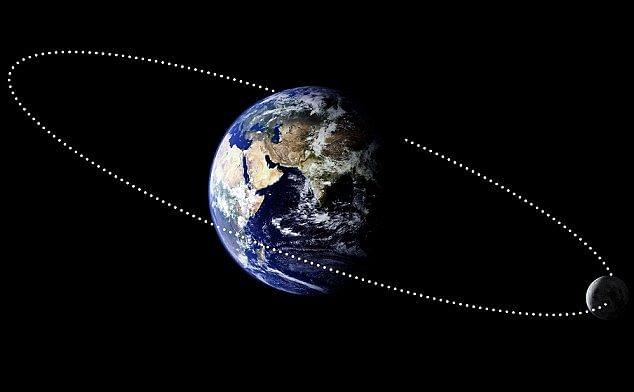
Moon’s Orbit around Earth
The truth is that it is not and the speed is right to stay where it is. The earth's magnetic field also protects us from harm. So for example, if the earth did not show any gravity, it would not exist in the first place. Without gravity, large sections of the earth's crust would collapse and float in space. Even so, without gravity, there would be no atmosphere or water on earth, and no living creature could ever survive in this hostile environment.
Read Also:
Gravity and Magnetic fields
[Click Here for Sample Questions]
The moon's orbit around the earth is believed to be one of the reasons why the earth is an active platform for sustaining life. All of this is due to the disruption of gravity. Just as the earth uses the moon's magnetic field for the moon, the moon uses its magnetic field for our planet. Although the gravitational pull of the moon is relatively small compared to the force of gravity on the earth, it still has some effects on our planet.

Magnetic Field Effect on Moon and Earth
Read More: Value of g on Moon
Rise and Fall of Tides
[Click Here for Sample Questions]
- The rising and falling of the oceans and even the lakes (to some extent) is a predetermined result of the gravitational pull of the moon.
- The high tide is when the moon's gravitational force is most intense as that part of the earth is much closer to the moon and the higher waves are also found at the far end of the moon due to the effect of inertia.
- The intermediate phase between the two points results in low-frequency waves.
Tidal Braking
[Click Here for Sample Questions]
The moon's gravitational pull also reduces the earth's orbit. This effect is known as tidal braking. Tidal braking increases the time of day by 2.3 milliseconds every century. As every action reacts, the effect of the brake transfers energy to the moon thus pushing the moon away from the earth. So the moon leaves the earth at a rate of about one point five inches each year.

Tidal Braking
Effect of Moon
[Click Here for Sample Questions]
- The effect of the moon on the planet's orbits may be the key to maintaining the climate for life on earth for billions of years.
- The gravitational pull between the earth and the moon is based on two elements, the mass of the celestial body and the distance between them.
Things to Remember
- The moon revolves around the earth but because of the speed at which the moon is connected to gravity, it keeps it from falling.
- The rising and falling of the oceans and even the lakes (to some extent) is a predetermined result of the gravitational pull of the moon.
- The gravitational pull between the earth and the moon is based on two elements, the mass of the celestial body and the distance between them.
- The moon's orbit around the earth is believed to be one of the reasons why the earth is an active platform for sustaining life.
Sample Questions
Ques. What would happen in the absence of gravity? (2 Marks)
Ans. Without gravity, large sections of the earth's crust would collapse and float in space. Even so, without gravity, there would be no atmosphere or water on earth, and no living creature could ever survive in this hostile environment.
Ques. Why is only one side of the moon visible to us? (2 Marks)
Ans. For the moon to complete its one orbit around the earth, it takes 27.3 days, and it completes its one orbit around its axis at the same time, that is, 27.3 days. As a result, although the moon rotates on its axis, we can see only one side of it and the other is hidden in the dark.
Ques. Why does the moon revolve around the earth? (2 Marks)
Ans. The moon is located in an open space in the sky, so no active force is at work to prevent it from moving on the earth. It orbits the Earth because of gravity, not allowing the moon to hover in space.
Ques. What is tidal braking? (2 Marks)
Ans. The moon's gravitational pull also reduces the earth's orbit. This effect is known as tidal braking. Tidal braking increases the time of day by 2.3 milliseconds every century. As every action reacts, the effect of the brake transfers energy to the moon thus pushing the moon away from the earth. So the moon leaves the earth at a rate of about one point five inches each year.
Ques. Does the moon revolve around its axis? (2 Marks)
Ans. Yes, the moon revolves around its axis. One lunar cycle takes about the same time as one orbit around the earth. Over time, there has been a decrease in the influence of gravity. Astronomers call this a closed state as we are expected to stay at the same speed from here onwards. Astronomers are always trying to learn new ideas and traits related to the moon.
Ques. Explain the effect of the moon on other bodies. (2 Marks)
Ans. The effect of the moon on the planet's orbits may be the key to maintaining the climate for life on earth for billions of years.
The gravitational pull between the earth and the moon is based on two elements, the mass of the celestial body and the distance between them. As the cluster survives, the earth becomes more and more powerful on the moon.
Ques. Explain the effect of the rising and fall of tidal waves on gravity. (2 Marks)
Ans. The rising and falling of the oceans and even the lakes (to some extent) is a predetermined result of the gravitational pull of the moon.
- The high tide is when the moon's gravitational force is most intense as that part of the earth is much closer to the moon and the higher waves are also found at the far end of the moon due to the effect of inertia.
- The intermediate phase between the two points results in low-frequency waves.
Ques. How is the revolution of the moon analogous to projectile motion? (2 Marks)
Ans. When the body is thrown, the force is applied directly to the curve of the earth but the movement of the object is in a parabolic state due to the action of gravity. The moon similarly revolves around the earth but because of the speed at which the moon is connected to gravity, it keeps the earth from falling. This keeps the moon in orbit around the earth even though it moves farther and farther away from our planet.
Check-Out:



Comments