



Content Curator
Characteristics of a sound wave includes its wavelength, amplitude, time period, frequency, and velocity or speed.
- Sound, like electricity, heat, and light, is a kind of energy.
- Vibration is the phrase used to describe the movement or shaking of the body, i.e. the to and fro motion of the body.
- Sound travels across a medium by contracting and expanding portions of the medium as it passes through.
- The pressure difference created by this compression and expansion is what we perceive as sound.
Key Terms: Refraction, Amplitude, Oscillations, Frequency, period, Wavelength, Sound wave, Time period
What is Sound?
[Click Here for Sample Questions]
Sound is a vibration that travels as an acoustic wave through a material such as air, liquid, or solid.
- Sound waves with frequencies ranging from around 20 Hz to 20 kHz, known as the audio frequency range, elicit an auditory perception in humans.
- These are sound waves with wavelengths ranging from 17 meters (56 feet) to 1.7 millimeters in air at atmospheric pressure (0.67 in).
- Ultrasound is defined as sound waves exceeding 20 kHz that are inaudible to humans. Infrasound refers to sound waves with frequencies less than 20 Hertz.
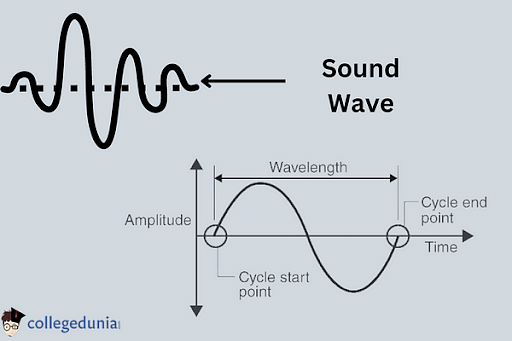
Sound Meaning Diagram
Production of Sound
[Click Here for Sample Questions]
Sound is produced by the rapid to and fro movement of an object i.e. vibration. The object subjected to vibration distorts the equilibrium condition of the particles in the medium, and vibration continues to transfer from one particle to another.
- The vibration of the body is the fundamental source of sound's creation.
- The emission of sound persists as long as a body's vibration continues.
- This sound provides a hearing sensation in our ears by passing across a continuous elastic membrane.
A tuning fork, for example, vibrates and creates sound when struck. If you contact the tuning fork with your hand, the vibration will stop.
As a result, the amount of sound produced will be lowered. As a tuning fork makes sounds, a pinball in touch with one of the tuning fork's arms moves away from the arm due to the fork's vibration.
Check More:
Propagation of Sound
[Click Here for Sample Questions]
Vibrating objects are known to generate sound. A medium is the matter or substance through which sound is transferred. It can take the form of a solid, liquid, or gas.
- Sound travels through a medium from its source to the listener.
- When an object vibrates, the particles in the medium around it vibrate as well.
- The particles do not make the entire journey from the vibrating object to the ear.
- A medium particle in touch with the vibrating object is initially pushed from its equilibrium location. It then applies a force to the particle next to it.
- As a result, the neighboring particle is displaced from its resting position.
- The initial particle returns to its original place after displacing the surrounding particle. This procedure continues until the sound reaches your ear.
- The disruption caused by a sound source in the medium passes through the medium rather than the medium's particles.
A wave is a disturbance that flows through a medium when the medium's particles cause neighboring particles to move. They, in turn, cause equivalent movement in others.
The particles of the medium do not move ahead on their own, but the disturbance does. This is what happens during sound propagation in a medium, hence sound can be visualized as a wave.
Types of Waves
[Click Here for Sample Questions]
There are two types of waves:
- Longitudinal waves
- Transverse waves
Longitudinal Waves
A wave in which the medium's particles vibrate back and forth in the same direction as the wave moves. Solids, liquids, and gases can all be used as mediums. Sound waves are hence longitudinal waves.
Transverse Waves
A wave in which the medium's particles vibrate up and down 'at right angles' to the wave's direction of travel. These waves can only be created in solids and liquids, not in gases.

Transverse and Longitudinal Waves
Read Also: Transverse and Longitudinal Waves
Characteristics of Sound Wave
[Click Here for Sample Questions]
The wavelength, Amplitude, Time-Period, Frequency, and Velocity or Speed are the five parameters that can be used to define a sound wave.
Wavelength
The shortest distance a sound wave can repeat itself is called the wavelength. It is equal to the length of a single complete wave. It is denoted with a Greek letter (lambda).

Wavelength
- The wavelength of a sound wave is the sum of its compression and any nearby rarefaction.
- The distance between the centers of two successive compressions or rarefactions is also equal to the wavelength.
- Half of its wavelength, or λ/2, separates the centers of compression from an adjacent rarefaction.
- The SI unit for wavelength measurement is the metre (m).
Amplitude
The amplitude of a wave can be expressed as the measure of the height of the wave.

Amplitude Diagram
- The largest displacement of the particles from their initial, undisturbed positions is the wave's amplitude when it travels through a medium.
- The amplitude is used to describe the size of the wave.
- The SI unit of amplitude measurement is the meter (m), but it is also sometimes expressed in centimeters.
Read More: Amplitude Formula
Time-Period
The wave's time period is the amount of time required to produce a single full wave, cycle, or cycle.
- The vibrating body now produces one entire wave from one single vibration.
- As a result, a time period is defined as the amount of time needed to complete one vibration.
- It's represented by the letter T.
- The second is used to measure time (s).
Frequency
The quantity of complete waves or cycles generated in one second is referred to as a wave's frequency.
- Since one complete wave is created by just one complete vibration of the vibrating body, the frequency is the measure of how many vibrations occur per second.
- For instance, the frequency of the waves will be 10 Hertz, or 10 cycles per second, if ten full waves or vibrations are created in one second.
- The SI unit of frequency is Hertz (Hz).
- A body generating one wave per second while vibrating has a frequency of one Hertz.
- Therefore, 1 Hz is equivalent to 1 vibration every second.
- The kilohertz (kHz) is a larger unit of frequency, with 1 kHz equaling 1000 Hz.
- The letter f stands for the frequency of a wave.
- A wave's frequency is the same as the frequency of the vibrating body that creates it.
Read More: Relation Between Amplitude and Frequency
Sound as Waveform
[Click Here for Sample Questions]
When sound waves are represented in a waveform, we immediately notice several basic properties.
- The waveform is a graphical representation of the pressure variation in the air that travels as sound.
- These waves alternate between high and low pressure areas.
- Because of the waveform, sound waves now appear to be extremely similar to light and other electromagnetic radiation.
Timbre
Consider a bell and a piano in a concert hall. Both instruments can produce the same musical notes, yet their sounds are vastly different.
- The piano generates a unique note, but striking a bell with the same pitch and amplitude produces a sound that continues to ring after it has been struck.
- The variation in sound is known as the Timbre.
- Timbre is described as the property of a sound that is utilized to distinguish two sounds that are of the same frequency.
- If two distinct sounds have the same frequency and loudness, they must have distinct timbres.
Reflection of Sound Waves
[Click Here for Sample Questions]
The phenomena of the Echo is caused by this sound characteristic. The rolling of thunder is also caused by repeated reflections from clouds and land surfaces.
- Sound waves reflect in the same way as light waves do.
- The incidence angle equals the reflection angle.
- A vast surface area reflecting a surface, such as a cloud, is required for the reflection.
- This reflecting principle is used in SONAR (Sound Navigation and Ranging) technology, which uses sound waves to navigate and communicate underwater.
- Sound waves reflected from objects are used to identify items on or beneath the water's surface.
Refraction of Sound Waves
[Click Here for Sample Questions]
Light refracts as the density of the material through which it travels changes. Similarly, sound refracts as the density of the atmosphere it is traveling through varies.
The density of a gas drops inversely proportional to temperature increase. It is so similar to light waves that it exhibits 100% internal reflection.
Diffraction of Sound Waves
[Click Here for Sample Questions]
Diffraction of sound waves is the phenomenon of the wave bending around objects. These can take the appearance of room walls, tables, or any other thing we observe around us.
We can hear the voice of a boy standing on the other side of a wall but cannot see him because of this phenomenon. This is because deeper tones of sound waves may bend better than sharp noises. Diffraction occurs in light waves as well, although to a much smaller extent.
Read Also:
Things to Remember
- Sound waves are produced due to variations in pressure and density of the medium.
- An Echo is the phenomenon of repetition of the sound of a source by reflection from an obstacle.
- The distance a wave travels in one second is known as the wave's velocity or speed.
- The sound wave propagates as compressions & rarefactions in the medium. Sound waves are longitudinal waves.
- Reflection of sound is used through SONAR to measure distances (ranging), communicate with or identify objects on or beneath the water's surface, such as other vessels.
Sample Questions
Ques. In which medium does the sound wave travel the fastest? (1 mark)
Ans: Through solids, sound waves travel the fastest.
Ques. Explosions happening on the Sun cannot be heard from Earth. Why? (1 mark)
Ans: Sound waves must travel through a material medium in order to be propagated. Because the space between Earth and the other planets is merely vacuum, the sound created during an explosion cannot be heard from Earth.
Ques. What is an ‘Echo’? (1 mark)
Ans: An echo is a reflection of sound that arrives at the listener after the main sound has passed. The delay is related to the distance between the source and the listener on the reflecting surface.
Ques. How does the sound produced by a vibrating object in a medium reach your ear? (3 marks)
Ans. Air is the most common medium for sound propagation. When vibrating objects, such as tuning fork prongs, move forward, the molecules of air in front of them are pushed out of the way.
This, in turn, compresses the air, resulting in a compression zone of high pressure and density. As it travels forward, the air compresses. Rarefaction occurs when the tuning fork prongs go backward in the air, creating an area of low pressure.
Low pressure, low density, and a large volume characterize this region. The compression and rarefaction zones in the air alternate as the tuning fork continues to vibrate. At the same site, these zones alternate. A ringing bell's force travels outward. The eardrums vibrate as a result of the energy entering the ears, allowing us to experience sound.
Ques. Why are sound waves called mechanical waves? (2 marks)
Ans. Mechanical energy is required to make an object vibrate. It is impossible to make sound energy on its own. Before reaching the ear, the mechanical energy of a vibrating object passes via a medium.
Sound waves travel in a straight line. It also cannot travel in a vacuum and must travel through a medium (solid, liquid, or gas). As a result, a sound wave is referred to as a mechanical wave.
Ques. What are the amplitude characteristics? (2 marks)
Ans. The vertical and maximum displacement of the wave from its mean location is referred to as the amplitude.
The amplitude is greater, and the energy is greater. The level of expression and compression experienced by the sounds a medium wave travels through is referred to as amplitude in sound.
Ques. How does the amplitude relate to the sound wave? (2 marks)
Ans. The amplitude of a wave is proportional to the amount of energy it carries. A high-amplitude wave carries a significant amount of energy, whereas a low-amplitude wave conveys a little amount of energy.
The intensity of the sound increases as the amplitude and wavelength of the sound increase. In simple terms, the amplitude is proportional to the intensity of a sound; if the sound is loud, the amplitude is larger, and vice versa.
Ques. How do frequency and amplitude affect the sound? (2 marks)
Ans. A vibration has two properties: regularity and frequency and amplitude, each of which influences how it sounds. The size of the vibration determines the amplitude, which defines how loud the sound is.
The pitch of a sound is determined by its frequency, which is the rate of vibration. Because sound travels at the same speed in the air at all frequencies, a change in frequency equals a change in wavelength.
Ques. What are Sound Waves? (3 marks)
Ans. Sound, like electricity, heat, and light, is a kind of energy. An example of sound waves is when a bell generates a loud ringing noise when struck. Instead of simply listening to the bell, place your finger on it once you've hit it.
Thus, it can be seen to vibrate. Vibration is the phrase which shows the movement or the shaking of the body, i.e. the to and fro motion of the body.
Sound is a vibration that travels through a medium as an audible type of energy. Sound travels across a medium by contracting and expanding portions of the medium as it passes through. The mobility of molecules in a medium is necessary for sound waves to propagate. As a result, sound waves are unable to travel in a vacuum.
Ques. How do sound waves propagate in a medium? (2 marks)
Ans. When an object vibrates, it pushes and compresses the air in front of it, generating a high-pressure zone. A series of compressions and rarefactions are formed in the air as the object goes back and forth quickly. These are the components that make up the sound wave that travels through the medium. In physics, sound is a vibration that travels through transmission media such as a gas, liquid, or solid as an acoustic wave.
Ques. Is diffraction of sound possible? (2 marks)
Ans. As sound waves pass through the doorway between the two rooms, the diffraction, bend, and spread. Diffraction happens only when the wavelength is close to the opening or object's size. In reality, when the wave's wavelength is smaller than the obstacle or opening, there is no discernible diffraction. Sound waves diffraction is frequent; we detect sound diffracting around corners or through door openings, allowing us to hear individuals speaking to us from other rooms.
Ques. Write a short note on characteristics of sound. (5 marks)
Ans: A sound wave has various features, much like any other wave. Amplitude, wavelength, period, frequency, and speed or velocity are the five properties of sound. It is essential that everyone learns about these properties in order to properly perceive sound.
Amplitude
The particles of the medium are momentarily moved from their true places when a wave travels through it. The amplitude of the wave is the largest deviation these medium particles make from their real positions during a wave's passage through them.
Wavelength
The shortest distance over which a sound wave can repeat itself is called the wavelength. It is equal to the length of a whole wave. The wavelength of a sound wave is the length of an adjacent rarefaction and compression put together.
- The distance between the centers of two subsequent rarefactions and compressions.
- The S.I. the wavelength unit is the meter.
Period
The period of the wave is the amount of time needed to create one full wave or cycle. One whole wave is created by one full vibration of the vibrating body.
- The period can be thought of as the length of time it takes to complete one vibration.
- T stands for the Period, and the second is the unit of measurement (S).
Frequency
The frequency of the wave is the total number of cycles or waves that are generated in one second. As an alternative, the quantity of vibrations per second can be used to describe frequency.
For instance, if 20 vibrations occur in a second, the waves will have a frequency of 10 Hertz and 10 cycles. When a wave travels through a different medium, its constant frequency does not change. Hertz or Hz are the two units of frequency.
Velocity
The distance a wave covers or travels in one second is referred to as the wave's velocity (speed with a direction vector).
- Meters per second (m/s) is the unit used to measure velocity.
- By dividing the distance traveled by the amount of time, one may determine the velocity of a wave.
- It can also be calculated by multiplying the wavelength by the wave's frequency.
Check More:



Comments