



Content Curator
An Electric Fuse is a device that is used for safety as it can limit the current in the circuit because of which there will not be any electrical damages or fire. This device protects the circuit from overloading and short-circuit.
This article will explain the functions, working, characteristics, and types of fuses.
Read Also: Potential Energy
| Table of Content |
Key Takeaways: Functions, Working of Fuse, Ratings, Voltage Drop, AC Fuses, DC Fuses, Breaking Capacity.
Definition of Electric Fuse
[Click Here for Sample Questions]
An electric fuse is made up of elements like zinc, copper, aluminium, and silver. This acts as a circuit breaker and breaks the circuit if there is any fault in the circuit because of excessive current flow.
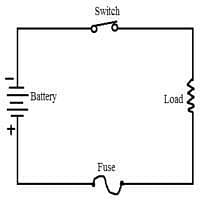
The electric fuse is made from a material that has high resistivity and a very low melting point and hence when there is more current flow it gets overheated and melts down.
Check Important Notes for Combination of Cells
Functions of Electric Fuse
[Click Here for Sample Questions]
There are many possible functions of an electric fuse. Some of them are listed below.
- An electric fuse acts as a protection and a barrier between the electric circuit and the human body.
- Whenever there is excess current flow, the electric fuse acts as a blocker and prevents damage to the electric device.
- It helps to reduce or prevent the overload of current. In case many appliances are connected to a single circuit, there’s a possibility of an overload and hence, the fuse becomes mandatory to terminate the circuit connection.
- There will be damage to the device whenever there are mismatched loads and this also can be prevented when there is an electric fuse.
Also Read:
Working of Electric Fuse
[Click Here for Sample Questions]
The electric fuse is a non-combustible material that is made from a thin metallic wire. It is always connected at both the ends of the terminal in the series connection with the circuit.
In a circuit, because the current flows excessively, heat will be generated melting the fuse as the melting point of the fuse is low. This also opens the circuit in addition to melting the fuse. This excessive current flow will cause breakdown and even stop the flow of the current. If such a case happens, the fuse has to be replaced or changed with a new one.
Characteristics
[Click Here for Sample Questions]
There are a few characteristics of an electric fuse in order to make it useful in various types of applications like residential, industrial, and automotive purposes.
Some of those characteristics include:
- Current rating or capacity
The current rating or current capacity of an electric fuse is the maximum amount of current that a fuse can handle before melting or blowing. The unit for this is Amperes.
- Voltage rating
Same as in the case of current the fuses are specified with a specific amount of voltage that they can handle. Depending on these voltage values fuses will be divided into low voltage (LV) Fuses and High voltage (HV) fuses.
- Heat energy
I2T value of the fuse is the measurement for the heat energy in the electric fuse. Due to the current flow heat energy is produced and an arc will also be produced when a fuse is blown.
- Breaking capacity of the fuse
This is also called the interrupting rating or short circuit rating. The breaking capacity of the fuse is the maximum safe value of current that a fuse can interrupt at a voltage point less than the maximum rated voltage for that particular fuse.
- Packaging Size:
AC fuse and DC fuse will have different packaging types. Different applications require different packaging sizes depending on the type of application that is used which suits the circuit.
?Also Read More:
Types of Fuses
[Click Here for Sample Questions]
Depending on the variety of applications there are many different types of fuses. Depending on the type of circuit they are used, the fuses can be categorized into AC Fuses and DC Fuses.
AC Fuses will be again divided into high voltage (HV) fuses and low voltages (LV) fuses.
High Voltage (HV) AC Fuses
These fuses are used for voltages above 1000V.
These are further classified into these three categories
- Cartridge Type HRC (High Rupturing Capacity) Fuses
- Liquid Type HRC Fuses
- Expulsion type Fuses.
Check Important Difference Between Fuse and Circuit Breaker
Low Voltage (LV) AC Fuses
Low Voltage (LV) AC Fuses are used for voltages that are less than 1000 V.
These are further divided into categories like
- Cartridge Fuses (Totally Enclosed Type)
- Rewireable Fuses (Semi – Enclosed Type)
- Switch Fuses
- Drop out Fuses
- Striker Fuses.

- AC Fuses:
AC fuses are small in size when compared to DC fuses. In AC arc can be extinct easily as compared to DC because voltage with 60 Hz or 50 Hz frequency changes its amplitude from zero to sixty every second.
- DC Fuses:
In a DC electrical fuse, DC will have constant value and hence the arc that is produced because of the heat that is generated by the excessive current cannot be extinguished easily. So, to minimize this fuse arching, the DC fuses are bigger than AC fuses.
?Also Check:
Applications
[Click Here for Sample Questions]
Electrical fuses will be available in almost all electrical or electronic circuits, systems, and applications. Some of those applications include
- Transformers
- Home electrical wiring
- All electrical appliances like air conditioners, TV, washing machines.
- Mobile phones
- Laptops
- Cameras
- All vehicles like cars, bikes, trucks, and buses
- Gaming console
- Printers and scanners.
Things to Remember
[Click Here for Sample Questions]
- The fuse wire thickness will be determined based on the amount of current flow in the circuit.
- The maximum current value that can be interrupted by the fuse is called breaking capacity and this should be more than the short circuit current.
- An electric fuse is an electronic, or mechanical device that can protect circuits from over current, overload by melting and opening the circuit by breaking the current flow at that point.
- An electric fuse works on the principle called the heating effect of electric current.
Read Also: Kirchhoffs Laws
Sample Questions
Ques: What are the two main types of electric Fuse?
Ans: The two major types of electric fuses include AC fuse and DC fuse.
Ques: How does an electric fuse work?
Ans: Whenever there is more amount of electricity in the circuit, the heat gets generated melting the fuse making the circuit open stopping the current to flow any further.
Ques: What is a fuse made of?
Ans: An electric fuse is a thin metal strip that is made up of elements like zinc, copper, aluminium, and silver
Ques: A fuse will be inserted in a live wire or a neutral wire?
Ans: A fuse wire will be inserted in a live wire, as it is the safety device that is used to secure the equipment from any damages that might have been caused because of overloading.
Ques: Which type of wire is used for the preparation of an electric fuse?
Ans: The wire that has a low melting point will be used as an electric fuse making it easy to melt and break the circuit whenever there is more current flow.
Read More



Comments