




NCERT Exemplar Solutions for Class 11 Physics Chapter 4 Laws of Motion solve all 42 questions from the Exemplar book. Every MCQ, Very Short Answer, Short Answer and Long Answer problem is worked step by step. The free PDF on this page runs to 77 pages and follows the 2026-27 syllabus.
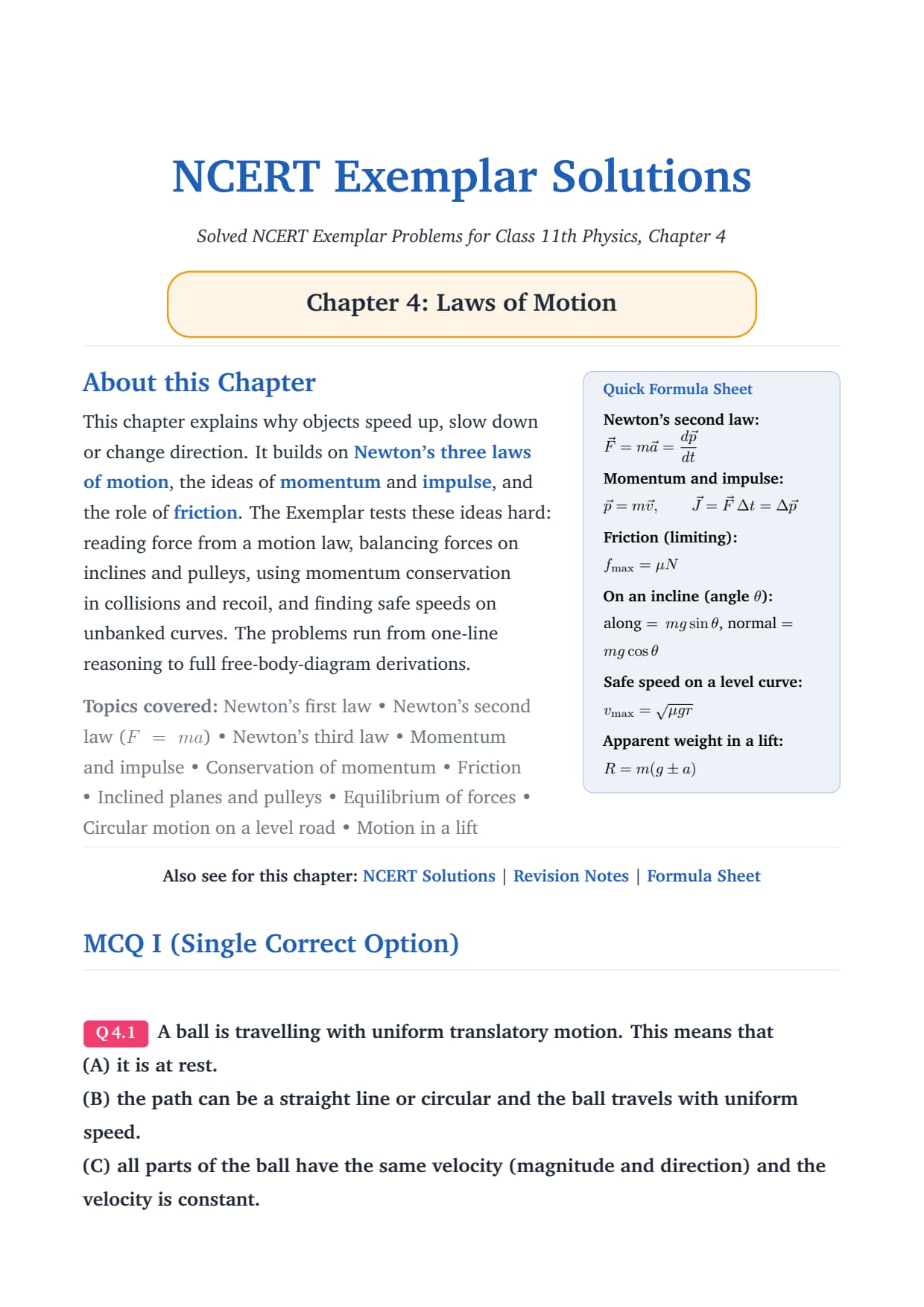
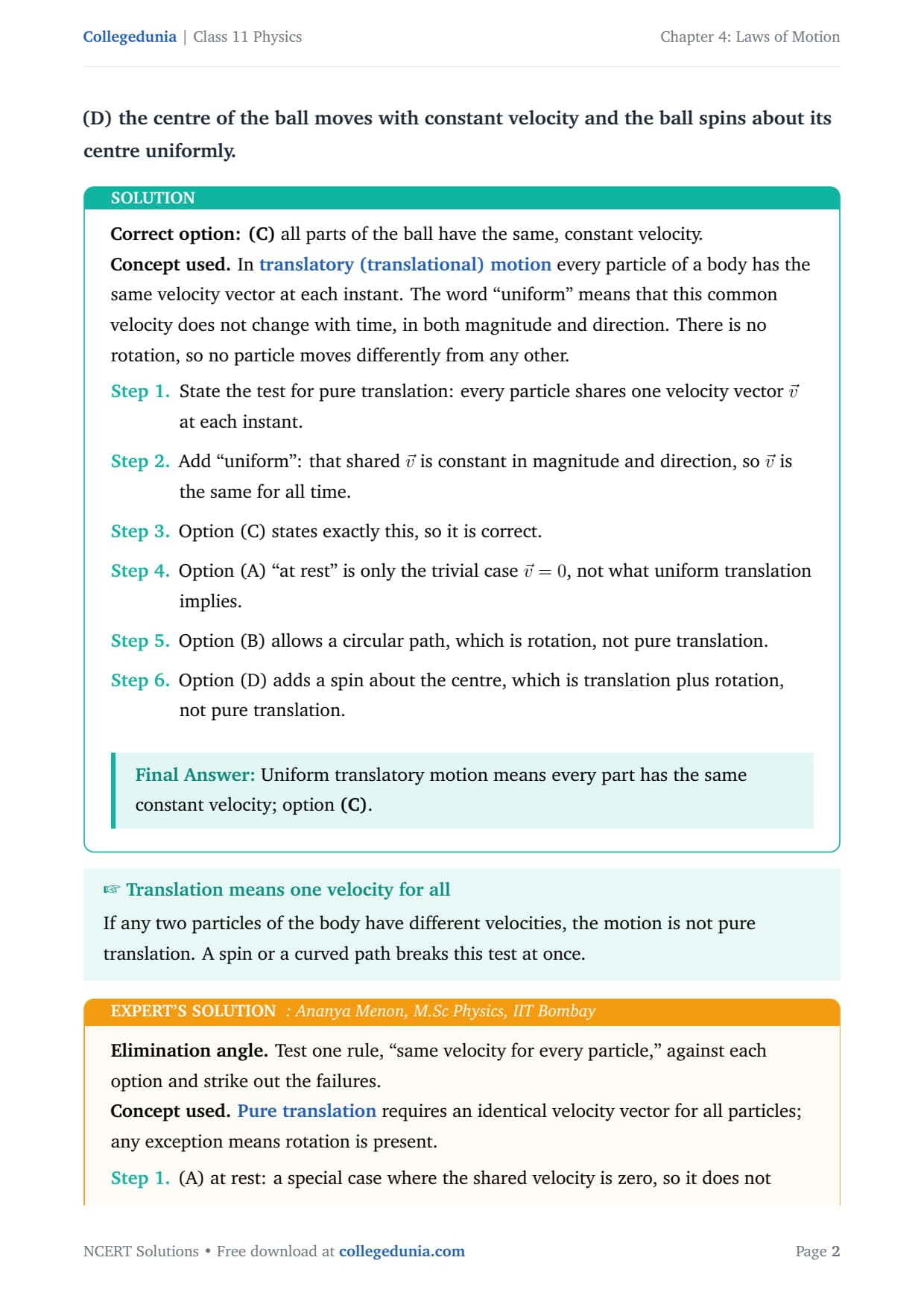
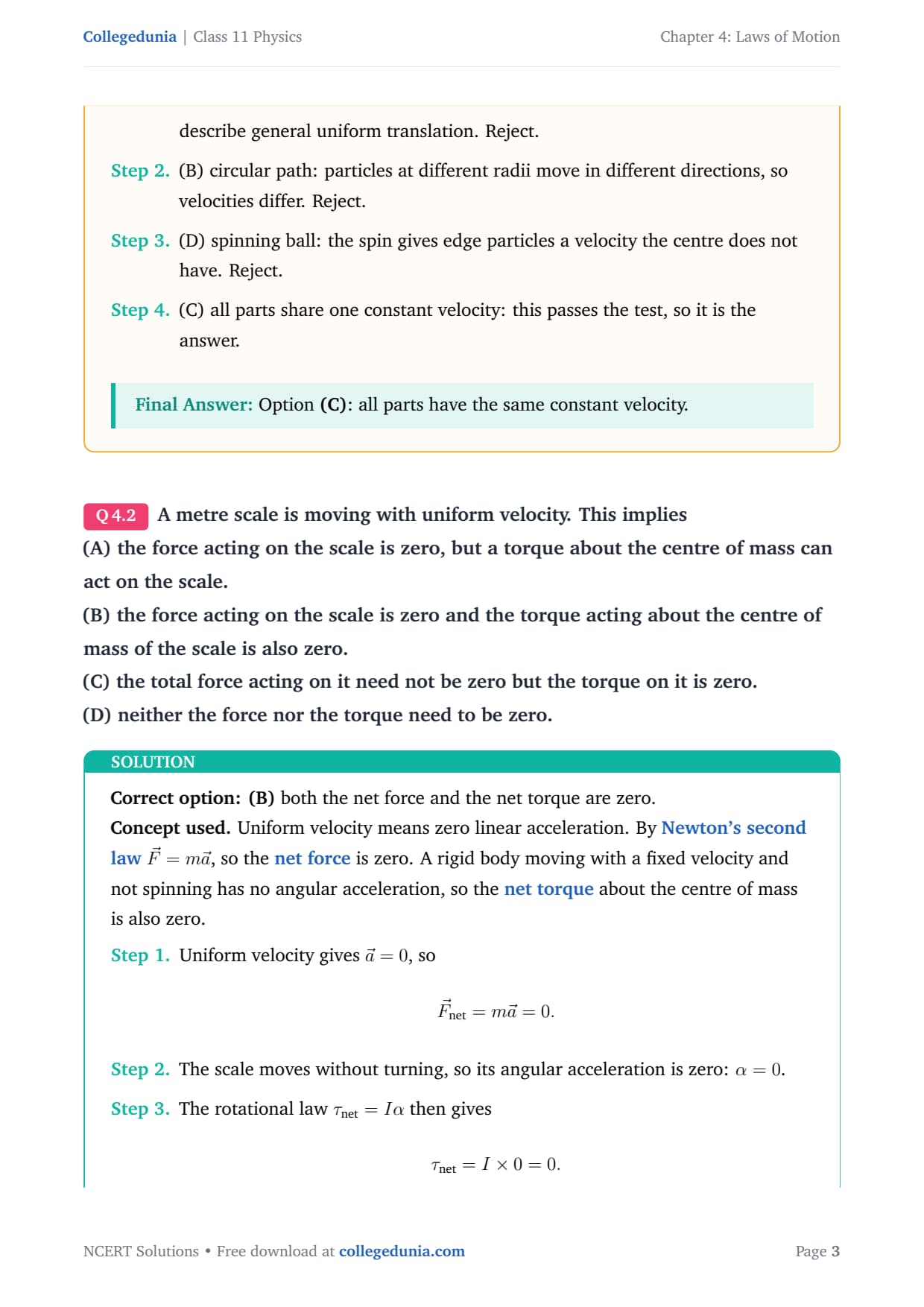
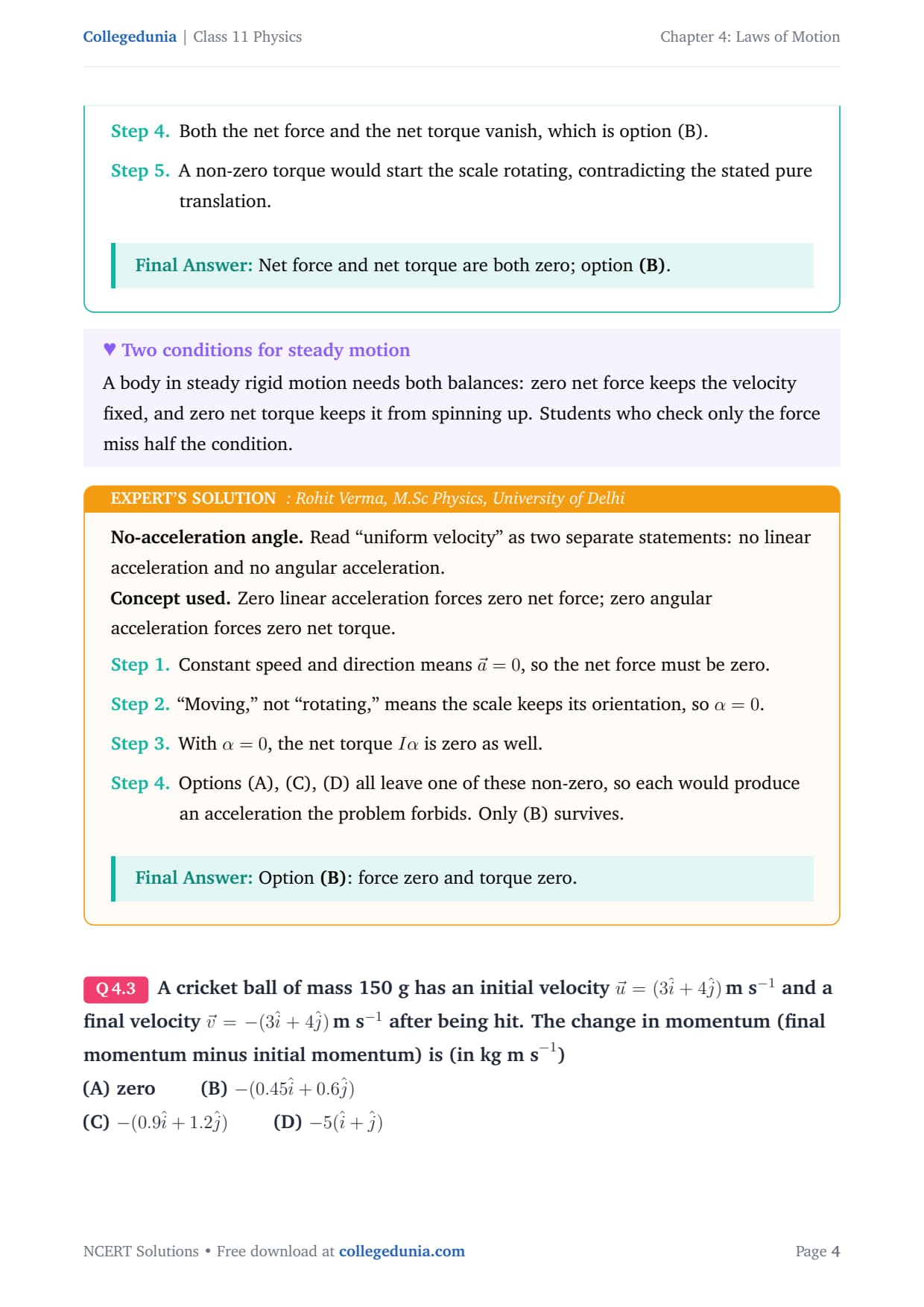
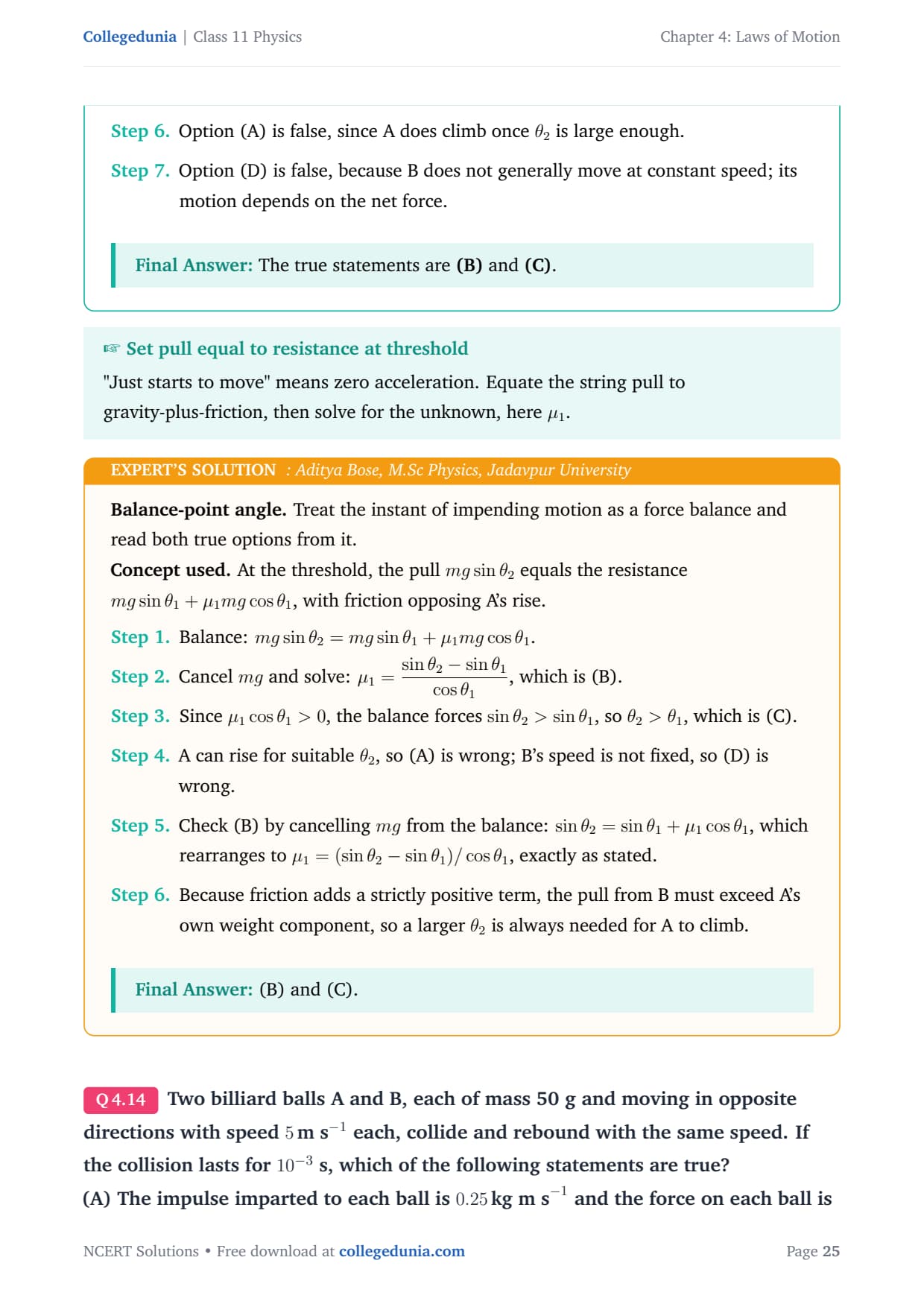
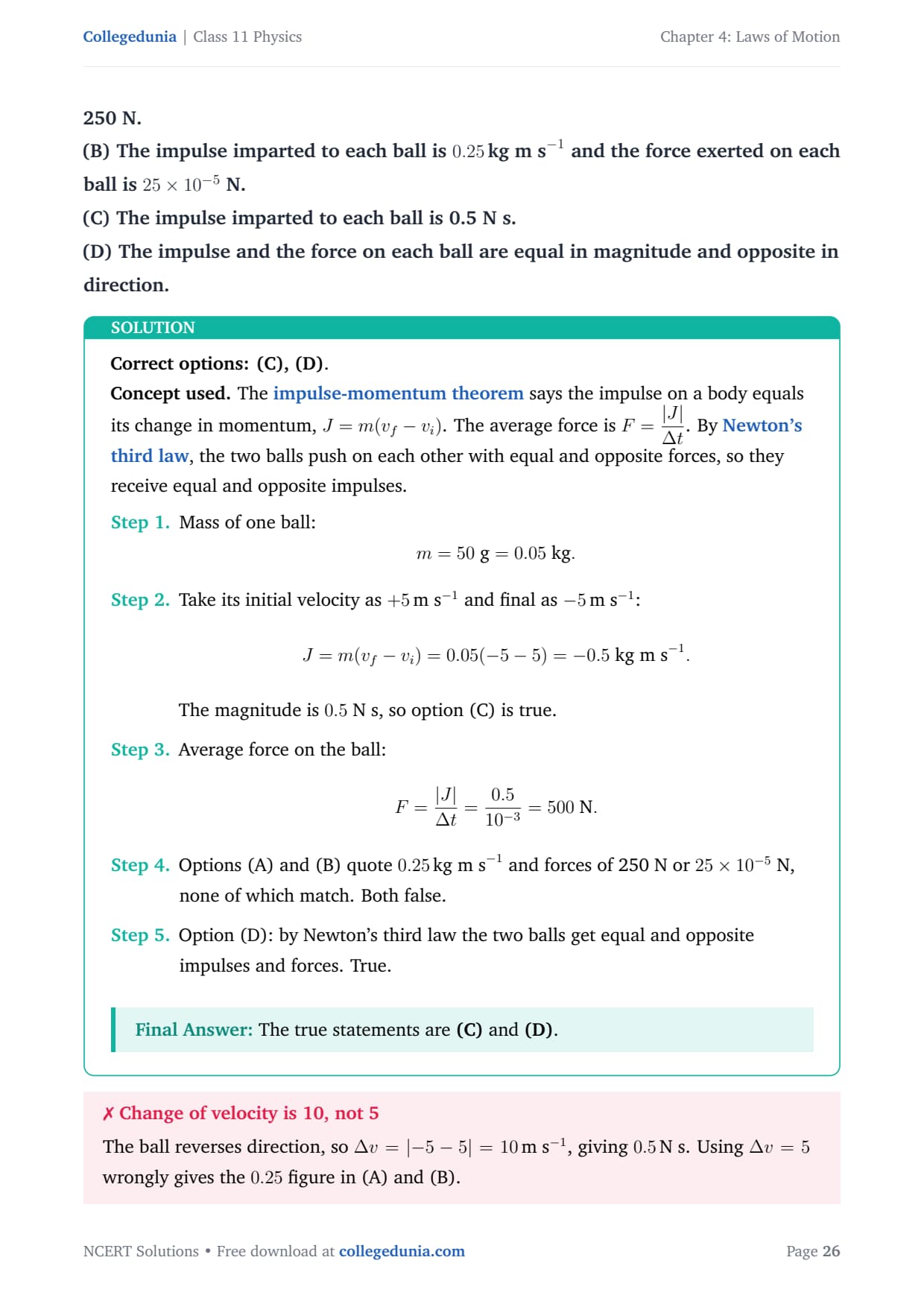
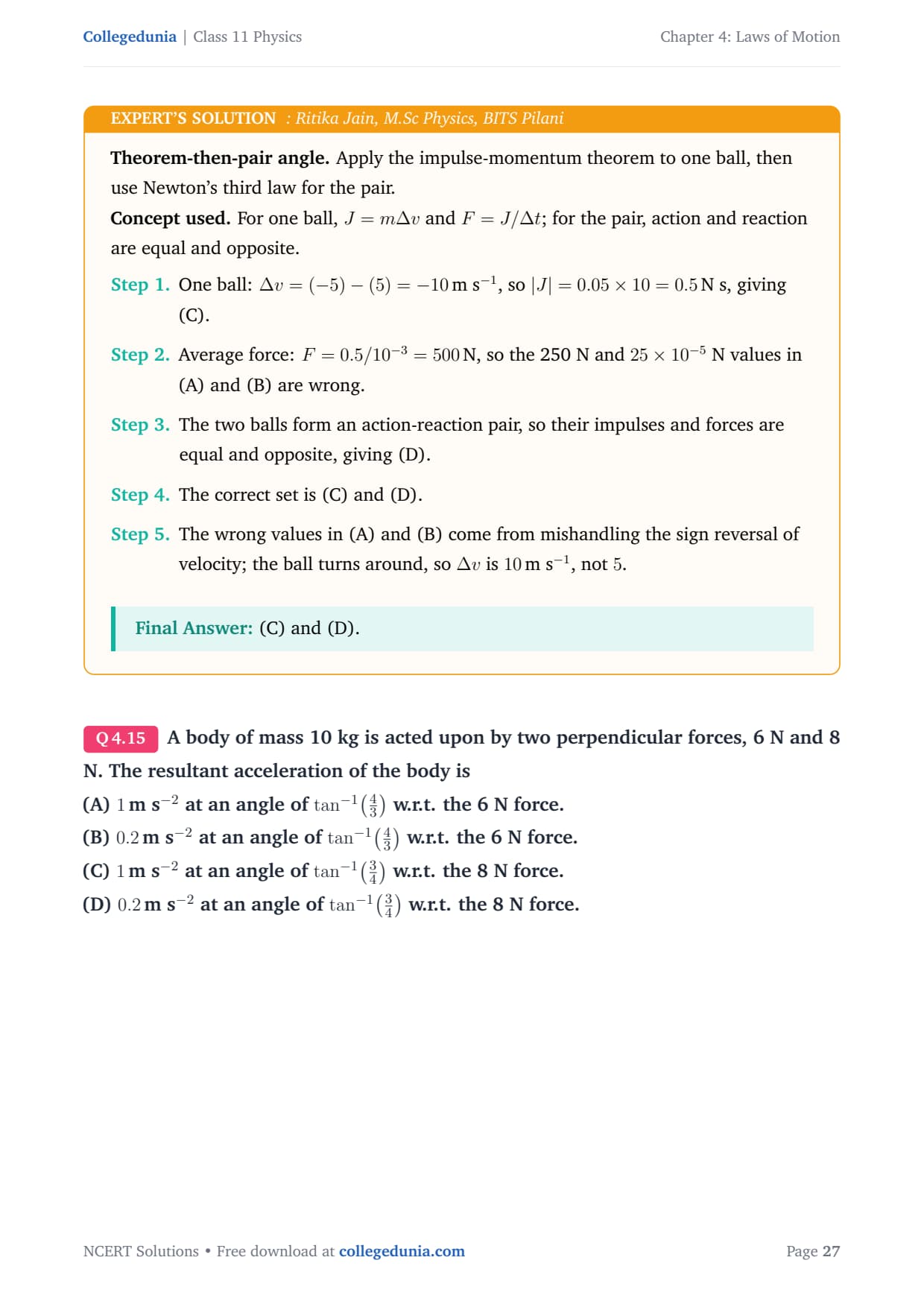
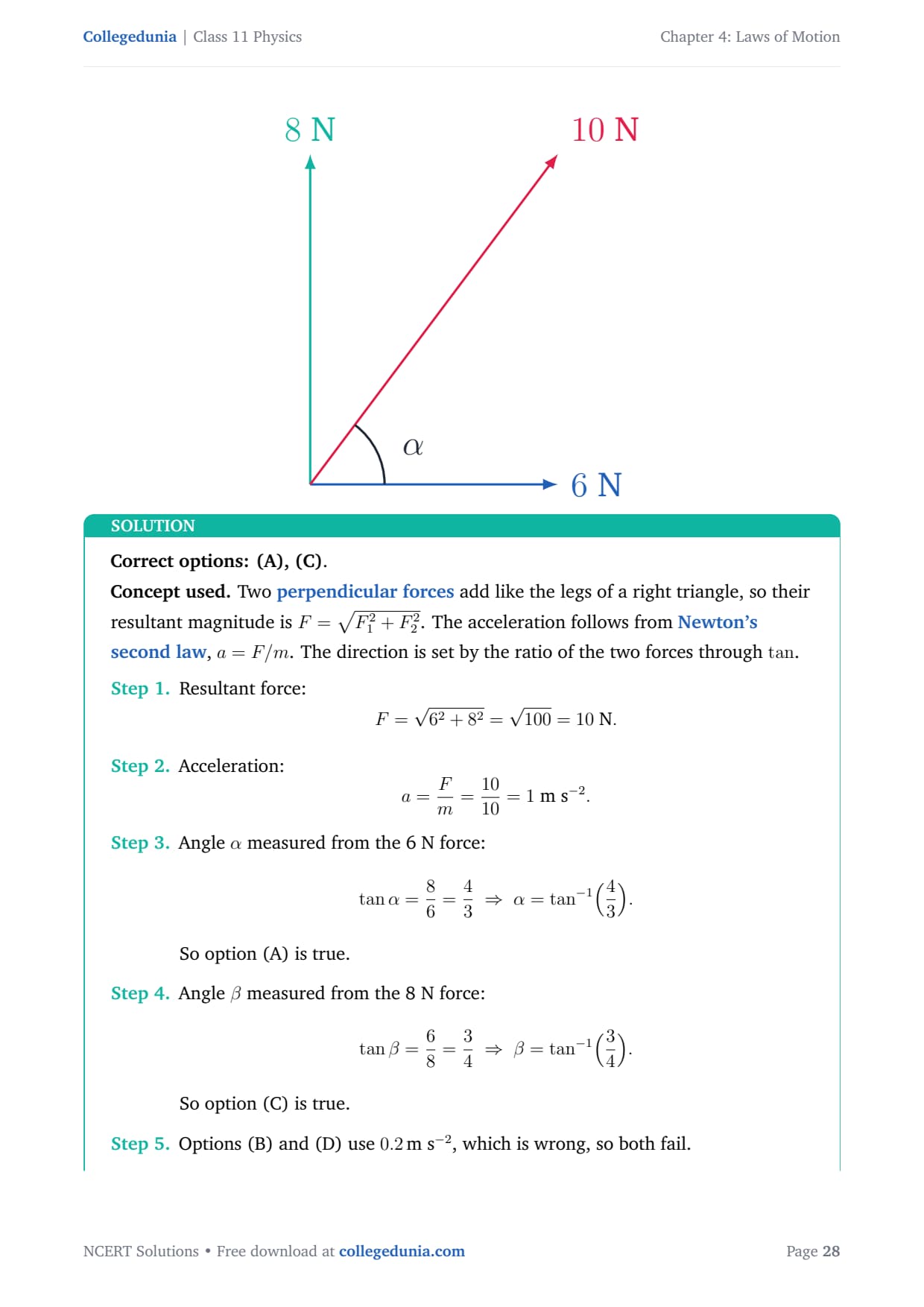
Laws of Motion is where Class 11 Physics stops describing motion and starts explaining it. Newton's three laws, friction, tension and circular motion all sit in this one chapter. The Exemplar pushes each idea well past the textbook exercise.
- CBSE Weightage: 6 to 8 marks, usually a free-body diagram numerical plus one short reasoning question
- JEE Main Weightage: 2 to 3 questions per year, most often on friction, pulleys or connected blocks
- NEET Weightage: 2 questions per year from momentum, impulse and friction
Solutions checked against the official NCERT Exemplar answer key, with every free-body diagram drawn out in full.
Topics Covered in the Class 11 Physics Laws of Motion Exemplar
The Exemplar for this chapter is built on five ideas. Each returns in Work Energy and Power, and again in Rotational Motion, so the effort here carries forward.
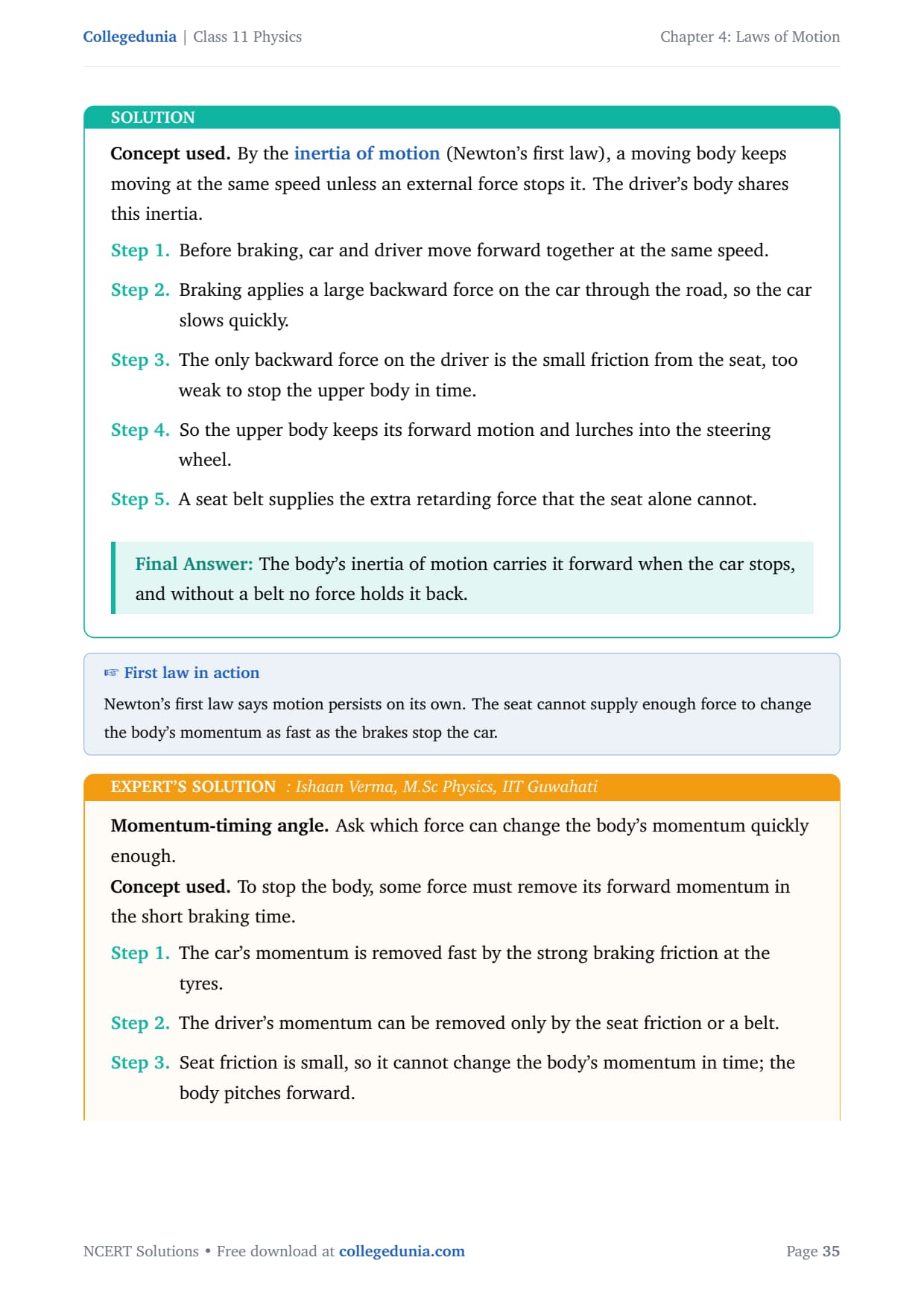
- Inertia and the first law: uniform translatory motion, and why zero force still allows a torque
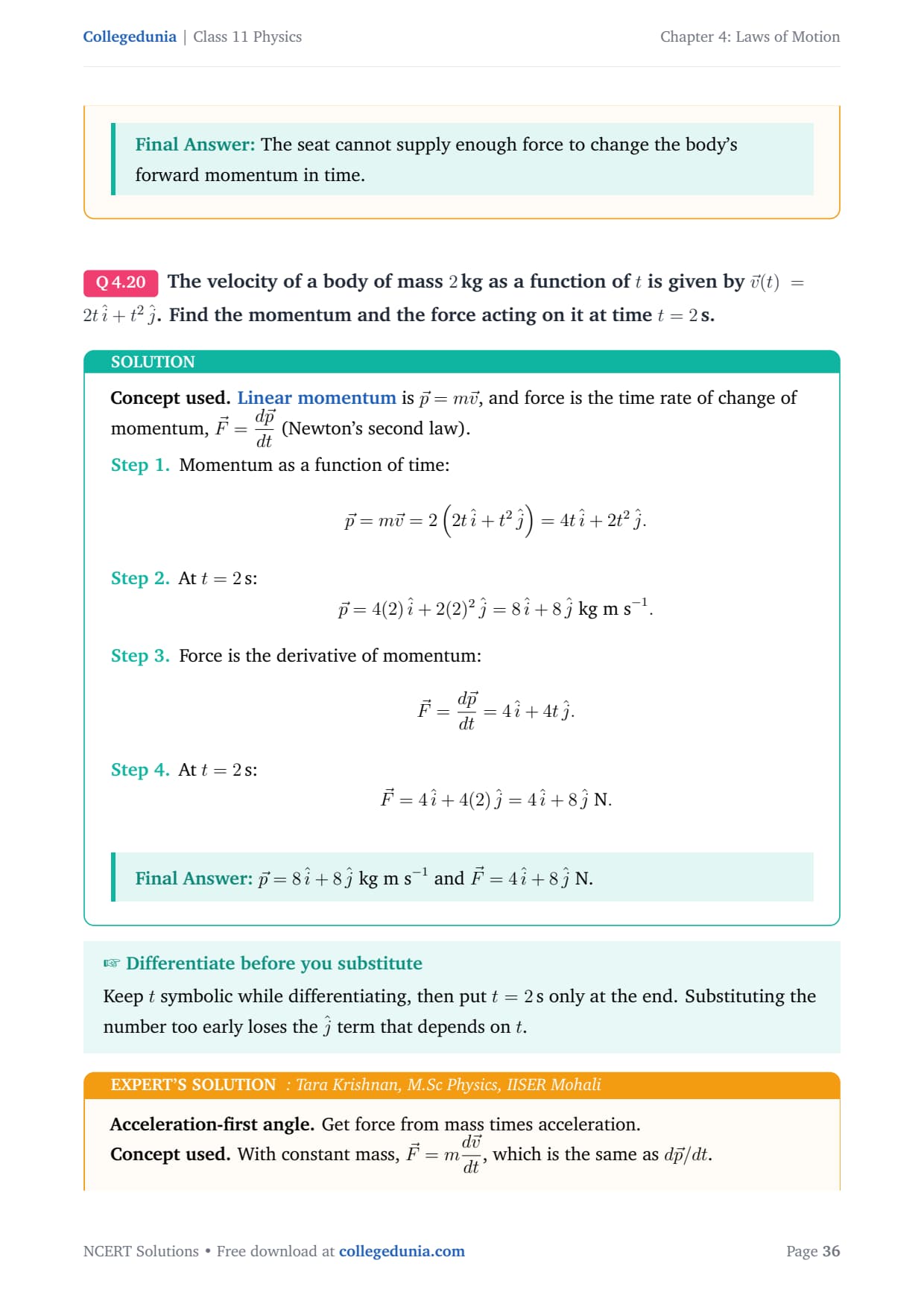
- Momentum and the second law: force as the rate of change of momentum, not simply mass times acceleration
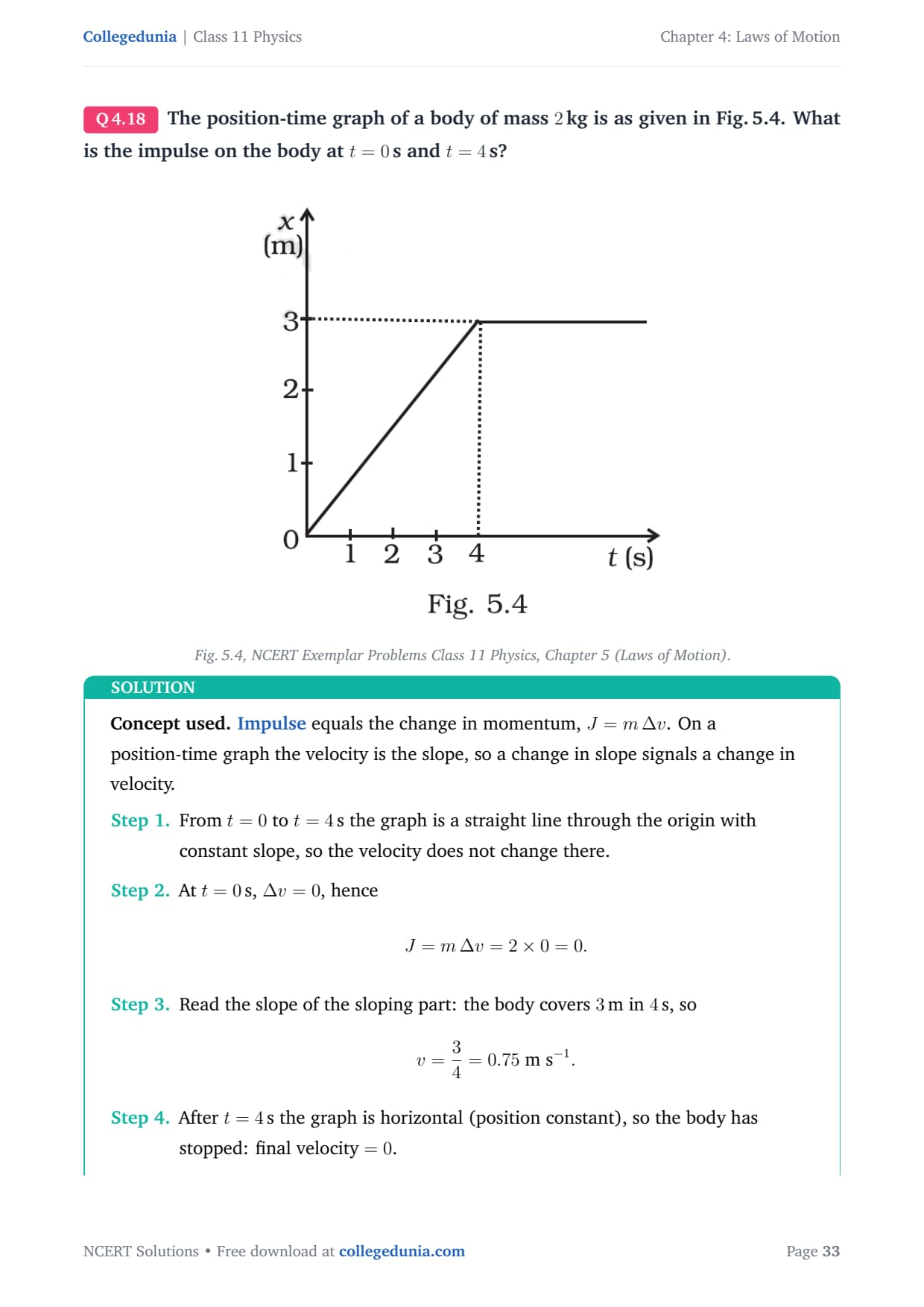
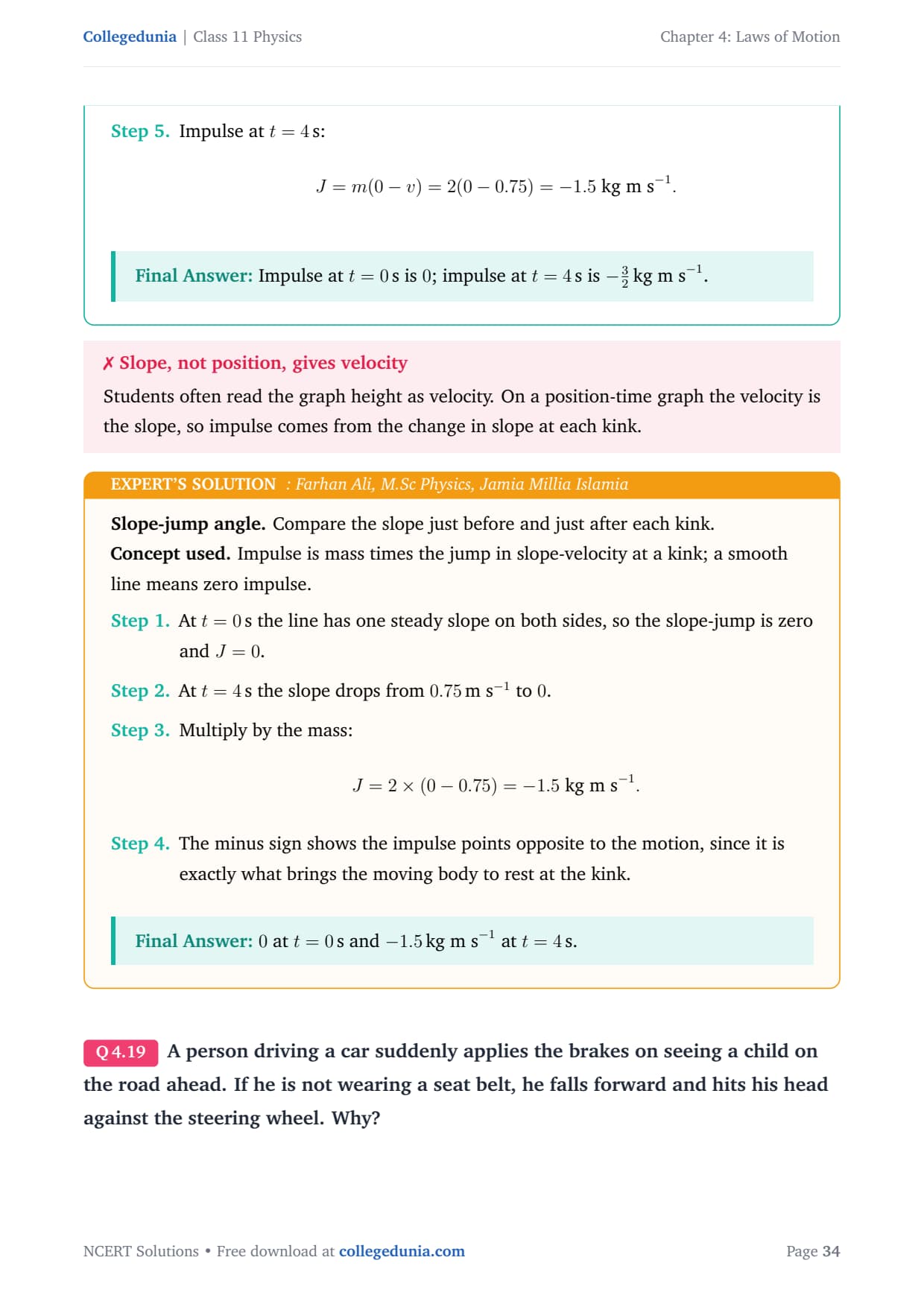
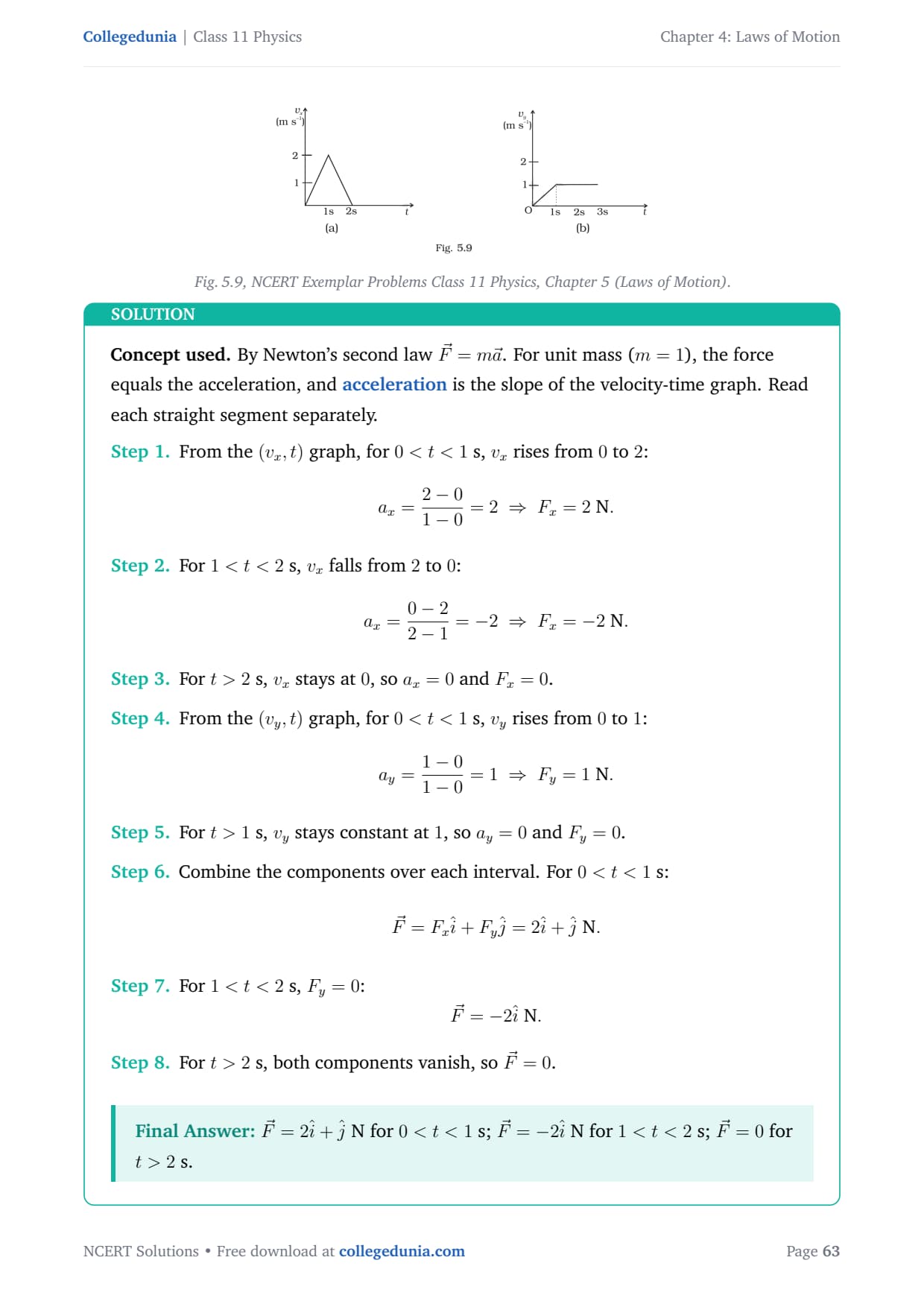
- Impulse: the impulse-momentum theorem, and reading impulse off the kinks in a position-time graph
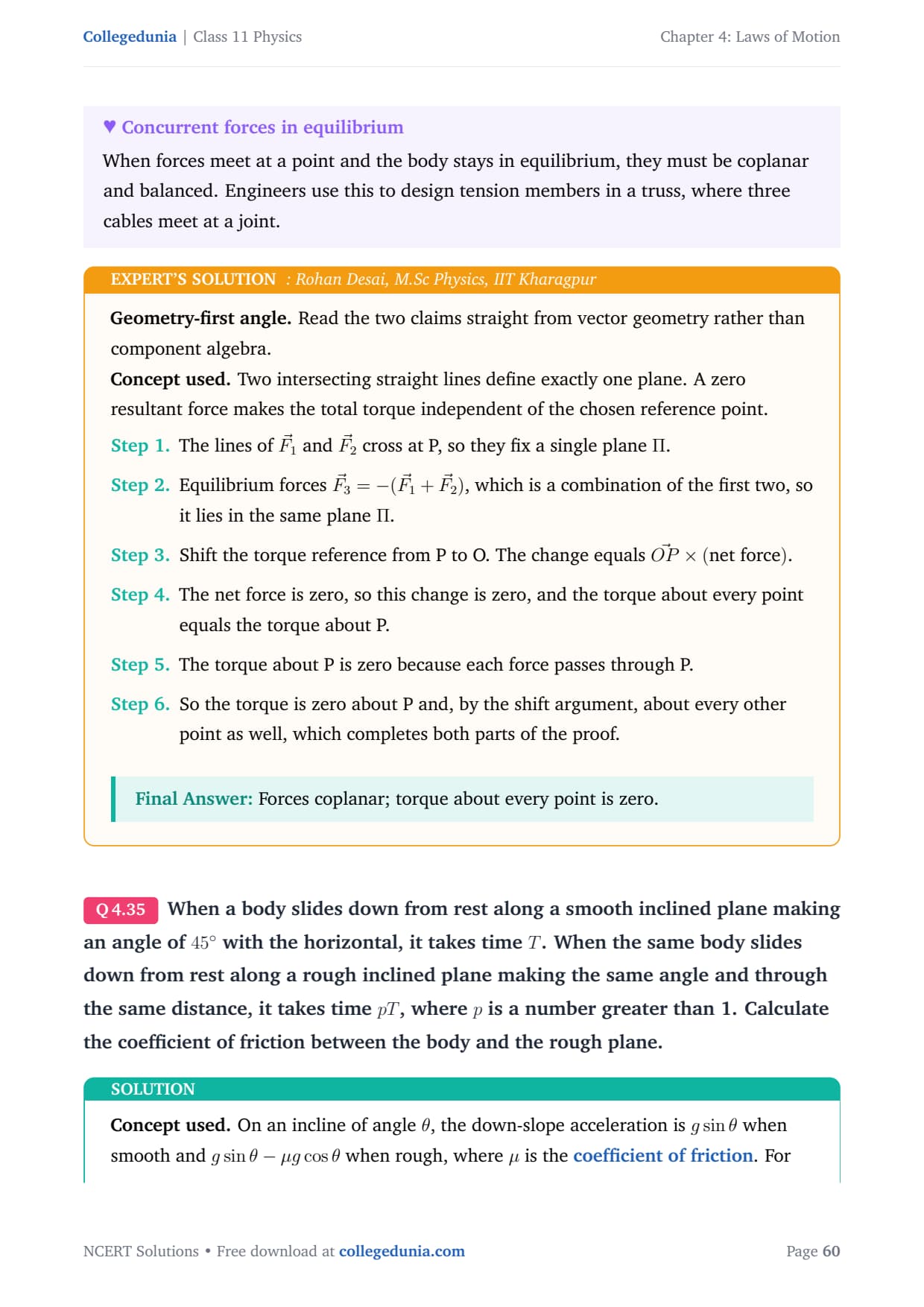
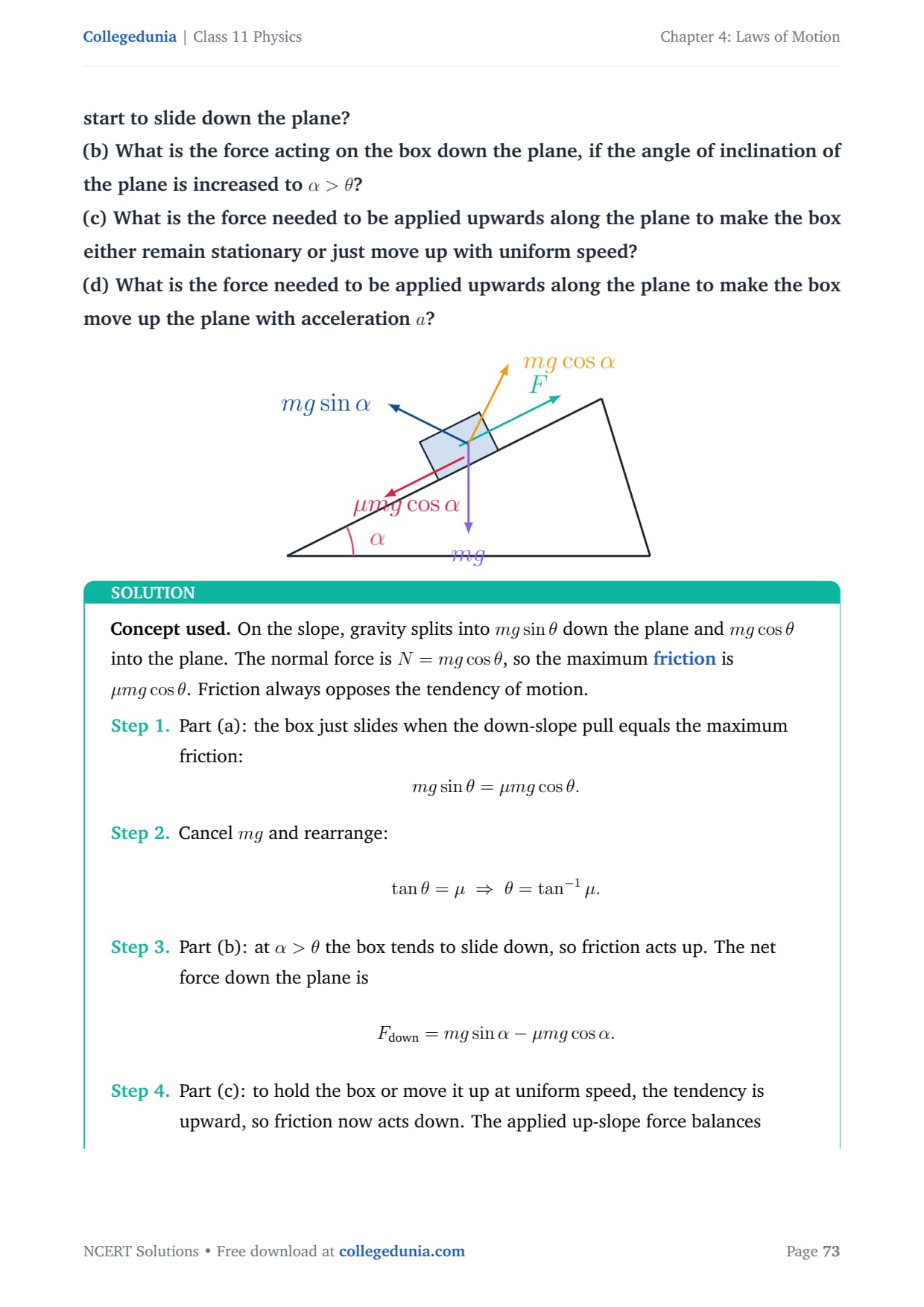
- Friction: static, limiting and kinetic friction, plus the coefficient of friction on slopes
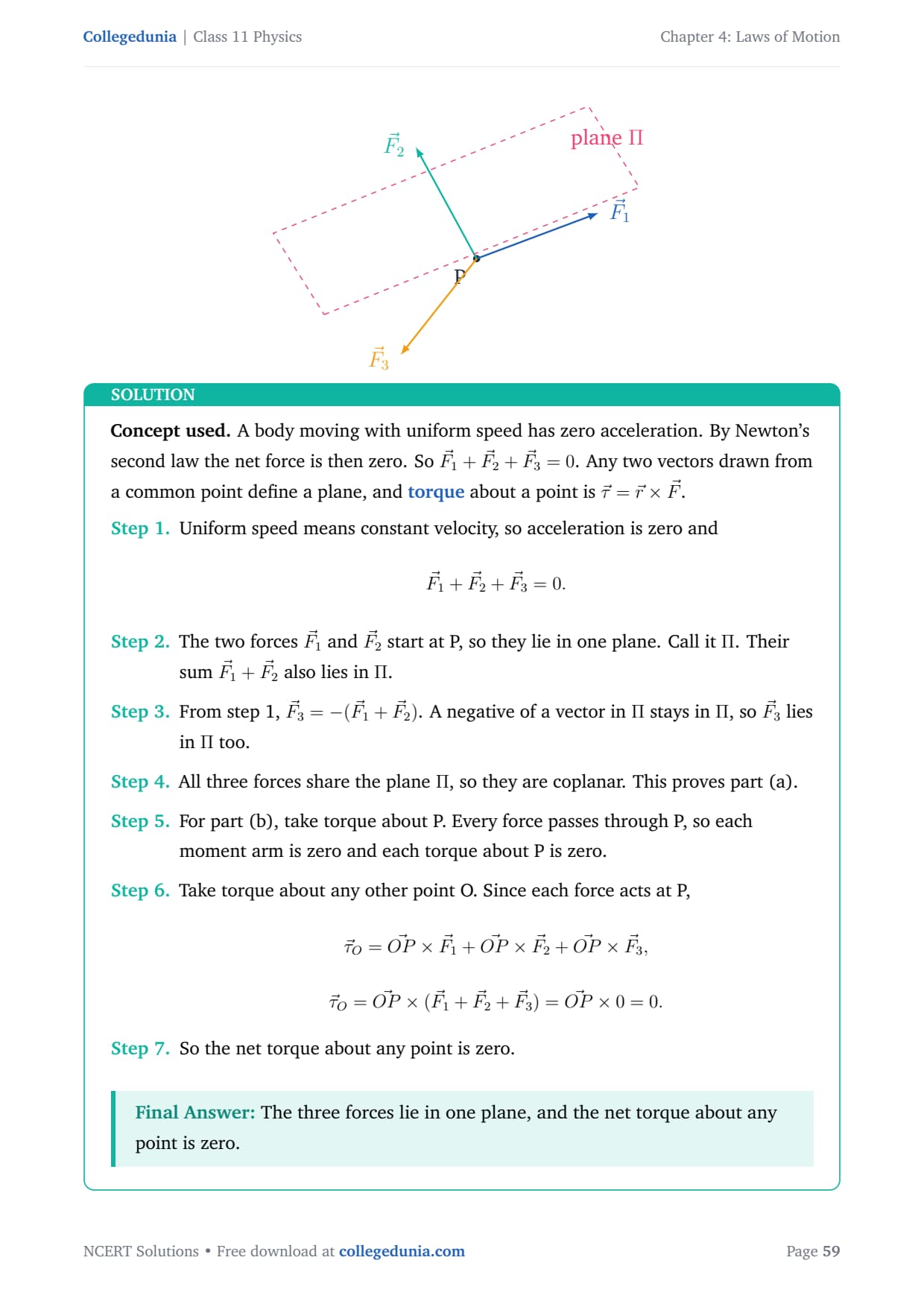
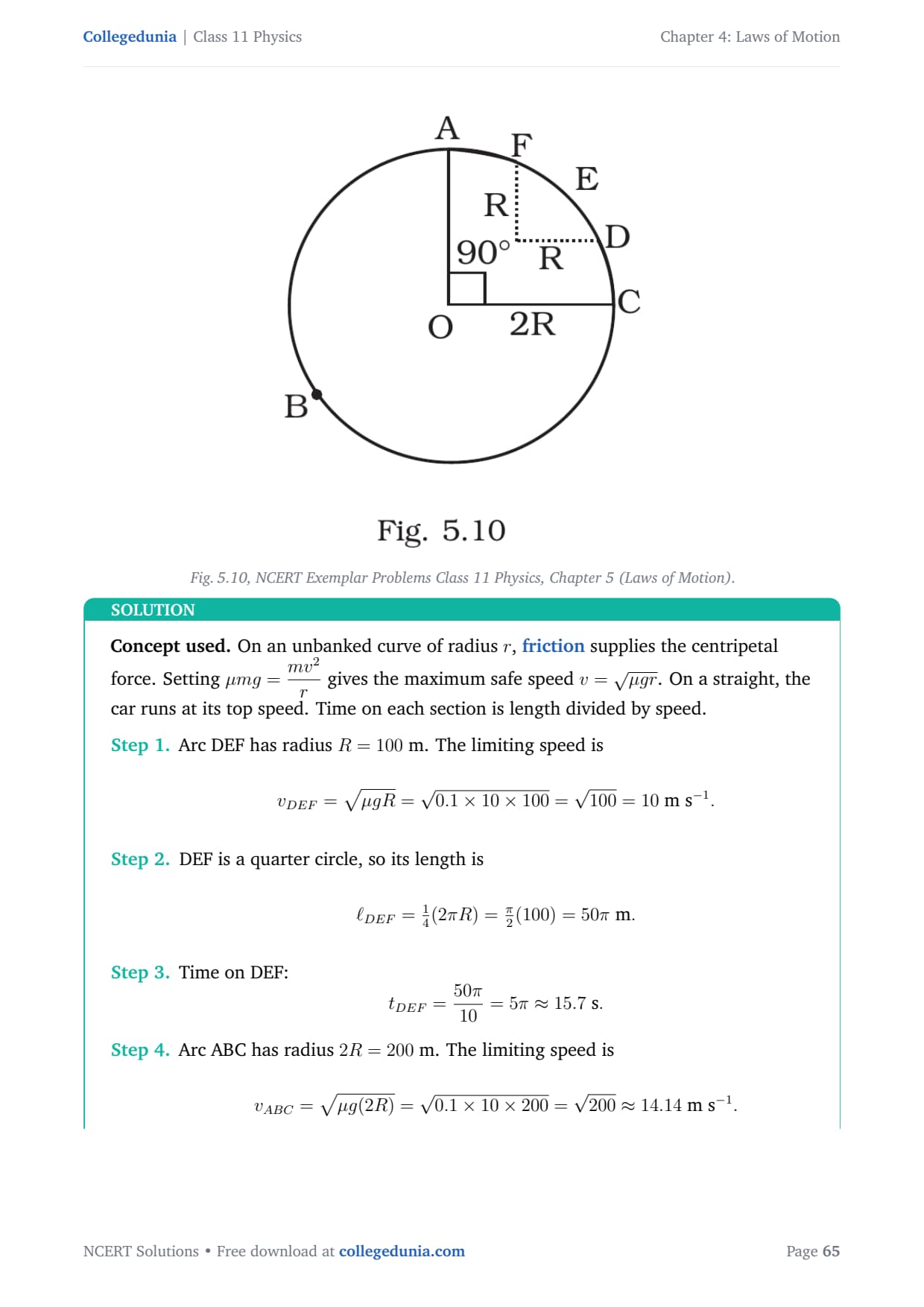
- Equilibrium and circular motion: concurrent forces, net torque, and friction as centripetal force
Question Types in the Laws of Motion NCERT Exemplar
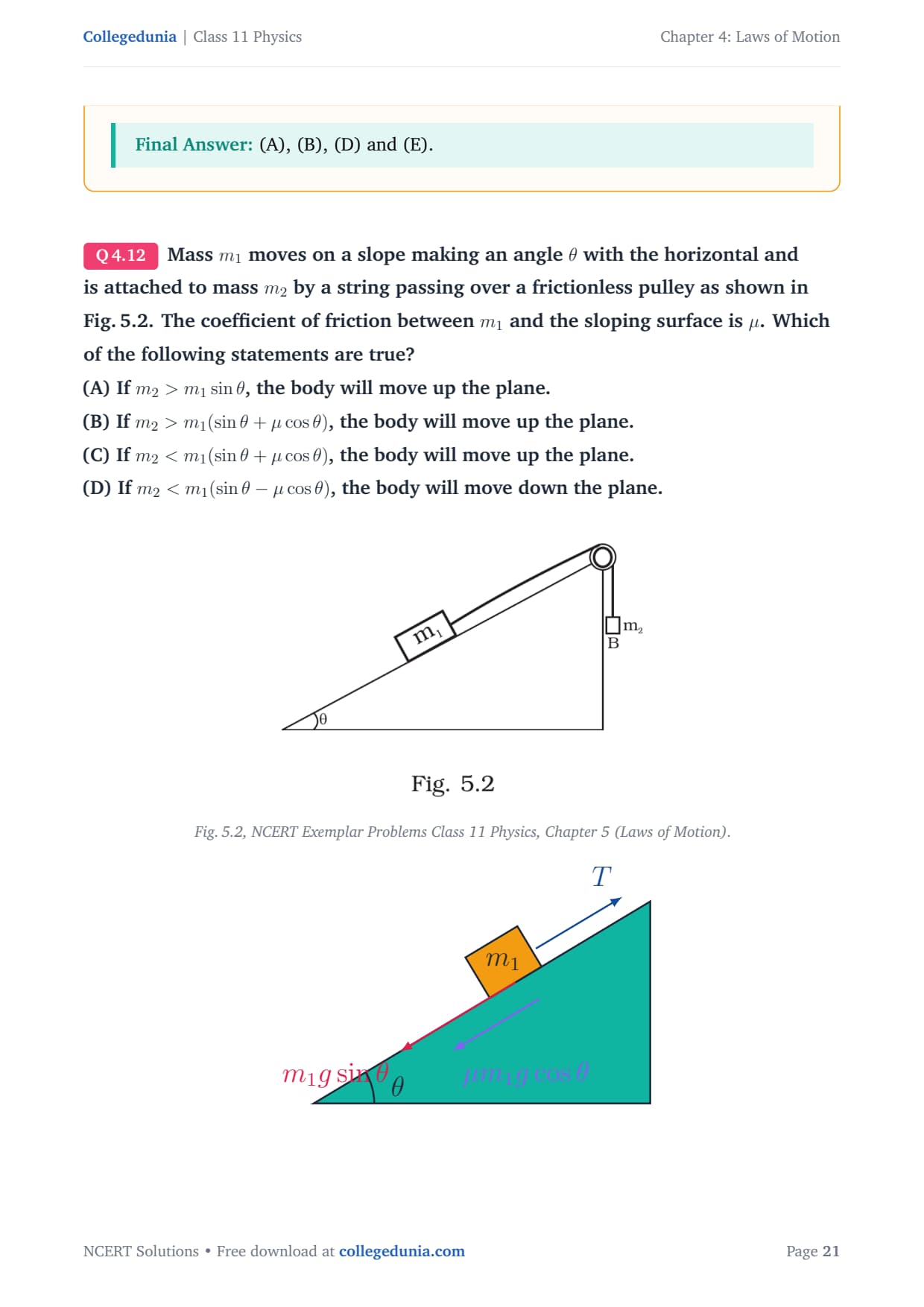
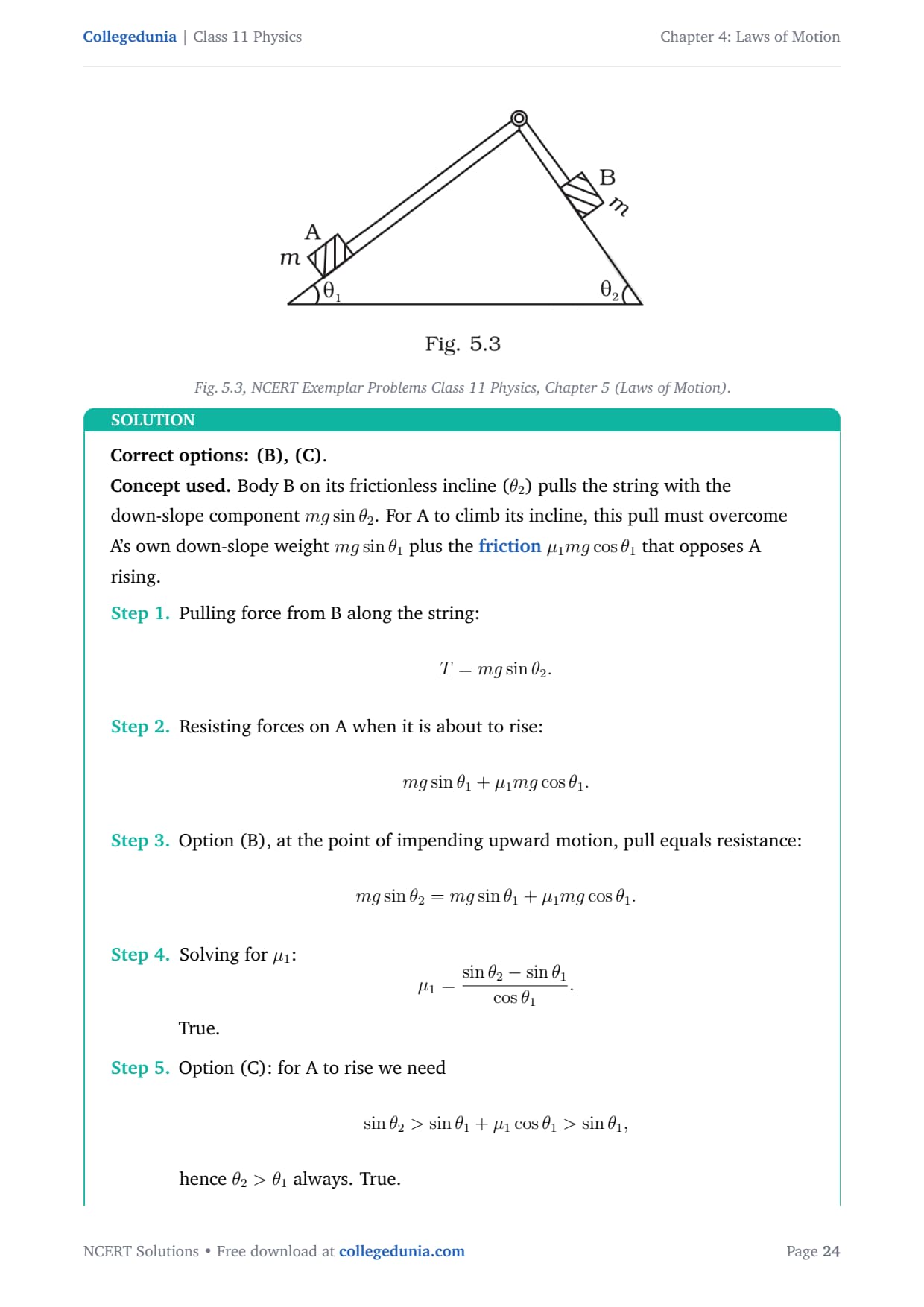
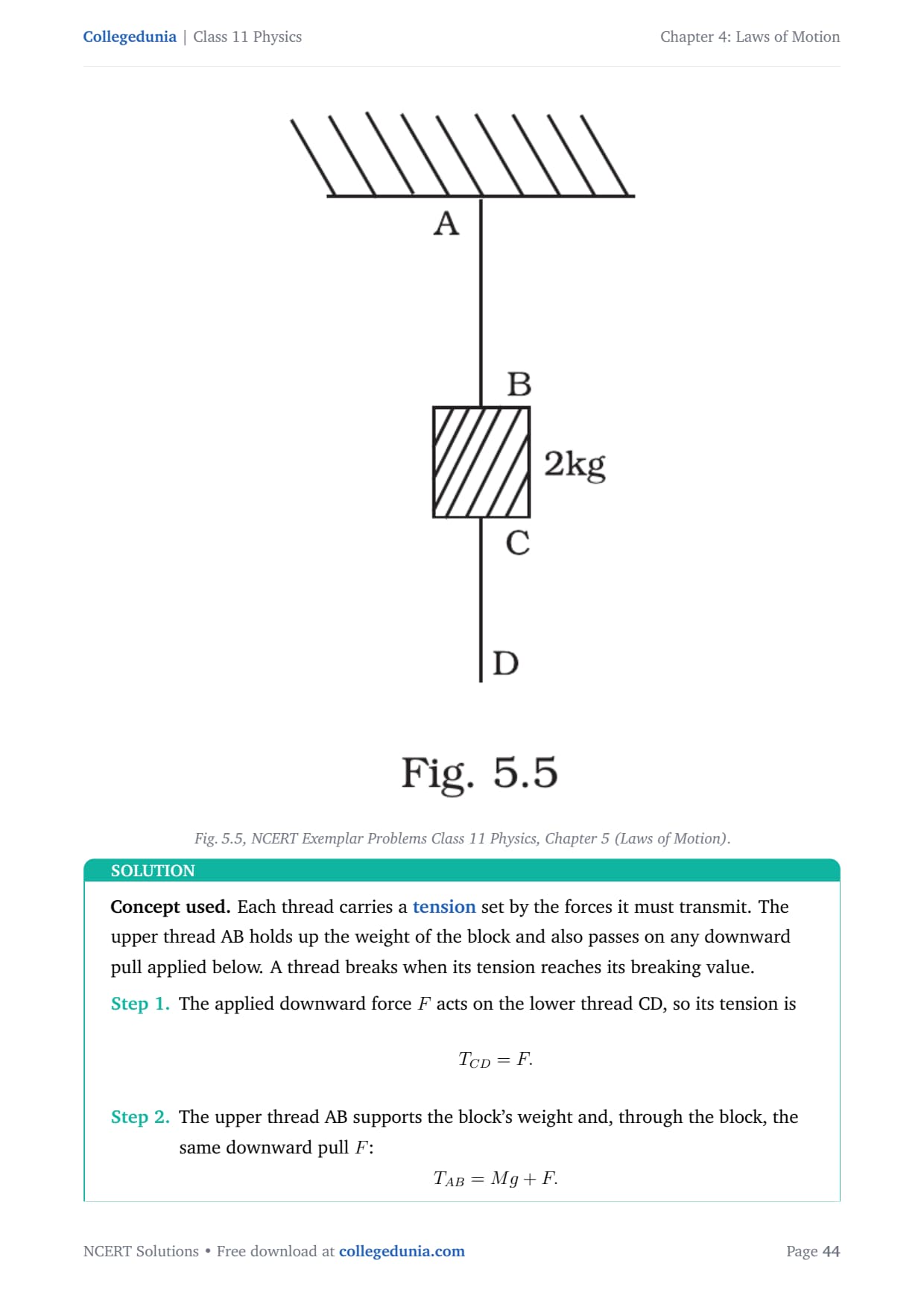
The 42 questions split across five types, and 11 quote a figure from the Exemplar book. Those figures are embedded in our PDF, so you never need the book beside it.
| Question Type | Count | What It Tests |
|---|---|---|
| MCQ I (single correct) | 9 | Direct reasoning on inertia, momentum and the second law |
| MCQ II (one or more correct) | 6 | Whether you can rule out every wrong option, not just spot one right one |
| VSA (Very Short Answer) | 10 | One-line physics reasoning, often on impulse in everyday situations |
| SA (Short Answer) | 8 | Tension, friction and recoil numericals worth 3 marks |
| LA (Long Answer) | 9 | Full free-body analysis, graphs and circular-track problems |
Key Rules and Formulas Used in the Laws of Motion Exemplar
Almost every question here reduces to one of the rules below. The PDF names the rule before applying it, so you can see which one is doing the work.
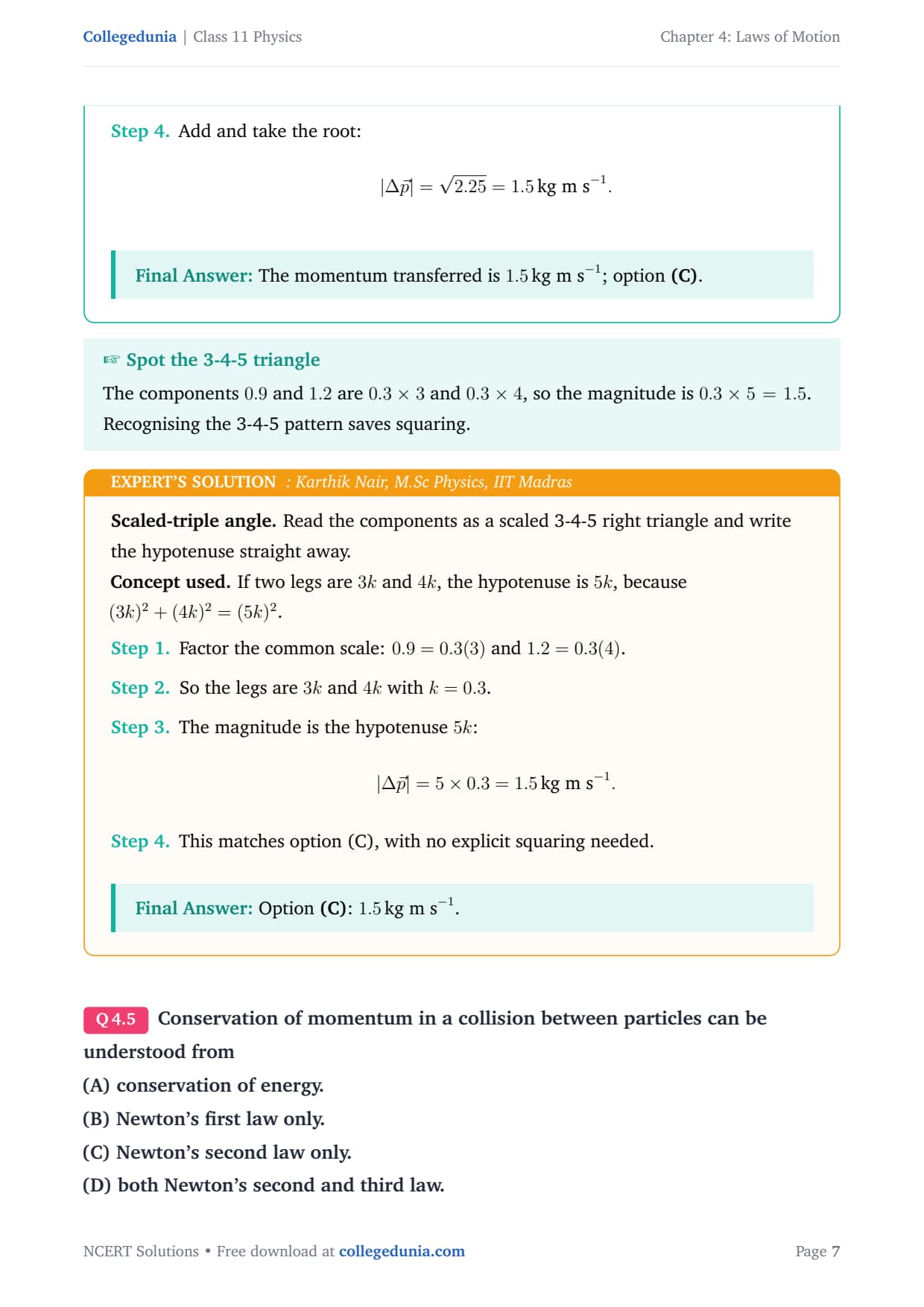
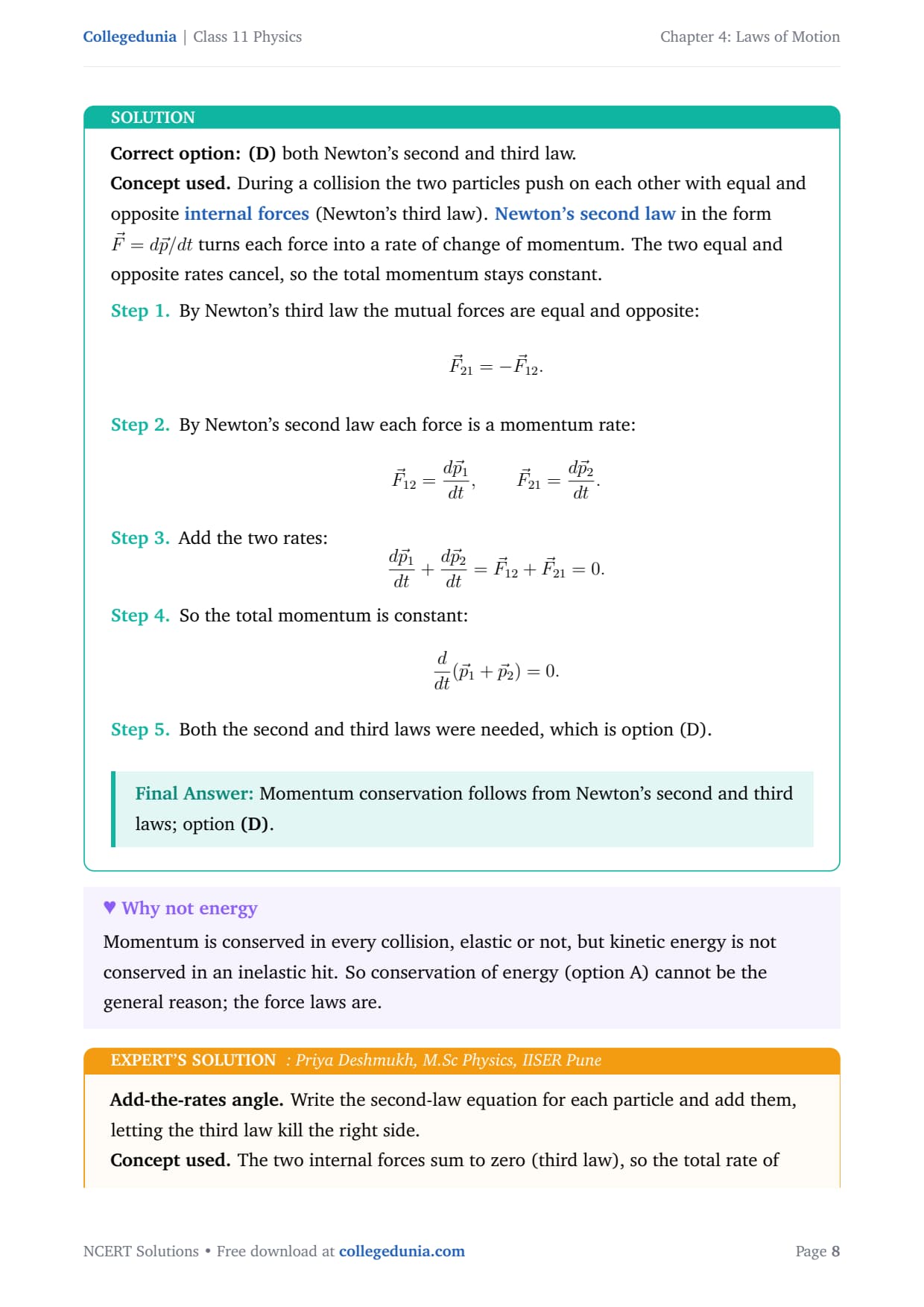
- Second law: F = dp/dt, so a force exists wherever momentum changes, even at constant speed
- Impulse: J = FΔt = Δp, which is why a longer contact time means a smaller force
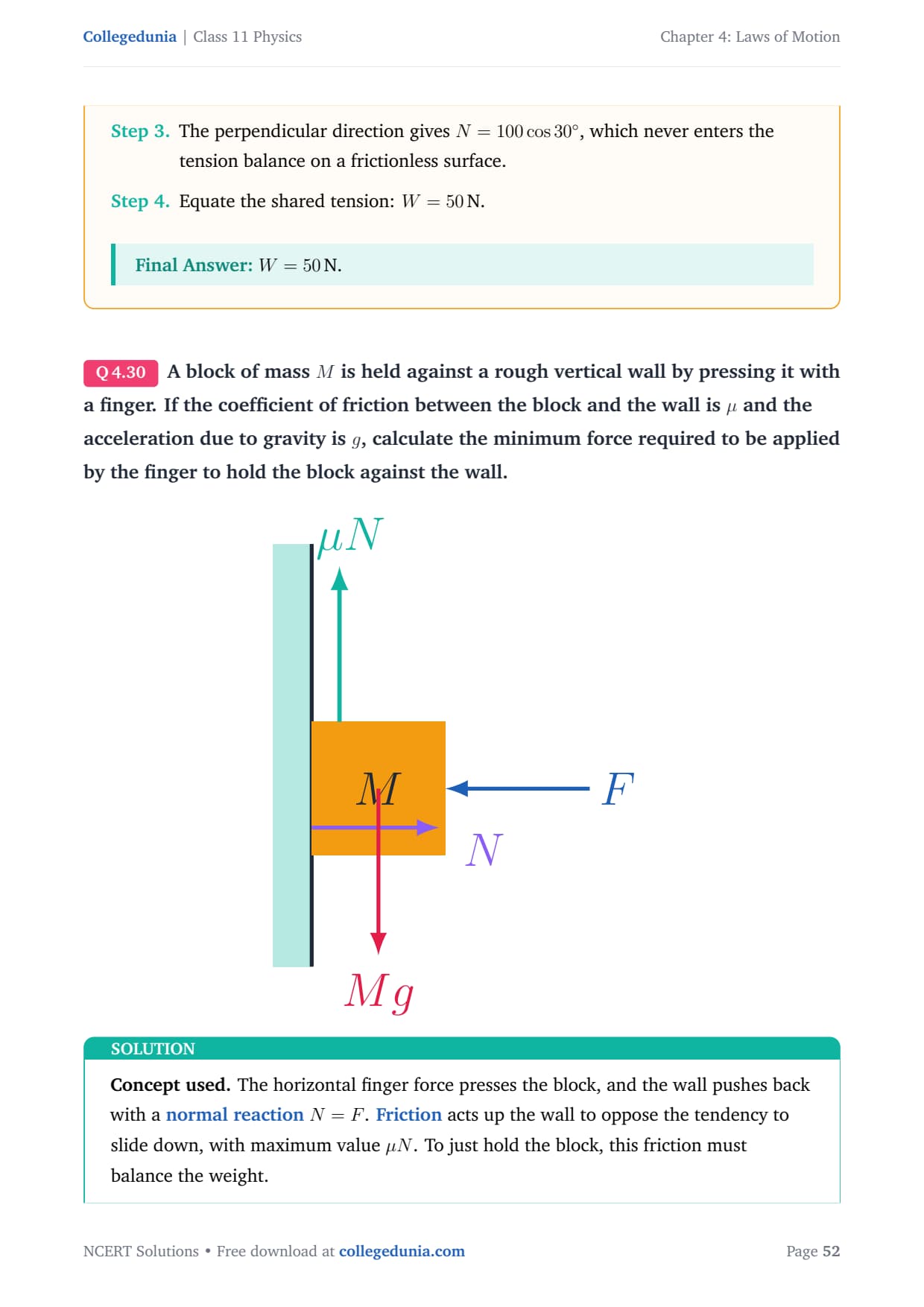
- Limiting friction: fmax = μN, where N is the normal reaction and not always the weight
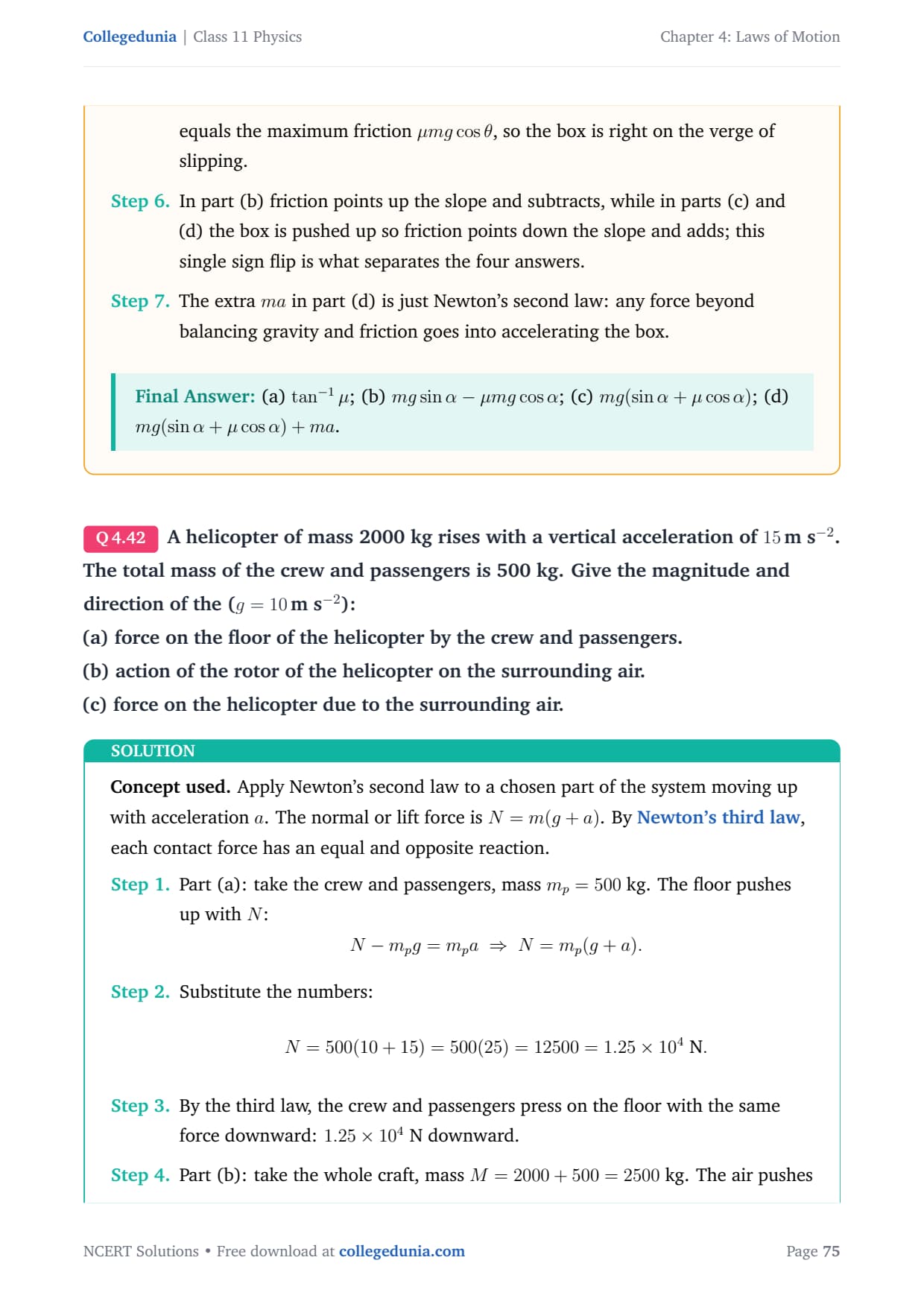
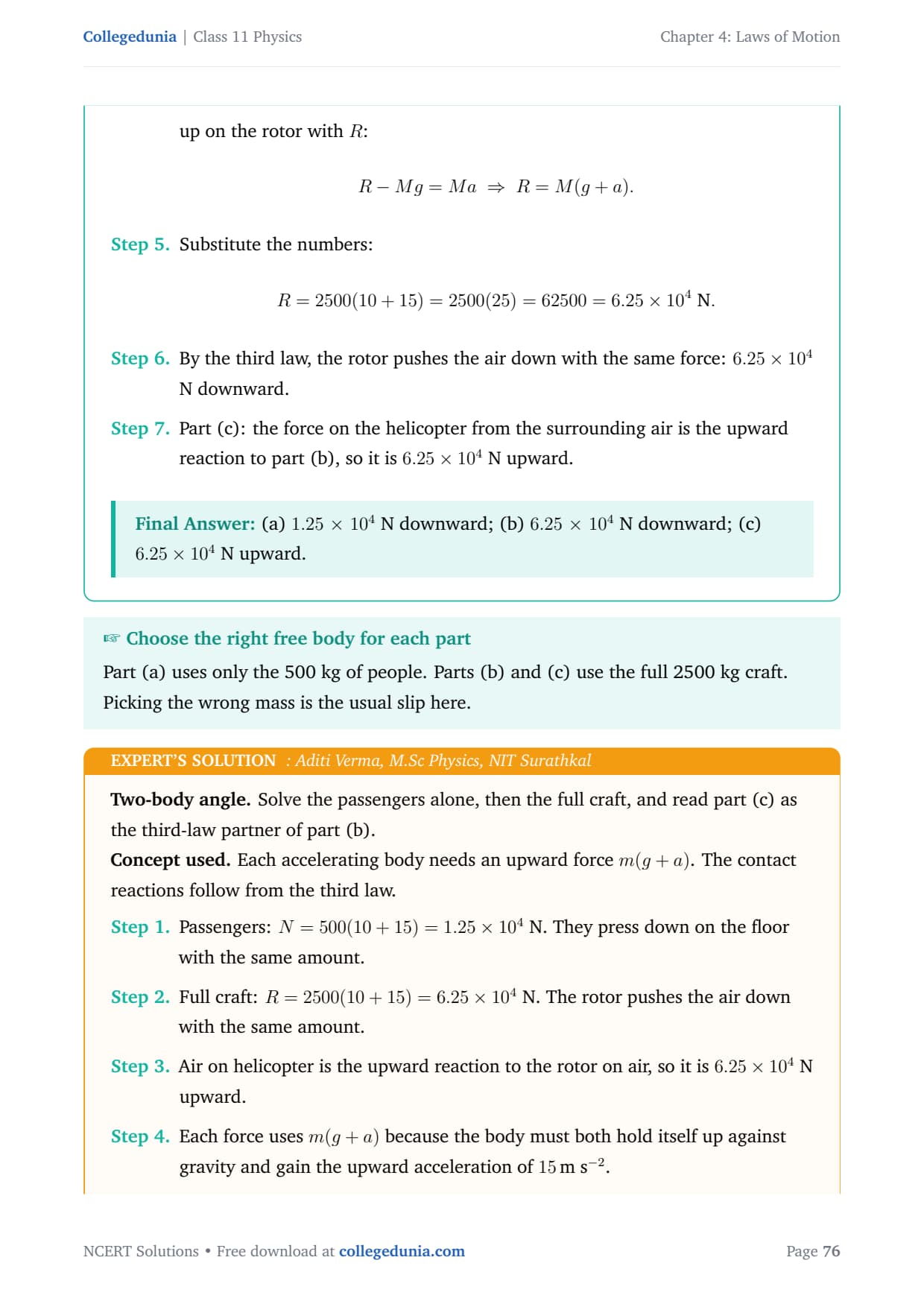
- Effective gravity in a lift: use g' = g + a going up, and g' = g − a coming down
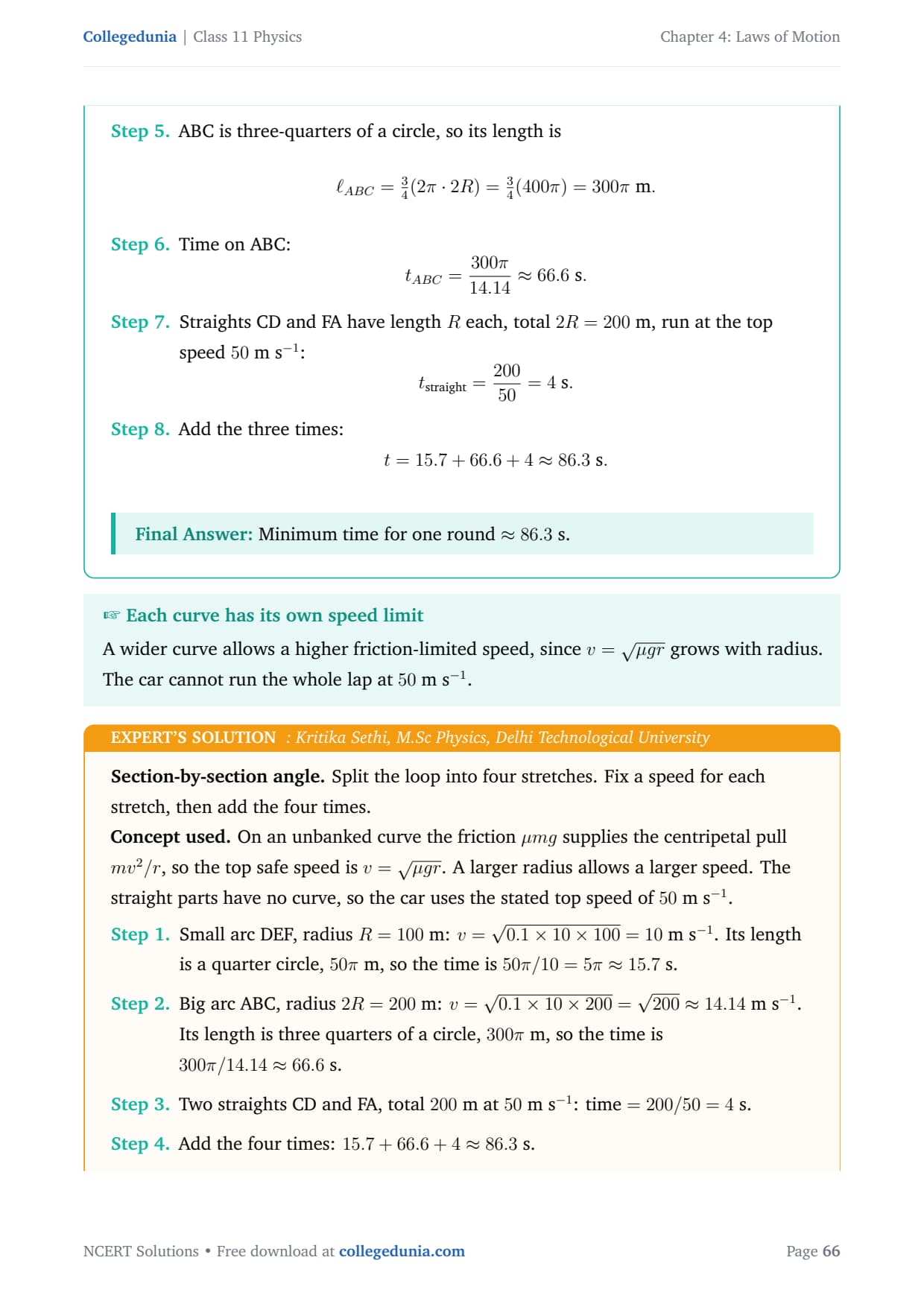
- Friction on a circular track: μmg supplies mv2/r, which fixes the maximum safe speed
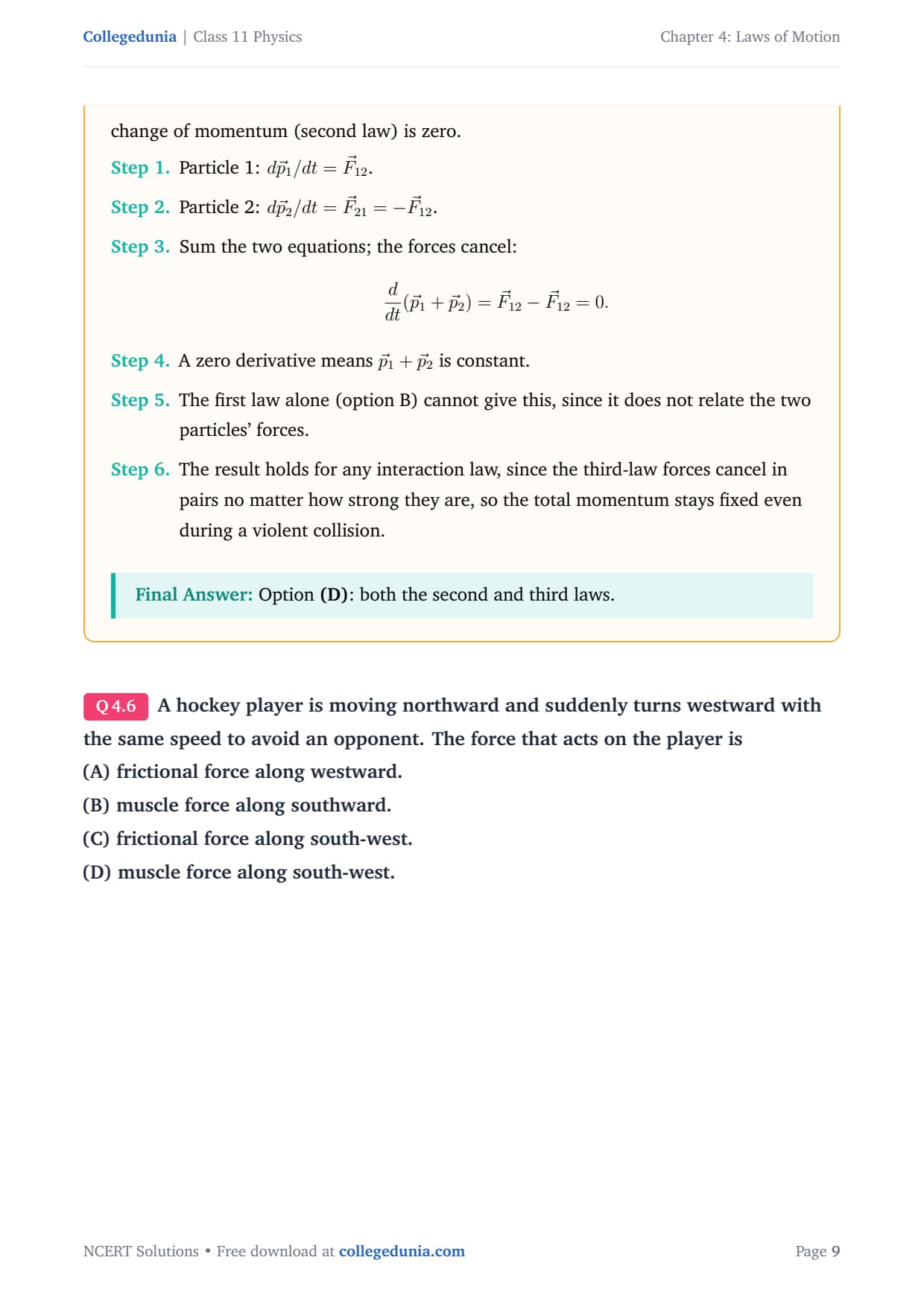
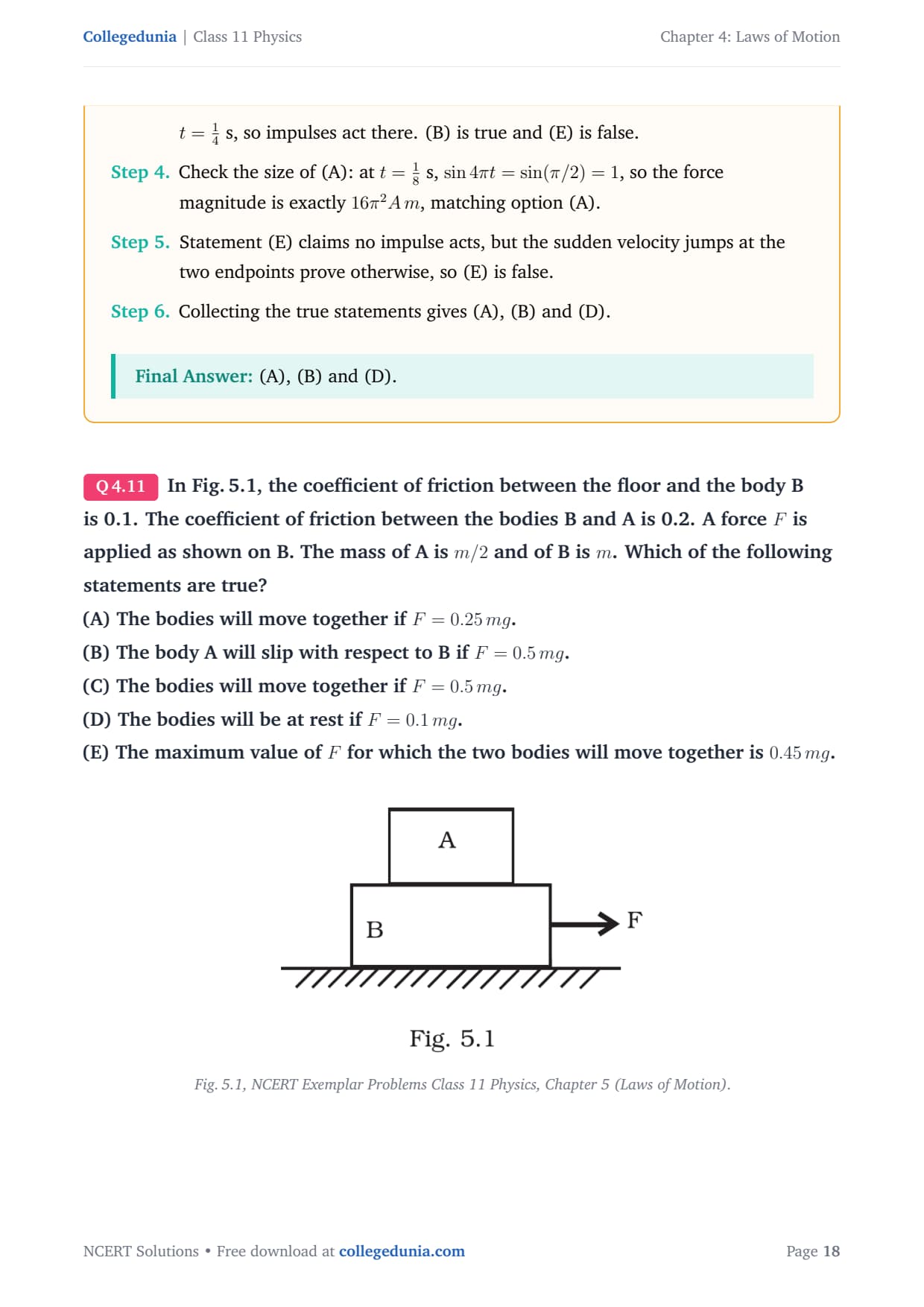
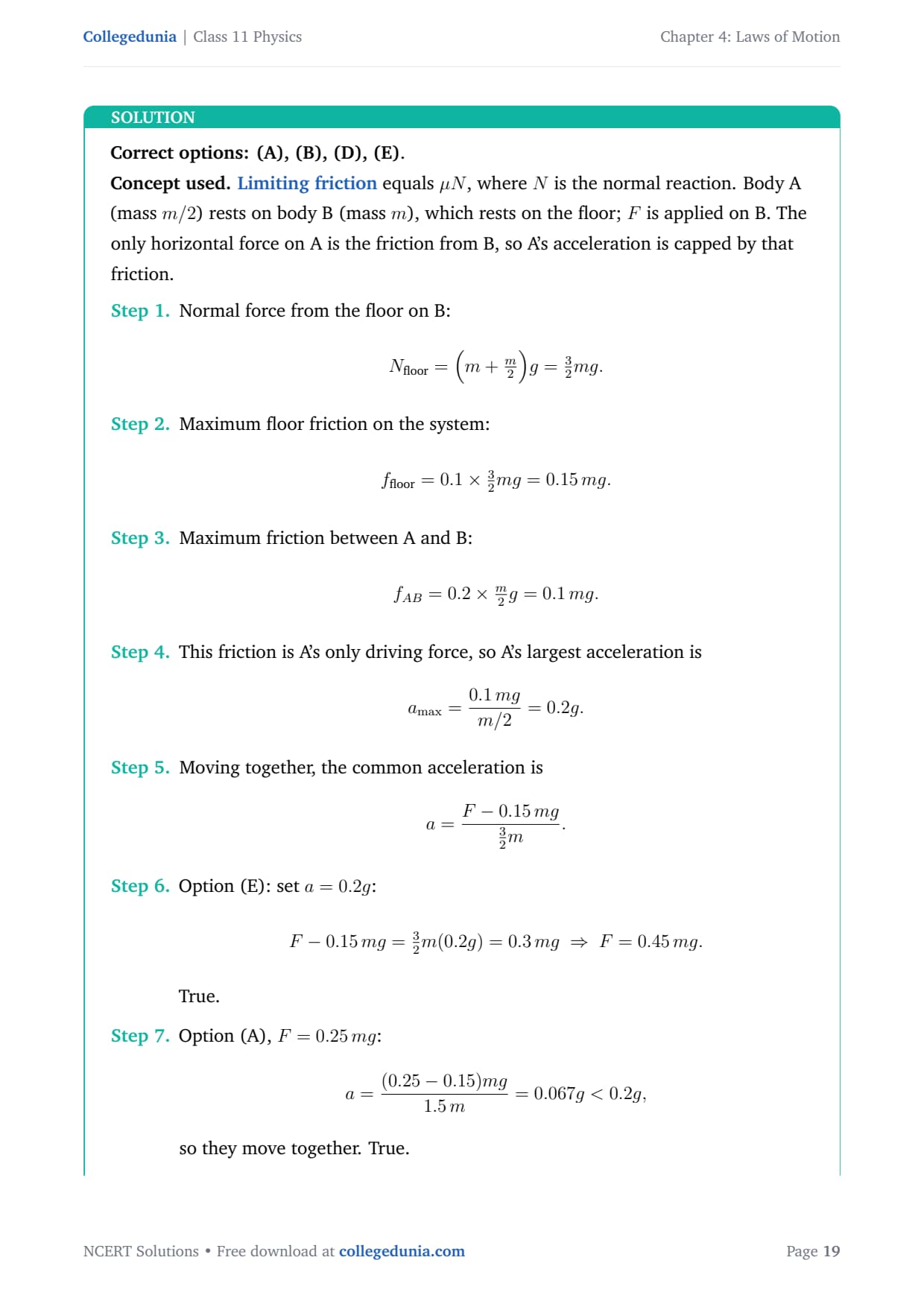
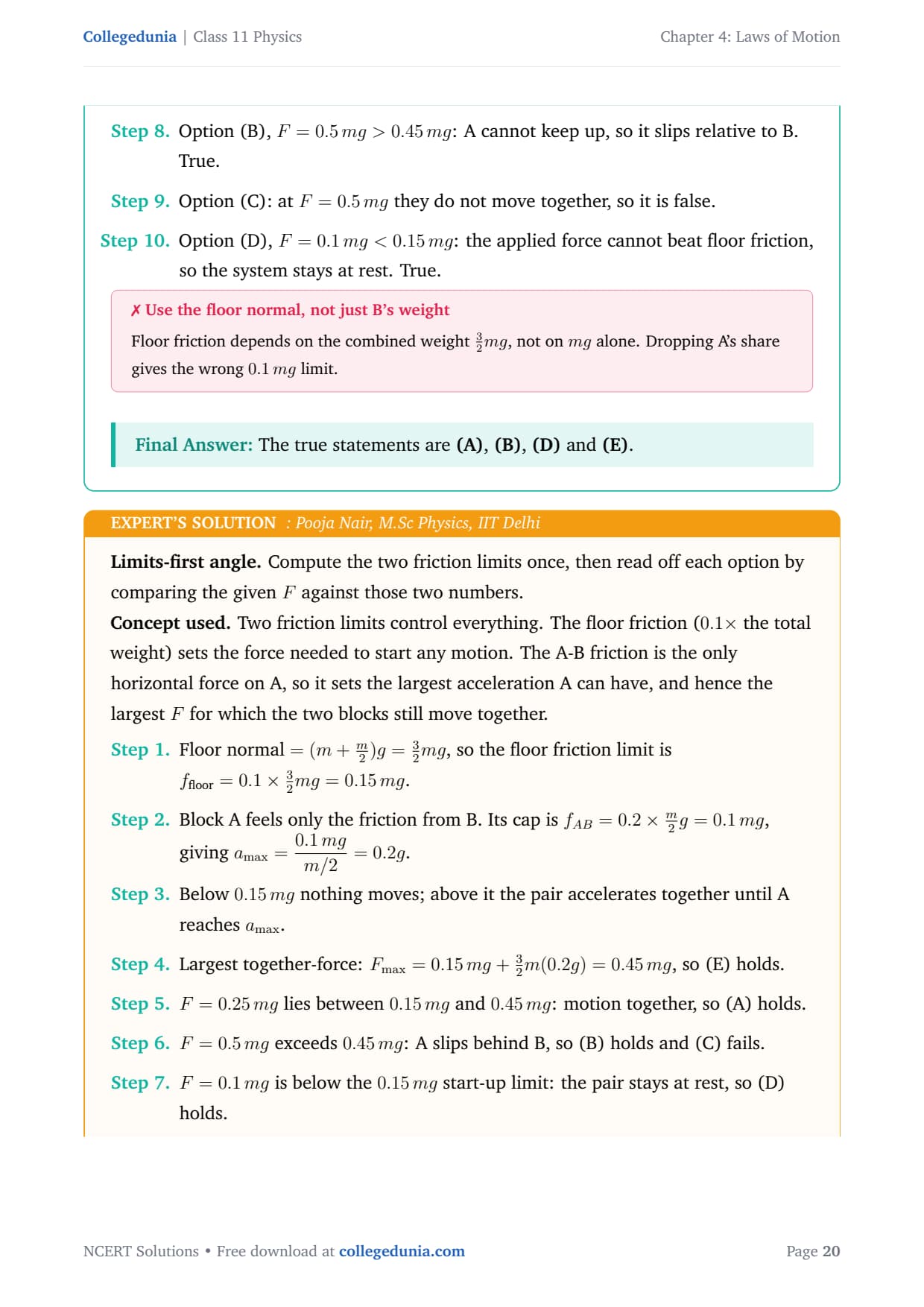
The normal reaction is the single most misused quantity in this chapter. In Question 11 the floor friction under block B depends on the combined weight of A and B, which is 3mg/2, not on mg alone. Dropping A's share gives a wrong friction limit.
Common Mistakes Students Make in Laws of Motion
The Exemplar sets traps on purpose. These four catch most students, and each is flagged in the PDF at the question where it bites.
- Forgetting the reversal: when a body rebounds, the initial and final velocities point opposite ways, so their magnitudes add. For the billiard balls in Question 14, Δv is 10 m/s, not 5.
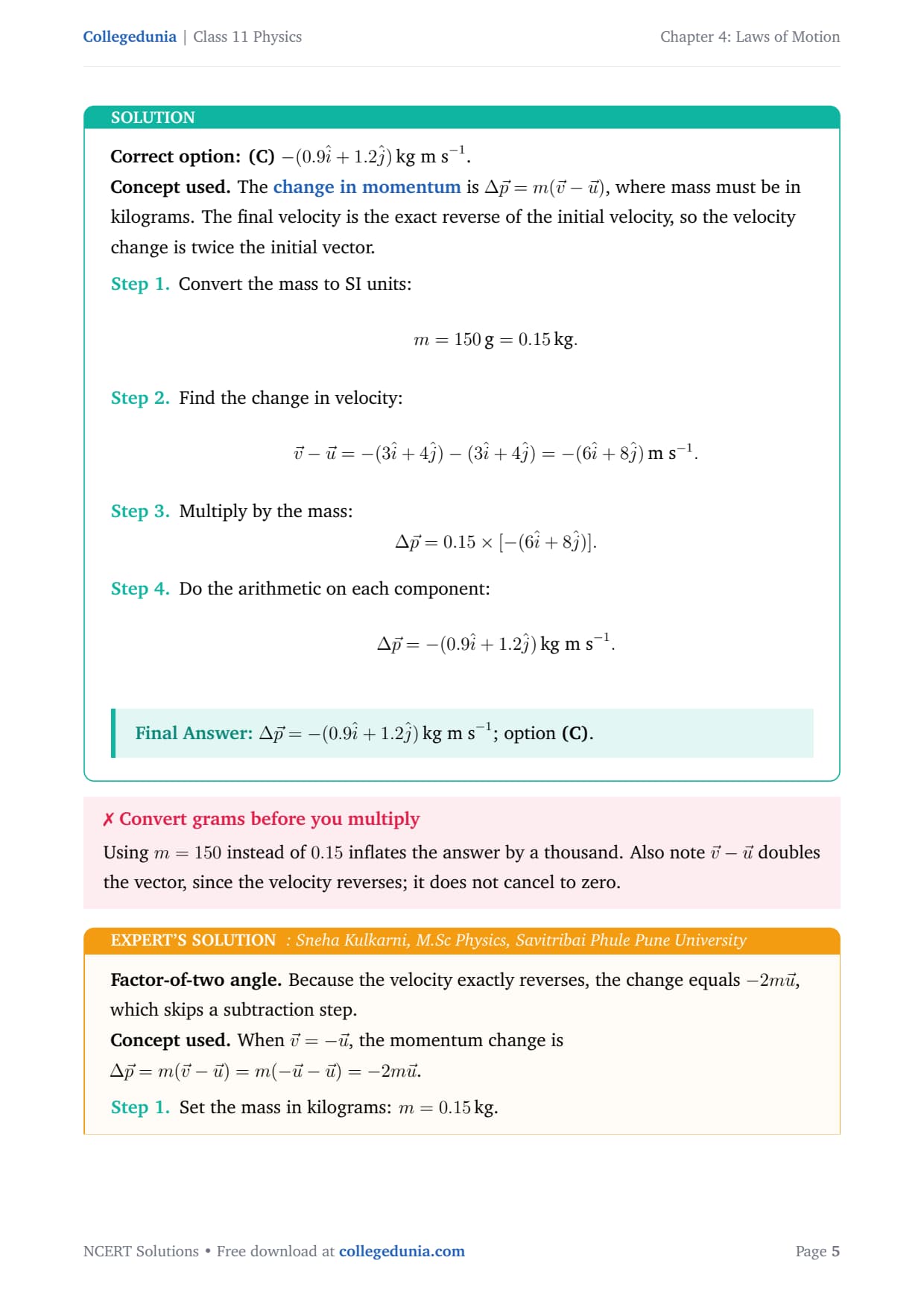
- Units before arithmetic: the cricket ball in Question 3 has mass 150 g. Using 150 instead of 0.15 inflates the momentum change by a factor of a thousand.
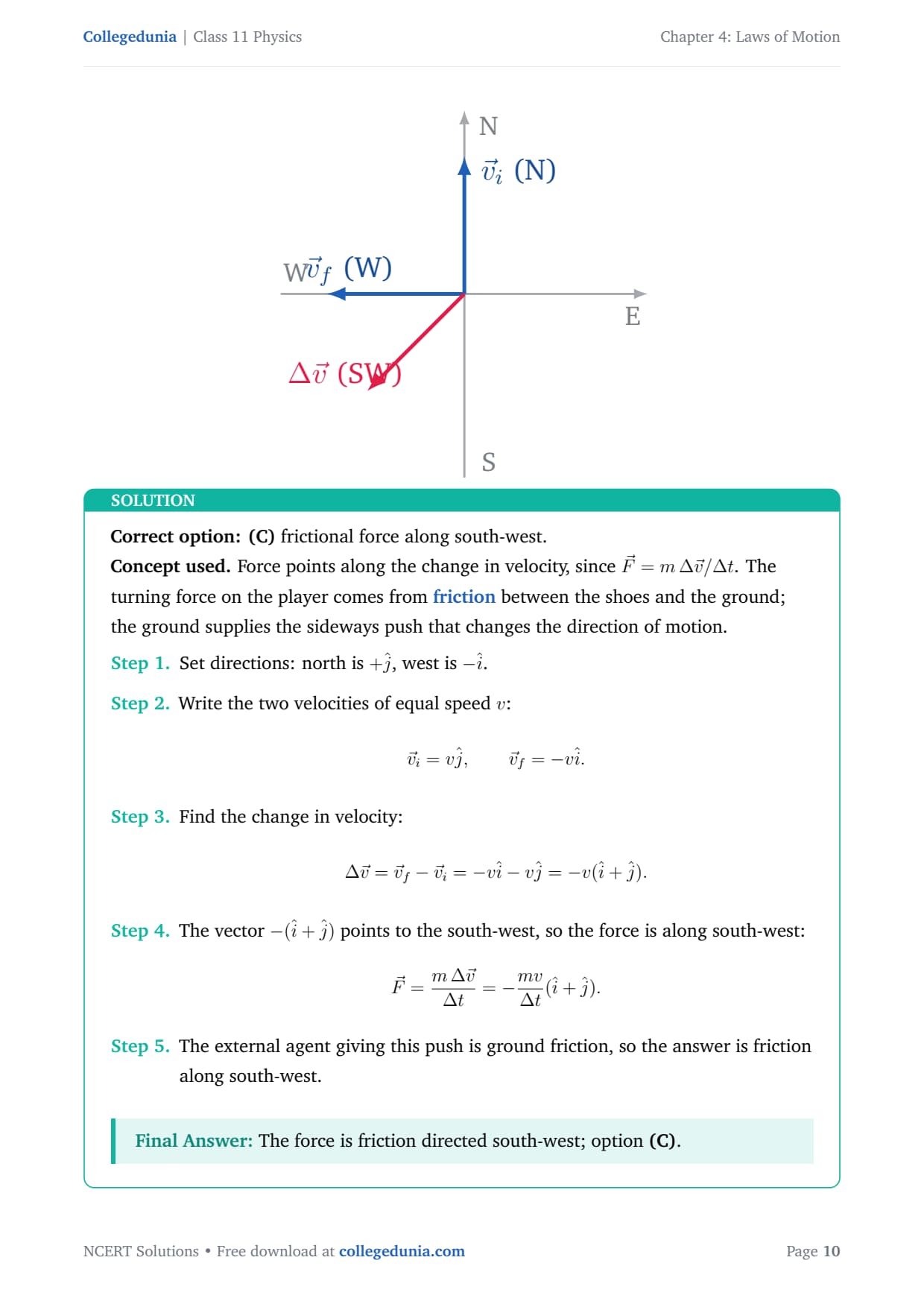
- Force follows the change, not the motion: the hockey player in Question 6 turns from north to west, so the friction force points south-west, along Δv. Muscle force is internal and cannot turn the player.
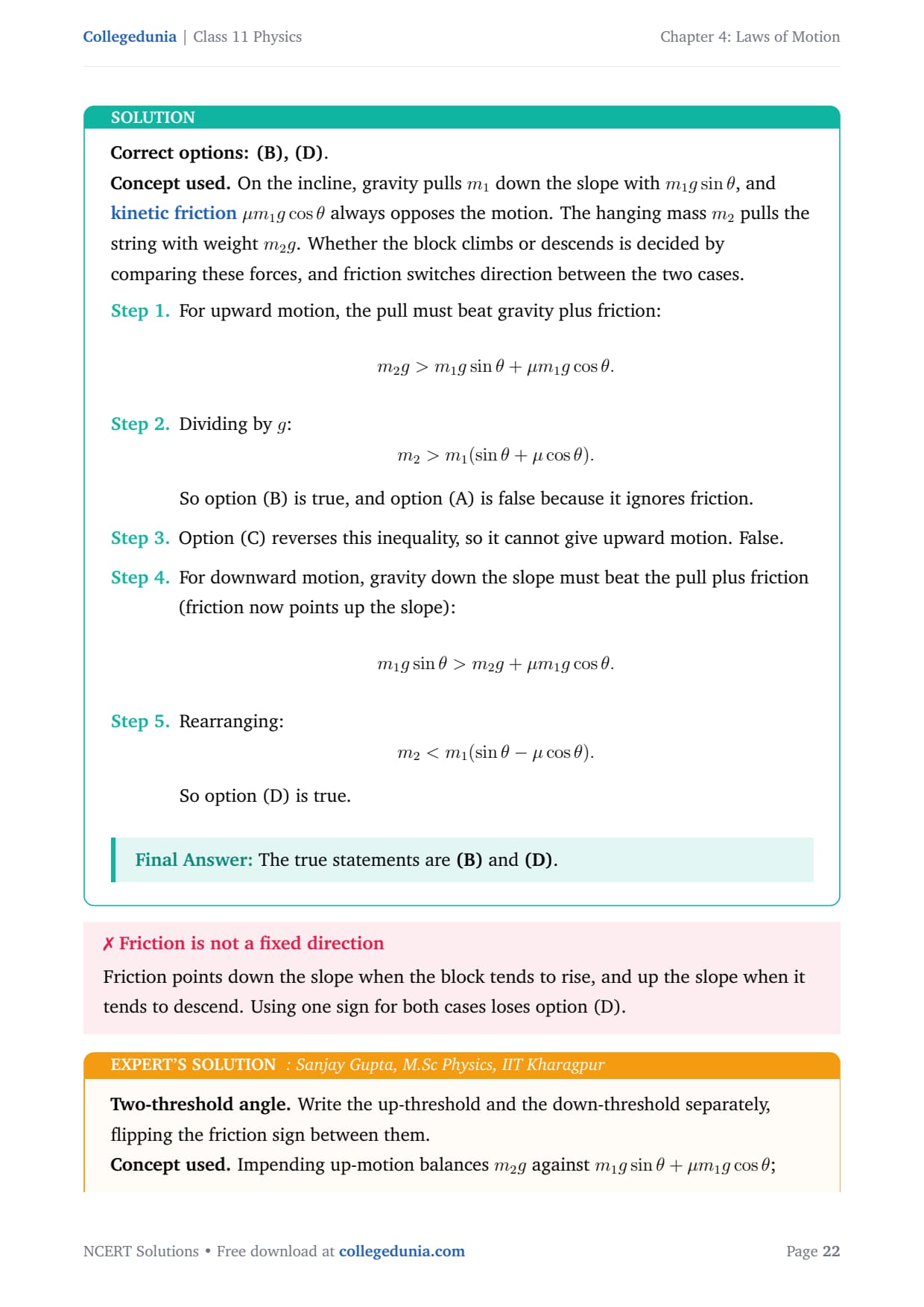
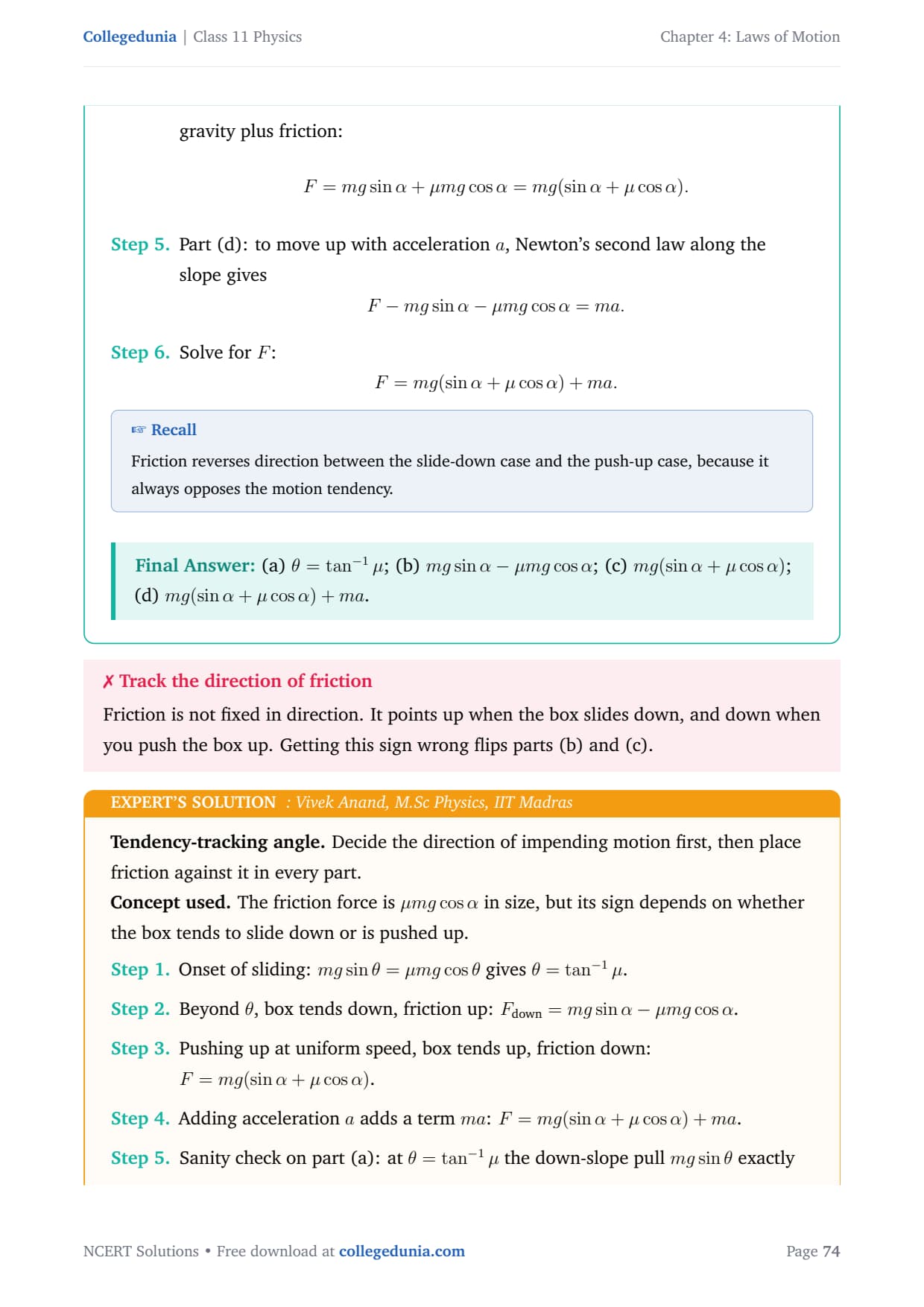
- Fixing the direction of friction: friction acts up the slope when a block tends to slide down, and down the slope when it tends to rise. One sign for both cases loses marks.
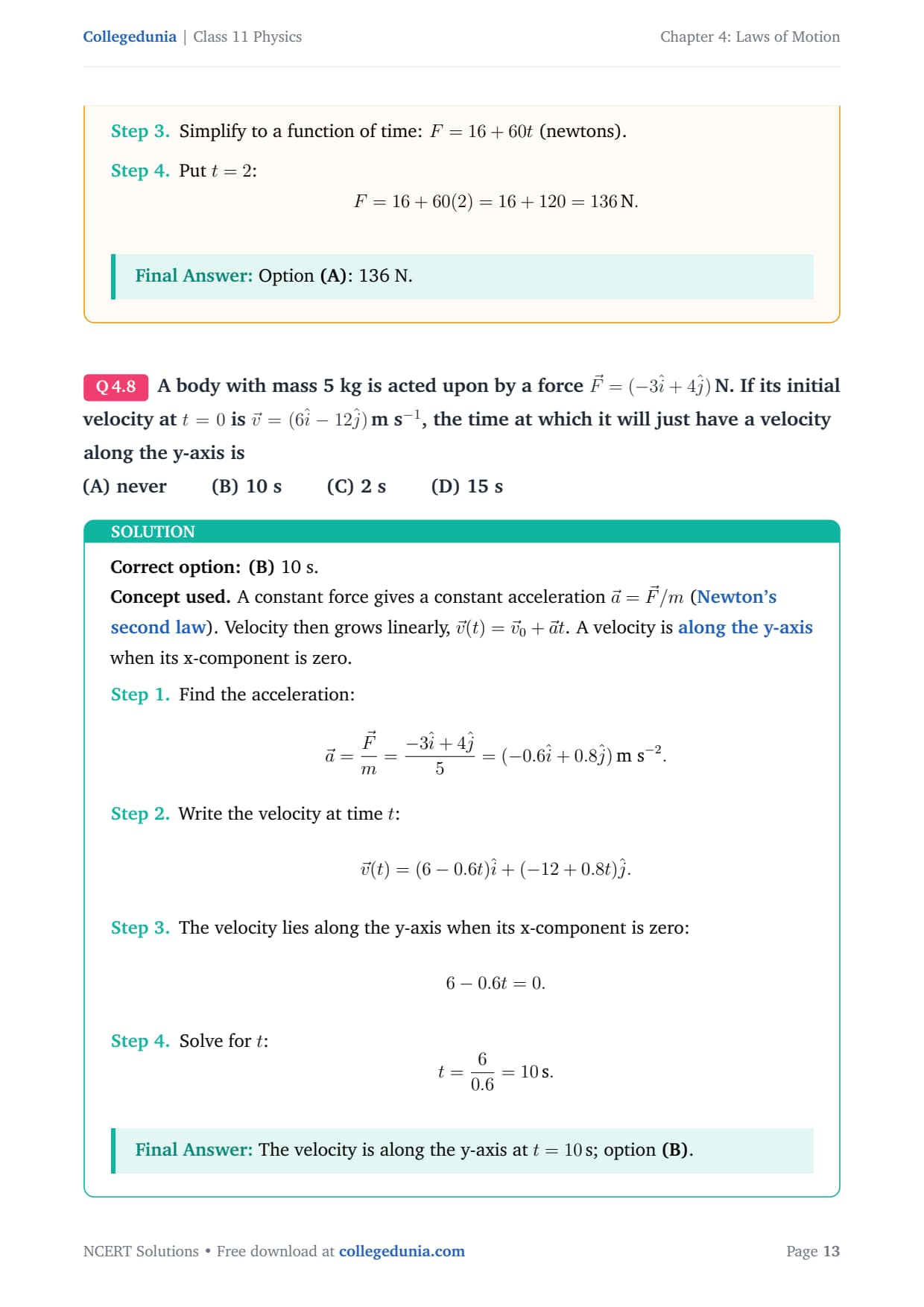
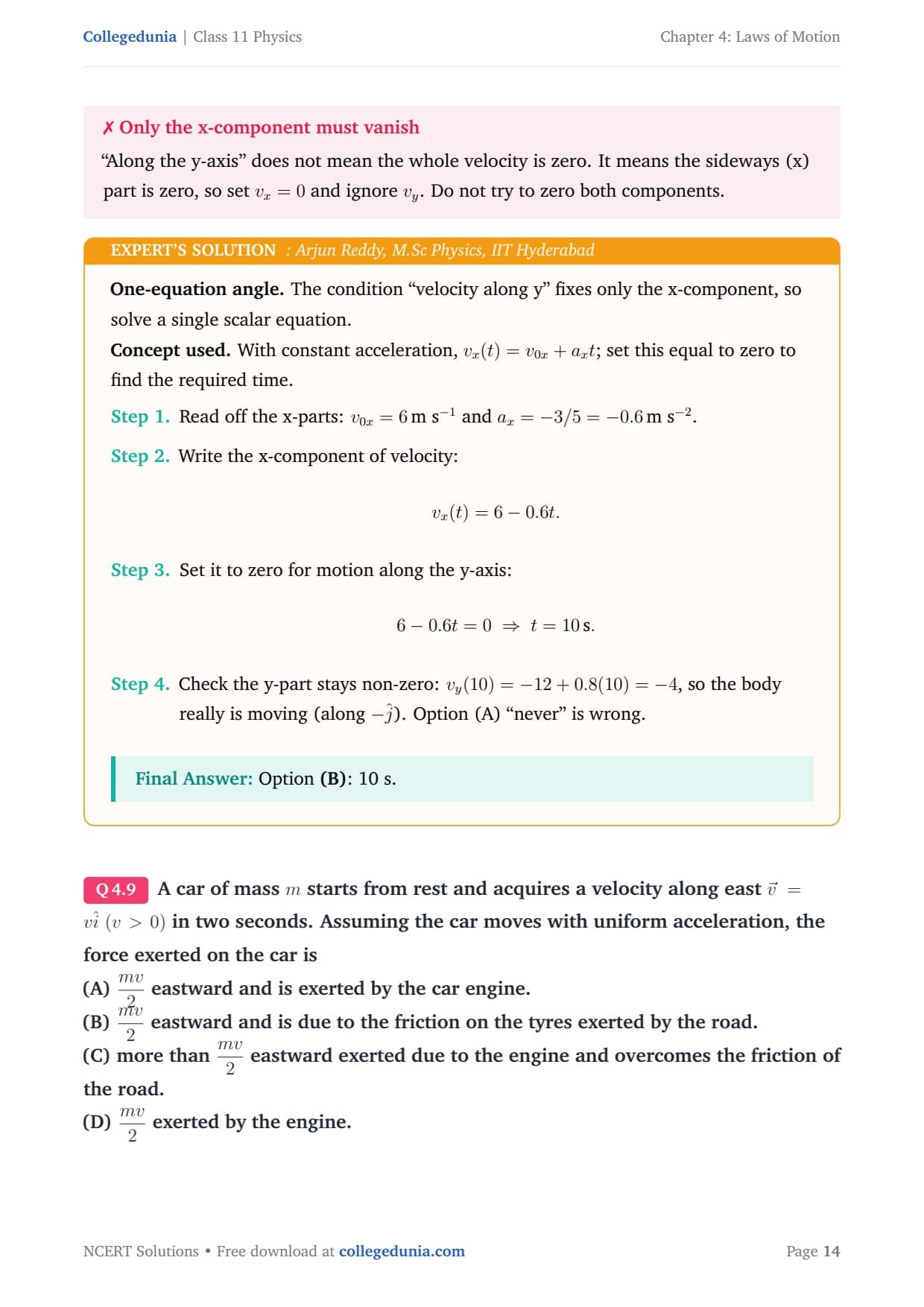
One more trap deserves naming. In Question 8 the phrase "velocity along the y-axis" means the sideways component vanishes, so you set vx = 0 and leave vy alone. Students who zero both components get no answer at all.
How the Exemplar Steps Up from the Class 11 Physics Textbook
The textbook hands you a rule and asks you to apply it. The Exemplar asks you to choose the rule, and often to explain why a tempting shortcut fails.
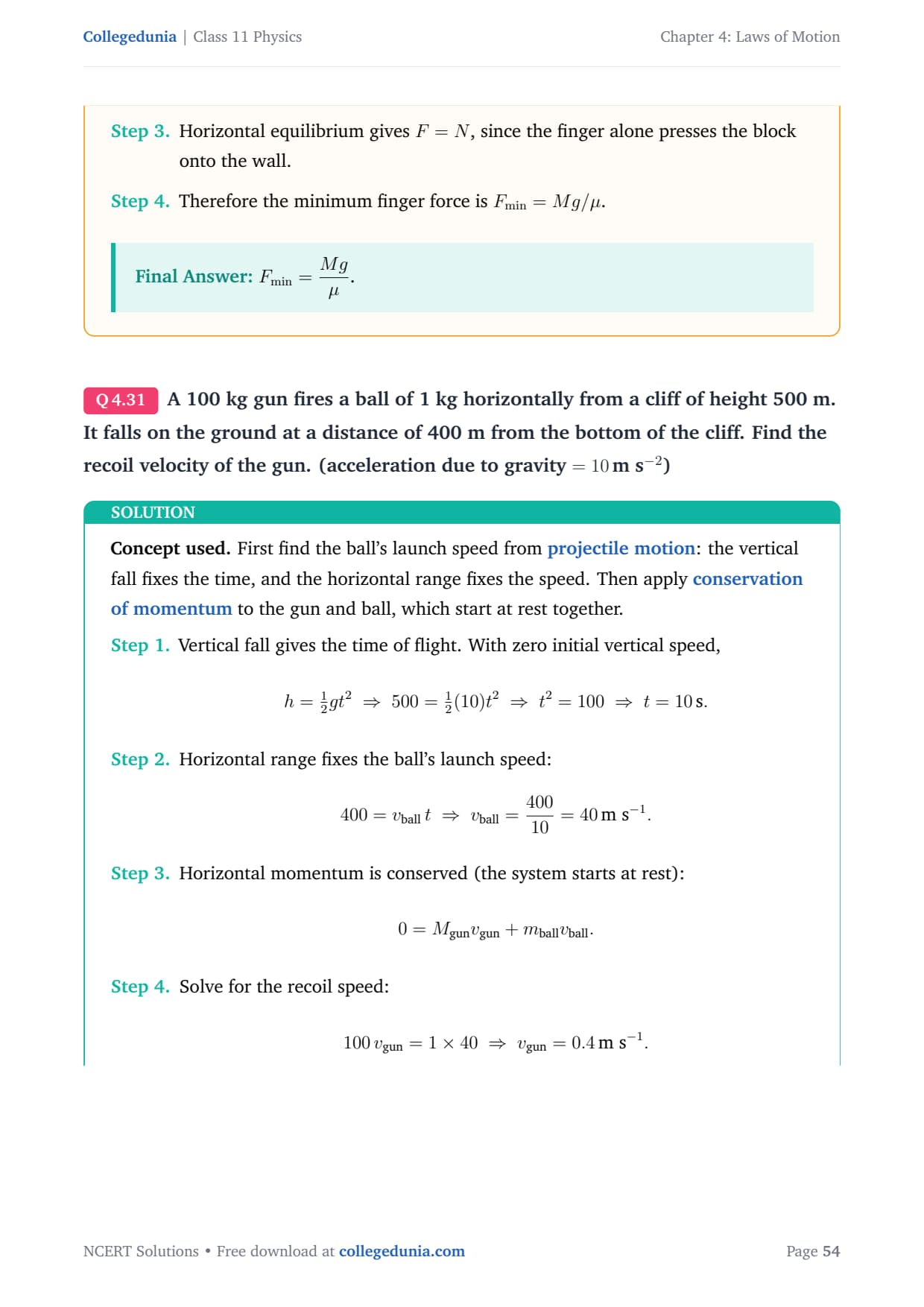
Question 31 shows the gap well. A 100 kg gun fires a 1 kg ball horizontally from a 500 m cliff, and the ball lands 400 m away. Momentum conservation needs the horizontal launch speed of 40 m/s, not the faster speed at which the ball finally strikes the ground. Gravity acts vertically, so it never changes horizontal momentum. Our solution derives that 40 m/s from the fall time first.
How to Use These NCERT Exemplar Solutions for Boards, JEE and NEET
Attempt each question before opening the solution. This chapter rewards a drawn free-body diagram over a remembered formula.
- Boards: the VSA set matches the 2 mark reasoning questions, including the porcelain-packing and muddy-ground favourites
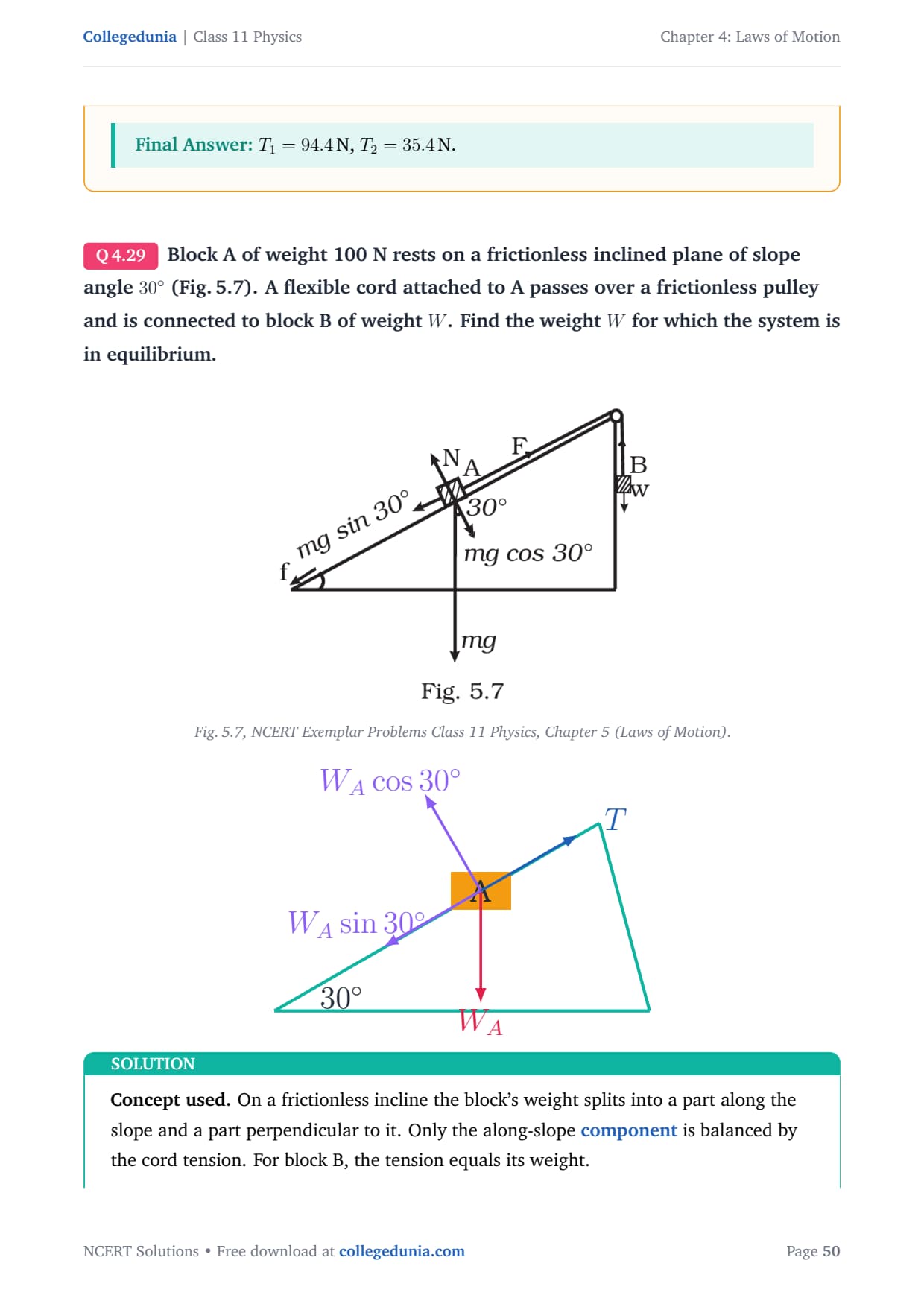
- JEE Main: start with the MCQ II block, since Questions 11 to 13 test connected blocks and inclines the way JEE does
- NEET: the MCQ I set covers the impulse and momentum recall that NEET repeats each year
Student Feedback
Students who used Collegedunia's Class 11 Physics Exemplar Solutions told us friction on inclined planes was the hardest part here. Around 7 in 10 said the labelled free-body diagrams helped most on the Long Answer problems, where a wrong diagram ruins every line that follows.
Other Resources for Class 11 Physics Laws of Motion
Collegedunia has the full study material for this chapter. Use the Notes for a first read, then the Exemplar once the basics hold.
Also Check:
- NCERT Solutions for Class 11 Physics Chapter 4
- Class 11 Physics Chapter 4 Notes
- Class 11 Physics Chapter 4 Handwritten Notes
- Class 11 Physics Chapter 4 NCERT Book PDF
- Class 11 Physics Chapter 4 Exemplar Questions with Solutions
NCERT Exemplar Solutions for Other Class 11 Physics Chapters
Every chapter below has the same step-by-step treatment and a free PDF.
Laws of Motion Class 11 Physics NCERT Exemplar Solutions FAQs
Ques. How many questions are there in the Class 11 Physics Laws of Motion Exemplar?
Ans. Chapter 4 has 42 questions. They are split into 9 MCQ I, 6 MCQ II, 10 Very Short Answer, 8 Short Answer and 9 Long Answer questions. All 42 are solved in the free 77-page PDF on this page.
Ques. Why is the change in momentum of the cricket ball in Question 3 not zero?
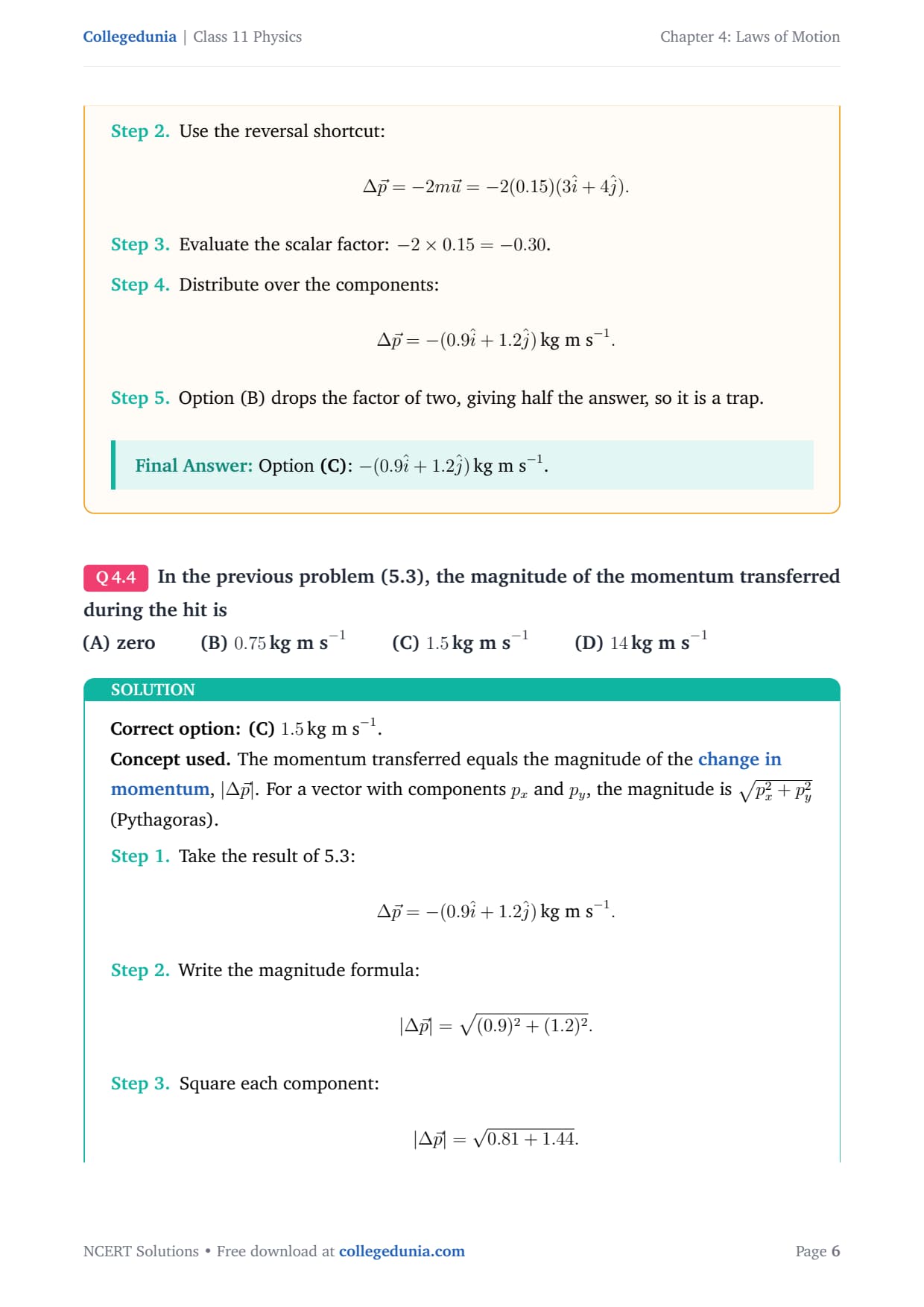
Ans. The final velocity is the exact negative of the initial one, so the velocity does not cancel, it doubles. The change is m times (v − u), which equals 2mu in magnitude. With m = 0.15 kg and u = 5 m/s, the momentum change is 1.5 kg m/s.
Ques. Which force turns the hockey player in Question 6?
Ans. Friction from the ground, directed south-west. The force must point along the change in velocity, and turning from north to west gives a Δv that points south-west. Muscle force is internal to the player, so it cannot supply the external turning force.
Ques. How does an accelerating lift change the tension and timing questions?
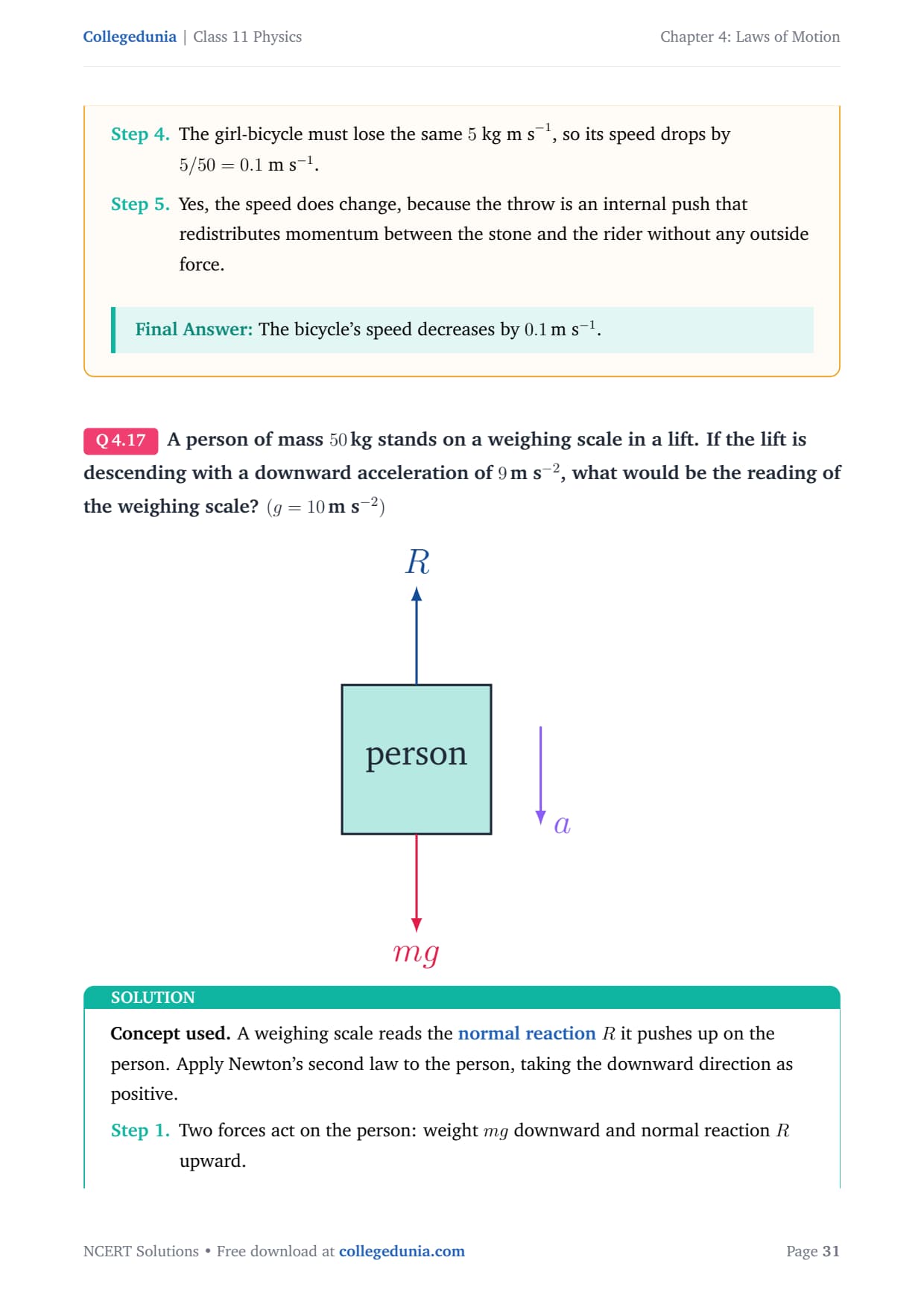
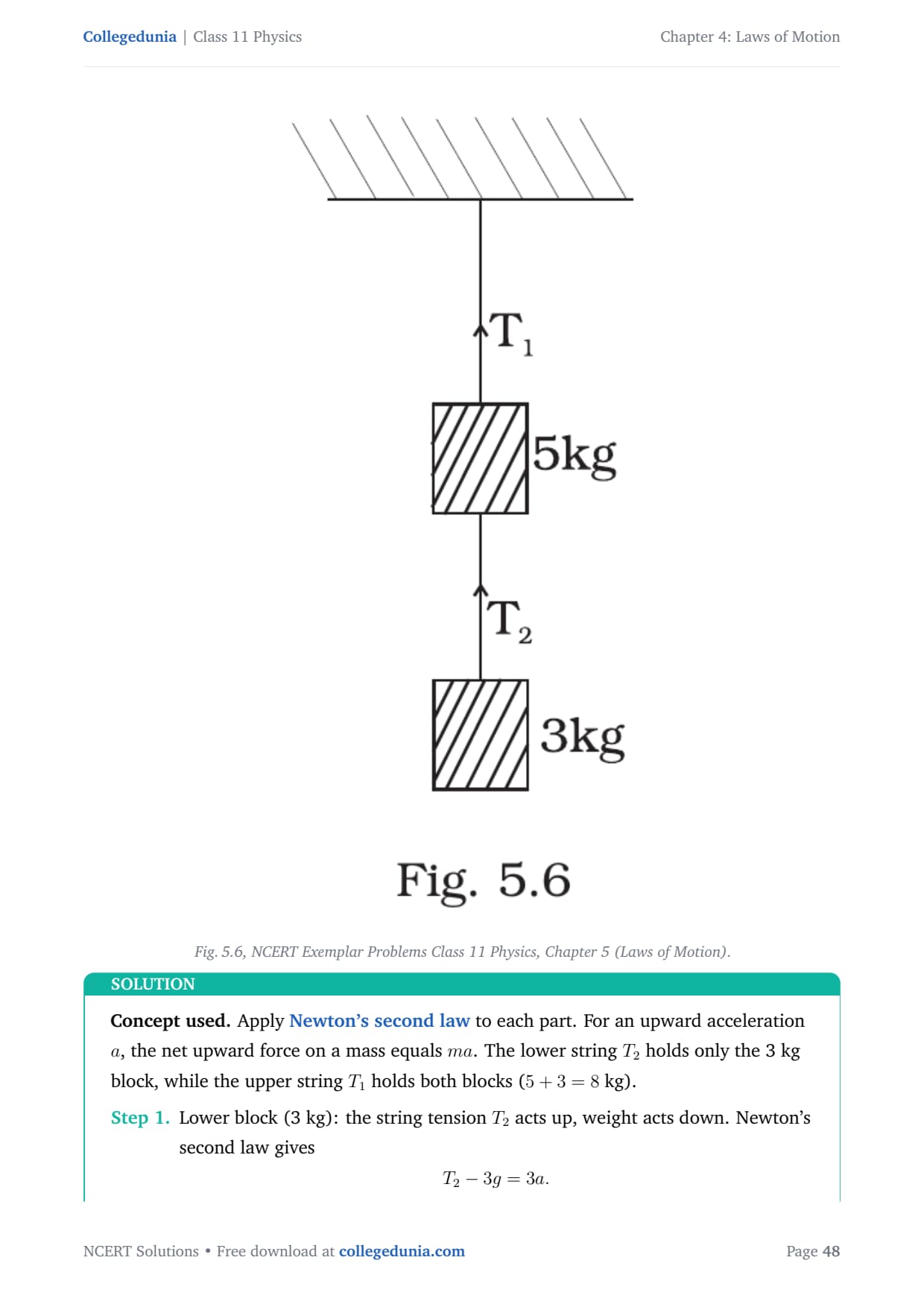
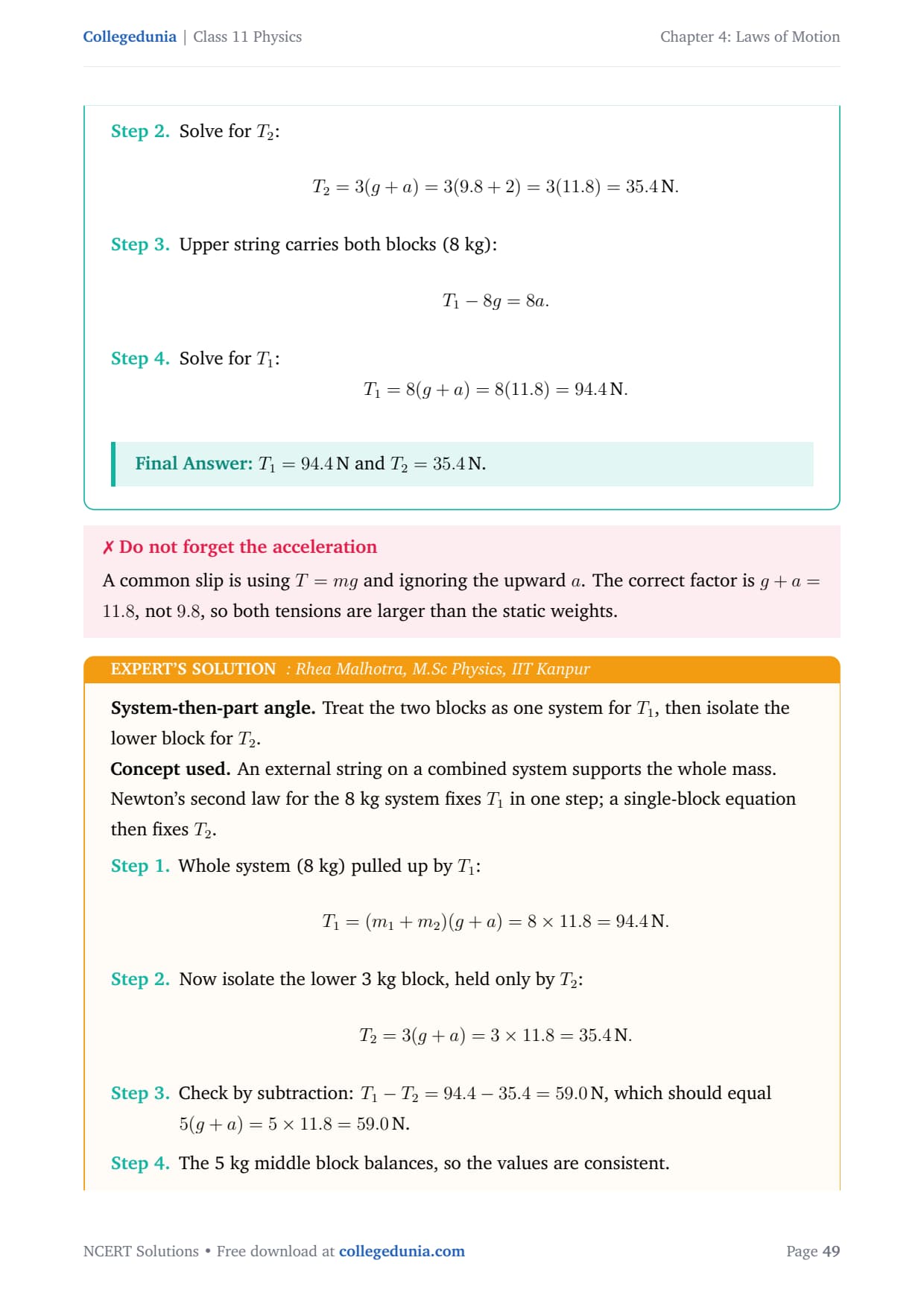
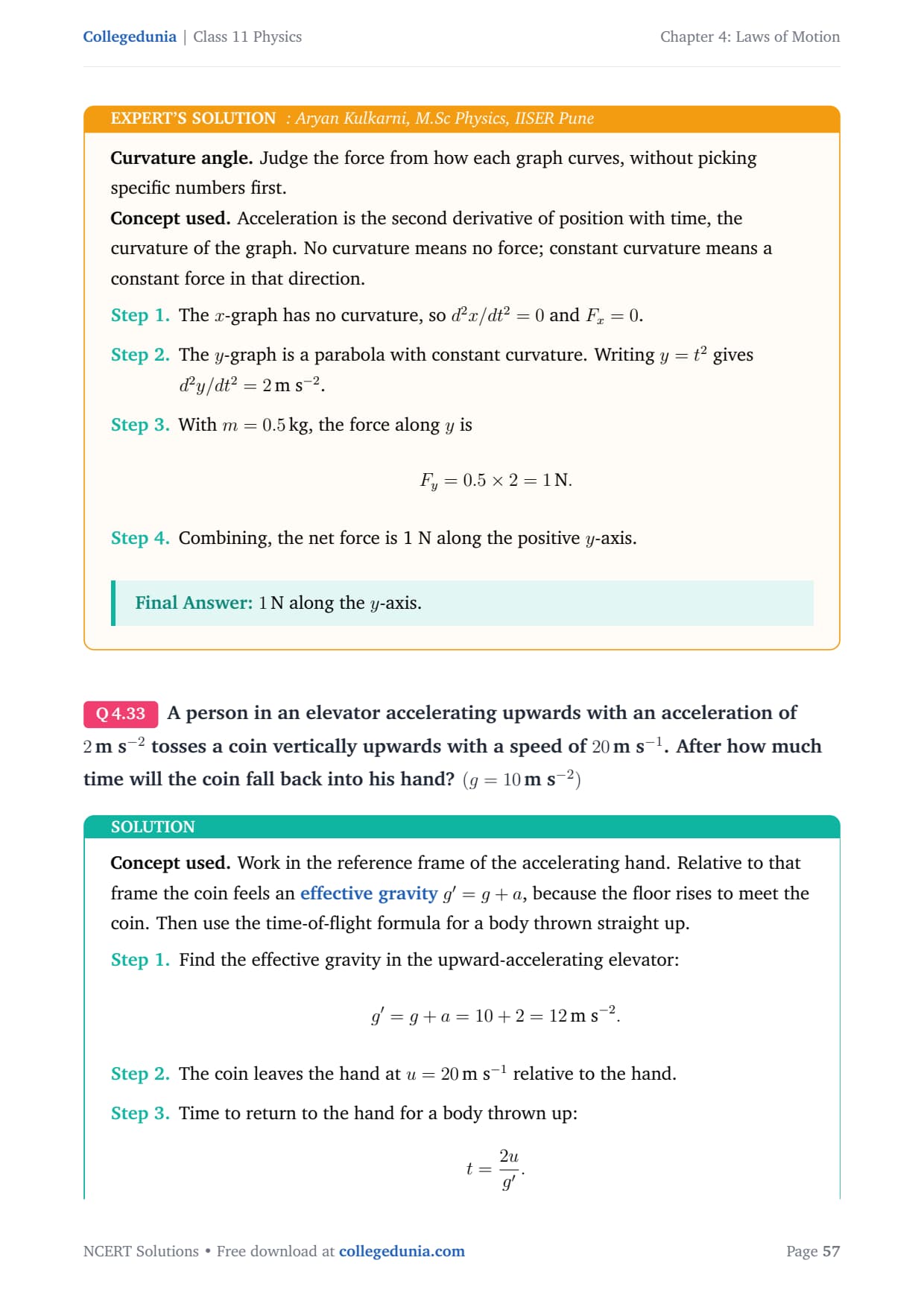
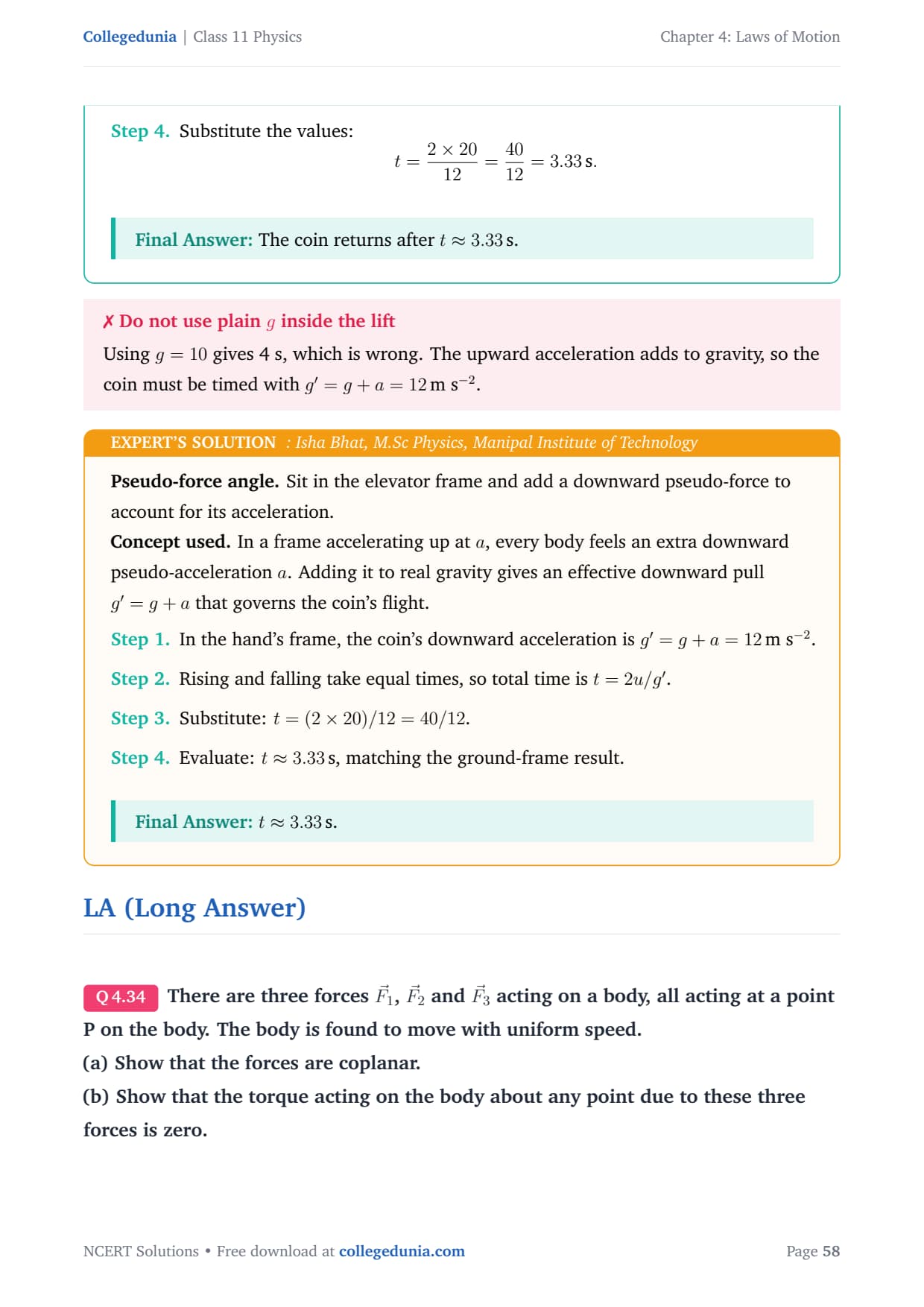
Ans. An upward acceleration adds to gravity, so you use g' = g + a. In Question 28 the strings feel g + a = 11.8 m/s2, which makes both tensions larger than the static weights. In Question 33 the coin inside the lift falls with g' = 12 m/s2, not 10.
Ques. Is the NCERT Exemplar enough for JEE friction questions?
Ans. For the basics, yes. Questions 11 to 13 cover connected blocks, inclines and two coefficients of friction at once, which is the standard JEE setup. Work those before starting a coaching module, since the harder problems assume this level.



Comments