




NCERT Exemplar Solutions for Class 11 Physics Chapter 5 Work Energy and Power solve all 48 questions from the Exemplar book. This chapter carries the largest MCQ I set in the book, with 18 single-correct questions. The free PDF on this page runs to 79 pages and follows the 2026-27 syllabus.
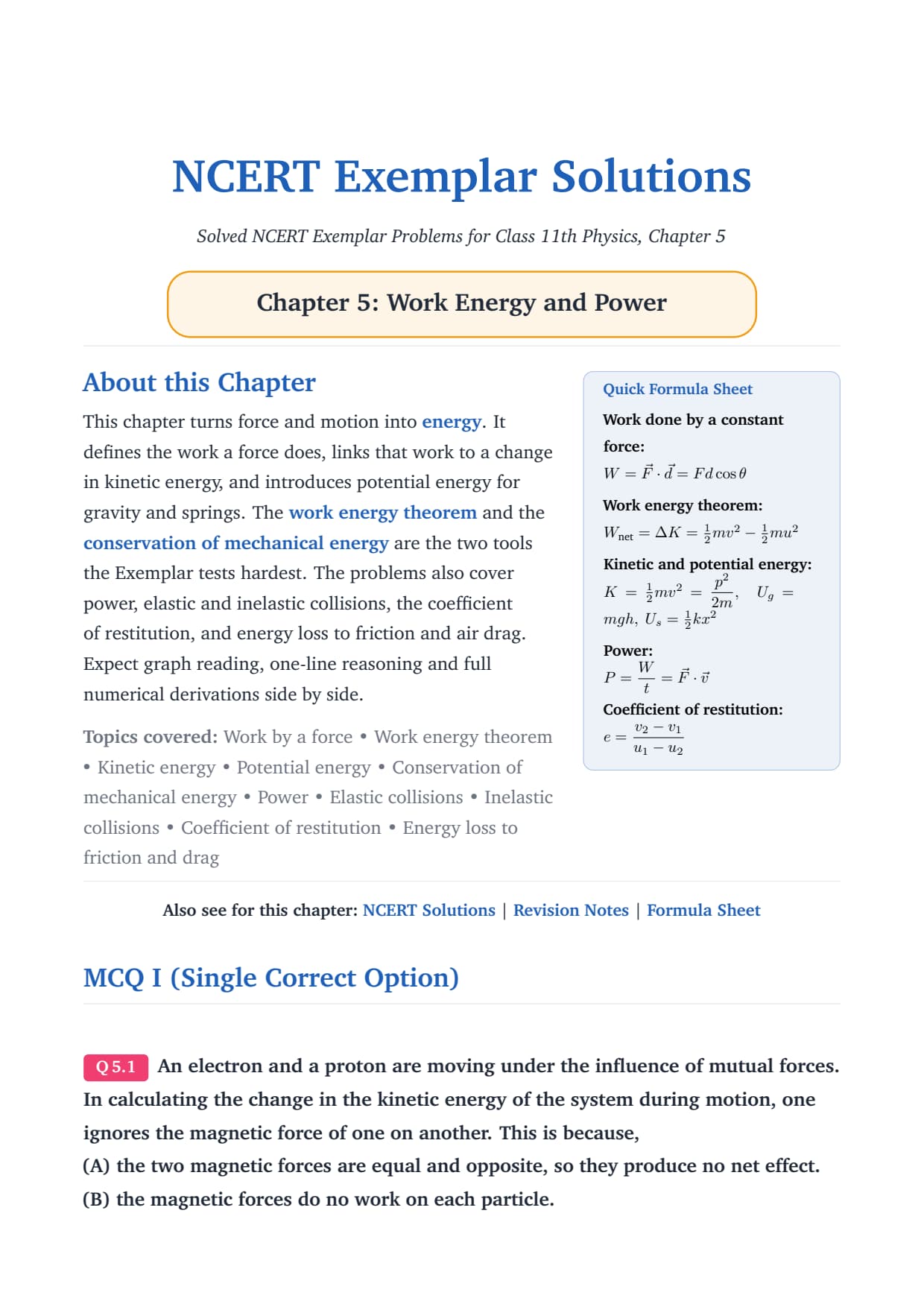
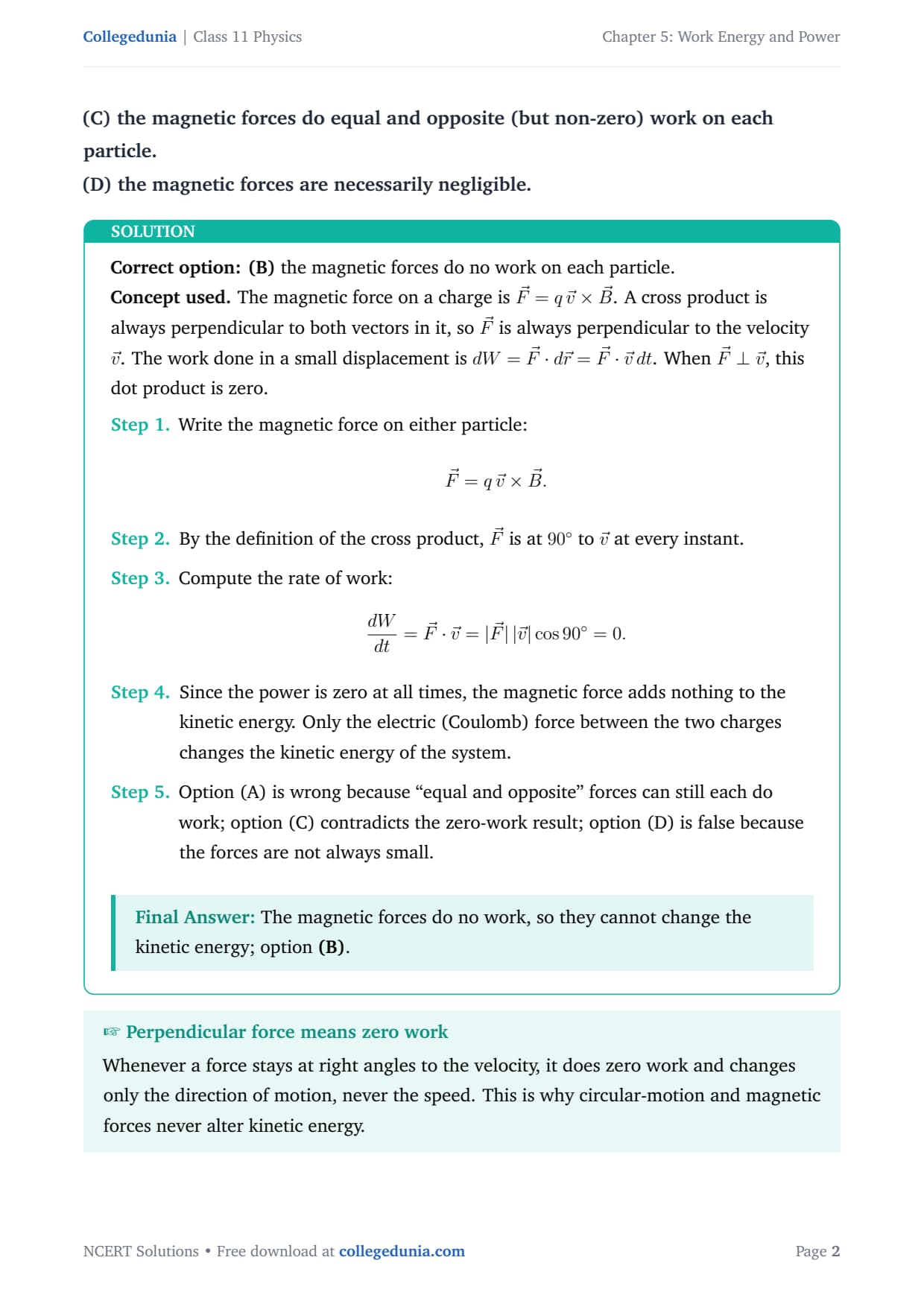
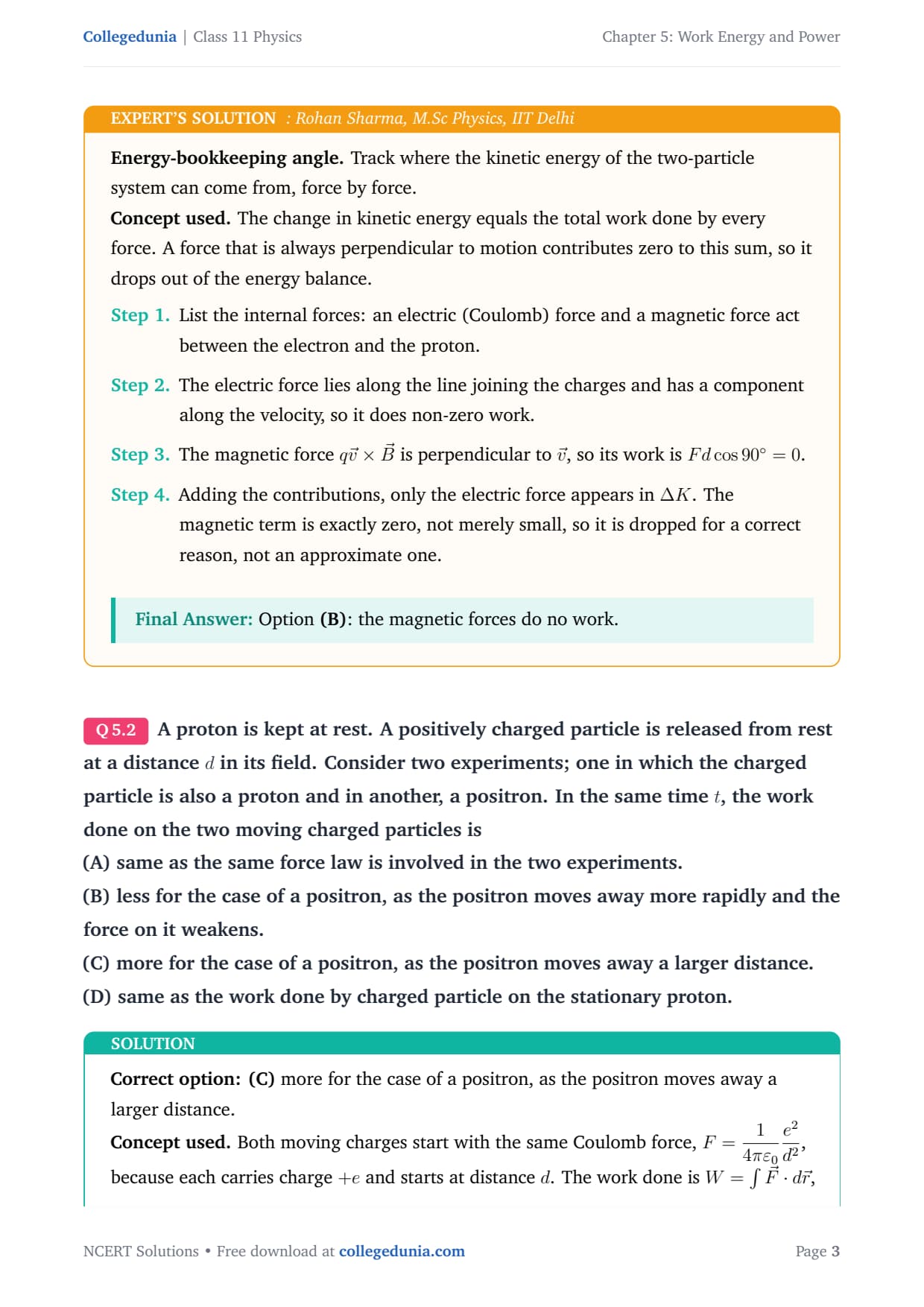
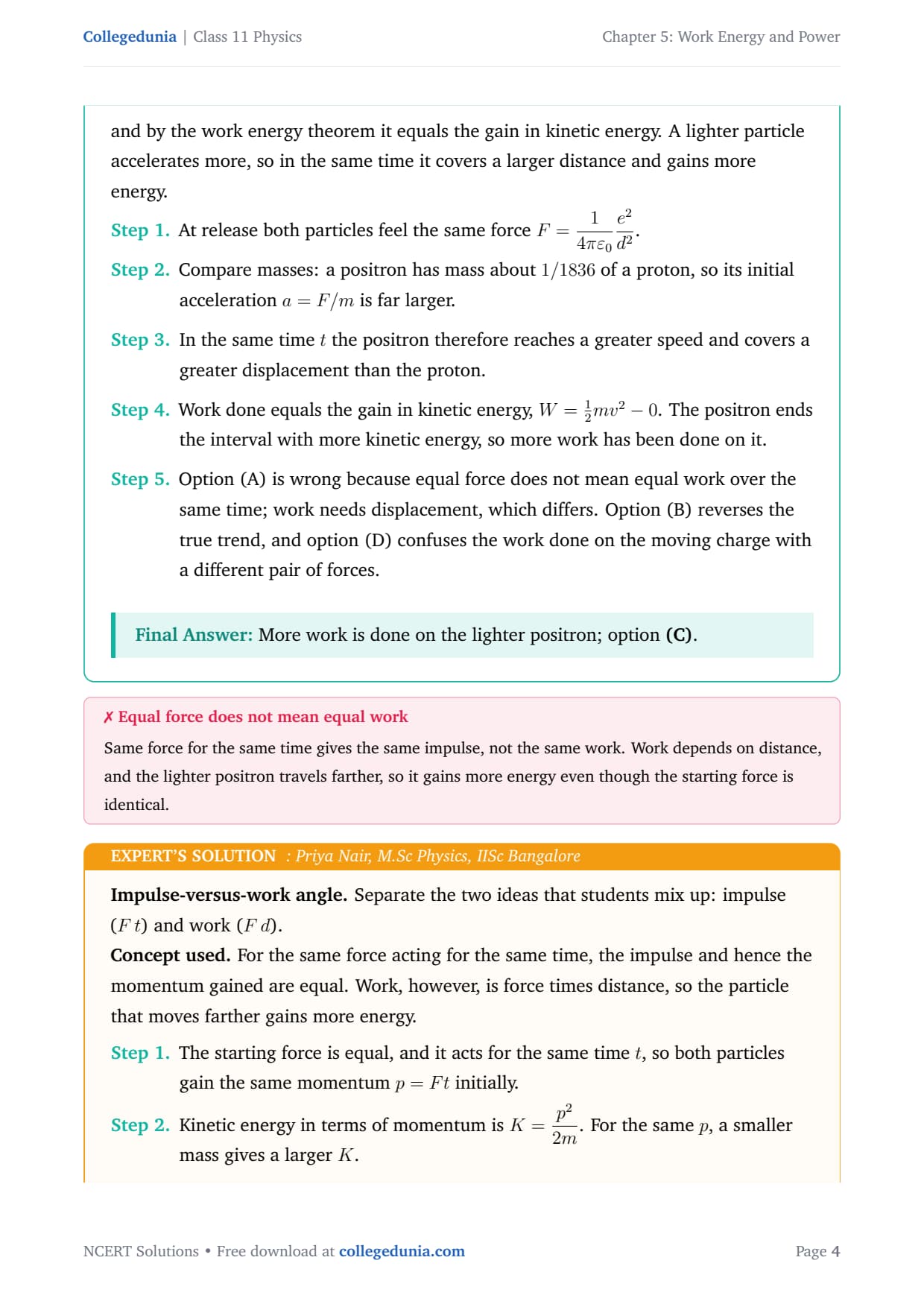
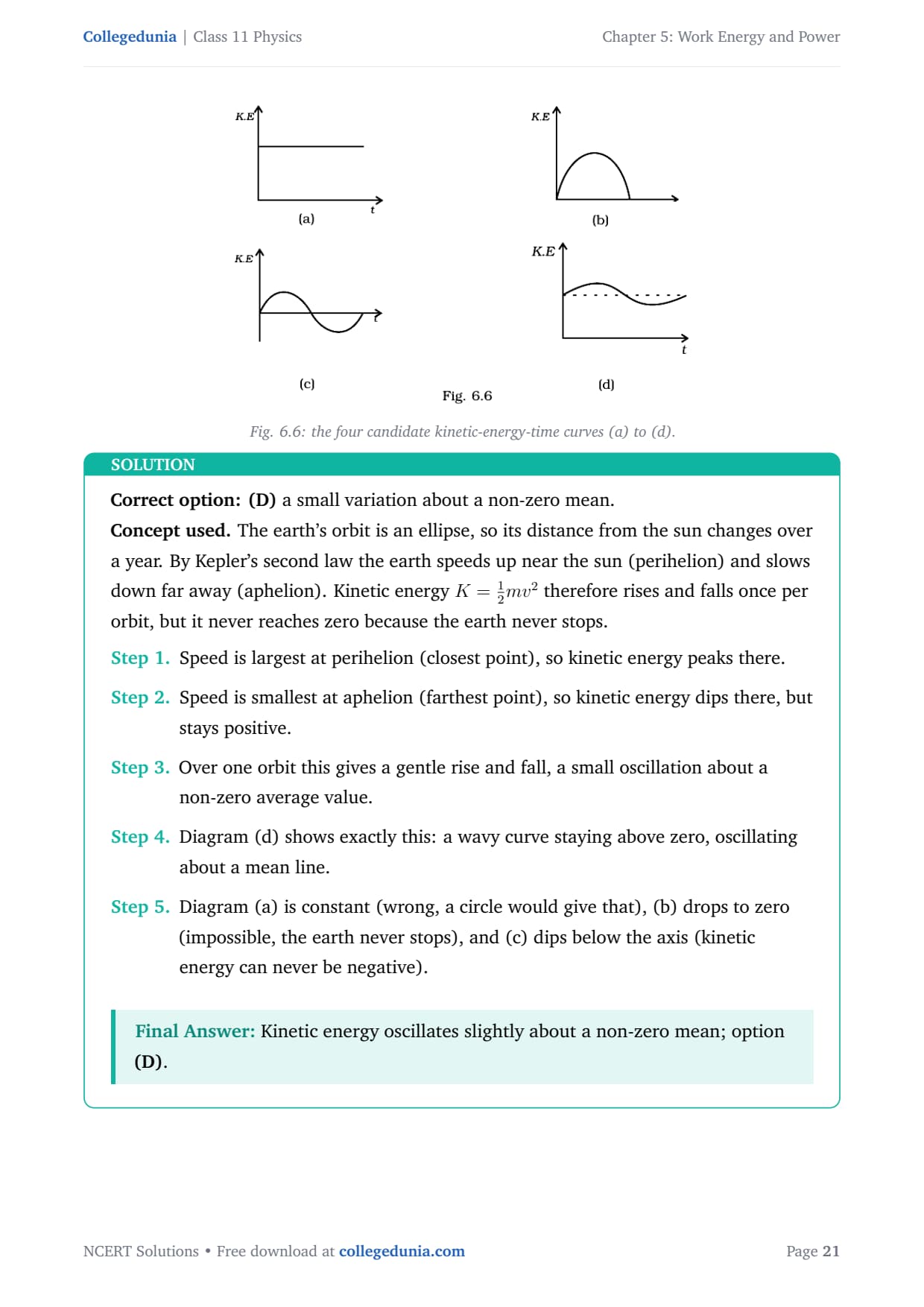
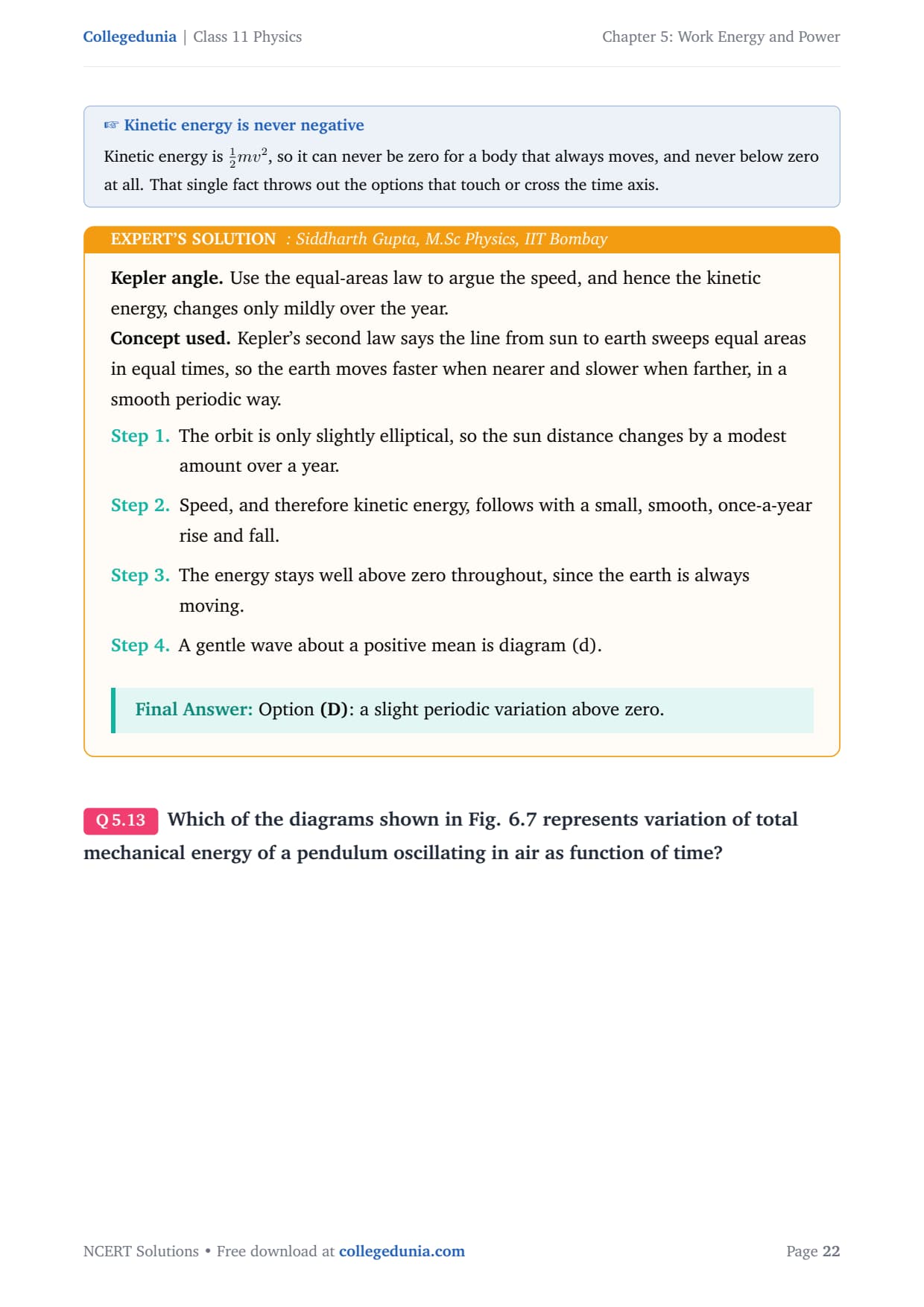
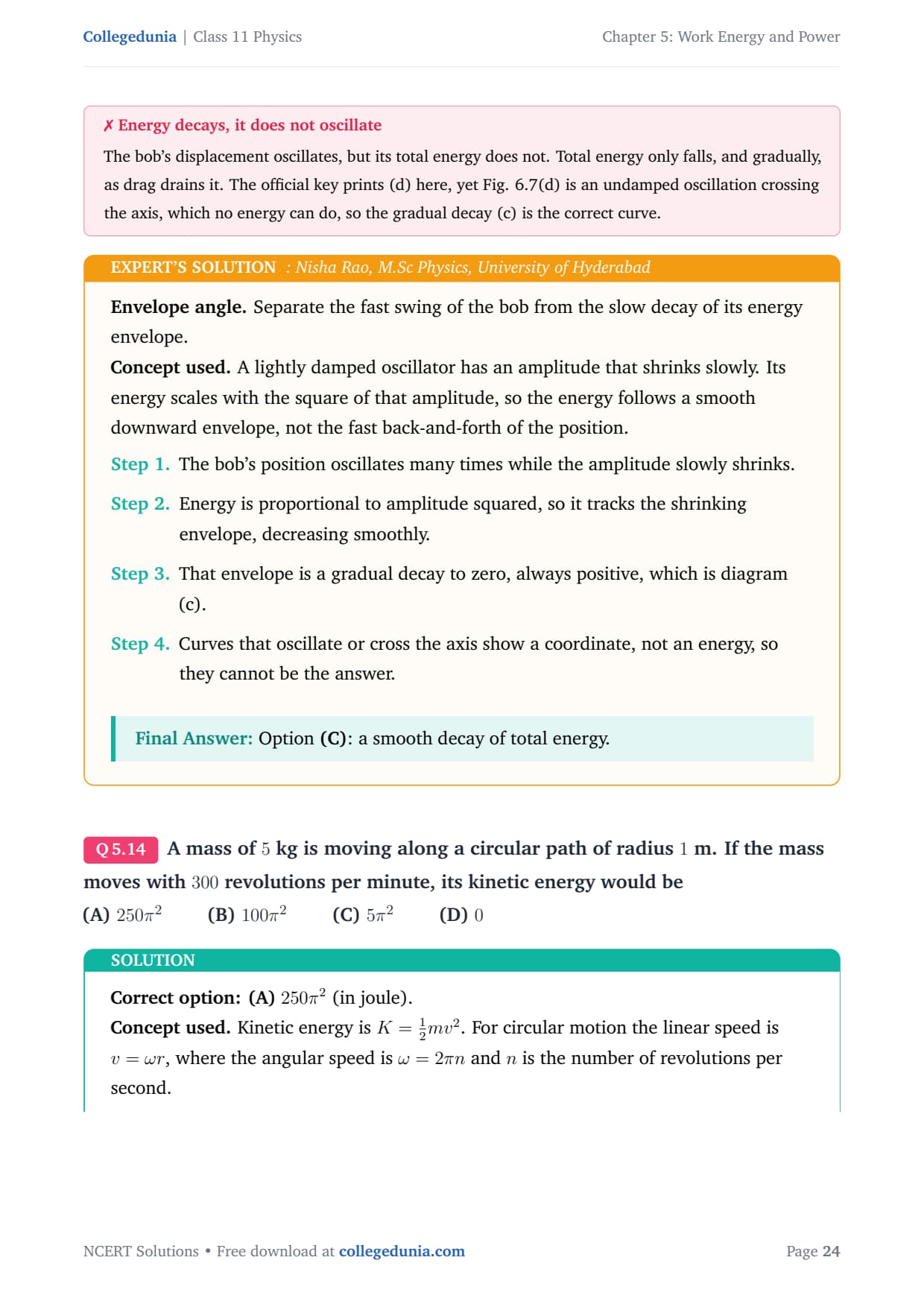
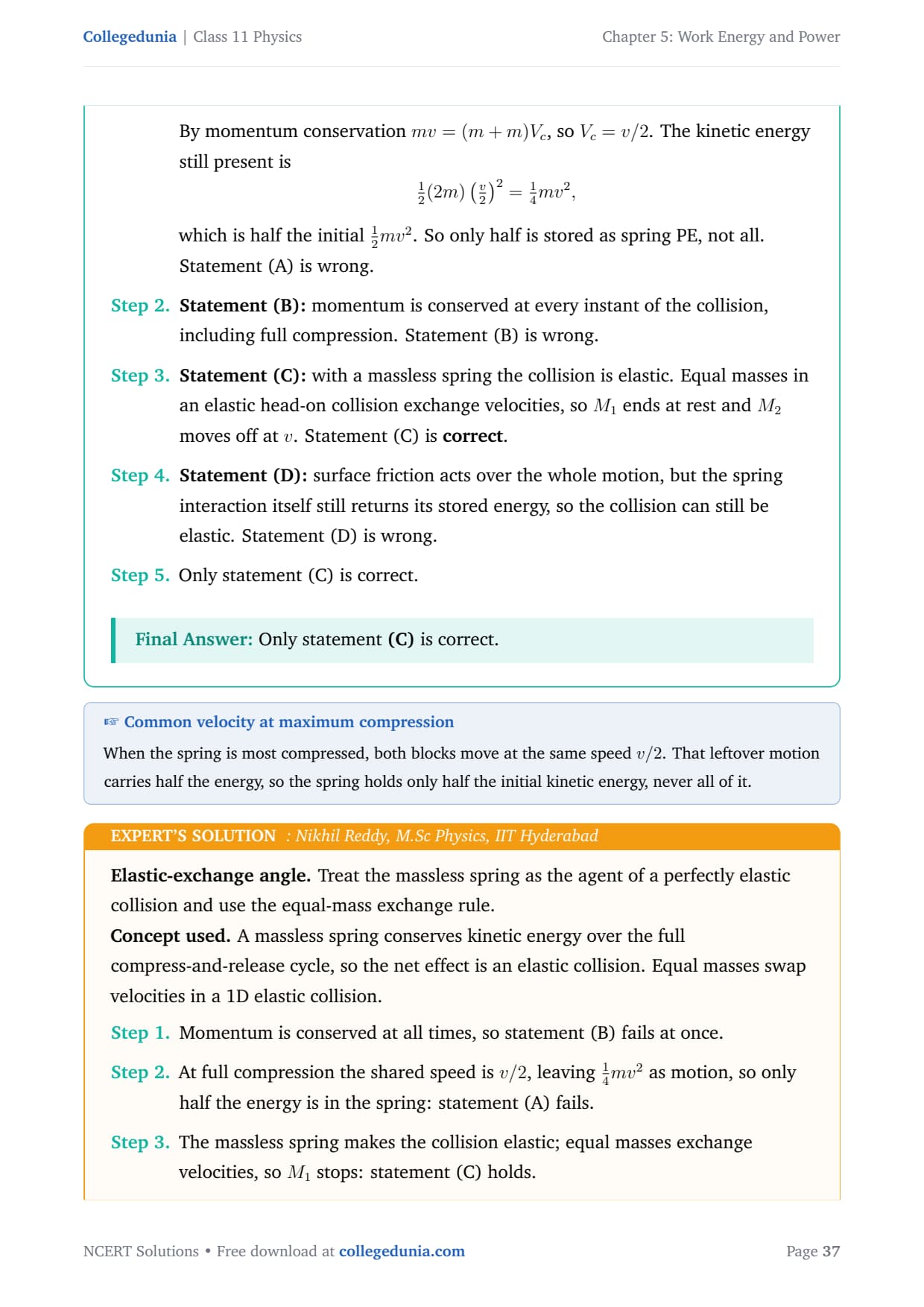
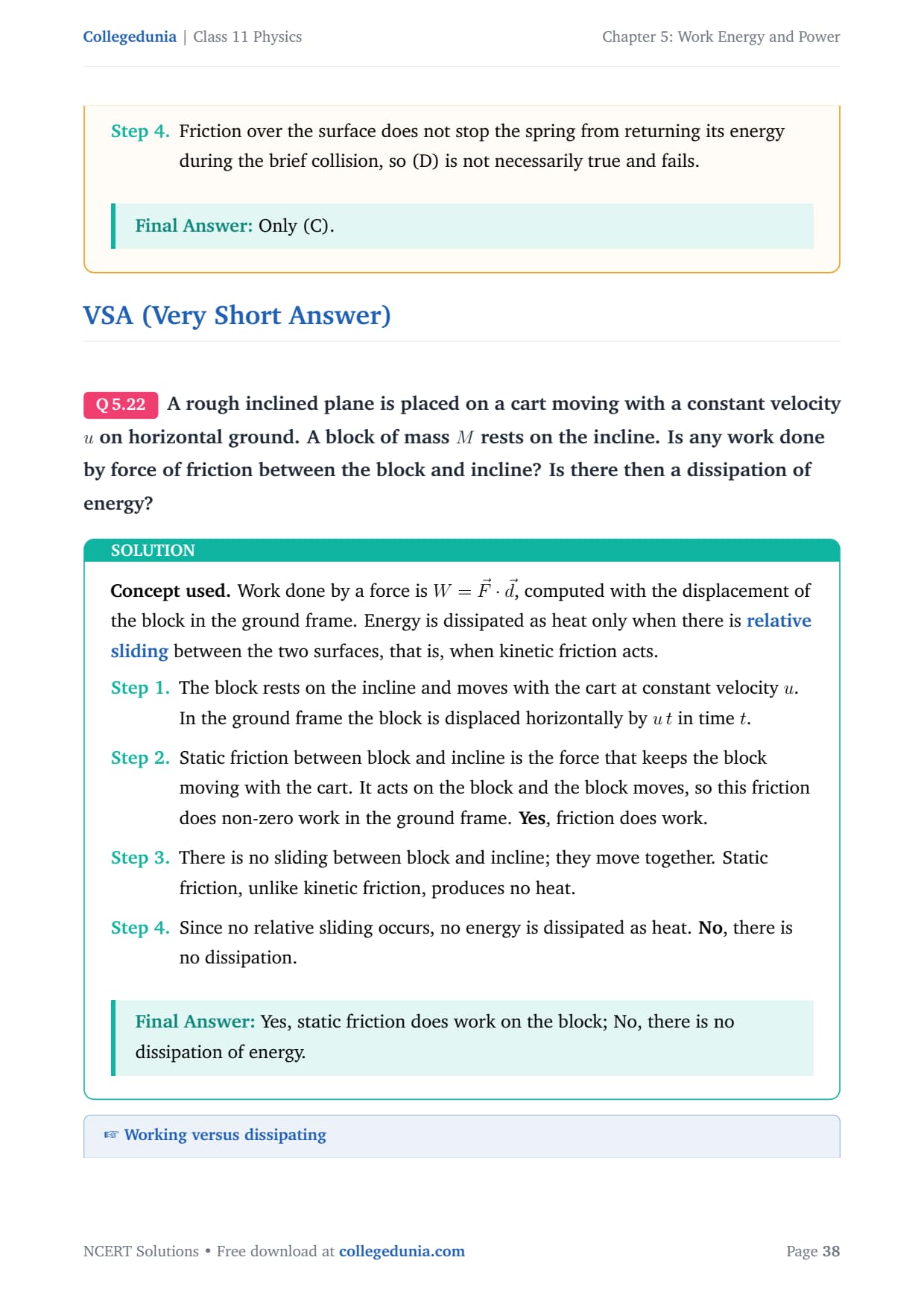
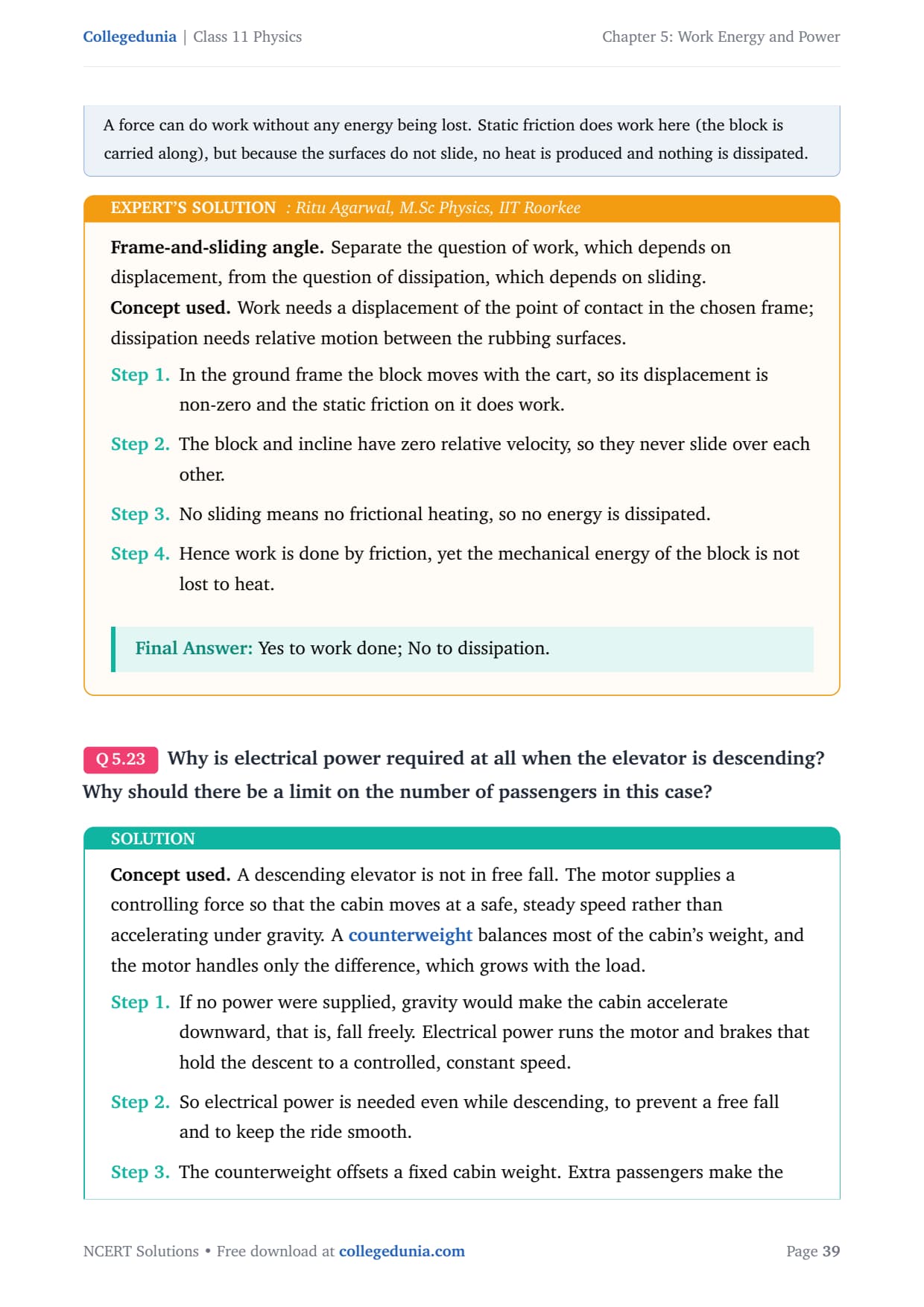
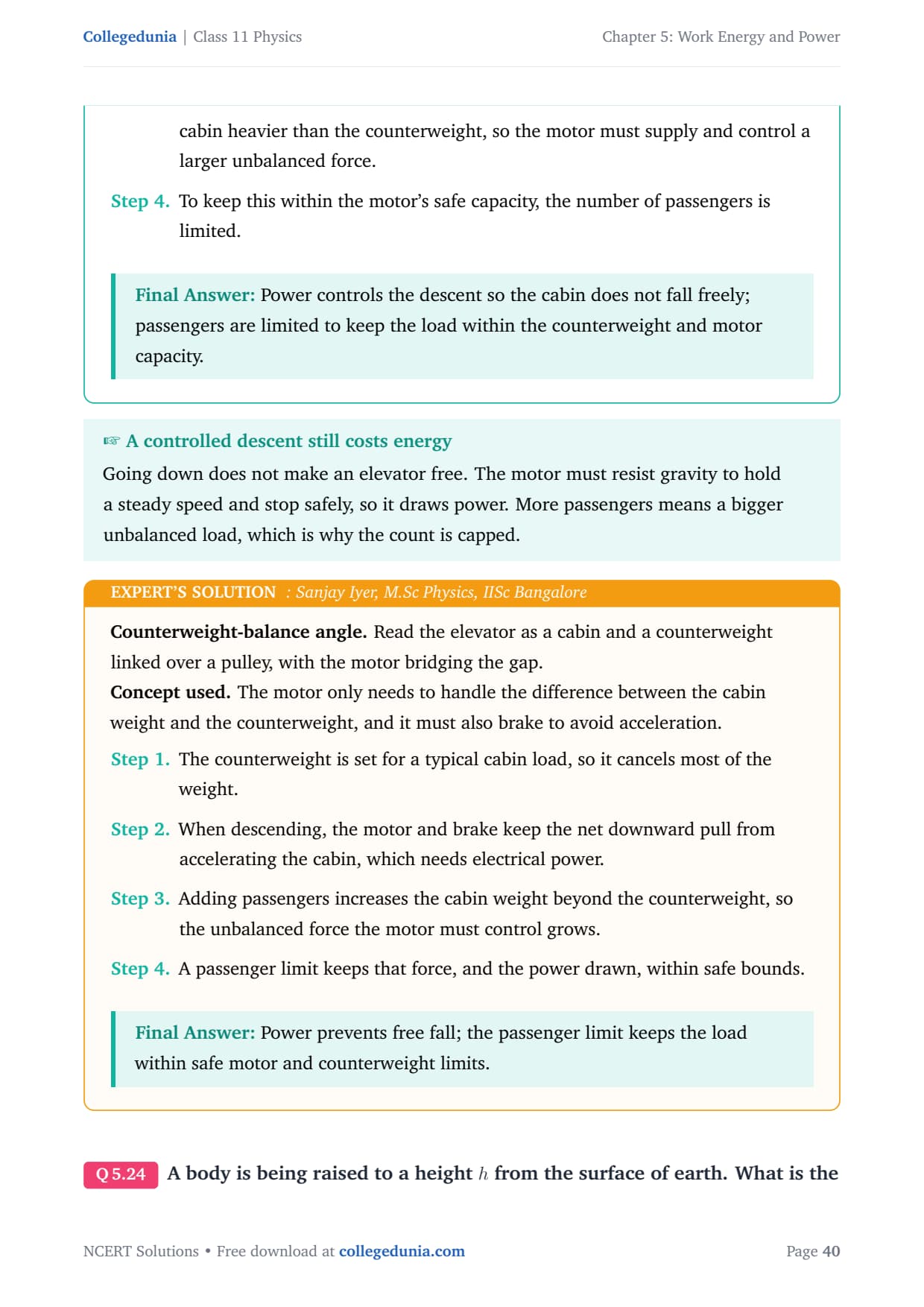
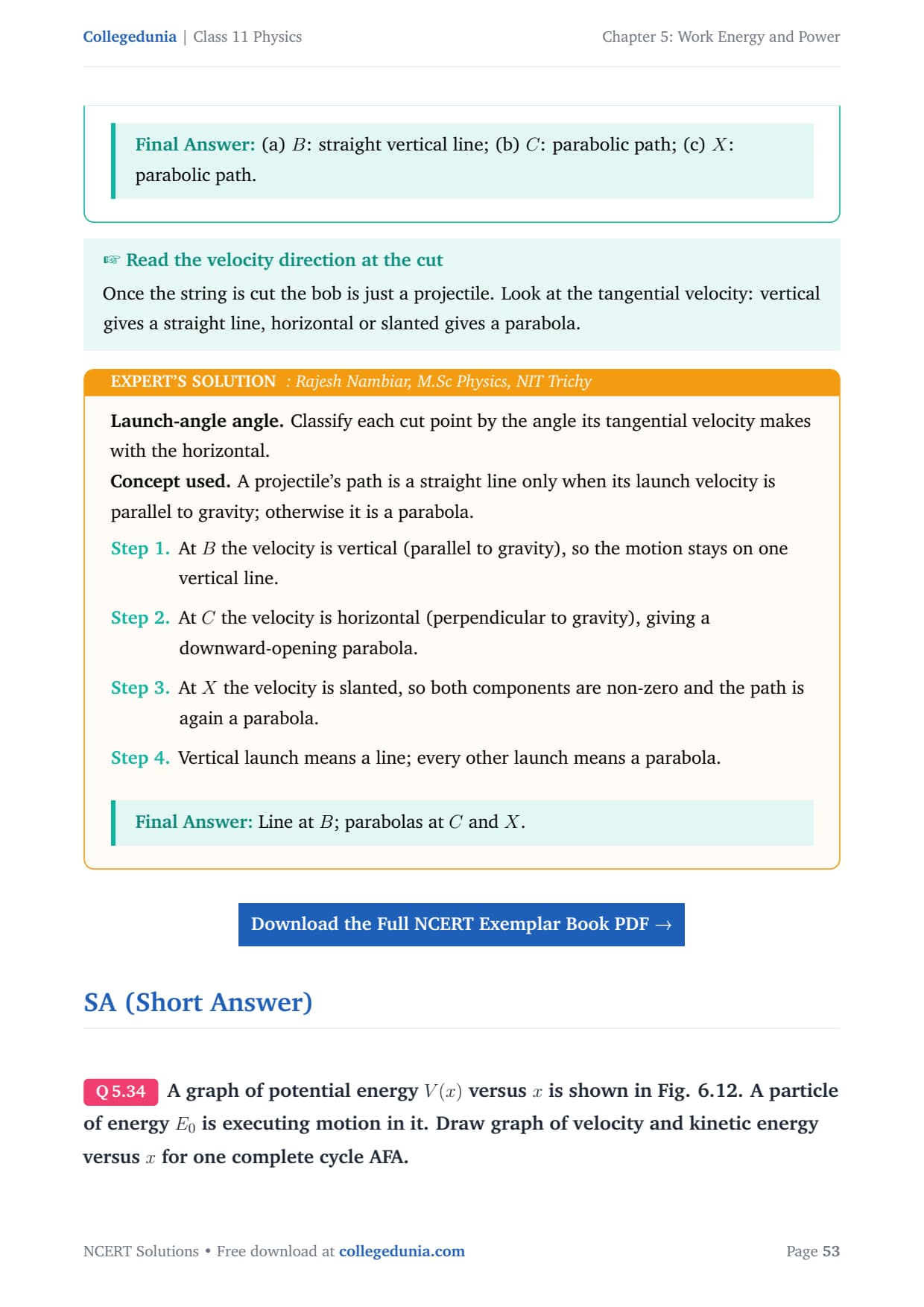
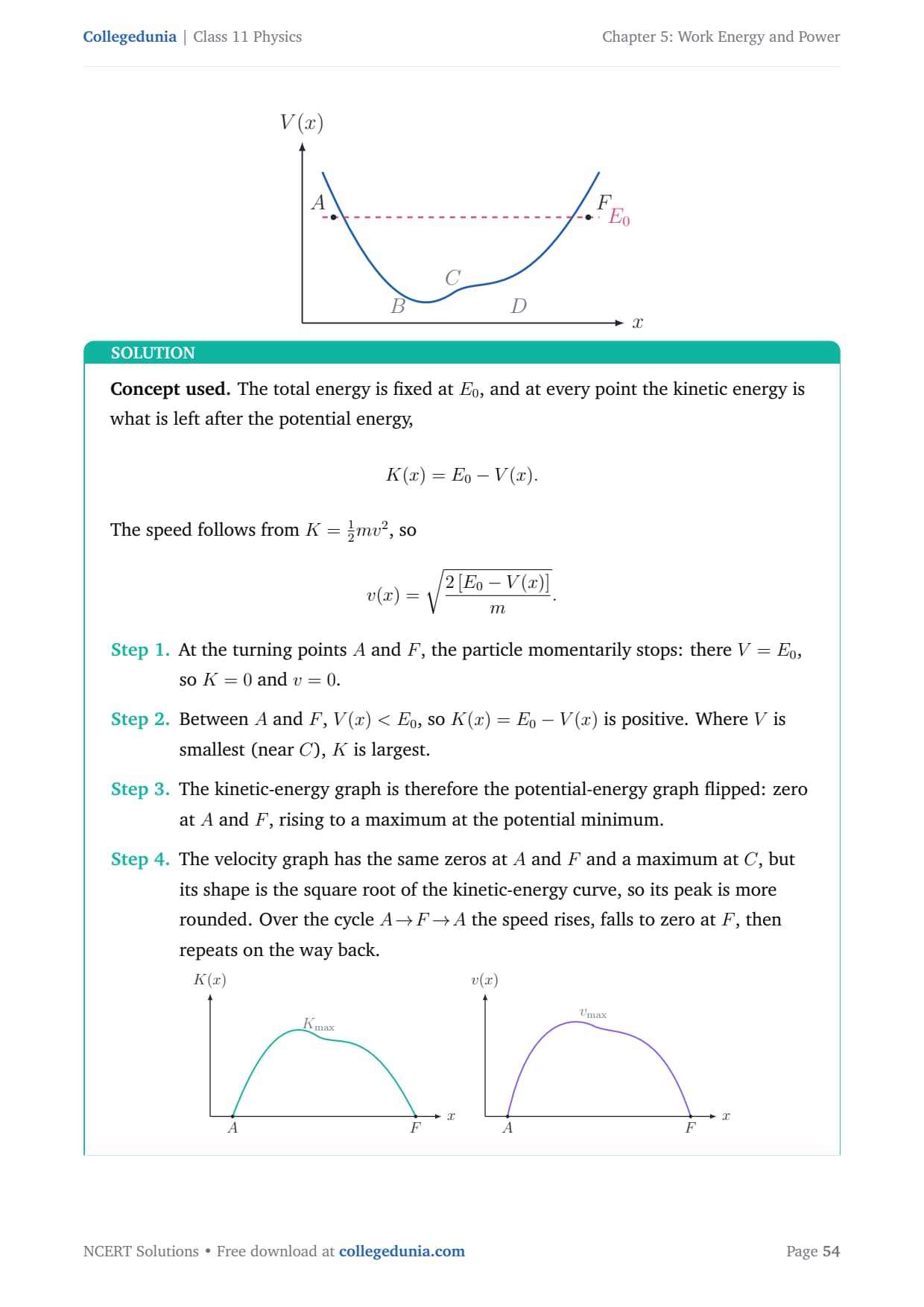
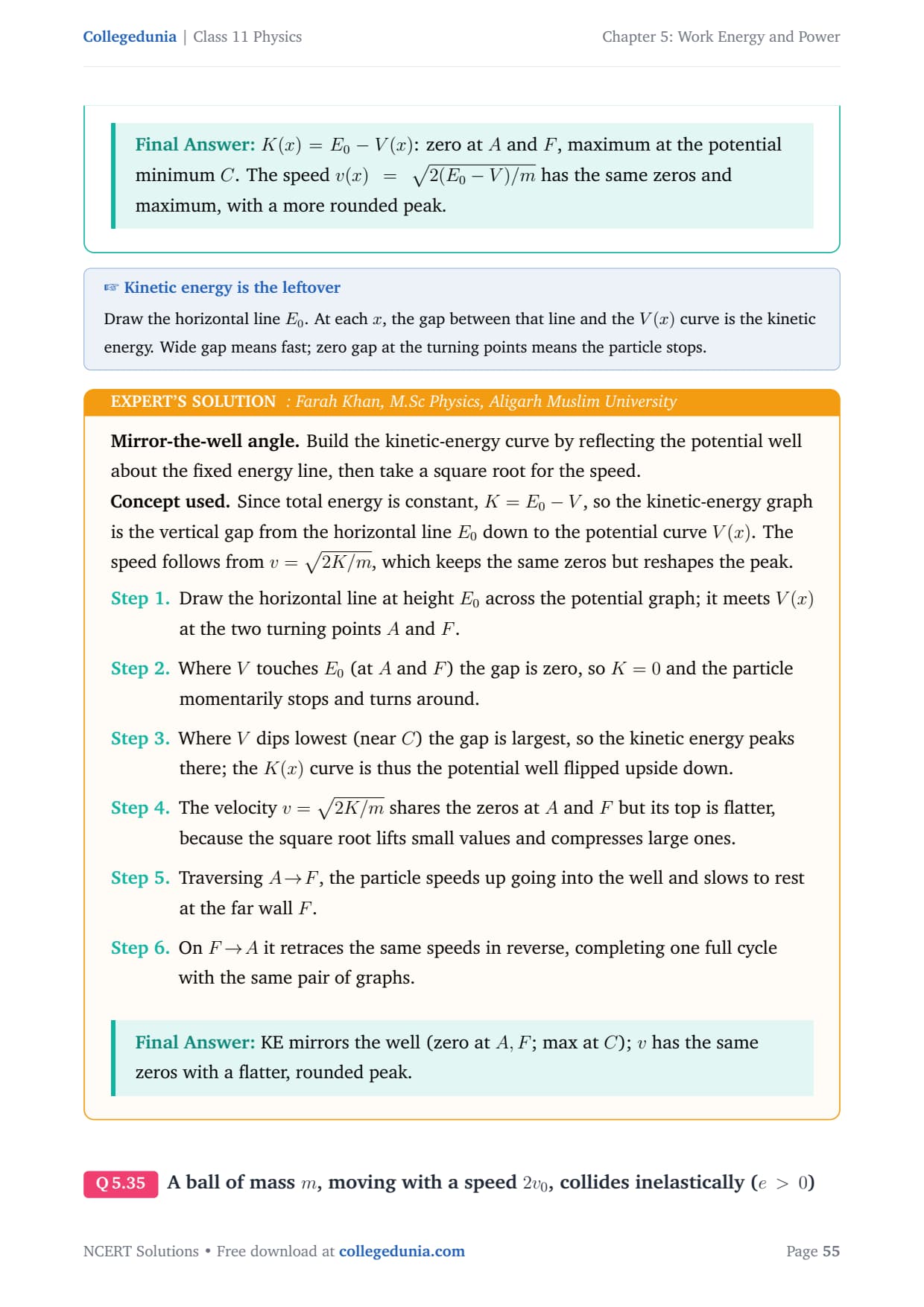
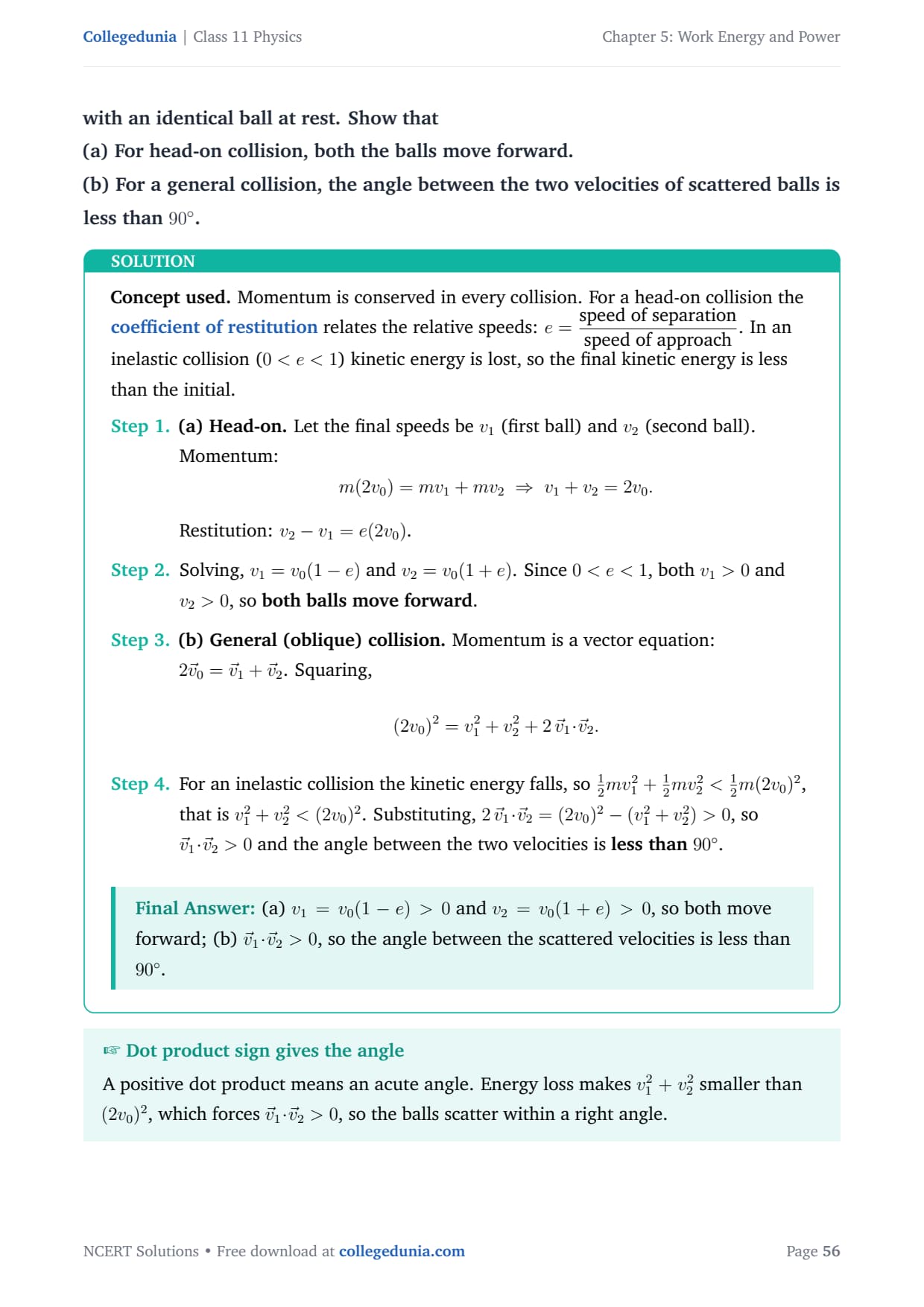
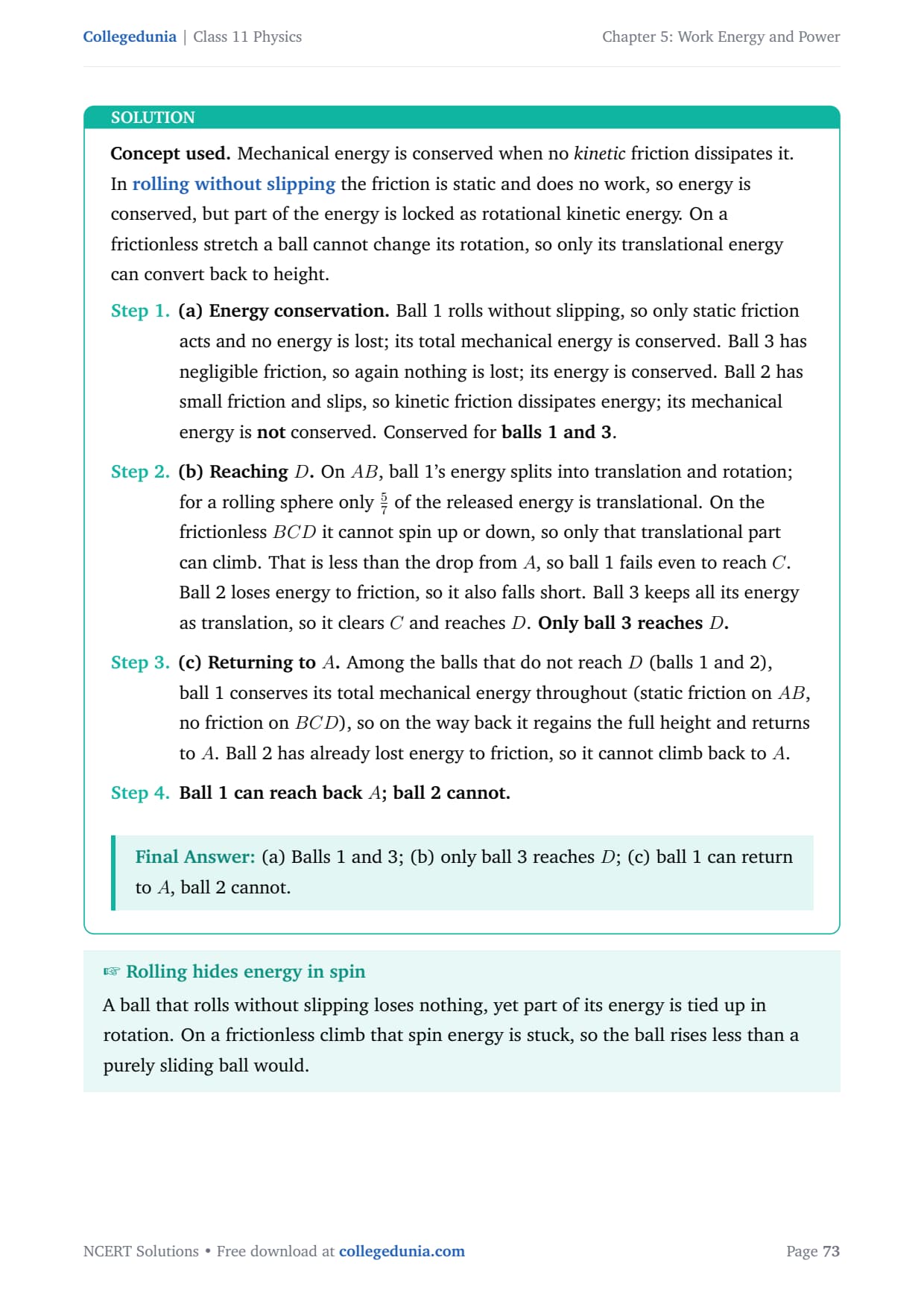
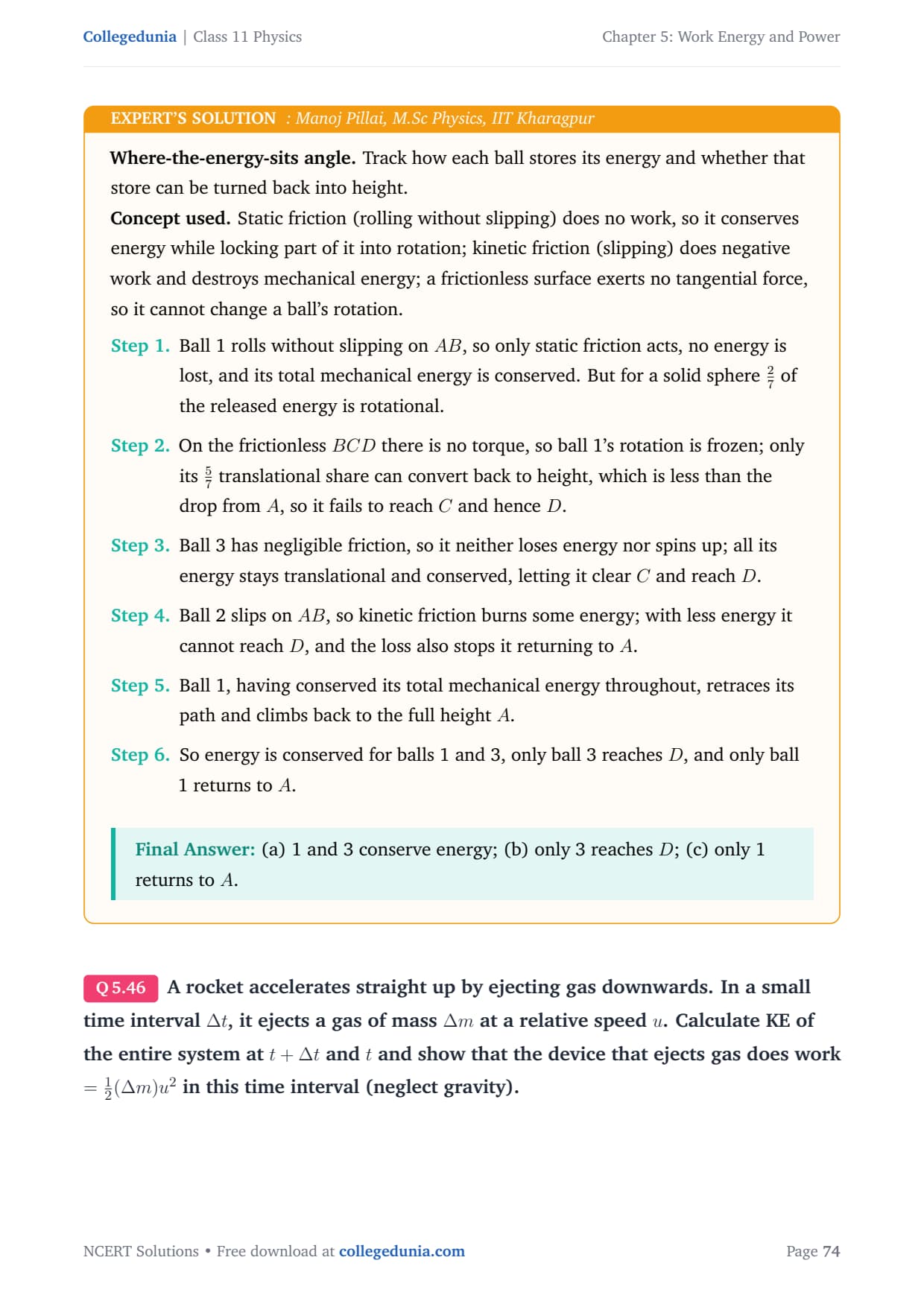
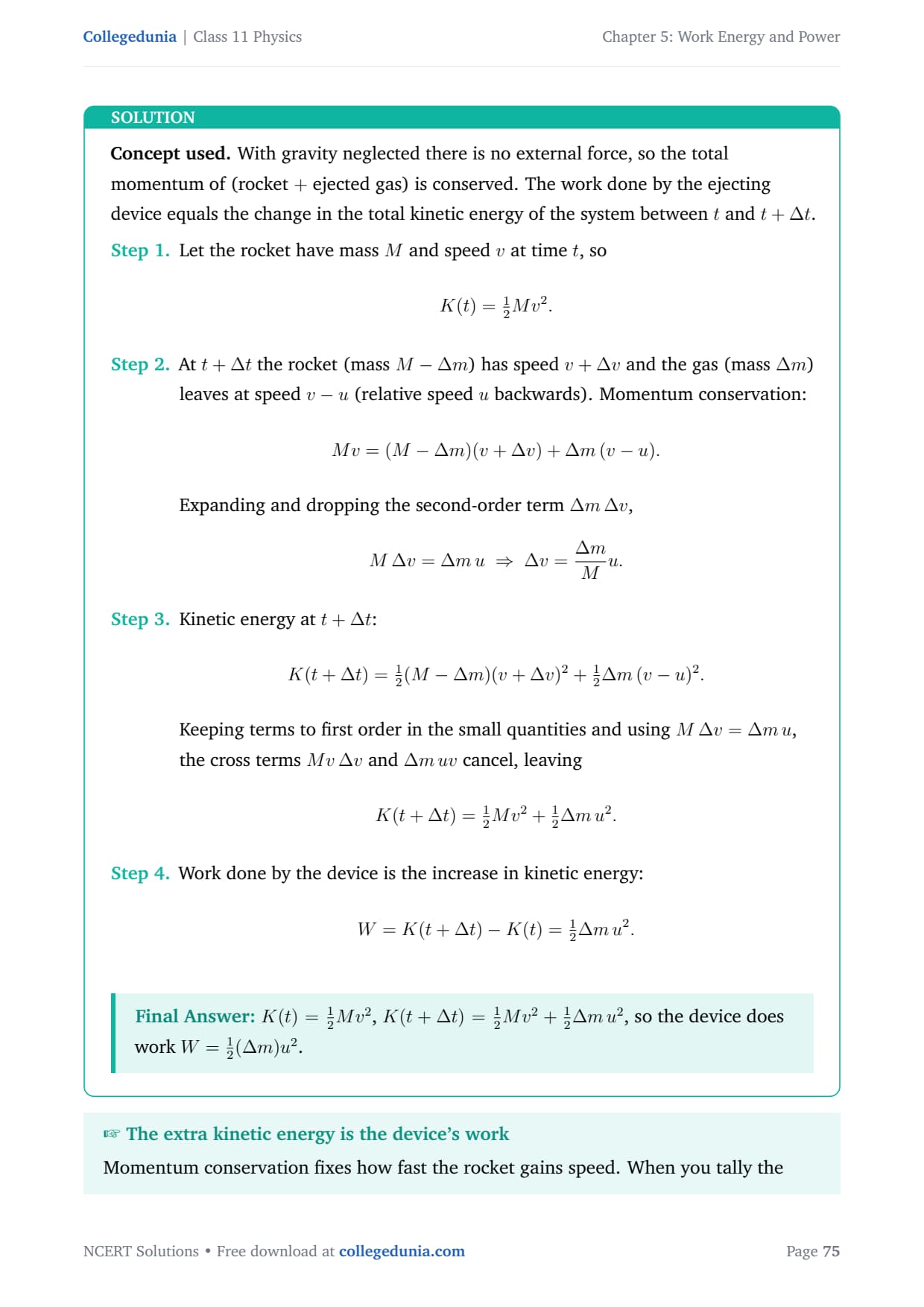
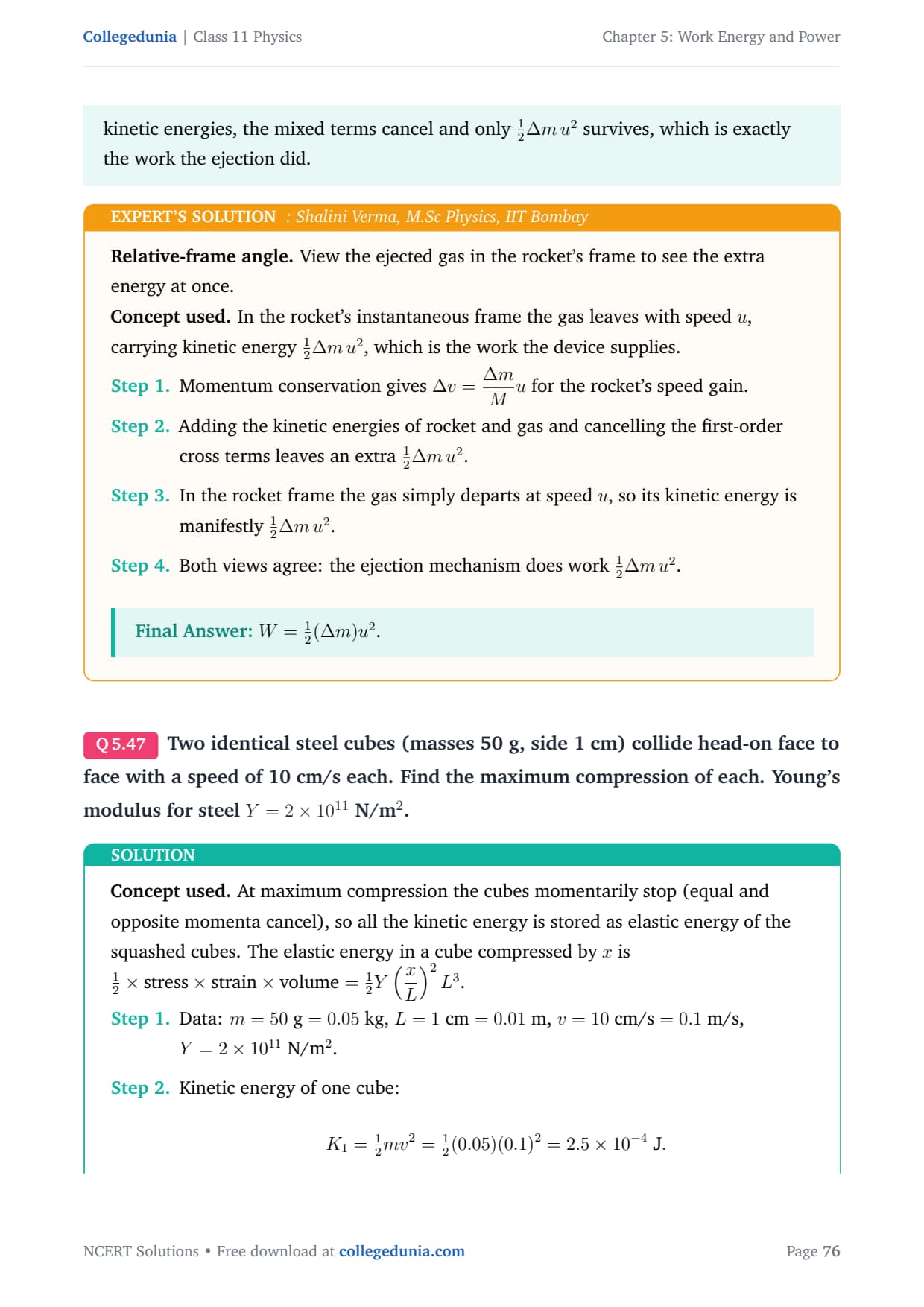
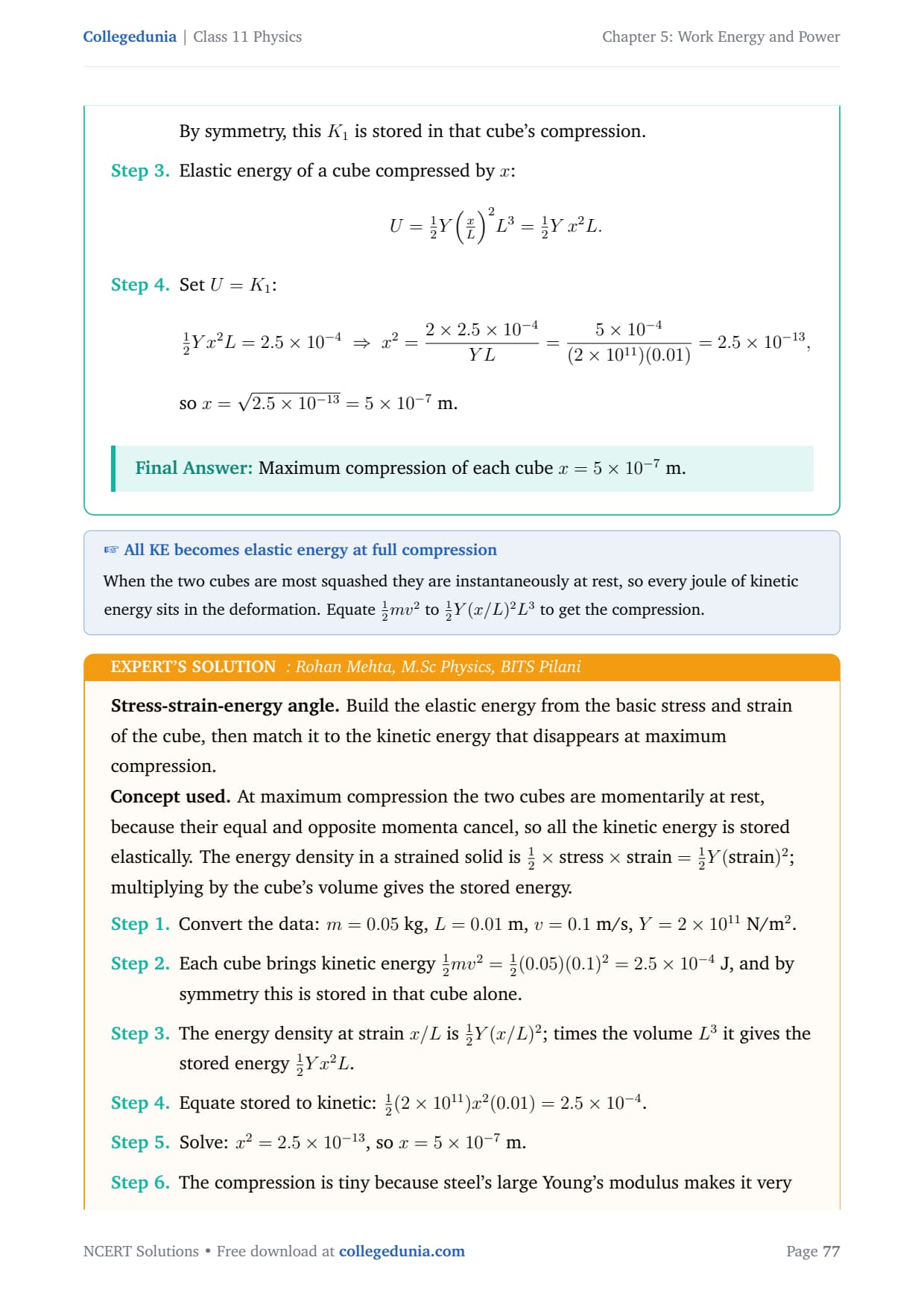
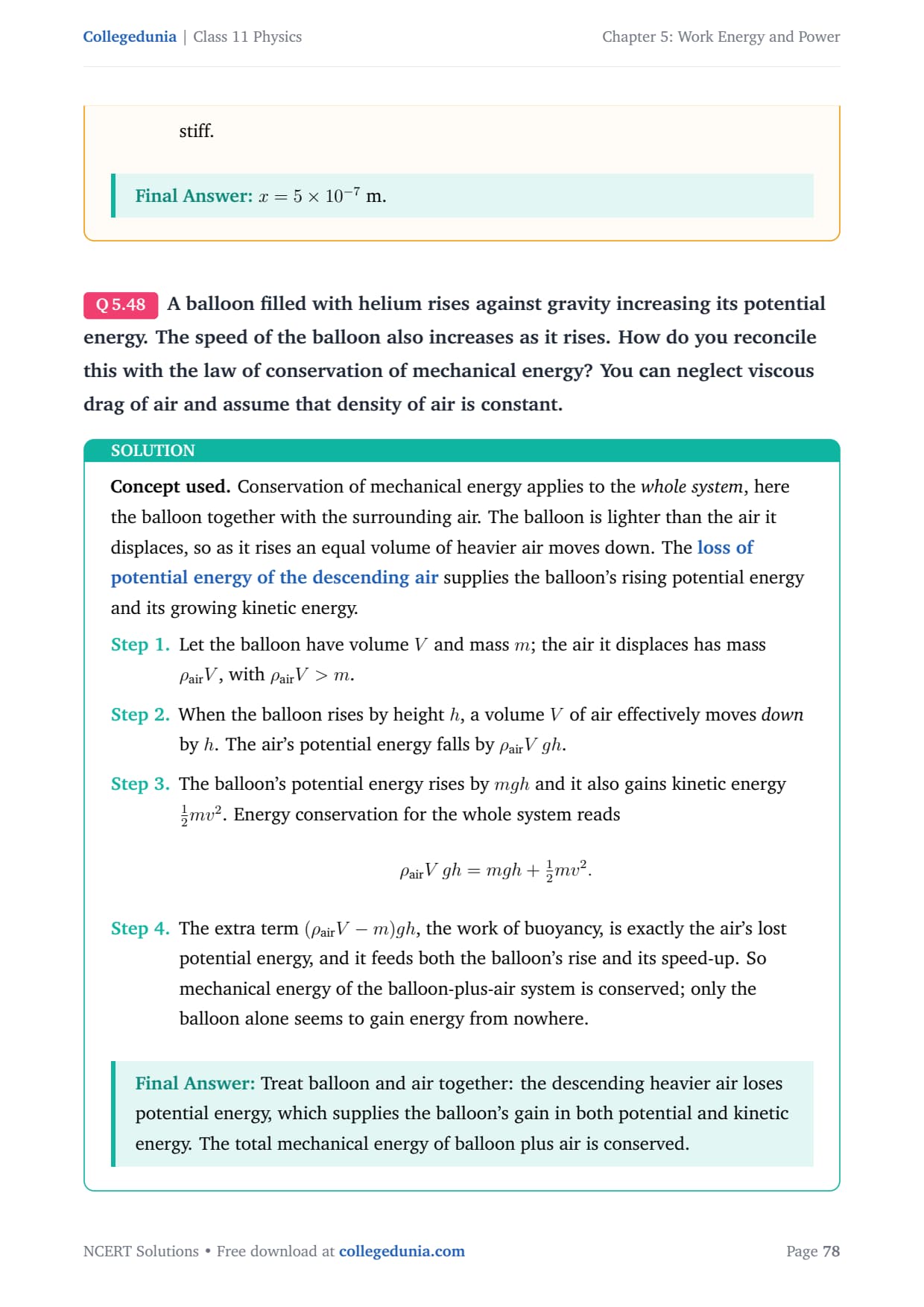
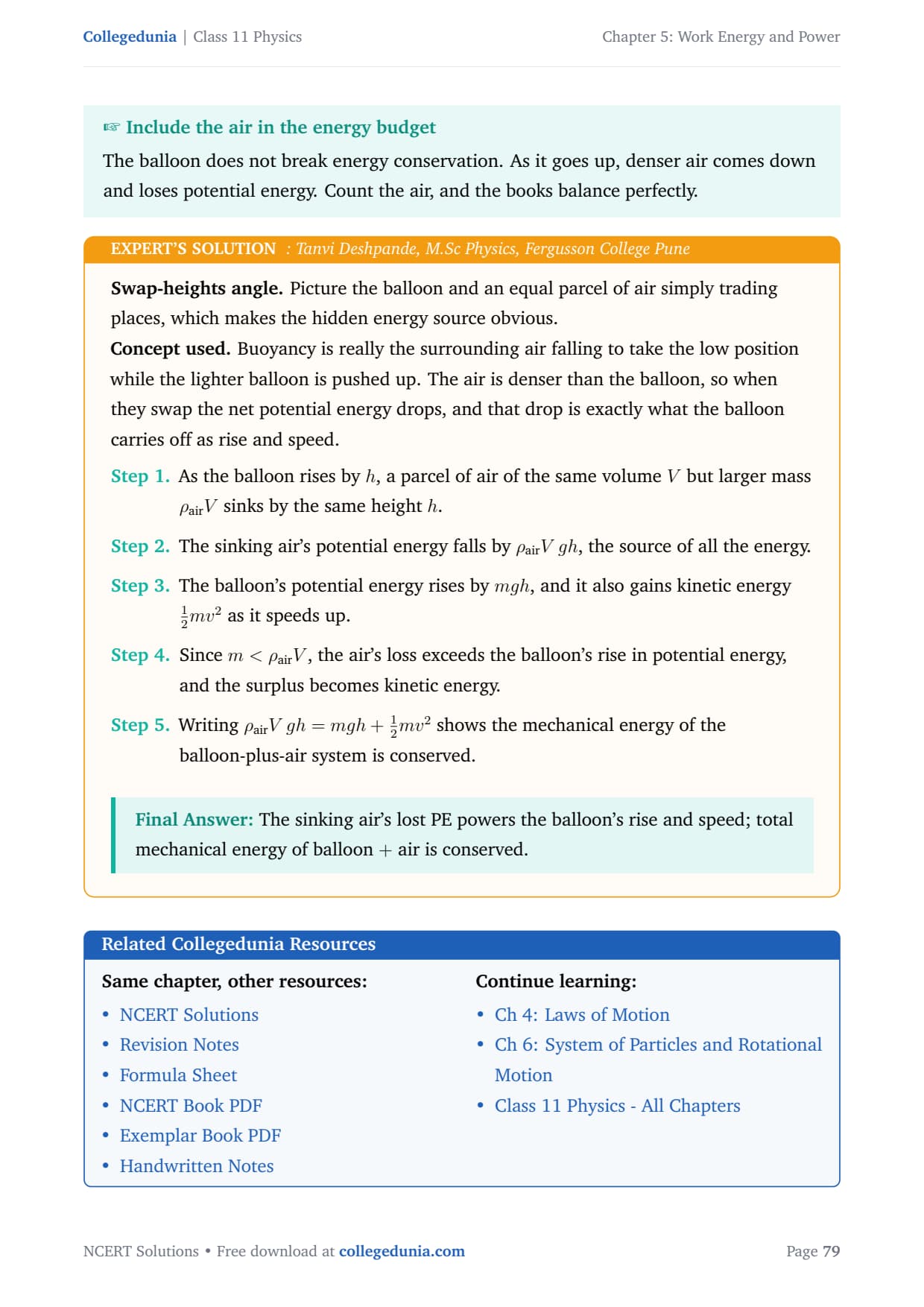
This chapter sits between the laws of motion and rotational motion, and borrows from both. The Exemplar leans hard on the work energy theorem and on collisions. Most of its traps concern which displacement you are allowed to use.
- CBSE Weightage: 6 to 7 marks, usually one numerical on the work energy theorem plus a short collision question
- JEE Main Weightage: 2 to 3 questions per year, most often on variable force, power and elastic collisions
- NEET Weightage: 2 questions per year from energy conservation and collisions
Solutions checked against the official NCERT Exemplar answer key, with every disputed answer worked out in full.
Topics Covered in the Class 11 Physics Work Energy and Power Exemplar
The Exemplar here is built on four ideas. Each returns in rotational motion and oscillations, so the effort carries forward.
- Work by a force: constant and variable force, the area under a force-displacement graph, and the sign of the work
- Work energy theorem: net work equals the change in kinetic energy, for any force
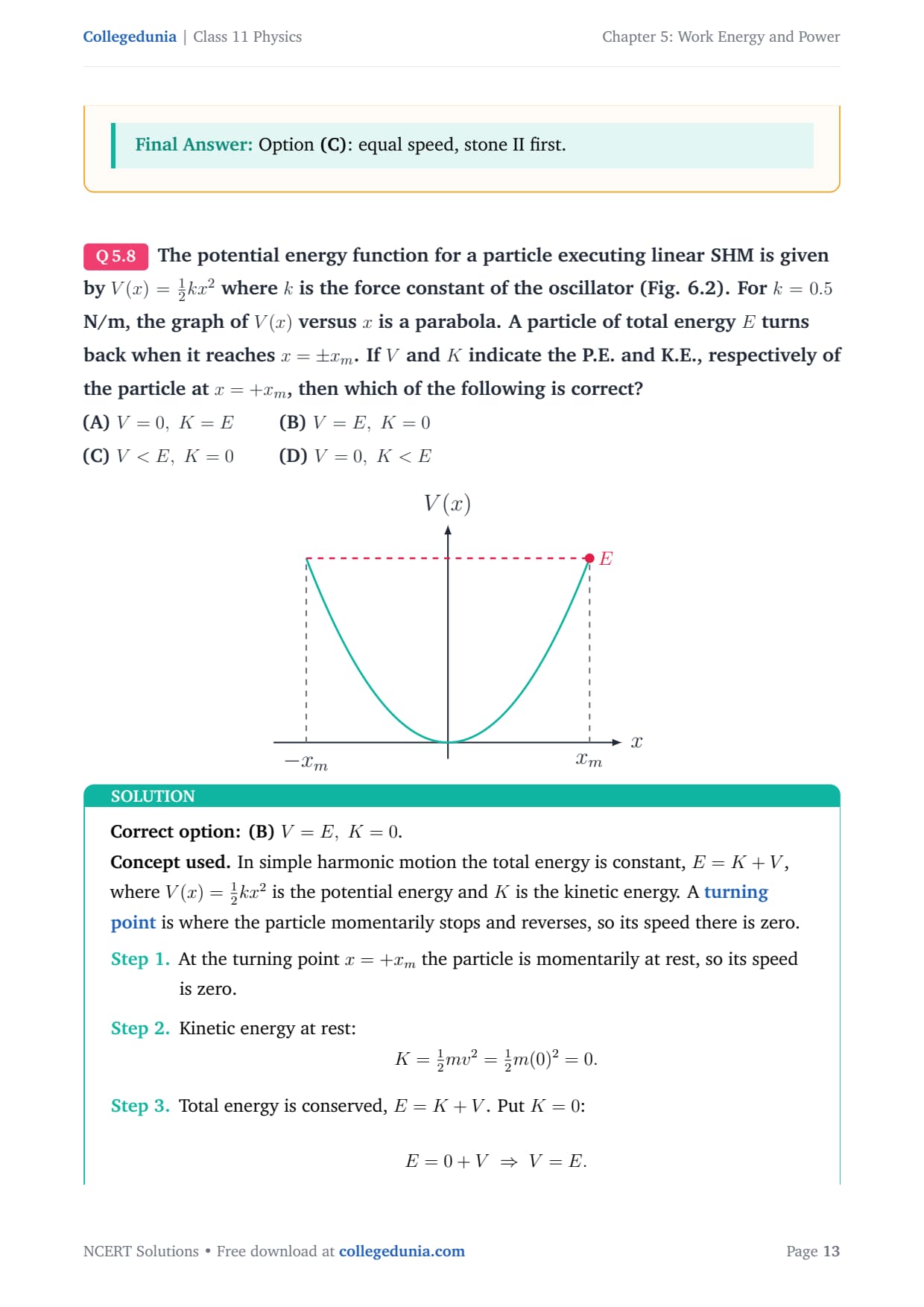
- Conservative forces: turning points, potential energy curves, and when mechanical energy is conserved
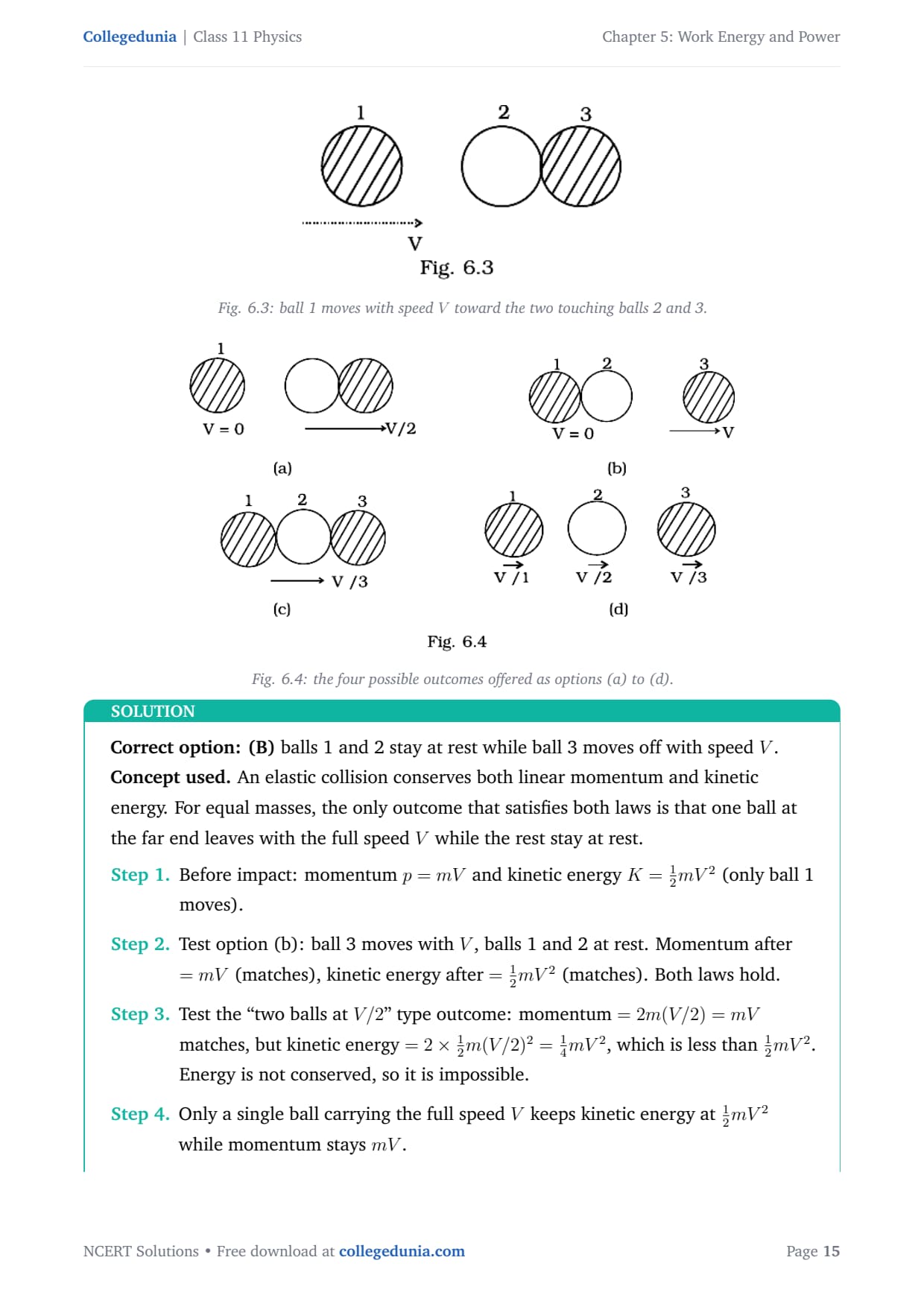
- Collisions and power: elastic and inelastic collisions, the coefficient of restitution, and instantaneous power
Question Types in the Work Energy and Power NCERT Exemplar
The 48 questions split across five types. The MCQ I set is unusually large, and it hides most of the chapter's reasoning traps.
| Question Type | Count | What It Tests |
|---|---|---|
| MCQ I (single correct) | 18 | Sign of work, graph reading, and quick energy numericals |
| MCQ II (one or more correct) | 3 | Ruling out every wrong option, not just spotting one right one |
| VSA (Very Short Answer) | 12 | One-line reasoning on whether a named force does work |
| SA (Short Answer) | 10 | Numericals on power, energy loss and stopping distance |
| LA (Long Answer) | 5 | Potential energy curves and collision analysis worth 5 marks |
Key Formulas Used in the Work Energy and Power Exemplar
Nearly every question reduces to one of the relations below. The PDF names each one before using it.
- Work by a constant force: W = F s cosθ, where θ is the angle between force and displacement
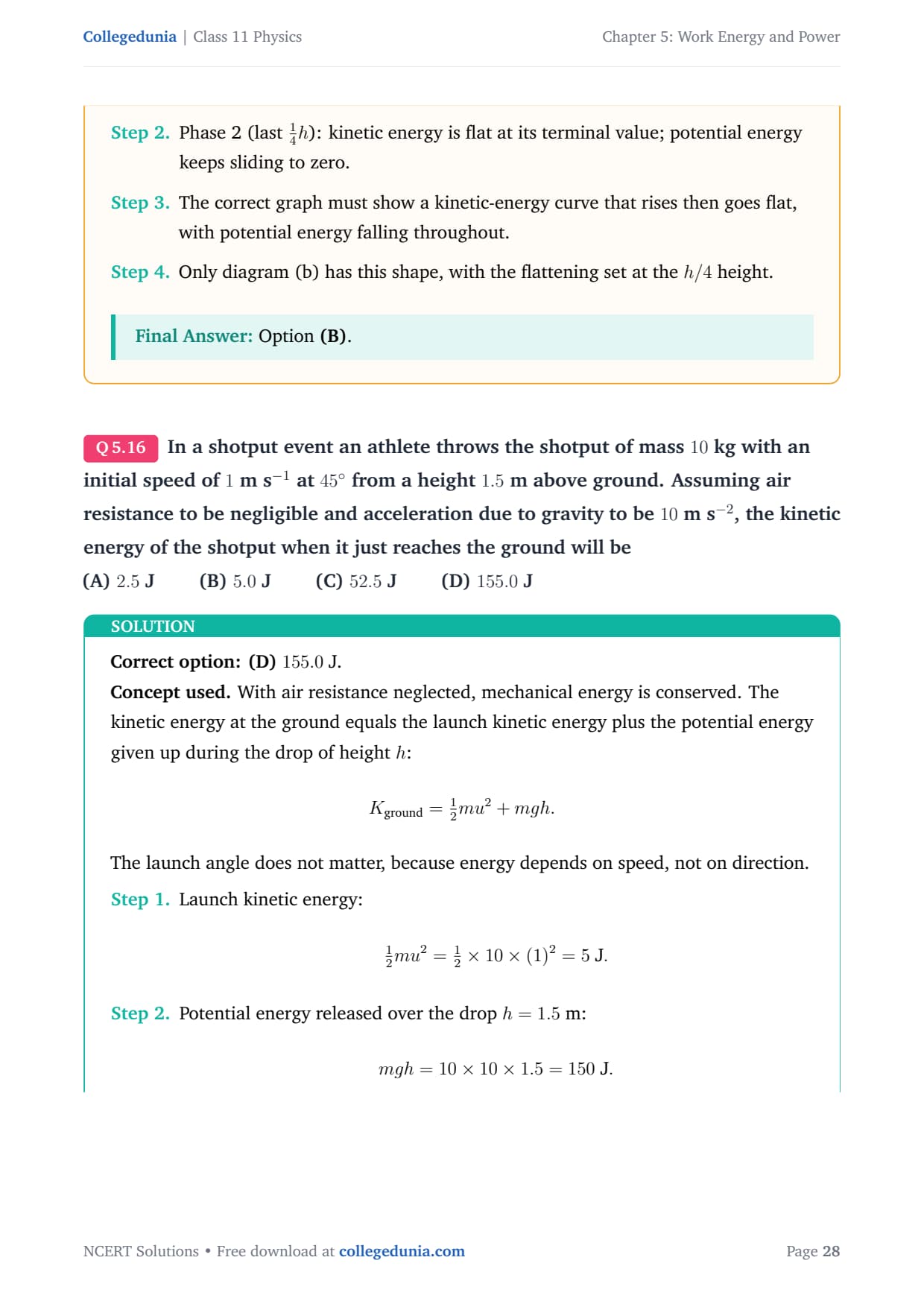
- Work energy theorem: Wnet = ΔK = ½mvf2 − ½mvi2
- Average force in a collision: F = Δp/Δt, with Δp = 2mv for a straight bounce back
- Power: P = dW/dt = F·v, giving instantaneous power directly
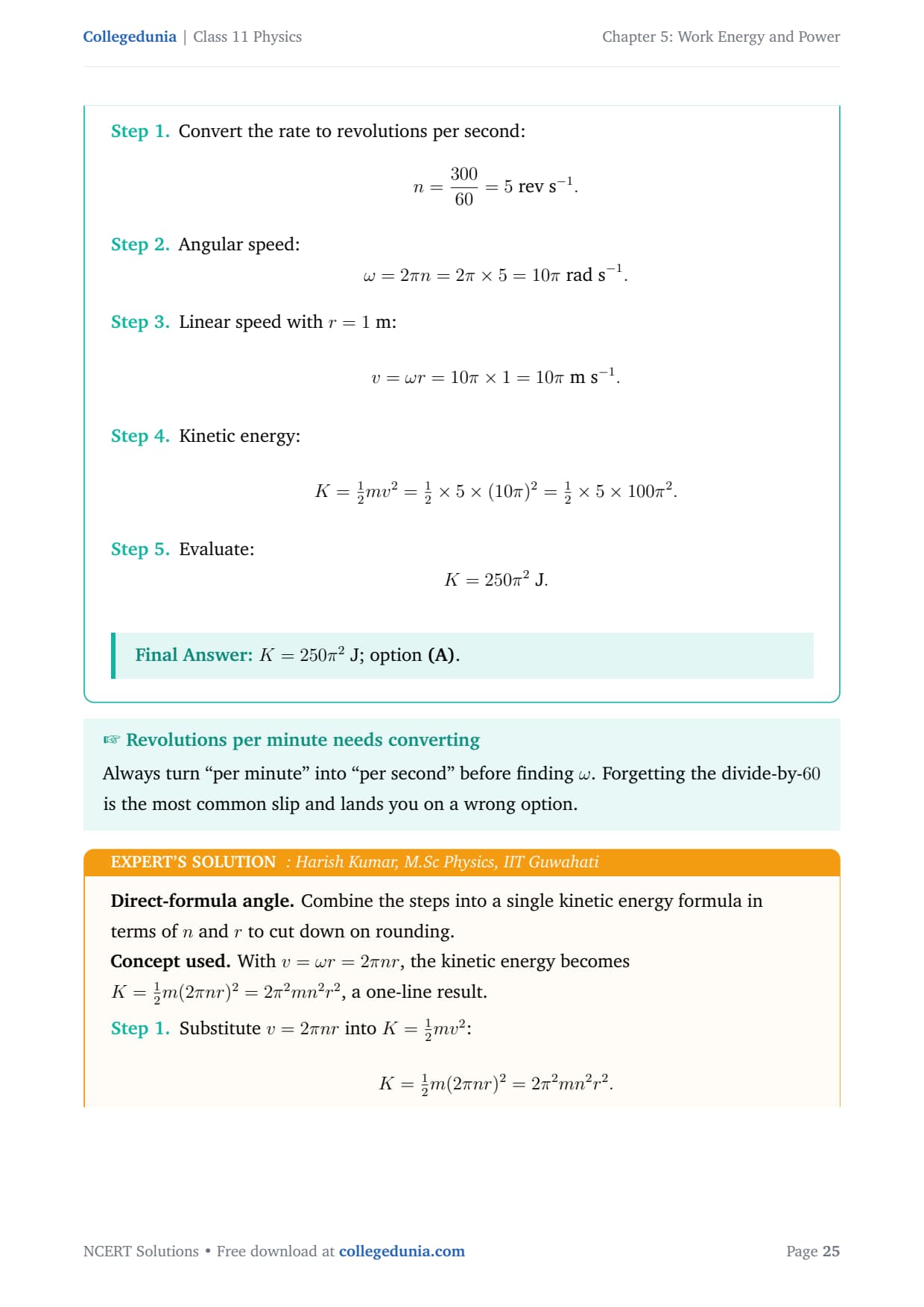
- Circular motion energy: K = ½mω2r2, with ω = 2πn
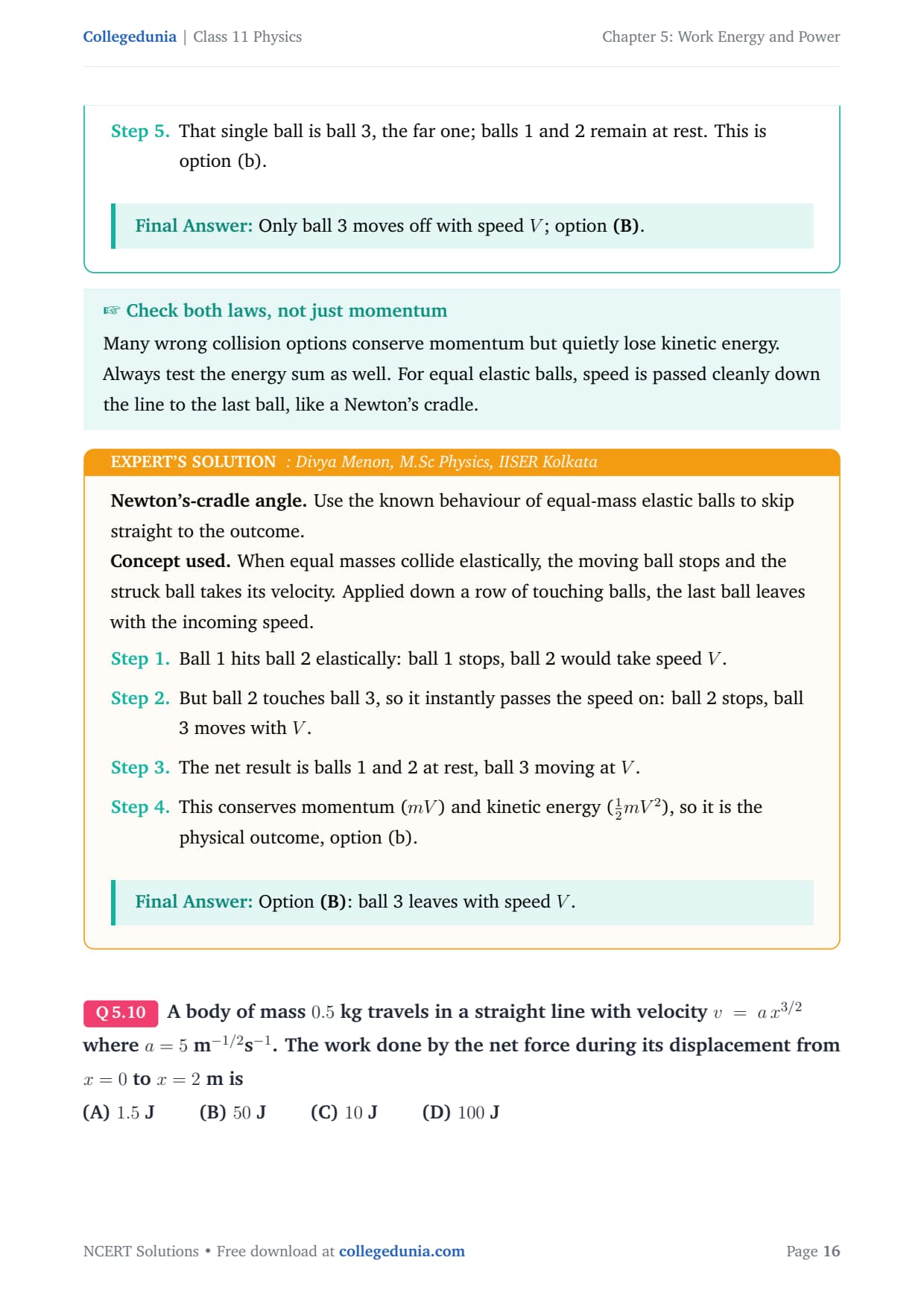
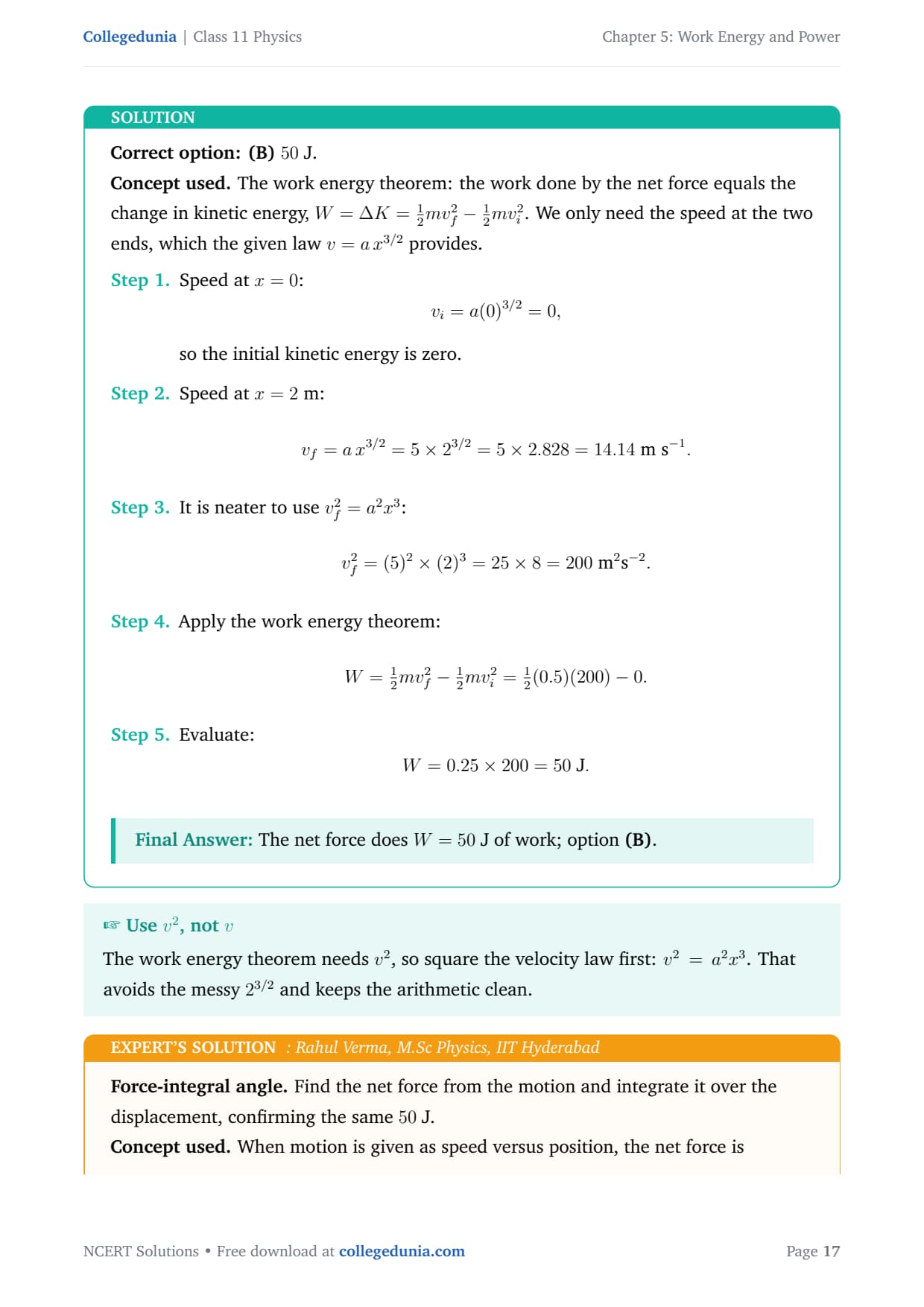
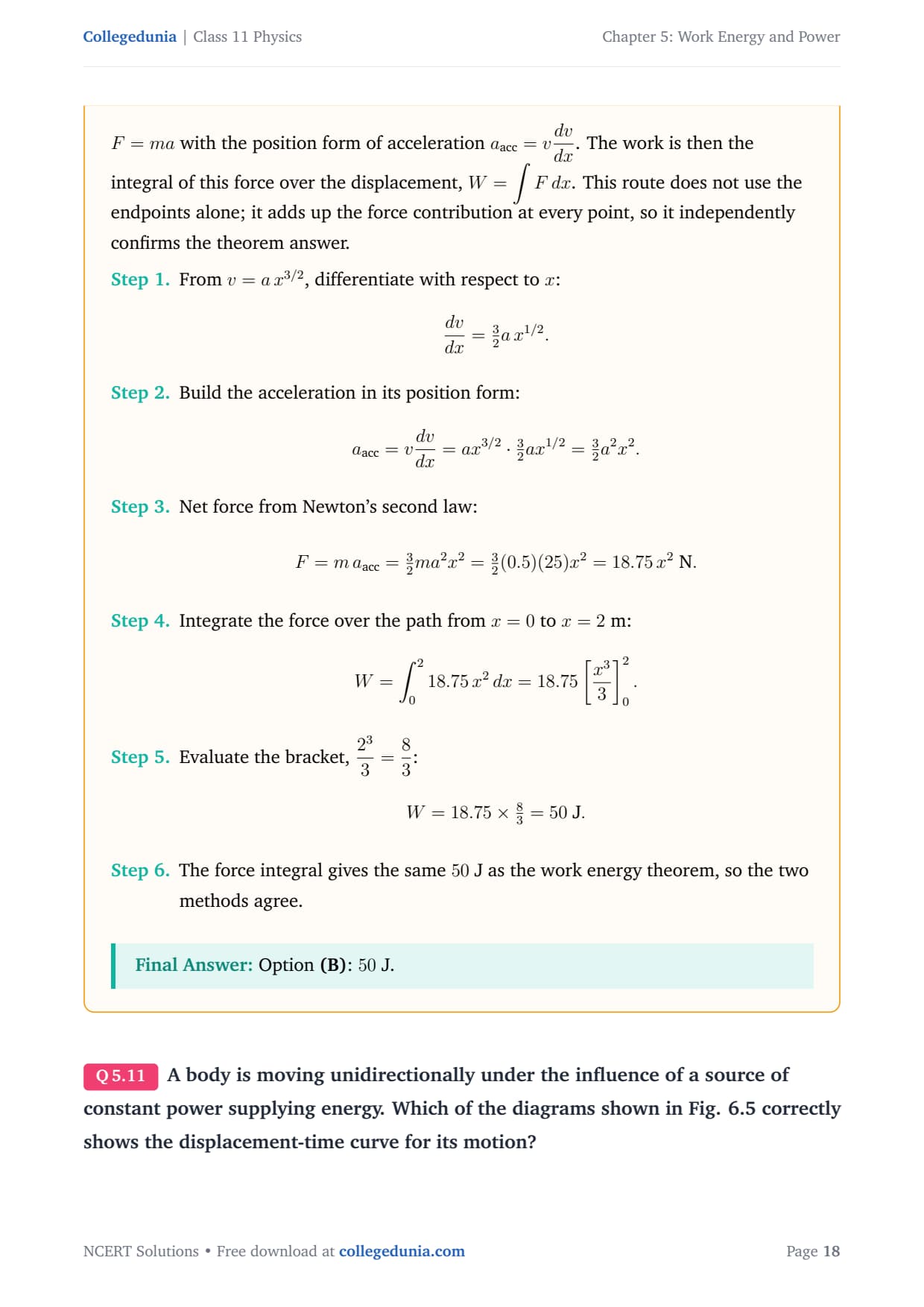
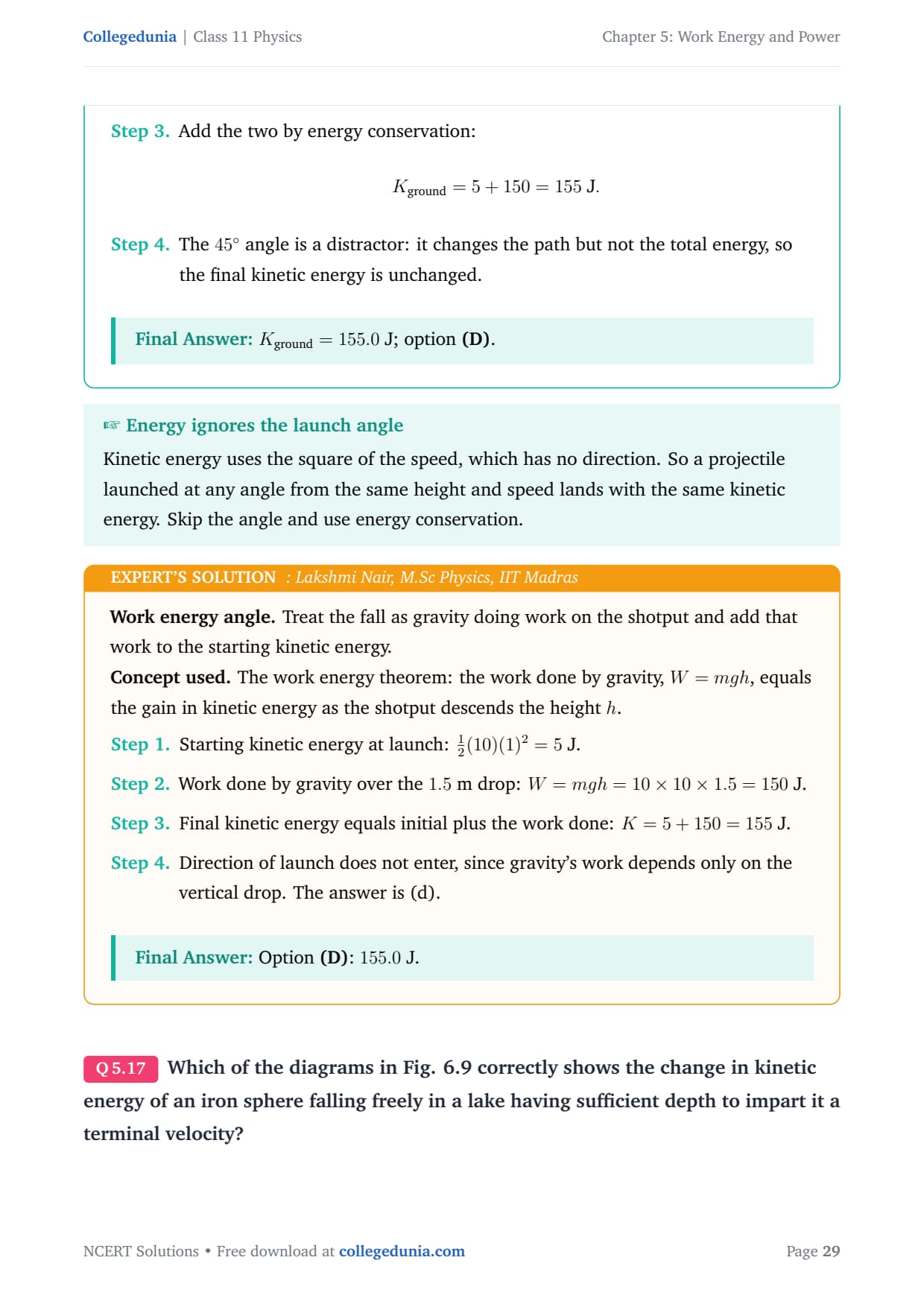
The work energy theorem holds for any force, constant or not. Question 10 uses this. A body of mass 0.5 kg moves with v = ax3/2, and you need the work from x = 0 to x = 2 m. The force never enters. The speeds at the two ends give 50 J.
Common Mistakes Students Make in Work Energy and Power
The Exemplar sets these traps on purpose. Each is flagged in the PDF where it appears.
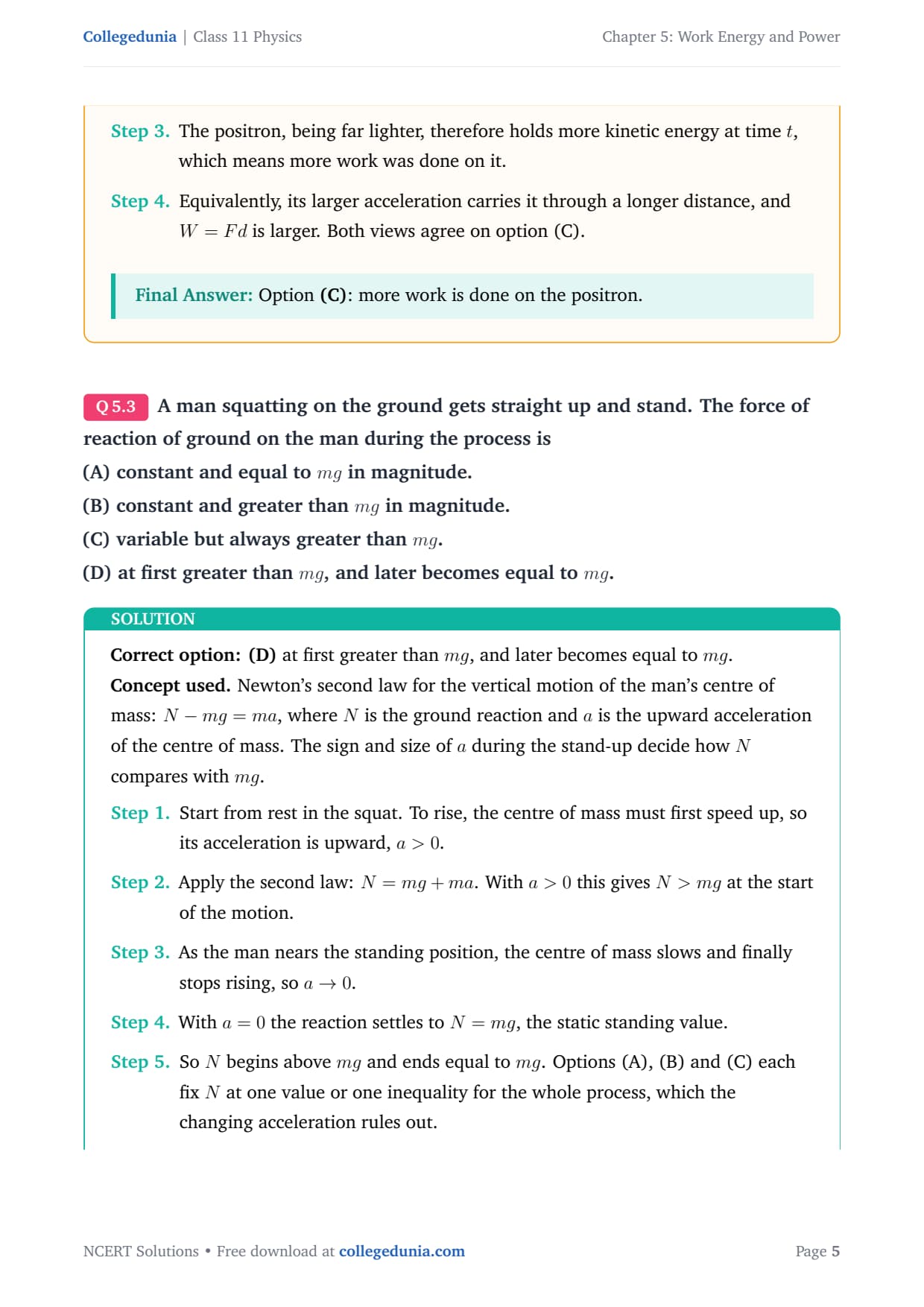
- Equal force is not equal work: in Question 2 an electron and a positron feel the same force for the same time. That fixes the impulse, not the work. The lighter positron travels farther, so it gains more energy.
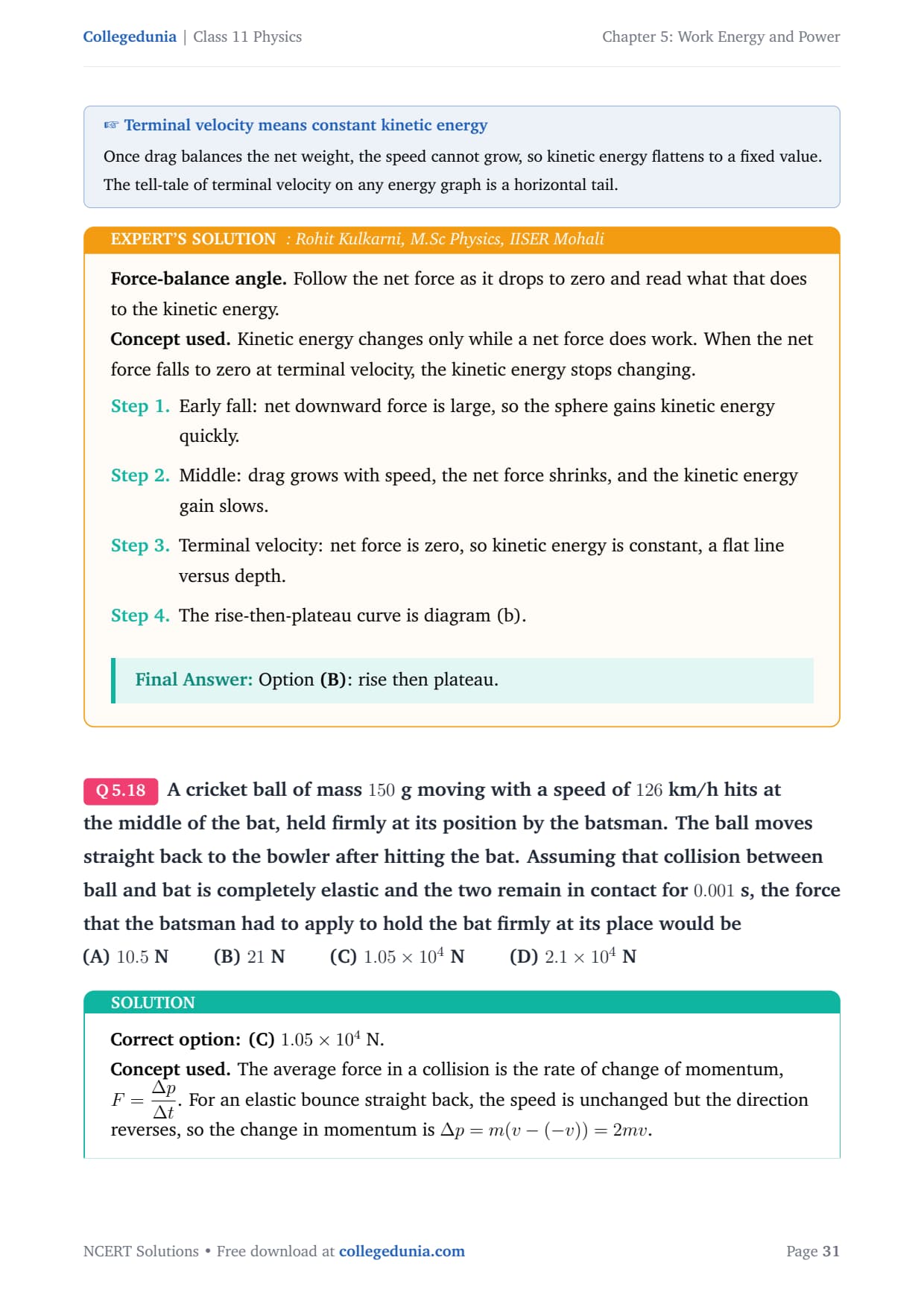
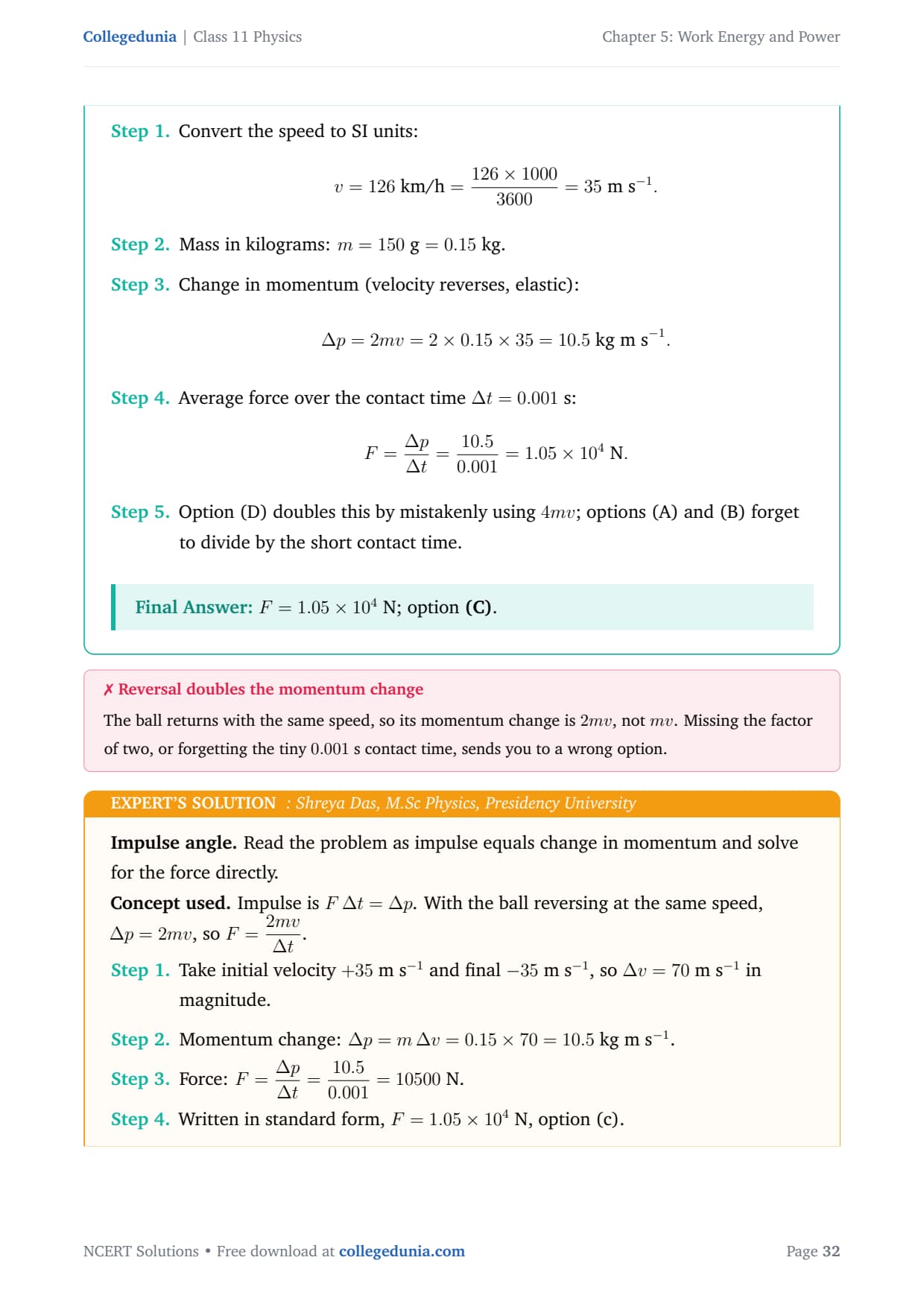
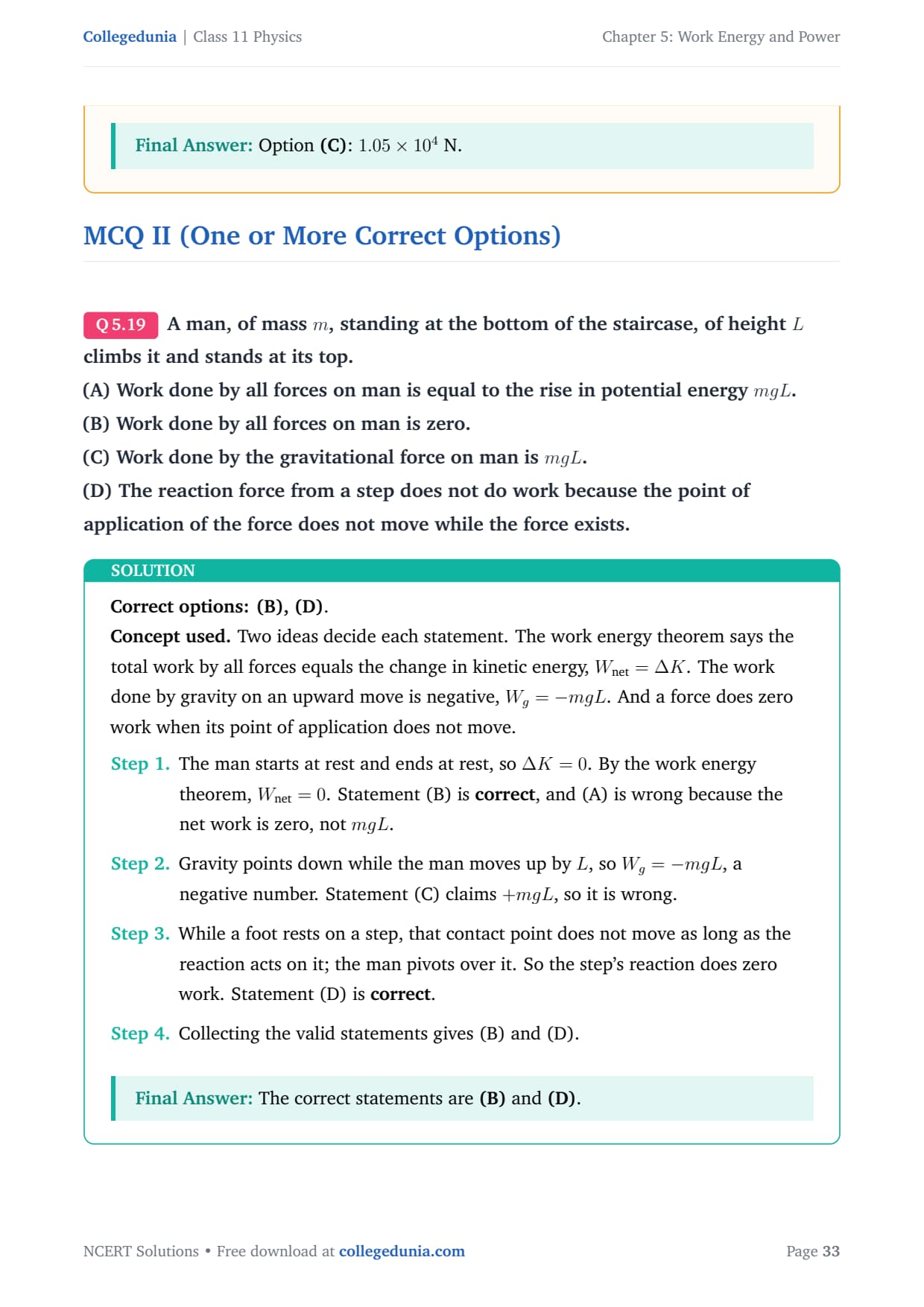
- Forgetting the factor of two: Question 18 has a 150 g cricket ball at 126 km/h rebounding straight back. The momentum change is 2mv, not mv, giving 1.05 × 10⁴ N.
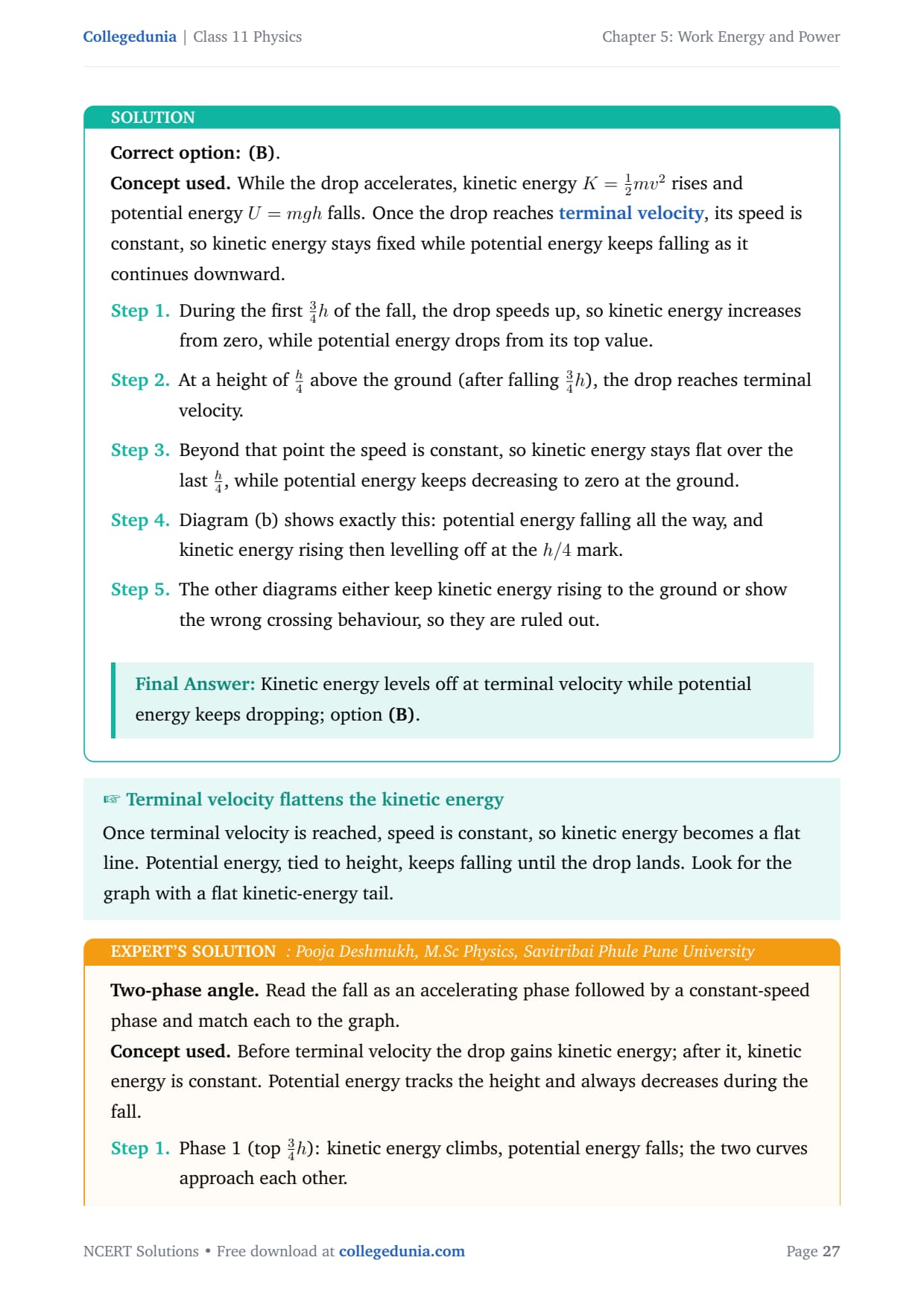
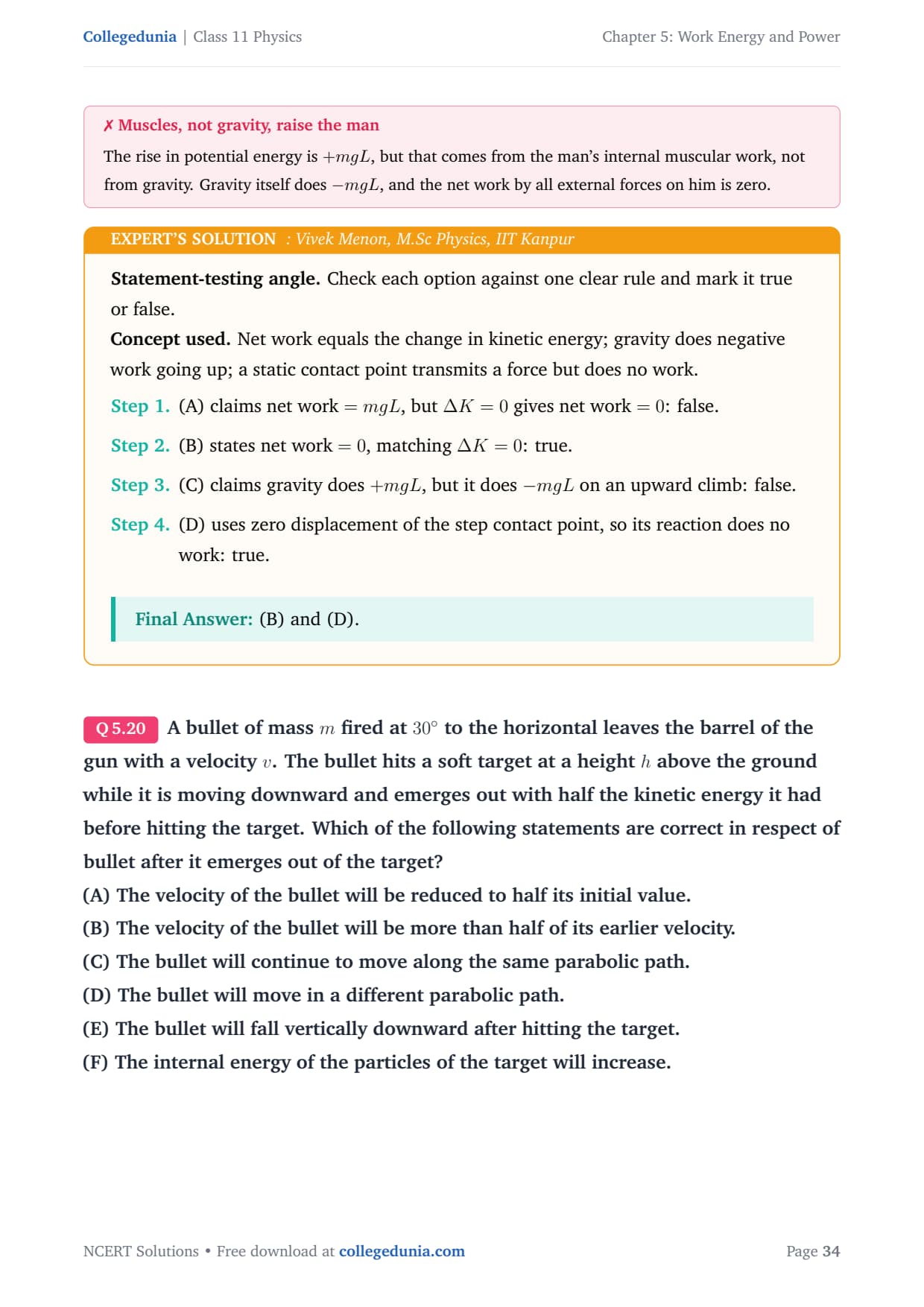
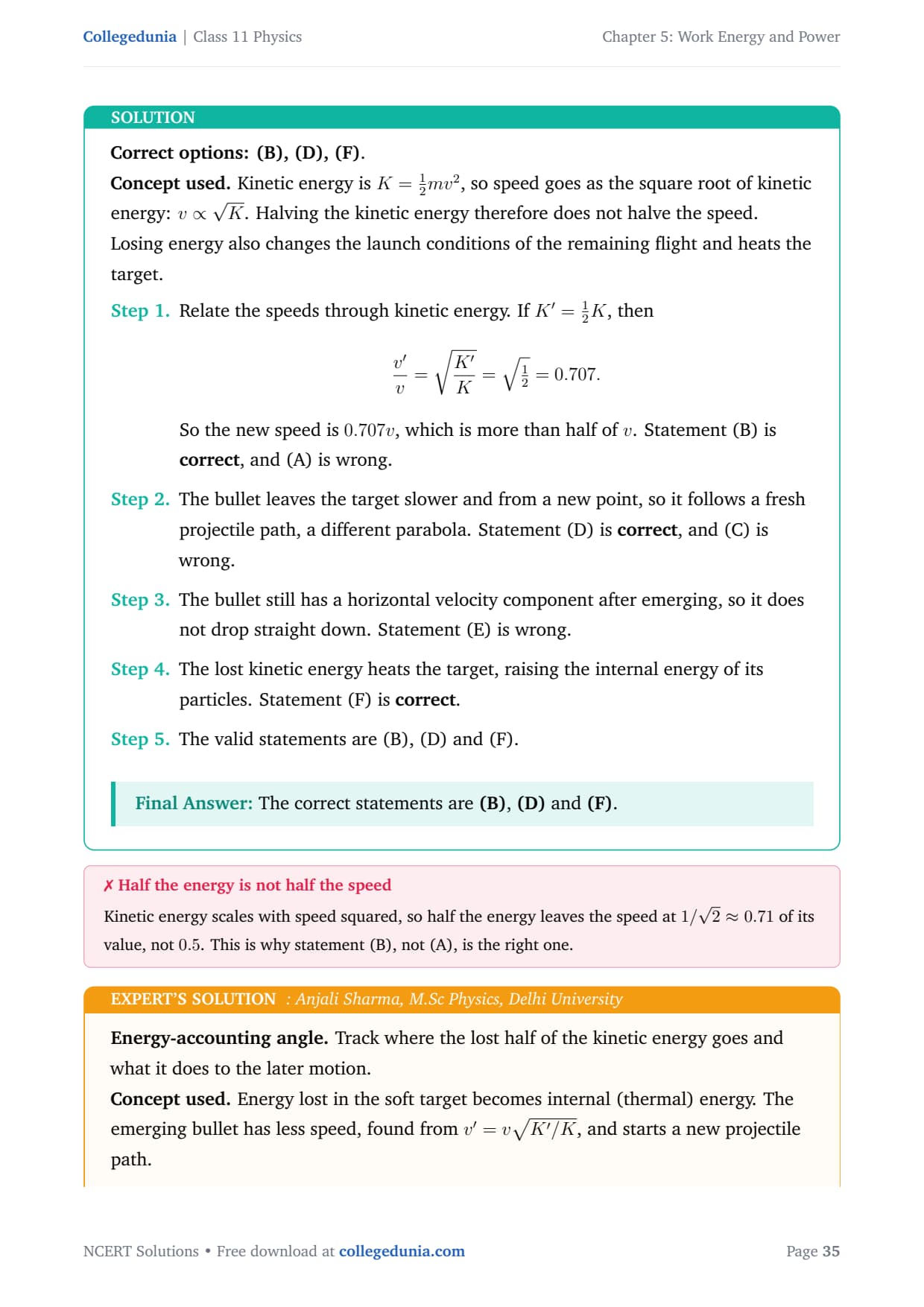
- Half the energy is not half the speed: kinetic energy goes as speed squared, so halving it leaves the speed at about 0.71 of its value.
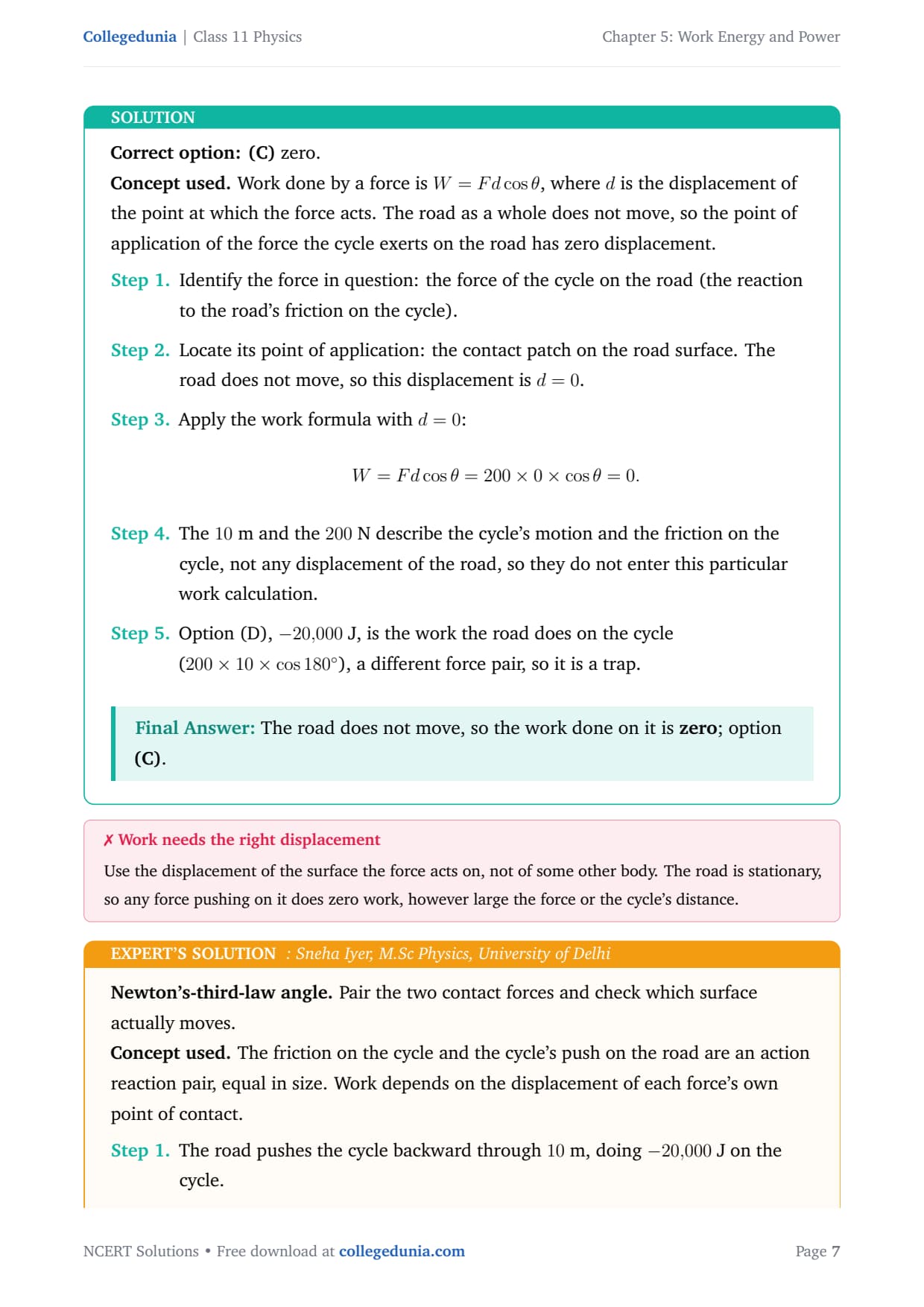
- Using the wrong displacement: in Question 25 a cyclist pushes on the road, but the road does not move, so the work on it is 0 J.
One more is worth naming. In Question 36 students reject a region because K > E there, which is allowed whenever the potential energy is negative. The only hard rule is that kinetic energy cannot be negative.
The Answer Key Error in Question 13
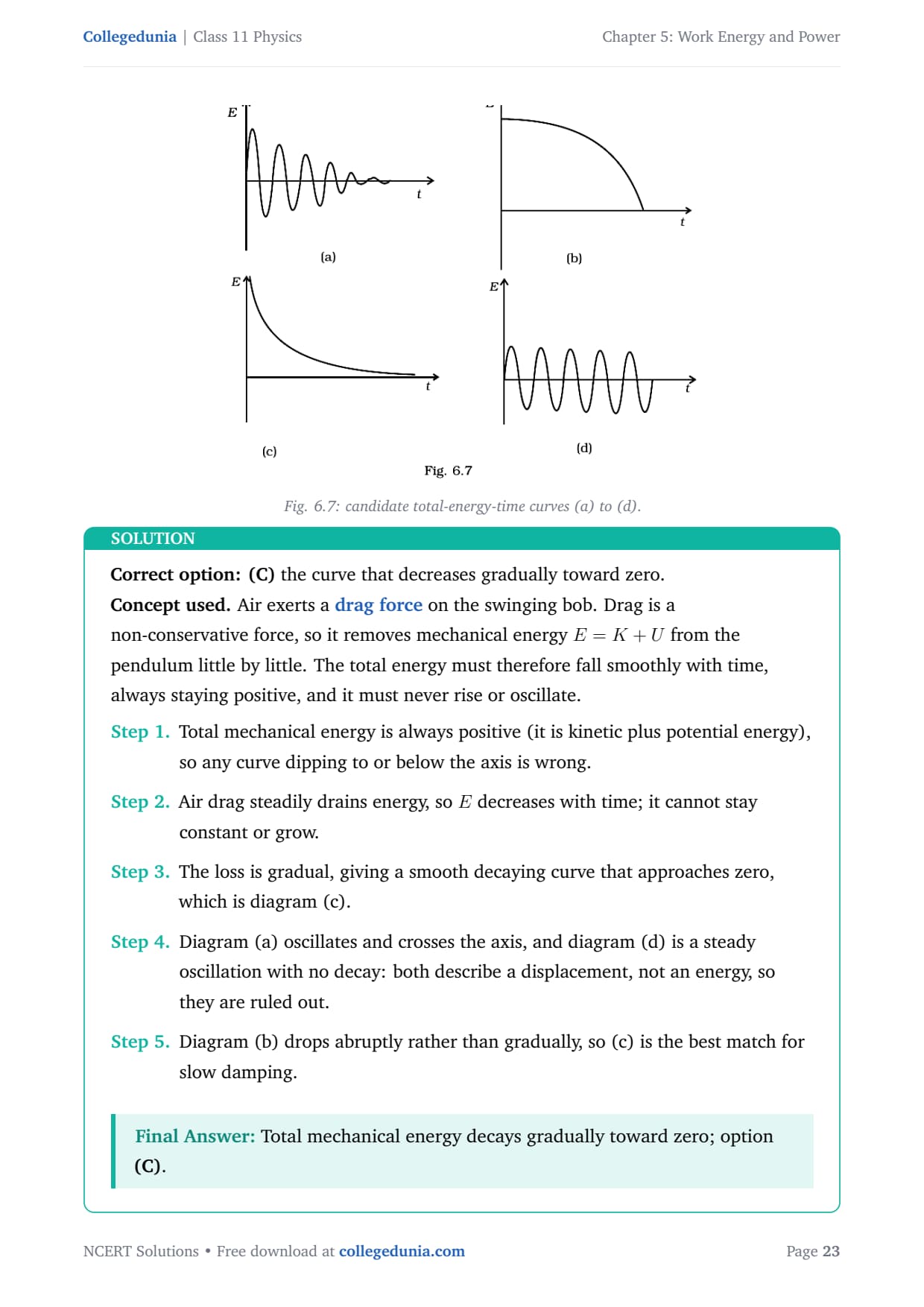
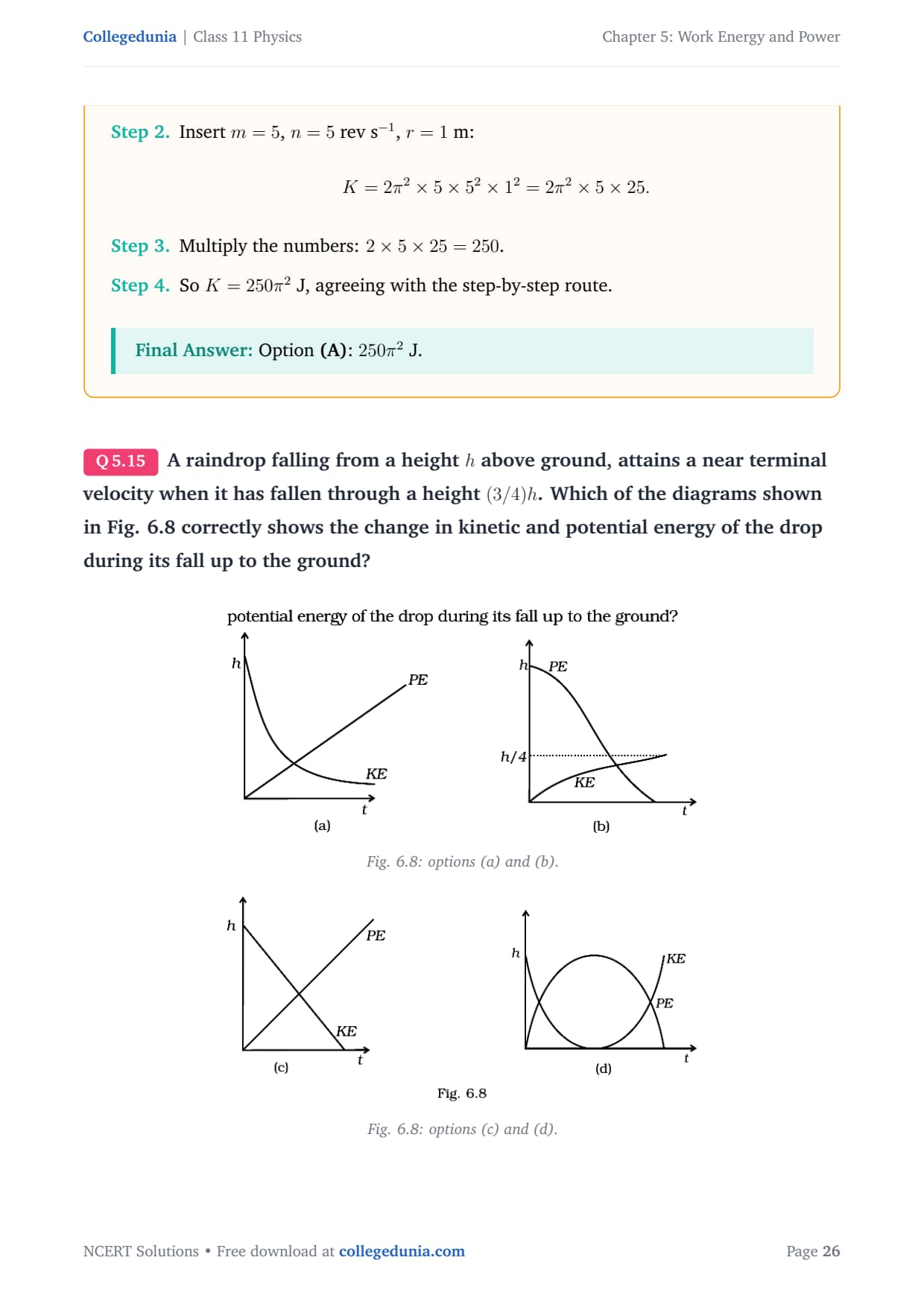
Question 13 asks which curve in Fig. 6.7 shows the total mechanical energy of a pendulum swinging in air. The official NCERT key prints (d), which cannot be right.
Fig. 6.7(d) is an undamped oscillation that crosses the axis. Total mechanical energy is kinetic plus potential energy, so it stays positive and never oscillates. Air drag drains it steadily, giving a smooth decay toward zero. That curve is (c). The trap works because the bob's displacement really does oscillate, so option (d) looks familiar. Collegedunia's PDF prints the key's answer, the correction, and the physics that separates them.
How the Exemplar Steps Up from the Class 11 Physics Textbook
The textbook hands you a force and asks for the work. The Exemplar hands you a graph or a velocity law, and you choose the method yourself.
Question 32 shows the gap. Two bodies with the same kinetic energy meet the same retarding force, and you must say which stops sooner. The mass cancels, so both cover the same distance. Students who reach for speed instead of energy miss this.
How to Use These NCERT Exemplar Solutions for Boards, JEE and NEET
Attempt each question before opening the solution.
- Boards: the VSA set matches the 2 mark "does this force do work" pattern
- JEE Main: start with Questions 10, 14 and 16, since variable force and energy conservation repeat yearly
- NEET: the 18 MCQ I questions cover the recall-level collision and power items NEET reuses
Student Feedback
Students who used Collegedunia's Class 11 Physics Exemplar Solutions told us the potential energy curve questions were the hardest part. Around 7 in 10 said the Question 13 correction saved them from memorising a wrong option.
Other Resources for Class 11 Physics Work Energy and Power
Collegedunia has the full study material set for this chapter. Use the Notes first, then the Exemplar for practice.
Also Check:
- NCERT Solutions for Class 11 Physics Chapter 5
- Class 11 Physics Chapter 5 Notes
- Class 11 Physics Chapter 5 Handwritten Notes
- Class 11 Physics Chapter 5 NCERT Book PDF
- Class 11 Physics Chapter 5 Exemplar Questions with Solutions
NCERT Exemplar Solutions for Other Class 11 Physics Chapters
Every chapter below has the same step-by-step treatment and a free PDF.
Work Energy and Power Class 11 Physics NCERT Exemplar Solutions FAQs
Ques. How many questions are there in the Class 11 Physics Work Energy and Power Exemplar?
Ans. Chapter 5 has 48 questions. They are split into 18 MCQ I, 3 MCQ II, 12 Very Short Answer, 10 Short Answer and 5 Long Answer questions. All 48 are solved in the free PDF on this page.
Ques. Is the NCERT answer key wrong for Question 13 of the Work Energy and Power Exemplar?
Ans. Yes. The key prints option (d) for the total mechanical energy of a pendulum swinging in air. Fig. 6.7(d) is an undamped oscillation that crosses the axis, and no total energy can do that. Air drag makes the energy decay smoothly toward zero, so the correct curve is (c). Our PDF shows both and explains the difference.
Ques. Why is the work done by a cyclist on the road zero in Question 25?
Ans. Work needs the displacement of the surface the force acts on. The road does not move, so the force applied to it covers zero distance. The work is 0 J no matter how hard the cyclist pushes or how far the cycle travels.
Ques. Can kinetic energy be greater than total energy in a potential energy curve question?
Ans. Yes, wherever the potential energy is negative. Since E = K + V, a negative V lets K exceed E. This is normal for gravitational and electrostatic potentials. The only forbidden case is negative kinetic energy, which is what rules out a region in Question 36.
Ques. Do I need the force to answer Question 10 of the Work Energy and Power Exemplar?
Ans. No. The work energy theorem applies to any net force, including a varying one. The velocity law v = ax3/2 gives the speed at x = 0 and x = 2 m, and the change in kinetic energy is the work done. That gives 50 J without ever finding the force.



Comments