




NCERT Exemplar Solutions for Class 11 Physics Chapter 8 Mechanical Properties of Solids solve all 29 questions from the Exemplar book. Every MCQ, Very Short Answer, Short Answer and Long Answer problem is solved step by step. The free PDF on this page runs to 47 pages and follows the 2026-27 syllabus.
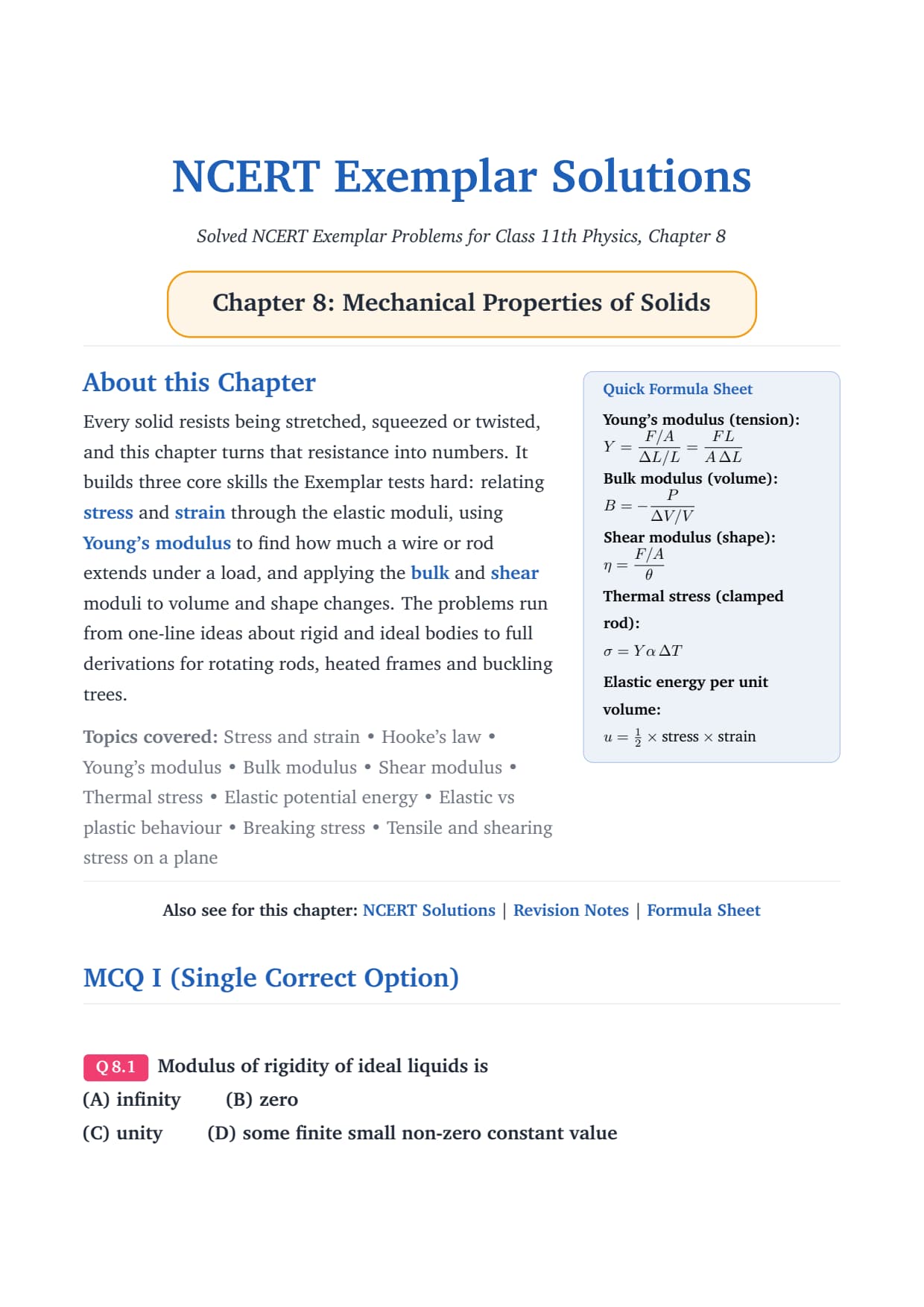
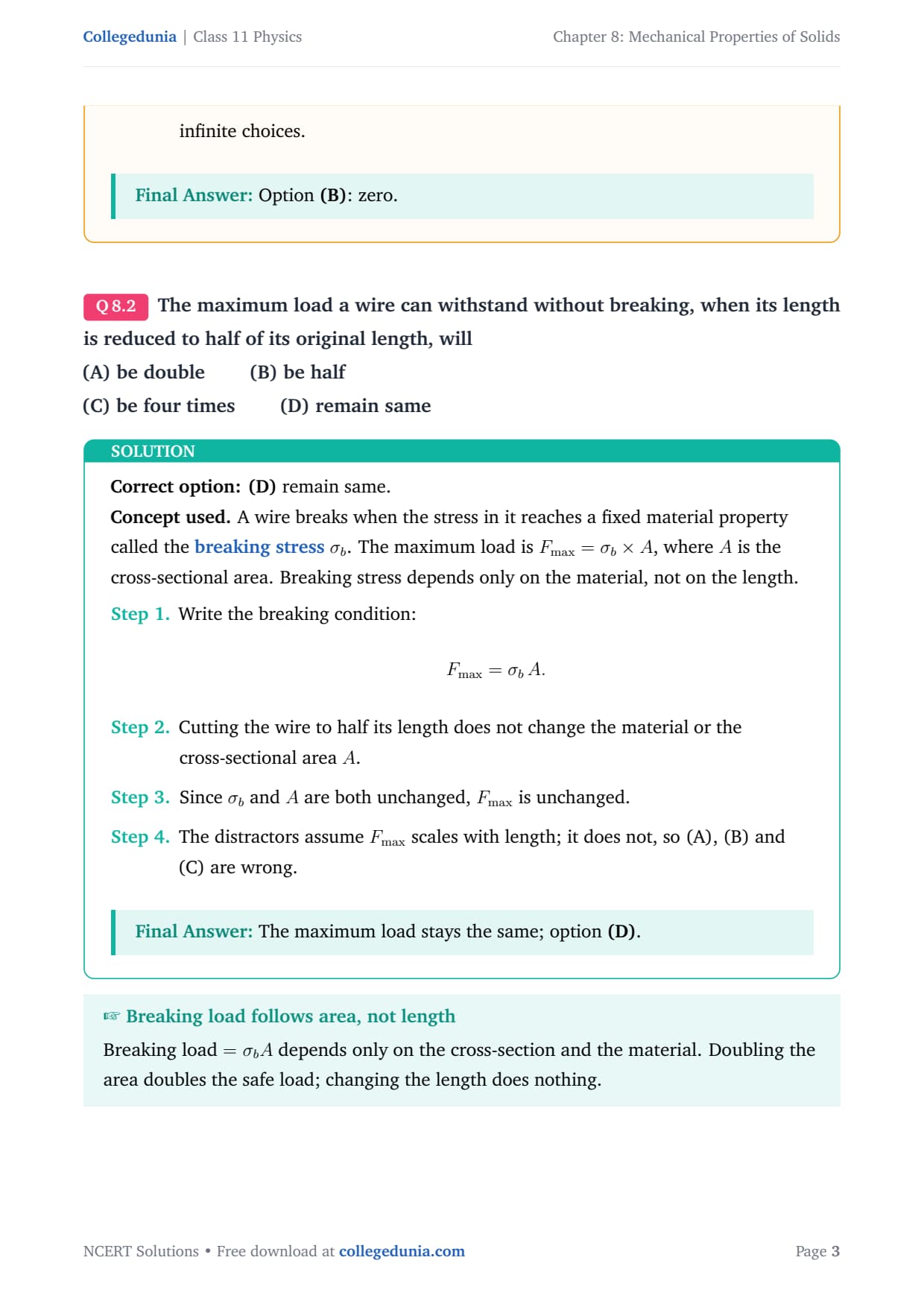
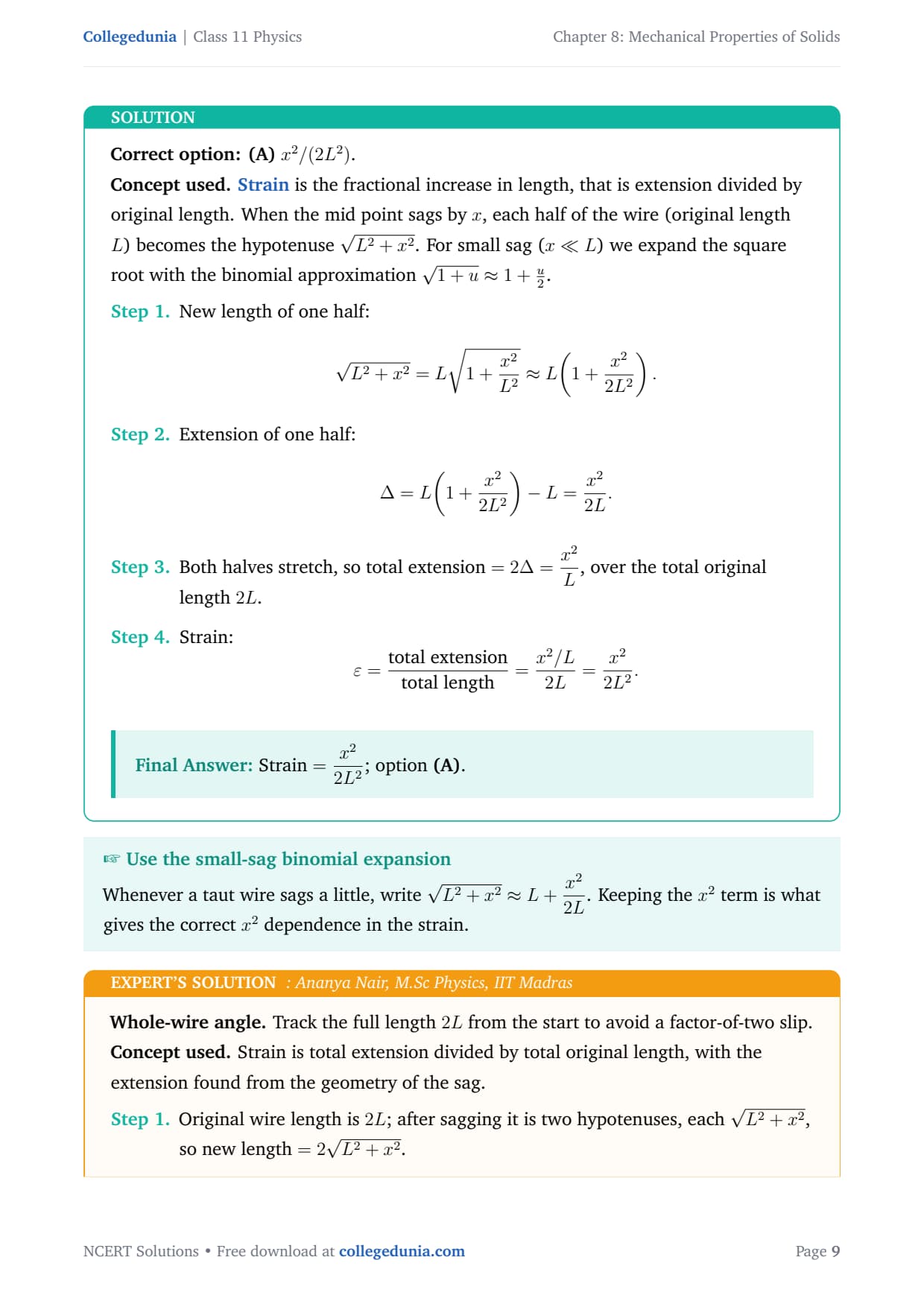
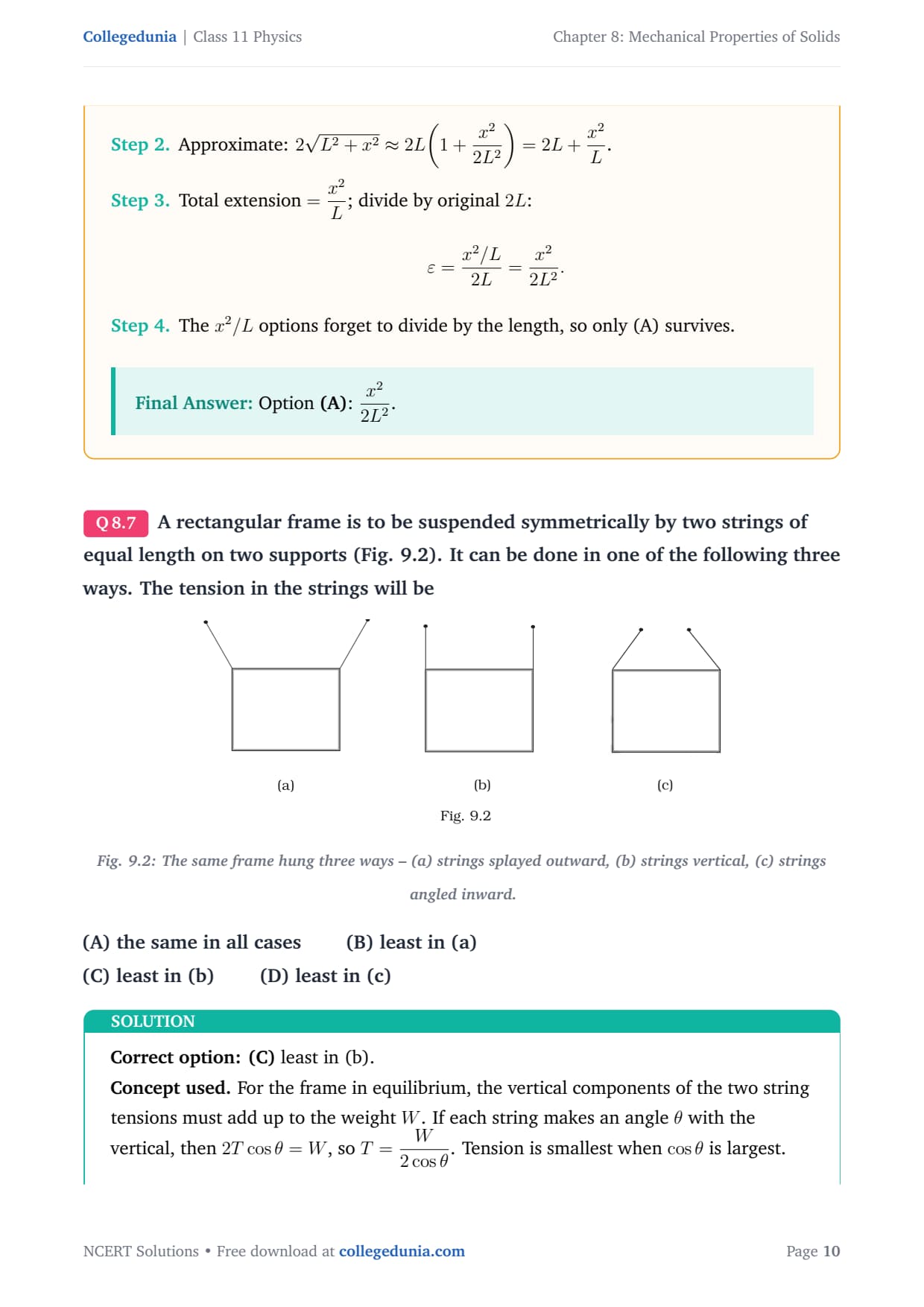
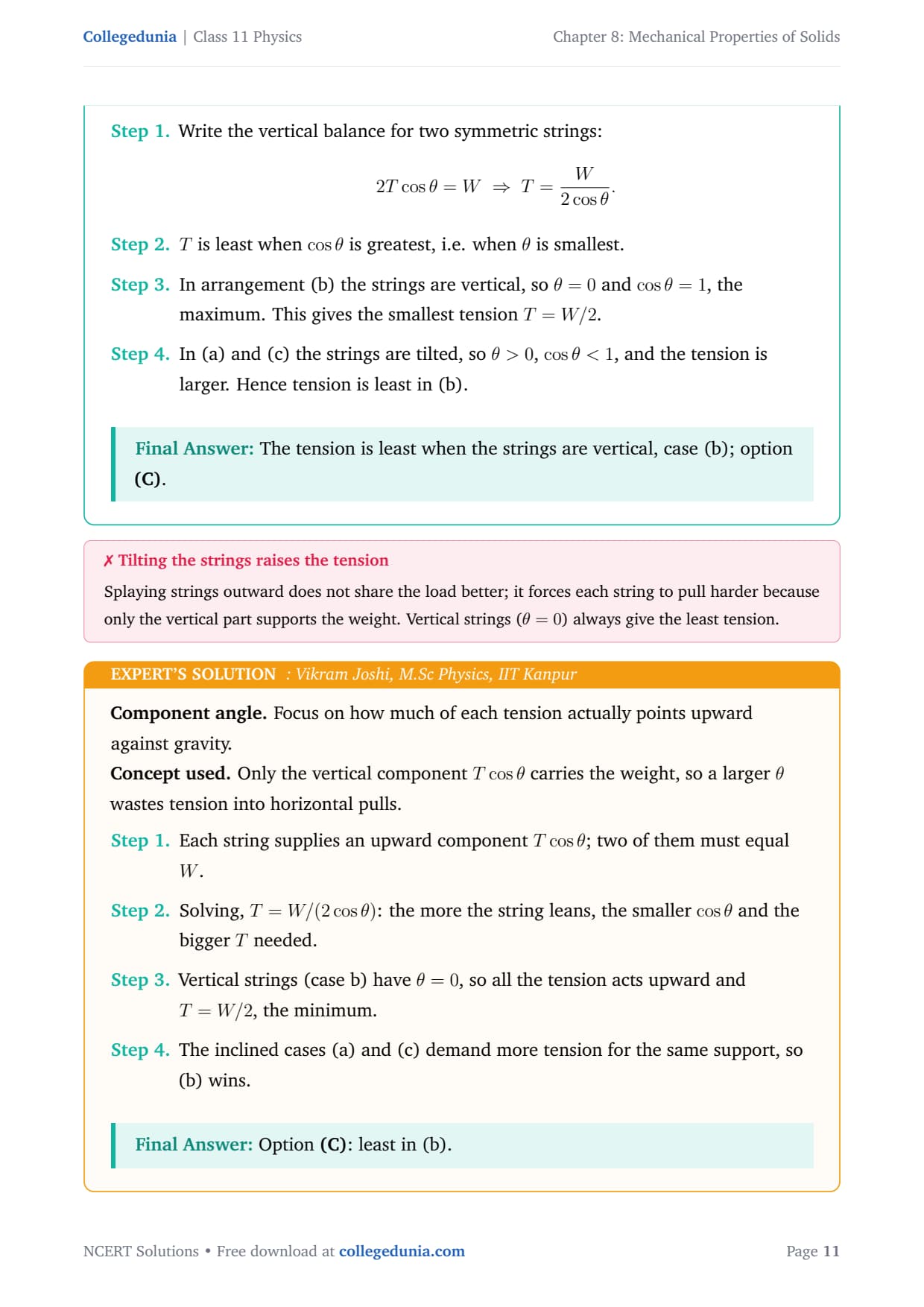
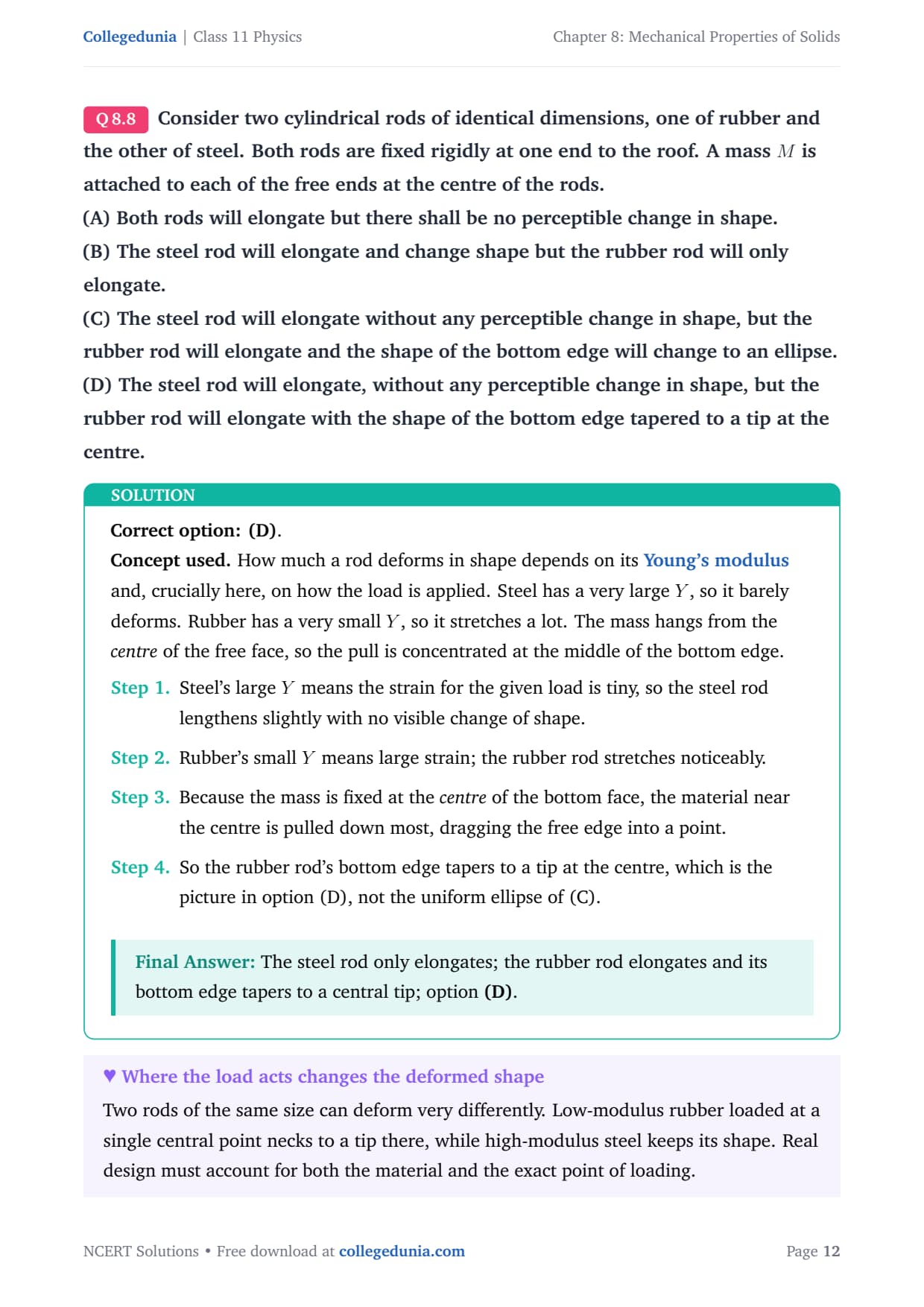


Every solid resists being stretched, squeezed or twisted, and this chapter turns that resistance into numbers. One point confuses students before they start. The Exemplar book prints this chapter as Chapter Nine, numbering its questions 9.1 to 9.29.
- CBSE Weightage: 4 to 5 marks, usually one short answer on Young's modulus or thermal stress
- JEE Main Weightage: 1 question per year, most often on elongation or elastic energy
- NEET Weightage: 1 question per year, generally a direct stress and strain calculation
Solutions checked against the official NCERT Exemplar answer key, with every misprint and disputed answer worked out in full.
Topics Covered in the Class 11 Physics Mechanical Properties of Solids Exemplar
The Exemplar rests on three elastic moduli and the situations calling for each. Picking the right modulus is half the work in most questions.
- Stress and strain: Hooke's law, and why stress is a tensor rather than a vector
- Young's modulus: how far a wire extends under a load, and what happens when two wires join
- Bulk and shear moduli: volume change under pressure, shape change under a tangential force
- Thermal stress and elastic energy: clamped rods that cannot expand, and stored spring energy
Question Types in the Mechanical Properties of Solids NCERT Exemplar
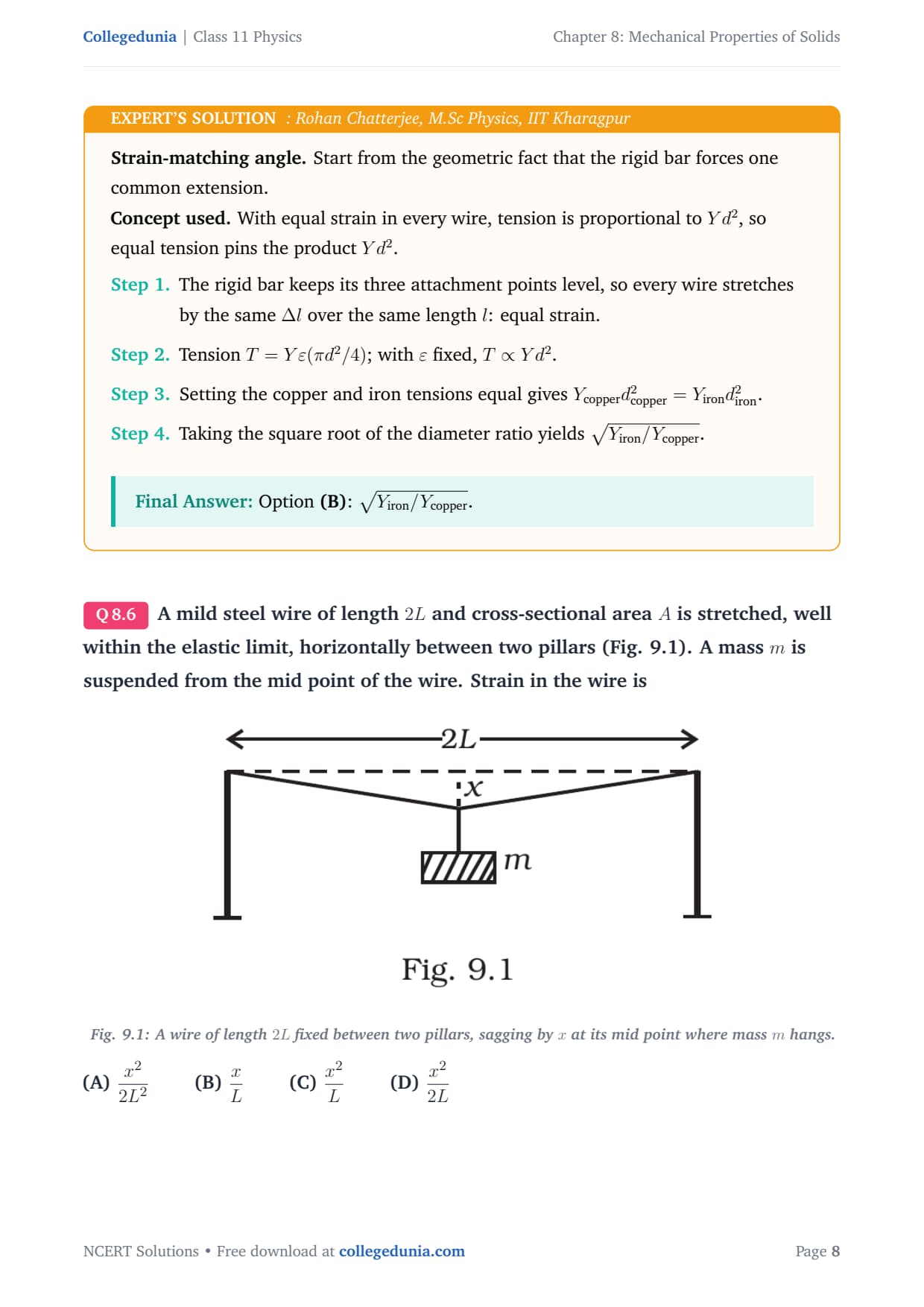
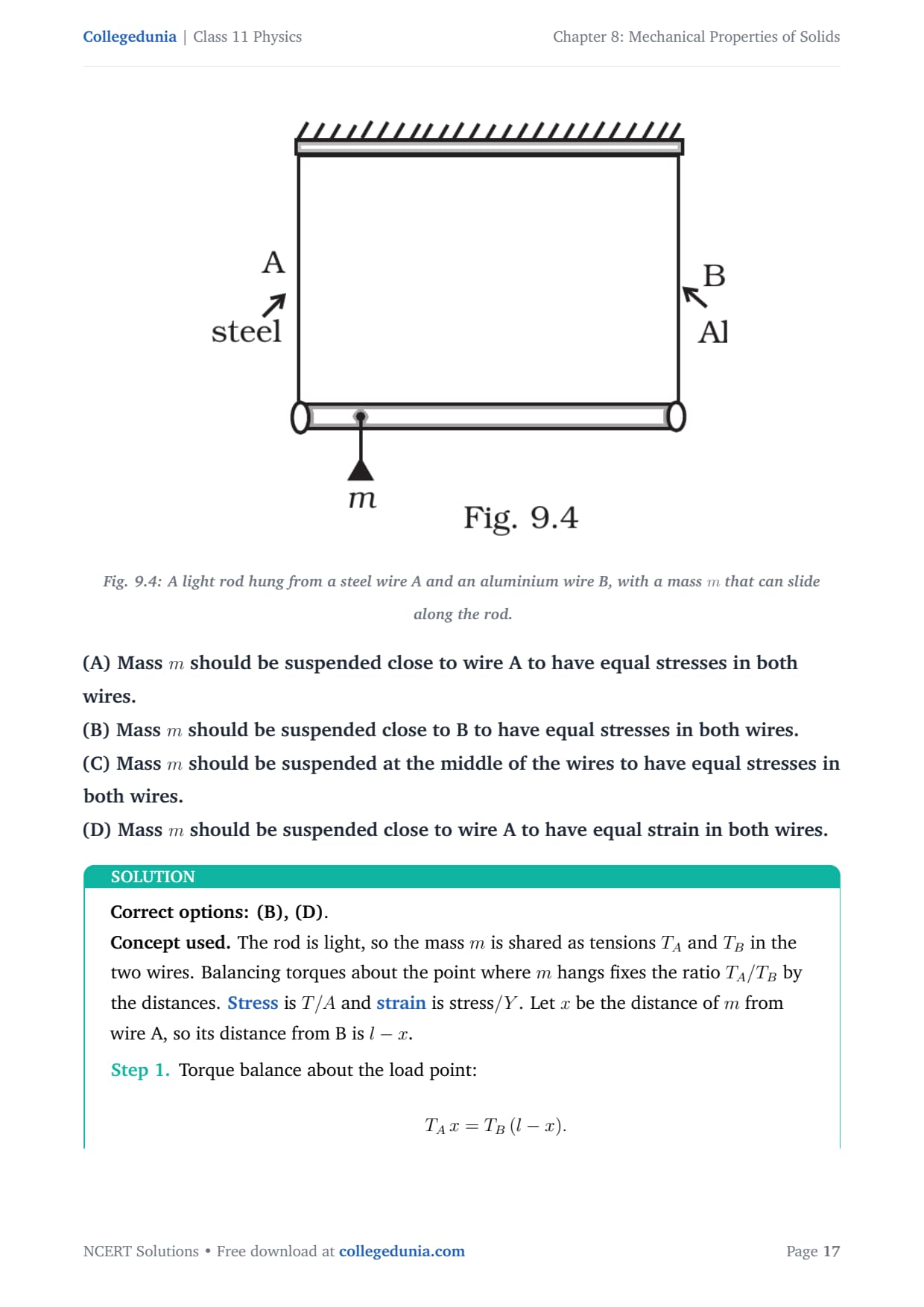
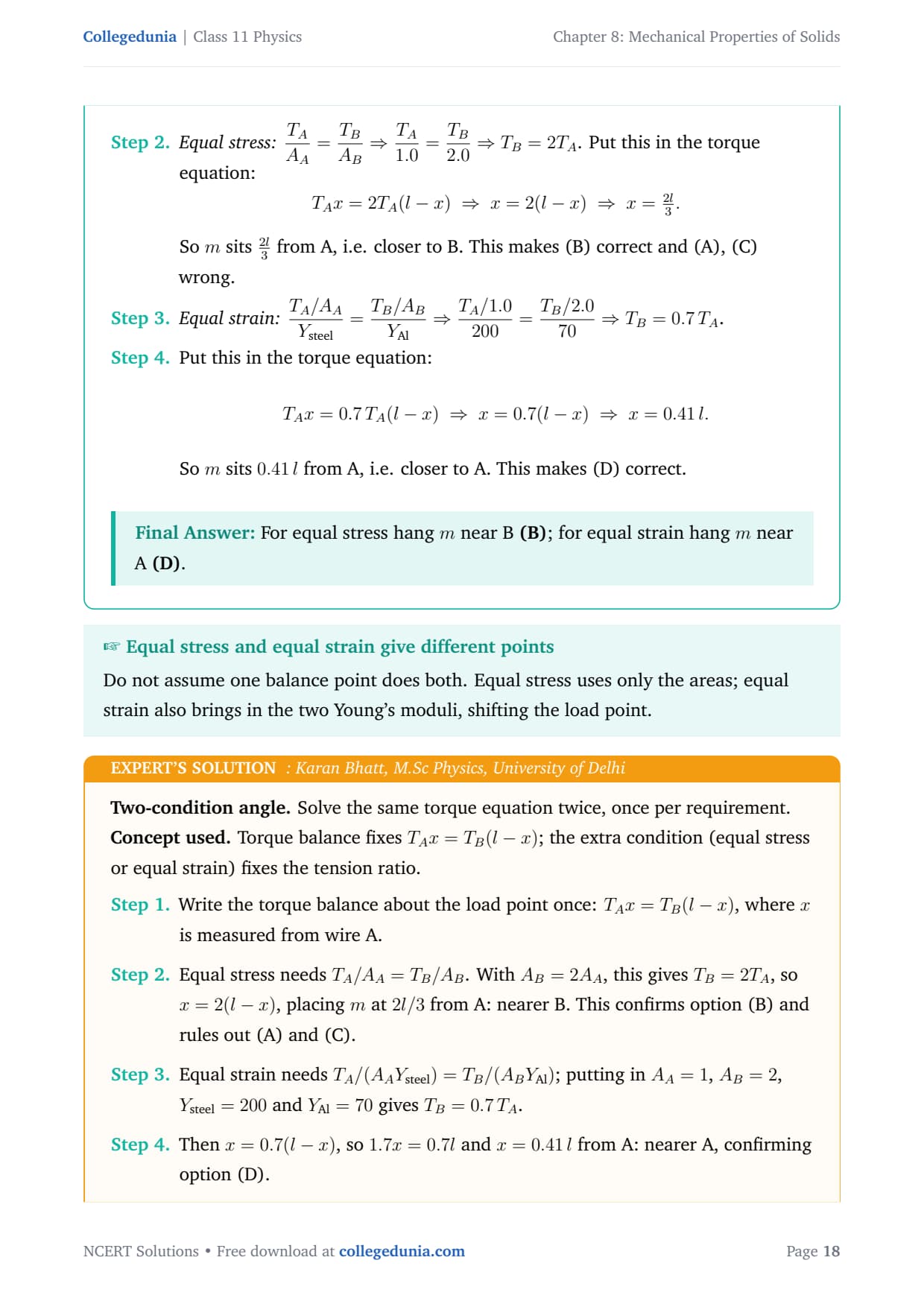
The 29 questions are split across five types. Five quote a figure from the book, and all five are reproduced inside the solutions.
| Question Type | Count | What It Tests |
|---|---|---|
| MCQ I (single correct) | 8 | Choosing the right modulus for a deformation |
| MCQ II (one or more correct) | 5 | Stress-strain graphs and composite wires |
| VSA (Very Short Answer) | 5 | One-line reasoning on rigid bodies and ideal liquids |
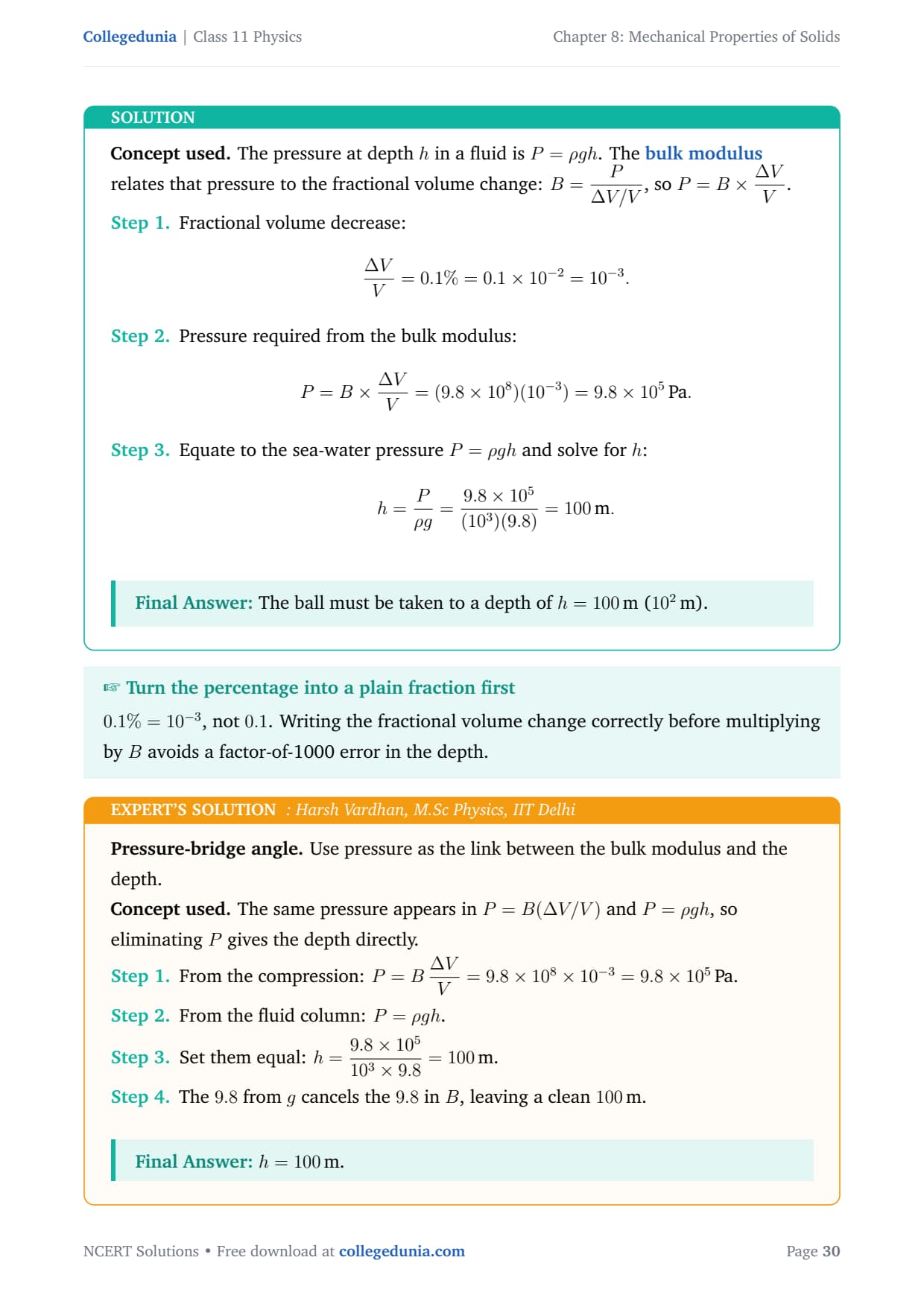
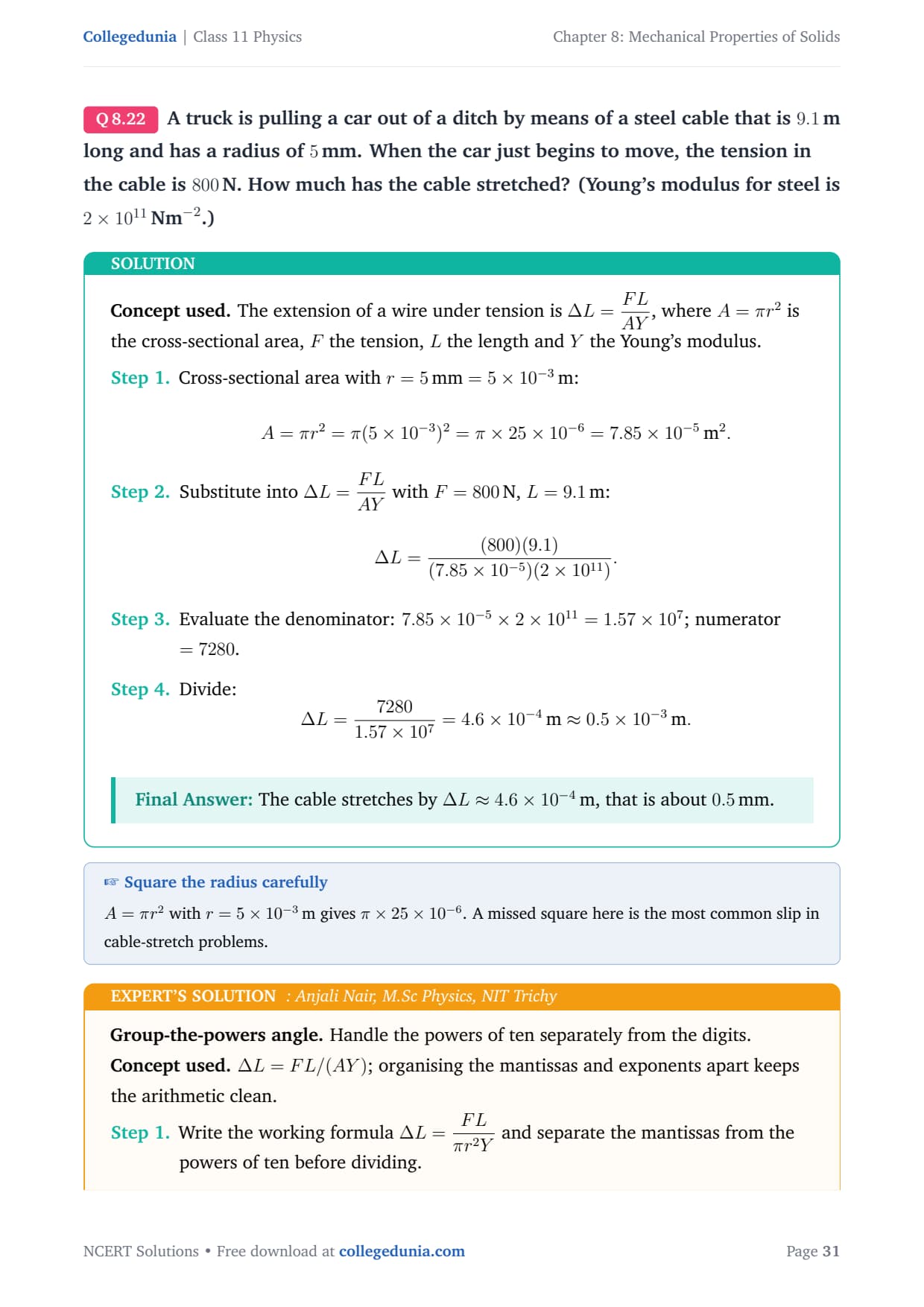
| SA (Short Answer) | 5 | Thermal stress, sea depth and cable extension |
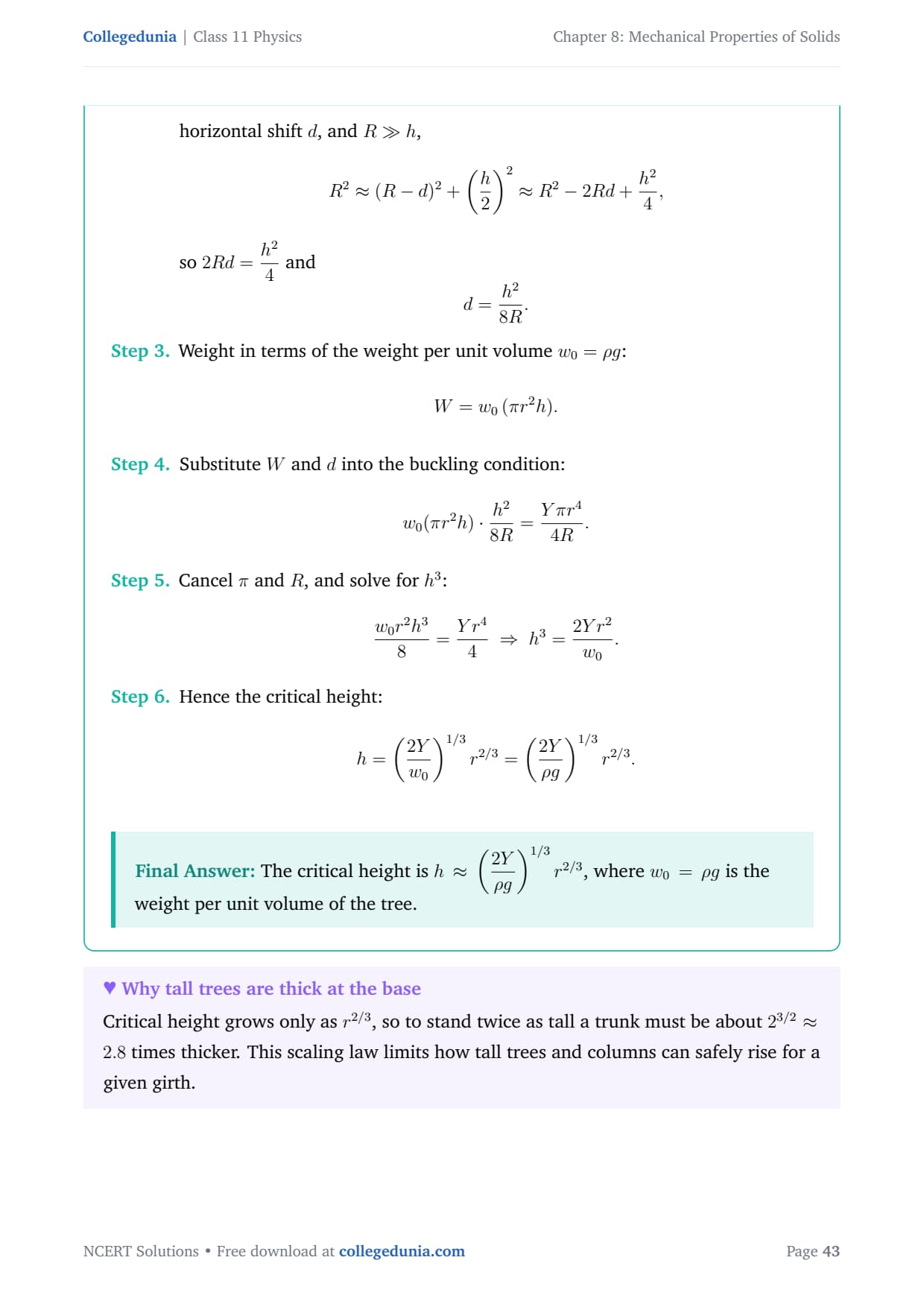
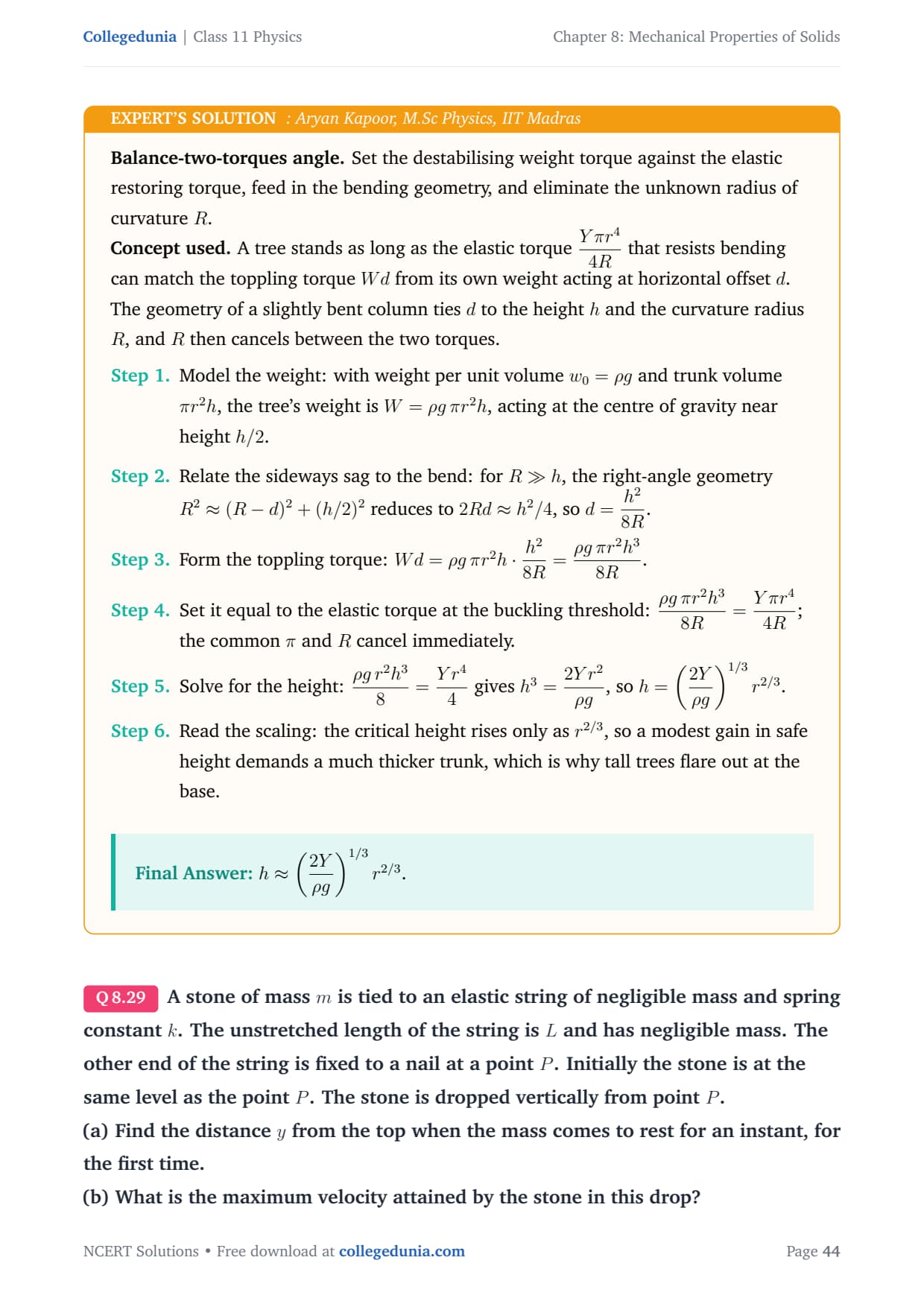
| LA (Long Answer) | 6 | Derivations for rotating rods and buckling trees |
Key Formulas Used in the Mechanical Properties of Solids Exemplar
Almost every numerical question reduces to one of the relations below. The PDF states the formula before substituting, so you can see which idea is doing the work.
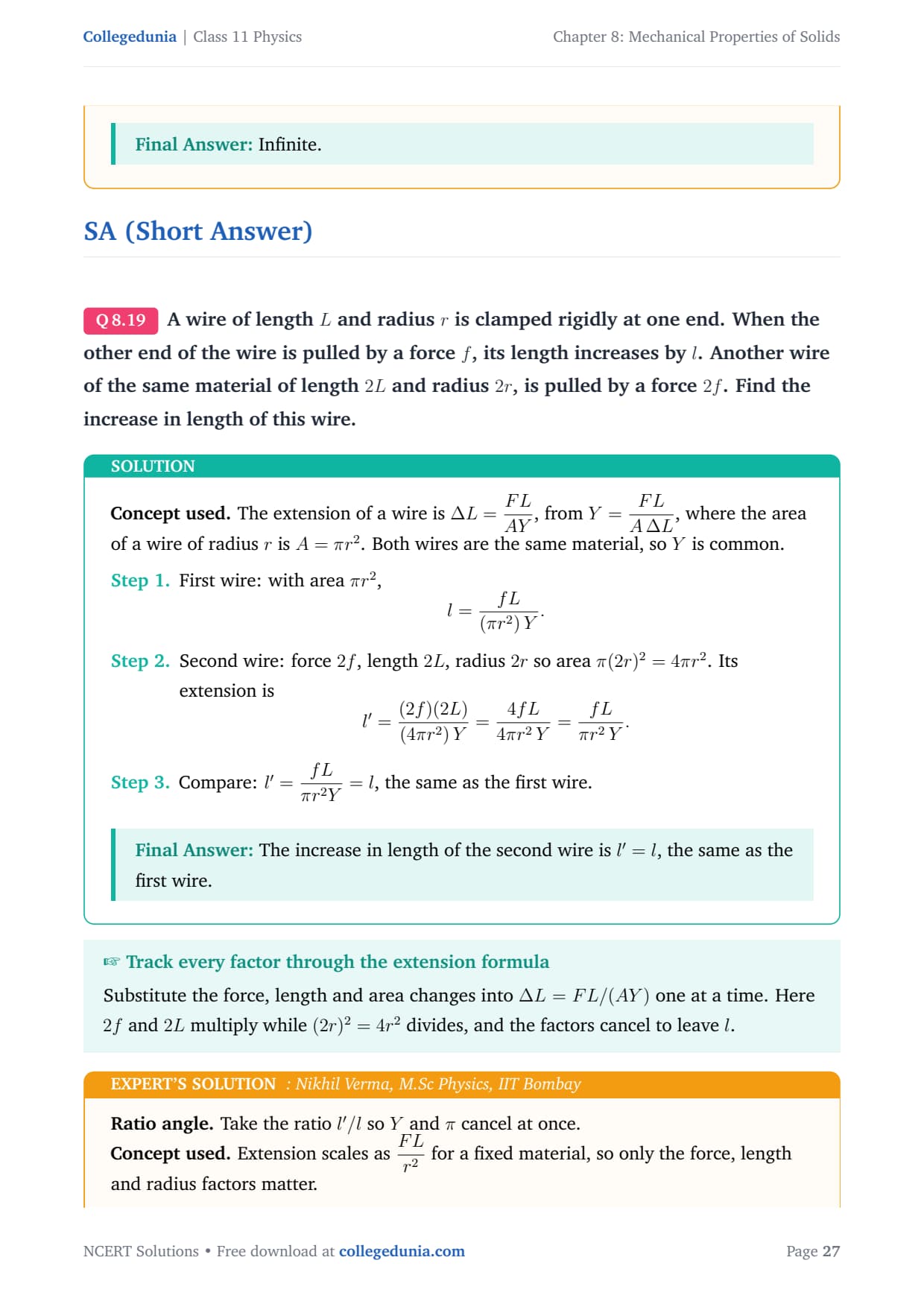
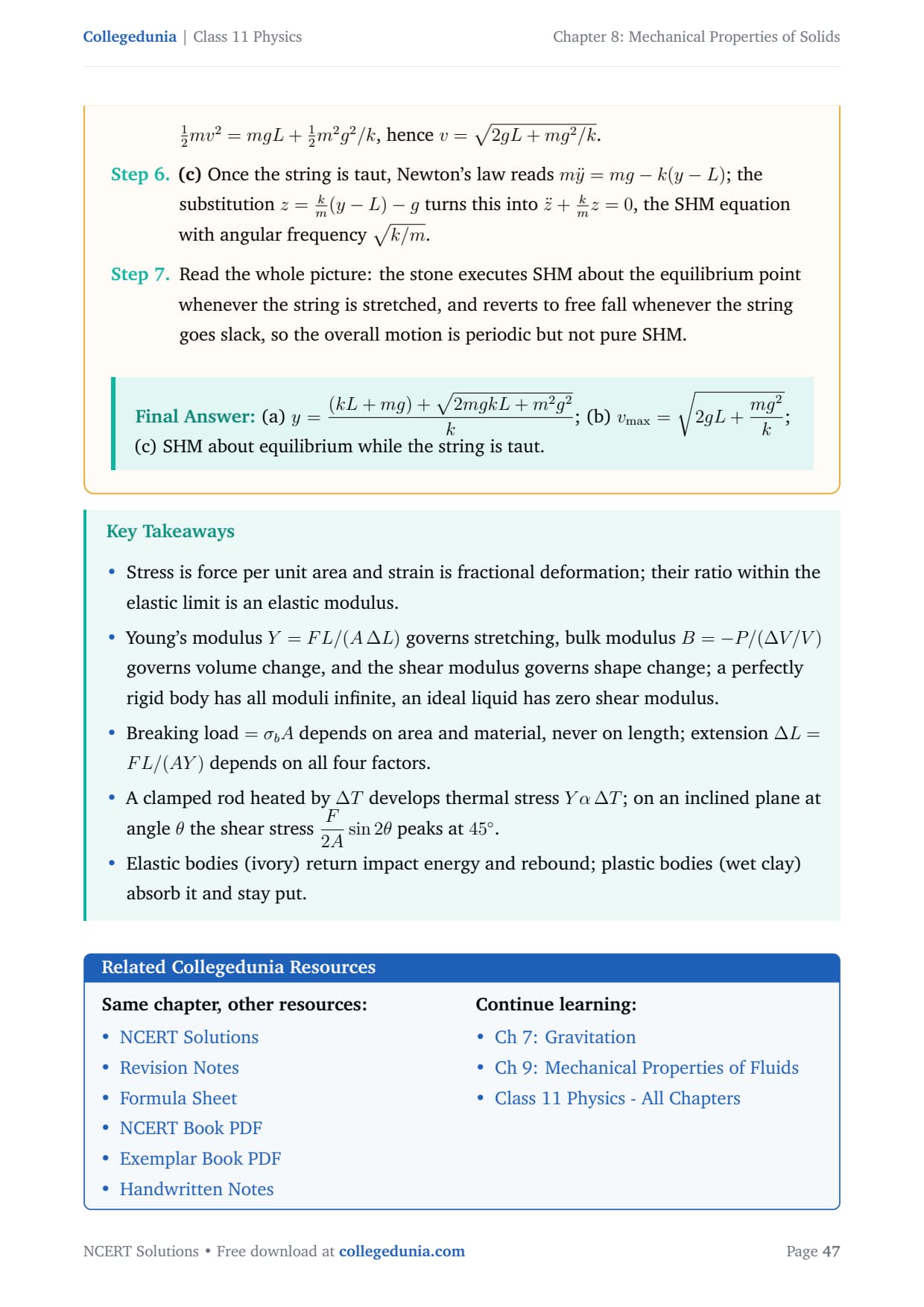
- Young's modulus: Y = FL / (A ΔL), for a wire stretched along its length
- Bulk modulus: B = −P / (ΔV/V), when pressure changes the volume
- Shear modulus: η = (F/A) / θ, when a tangential force changes the shape
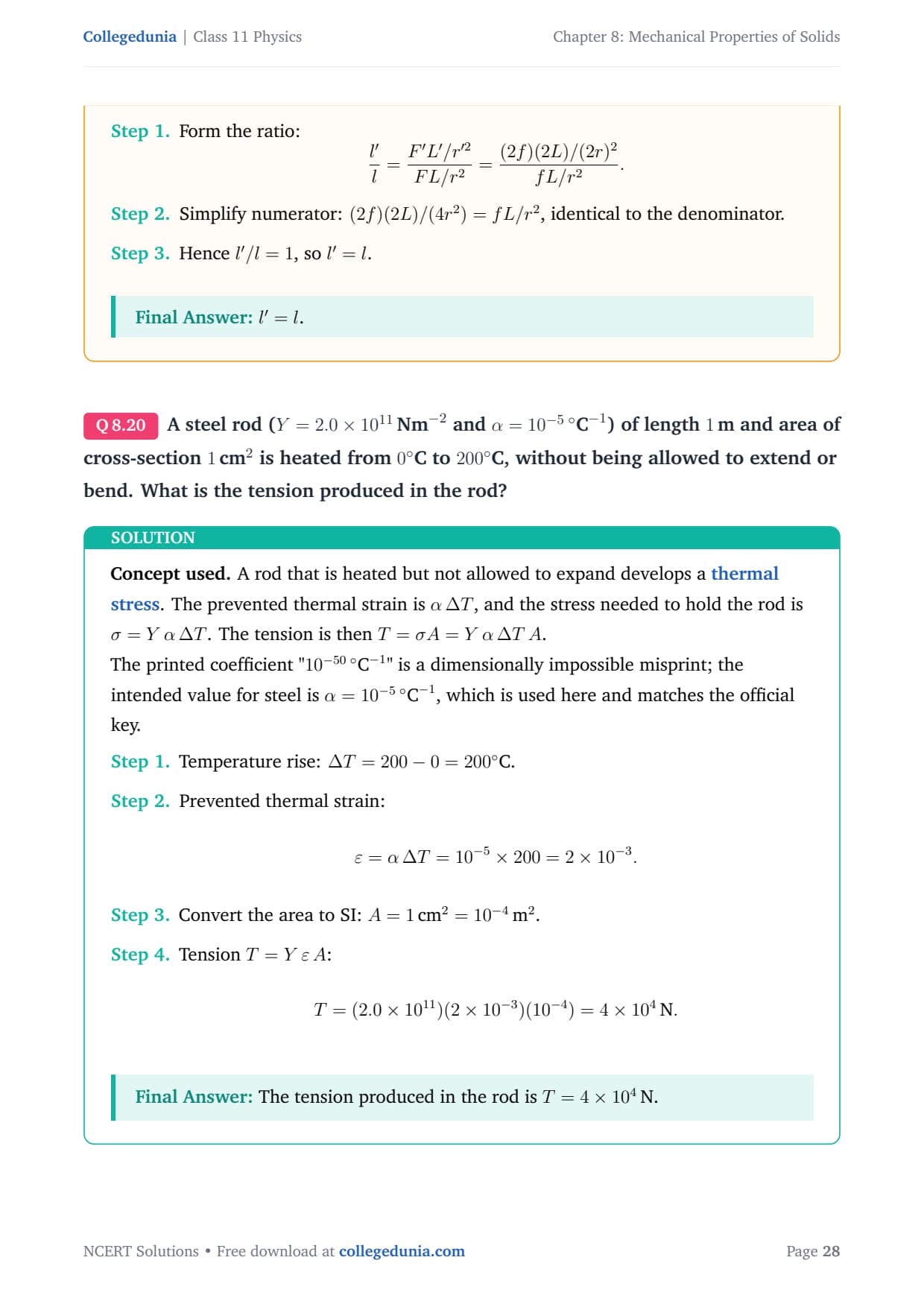
- Thermal stress: σ = Y α ΔT for a heated but clamped rod
- Elastic energy per unit volume: u = ½ × stress × strain
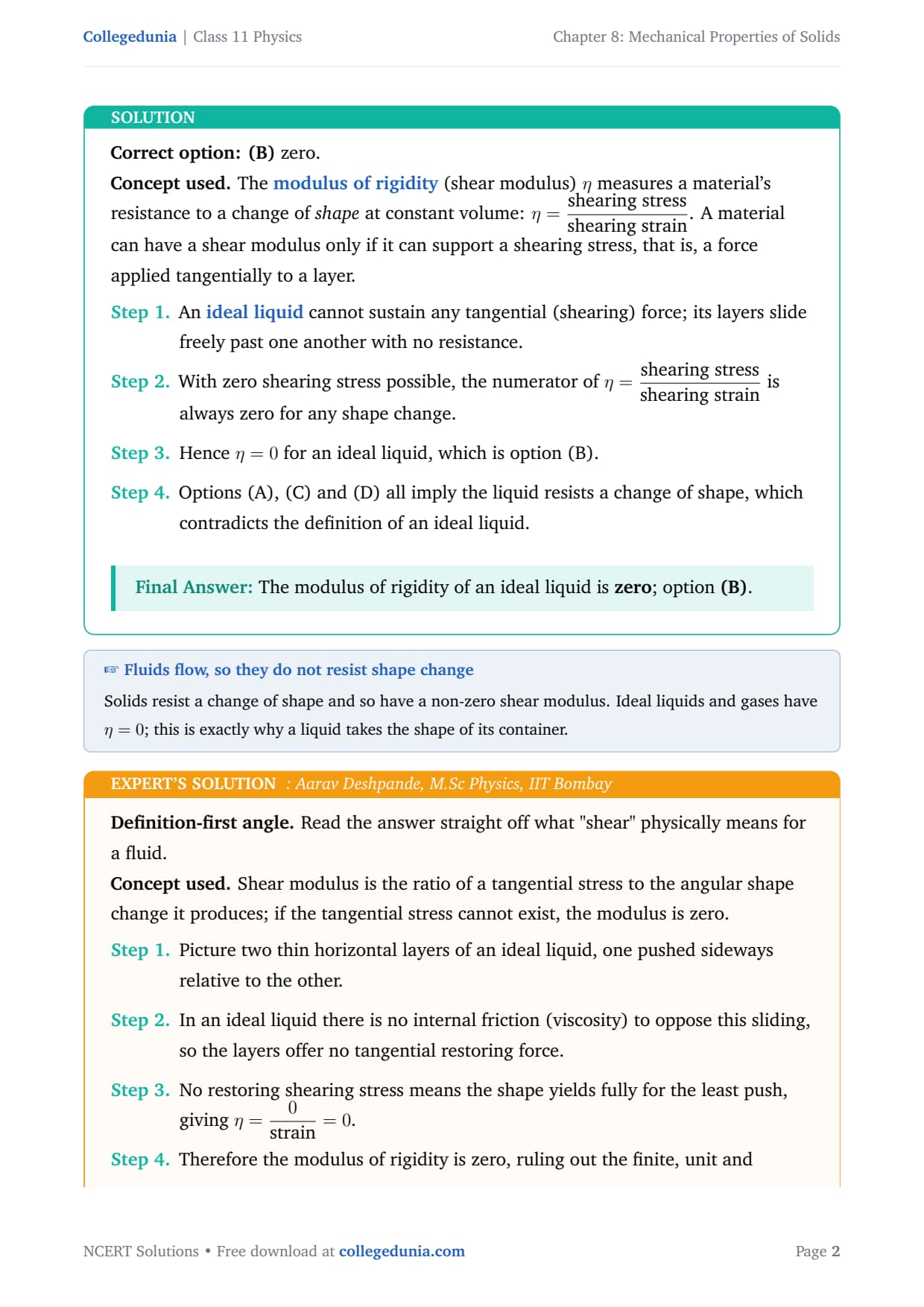
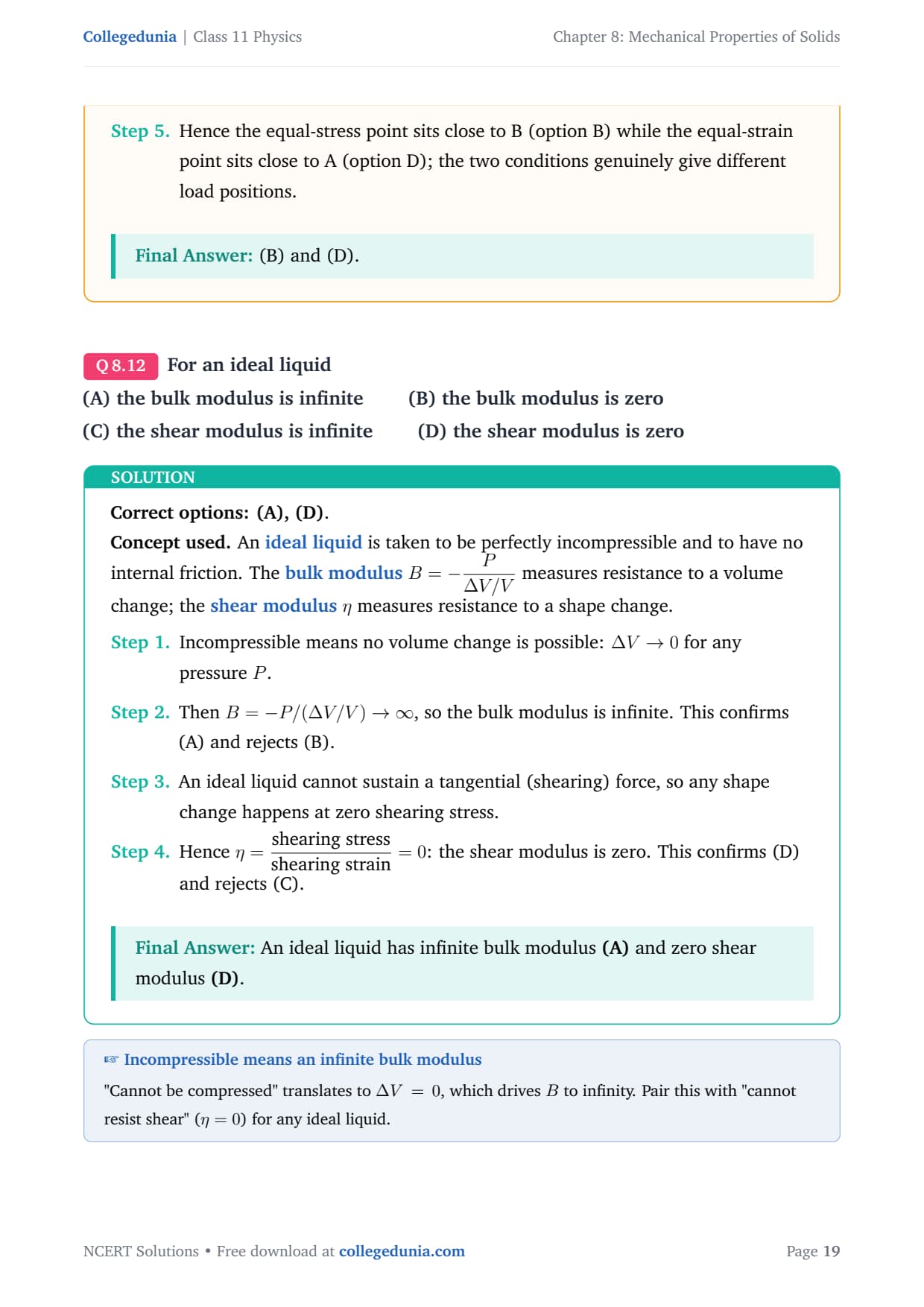
The modulus of rigidity of an ideal liquid is zero, not infinity. Question 1 opens the chapter with that point. A liquid cannot hold a tangential force at rest, so it never resists a shape change.
The Misprinted Coefficient in the Thermal Stress Question
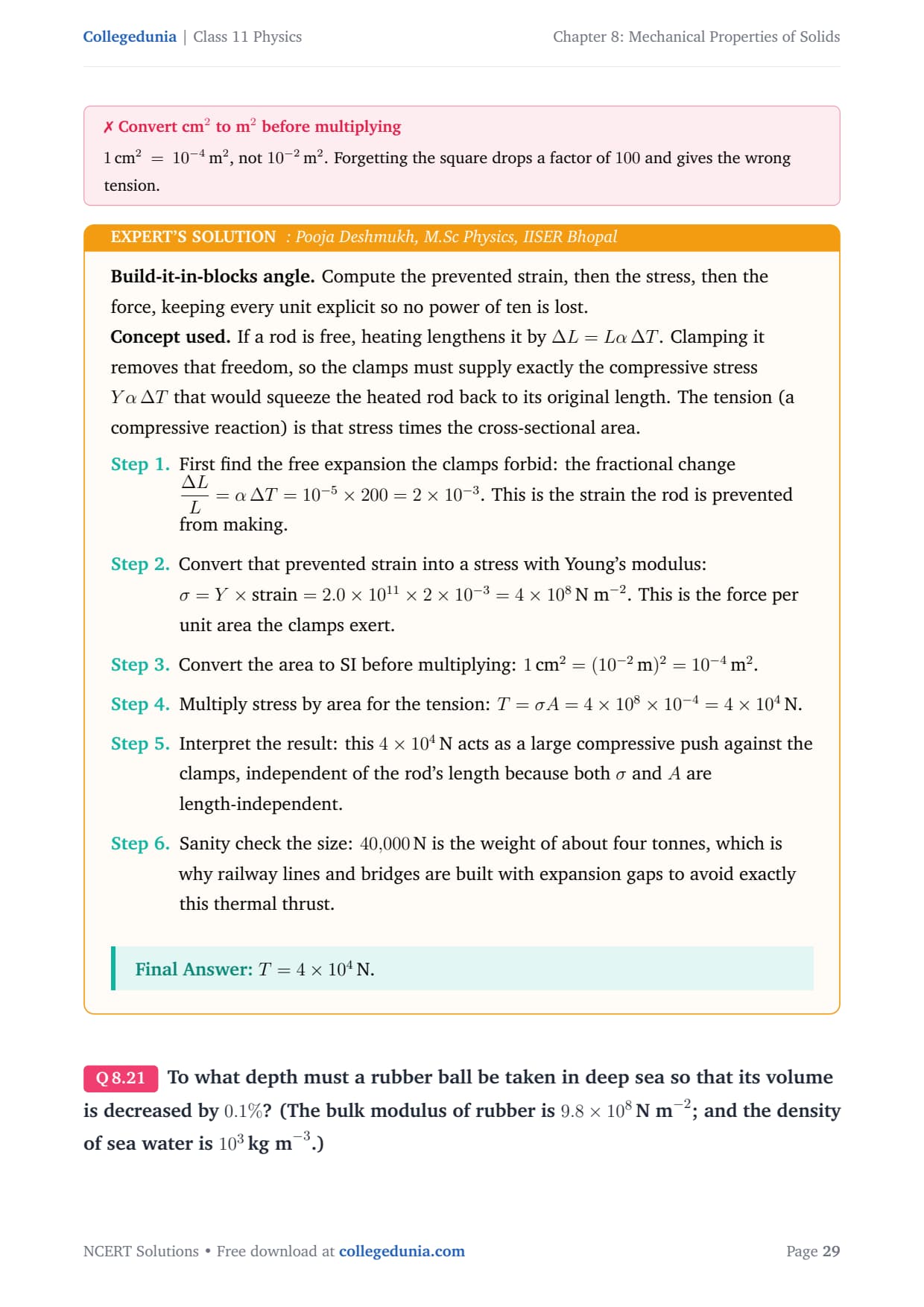
Question 20 is worth flagging before your exam. It gives a steel rod with Y = 2.0 × 10¹¹ N m-2, length 1 m and area 1 cm2, heated from 0°C to 200°C without being allowed to extend.
The printed expansion coefficient reads α = 10-50 °C-1. That value is impossible, and the official key does not use it either. The intended value is α = 10-5 °C-1, the standard figure for steel. It gives a prevented strain of 2 × 10⁻³ and a tension of 4 × 10⁴ N, which is what the key prints. Our solution names the misprint and solves with the corrected value.
Common Mistakes Students Make in Mechanical Properties of Solids
The Exemplar sets traps on purpose. These four catch most students, and each is flagged in the PDF where it bites.
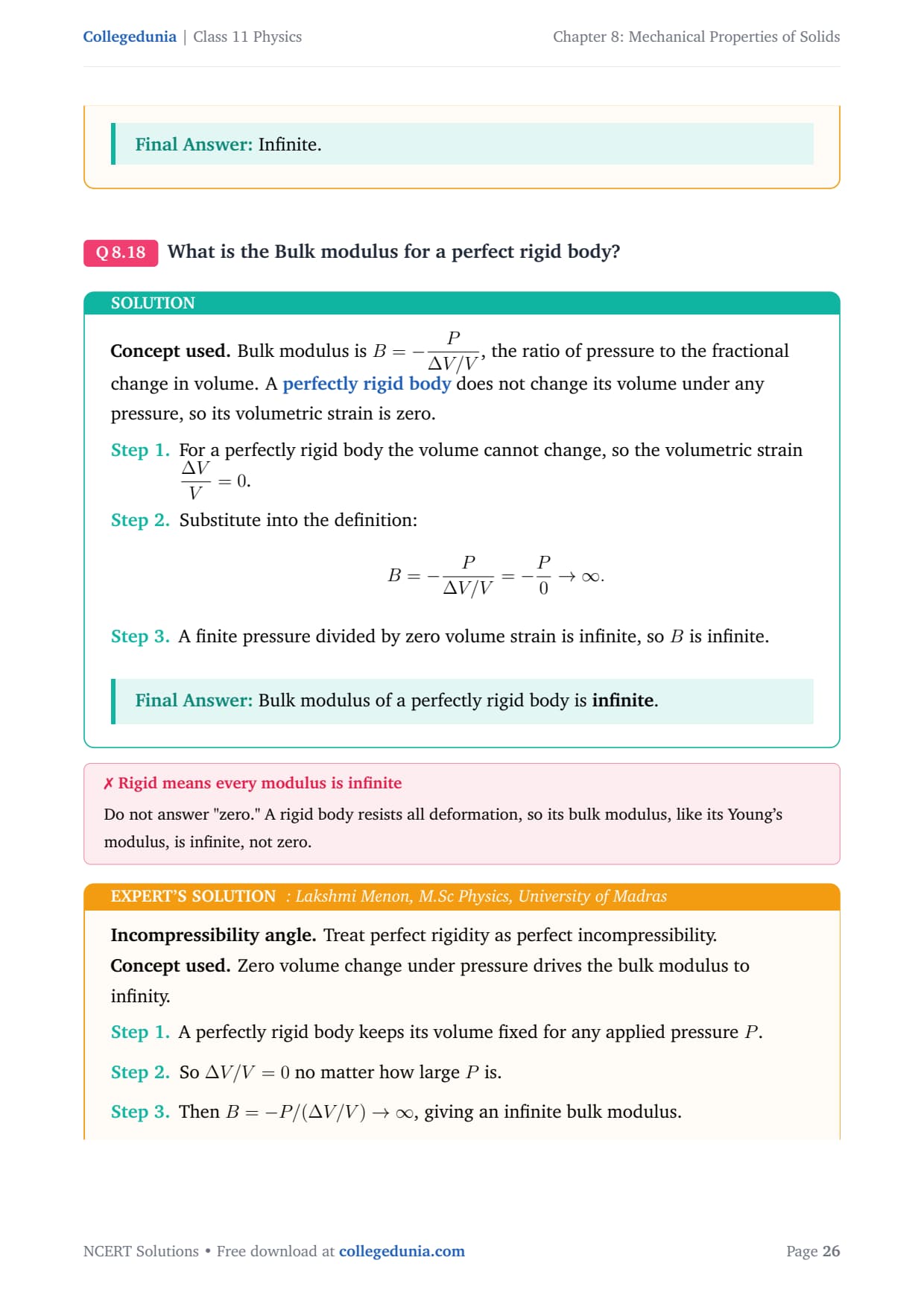
- Rigid means infinite, not zero: a rigid body resists all deformation, so its bulk modulus is infinite
- Stress is not a vector: it changes with the plane you pick, which makes it a tensor
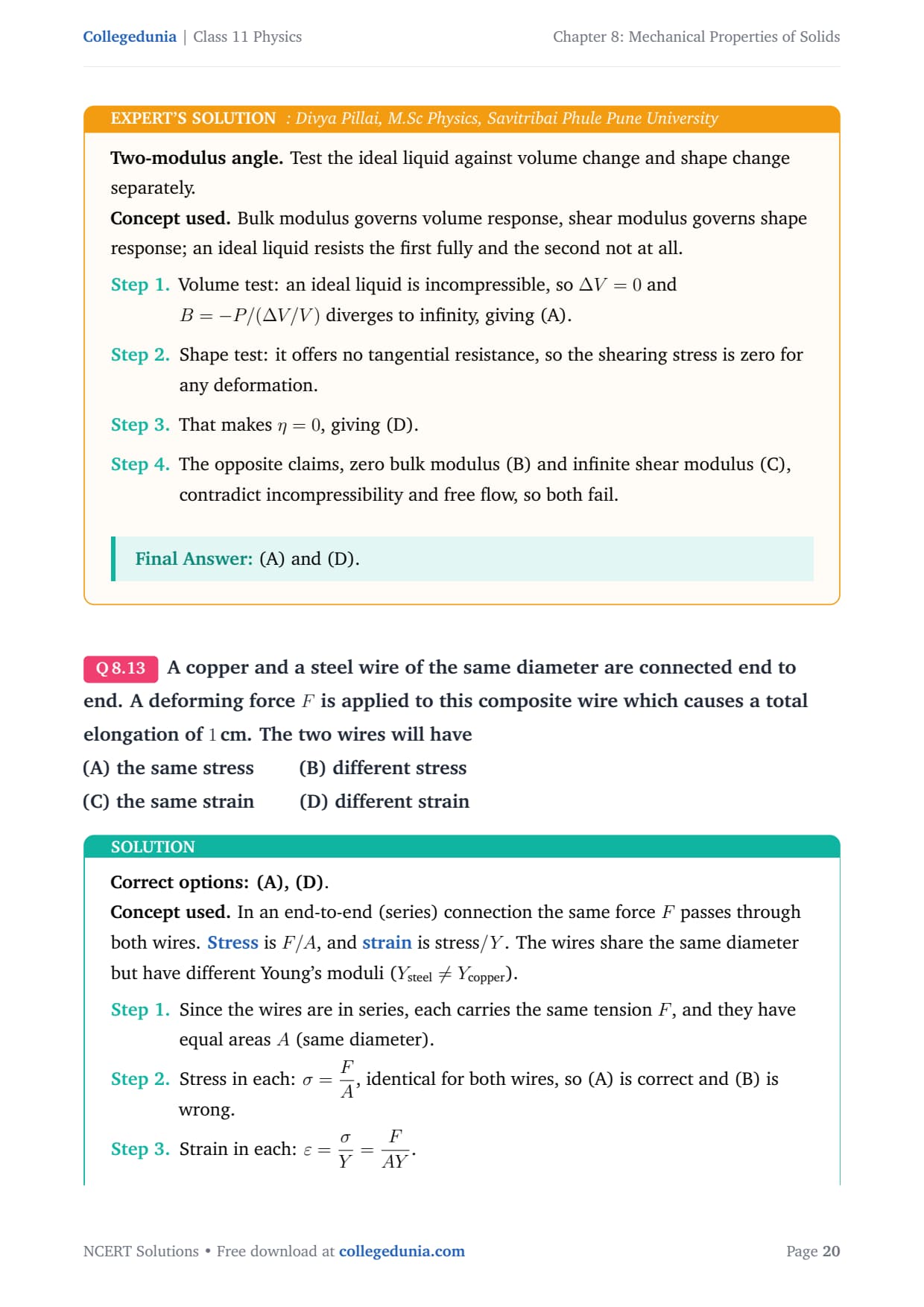
- Tension inside a wire: the ceiling pulls up with F and the load down with F, yet the internal tension is F, not 2F
- Area conversion: 1 cm2 equals 10-4 m2, and the missed square costs a factor of 100
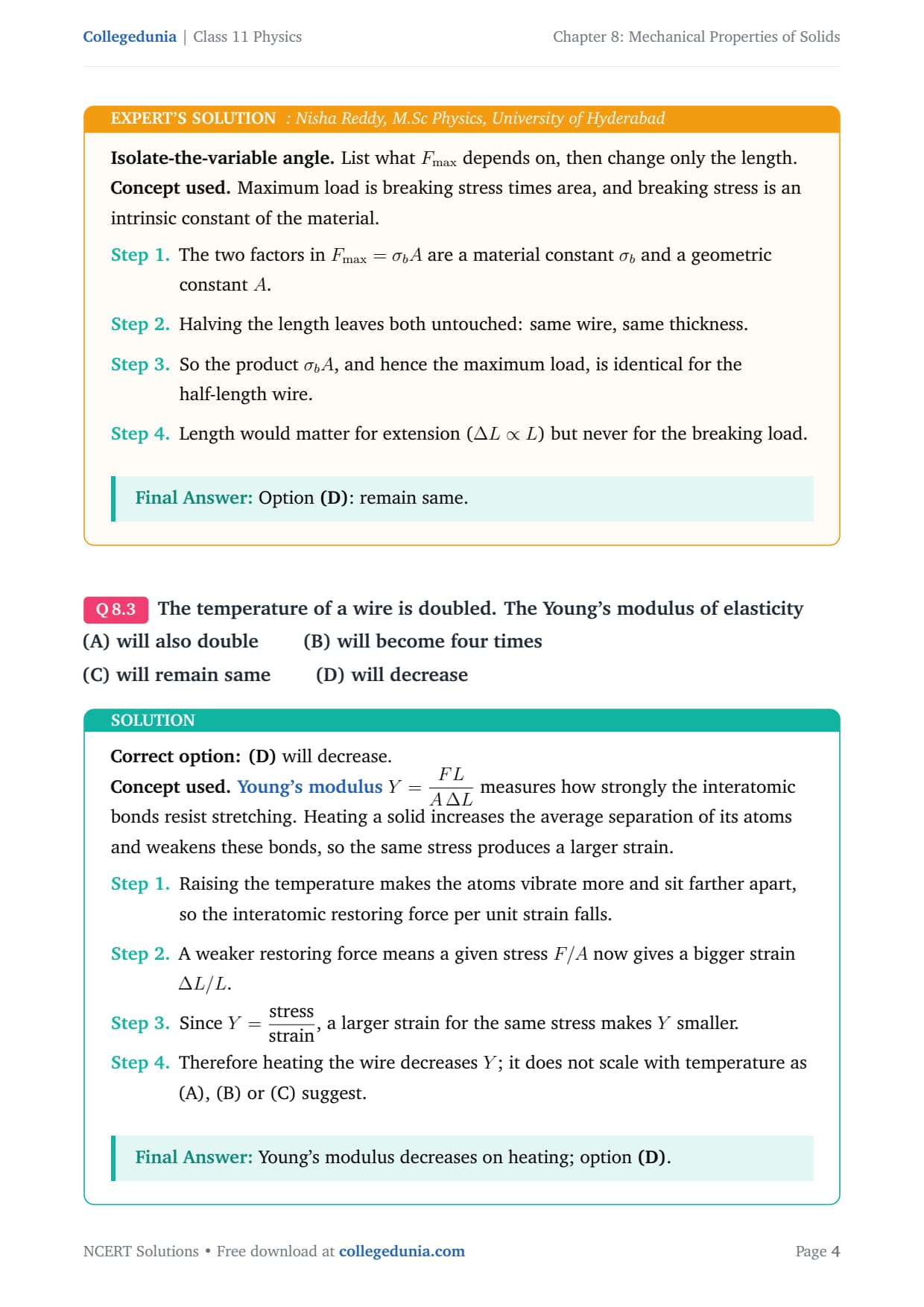
One more idea is worth naming. Elastic moduli fall as a solid is heated, because the bonds soften. Doubling the temperature does not double the modulus, and Question 3 is built on that gap.
How the Exemplar Steps Up from the Class 11 Physics Textbook
The textbook hands you a modulus and asks you to substitute. The Exemplar makes you decide which modulus applies, and sometimes what the question means.
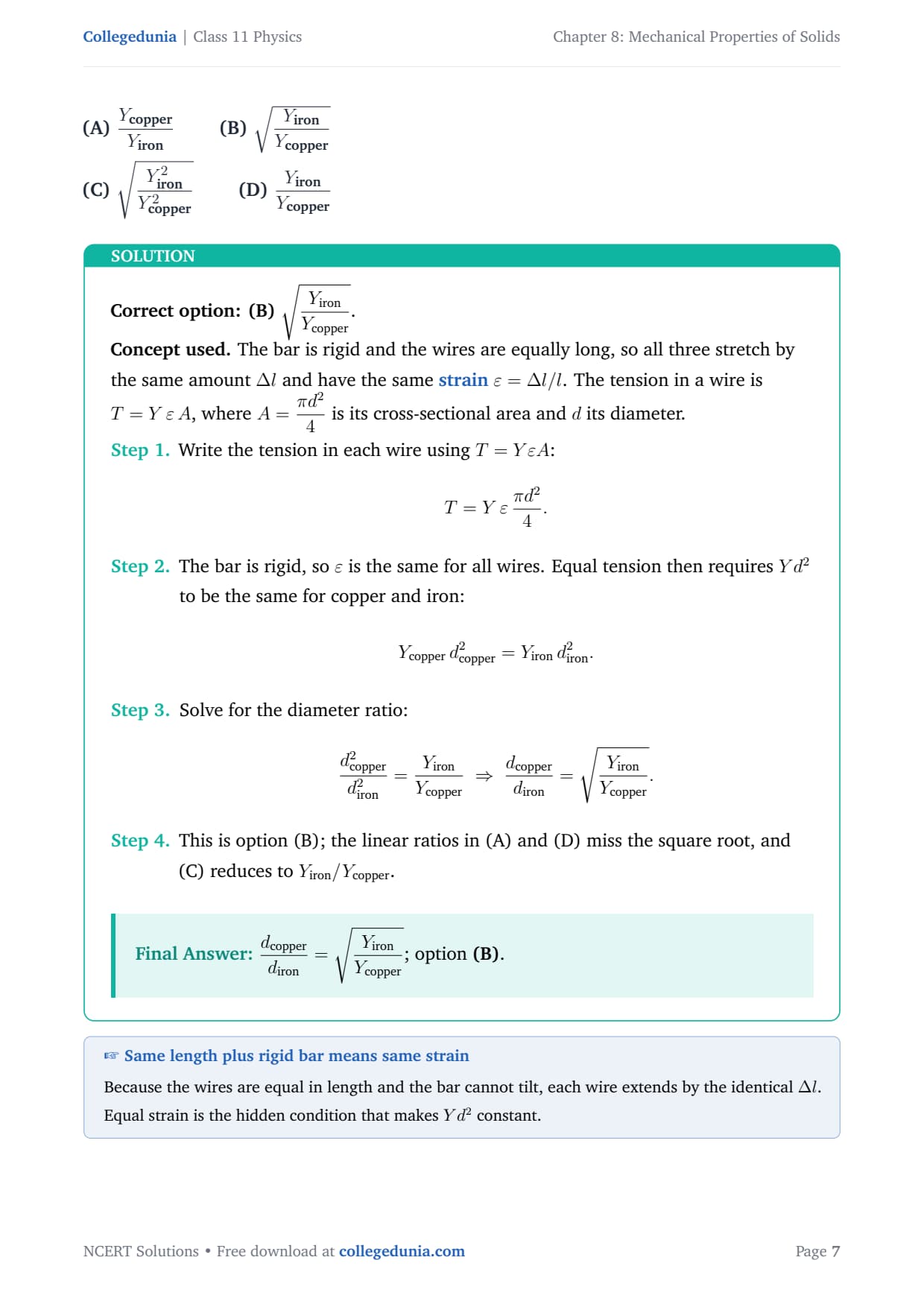
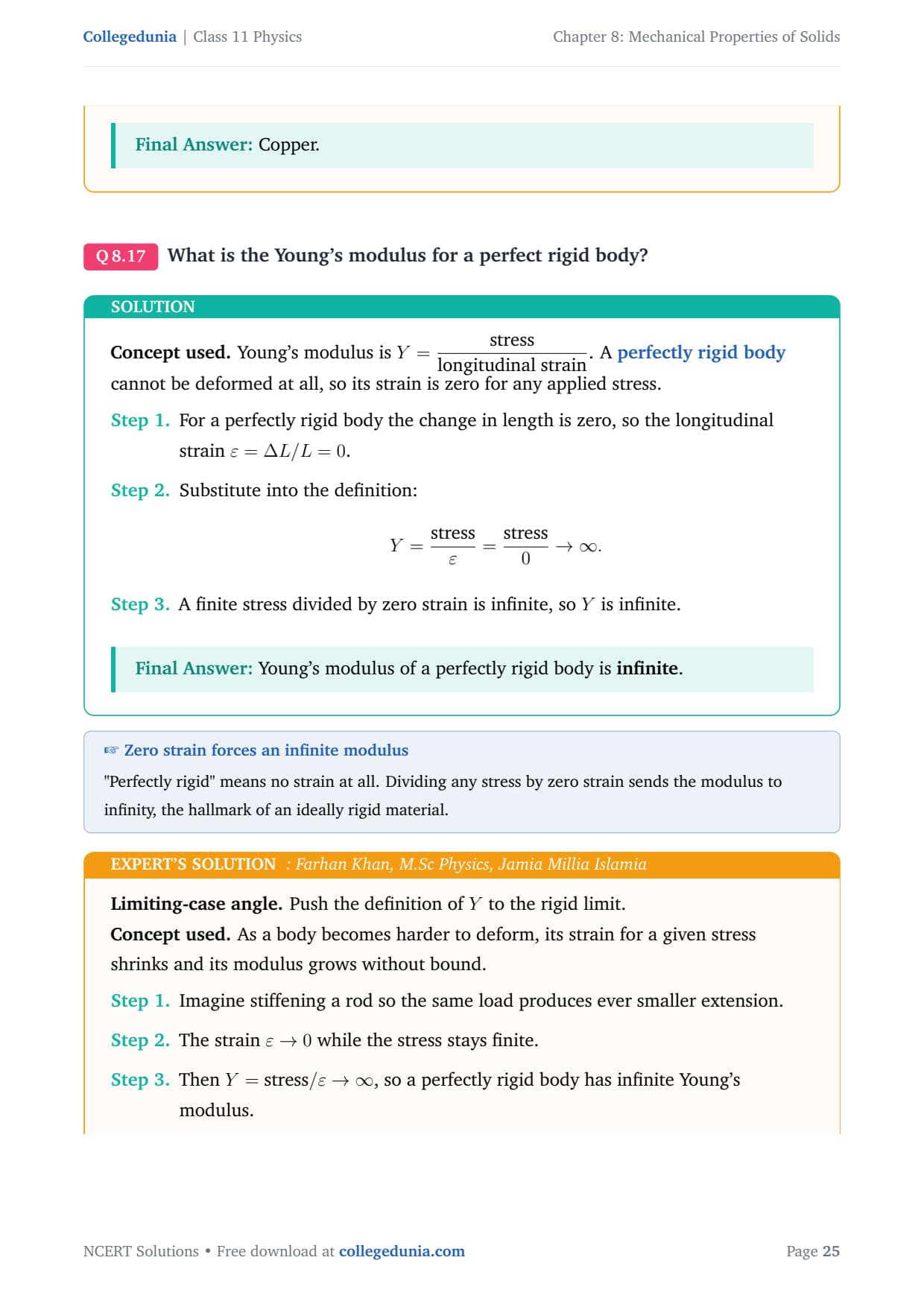
Question 16 is the clearest example. It asks about identical steel and copper springs that are "equally stretched," and on which more work must be done. The phrase carries two readings. Under equal applied load, the softer copper spring extends more, so W = ½FΔl is larger for copper. Under equal extension, the stiffer steel would win. The official key answers copper, so our solution follows the key and shows why the other reading flips it. Question 5 rewards the same care, giving a diameter ratio of √(Yiron/Ycopper).
How to Use These NCERT Exemplar Solutions for Boards, JEE and NEET
Try each question before opening the solution. The Exemplar rewards the attempt more than the reading.
- Boards: the VSA and SA questions match the 2 and 3 mark board pattern
- JEE Main: start with the six Long Answer questions, whose derivations match JEE depth
- NEET: the eight MCQ I questions cover the recall-level physics NEET repeats yearly
Student Feedback
Students who used Collegedunia's Class 11 Physics Exemplar Solutions told us the Long Answer derivations were the hardest part. Around 7 in 10 said the flagged misprint in the thermal stress question saved them a wrong answer.
Other Resources for Class 11 Physics Mechanical Properties of Solids
Collegedunia has the full set of study material for this chapter. Use the Notes for a first read, then the Exemplar once the moduli are clear.
Also Check:
- NCERT Solutions for Class 11 Physics Chapter 8
- Class 11 Physics Chapter 8 Notes
- Class 11 Physics Chapter 8 Handwritten Notes
- Class 11 Physics Chapter 8 NCERT Book PDF
- Class 11 Physics Chapter 8 Exemplar Questions with Solutions
NCERT Exemplar Solutions for Other Class 11 Physics Chapters
Every chapter below has the same step-by-step treatment and a free PDF.
Mechanical Properties of Solids Class 11 Physics NCERT Exemplar Solutions FAQs
Ques. How many questions are there in the Class 11 Physics Mechanical Properties of Solids Exemplar?
Ans. Chapter 8 has 29 questions. They are split into 8 MCQ I, 5 MCQ II, 5 Very Short Answer, 5 Short Answer and 6 Long Answer questions. All 29 are solved in the free 47-page PDF on this page.
Ques. Why does Question 20 print the expansion coefficient as 10-50 per degree Celsius?
Ans. That is a misprint in the Exemplar book. A coefficient of 10-50 °C-1 is physically impossible, and the official answer key does not use it. The intended value for steel is 10-5 °C-1. Using it gives a tension of 4 × 10⁴ N, which matches the key.
Ques. For identical steel and copper springs equally stretched, why is the answer copper?
Ans. The official key reads "equally stretched" as stretched under the same applied load. Copper has the smaller elastic modulus, so it is the softer spring and extends more. Since work done is half the force times the extension, copper takes more work. Under an equal-extension reading the stiffer steel would need more work instead.
Ques. Why is the modulus of rigidity of an ideal liquid zero?
Ans. An ideal liquid cannot sustain a tangential force while at rest. Any shearing force makes it flow rather than resist, so it offers no opposition to a change of shape. The shear modulus is therefore zero, not infinity.
Ques. Is the bulk modulus of a perfectly rigid body zero or infinite?
Ans. Infinite. A perfectly rigid body cannot be compressed at all, so the fractional volume change is zero for any pressure. Dividing pressure by zero strain gives an infinite bulk modulus. The same reasoning makes its Young's modulus infinite.



Comments