




NCERT Exemplar Solutions for Class 11 Physics Chapter 12 Kinetic Theory work through all 31 questions in the Exemplar book. Every MCQ, Very Short Answer, Short Answer and Long Answer problem is solved step by step. The free PDF runs to 48 pages and follows the 2026-27 syllabus.
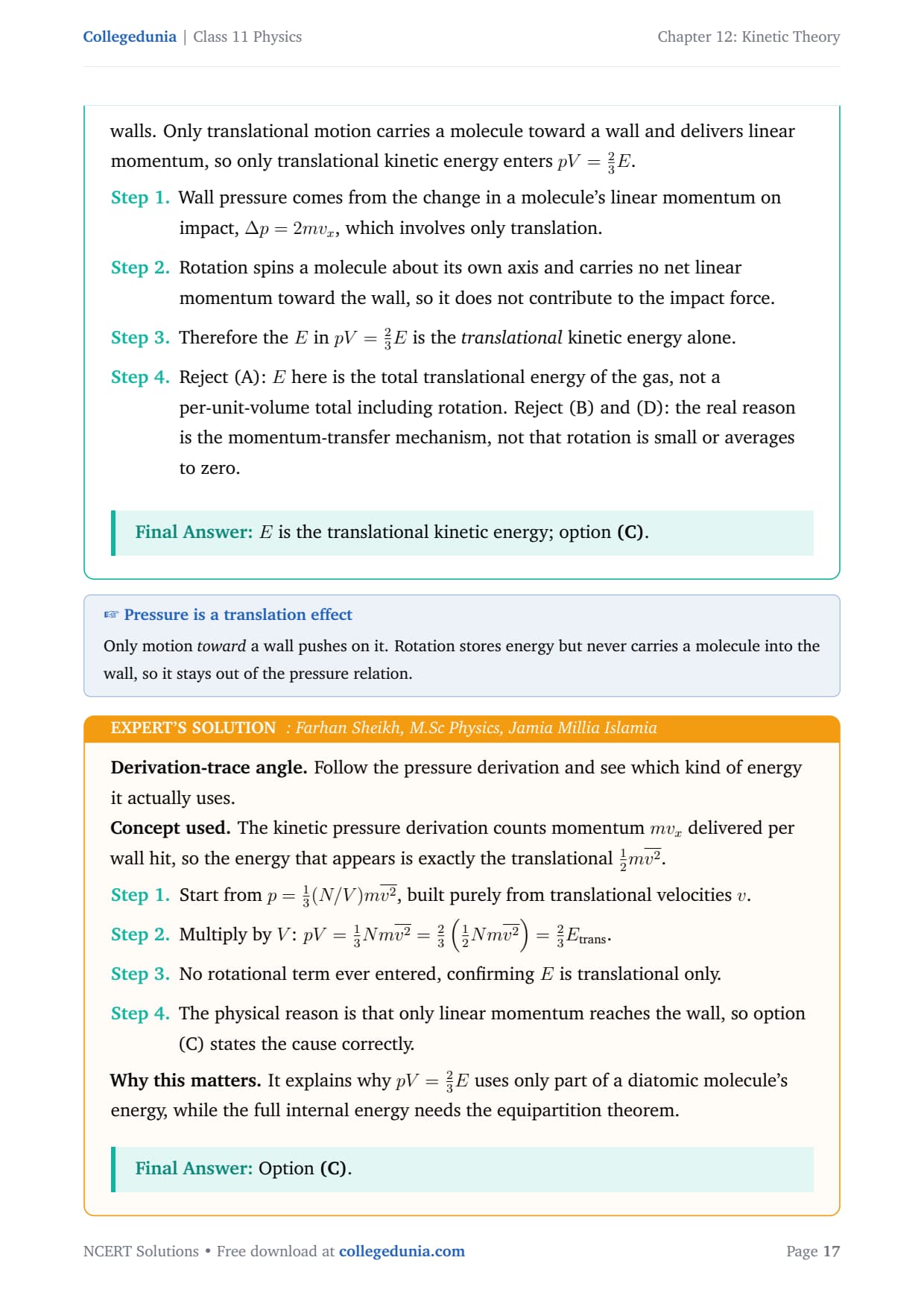
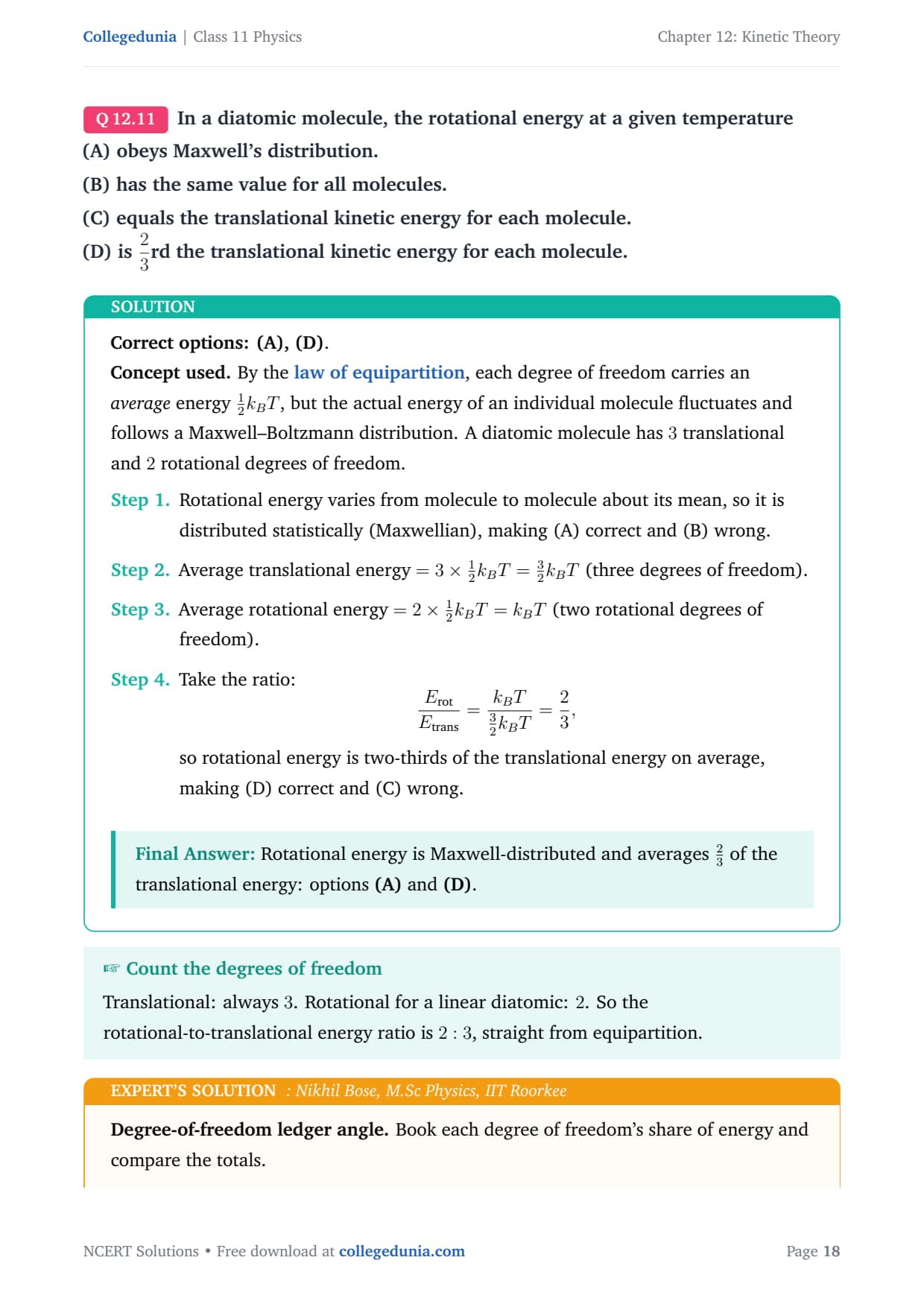
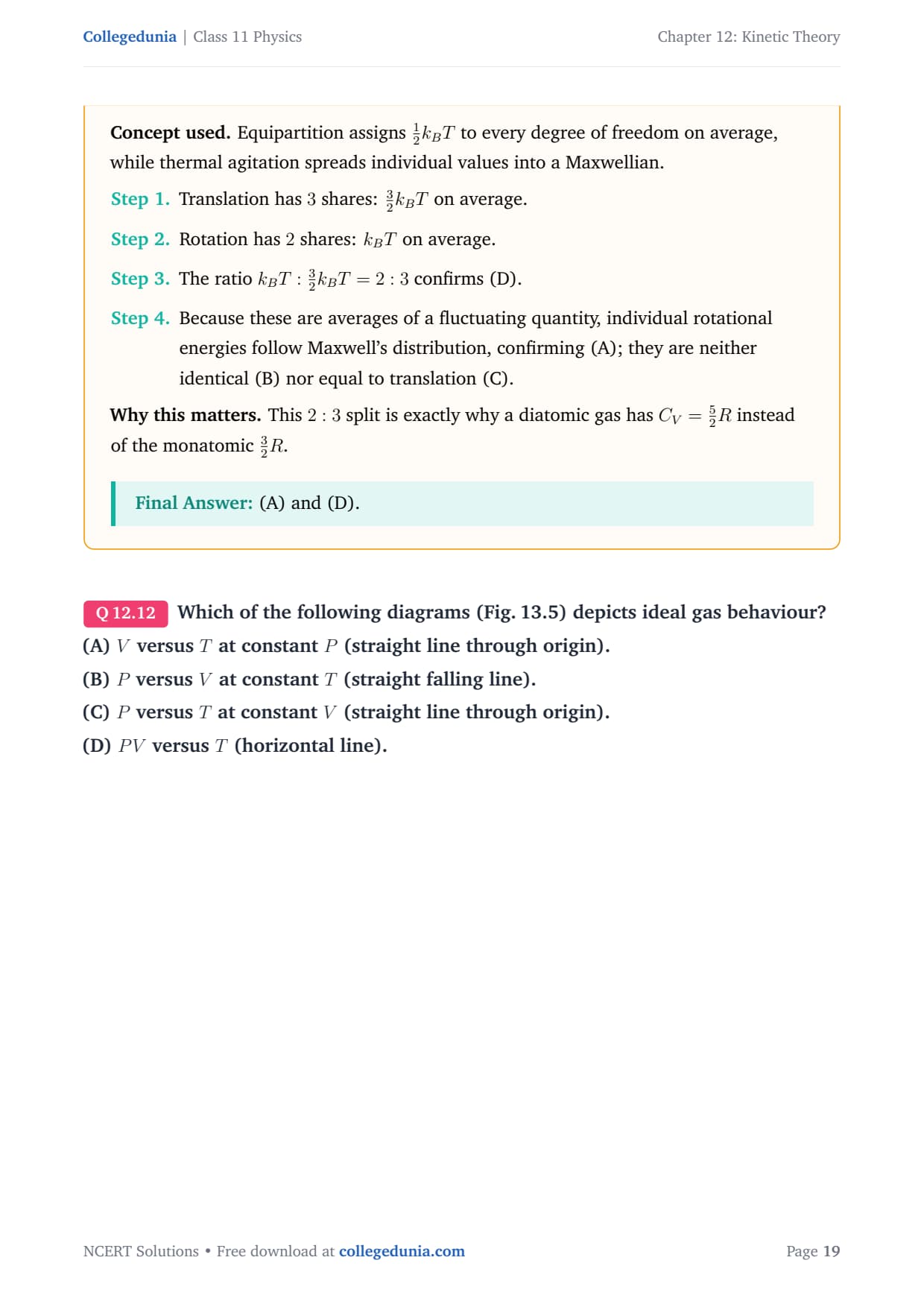
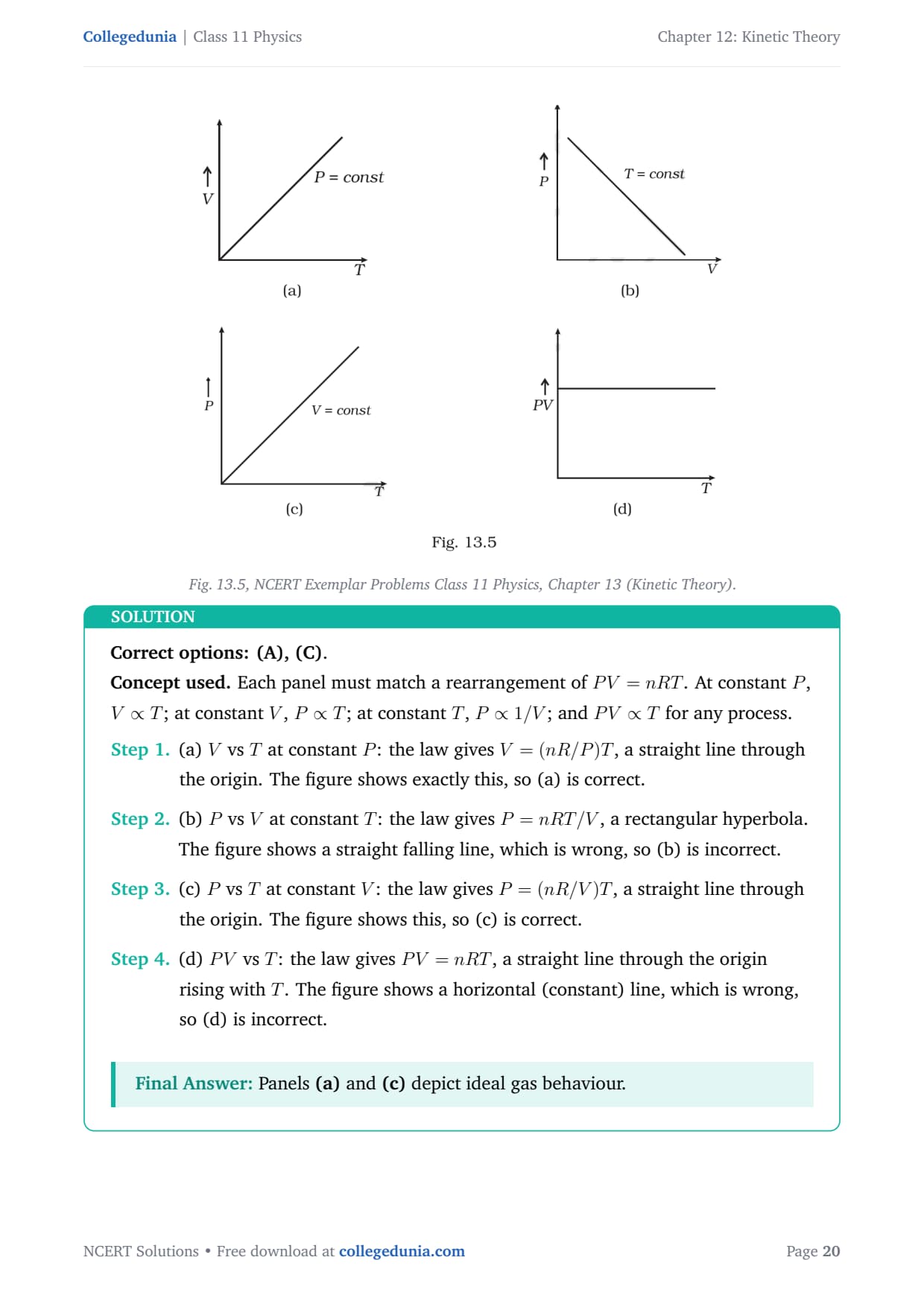
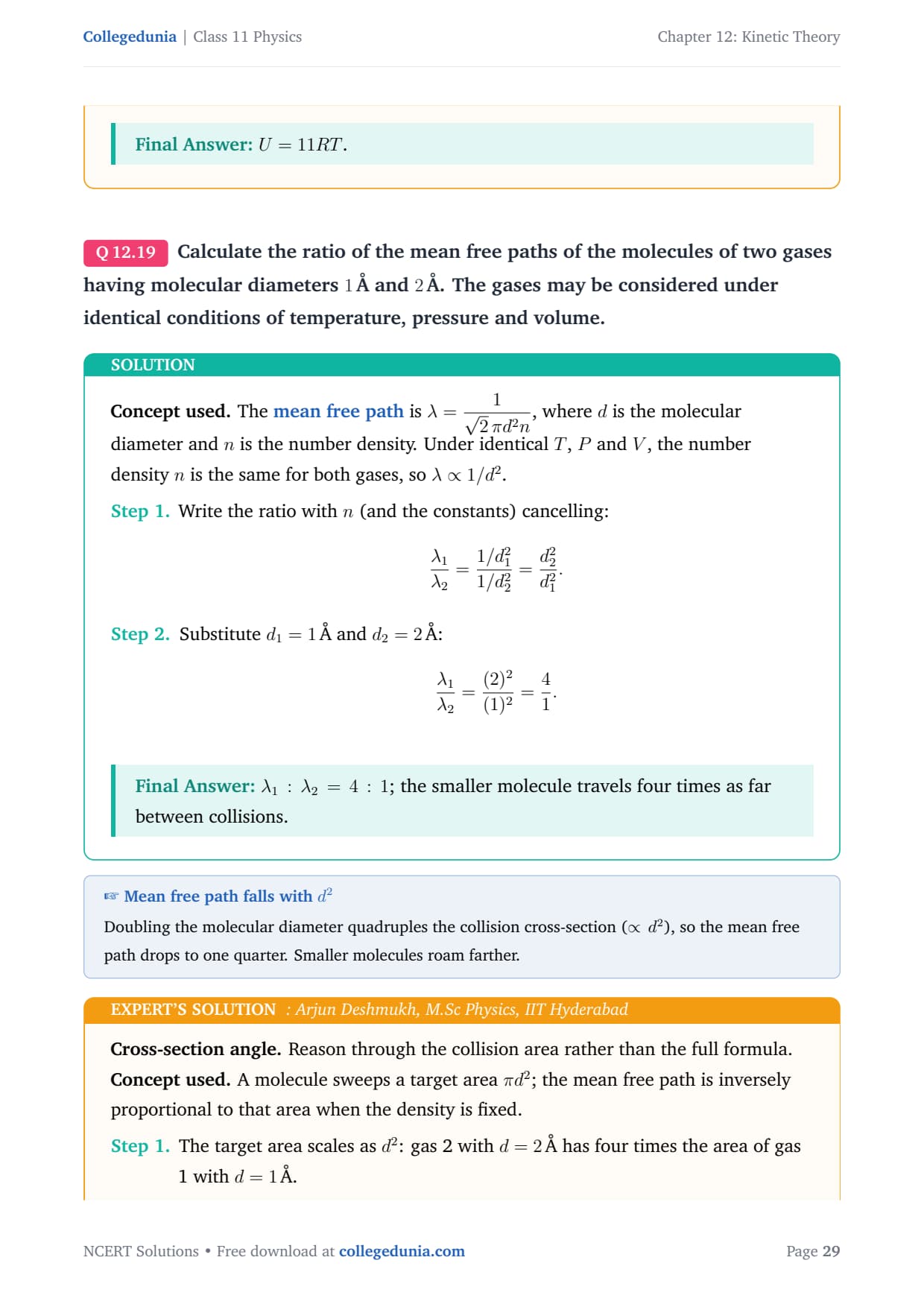
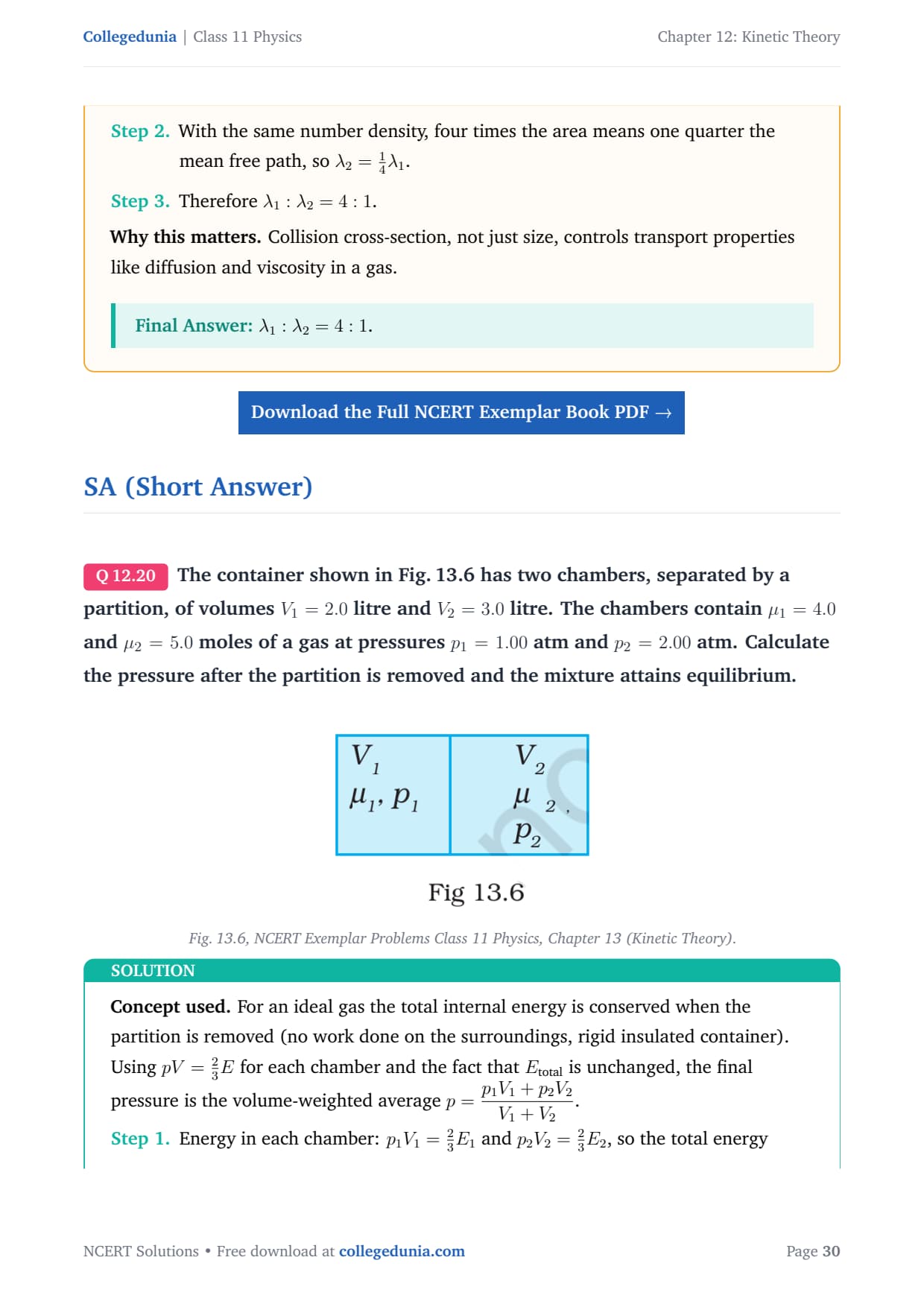
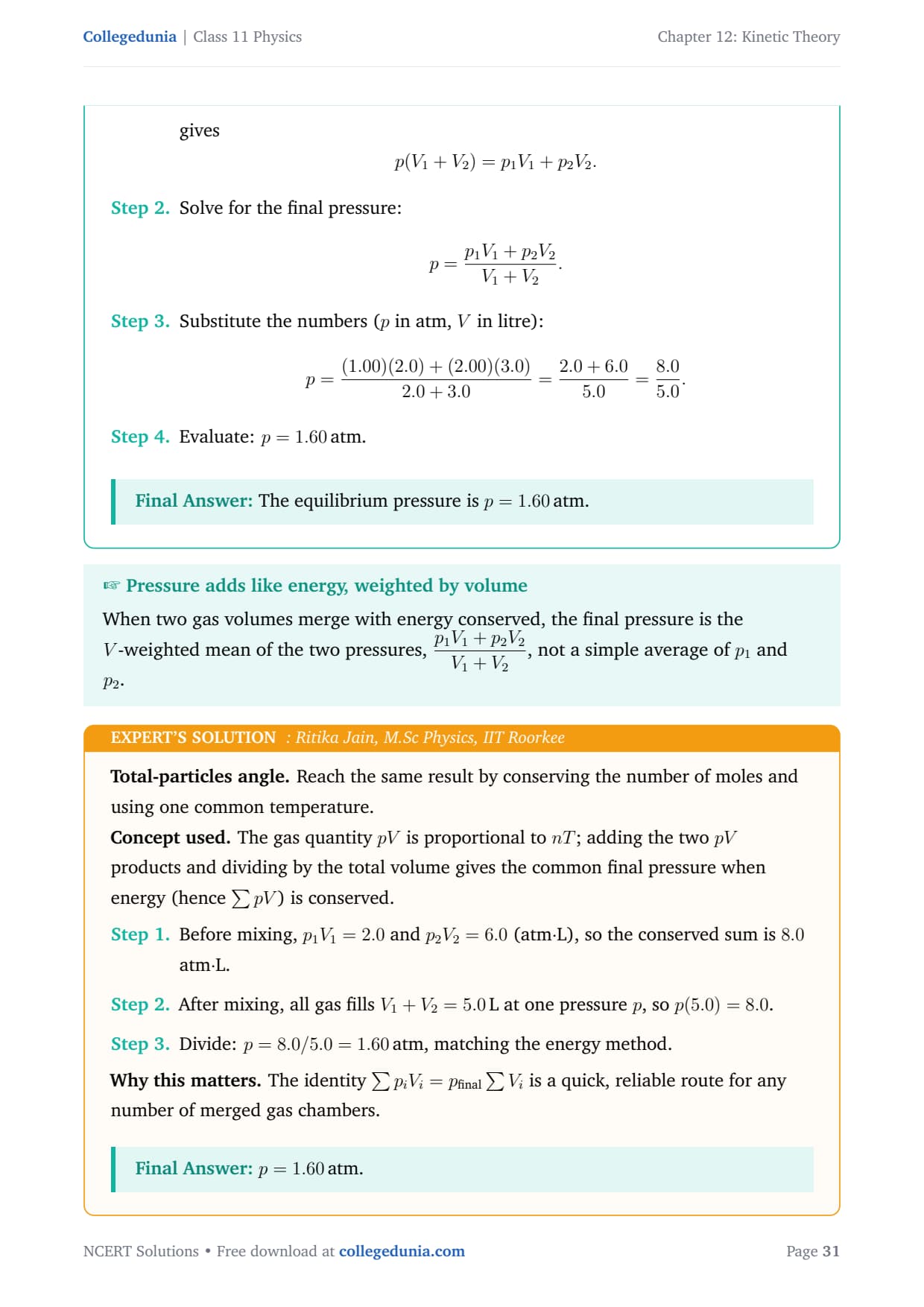
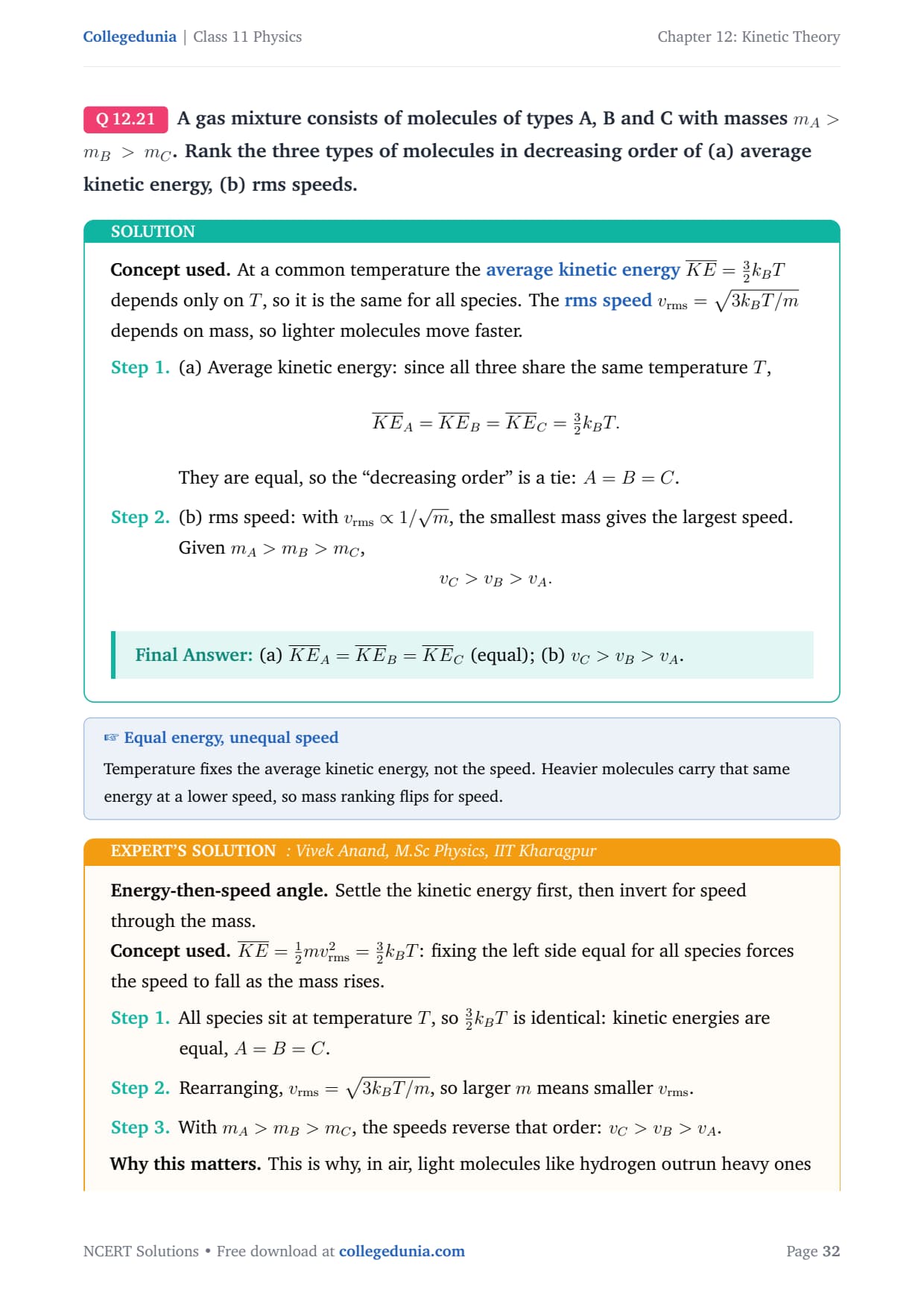
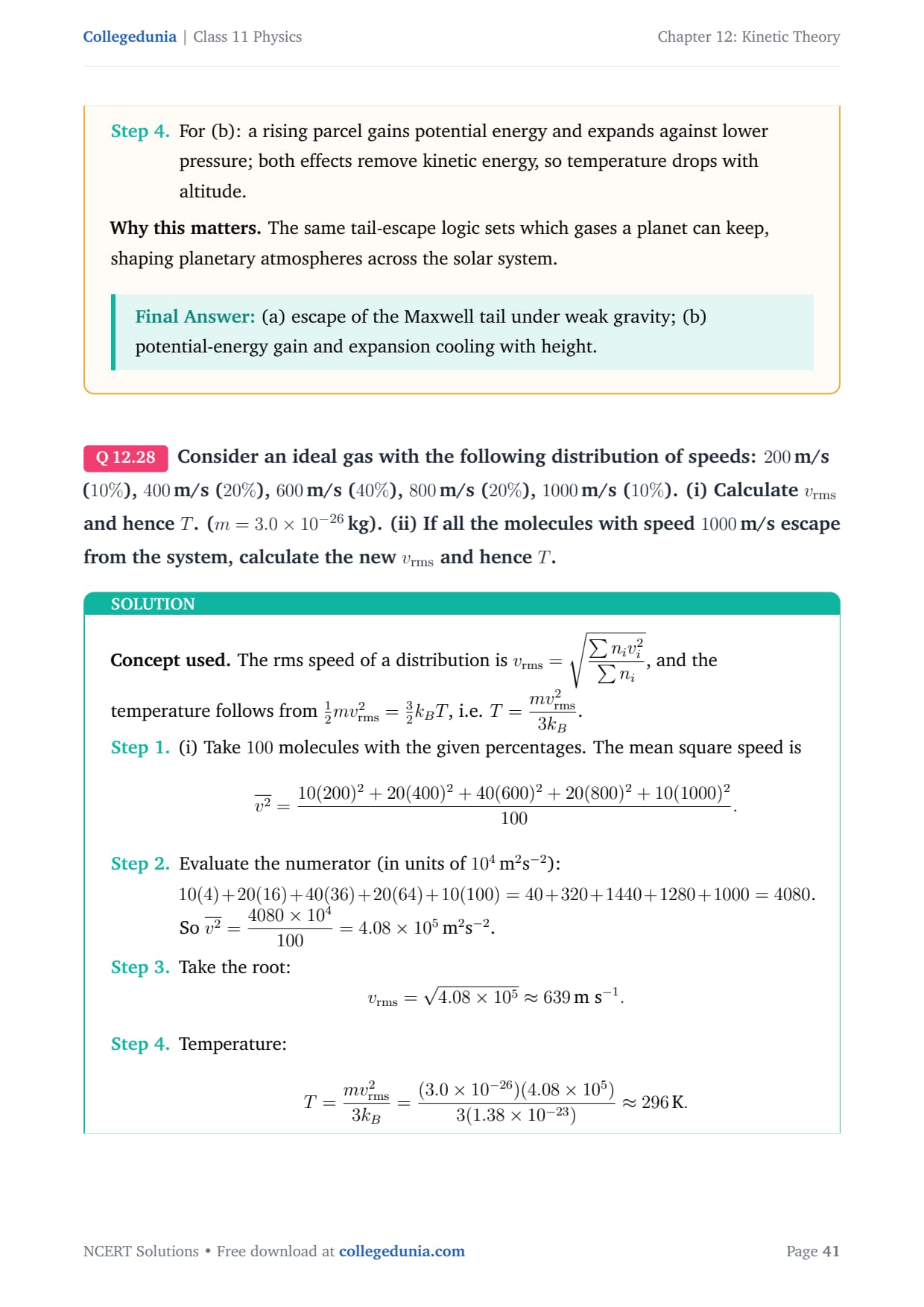
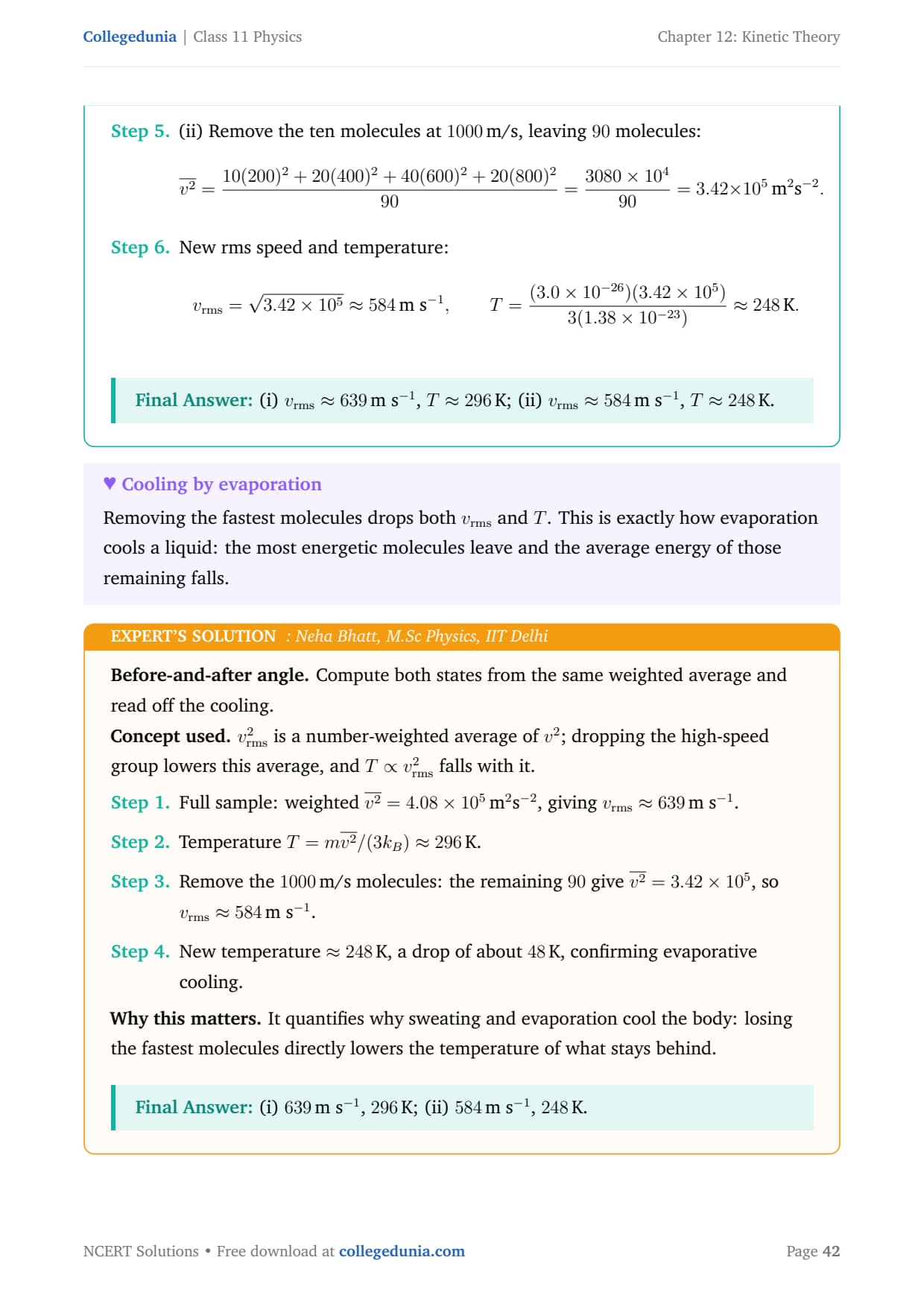
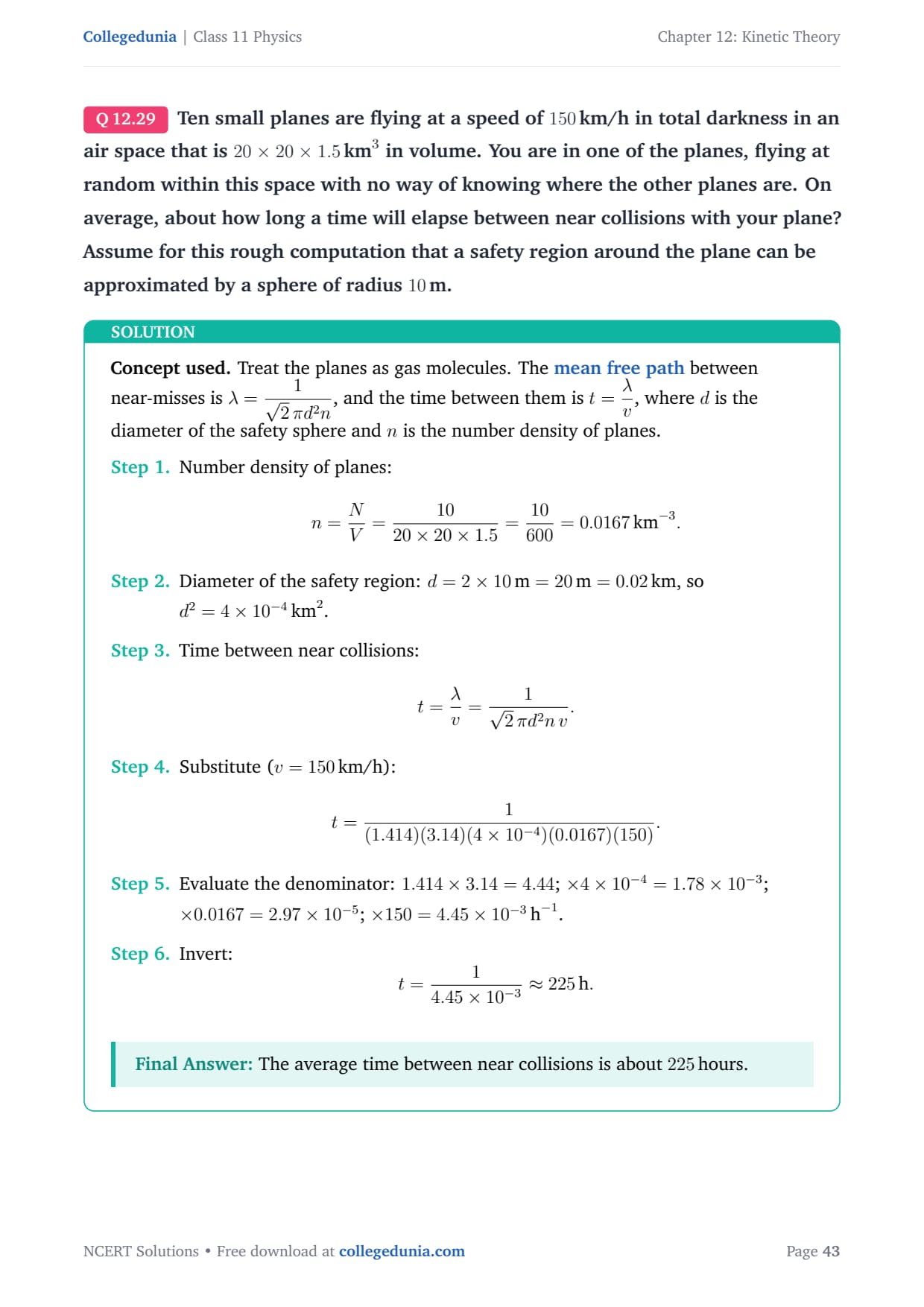
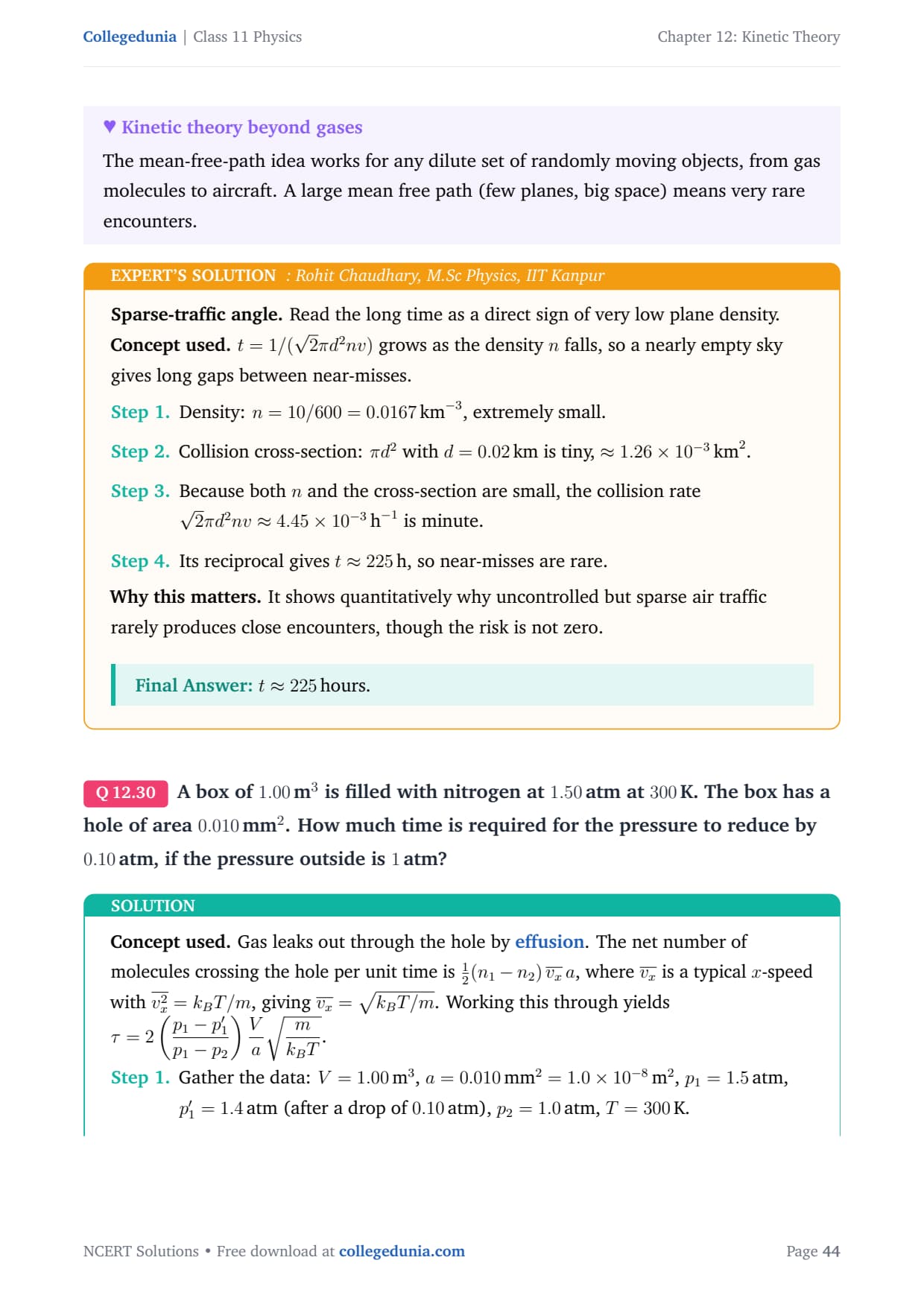
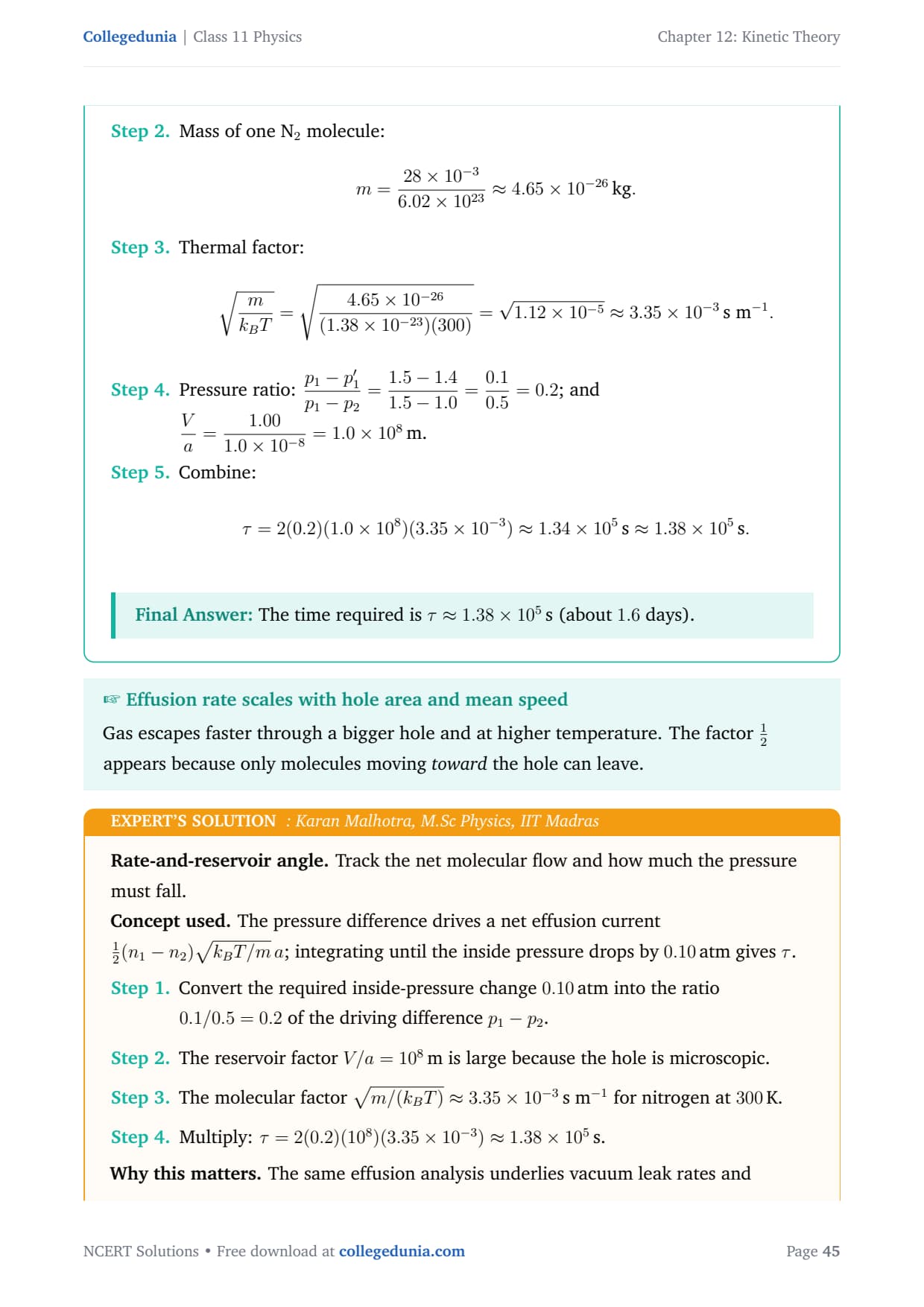
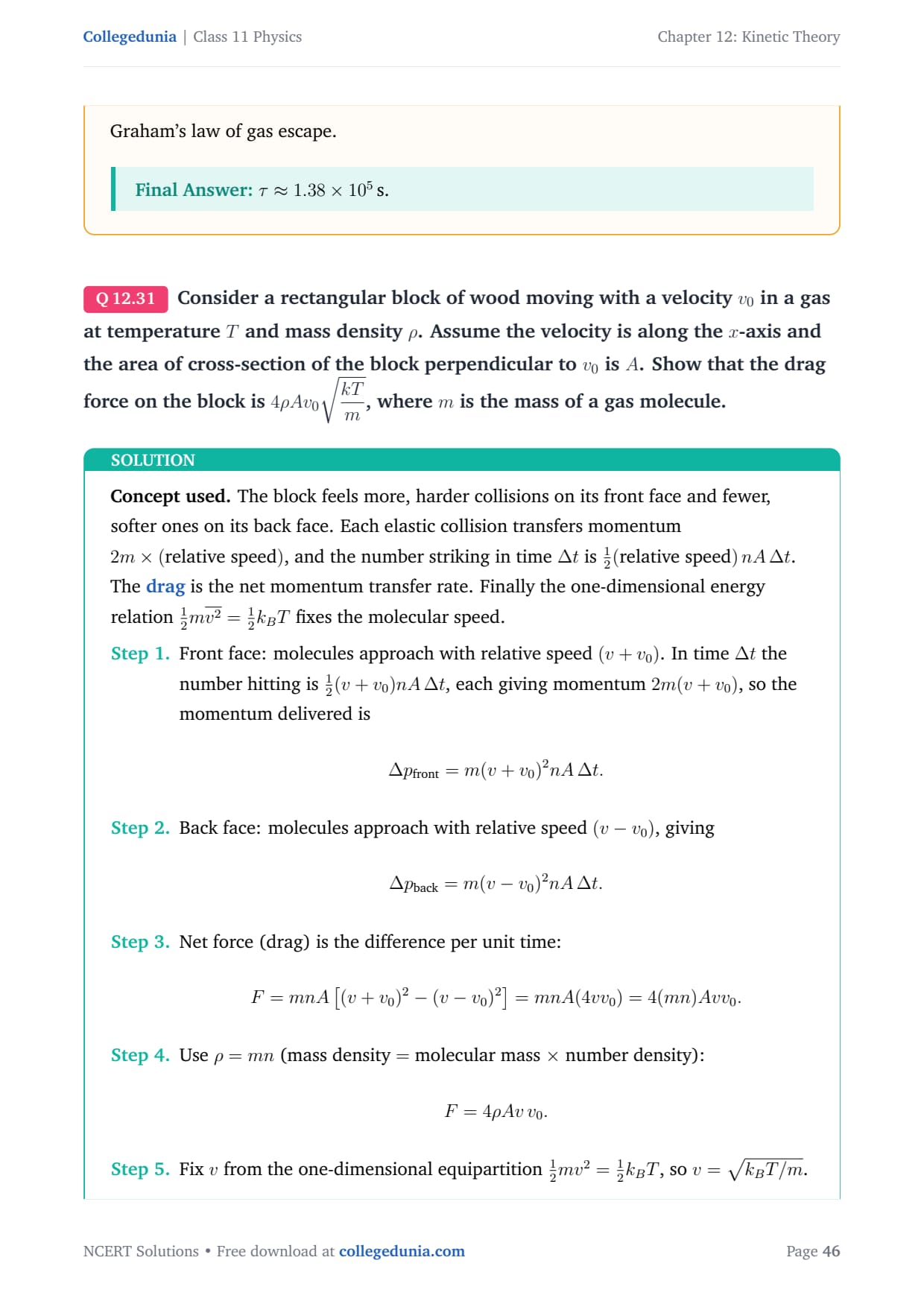
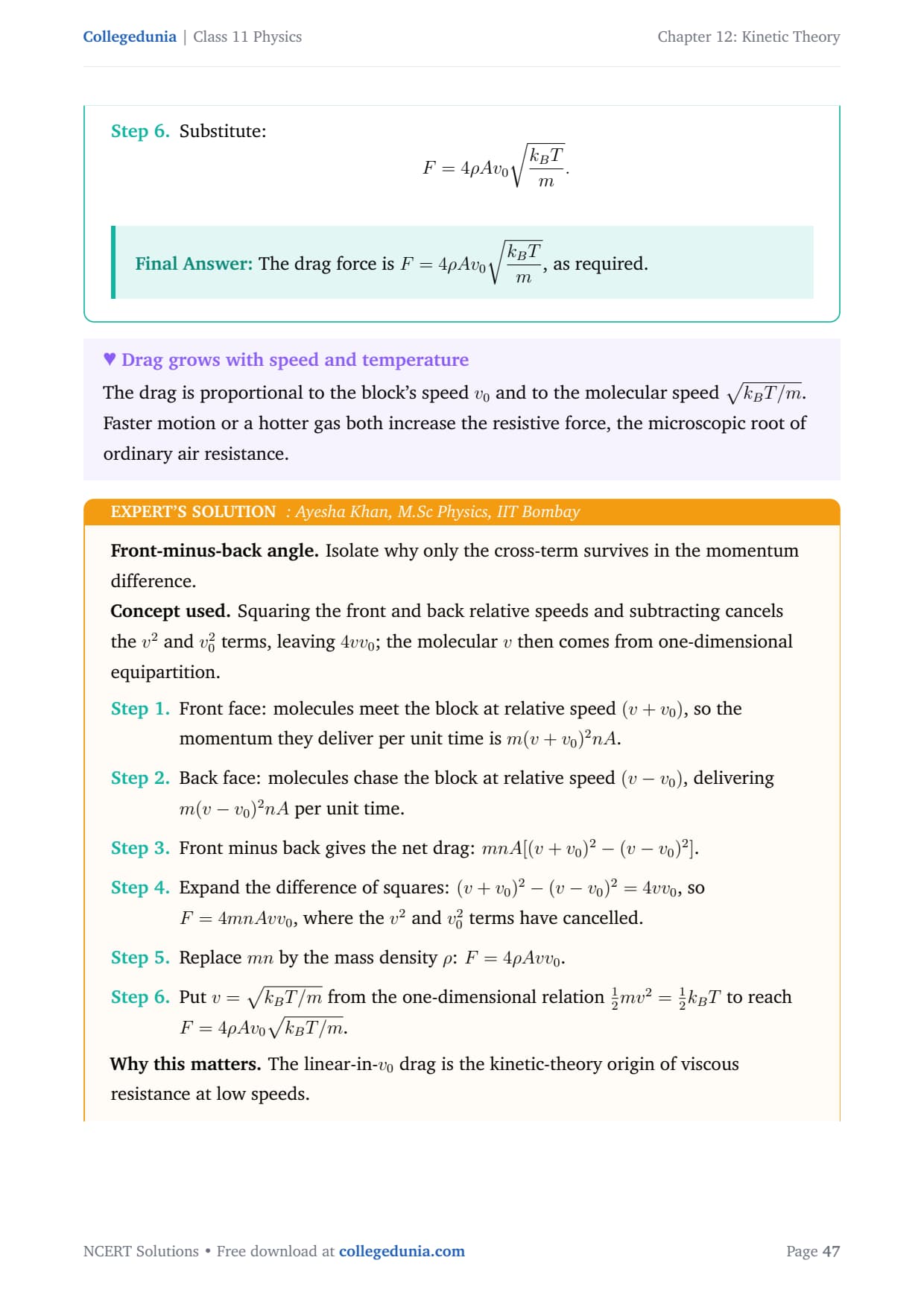
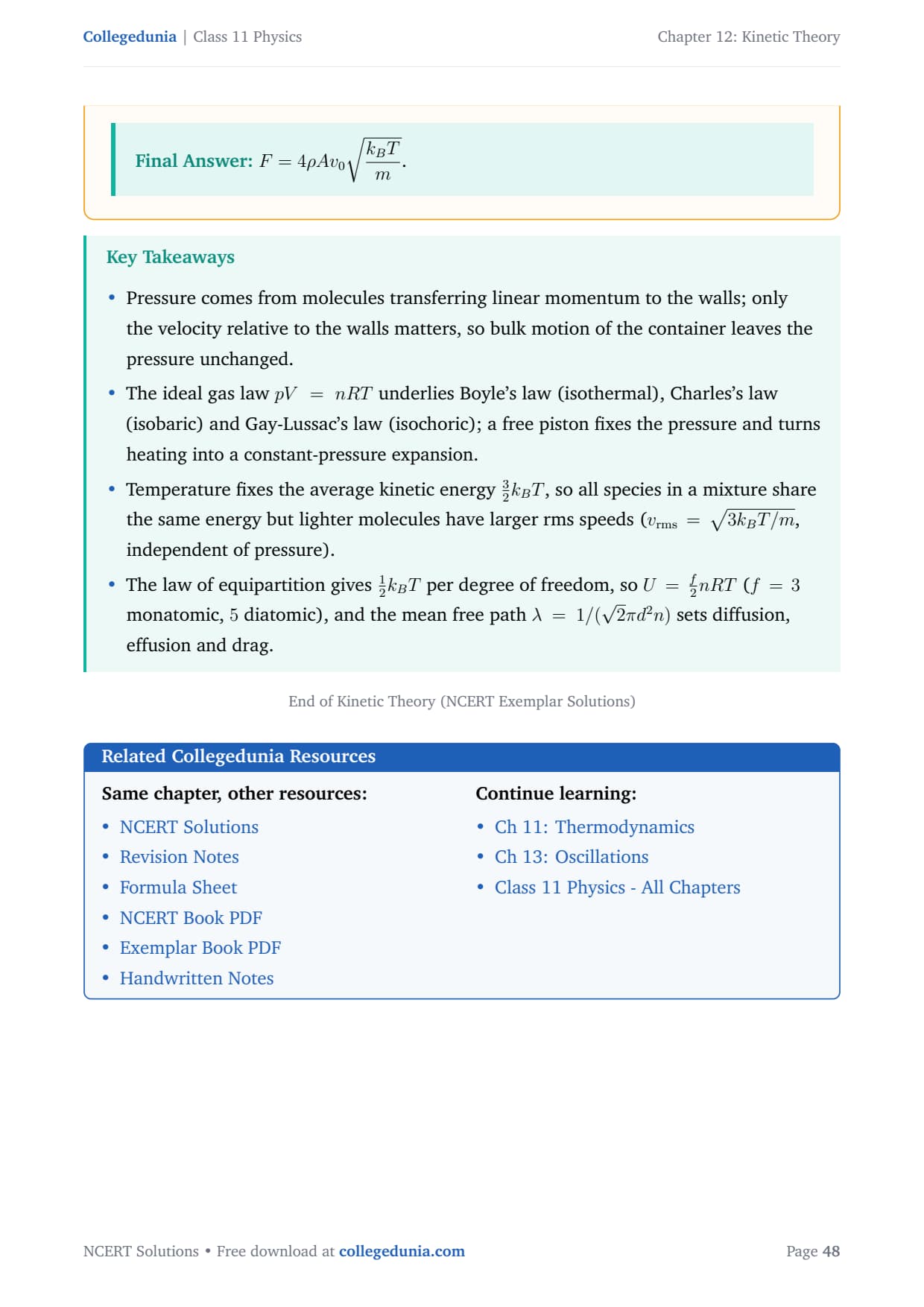
Kinetic Theory explains pressure and temperature from the random motion of molecules. It is a short chapter with a heavy formula load, and the Exemplar tests the assumptions behind each formula rather than the formula itself.
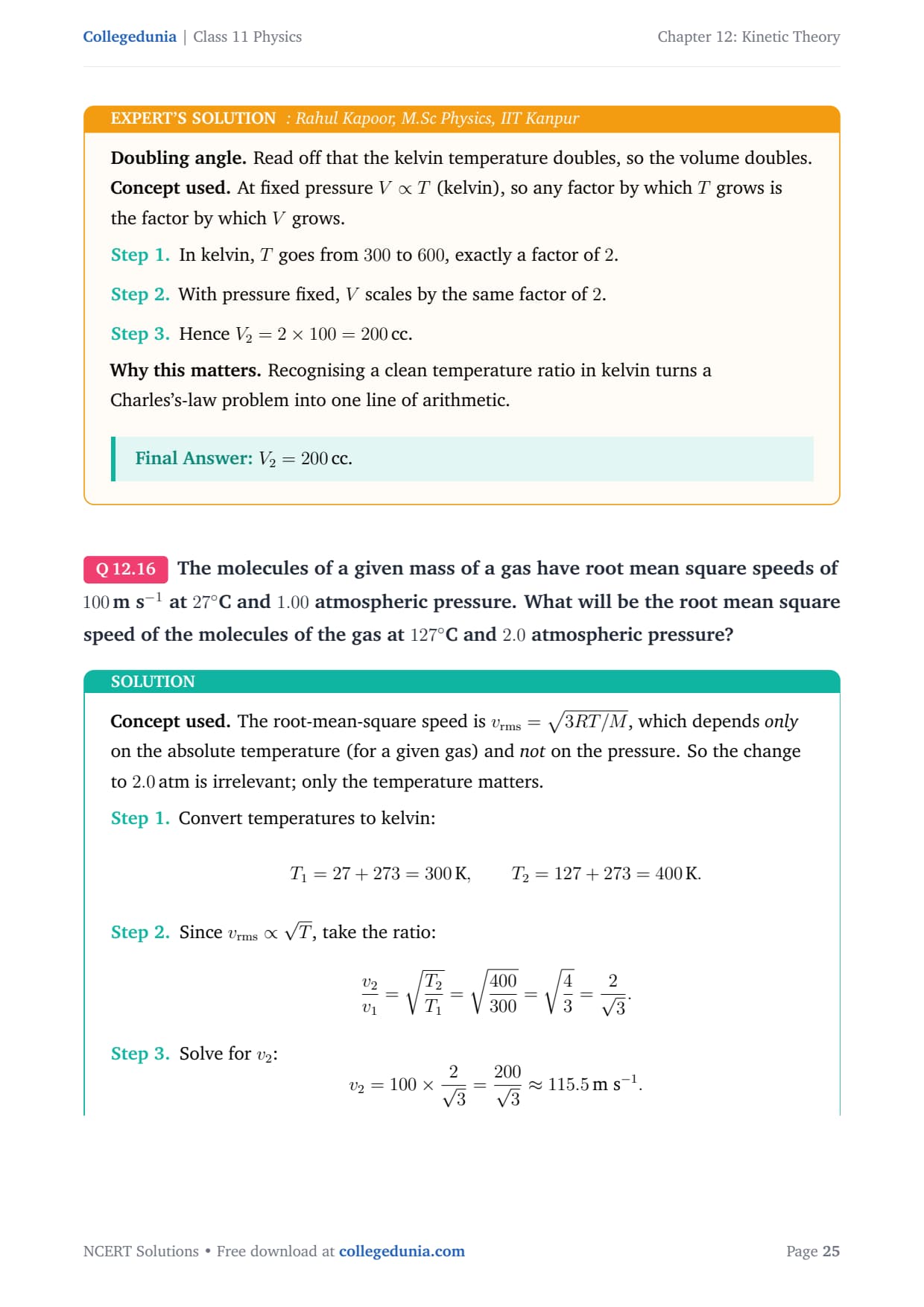
- CBSE Weightage: 4 to 5 marks, usually one question on equipartition or rms speed
- JEE Main Weightage: 1 to 2 questions per year on degrees of freedom and mean free path
- NEET Weightage: 1 to 2 questions per year from the gas laws and kinetic energy of molecules
Every answer is checked against the official NCERT Exemplar answer key, with the full calculation shown for each numerical.
Why the Exemplar Prints This Chapter as Chapter 13
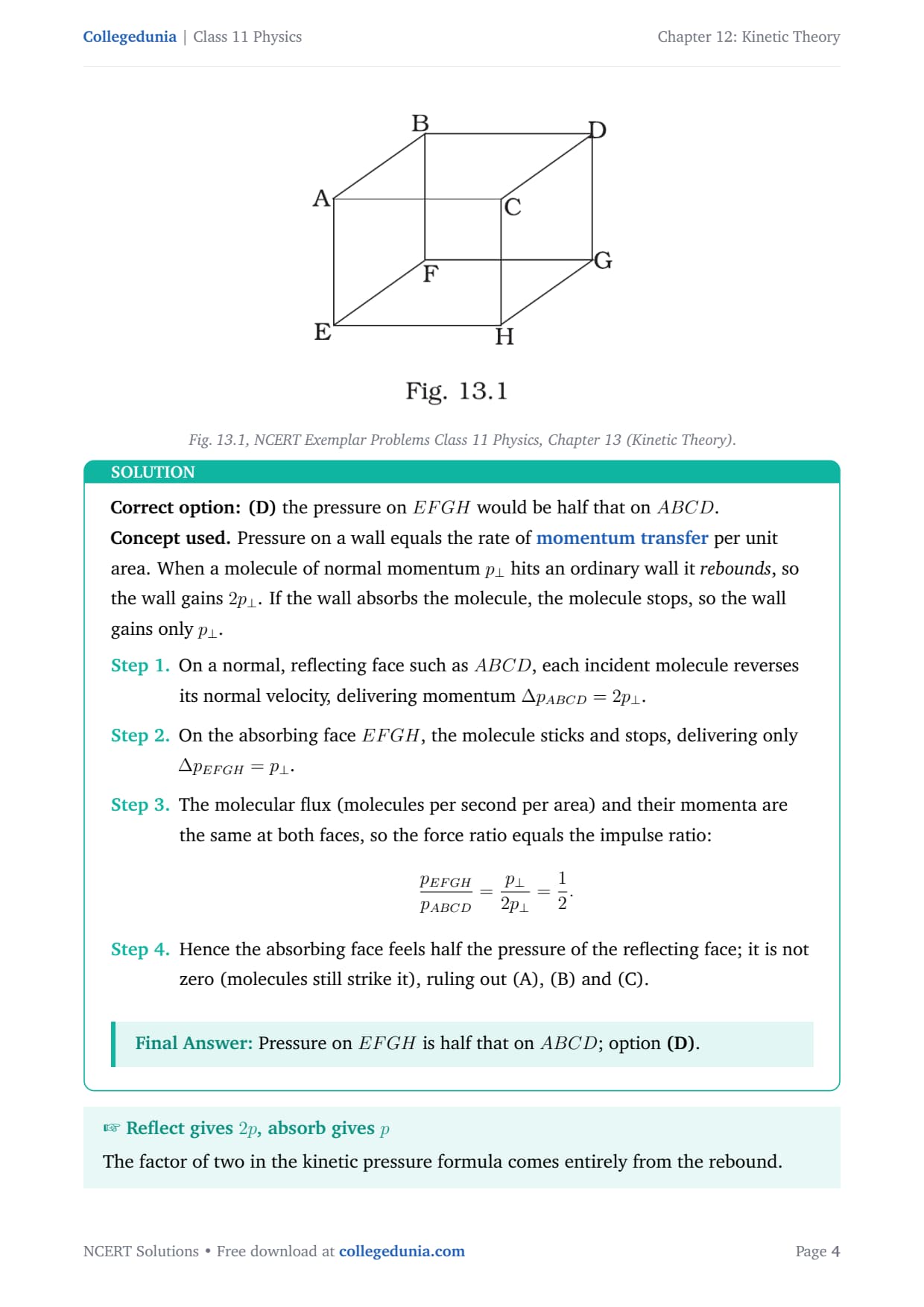
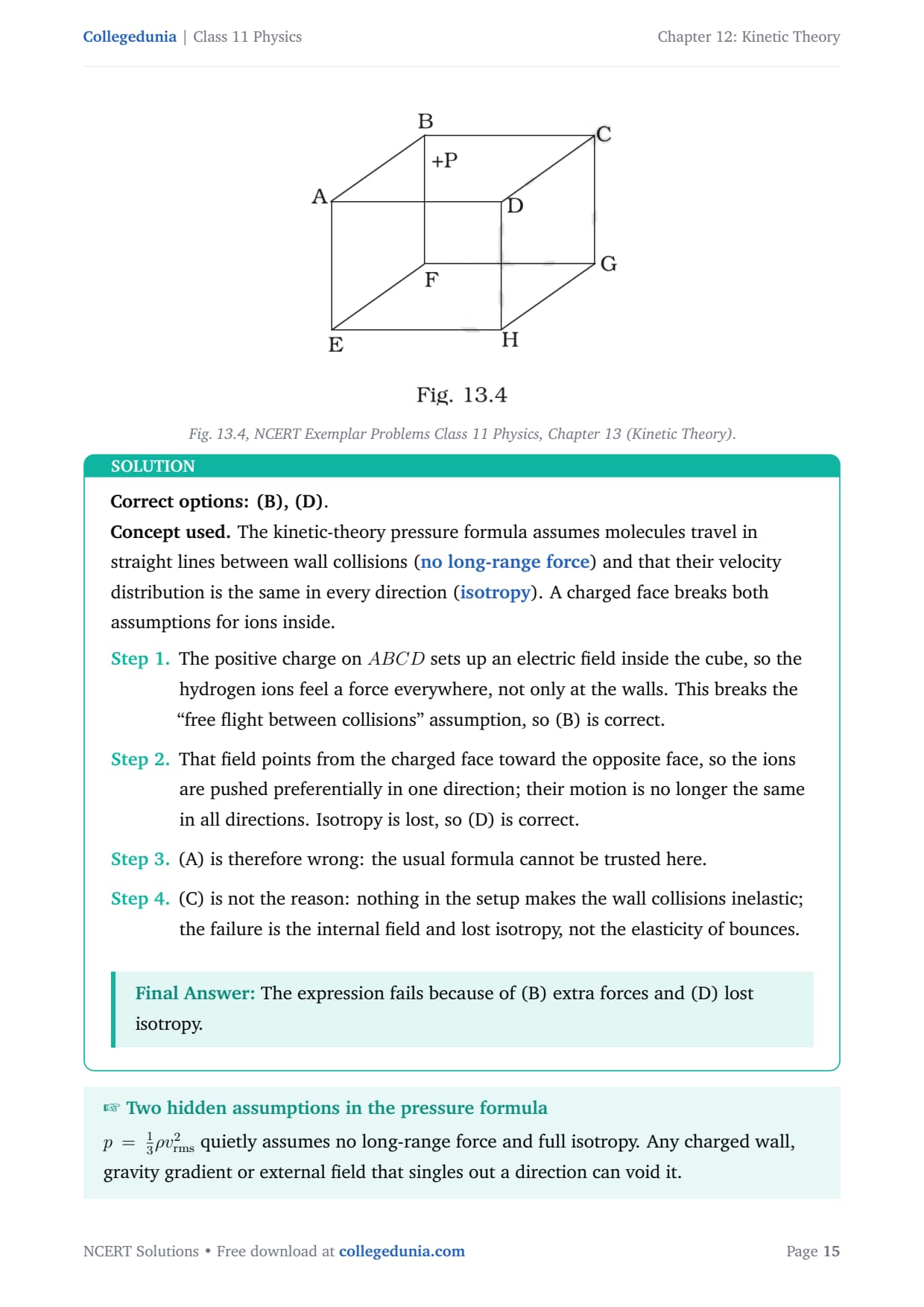
The Exemplar book still uses the older chapter order. Kinetic Theory appears there as Chapter Thirteen, so its six figures are labelled Fig. 13.1 to Fig. 13.6. The 2026-27 textbook lists the same chapter at number 12.
The questions and the answer key are identical; only the chapter number differs. Our PDF keeps the book's original figure labels, so any figure you look up in the Exemplar matches ours exactly.
Topics Covered in the Class 11 Physics Kinetic Theory Exemplar
The chapter builds three ideas, and almost every question leans on one of them. The molecular picture comes first, then temperature, then energy sharing.
- Ideal gas equation: pV = nRT = NkBT, plus Boyle's and Charles's laws as special cases
- Kinetic theory of pressure: p = (1/3)ρvrms2, derived from momentum handed to the walls
- Kinetic interpretation of temperature: average kinetic energy equals (3/2)kBT for every species
- Equipartition and mean free path: degrees of freedom, internal energy, and λ = 1/(√2 πd2n)
Question Types in the Kinetic Theory NCERT Exemplar
The 31 questions split across five types. The Long Answer set is the hardest part, since those five ask for full derivations rather than substitution.
| Question Type | Count | What It Tests |
|---|---|---|
| MCQ I (single correct) | 8 | Reasoning about pressure, gas laws and the Maxwell distribution |
| MCQ II (one or more correct) | 5 | Whether you can rule out every wrong option, not just spot one right one |
| VSA (Very Short Answer) | 6 | Quick numericals on moles, rms speed, internal energy and mean free path |
| SA (Short Answer) | 7 | Mixing gases, checking ideal-gas validity, and equipartition sums |
| LA (Long Answer) | 5 | Escape of atmospheres, effusion timing and a drag-force derivation |
Key Formulas Used Across the Kinetic Theory Exemplar Solutions
The PDF states the formula before applying it, so you can see which rule does the work. These five carry the whole chapter.
- Pressure: p = (1/3)(N/V)m̅v2, so pV = (2/3)E with E the translational energy only
- rms speed: vrms = √(3kBT/m) = √(3RT/M), with no pressure term in it
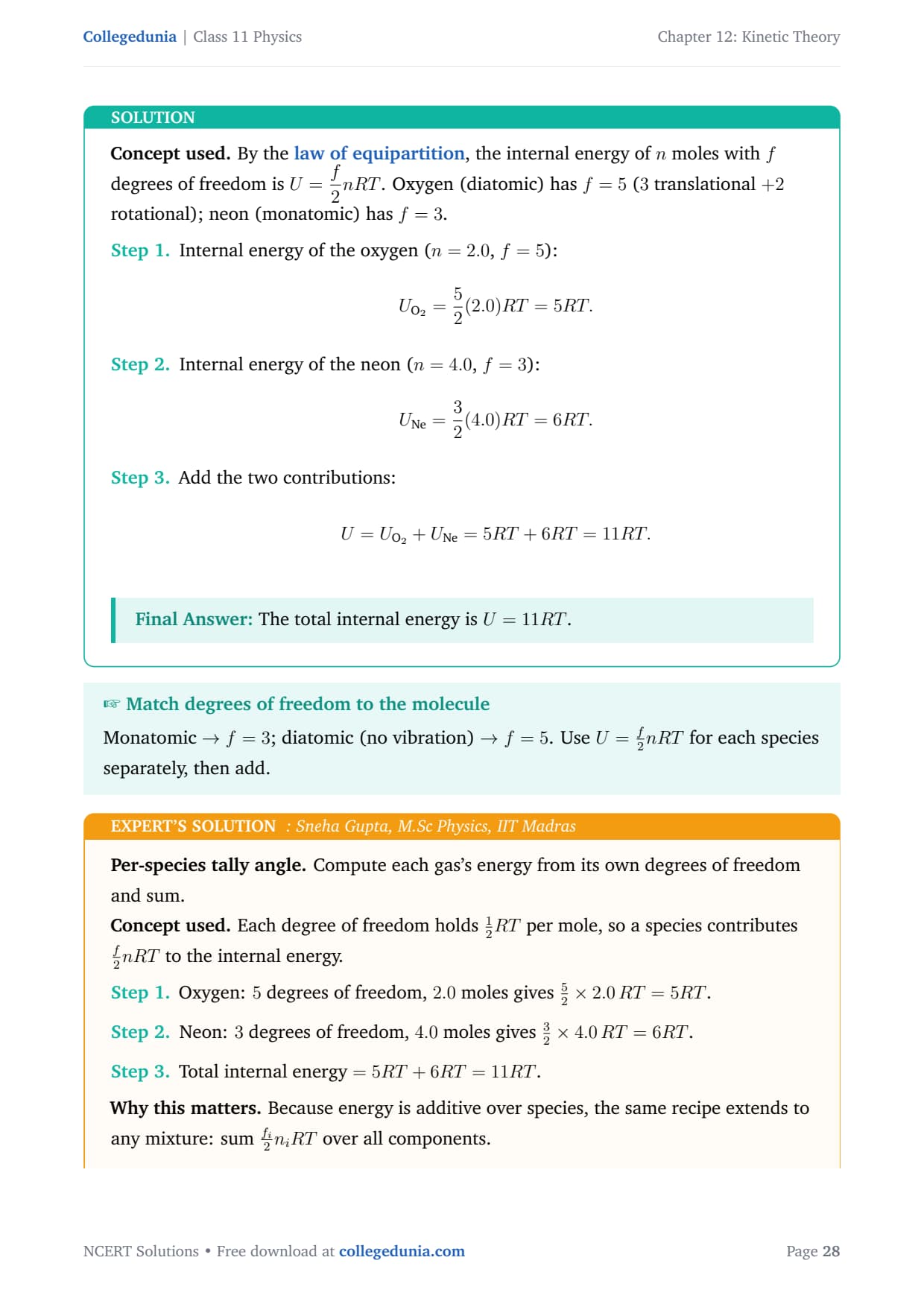
- Internal energy: U = (f/2)nRT, where f = 3 for monatomic and f = 5 for diatomic gases
- Mean free path: λ = 1/(√2 πd2n), so λ falls as the square of the diameter
- Boltzmann constant: kB = 1.38 × 10⁻²³ J K-1, used in every temperature conversion
Common Mistakes Students Make in Kinetic Theory
The Exemplar sets its traps on purpose. Each one is flagged in the PDF at the question where it appears.
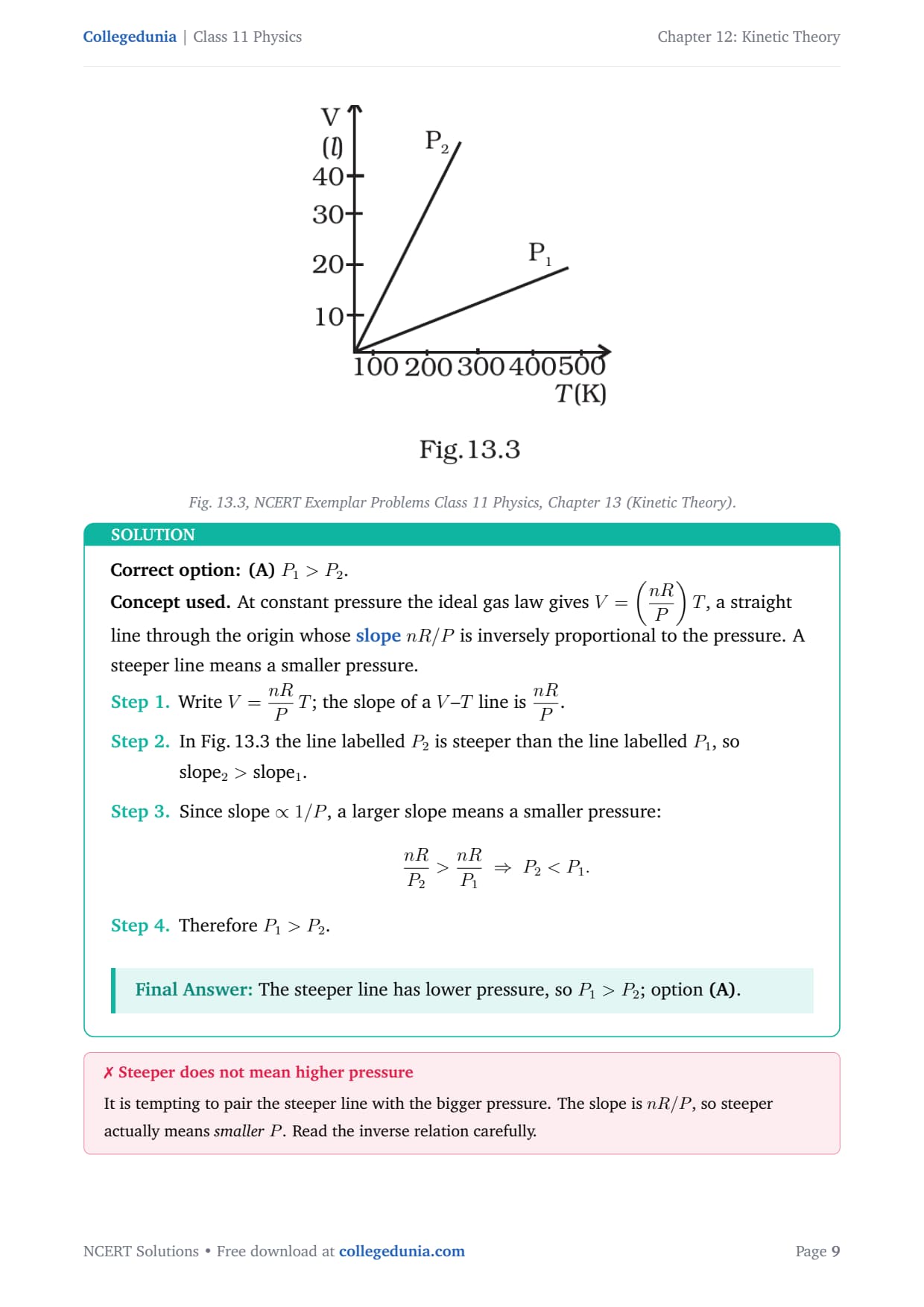
- Reading a V-T graph backwards: Question 5 shows two isobars in Fig. 13.3. The slope is nR/P, so the steeper line has the smaller pressure. The answer is P1 > P2.
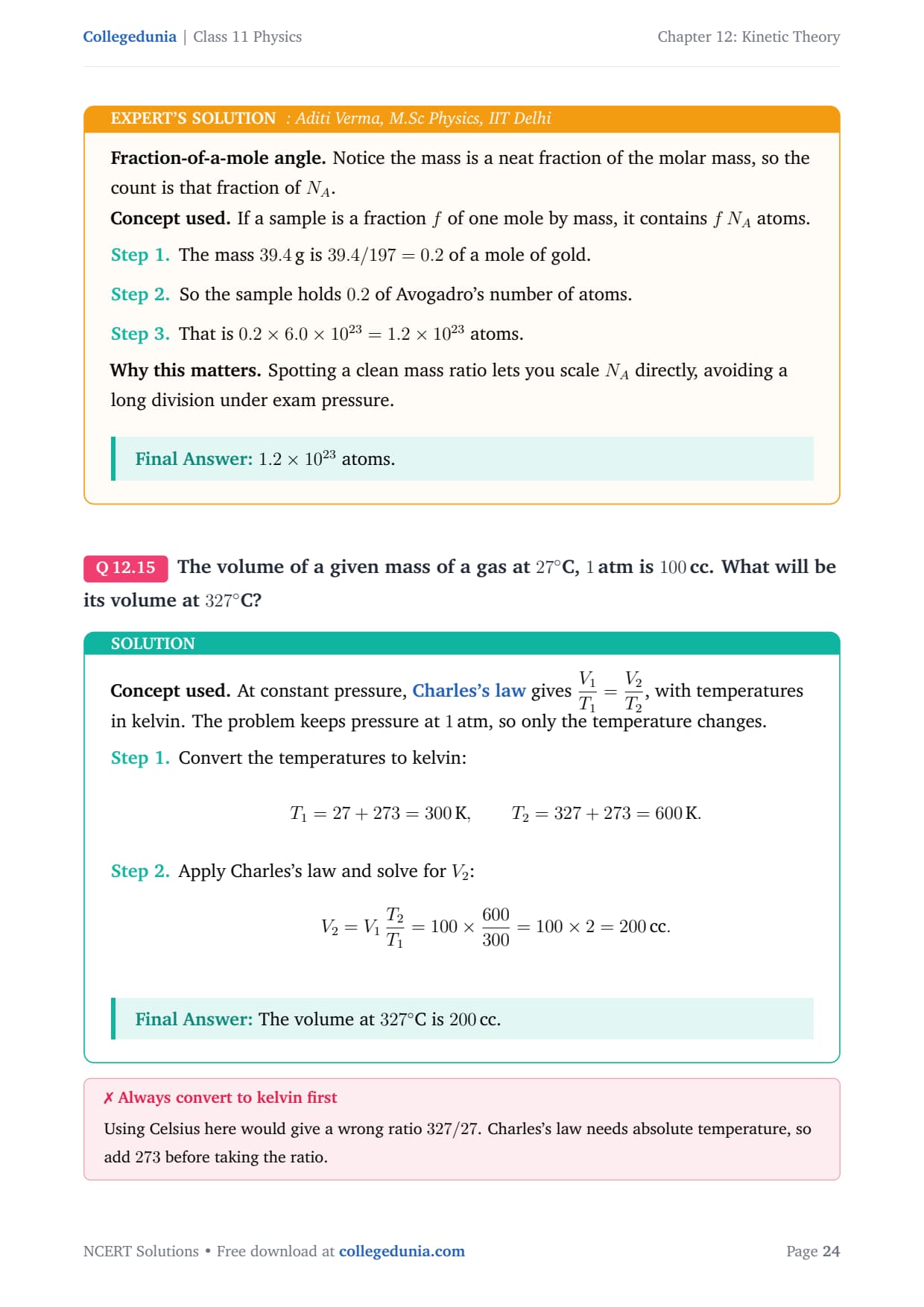
- Skipping the kelvin conversion: Question 15 heats 100 cc of gas from 27°C to 327°C. In kelvin that is 300 K to 600 K, so the volume doubles to 200 cc. A Celsius ratio gives nonsense.
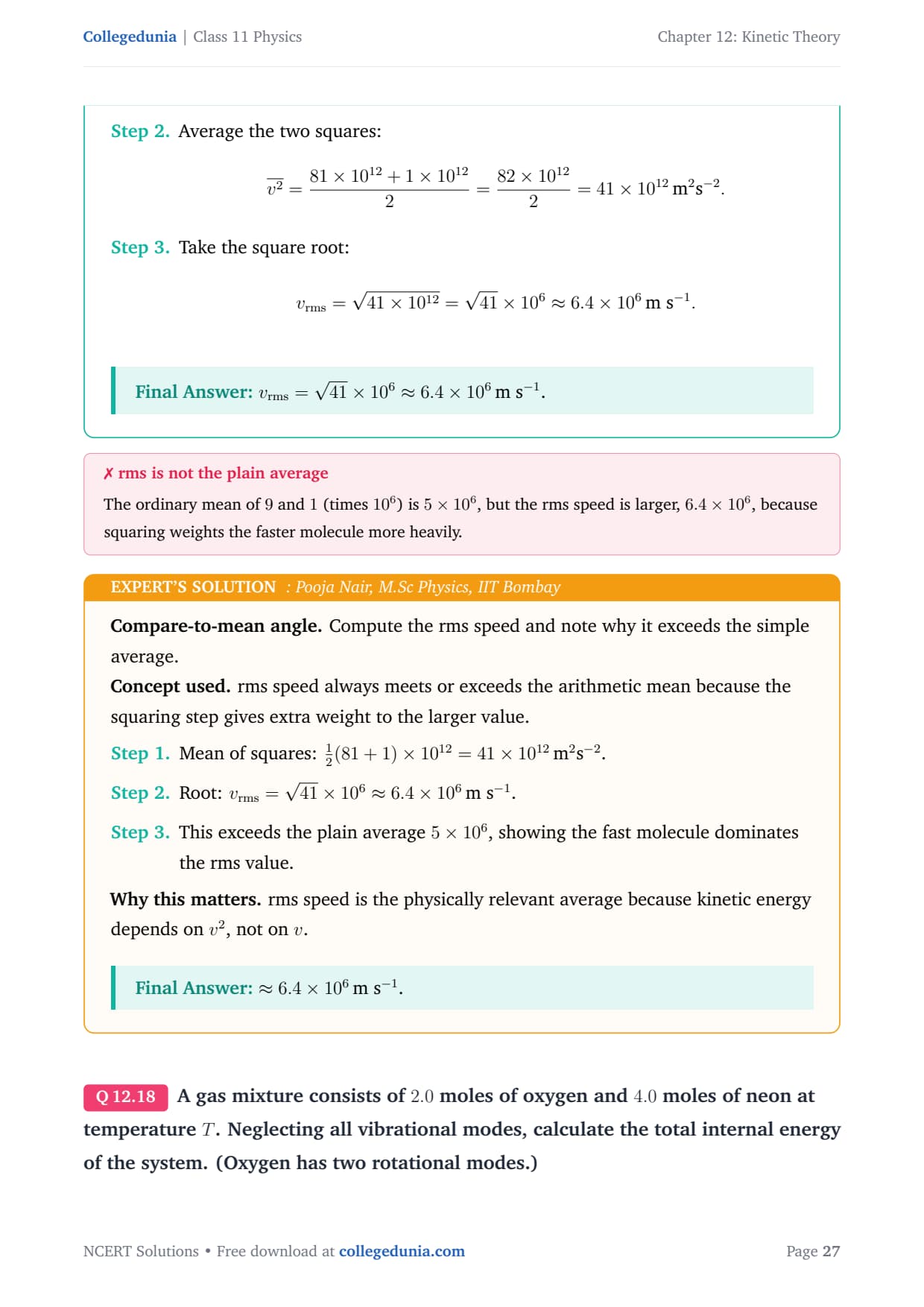
- Averaging speeds instead of squares: Question 17 gives two molecules at 9 × 10⁶ and 1 × 10⁶ m s-1. The plain mean is 5 × 10⁶, but vrms is √41 × 106, about 6.4 × 10⁶ m s-1.
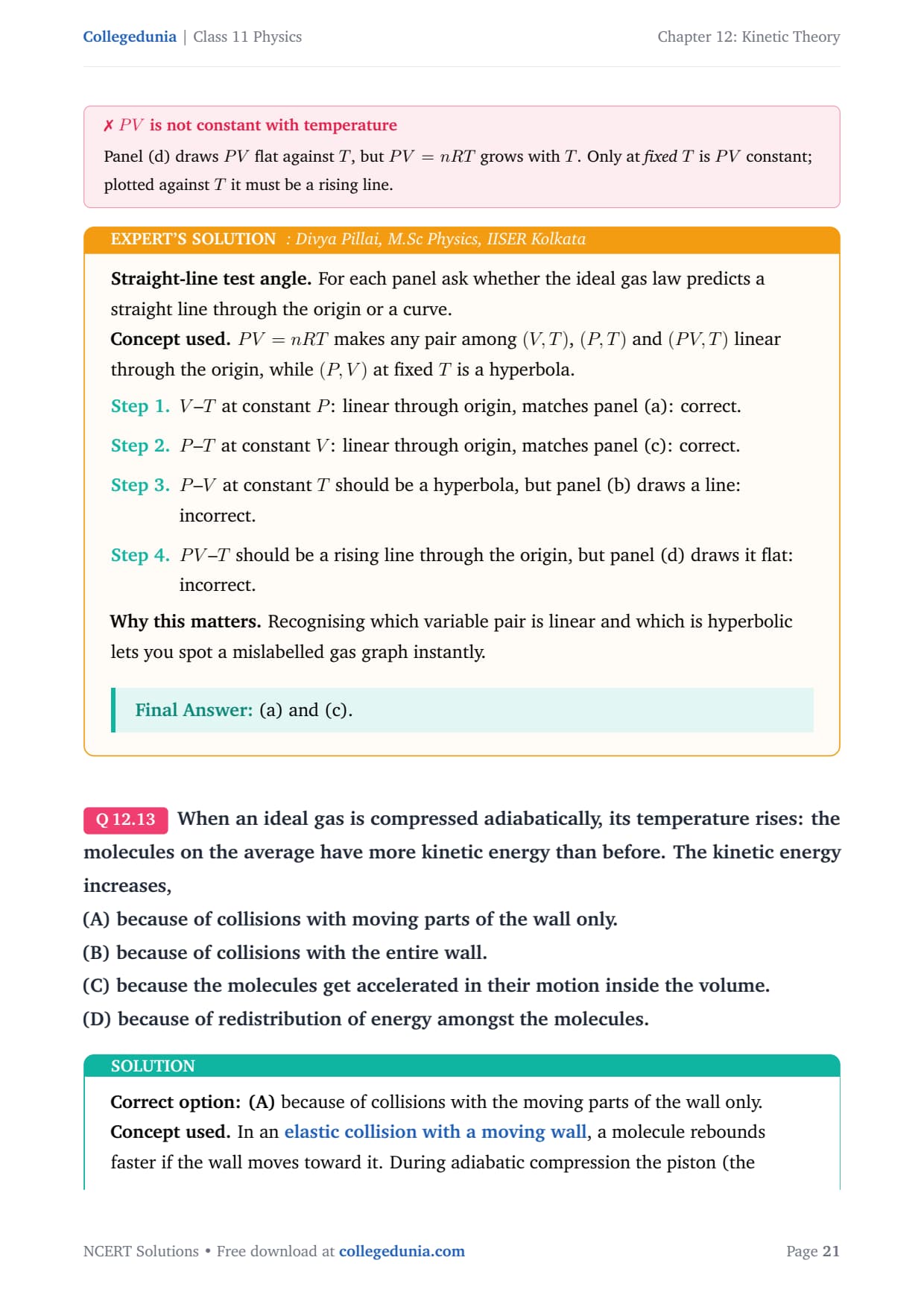
- Forgetting that PV rises with T: Question 12 draws PV flat against T in Fig. 13.5. Since PV = nRT, that panel cannot be ideal behaviour.
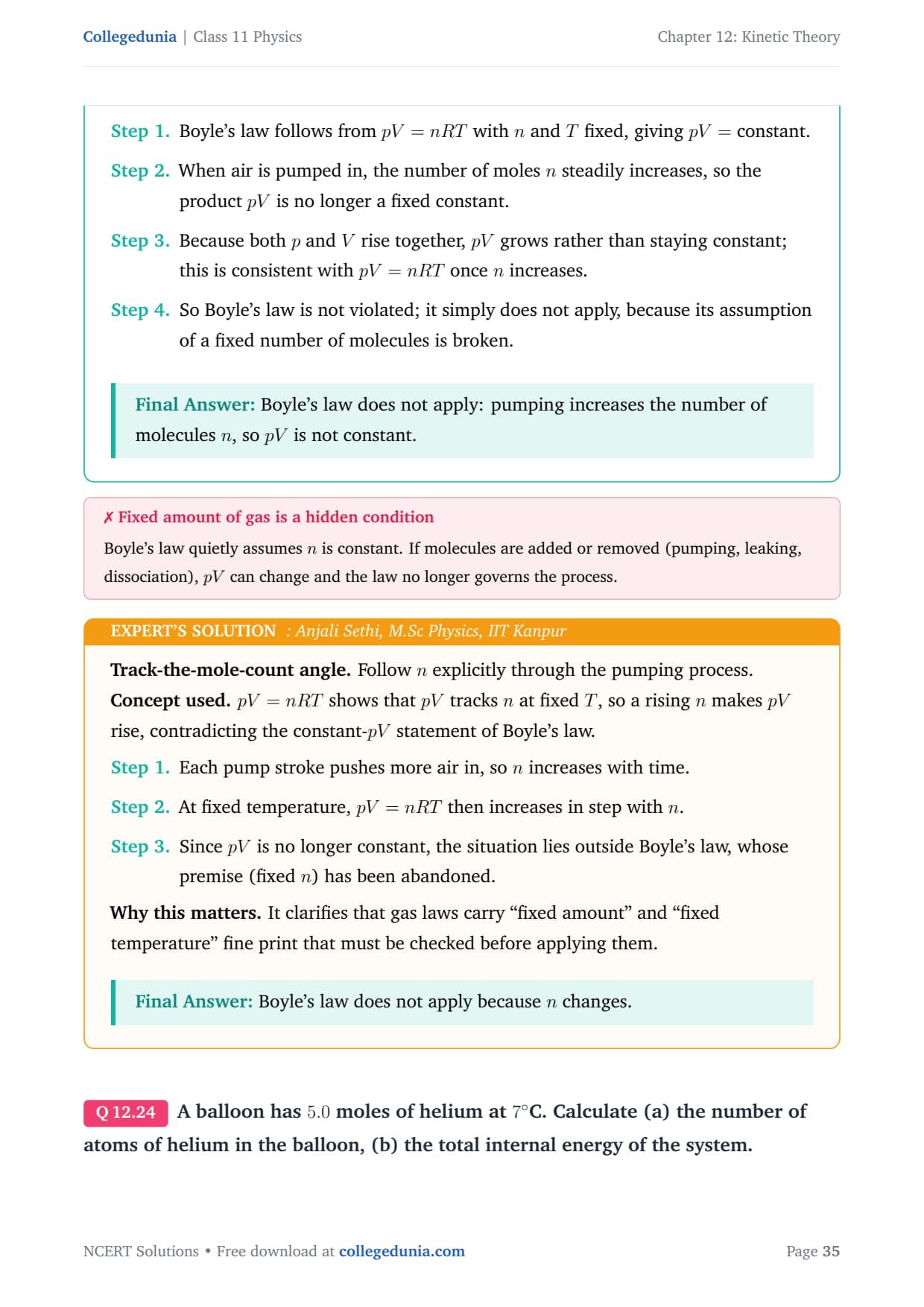
One more trap is worth naming. Question 23 asks about pumping air into a cycle tyre, where pressure and volume both rise. Boyle's law is not broken here. It simply does not apply, because pumping adds molecules and n is no longer fixed.
How These Exemplar Questions Go Beyond the Class 11 Physics Textbook
The textbook asks you to substitute into a formula. The Exemplar asks whether the formula holds at all.
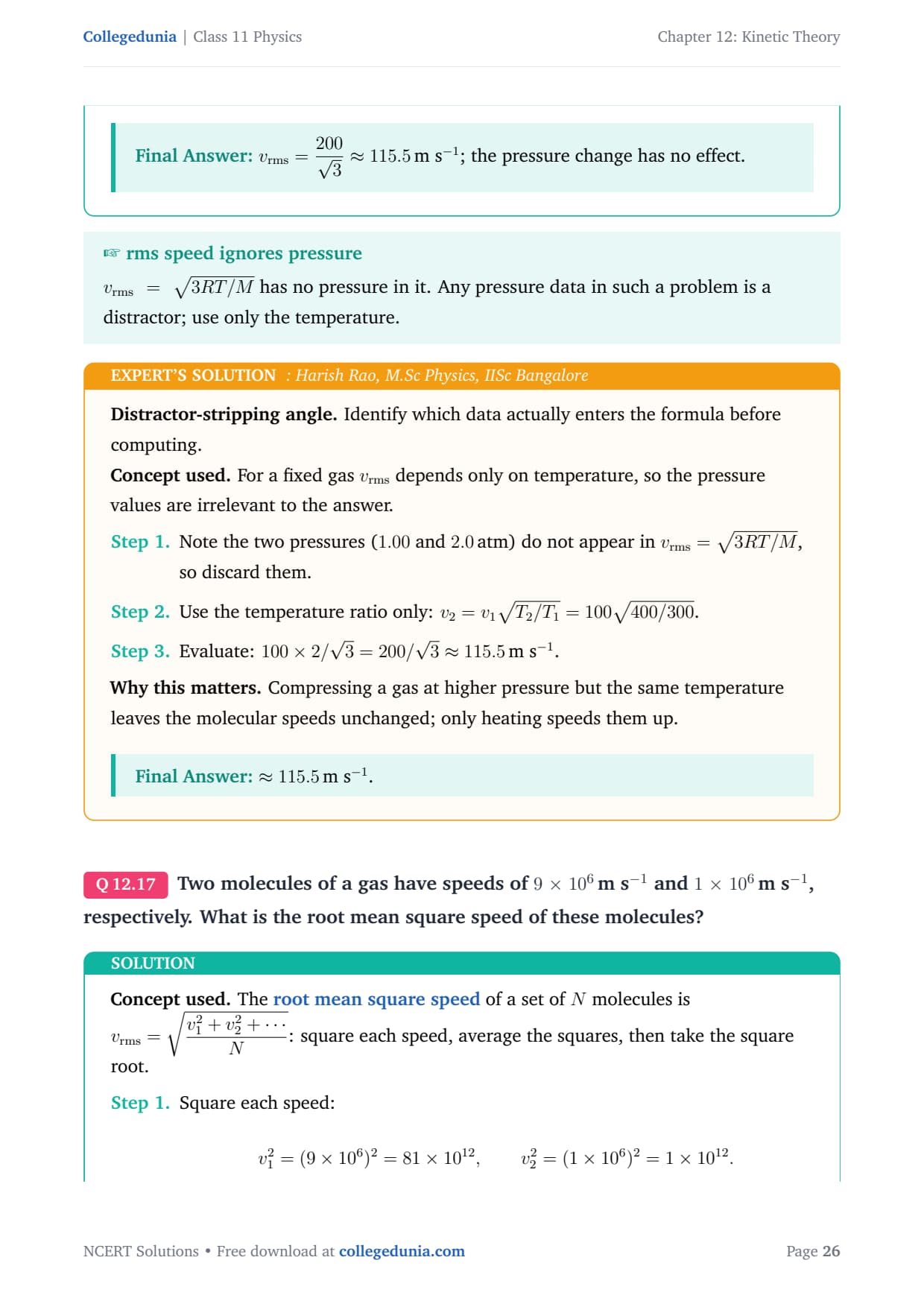
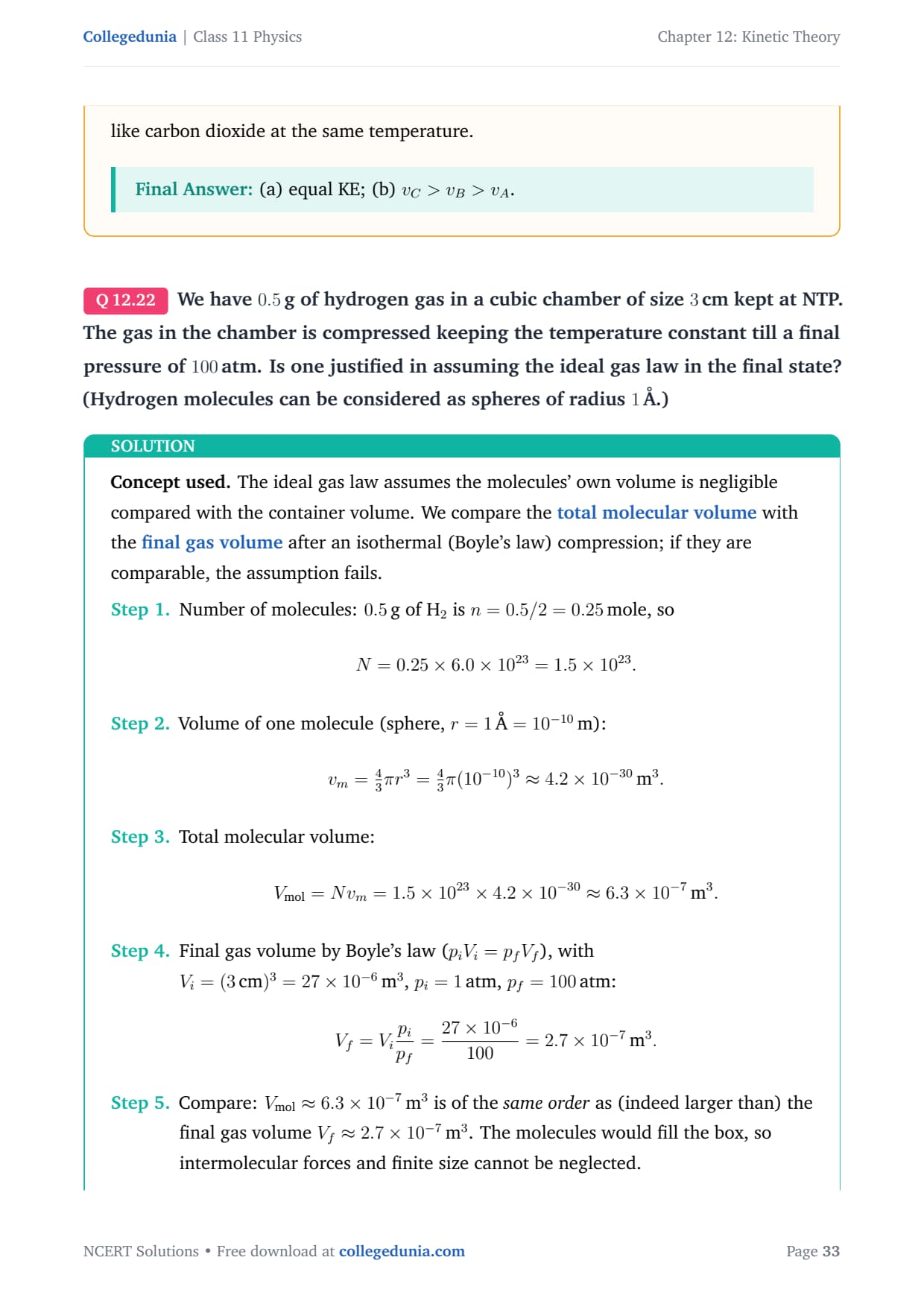
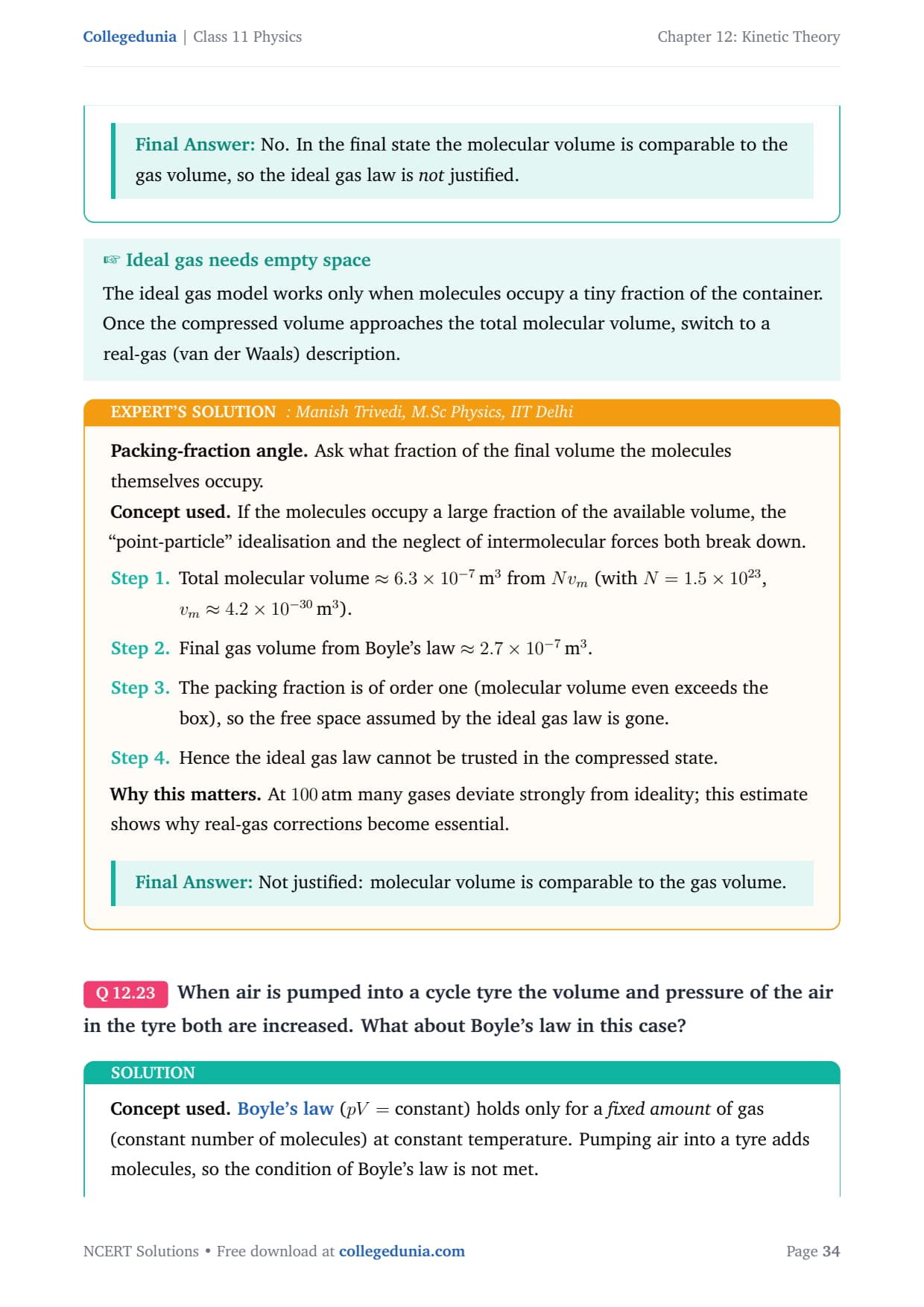
Question 16 is a clean example. It gives vrms = 100 m s-1 at 27°C and 1.00 atm, then asks for the speed at 127°C and 2.0 atm. Since vrms = √(3RT/M) has no pressure in it, both pressure values are distractors. The answer is 200/√3, near 115.5 m s-1. Question 22 goes further, showing that at 100 atm the ideal gas law itself stops being justified.
How to Use These NCERT Exemplar Solutions for Boards, JEE and NEET
Attempt each question before opening the solution. This chapter rewards the attempt far more than the reading.
- Boards: the VSA and SA sets match the 2 and 3 mark board pattern closely
- JEE Main: start with Questions 29 to 31 on mean free path, effusion and drag
- NEET: the eight MCQ I questions cover the recall-level gas-law items NEET repeats
Student Feedback
Students who used Collegedunia's Class 11 Physics Exemplar Solutions told us the Long Answer set took the longest. Around 7 in 10 said the step-by-step layout helped most on Question 31, the drag-force derivation, where the textbook offers no practice.
Other Resources for Class 11 Physics Kinetic Theory
Collegedunia has the full study material for this chapter. Read the Notes first, then practise with the Exemplar once the gas laws are clear.
Also Check:
- NCERT Solutions for Class 11 Physics Chapter 12
- Class 11 Physics Chapter 12 Notes
- Class 11 Physics Chapter 12 Handwritten Notes
- Class 11 Physics Chapter 12 NCERT Book PDF
- Class 11 Physics Chapter 12 Exemplar Questions with Solutions
NCERT Exemplar Solutions for Other Class 11 Physics Chapters
Every chapter below has the same step-by-step treatment and a free PDF.
Kinetic Theory Class 11 Physics NCERT Exemplar Solutions FAQs
Ques. How many questions are there in the Class 11 Physics Kinetic Theory Exemplar?
Ans. Chapter 12 has 31 questions. They split into 8 MCQ I, 5 MCQ II, 6 Very Short Answer, 7 Short Answer and 5 Long Answer questions. All 31 are solved in the free 48-page PDF on this page.
Ques. Why does the Exemplar book number Kinetic Theory as Chapter 13?
Ans. The Exemplar follows the older chapter order, where Kinetic Theory was Chapter Thirteen. That is why its six figures are printed as Fig. 13.1 to Fig. 13.6. The current textbook lists it as Chapter 12. The content and the answer key are the same.
Ques. Does the rms speed of a gas depend on its pressure?
Ans. No. The formula vrms = √(3RT/M) contains only the temperature and the molar mass. Question 16 gives two pressure values on purpose, and both are distractors. Only the change from 300 K to 400 K matters, giving 200/√3 or about 115.5 m s-1.
Ques. What is the total internal energy of 2 moles of oxygen and 4 moles of neon at temperature T?
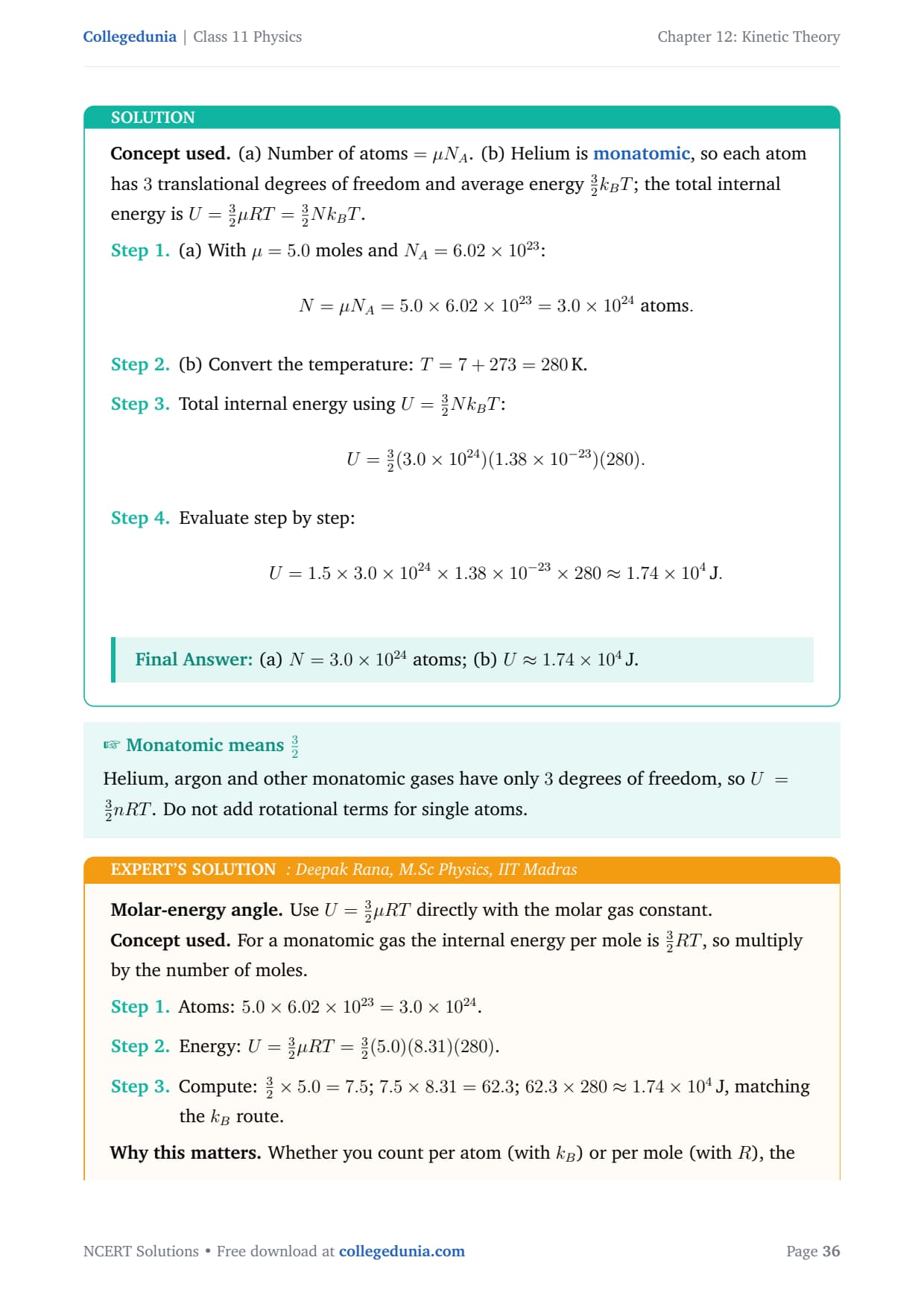
Ans. It is 11RT. This is Question 18. Oxygen is diatomic with f = 5, so it holds (5/2)(2)RT = 5RT. Neon is monatomic with f = 3, so it holds (3/2)(4)RT = 6RT. Adding the two gives 11RT.
Ques. Is Boyle's law violated when air is pumped into a cycle tyre?
Ans. No, and Question 23 turns on this point. Boyle's law assumes a fixed number of molecules at constant temperature. Pumping raises n, so pV = nRT grows instead of staying constant. The law is not broken; its condition is simply not met.



Comments