




NCERT Exemplar Solutions for Class 11 Physics Chapter 9 Mechanical Properties of Fluids solve all 23 questions from the Exemplar book. Every MCQ, Very Short Answer, Short Answer and Long Answer problem is worked step by step. The free PDF on this page runs to 45 pages and follows the 2026-27 syllabus.
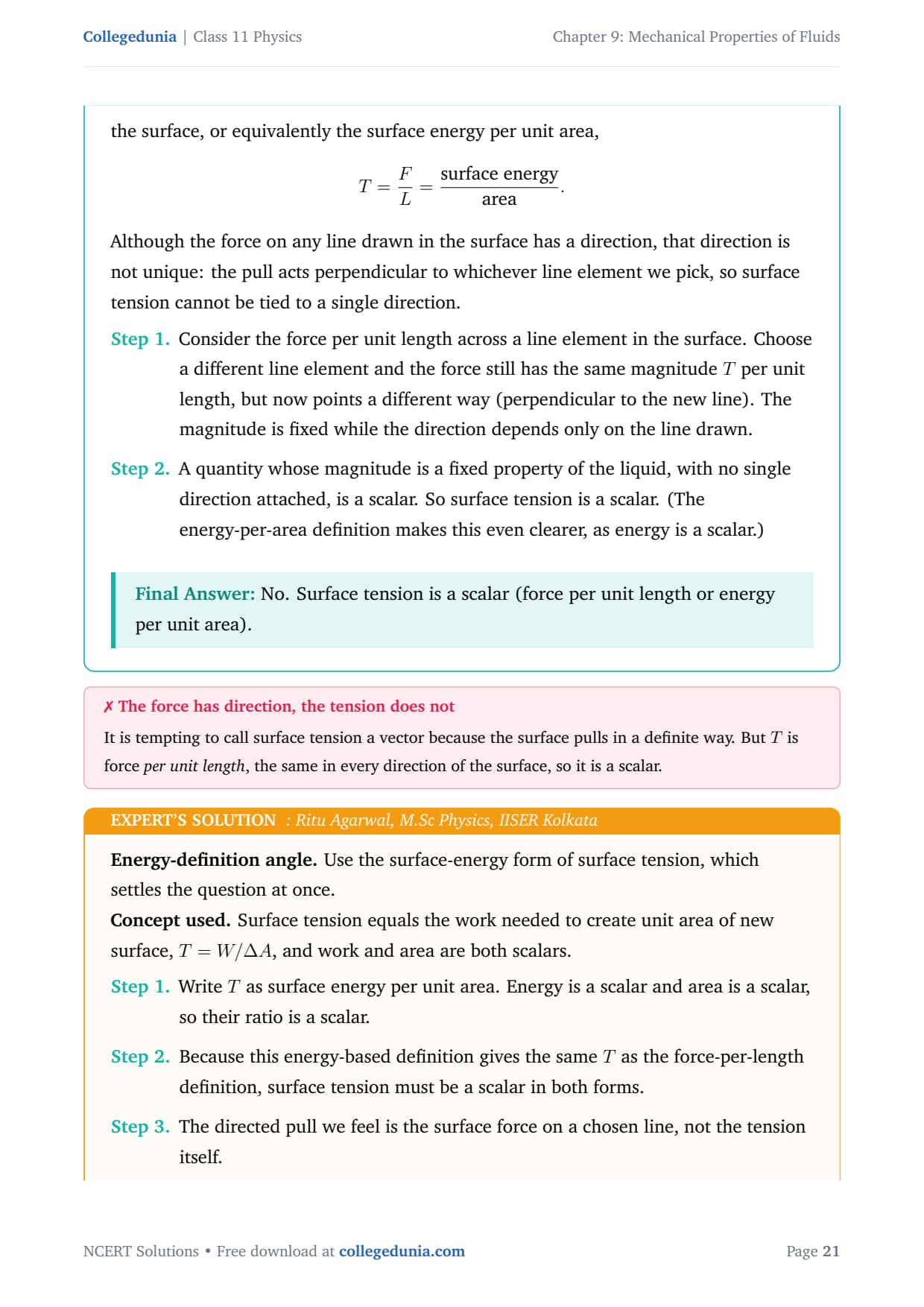
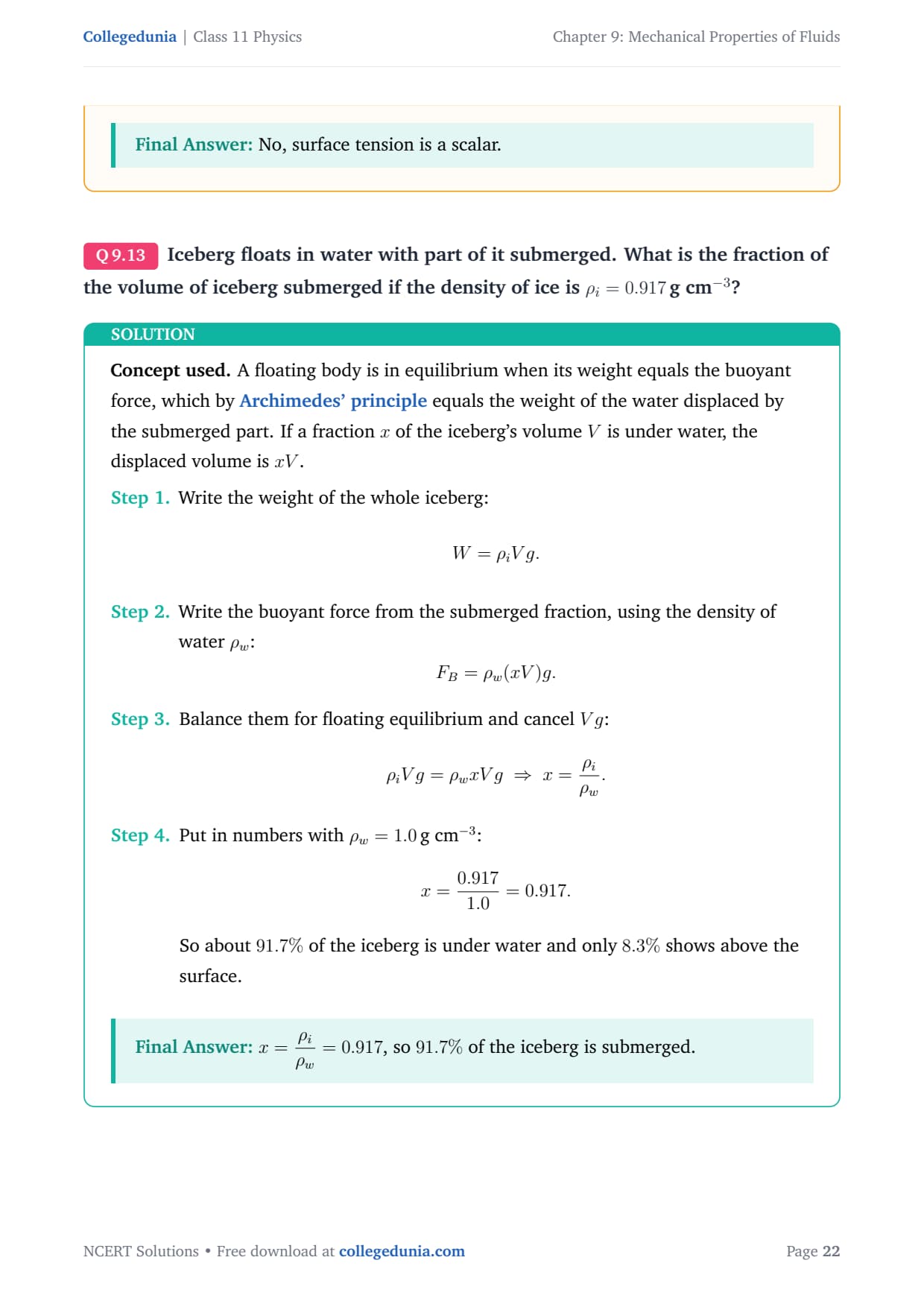
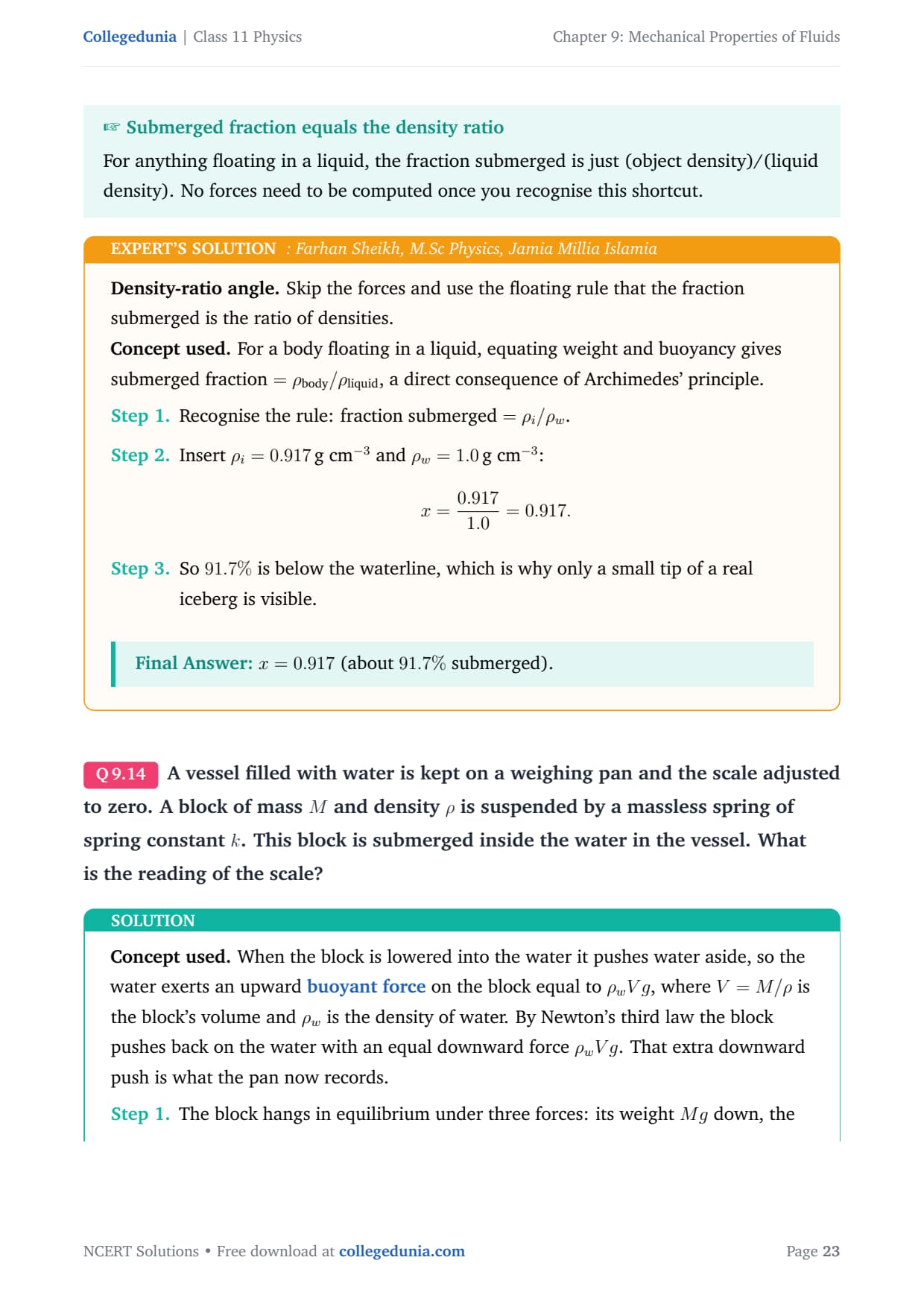
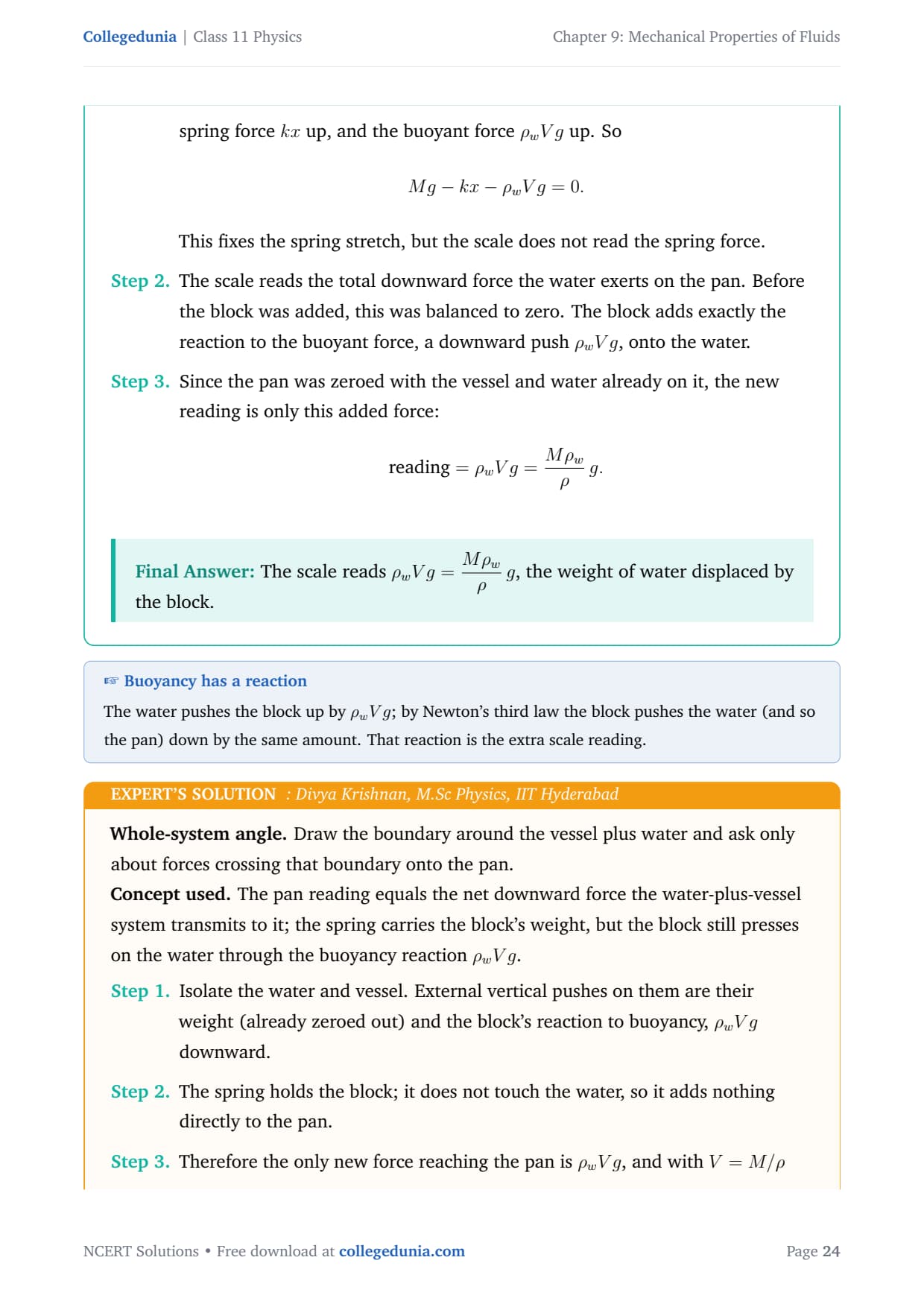
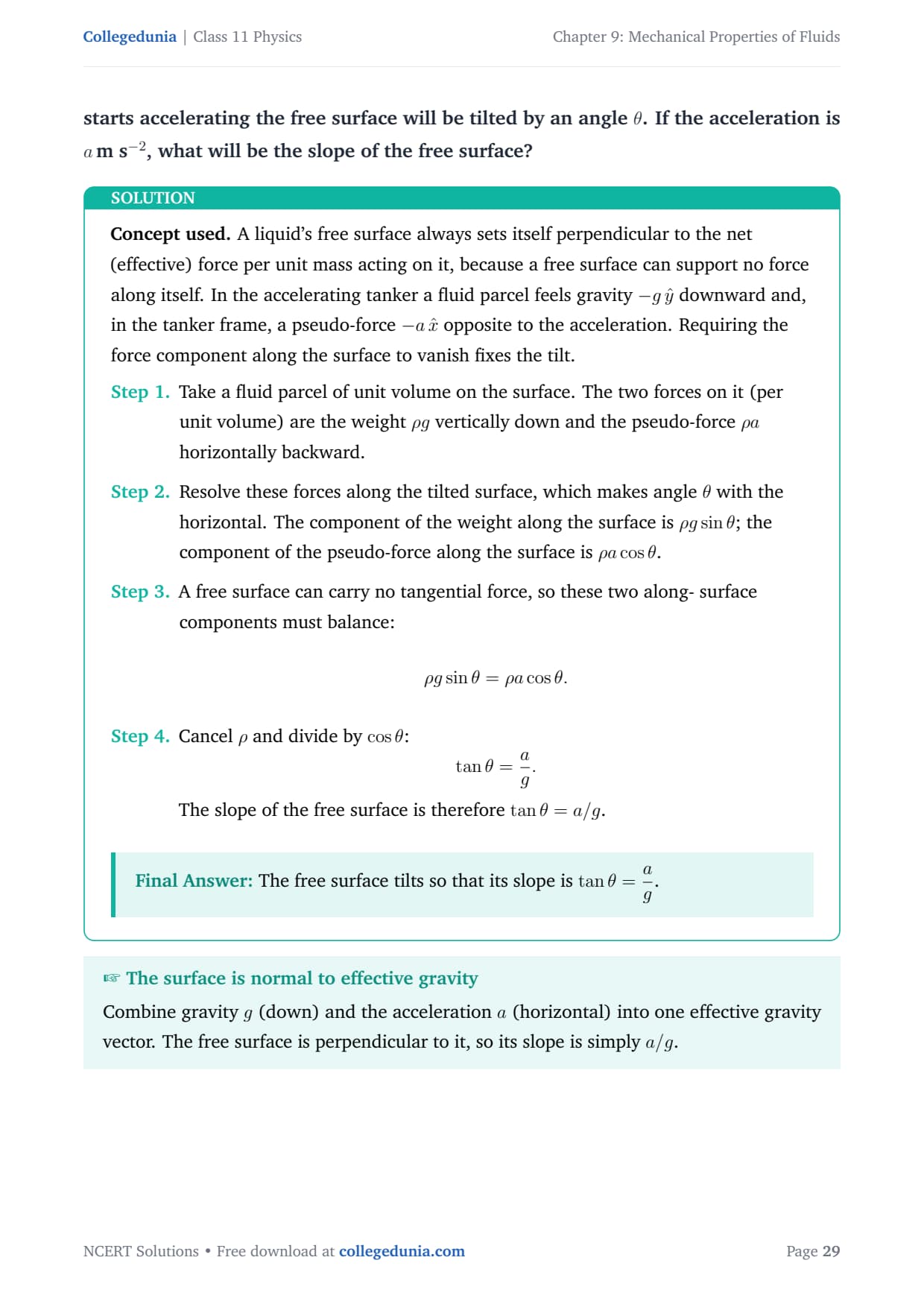
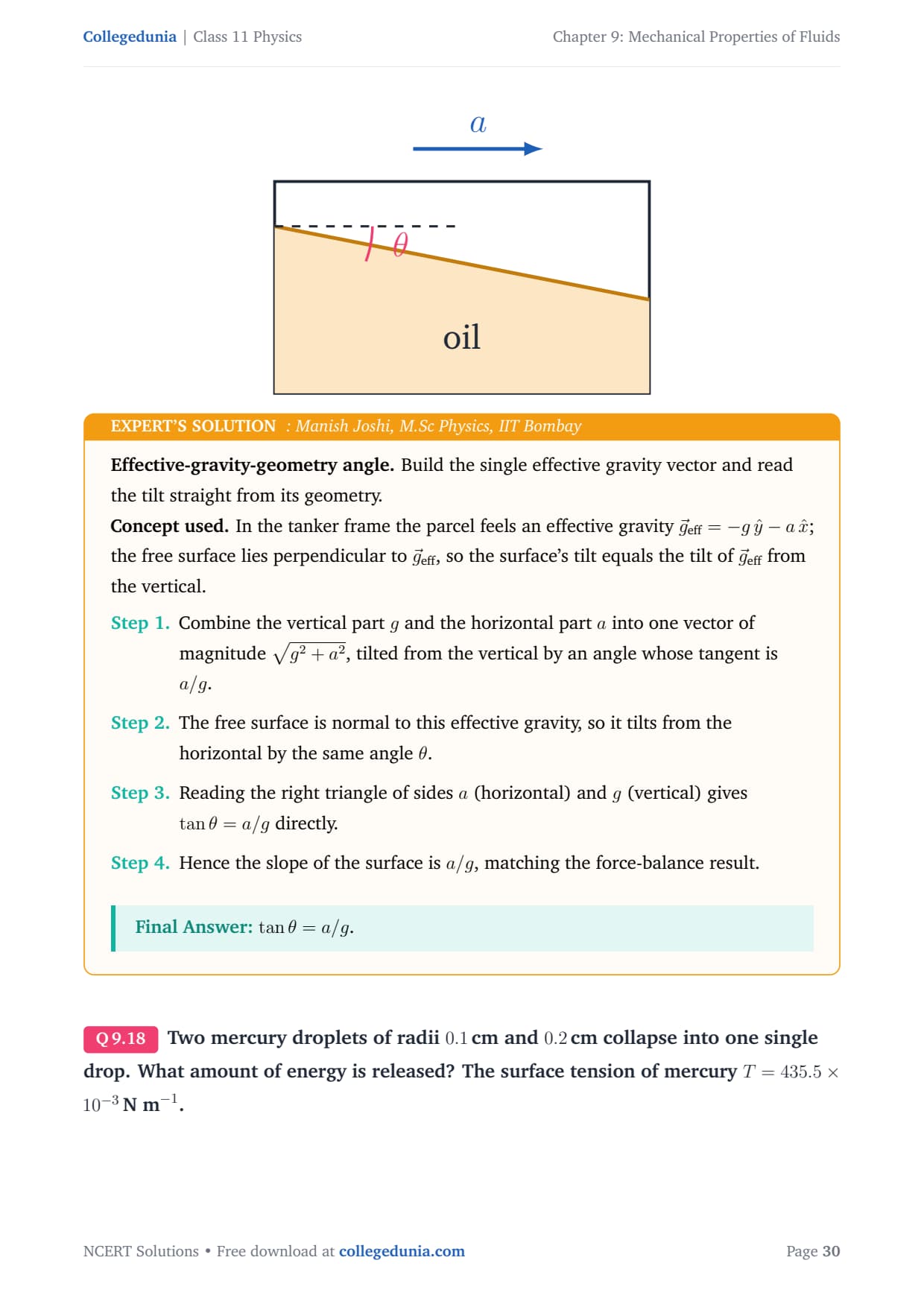
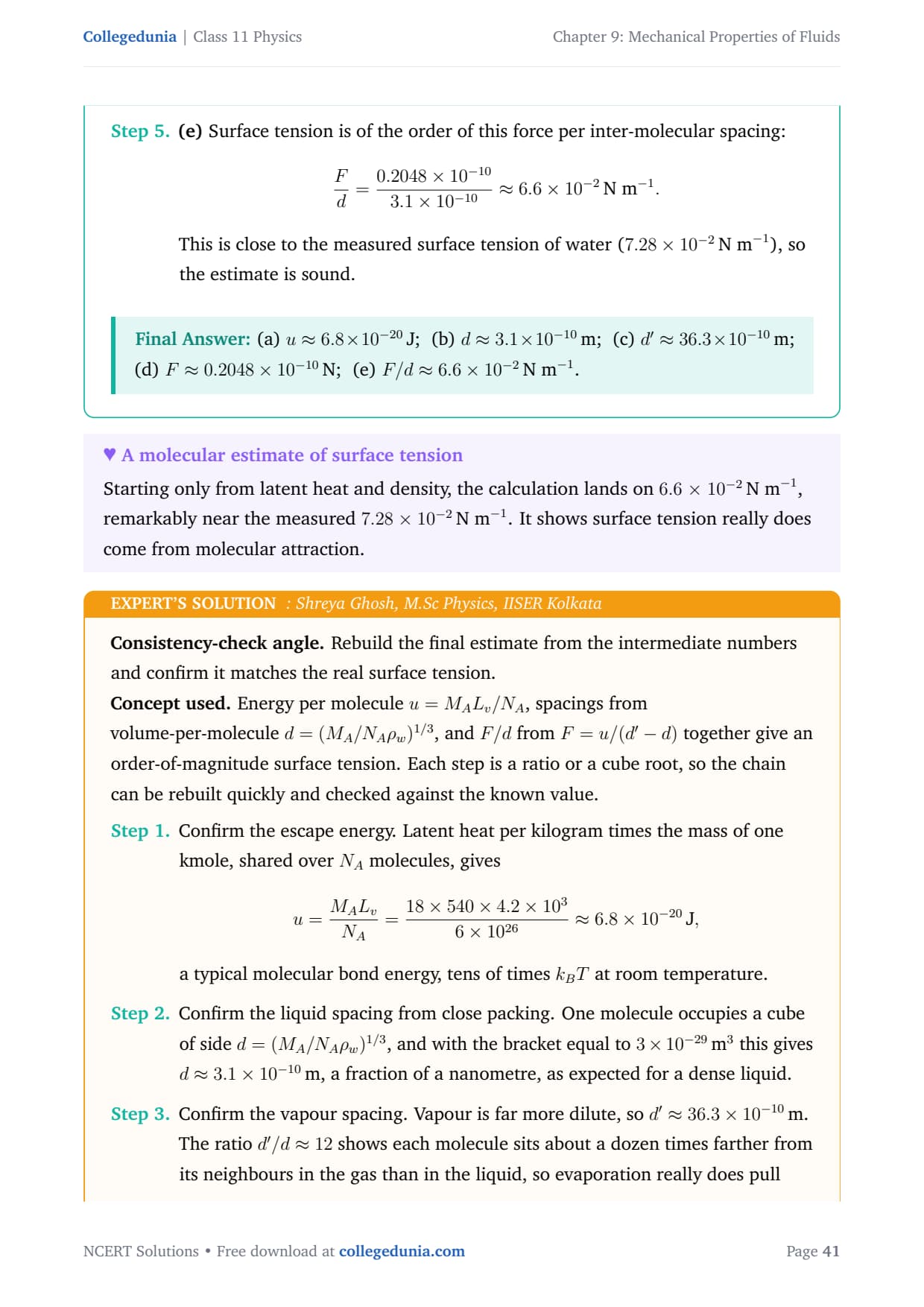
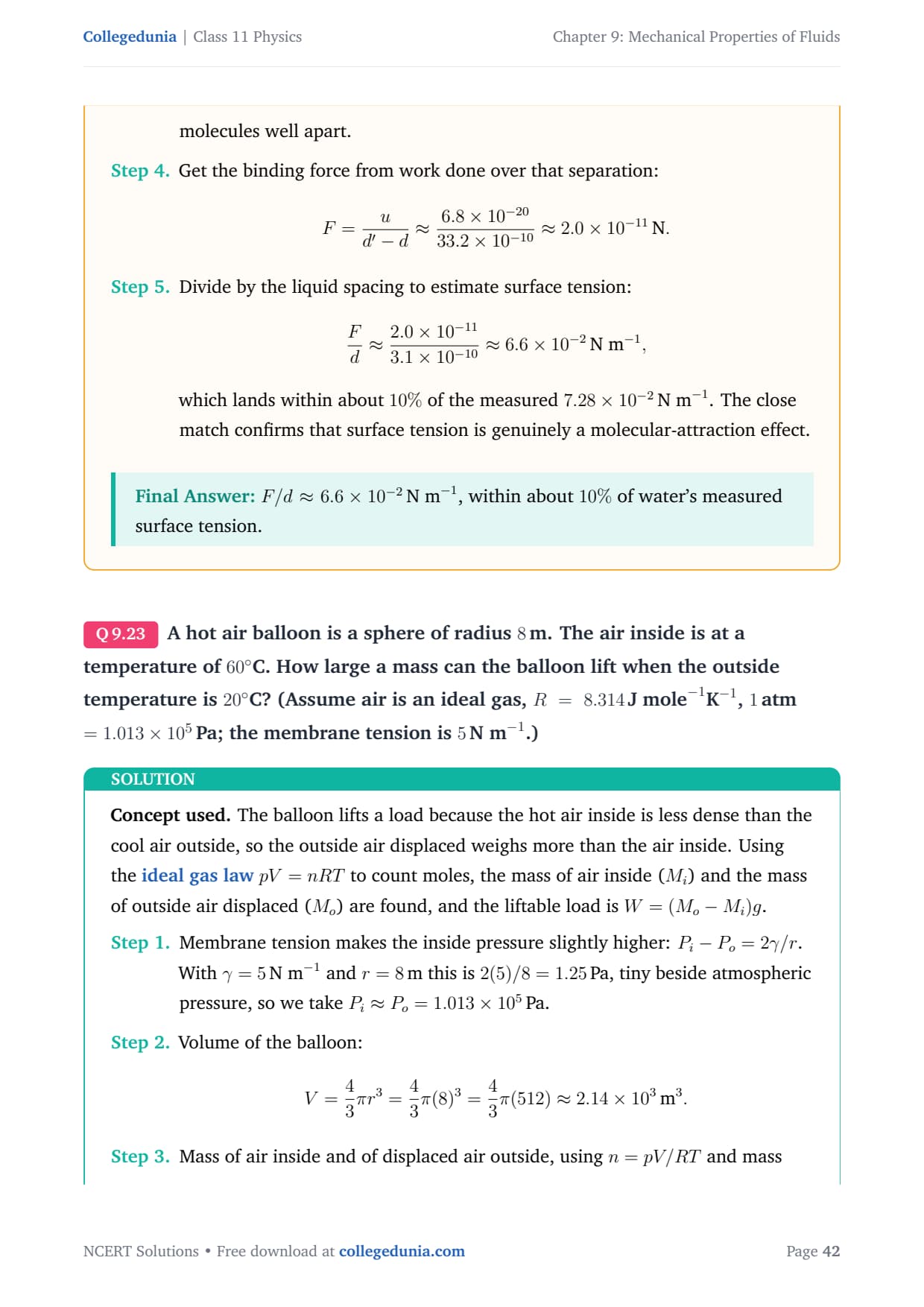
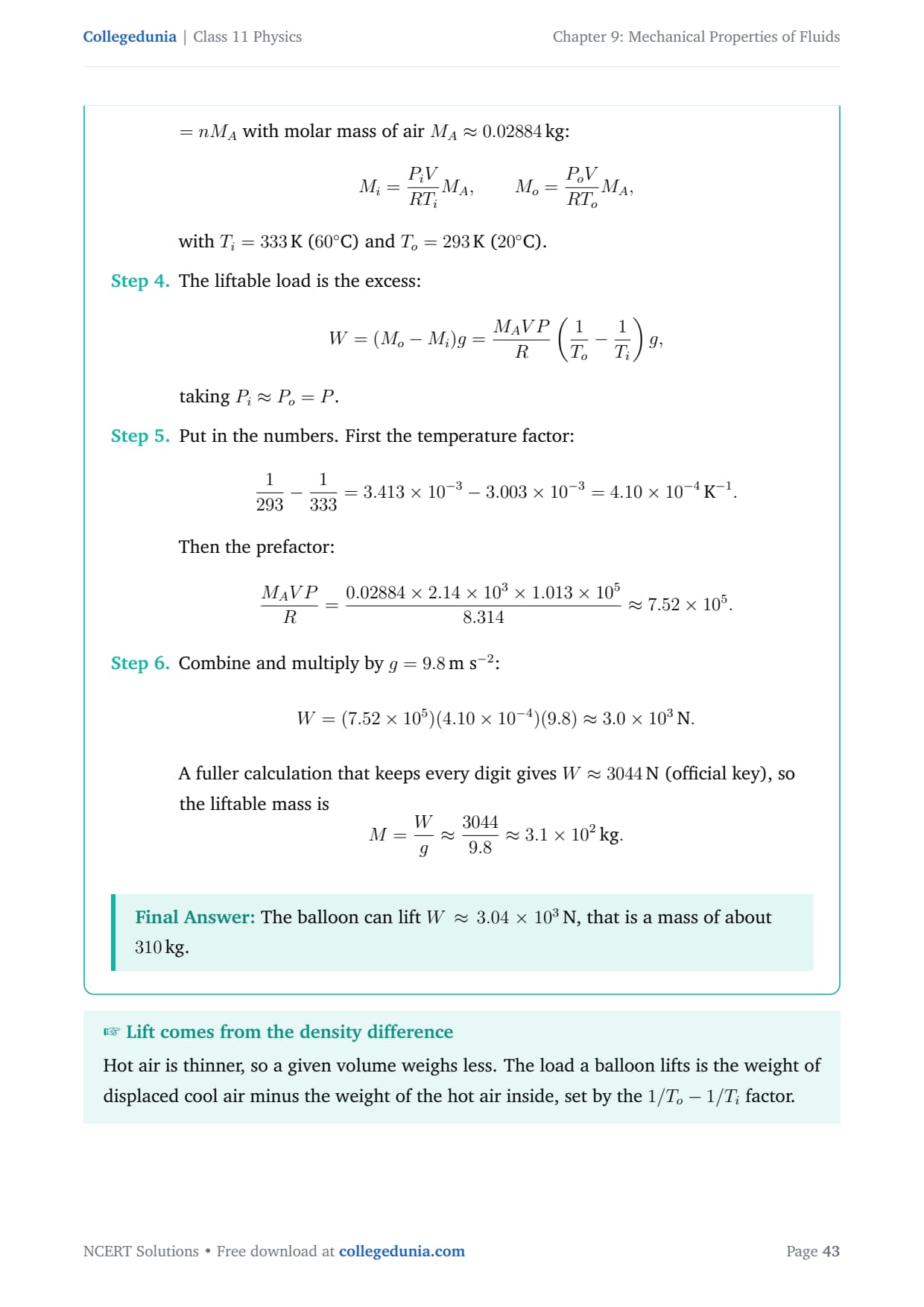
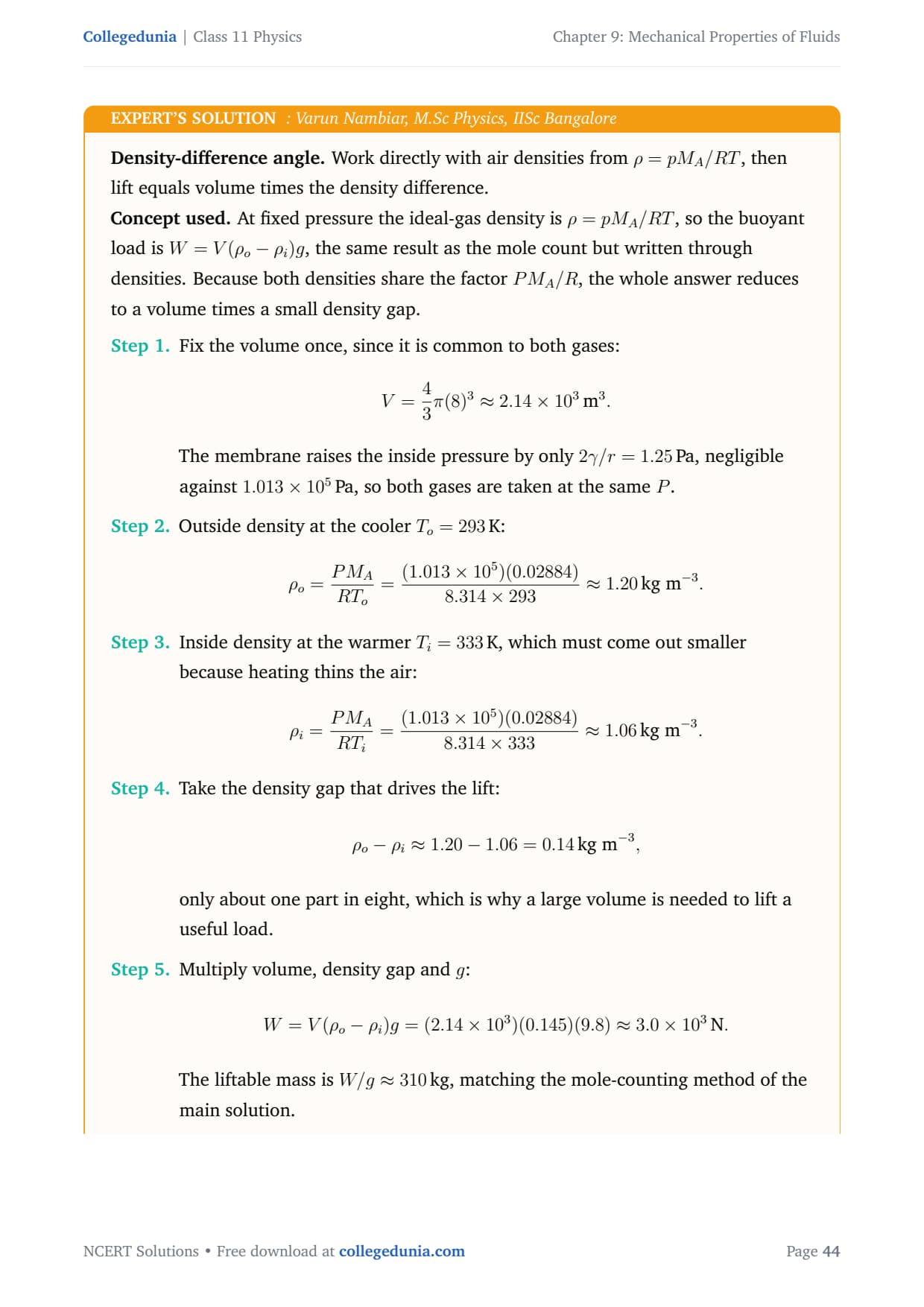
This is the shortest chapter in the Class 11 Physics Exemplar, with only 23 questions. That count is misleading. The questions are dense, and the three Long Answer problems are among the longest in the whole book.
- CBSE Weightage: 4 to 5 marks, usually one question on Bernoulli's principle or surface tension
- JEE Main Weightage: 1 to 2 questions per year, most often on continuity, viscosity or excess pressure
- NEET Weightage: 1 to 2 questions per year from buoyancy, capillarity and Stokes' law
Solutions checked against the official NCERT Exemplar answer key, with every disputed answer worked out in full.
Topics Covered in the Class 11 Physics Mechanical Properties of Fluids Exemplar
The chapter runs on five ideas, and the 23 questions rotate through them. Nothing here is optional, because each idea carries at least four questions of its own.
- Pressure and Pascal's law: pressure at a point is a scalar, and it grows with depth
- Buoyancy: Archimedes' principle, floating fractions and what happens to the water level
- Continuity and Bernoulli: how speed and pressure trade off along a streamline
- Viscosity: Stokes' law, terminal velocity and the Reynolds number
- Surface tension: angle of contact, capillary rise, surface energy and excess pressure
Question Types in the Mechanical Properties of Fluids NCERT Exemplar
The split is unusually even, five questions in each type except the Long Answer set. That evenness means no topic can be skipped safely.
| Question Type | Count | What It Tests |
|---|---|---|
| MCQ I (single correct) | 5 | Direct reasoning on continuity, meniscus shape and streamline flow |
| MCQ II (one or more correct) | 5 | Whether you can rule out every wrong option, not just spot one right one |
| VSA (Very Short Answer) | 5 | One-line reasoning, often a yes-or-no with a justification |
| SA (Short Answer) | 5 | Numerical work on capillary rise, surface energy and excess pressure |
| LA (Long Answer) | 3 | Multi-part derivations worth 5 marks each |
Where the Official Answer Key Differs From the Correct Working
Two questions in this chapter have an official answer that does not match careful arithmetic. Our PDF prints both numbers so students know what the marking scheme expects.
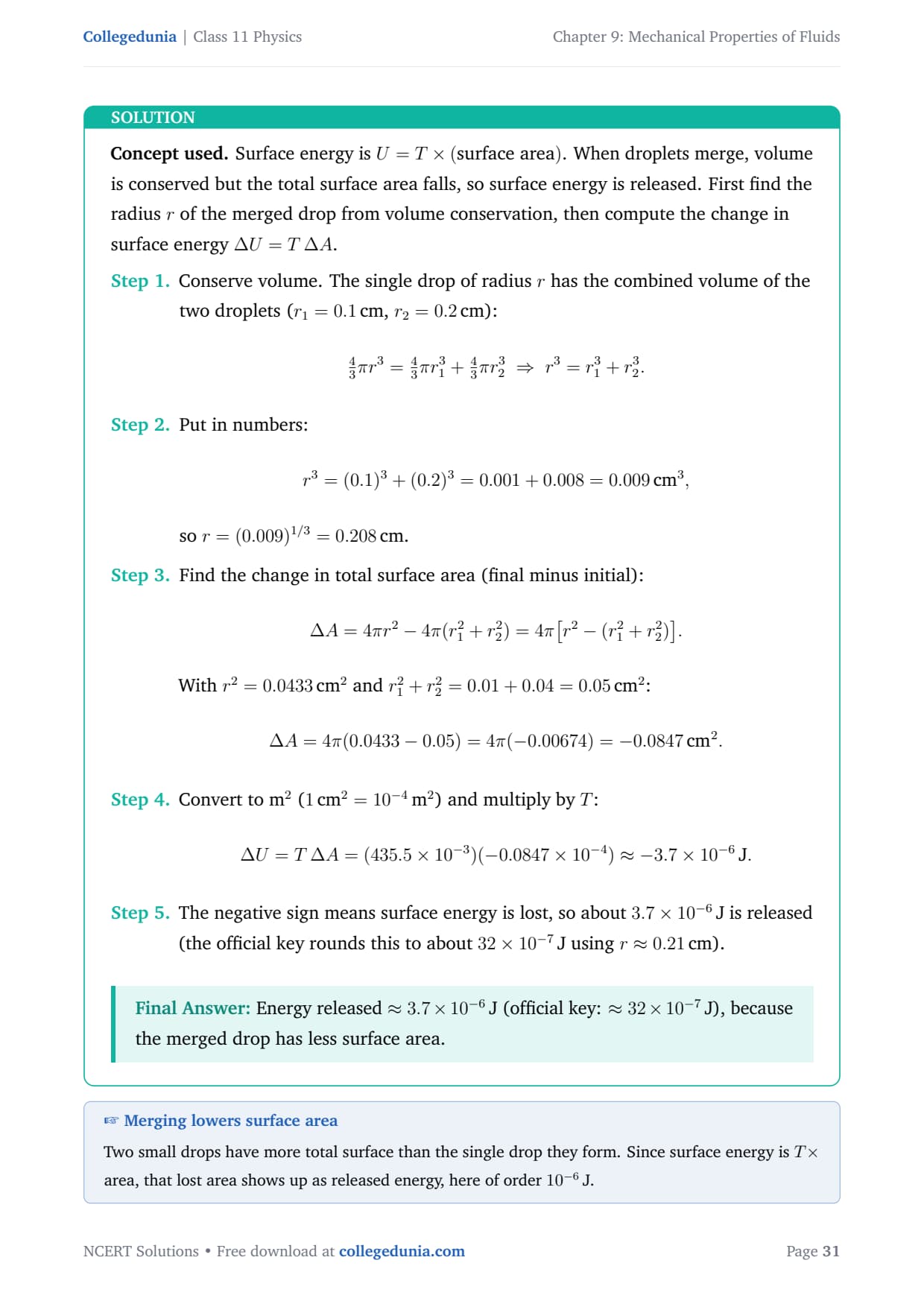
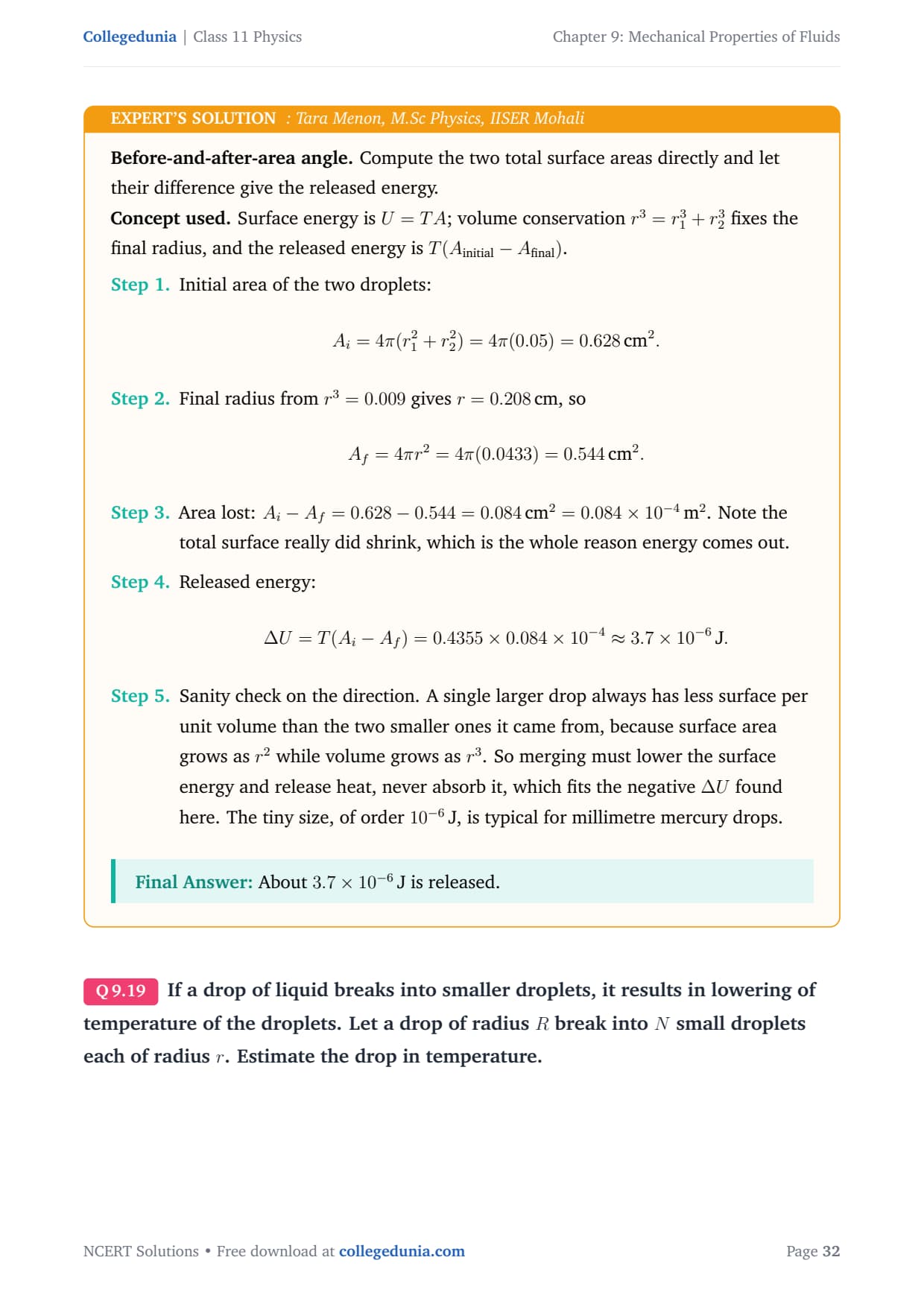
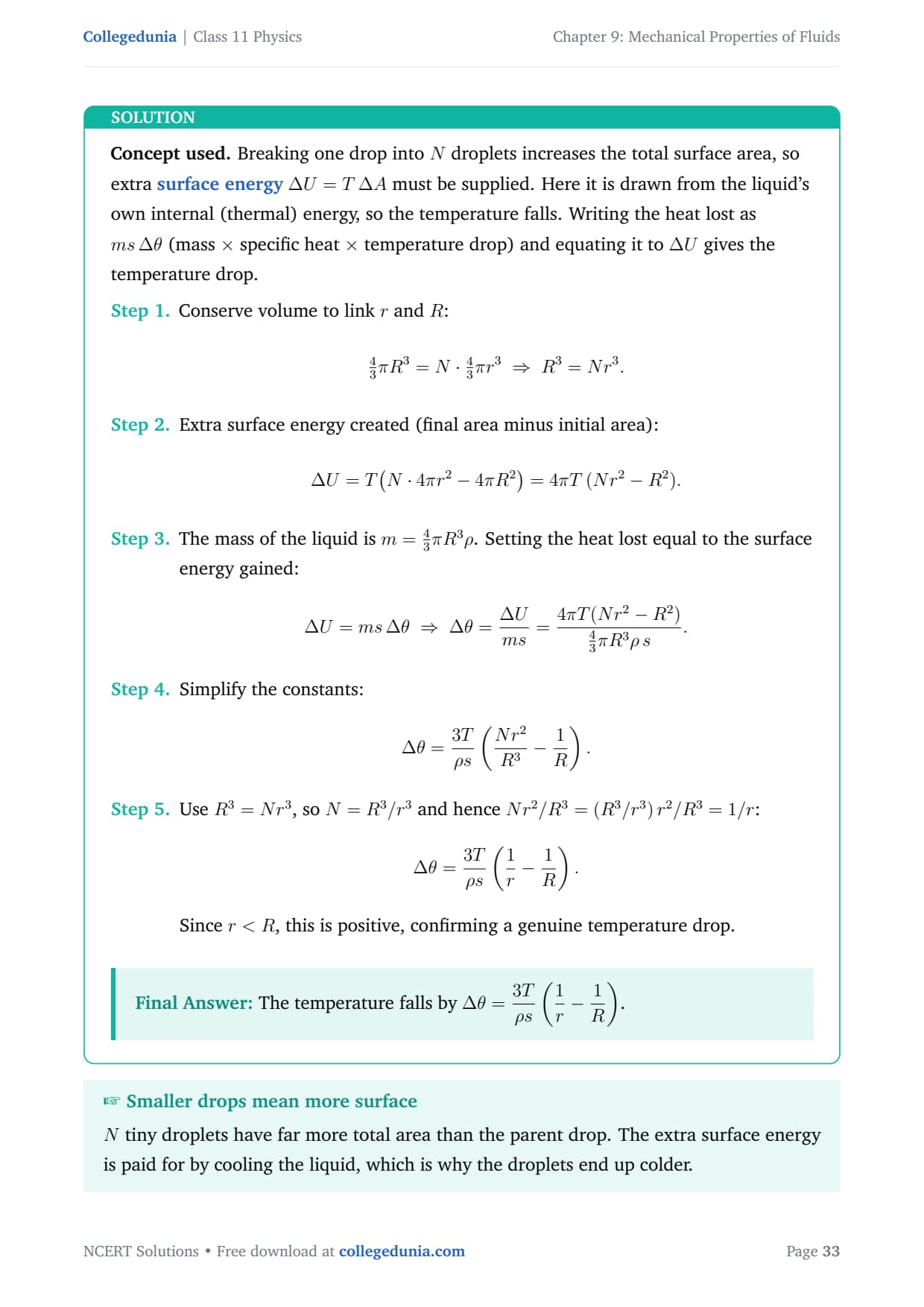
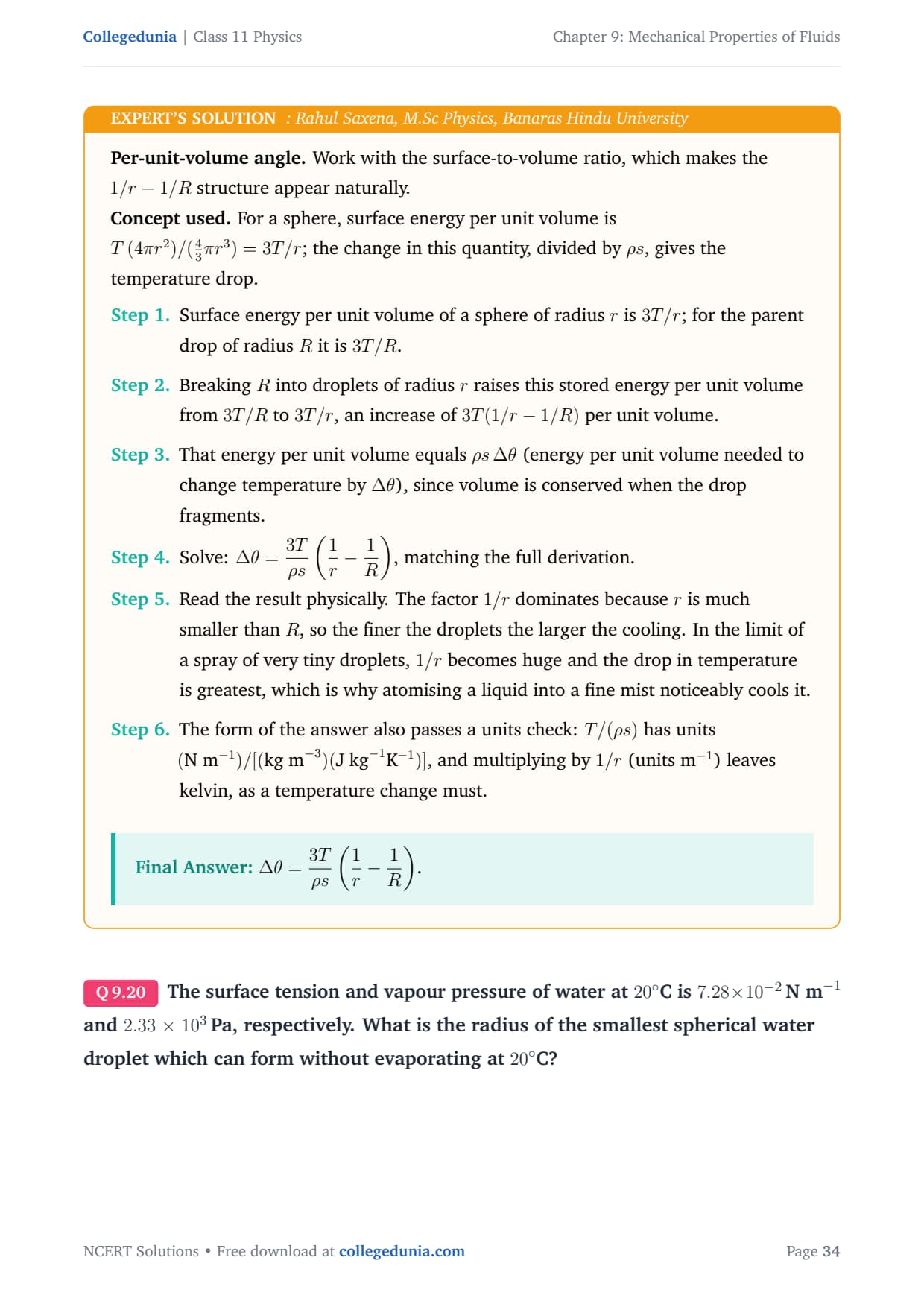
Question 18 merges two mercury droplets of radii 0.1 cm and 0.2 cm and asks for the energy released, with T = 435.5 × 10⁻³ N m-1. Working the surface-area change exactly gives about 3.7 × 10⁻⁶ J. The official key prints about 32 × 10-7 J, because it rounds the merged radius to 0.21 cm before computing the area.
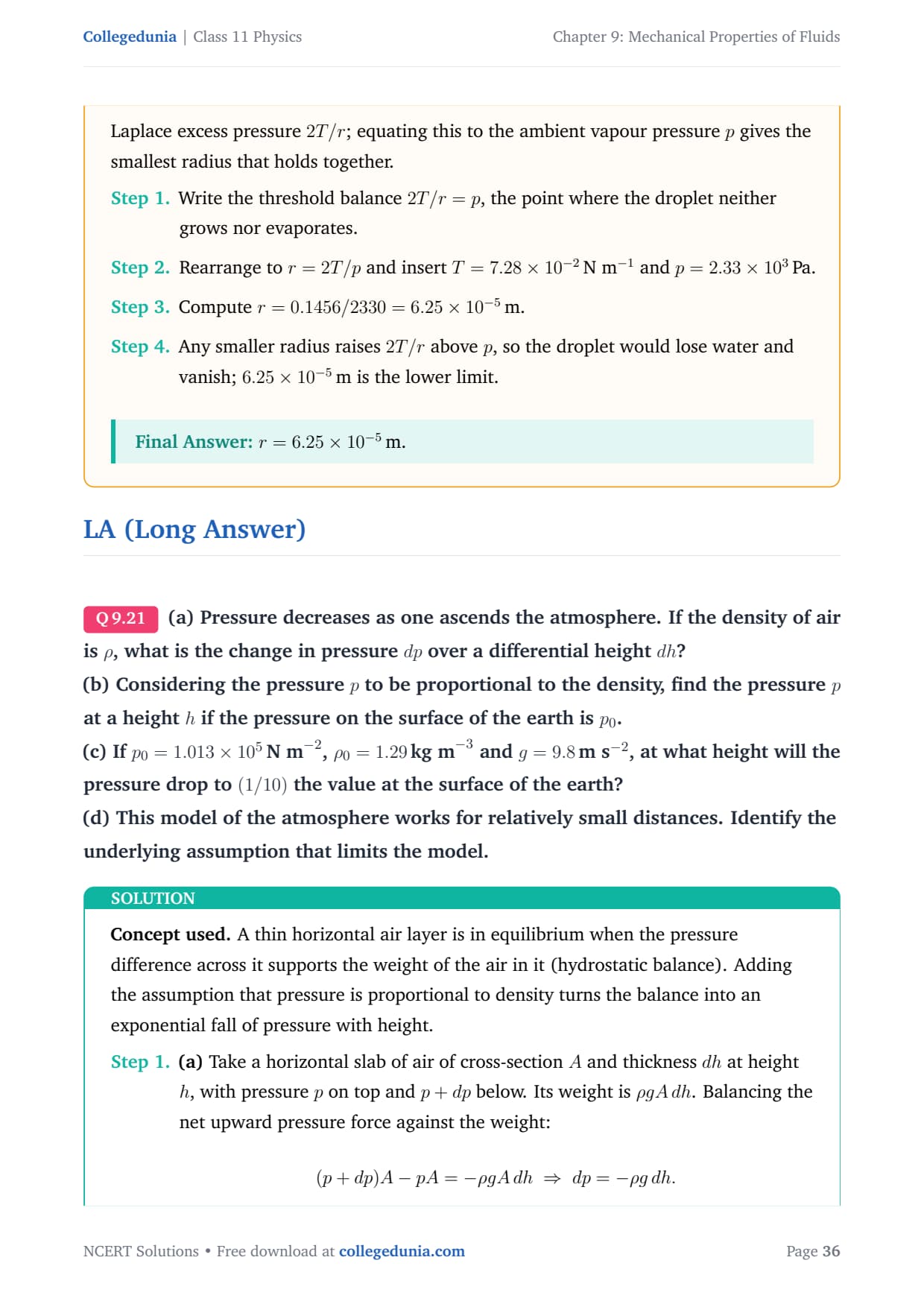
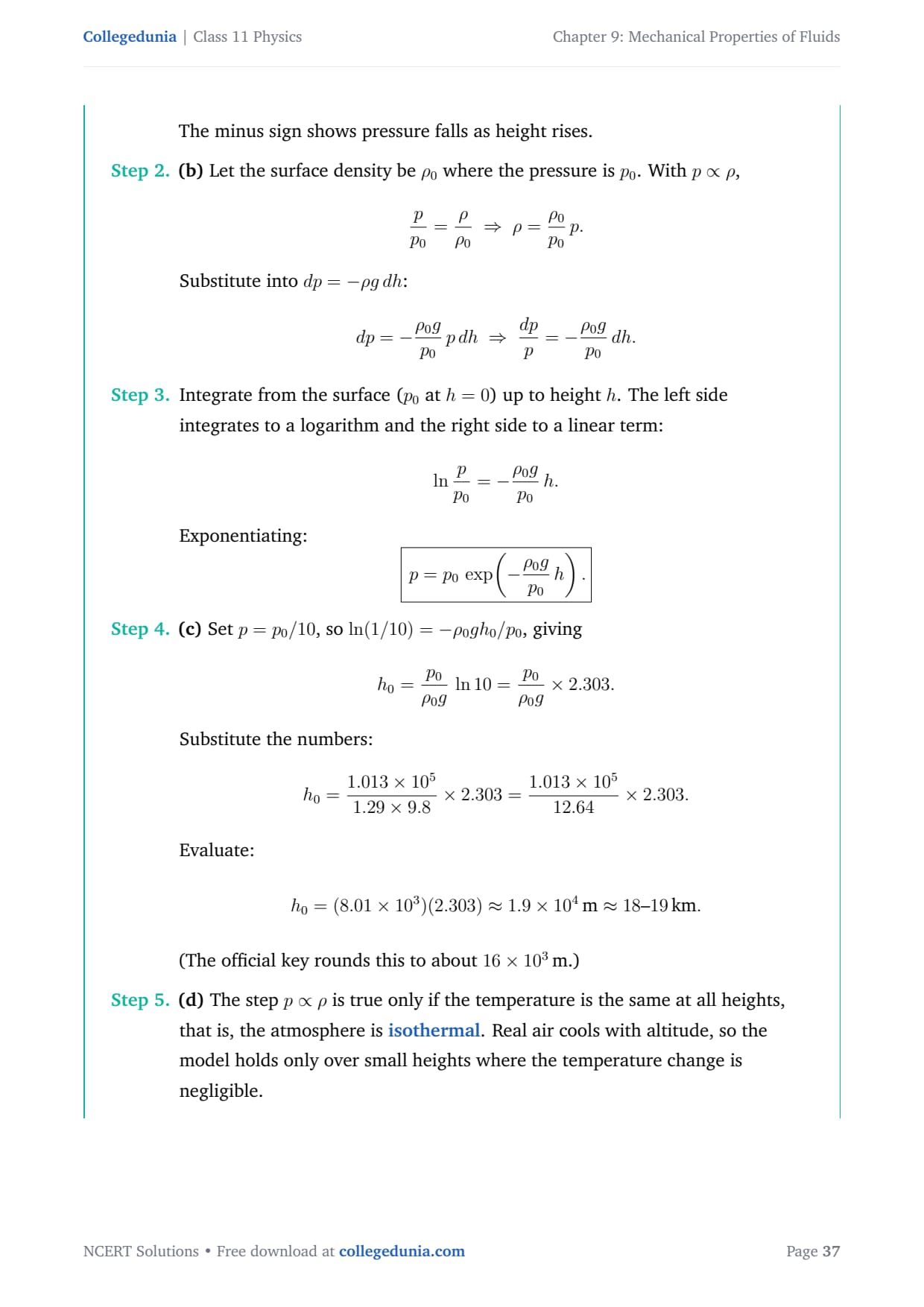
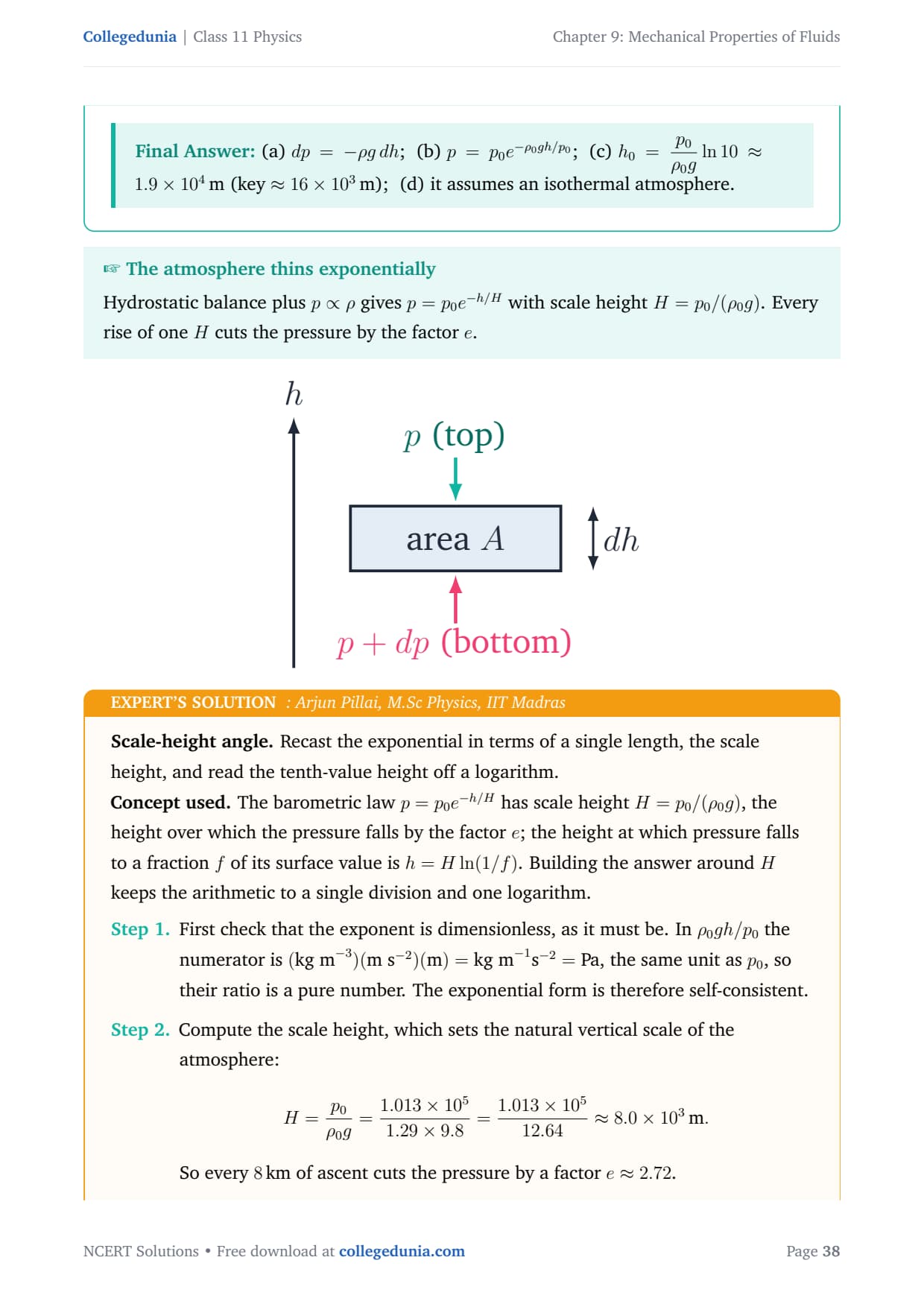
Question 21 is the atmosphere problem. Part (c) asks at what height pressure drops to one tenth of its surface value, given p0 = 1.013 × 10⁵ N m-2 and ρ0 = 1.29 kg m-3. The exponential model gives roughly 1.9 × 10⁴ m, near 18 to 19 km. The key states about 16 × 103 m. Part (d) asks for the assumption that limits the model, and the answer is that the atmosphere is treated as isothermal.
Common Mistakes Students Make in Mechanical Properties of Fluids
The Exemplar sets its traps on purpose. Three catch most students, and each is flagged in the PDF at the question where it bites.
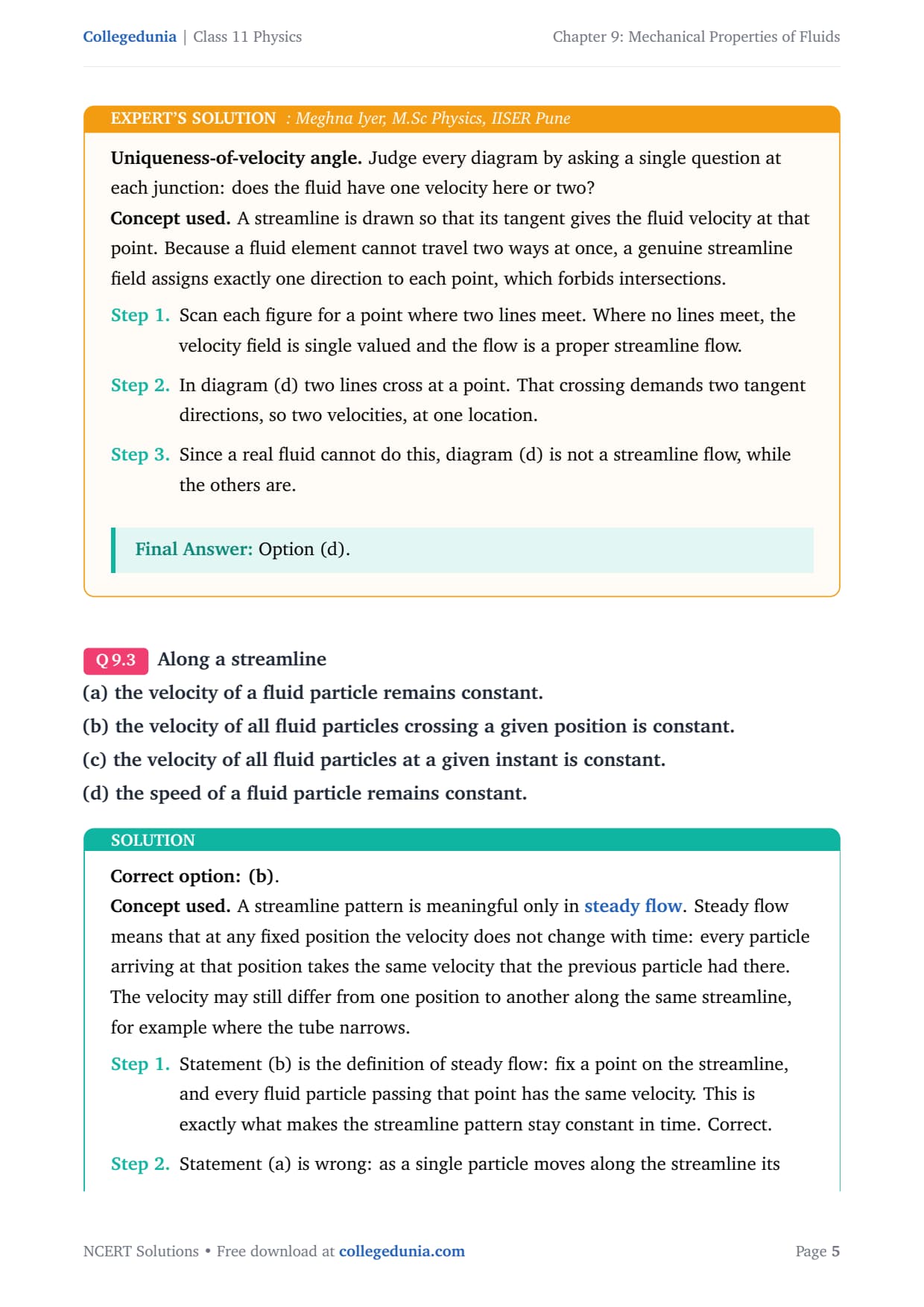
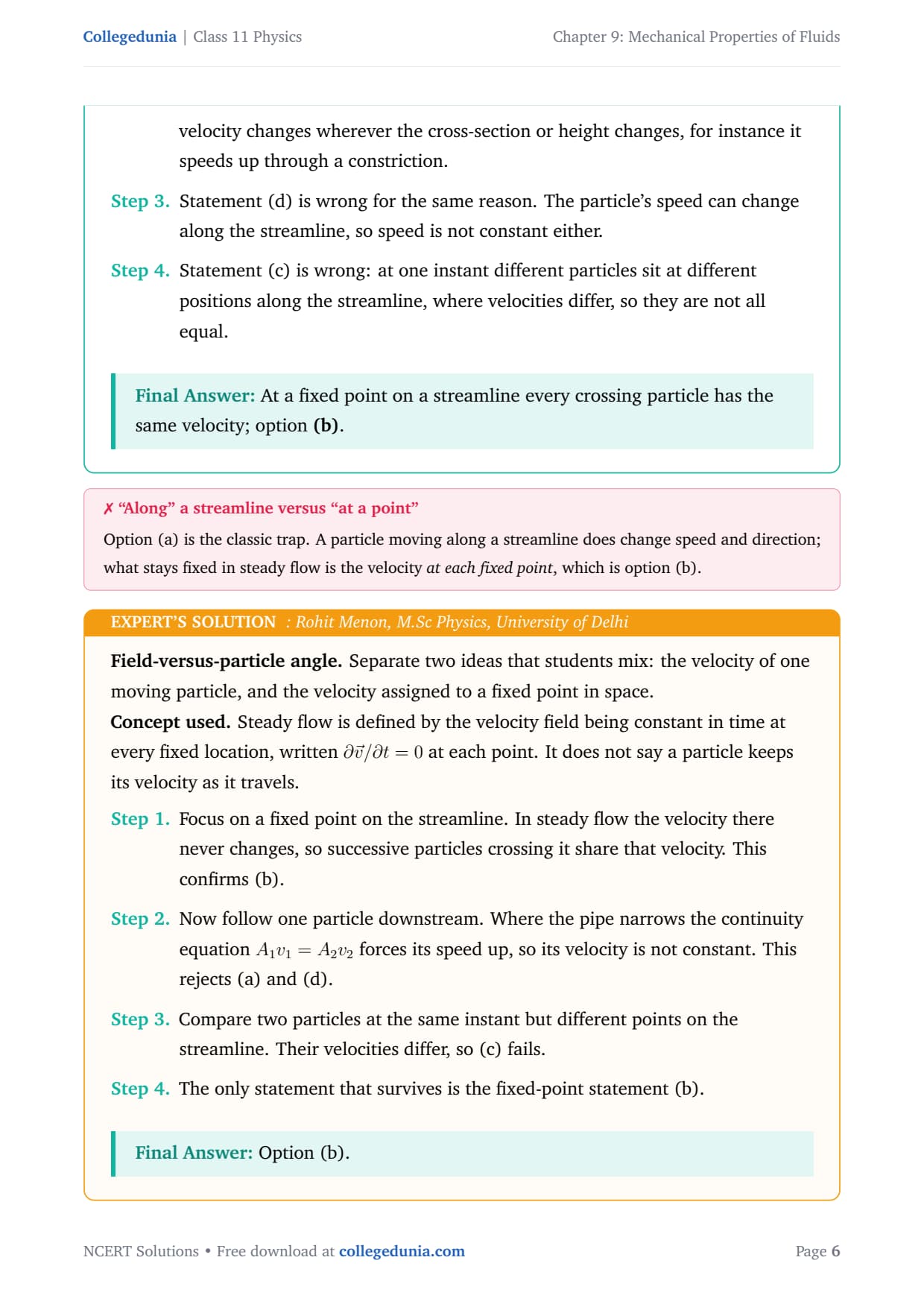
- "Along" a streamline versus "at a point": Question 3 asks what stays constant in steady flow. A particle travelling along a streamline does change speed and direction. What is fixed is the velocity at each fixed point in space.
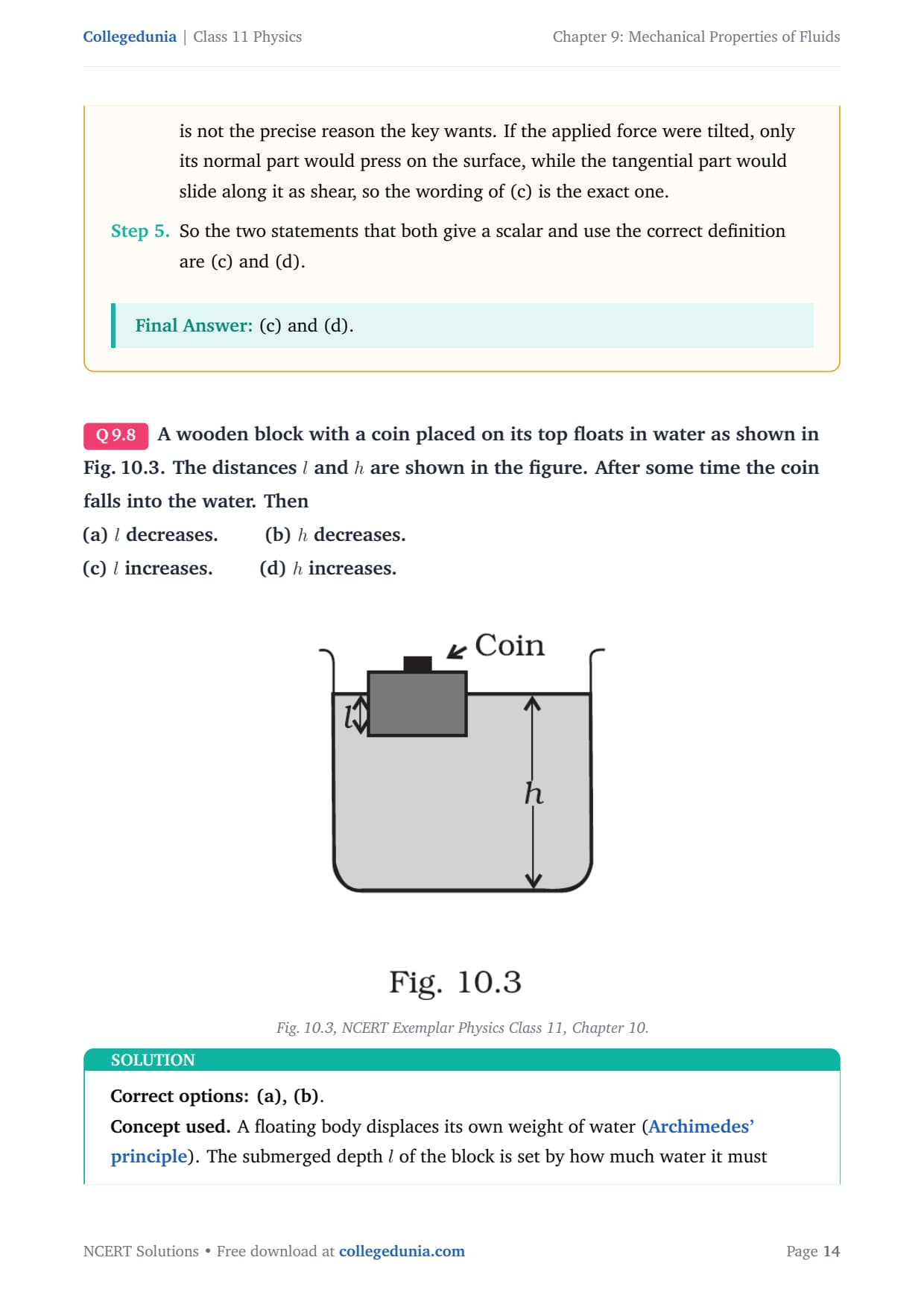
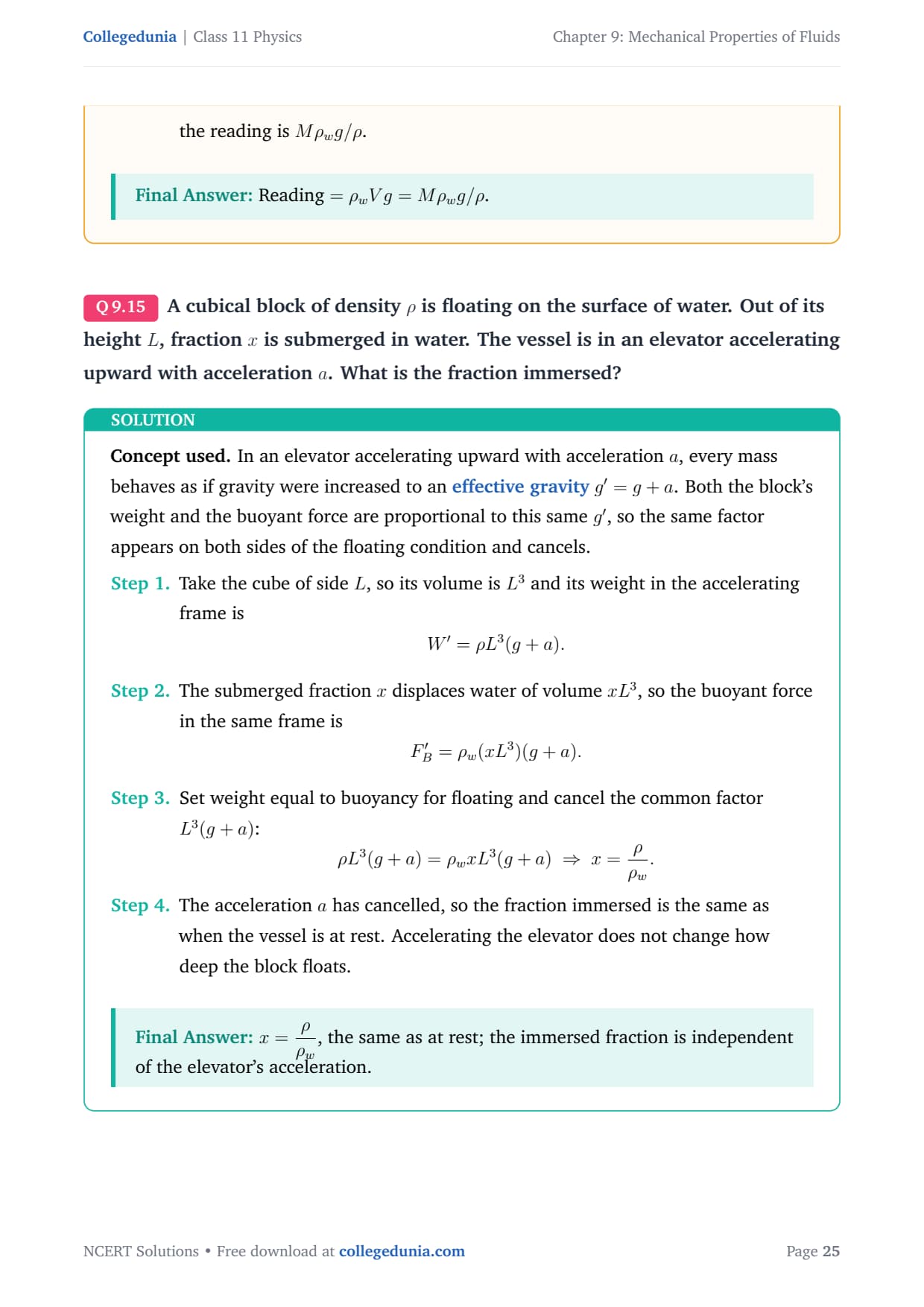
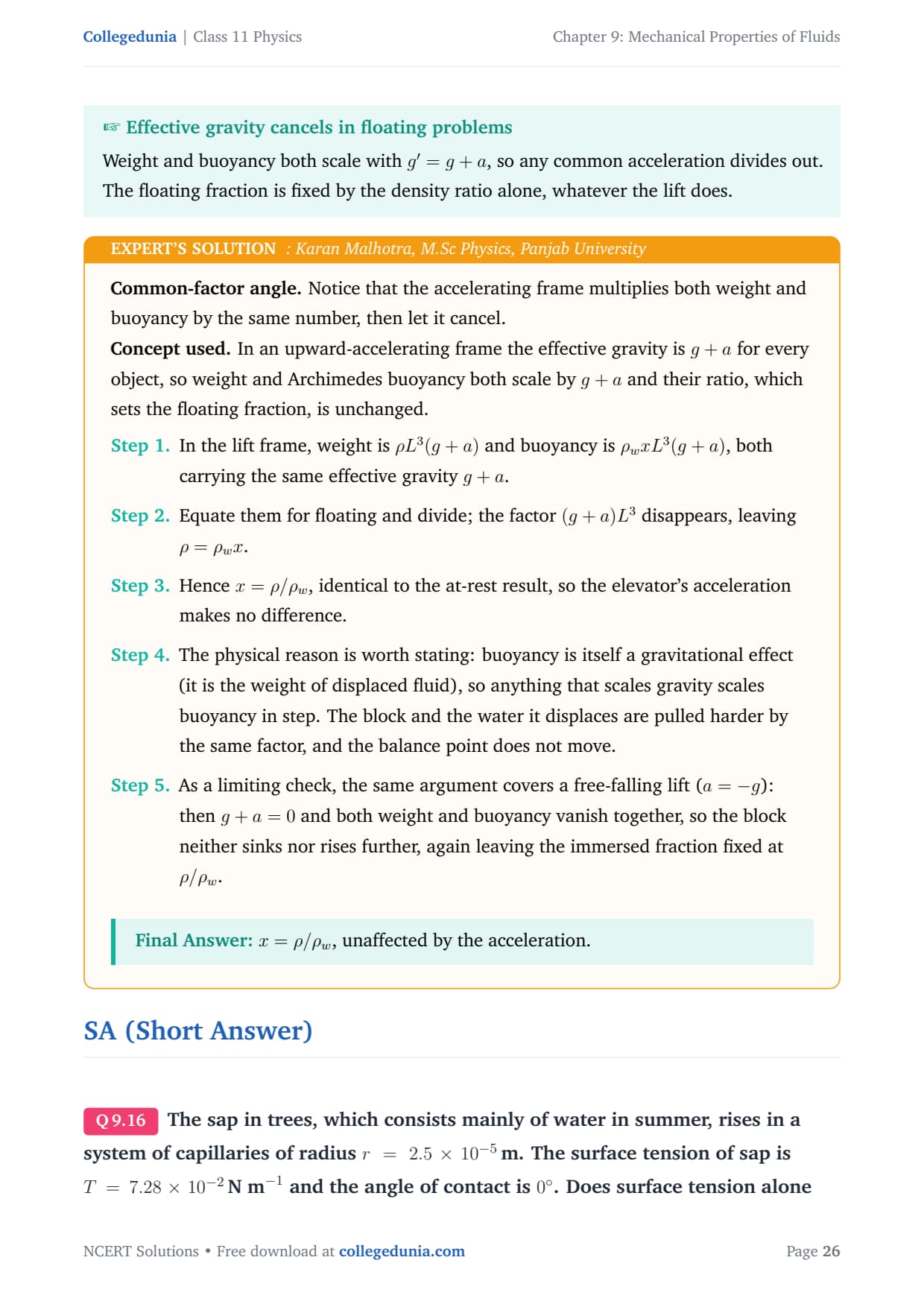
- Following the wrong displaced volume: Question 8 drops a coin from a floating block into the water. A coin on the block displaces its full weight of water, while a sunken coin displaces only its own volume, so the water level falls.
- Calling surface tension a vector: Question 12 asks directly. T is force per unit length, the same in every direction of the surface, so it is a scalar even though the force it produces has direction.
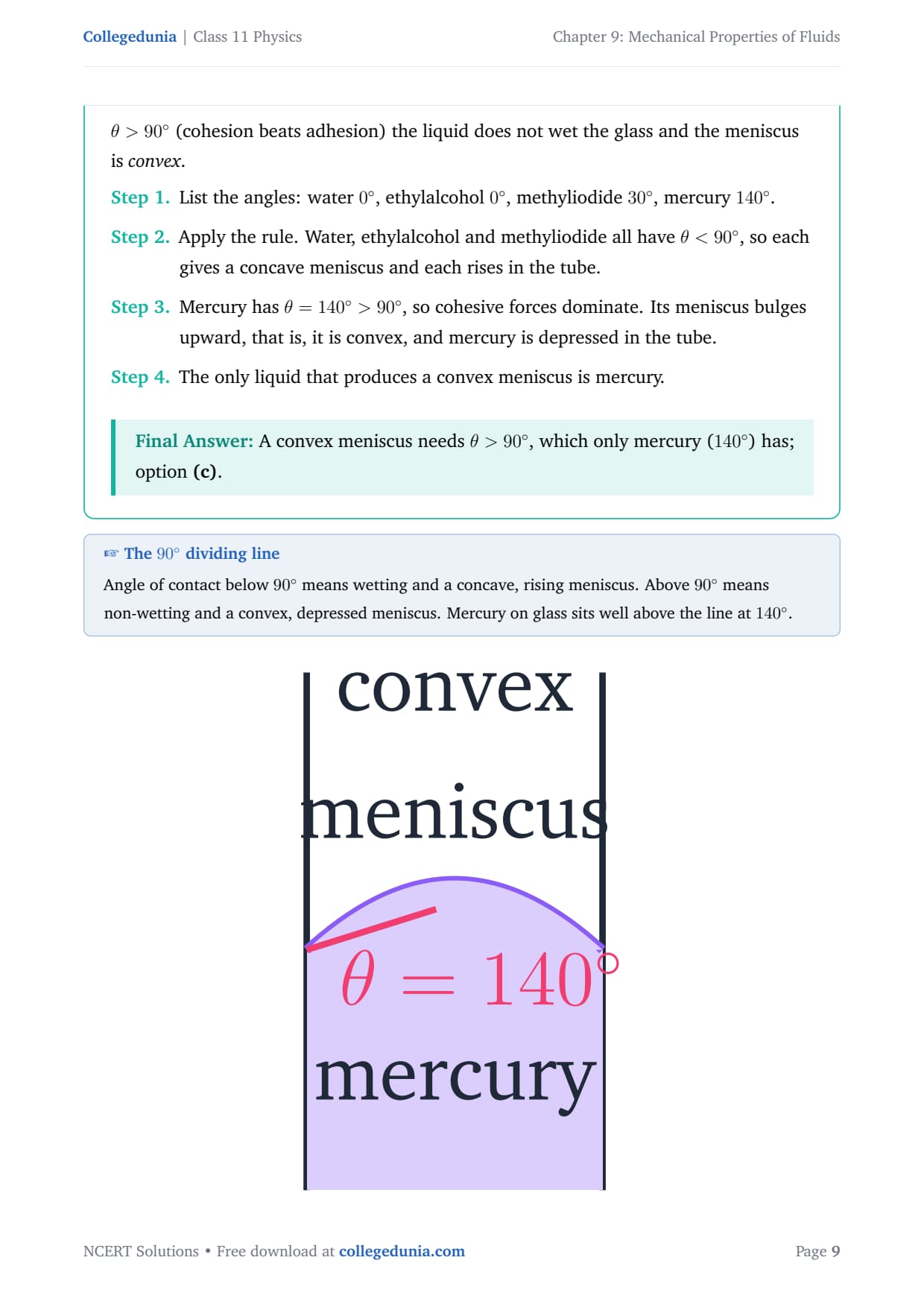
Question 5 rewards one clean rule: an angle of contact above 90° means a convex meniscus. Of water, ethyl alcohol, mercury and methyl iodide, only mercury sits at 140°, so mercury is the answer.
How the Exemplar Steps Up from the Class 11 Physics Textbook
The textbook hands you a formula and asks you to substitute. The Exemplar asks which formula applies, and often whether the physics works at all.
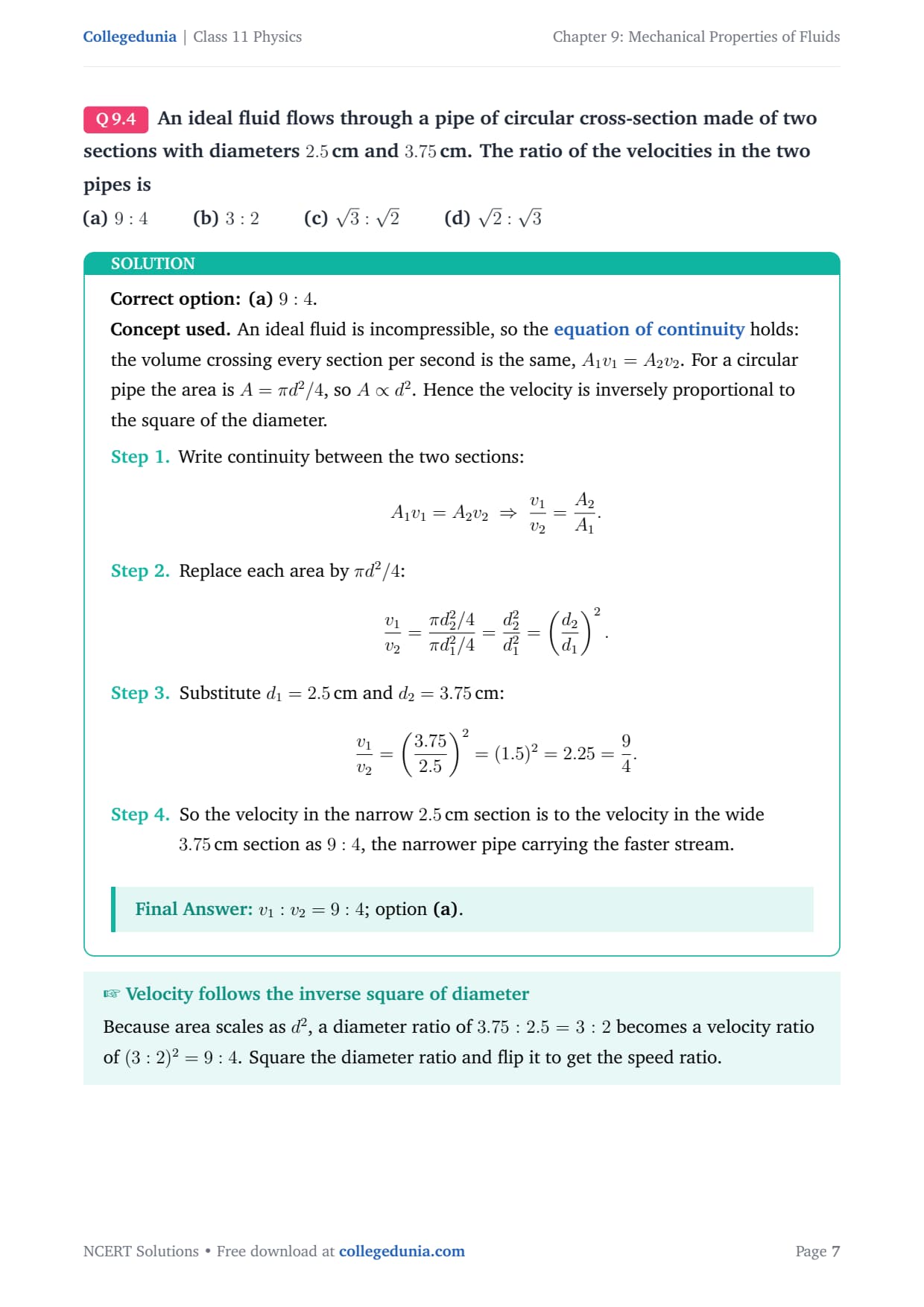
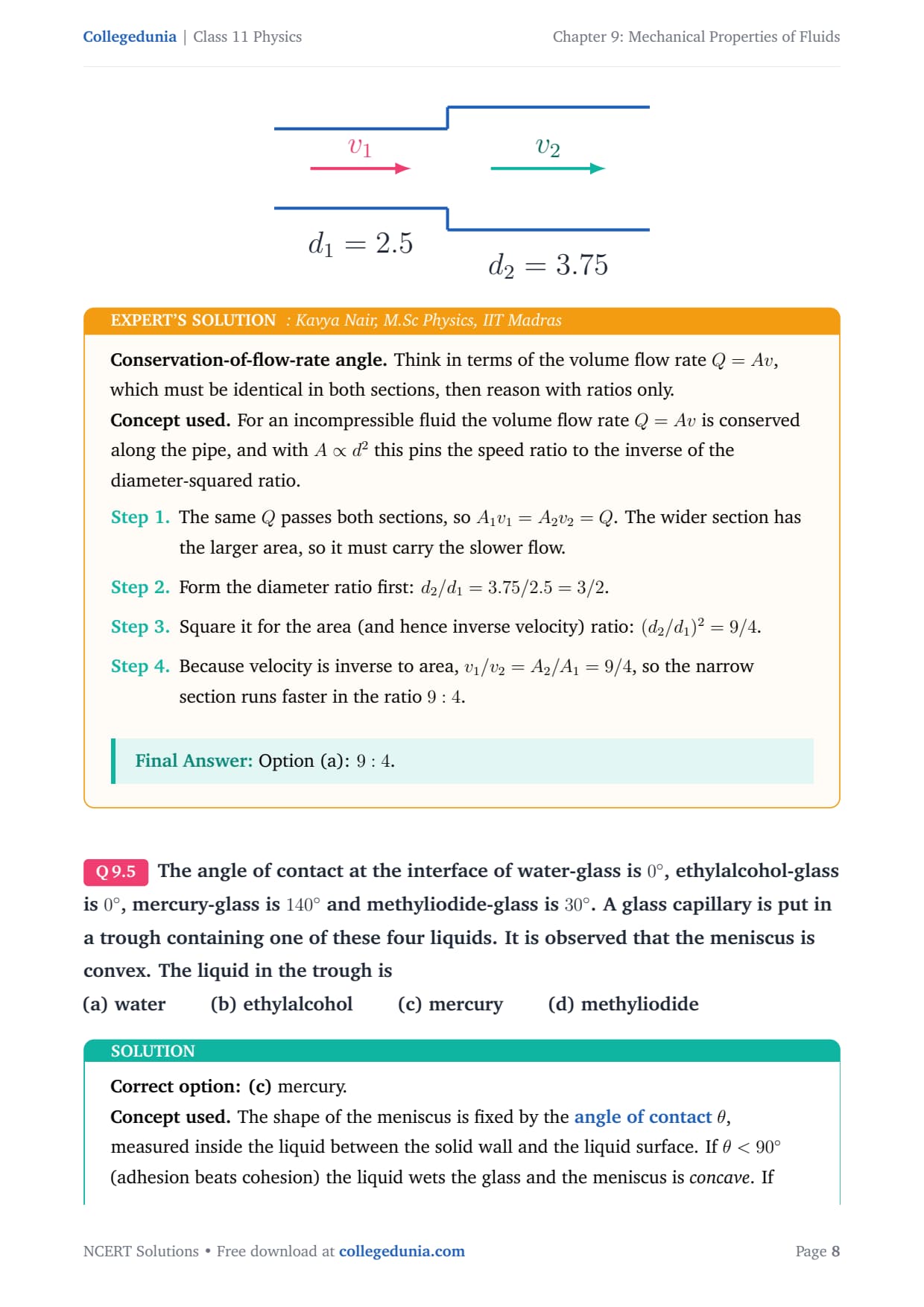
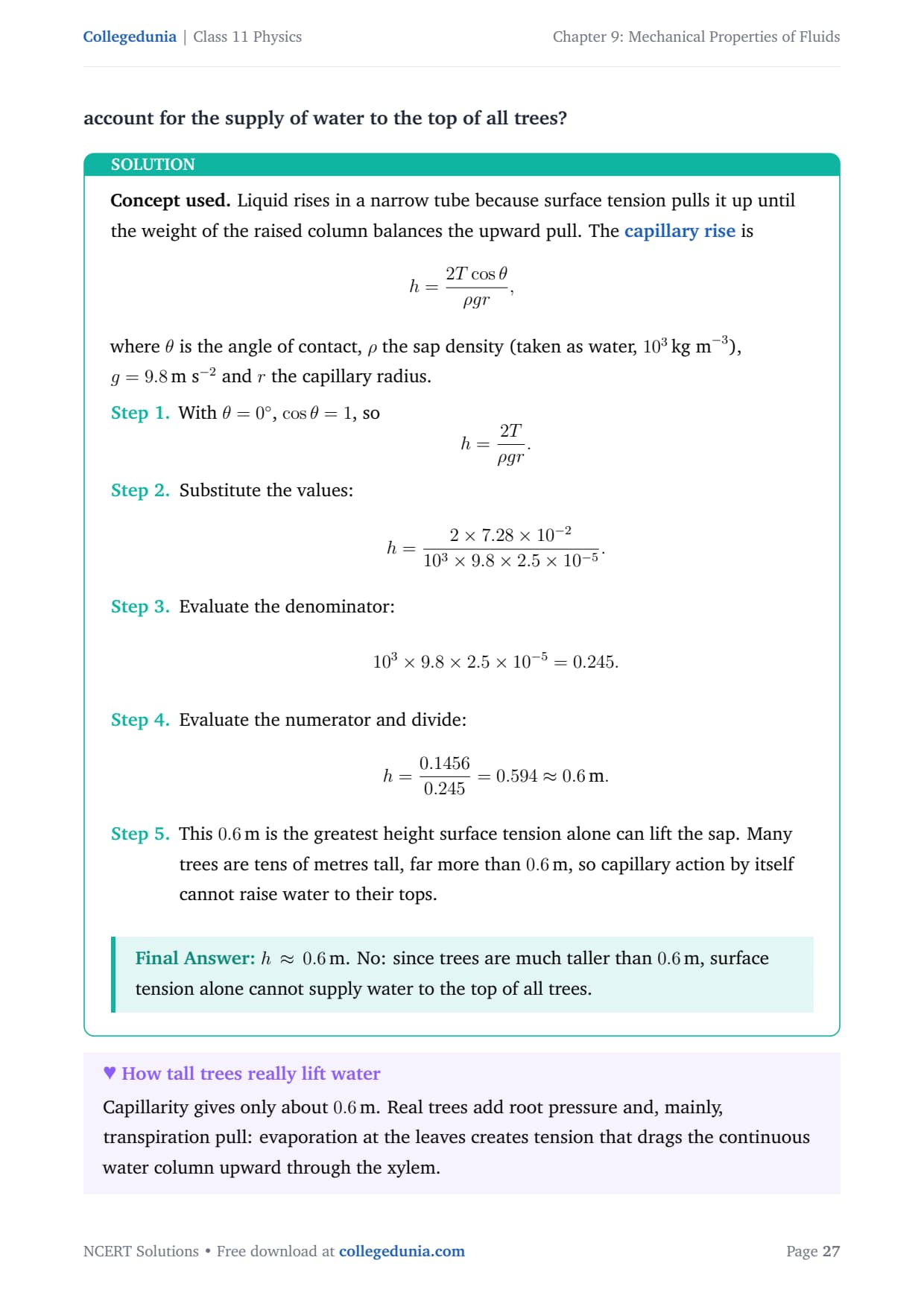
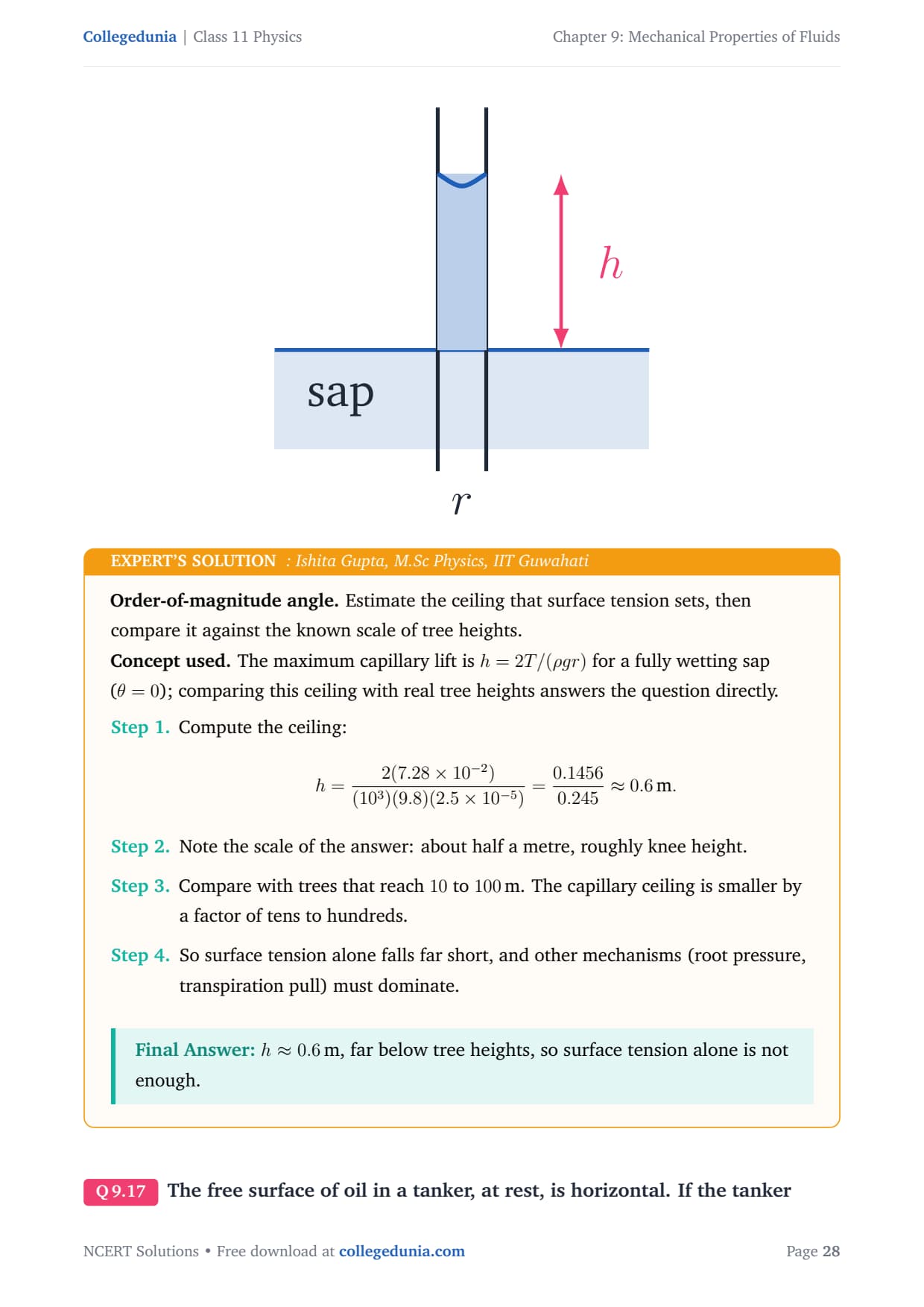
Question 16 shows the difference well. Sap rises in tree capillaries of radius 2.5 × 10⁻⁵ m with T = 7.28 × 10⁻² N m-1 and zero angle of contact. Capillary rise gives only about 0.6 m. The real answer is that surface tension alone cannot lift sap to the top of tall trees. Question 4, by contrast, needs one step: since area goes as the square of the diameter, pipes of 2.5 cm and 3.75 cm give a velocity ratio of 9:4.
How to Use These NCERT Exemplar Solutions for Boards, JEE and NEET
Attempt each question before opening the solution. With only 23 questions, the whole chapter fits into two sittings.
- Boards: the VSA set matches the 2 mark reasoning pattern almost exactly
- JEE Main: start with the MCQ II set, since partial answers score nothing there or in the exam
- NEET: Questions 13 and 15 on floating fractions cover the buoyancy questions NEET repeats
Student Feedback
Students who used Collegedunia's Class 11 Physics Exemplar Solutions told us surface tension was the hardest section, not fluid dynamics. Around 7 in 10 said the Long Answer problems on the atmosphere and the hot air balloon took longer than any other chapter in the book.
Other Resources for Class 11 Physics Mechanical Properties of Fluids
Collegedunia has the full study set for this chapter. Read the Notes first, then use the Exemplar once the five core ideas are clear.
Also Check:
- NCERT Solutions for Class 11 Physics Chapter 9
- Class 11 Physics Chapter 9 Notes
- Class 11 Physics Chapter 9 Handwritten Notes
- Class 11 Physics Chapter 9 NCERT Book PDF
- Class 11 Physics Chapter 9 Exemplar Questions with Solutions
NCERT Exemplar Solutions for Other Class 11 Physics Chapters
Every chapter below has the same step-by-step treatment and a free PDF.
Mechanical Properties of Fluids Class 11 Physics NCERT Exemplar Solutions FAQs
Ques. How many questions are there in the Class 11 Physics Mechanical Properties of Fluids Exemplar?
Ans. Chapter 9 has 23 questions, the fewest of any chapter in the book. They split into 5 MCQ I, 5 MCQ II, 5 Very Short Answer, 5 Short Answer and 3 Long Answer questions. All 23 are solved in the free PDF on this page.
Ques. Why does the answer key print 32 × 10-7 J for the mercury droplet question?
Ans. Question 18 merges droplets of radii 0.1 cm and 0.2 cm. The key rounds the merged radius to 0.21 cm before finding the area change, which gives about 32 × 10-7 J. Carrying the exact radius through gives about 3.7 × 10⁻⁶ J. Our solution shows both routes.
Ques. Is surface tension a scalar or a vector?
Ans. A scalar. Question 12 asks this directly. Surface tension is force per unit length, or equivalently the work needed to create unit area of new surface. Work and area are both scalars, so T is a scalar, even though the force the surface exerts does have a direction.
Ques. Does surface tension explain how sap reaches the top of tall trees?
Ans. No. Question 16 gives capillaries of radius 2.5 × 10⁻⁵ m and sap surface tension 7.28 × 10⁻² N m-1. The capillary rise formula returns only about 0.6 m. Trees grow far taller, so other mechanisms such as root pressure and transpiration pull must supply the rest.
Ques. What assumption limits the atmosphere model in Question 21?
Ans. The model takes pressure as proportional to density, which only holds if the temperature is the same at every height. That means an isothermal atmosphere. Real air cools with altitude, so the exponential result is reliable only over small heights.



Comments