




NCERT Exemplar Solutions for Class 11 Physics Chapter 11 Thermodynamics work through all 27 questions from the Exemplar book. Every MCQ, Very Short Answer, Short Answer and Long Answer problem is solved step by step. The free PDF on this page runs to 45 pages and follows the 2026-27 syllabus.
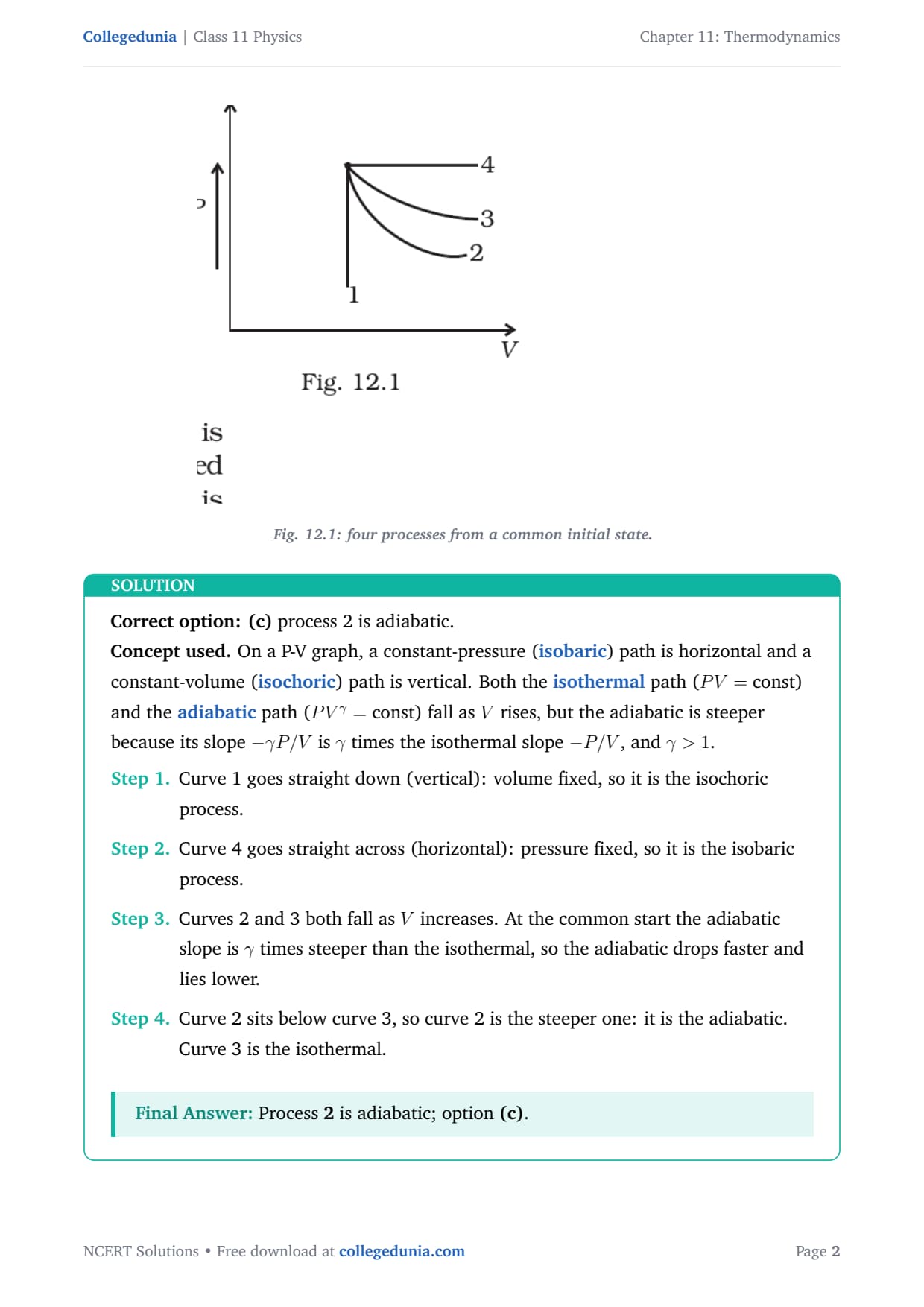
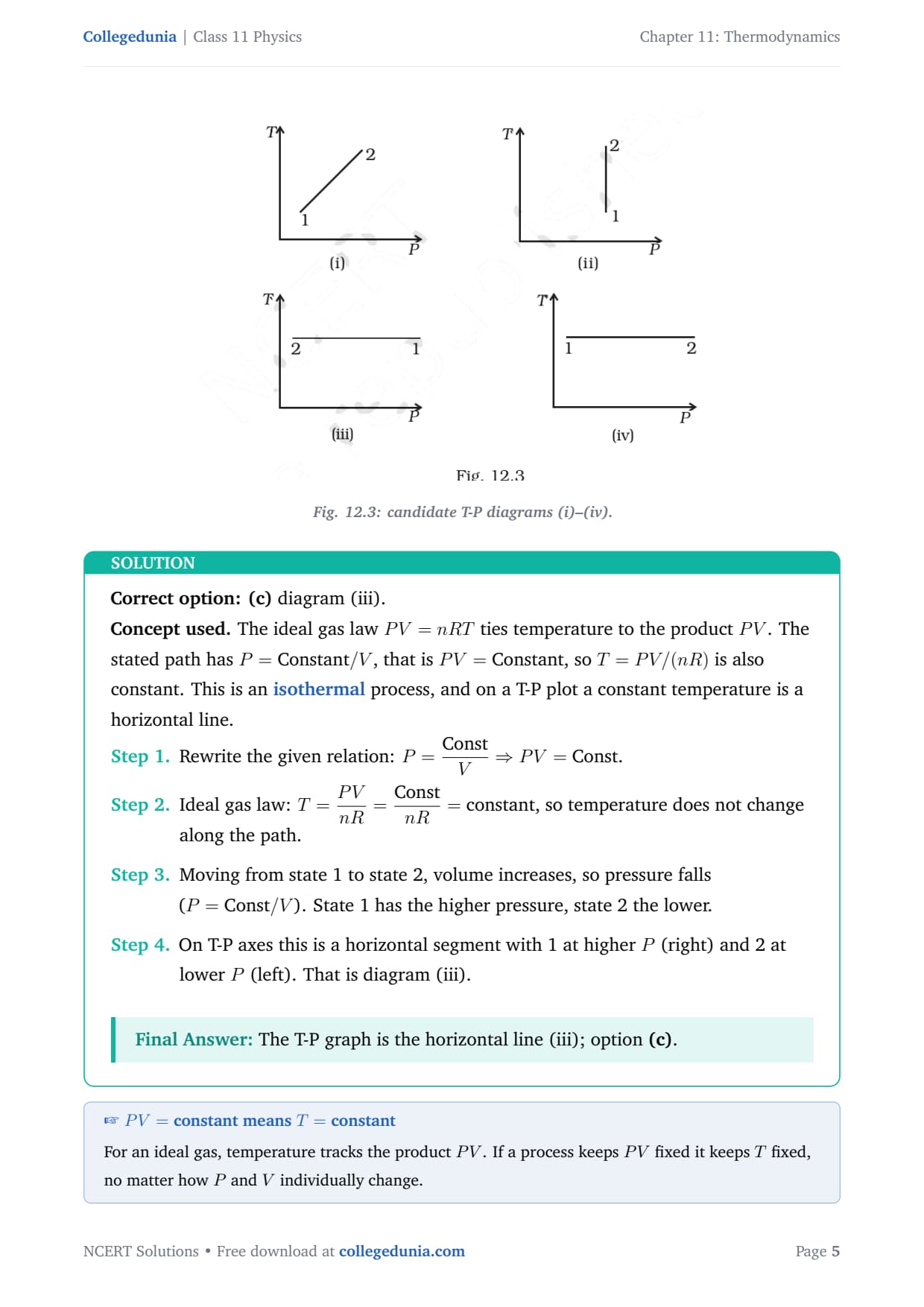
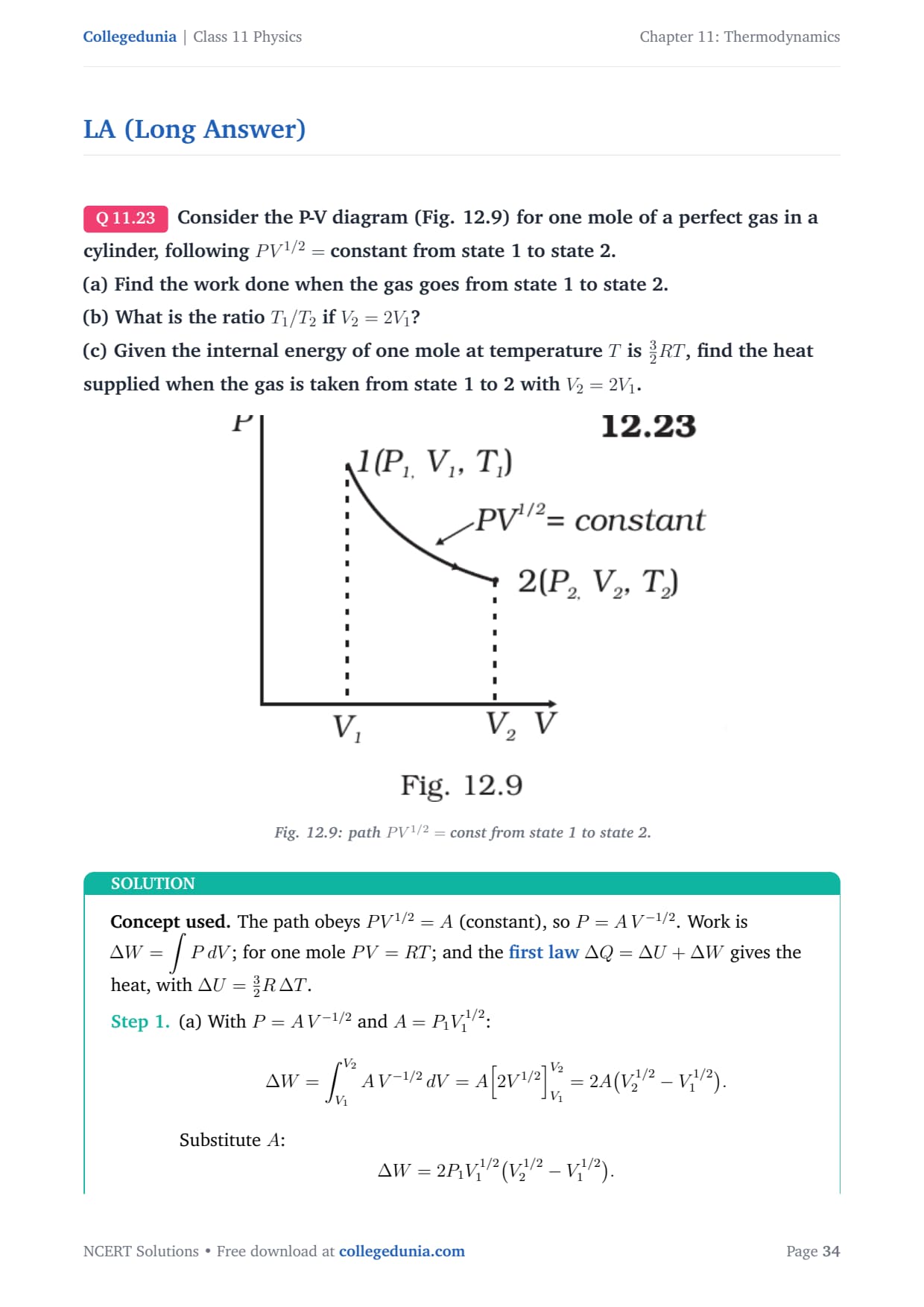
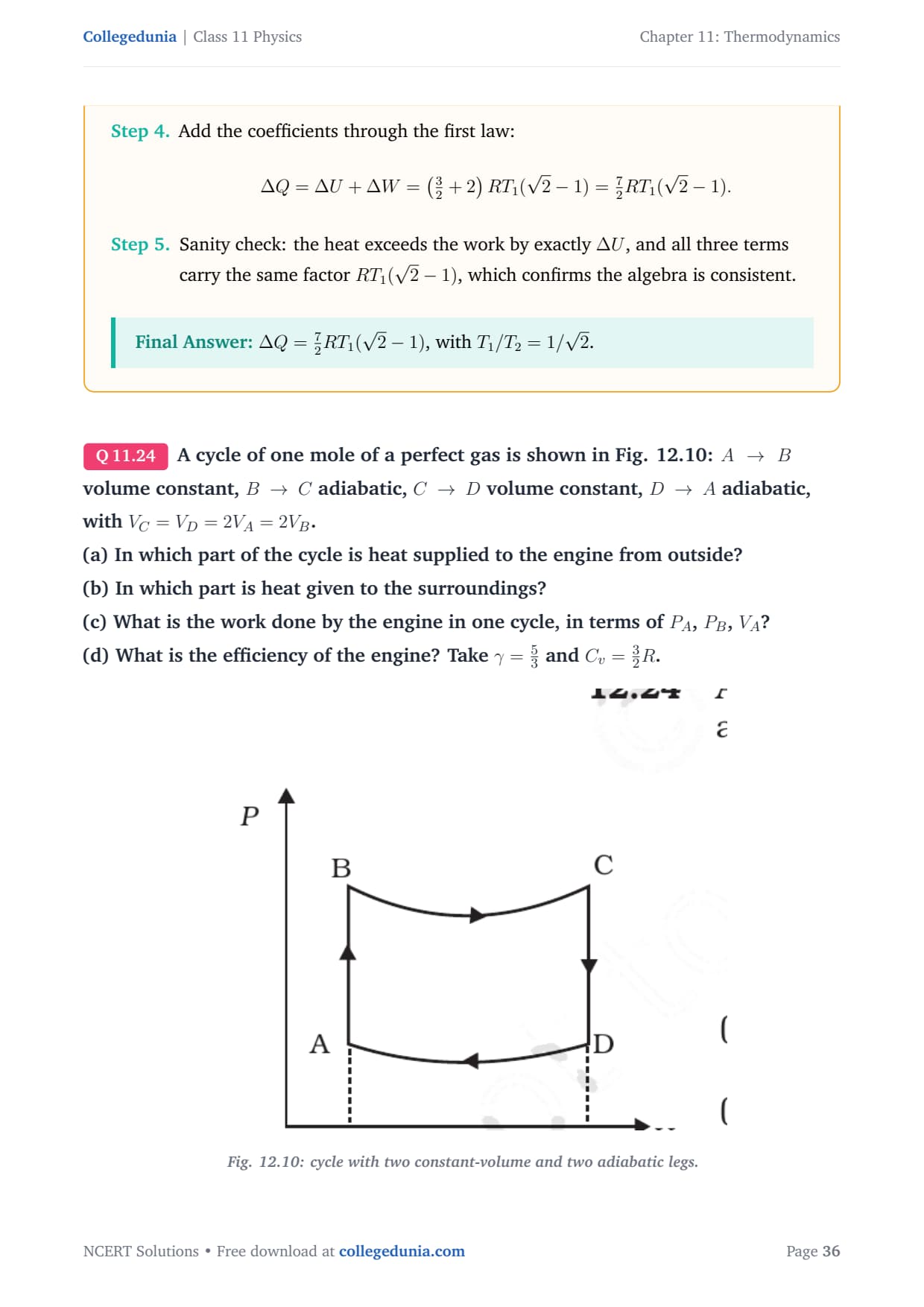
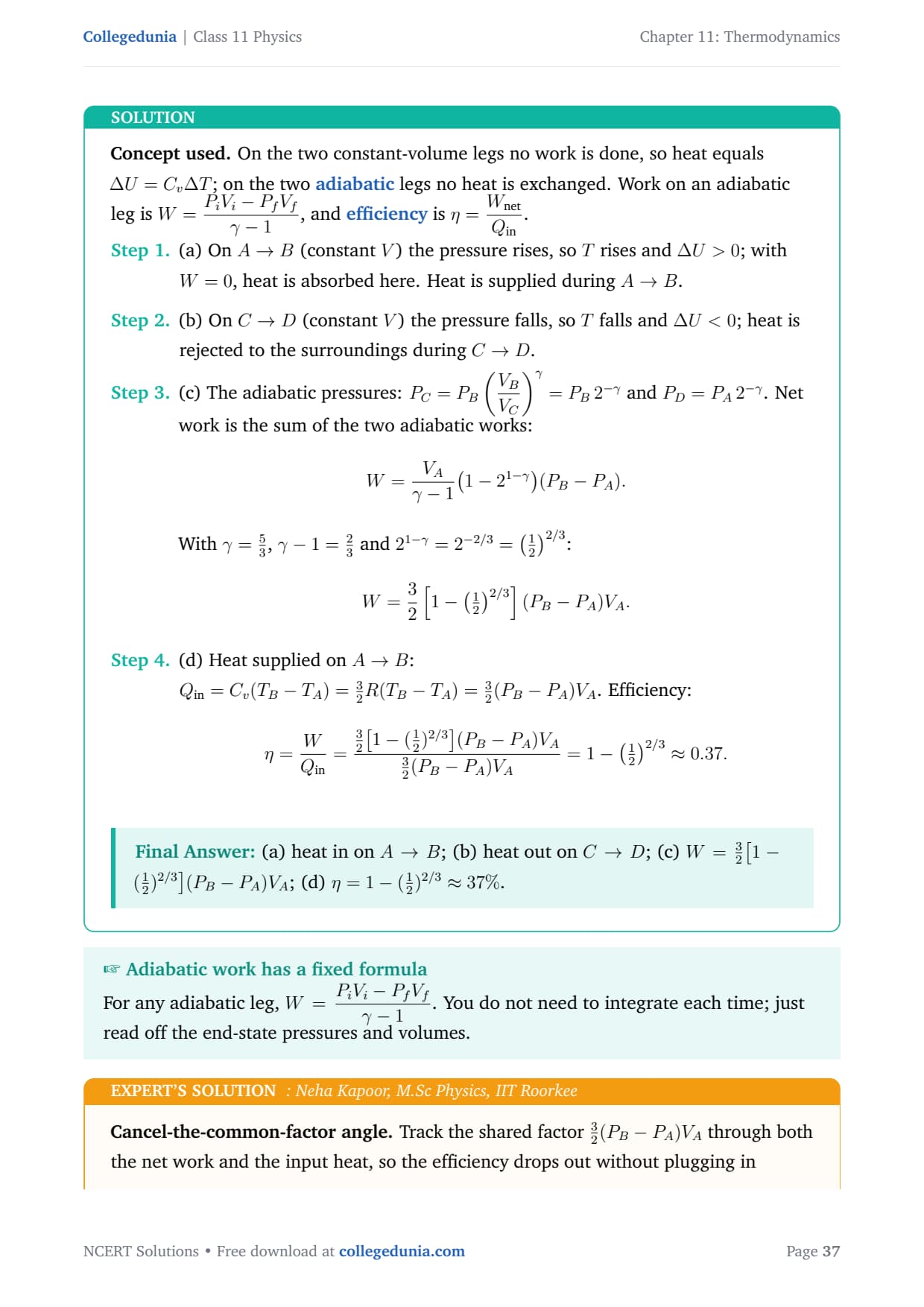
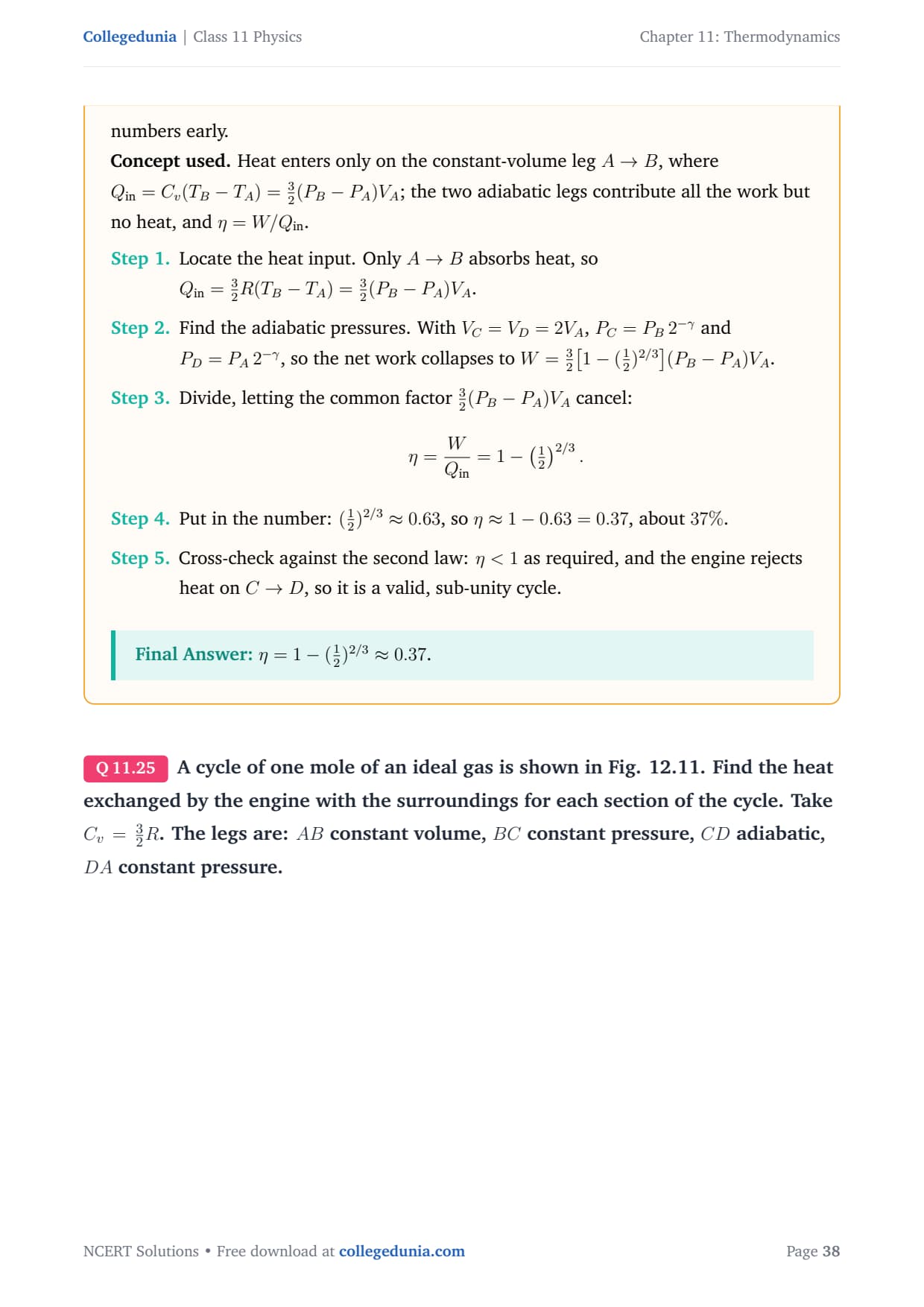
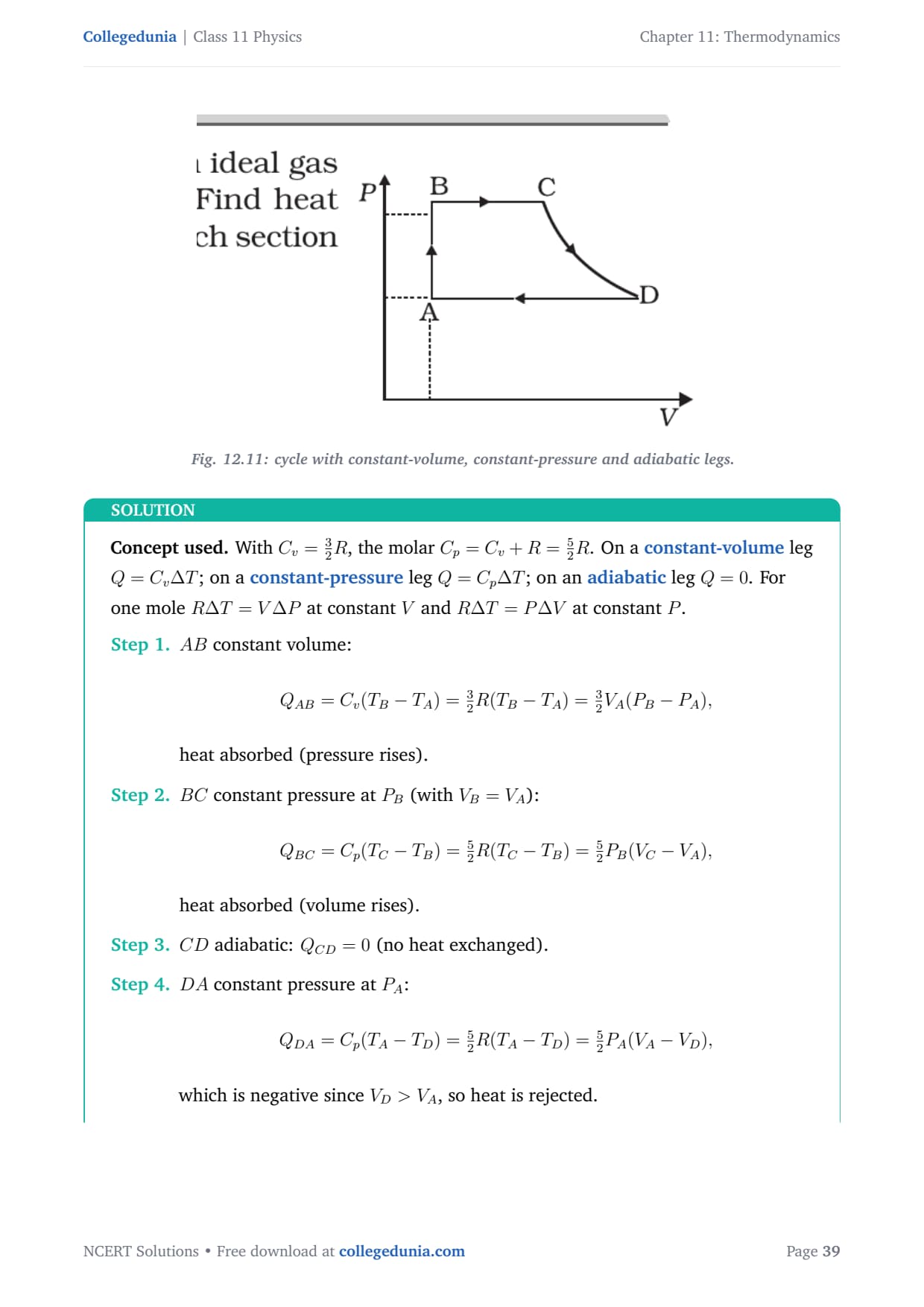
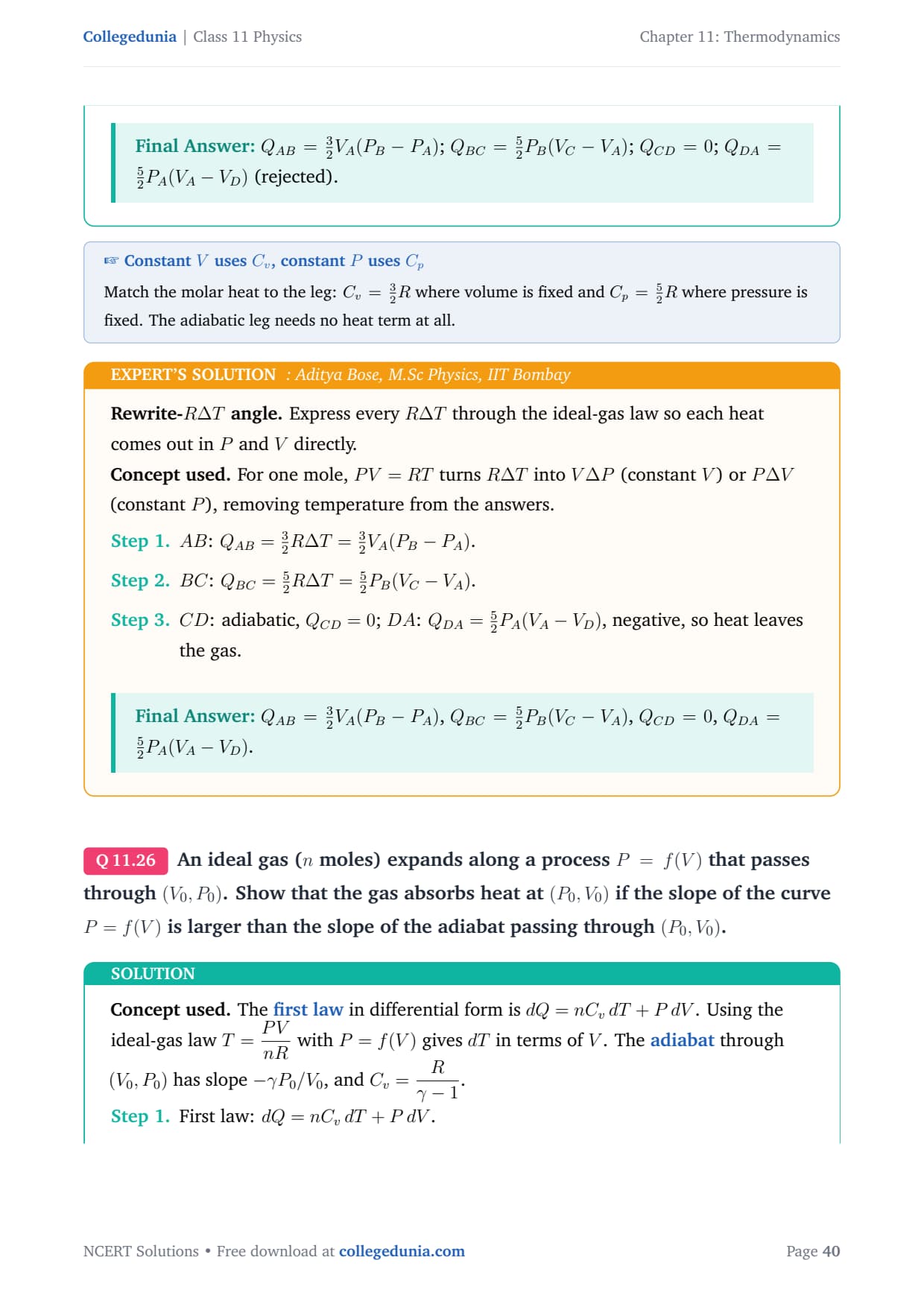
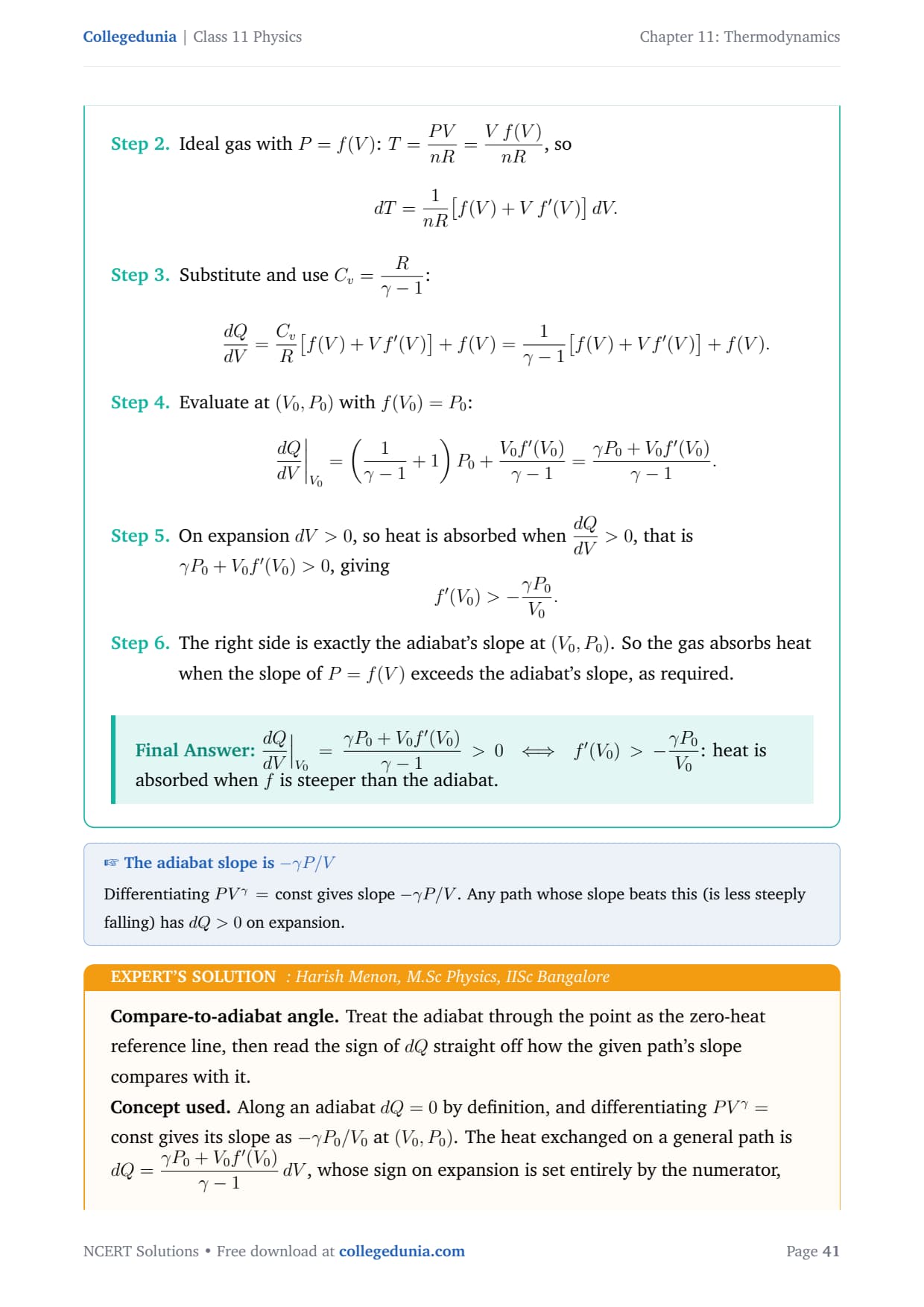
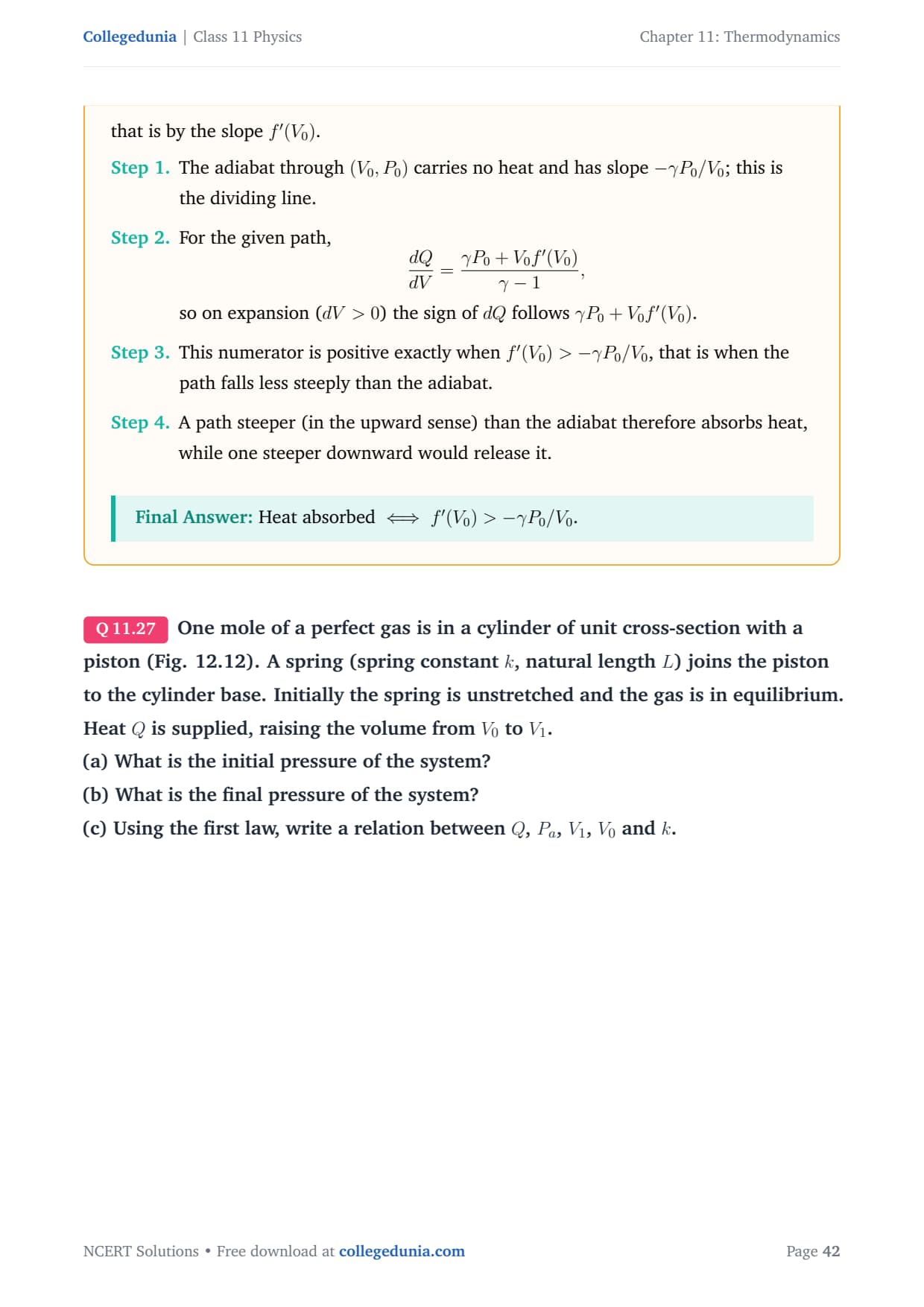
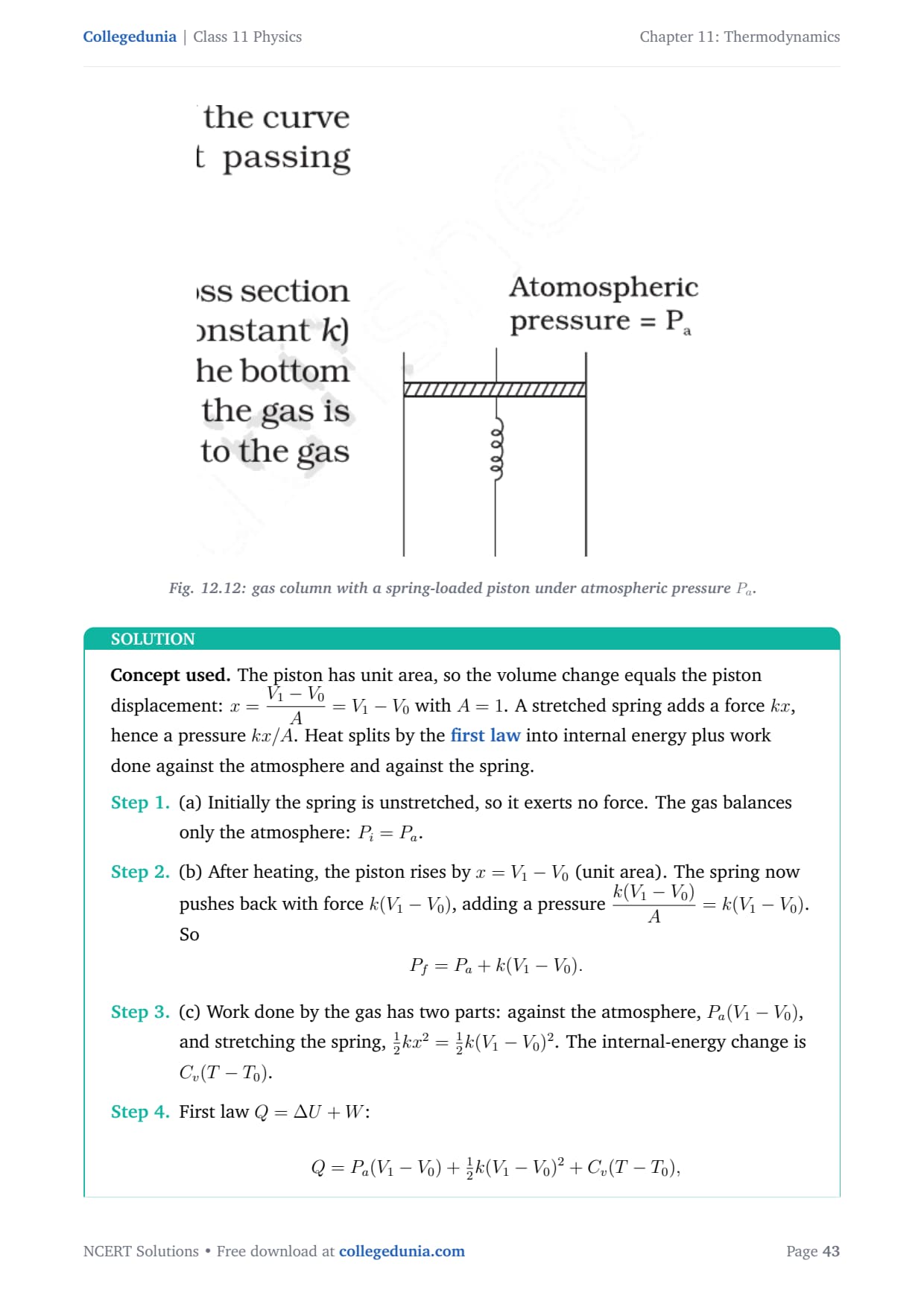
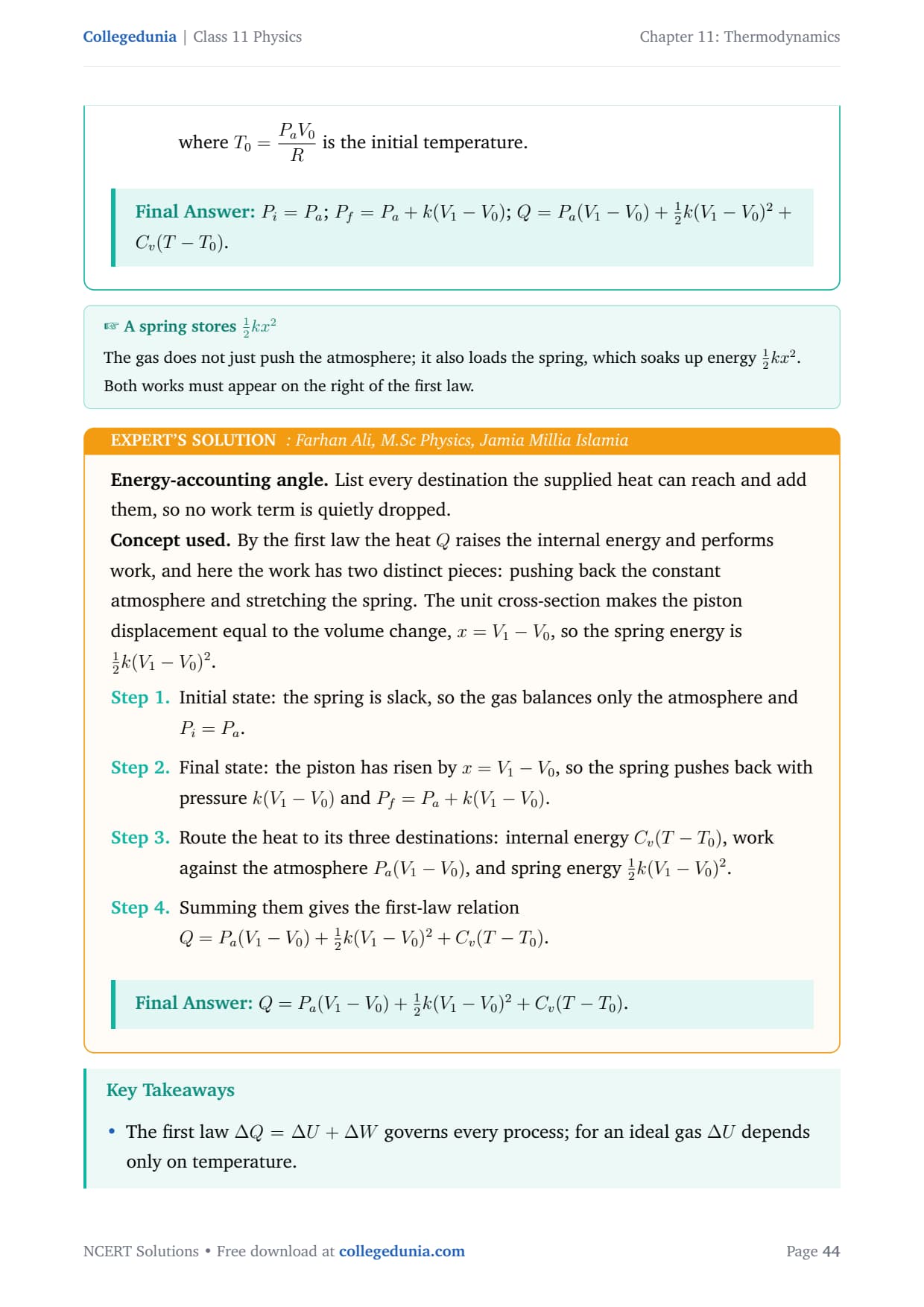
One detail confuses students before they even start. The Exemplar book still prints this chapter as Chapter Twelve, so every figure inside it is labelled Fig. 12.1 through Fig. 12.12. The new textbook numbers the same chapter as 11. Both refer to identical content.
- CBSE Weightage: 6 to 8 marks, usually one numerical on the first law or Carnot efficiency
- JEE Main Weightage: 1 to 2 questions per year, most often on P-V work and adiabatic processes
- NEET Weightage: 1 to 2 questions per year from heat engines, refrigerators and the first law
Solutions checked against the official NCERT Exemplar answer key (keep316), with every disputed answer worked out in full.
Topics Covered in the Class 11 Physics Thermodynamics Exemplar
This chapter turns heat, work and temperature into one bookkeeping rule. The Exemplar builds every question on the four ideas below, and the 11 book figures are almost all P-V diagrams.
- First law of thermodynamics: ΔQ = ΔU + ΔW, plus the sign convention that decides half the marks
- The four standard processes: isothermal, adiabatic, isobaric and isochoric, and how each looks on a P-V plot
- Work as area: ΔW as the area under a path, and the loop area for a full cycle
- Heat engines and refrigerators: Carnot efficiency η = 1 − T2/T1 and the coefficient of performance
Question Types in the Thermodynamics NCERT Exemplar
The 27 questions split across five types. The Long Answer set is the demanding part, since those five run to full cyclic-process derivations with spring-loaded pistons.
| Question Type | Count | What It Tests |
|---|---|---|
| MCQ I (single correct) | 6 | Identifying a process from the shape of its P-V curve |
| MCQ II (one or more correct) | 5 | Ruling out every wrong option, not just spotting one right one |
| VSA (Very Short Answer) | 5 | One-line sign reasoning on heat and internal energy |
| SA (Short Answer) | 6 | Numericals on Carnot engines and refrigerators |
| LA (Long Answer) | 5 | Full cycle derivations worth 5 marks |
Key Formulas Used in the Thermodynamics Exemplar
Almost every question here comes back to one of the relations below. The PDF states the rule before applying it.
- First law: ΔQ = ΔU + ΔW, with heat added positive and work by the gas positive
- Work on a P-V diagram: ΔW equals the area under the path
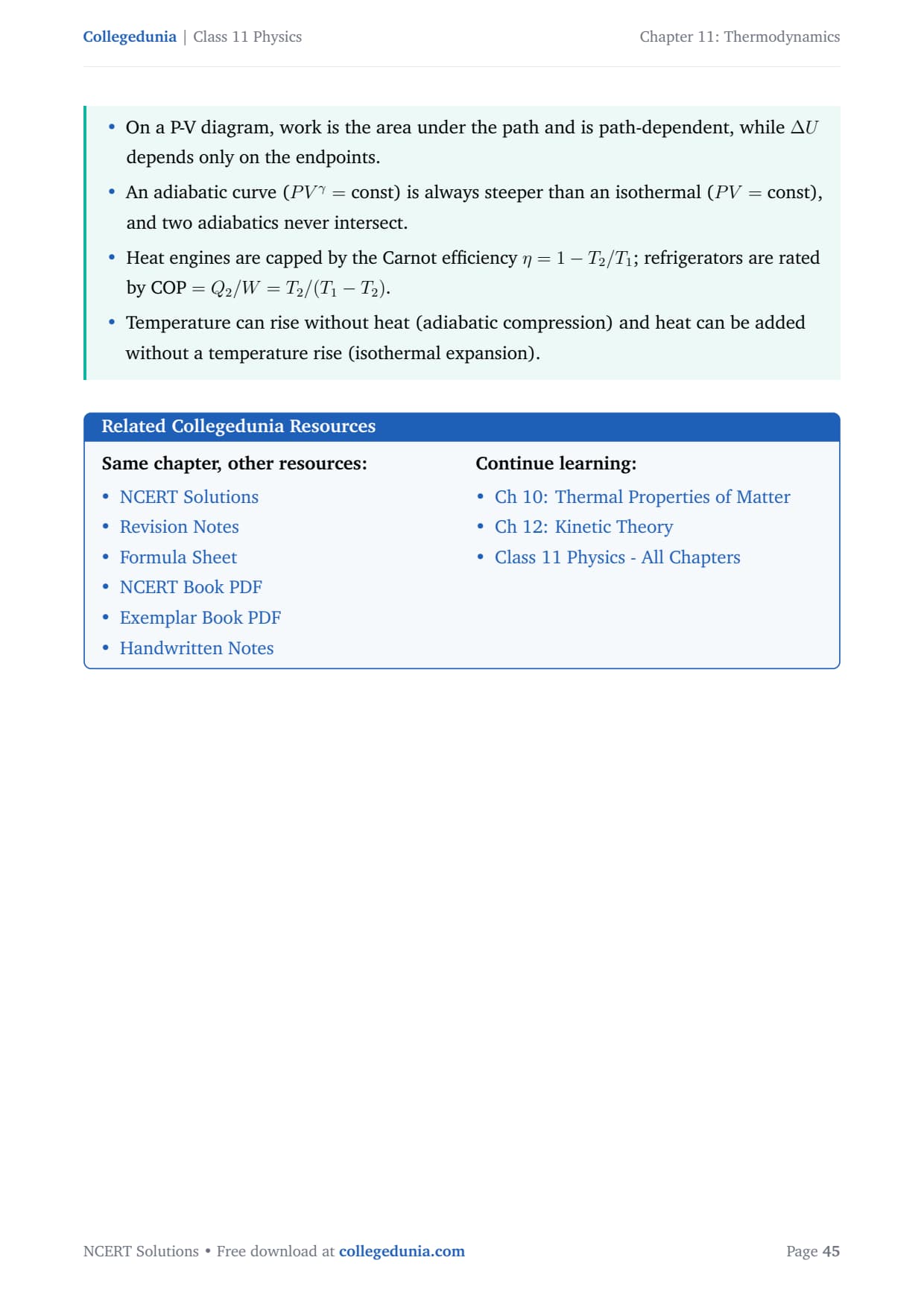
- Adiabatic relation: PVγ stays constant, so no heat crosses the boundary
- Carnot efficiency: η = 1 − T2/T1, with both temperatures in kelvin
- Refrigerator COP: β = Q2/W = T2/(T1 − T2)
Internal energy is a state function, but heat and work are path functions. That single distinction answers more Exemplar questions than any formula. Question 13 is built on it directly.
The Answer-Key Error in Question 2 of the Thermodynamics Exemplar
Question 2 asks how much sweat a jogger evaporates per minute. The body produces 14.5 × 10³ cal/min, and evaporating 1 kg of sweat needs 580 × 103 cal. Applying m = Q/L gives 14.5/580, which equals 0.025 kg.
That value is not among the four printed options. The official key marks option (a), 0.25 kg, so the printed data and the key differ by a factor of ten. Our solution shows the honest arithmetic first, then flags the mismatch. In the exam, pick option (a), since that is the marking scheme's answer.
Common Mistakes Students Make in Thermodynamics
The Exemplar sets traps on purpose. Three catch most students, and each is flagged in the PDF where it appears.
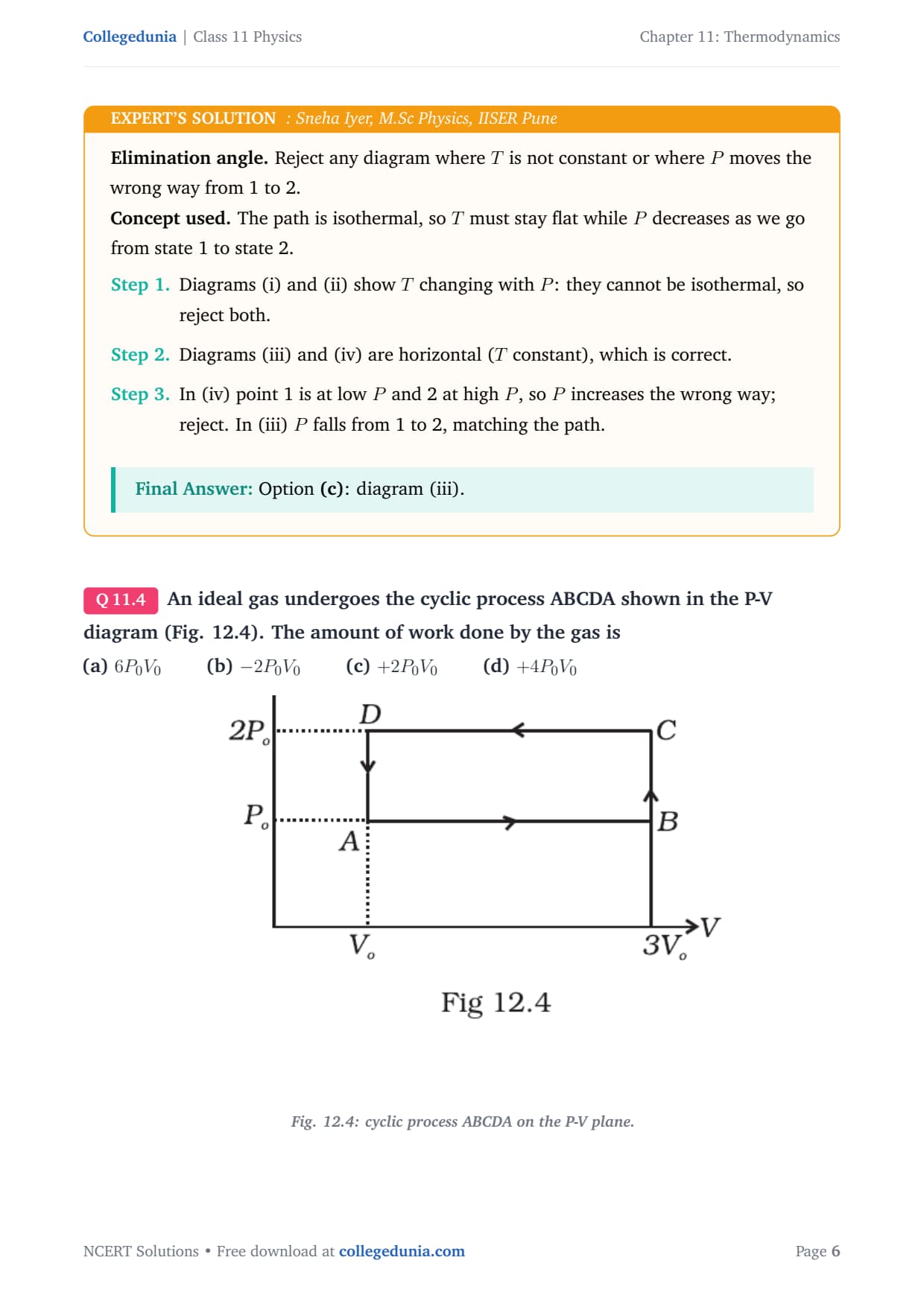
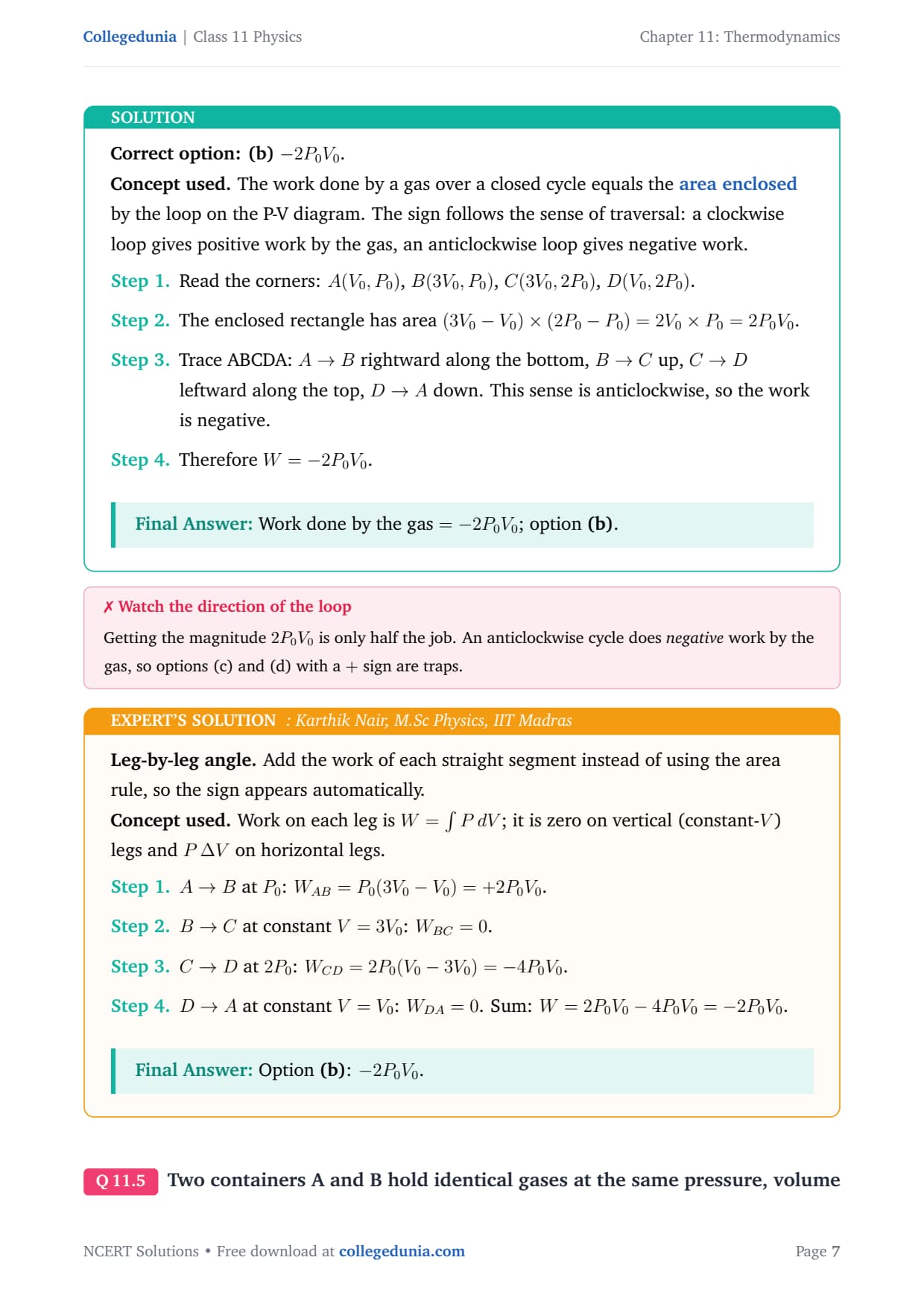
- Losing the sign of a loop: Question 4 gives the cycle ABCDA in Fig. 12.4. The magnitude 2P0V0 is only half the job, since an anticlockwise cycle does negative work. The answer is −2P0V0.
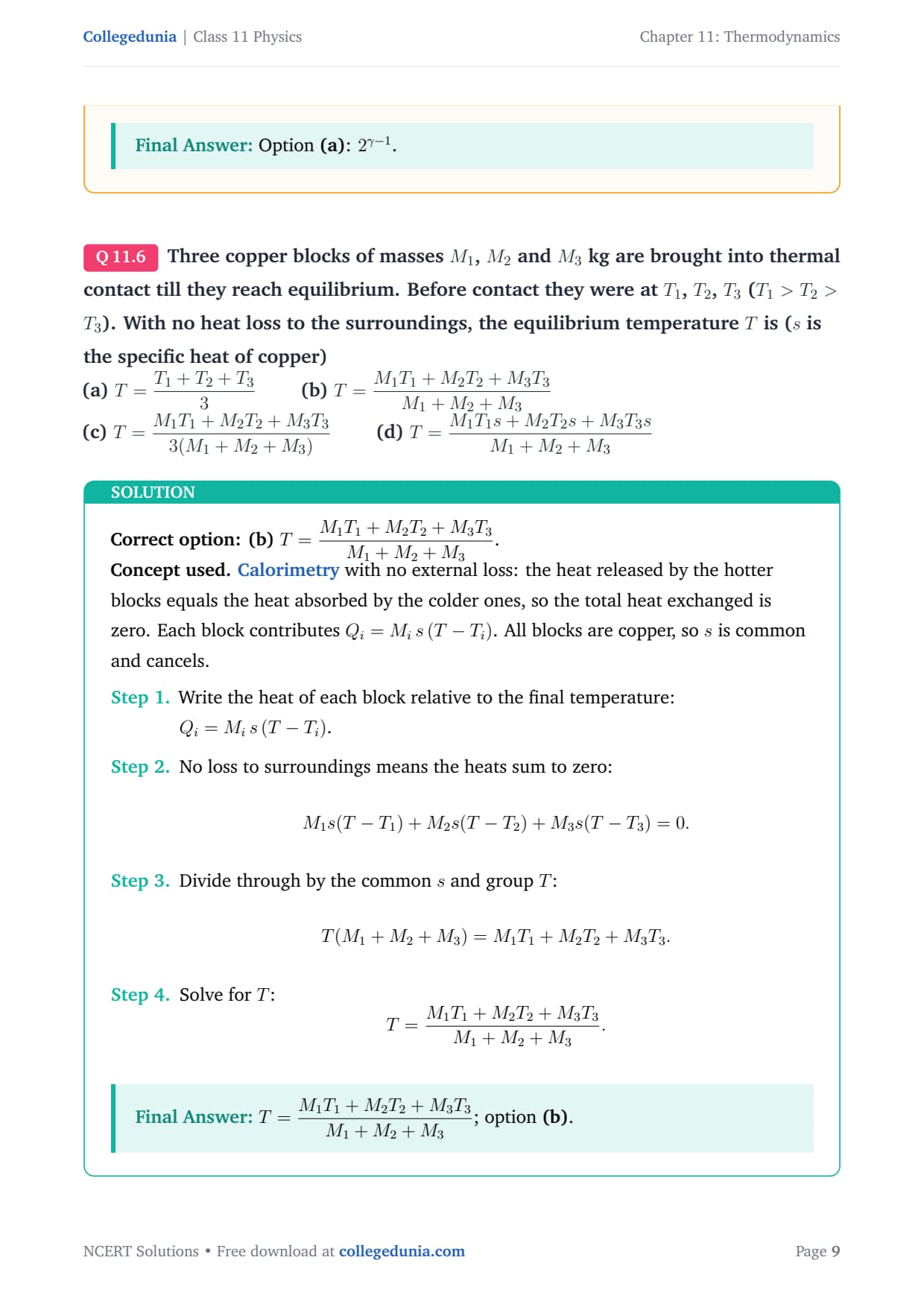
- Keeping a term that cancels: in Question 6 all three blocks share one material, so the specific heat divides out. The result is the mass-weighted mean temperature.
- The open-fridge question: Question 14 leaves a refrigerator door open. The machine dumps more heat at the back than it removes at the front, so the room gets hotter.
How the Exemplar Steps Up from the Class 11 Physics Textbook
The textbook exercise applies a rule you were just handed. The Exemplar asks you to choose the rule yourself, and often to explain why the tempting one does not apply.
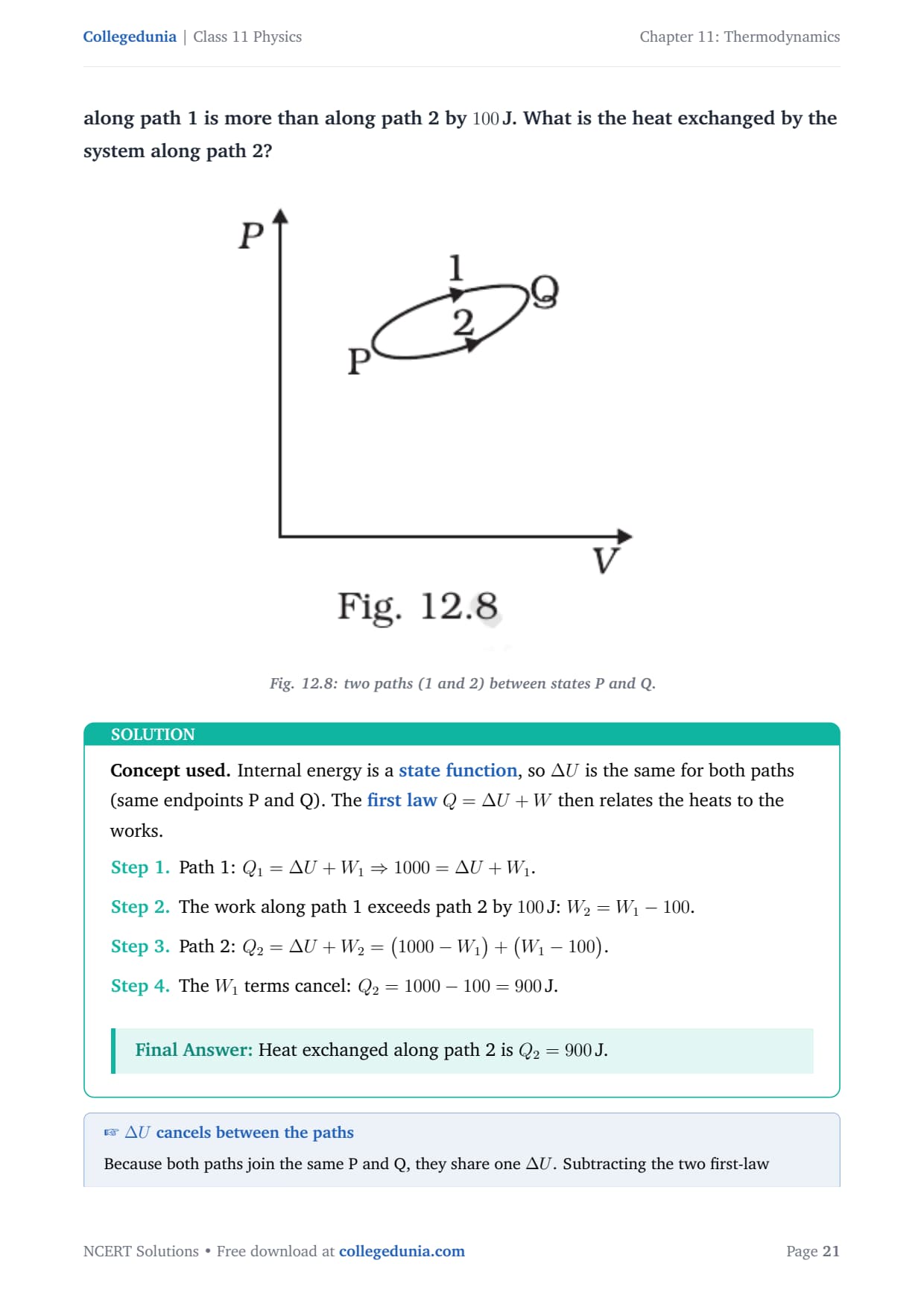
Question 13 shows the gap well. A system goes from P to Q along two different paths in Fig. 12.8. Path 1 receives 1000 J of heat and does 100 J more work than path 2. Because ΔU depends only on the endpoints, the heat along path 2 must be 900 J.
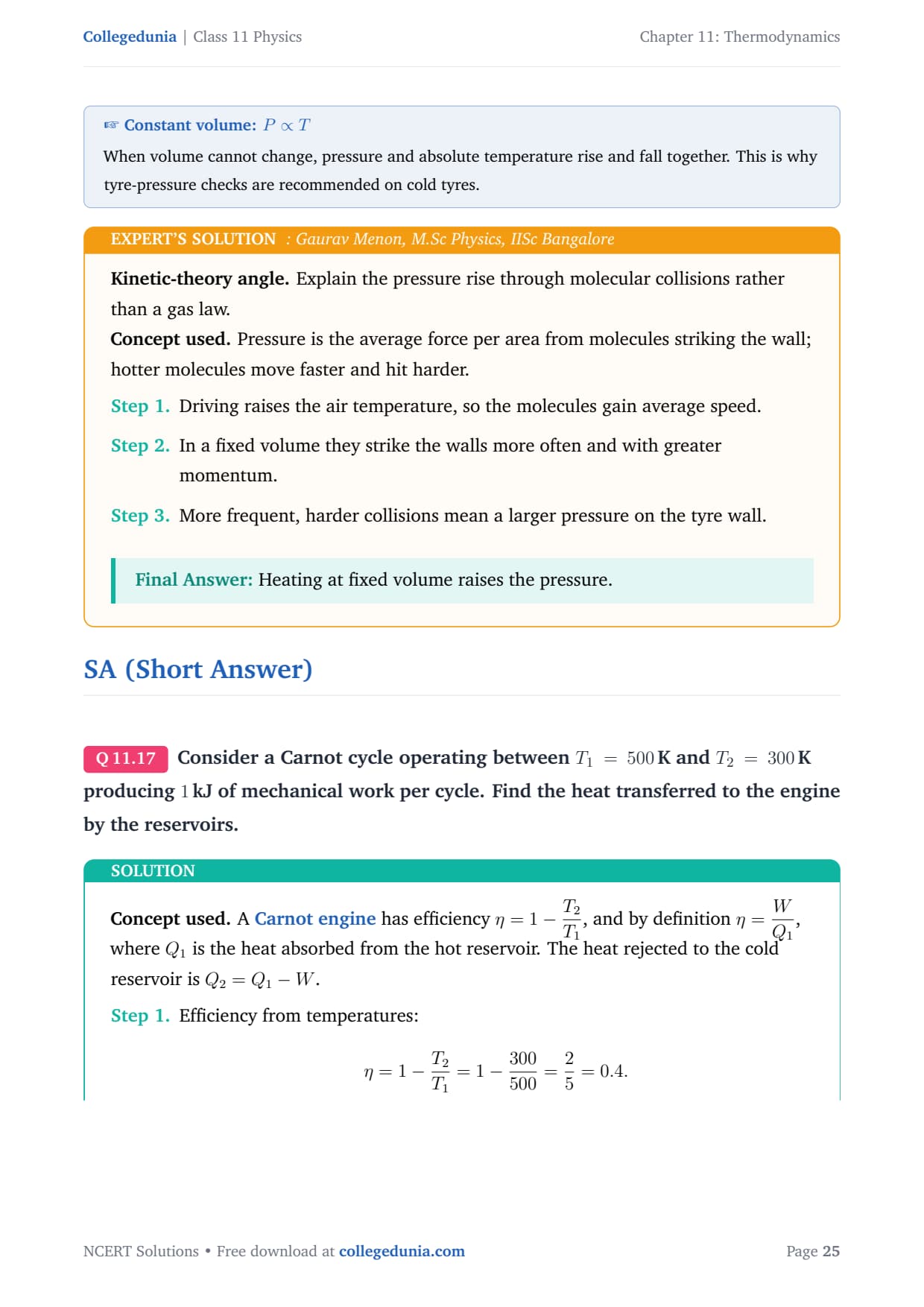
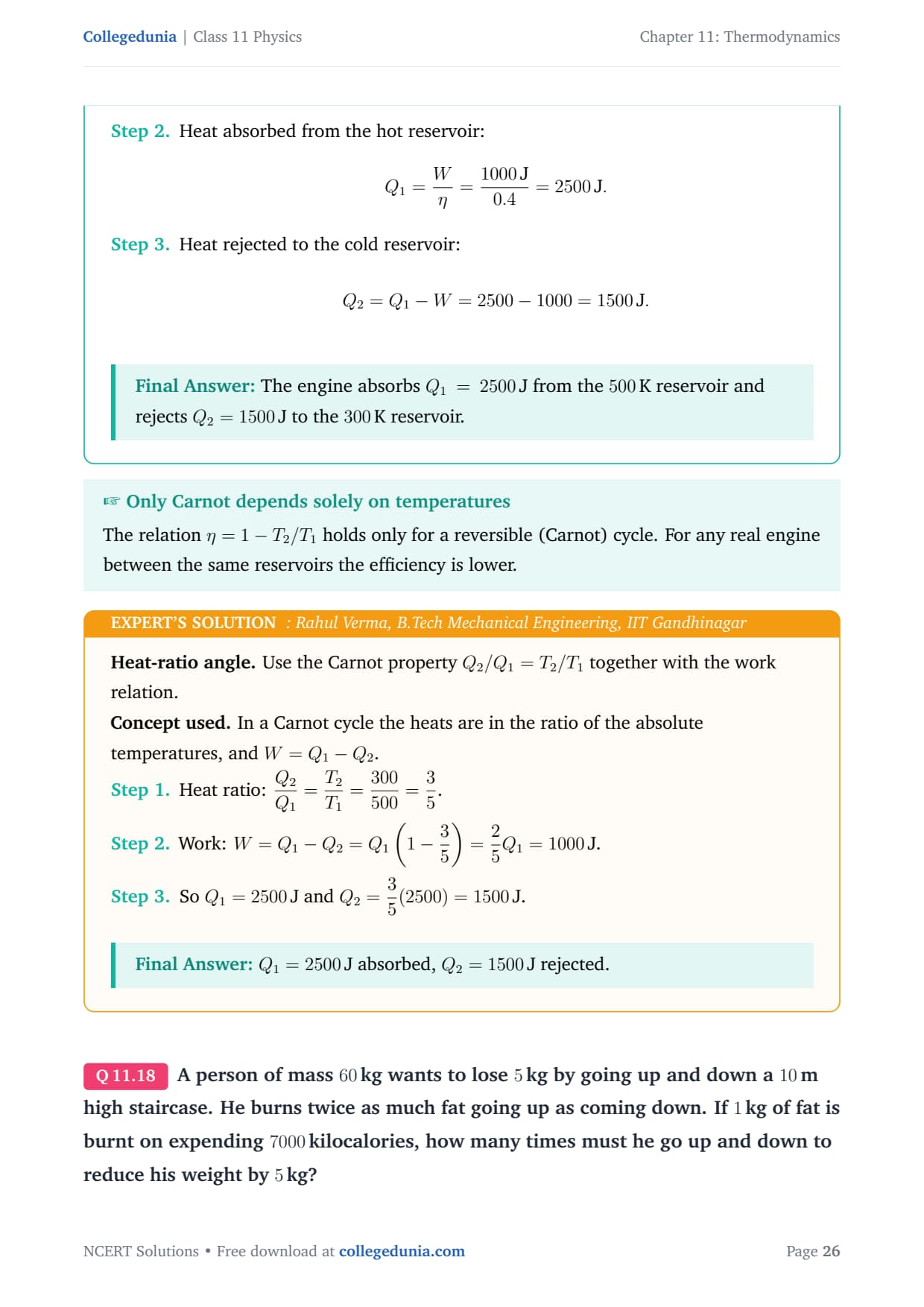
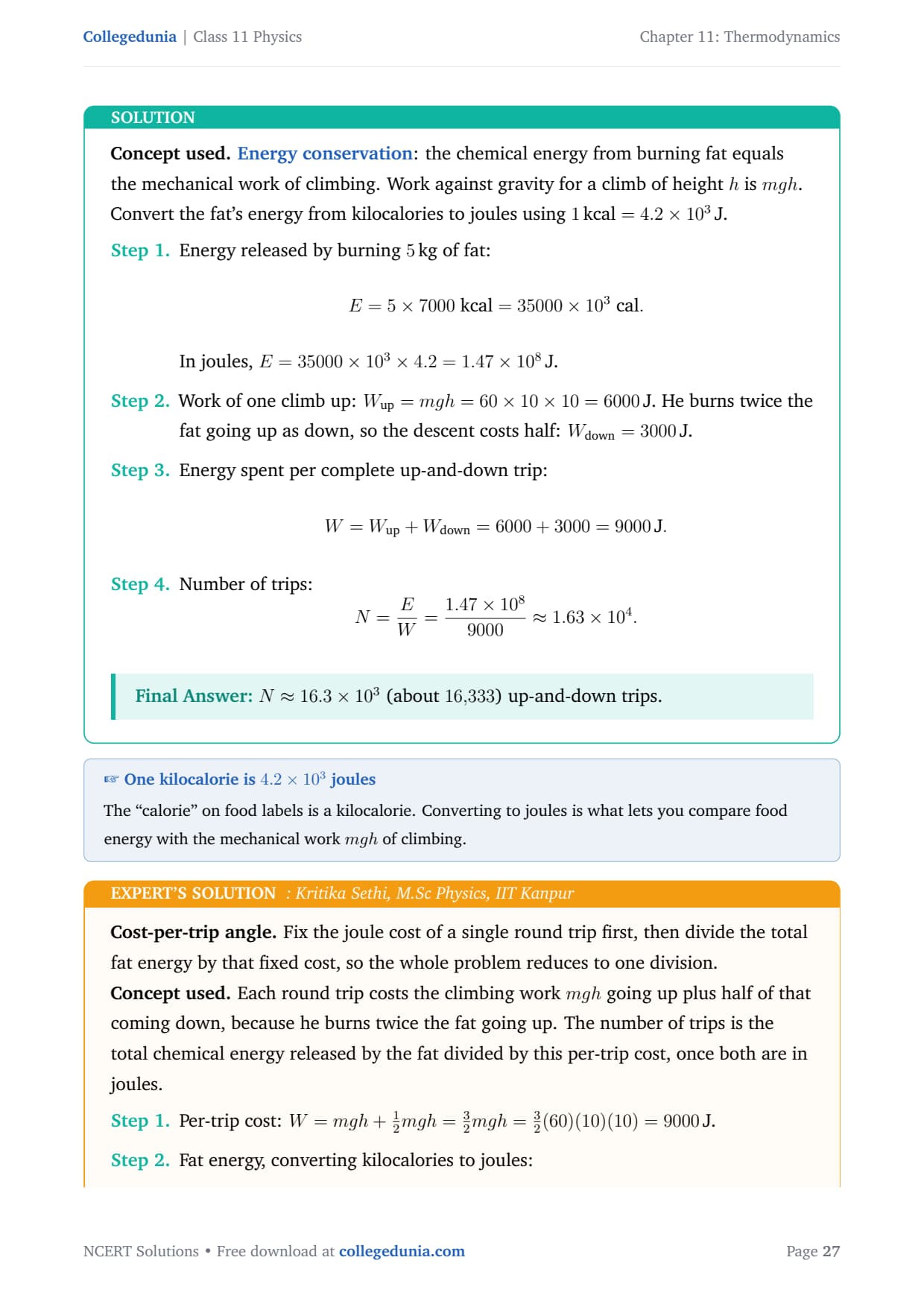
The numericals stay demanding too. Question 17 runs a Carnot cycle between 500 K and 300 K producing 1 kJ of work, which needs 2500 J from the hot reservoir and rejects 1500 J. Question 18 works out to roughly 16,300 staircase climbs to burn 5 kg of fat.
How to Use These NCERT Exemplar Solutions for Boards, JEE and NEET
Try each question before you open the solution. The Exemplar rewards the attempt far more than the reading.
- Boards: the VSA and SA questions match the 2 and 3 mark board pattern closely
- JEE Main: start with the five Long Answer problems, since JEE tests cyclic processes the same way
- NEET: the MCQ I set covers the recall-level engine and process questions NEET repeats yearly
Student Feedback
Students who used Collegedunia's Class 11 Physics Exemplar Solutions told us the sign convention was the hardest part of this chapter. Around 7 in 10 said the step-by-step P-V work made the cyclic-process questions manageable.
Other Resources for Class 11 Physics Thermodynamics
Collegedunia has the full study material set for this chapter. Use the Notes for a first read and the Exemplar for practice.
Also Check:
- NCERT Solutions for Class 11 Physics Chapter 11
- Class 11 Physics Chapter 11 Notes
- Class 11 Physics Chapter 11 Handwritten Notes
- Class 11 Physics Chapter 11 NCERT Book PDF
- Class 11 Physics Chapter 11 Exemplar Questions with Solutions
NCERT Exemplar Solutions for Other Class 11 Physics Chapters
Every chapter below has the same step-by-step treatment and a free PDF.
Thermodynamics Class 11 Physics NCERT Exemplar Solutions FAQs
Ques. How many questions are there in the Class 11 Physics Thermodynamics Exemplar?
Ans. Chapter 11 has 27 questions. They are split into 6 MCQ I, 5 MCQ II, 5 Very Short Answer, 6 Short Answer and 5 Long Answer questions. All 27 are solved in the free 45-page PDF on this page.
Ques. Why does the Exemplar book call Thermodynamics Chapter 12 instead of Chapter 11?
Ans. The Exemplar publication still uses the older chapter order, so it prints Thermodynamics as Chapter Twelve and labels its figures Fig. 12.1 to Fig. 12.12. The new textbook lists the same chapter as 11. The content is identical, so use our Chapter 11 solutions with the Exemplar book without worrying about the number.
Ques. Why does the answer key mark 0.25 kg in Question 2 when the data give 0.025 kg?
Ans. Substituting the printed values into m = Q/L gives 14.5/580, which is 0.025 kg. That number is not among the options, and the official key records option (a), 0.25 kg. There is a known factor-of-ten mismatch between the printed data and the key, so choose option (a) in the exam and note the arithmetic separately.
Ques. Why is the work done in Question 4 negative?
Ans. The work done over a closed cycle equals the area enclosed on the P-V diagram, and its sign follows the direction of travel. The cycle ABCDA in Fig. 12.4 runs anticlockwise, which means work is done on the gas rather than by it. The area gives a magnitude of 2P0V0, so the answer is −2P0V0.
Ques. Can you cool a room by leaving the refrigerator door open?
Ans. No, the room gets warmer. A refrigerator moves heat from inside to the coils at the back, and it also adds the motor's electrical energy as heat. Treating the room and the fridge as one sealed box, more heat leaves the back than the open door removes, so the net effect is warming.



Comments