




These Kinship, Caste and Class handwritten notes turn the whole early-society chapter into clean, handwritten pages for fast last-minute revision. They follow the 2026-27 CBSE syllabus and Theme 3 of Themes in Indian History Part I. Students get the dates, dynasties, source names and the rule-versus-practice idea in a pen-on-paper format that is easy to skim before a test.
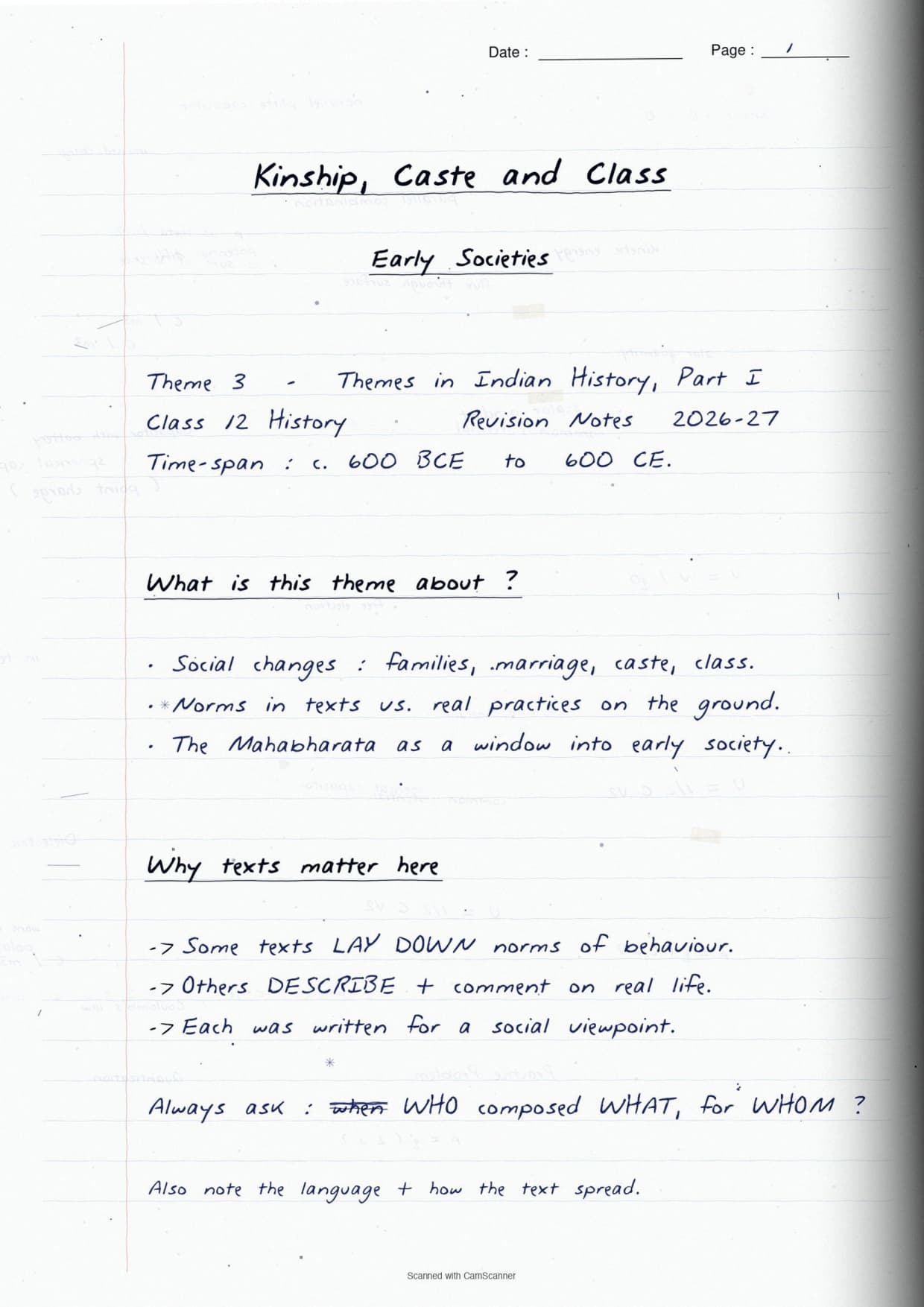
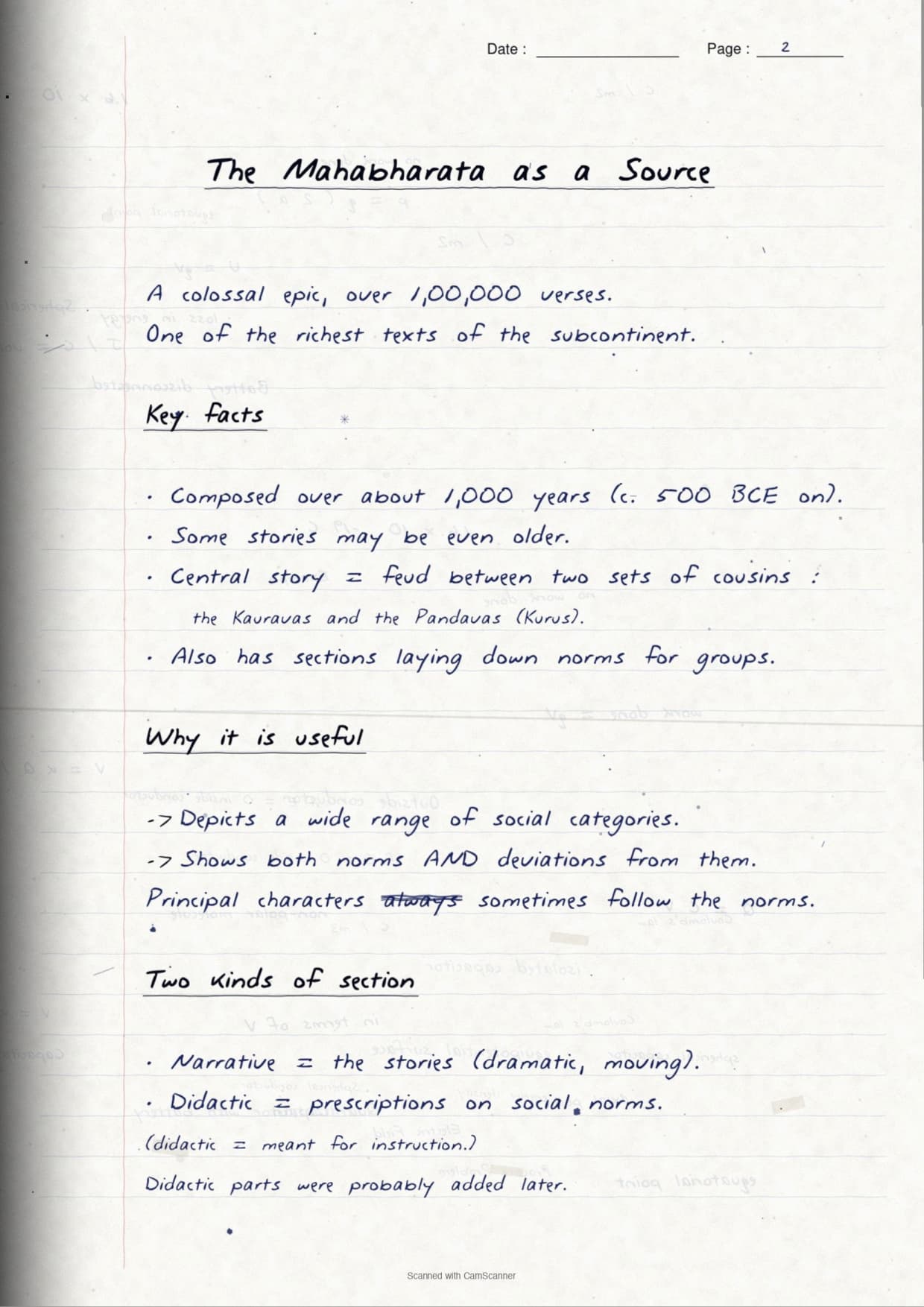
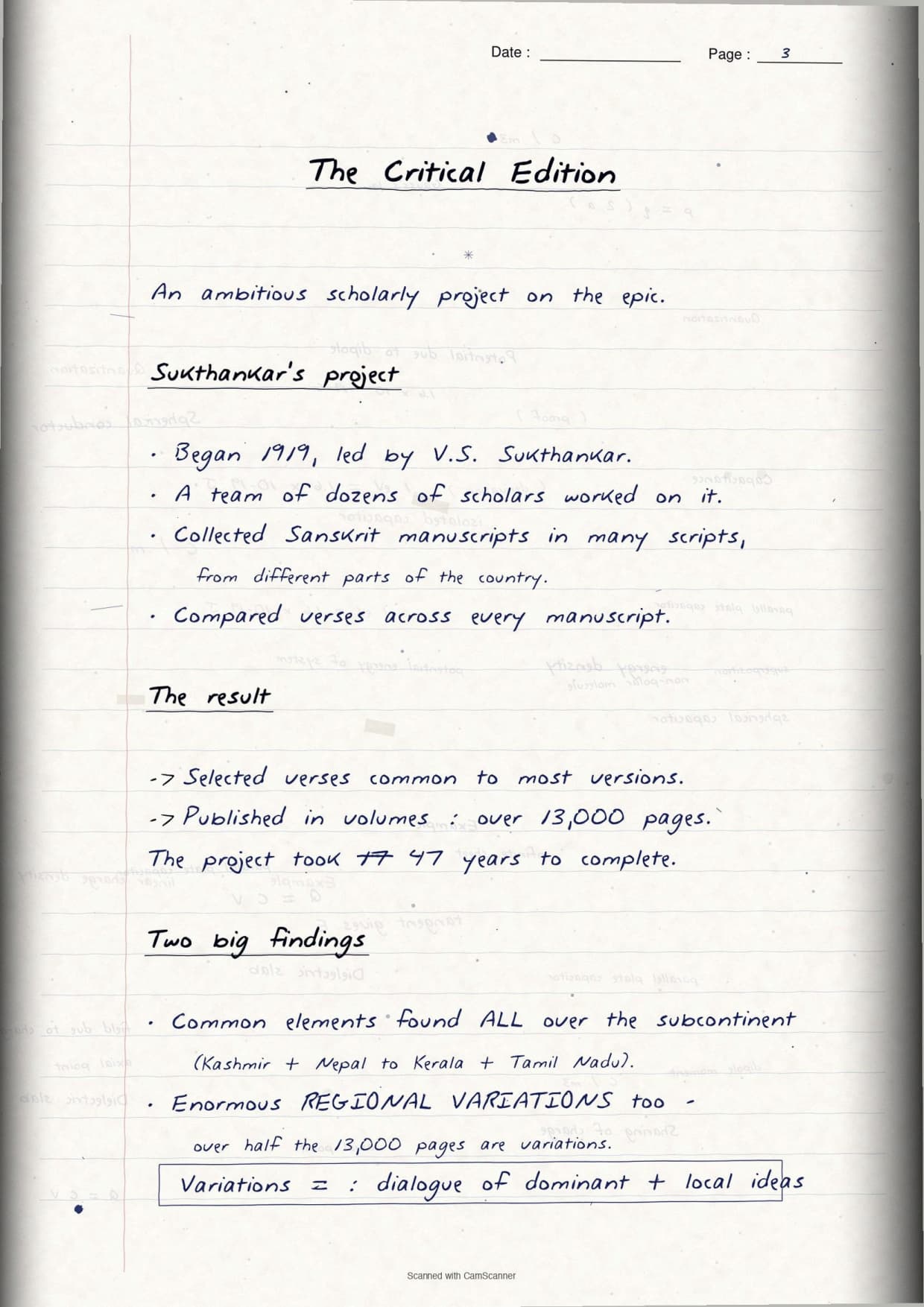
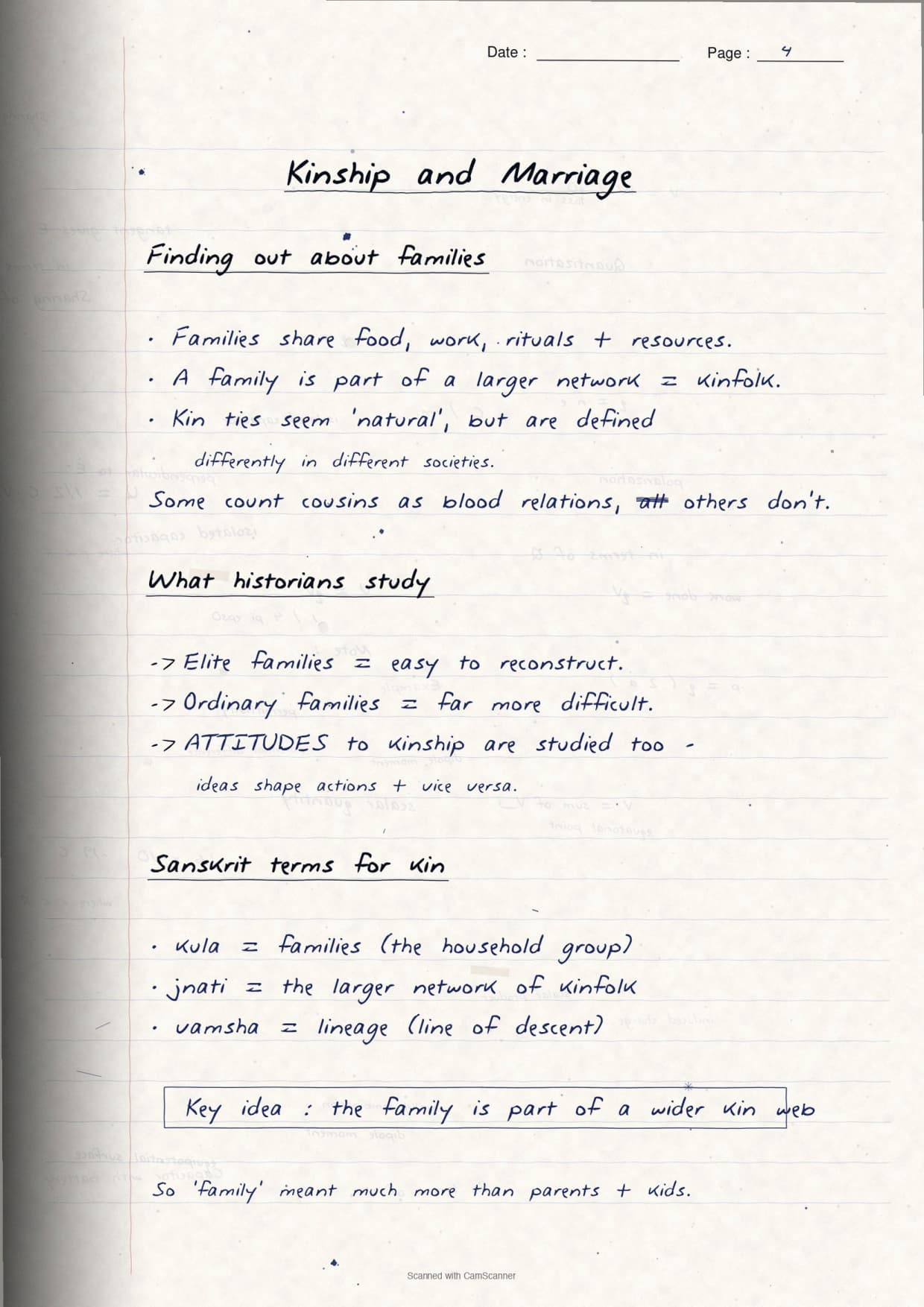
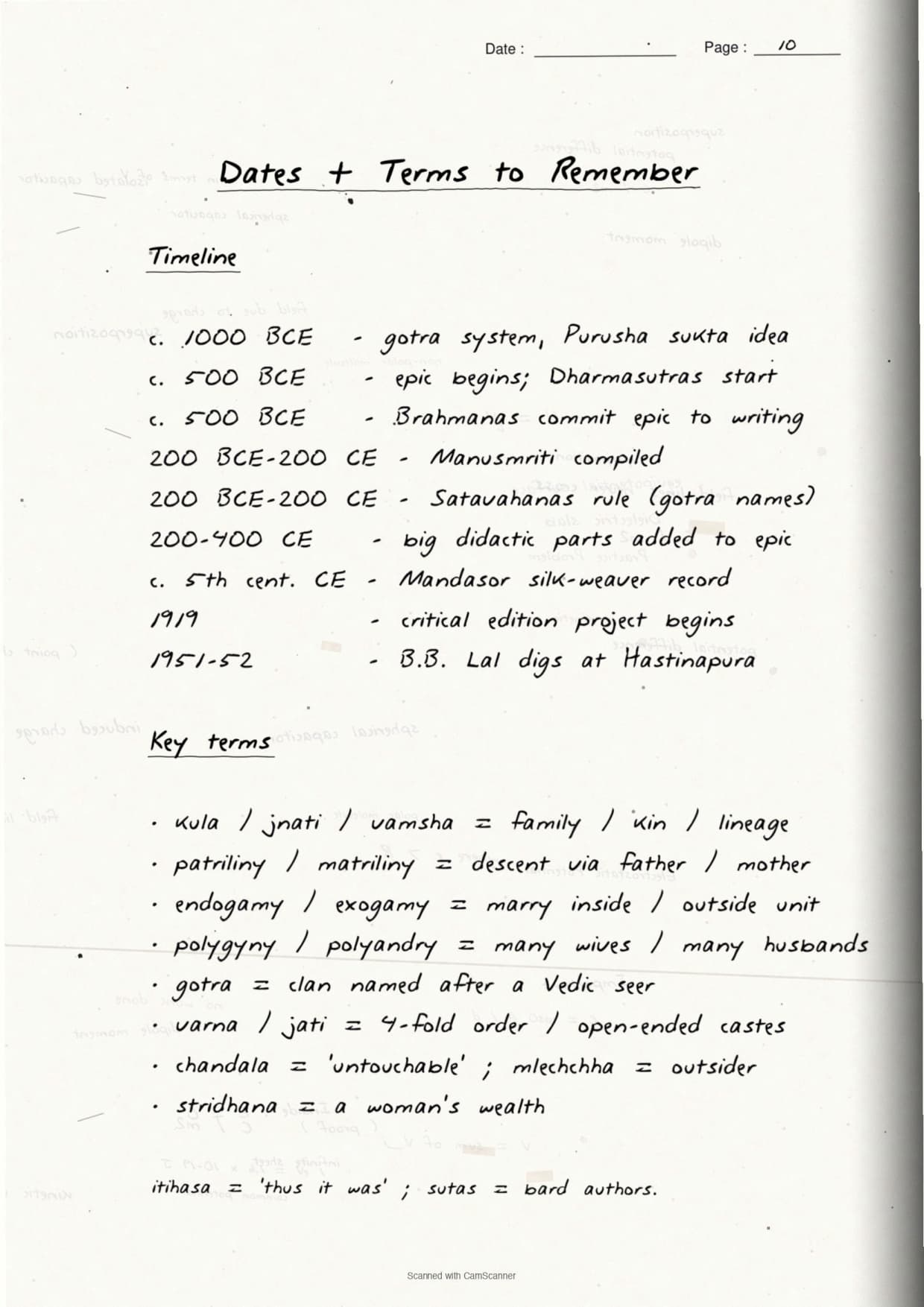
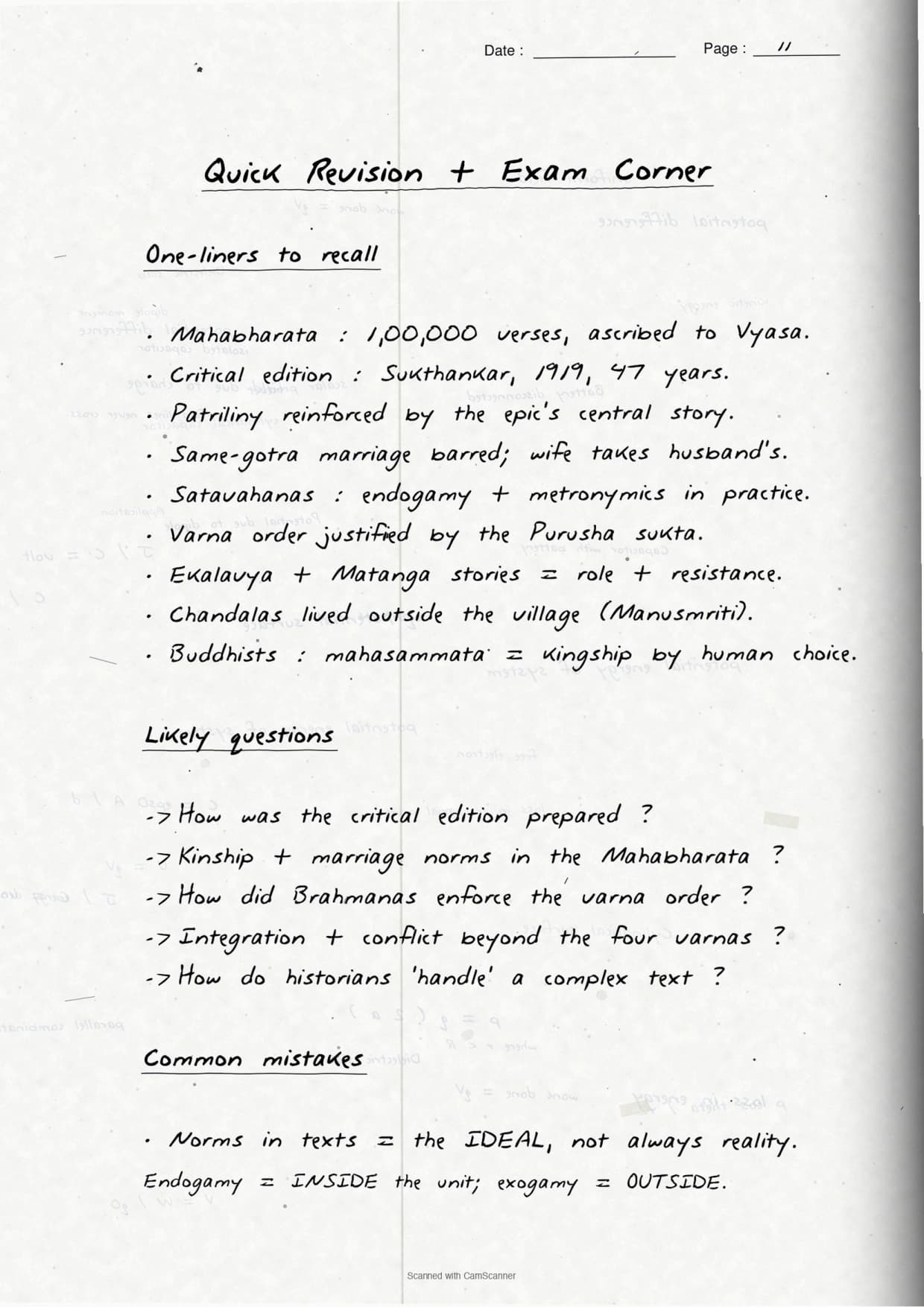
- Handwritten pages with boxed key terms and labelled charts.
- This Class 12 History chapter usually carries 6 to 8 marks in the board paper.
- Pairs with the NCERT Solutions, Notes and Book PDF linked lower on this page.
These Kinship, Caste and Class handwritten notes are prepared from the official NCERT Themes in Indian History Part I and checked against the last five years of CBSE board papers.
Student Feedback: In a Collegedunia poll of 8,210 Class 12 History students before the 2026 boards, 73% of students said handwritten notes felt faster to revise from than printed text for this chapter. Most students used the boxed varna chart and the dynasty list to recall the caste answers in the exam.
Source: 2026-27 Class 12 History student poll. Sample of 8,210 students from CBSE schools across 12 states.
|
Table of Contents |
What These Handwritten Notes Include
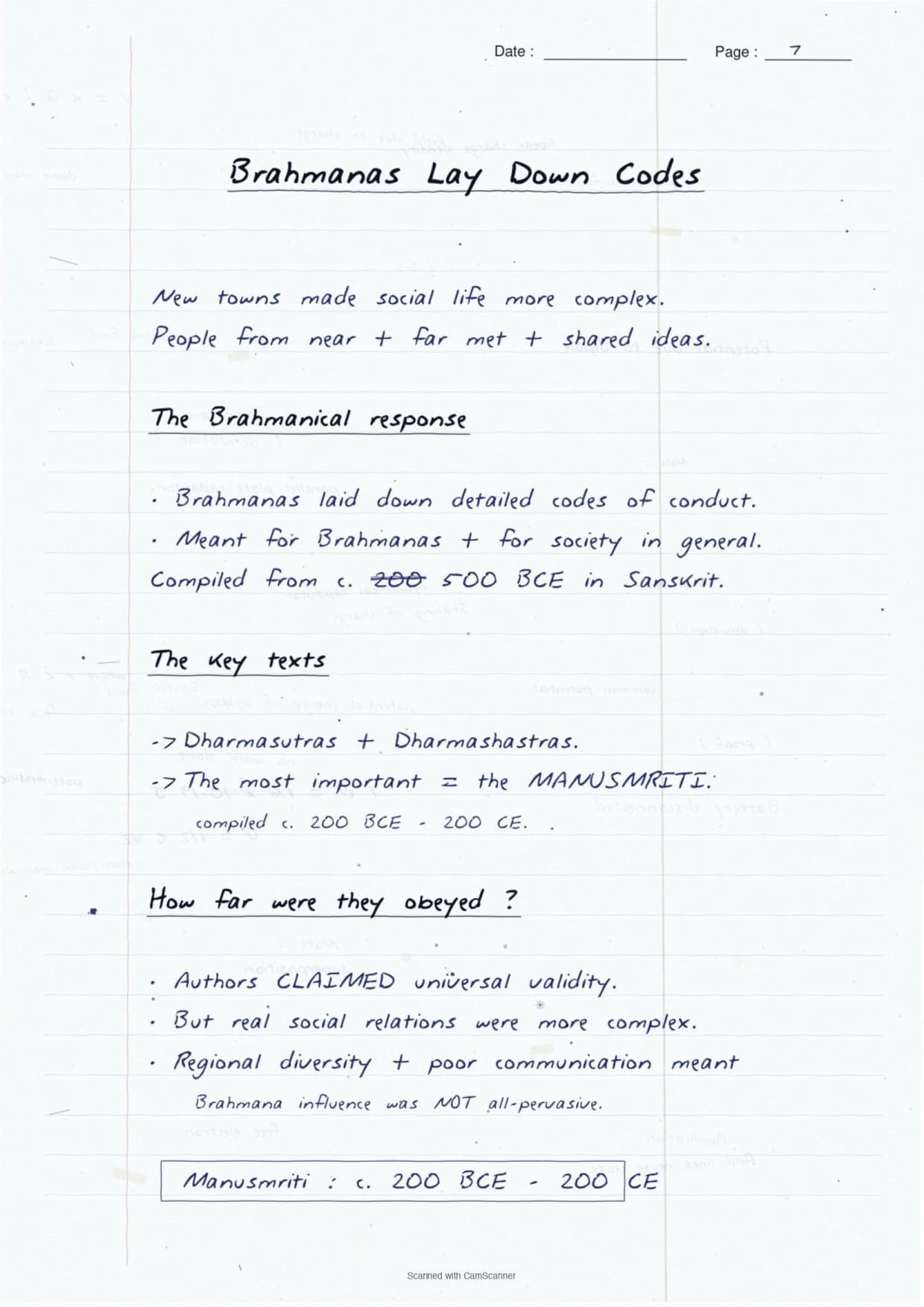
Kinship, Caste and Class is the third chapter of Themes in Indian History Part I. It studies early Indian society from about 600 BCE to 600 CE, read mostly through the Mahabharata, the Dharmashastras and inscriptions. These handwritten notes condense the chapter into pages a student can read in one sitting.
Every page is built around the three words in the chapter title:
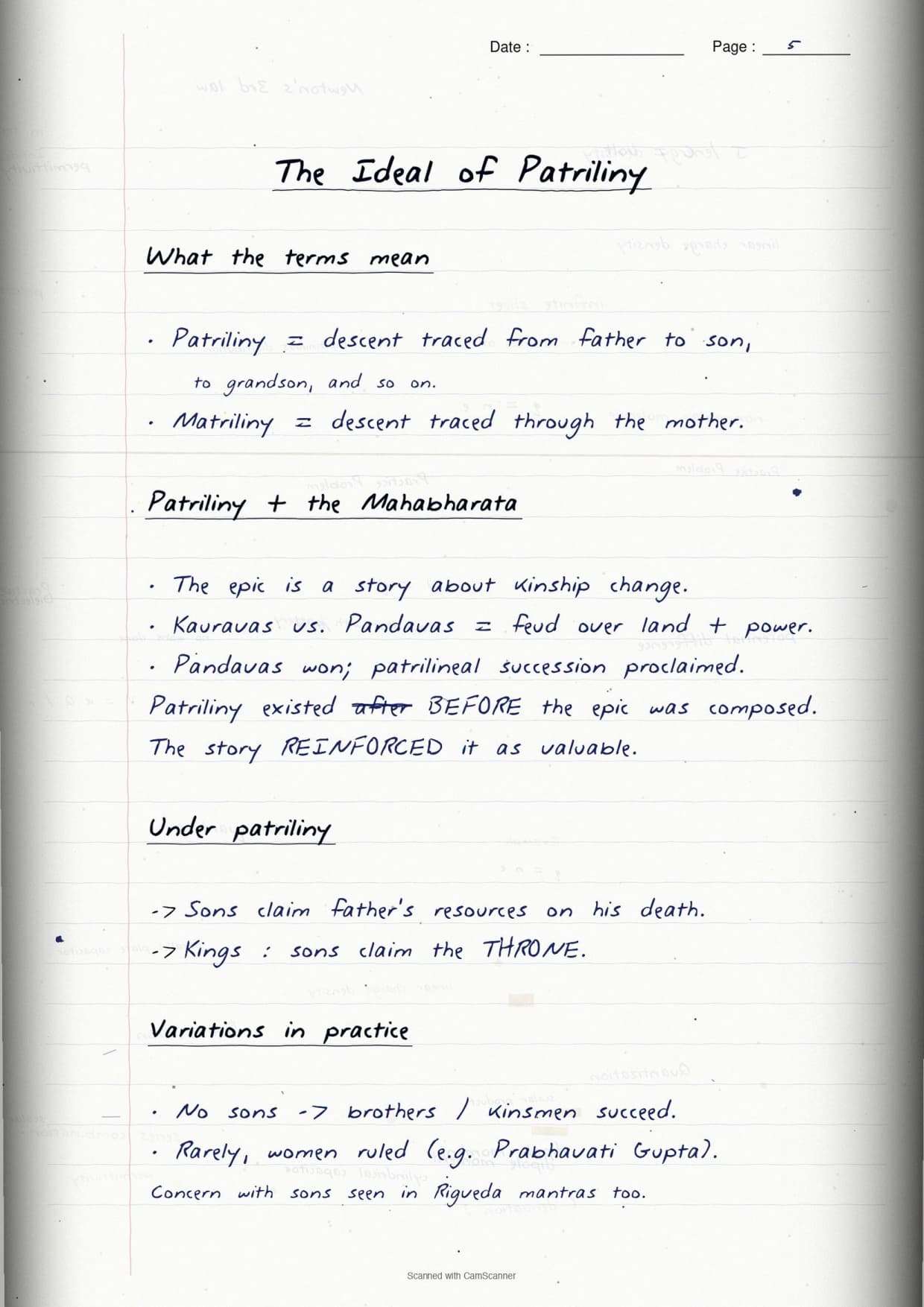
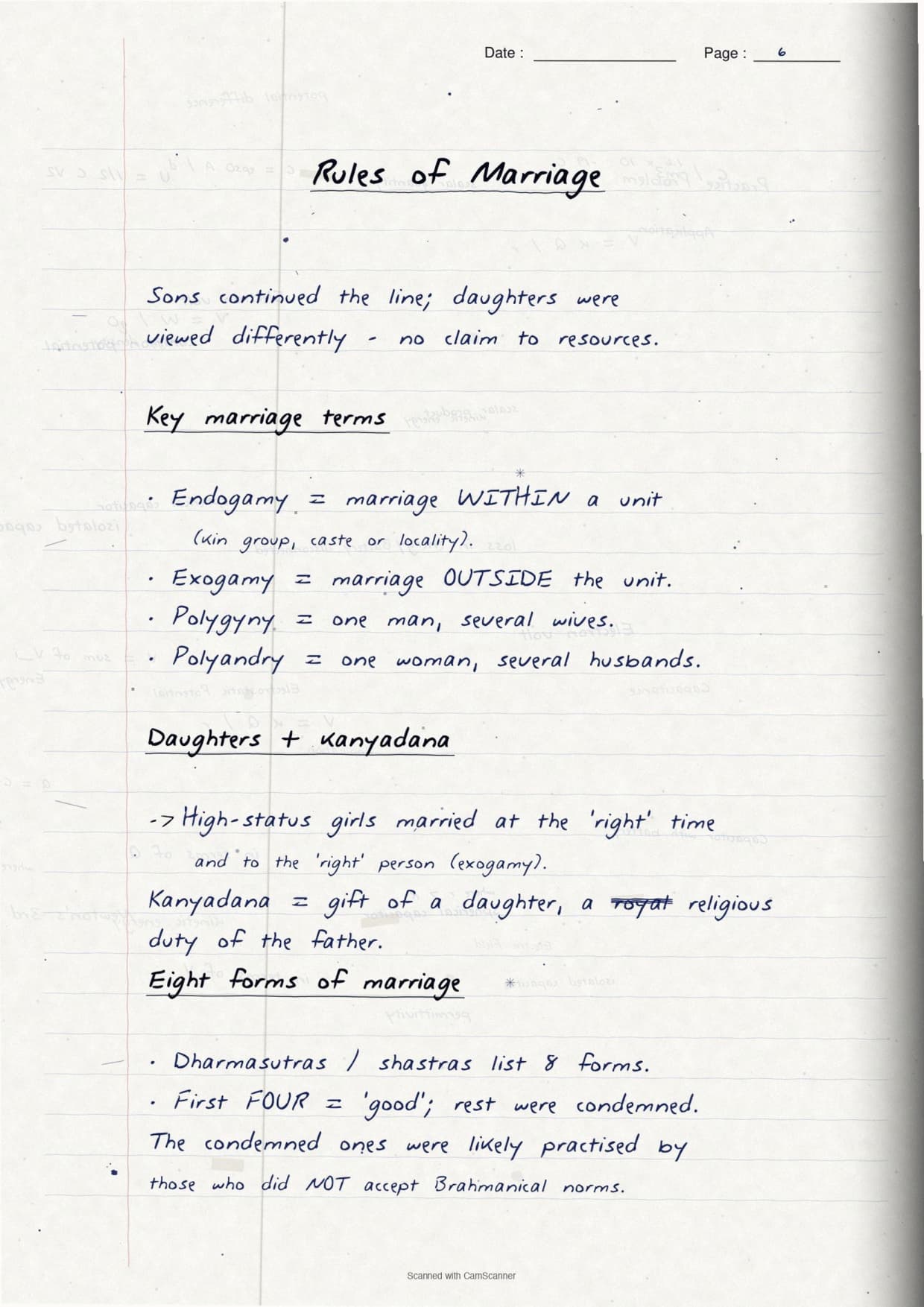
- Kinship pages cover patriliny, the gotra and the rules of marriage.
- Caste pages cover the varna and jati order and non-Kshatriya kings.
- Class pages cover gender, property and who controlled wealth.
Because the notes are handwritten, the key terms sit in boxes and the important dates are underlined, so the eye jumps straight to them. This makes the kinship, caste and class handwritten notes ideal for a last revision when there is no time to read full paragraphs. Pair each Brahmanical rule with the case that breaks it, and the whole of chapter 3 history class 12 falls into place.
Kinship, Patriliny and Gotra Pages
The kinship pages start with patriliny, tracing descent from father to son. They box the marriage rules of gotra and exogamy beside it, so students can copy the lists straight onto the answer sheet. The point underlined in red is why these rules mattered most to elite families.
- Patriliny: sons inherit land, cattle, wealth and, for kings, the throne; the Mahabharata ends by proclaiming it.
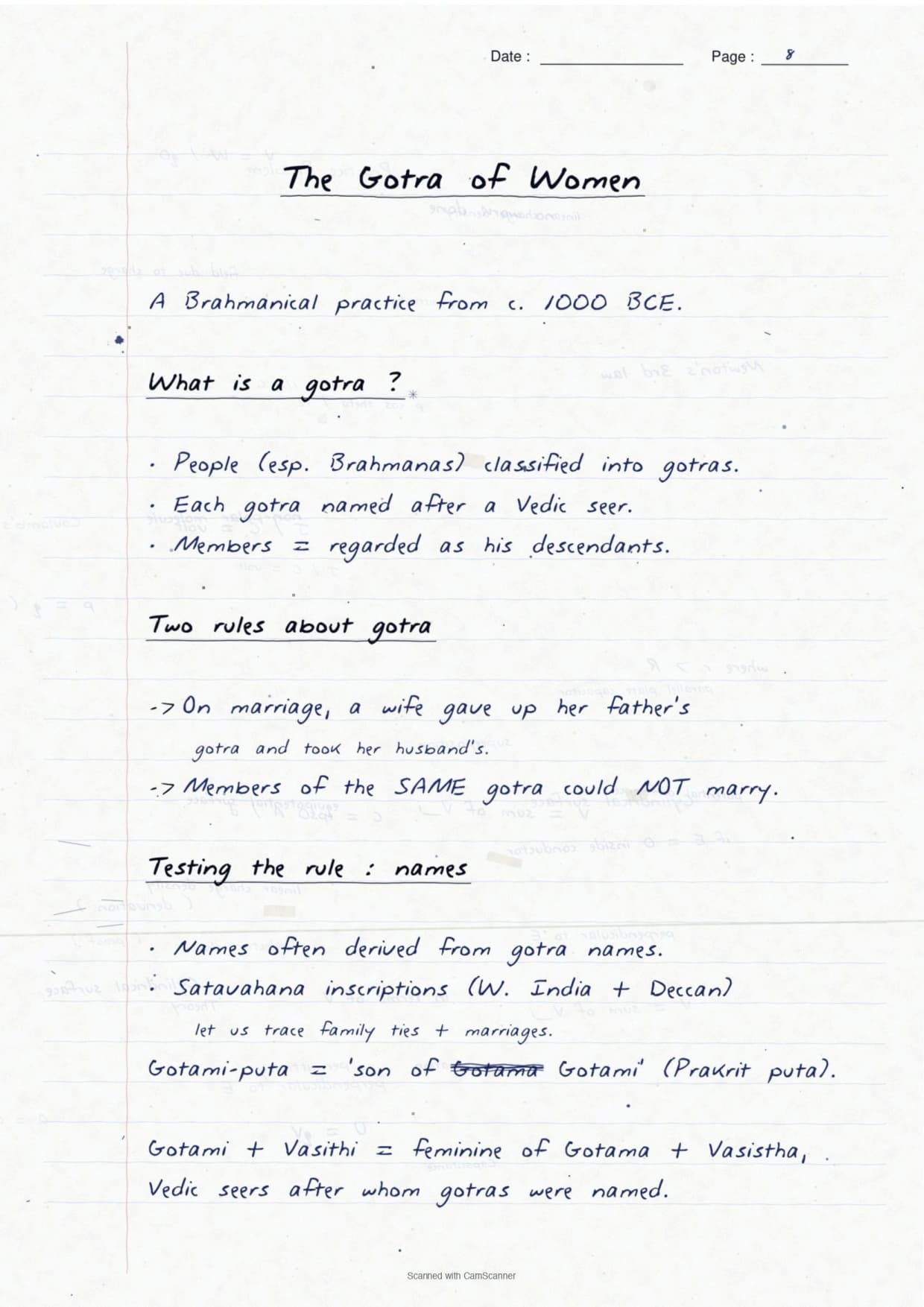
- Gotra rule: a wife took her husband's gotra; same-gotra people could not marry.
- Exogamy: the Brahmanical ideal was to marry outside the kin group.
- Kanyadana: gifting a daughter in marriage was the father's religious duty.
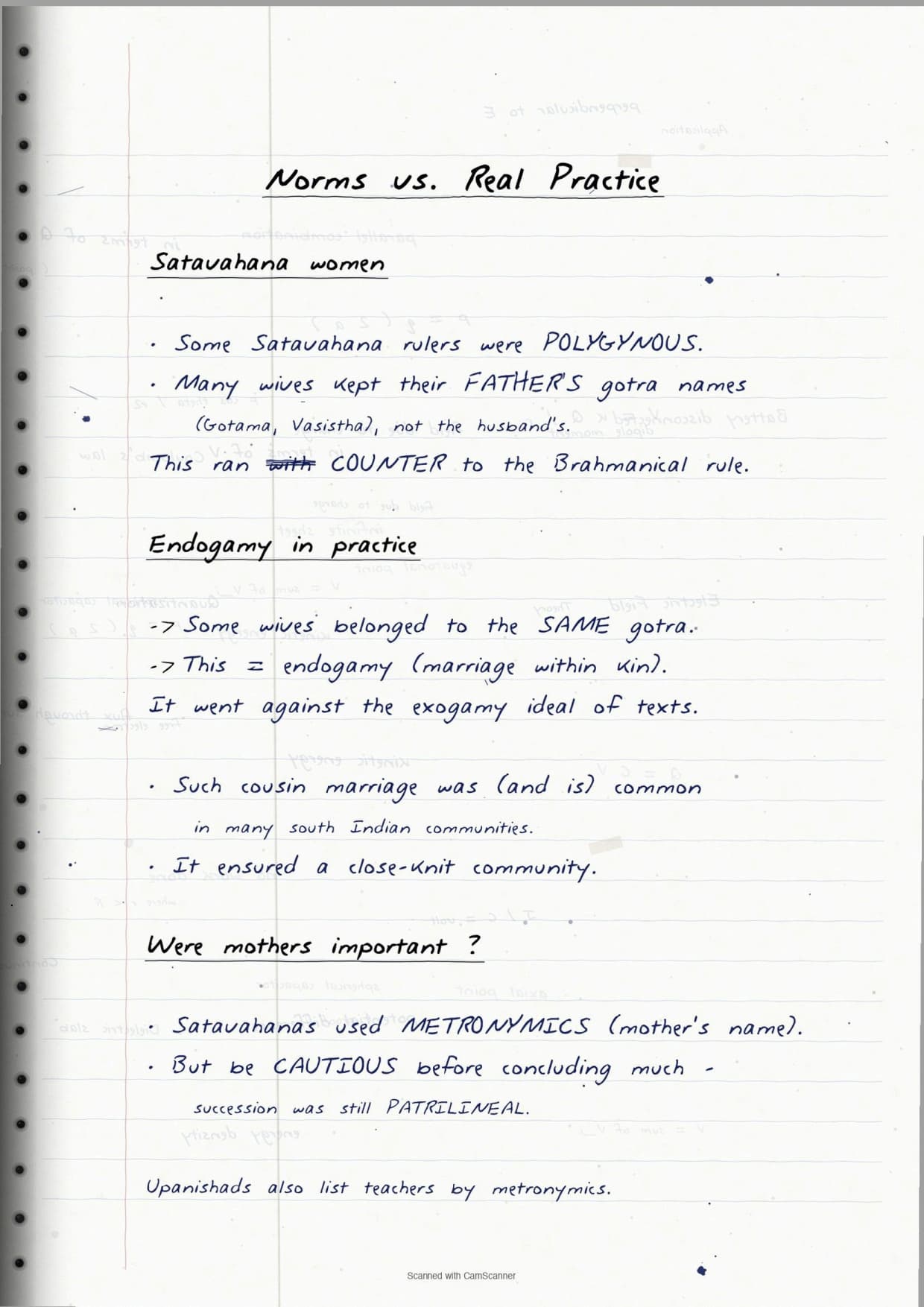
The notes underline the key point: elite families had property and thrones, so they needed a fixed rule of descent more than ordinary families did. A hand-drawn arrow links each rule to the case that breaks it, so students see at a glance that Satavahana queens kept their fathers' gotras against the rule.
Varna, Jati and Non-Kshatriya Kings Pages
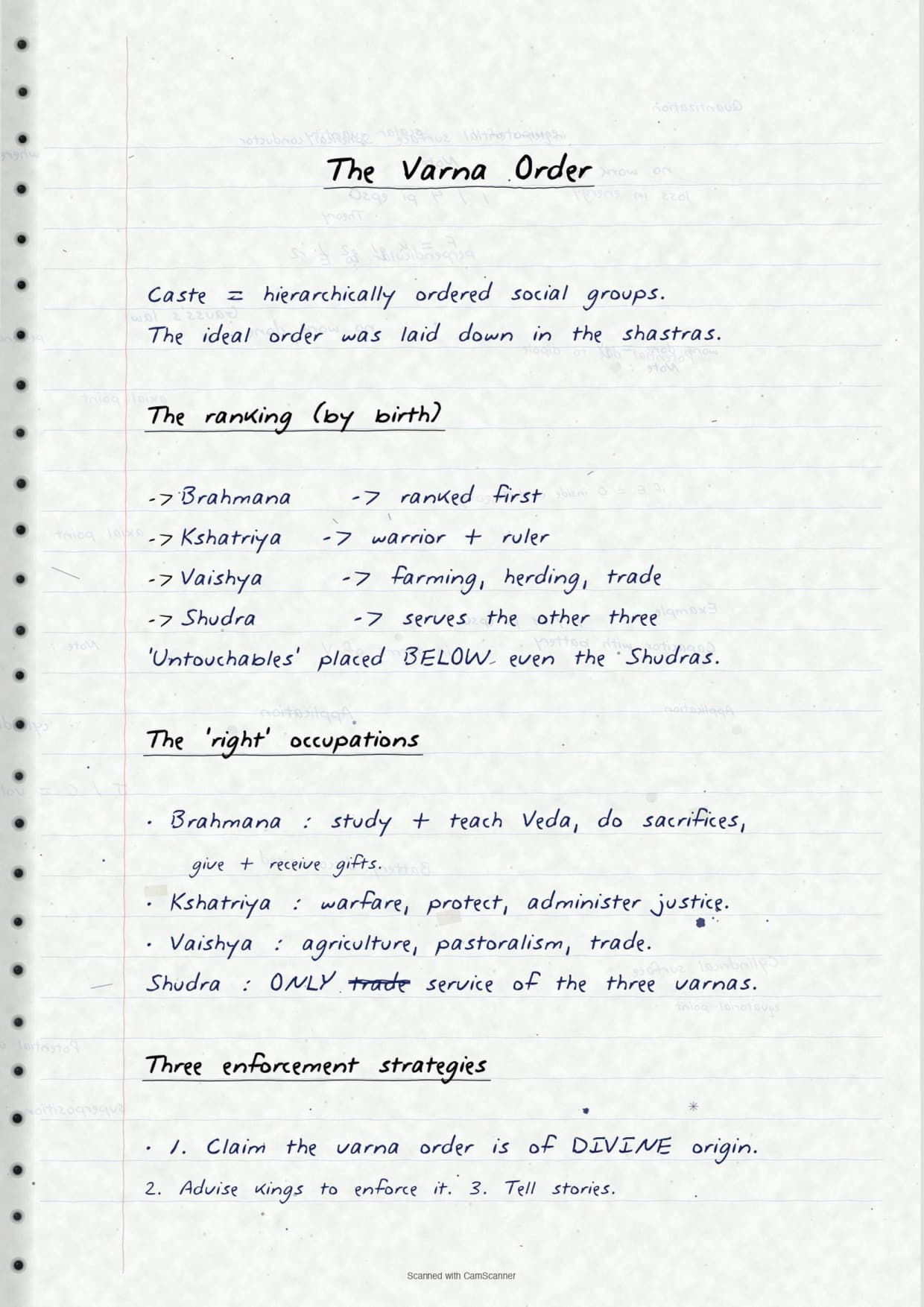
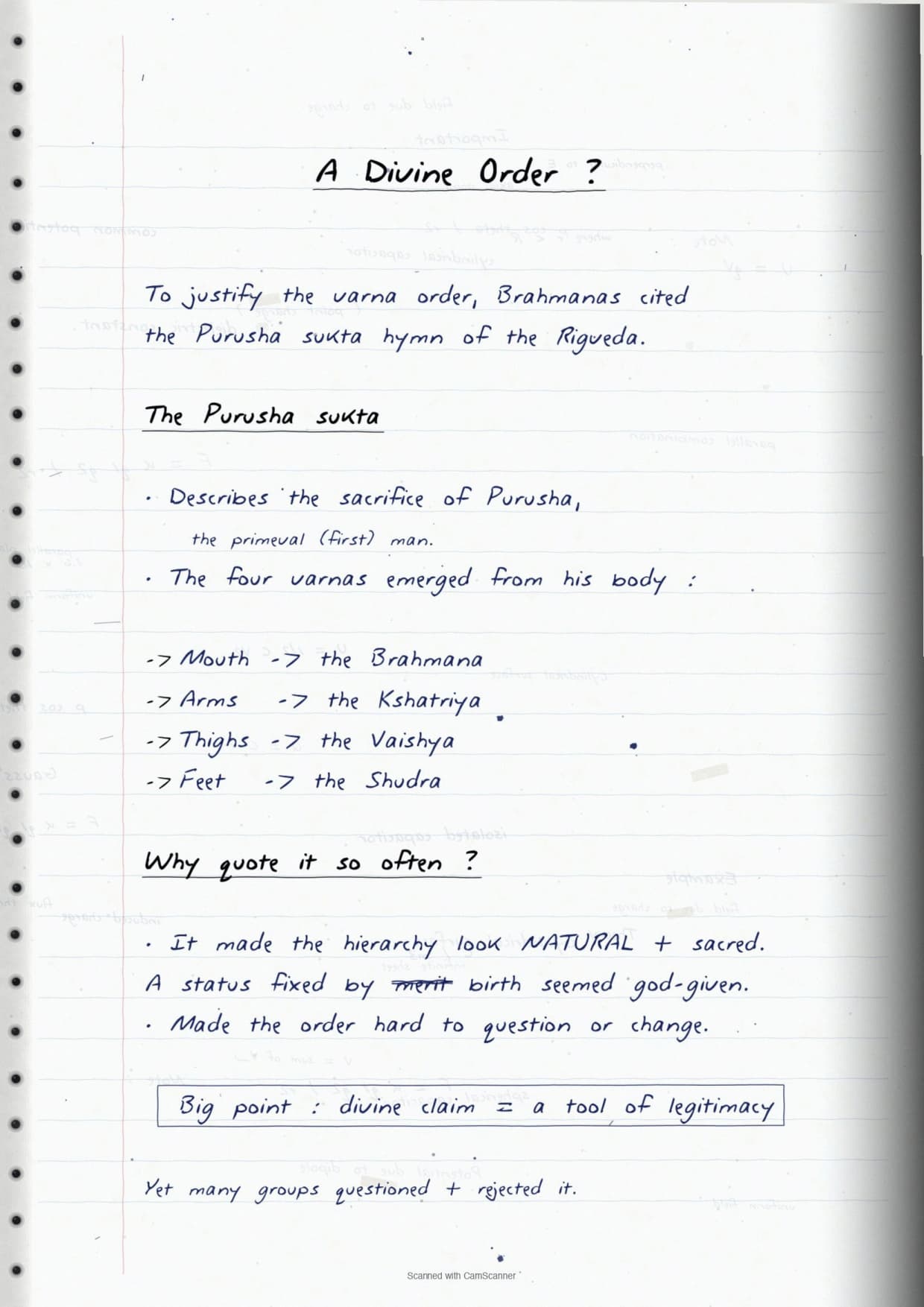
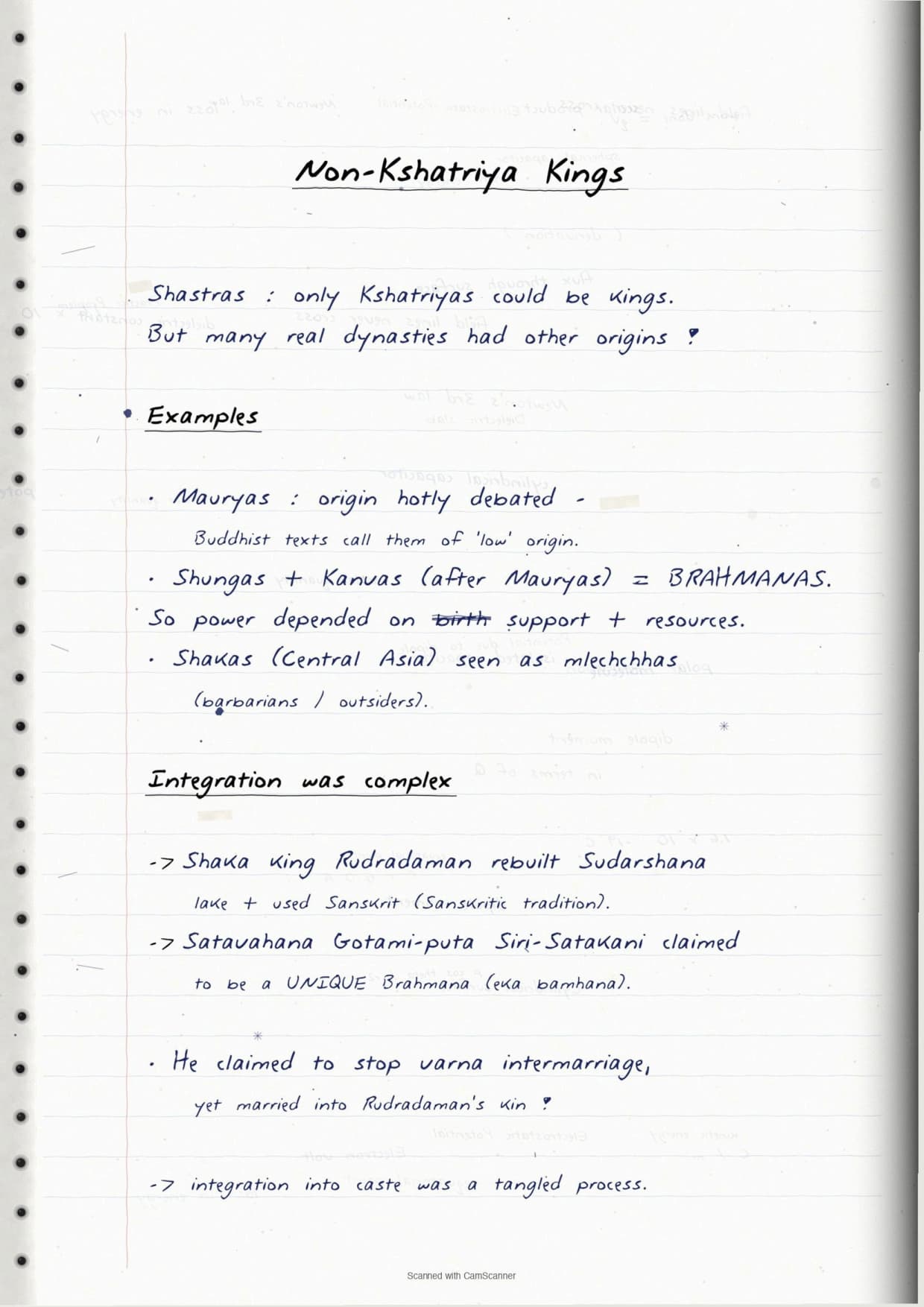
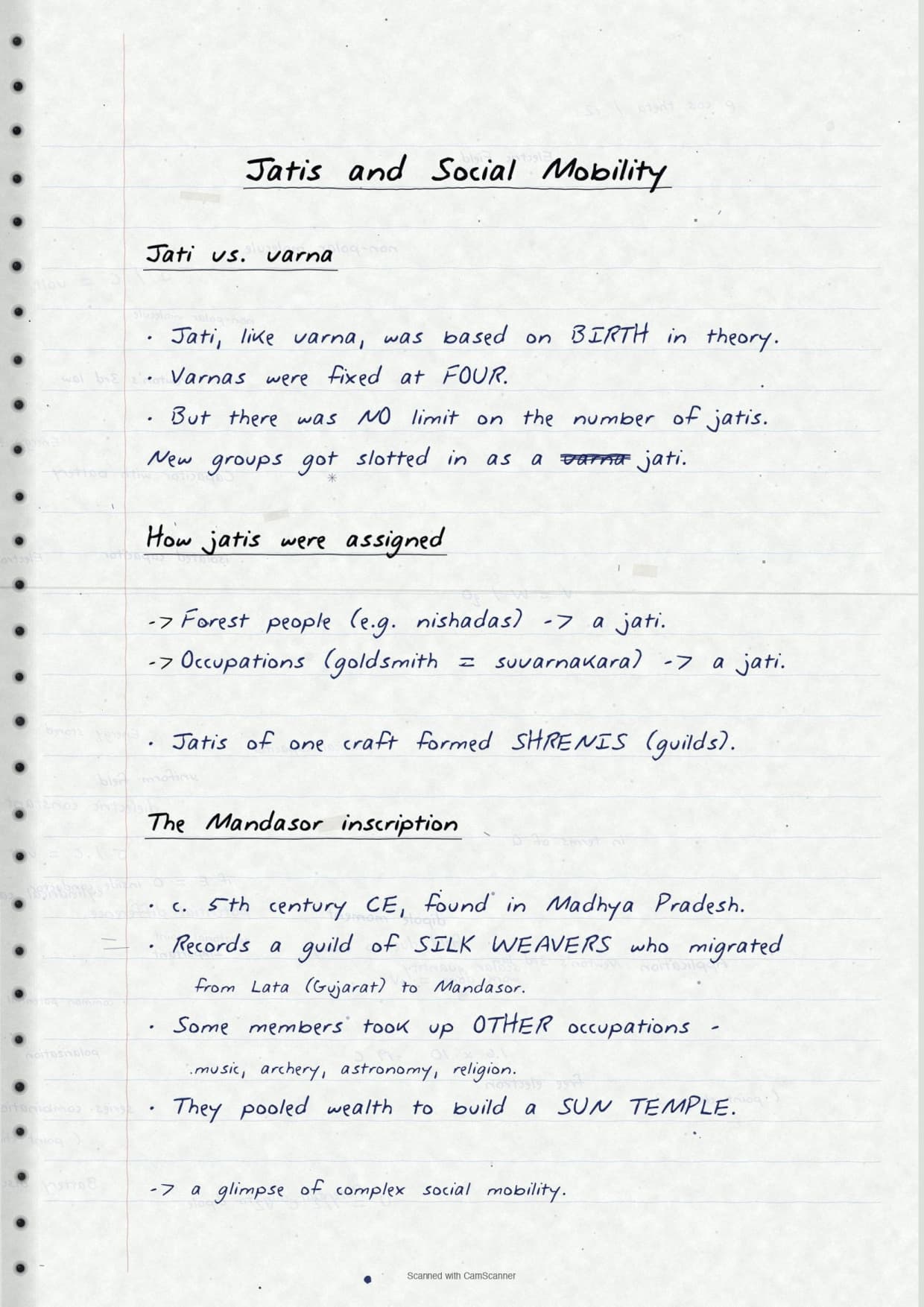
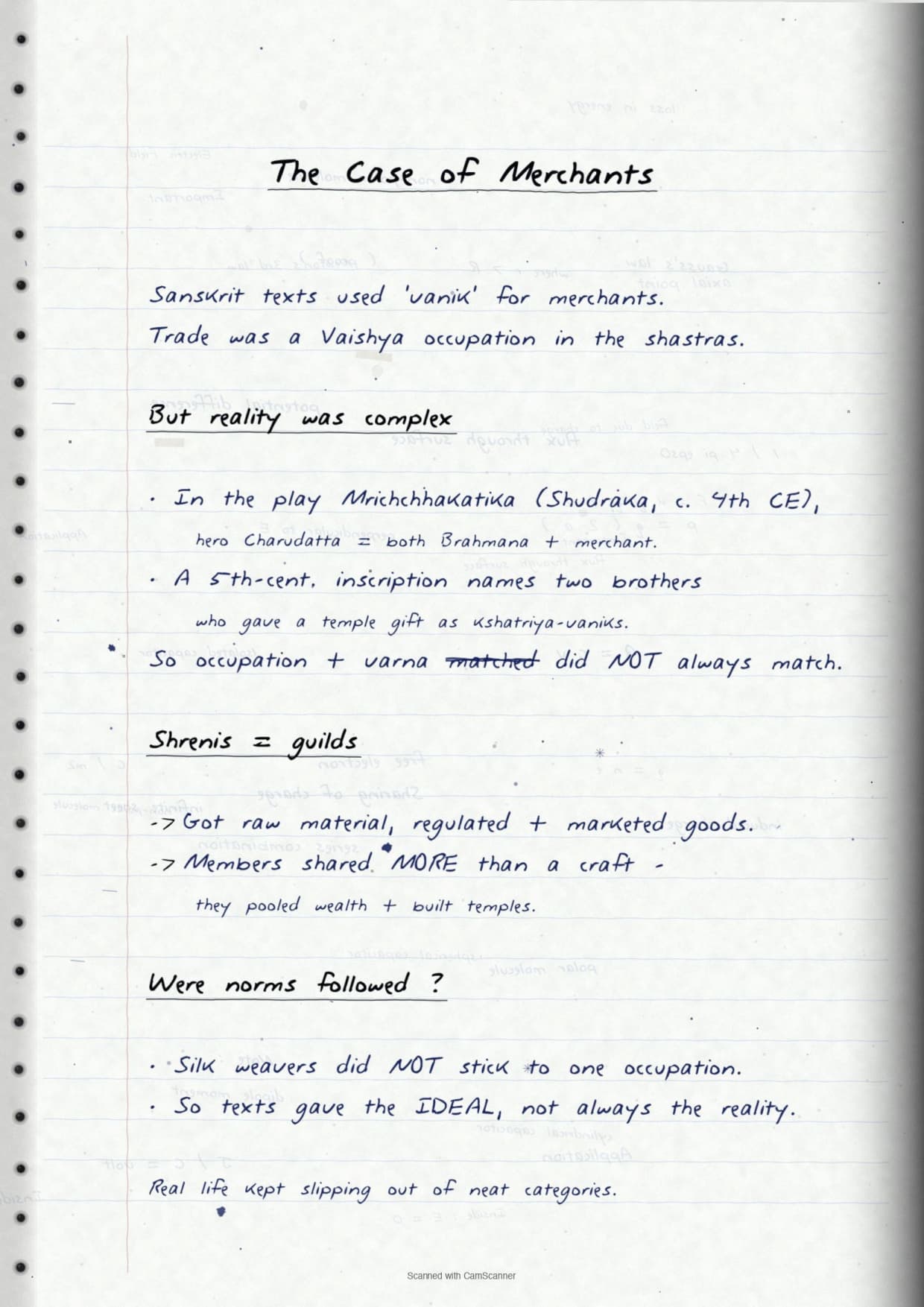
The caste pages carry a boxed chart of the four varnas from the Purusha sukta, then a table of the kings who broke the Kshatriya rule. The chart marks each varna and its place, so students can describe the order in detail. The table below lists what the pages cover for quick revision.
| Dynasty | Origin and what it shows |
|---|---|
| Mauryas | Disputed origin; Buddhist texts call them Kshatriyas, Brahmanical texts call them "low". |
| Shungas and Kanvas | Successors of the Mauryas; they were Brahmanas. |
| Shakas | Central-Asian outsiders, treated as mlechchhas, yet adopted Sanskritic ways. |
| Satavahanas | King Gotami-puta claimed to be a "unique Brahmana" while upholding varna. |
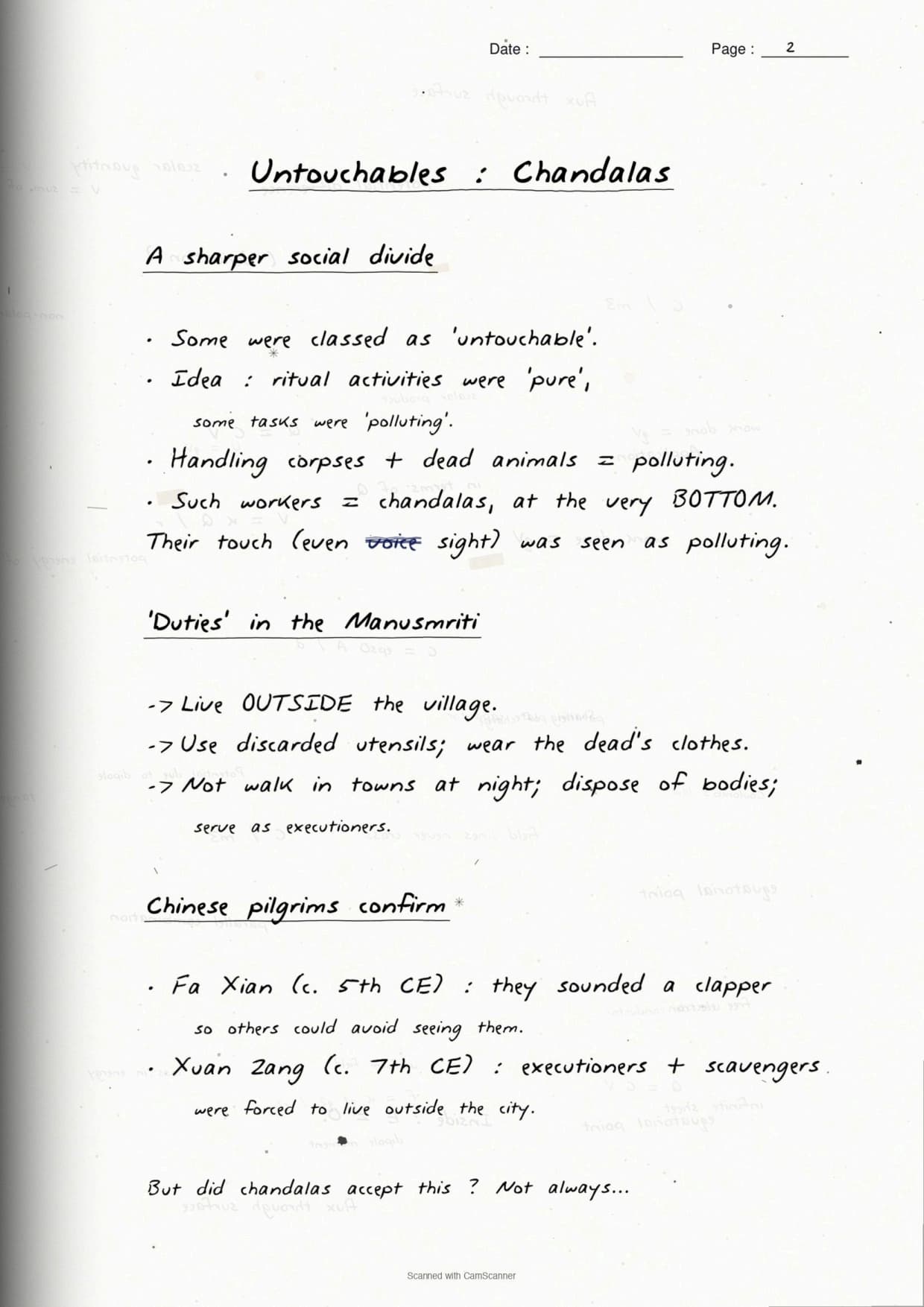
The notes box the single most important point in red ink: political power went to whoever could gather support and resources, not to Kshatriya birth. The pages also note the jati order below the four varnas and the way chandalas were pushed to "untouchability", so the caste picture is complete on one sheet.
Gender, Property and Social Contract Pages
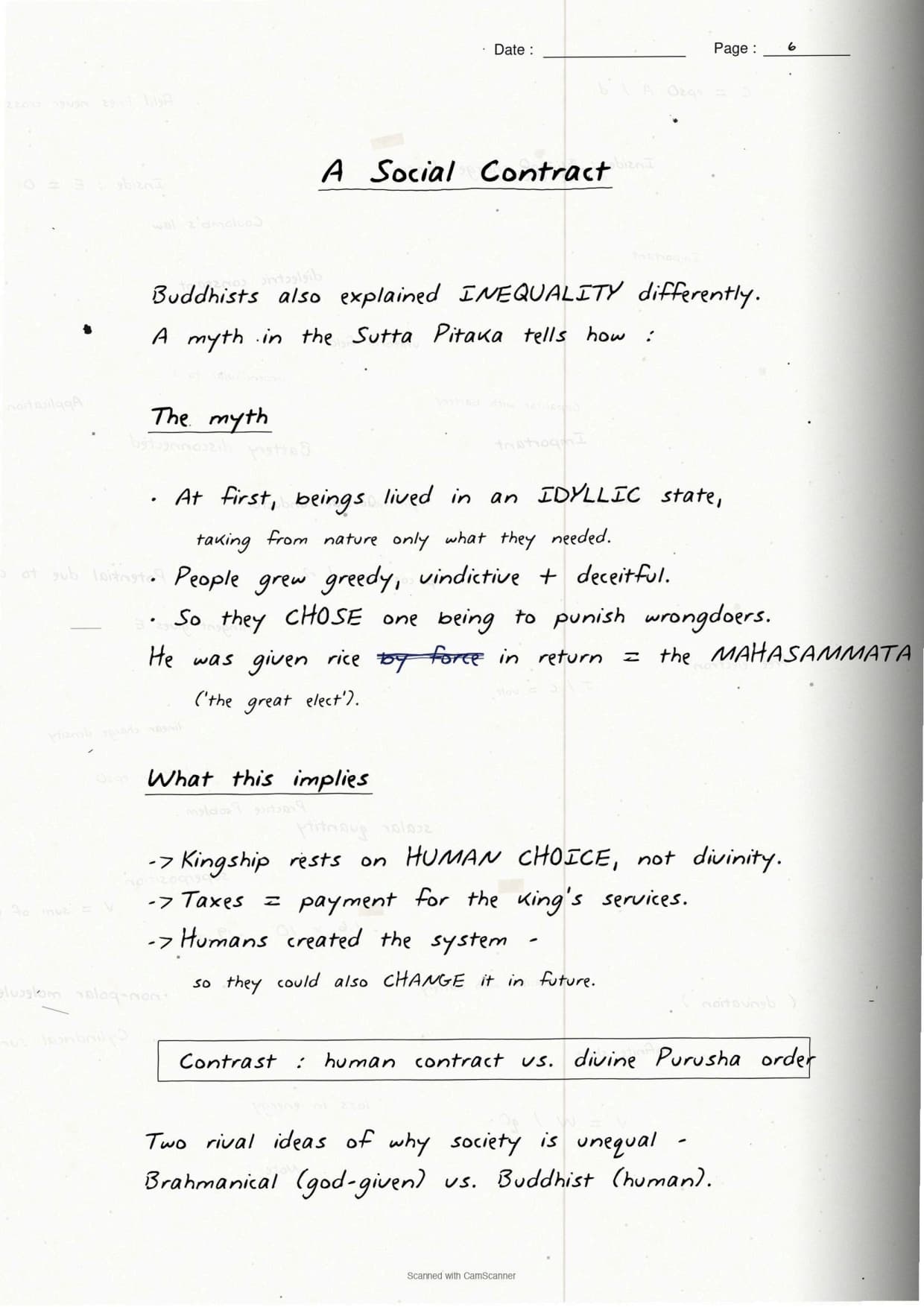
The class pages cover gender and property, the most unequal part of early society. The notes use Draupadi at dice as the sharpest example and box the two rival myths of social order side by side. Learn these as short lists for the gender essay and the difference question.
- Sons over daughters: sons inherited under patriliny; daughters had no claim and were married out.
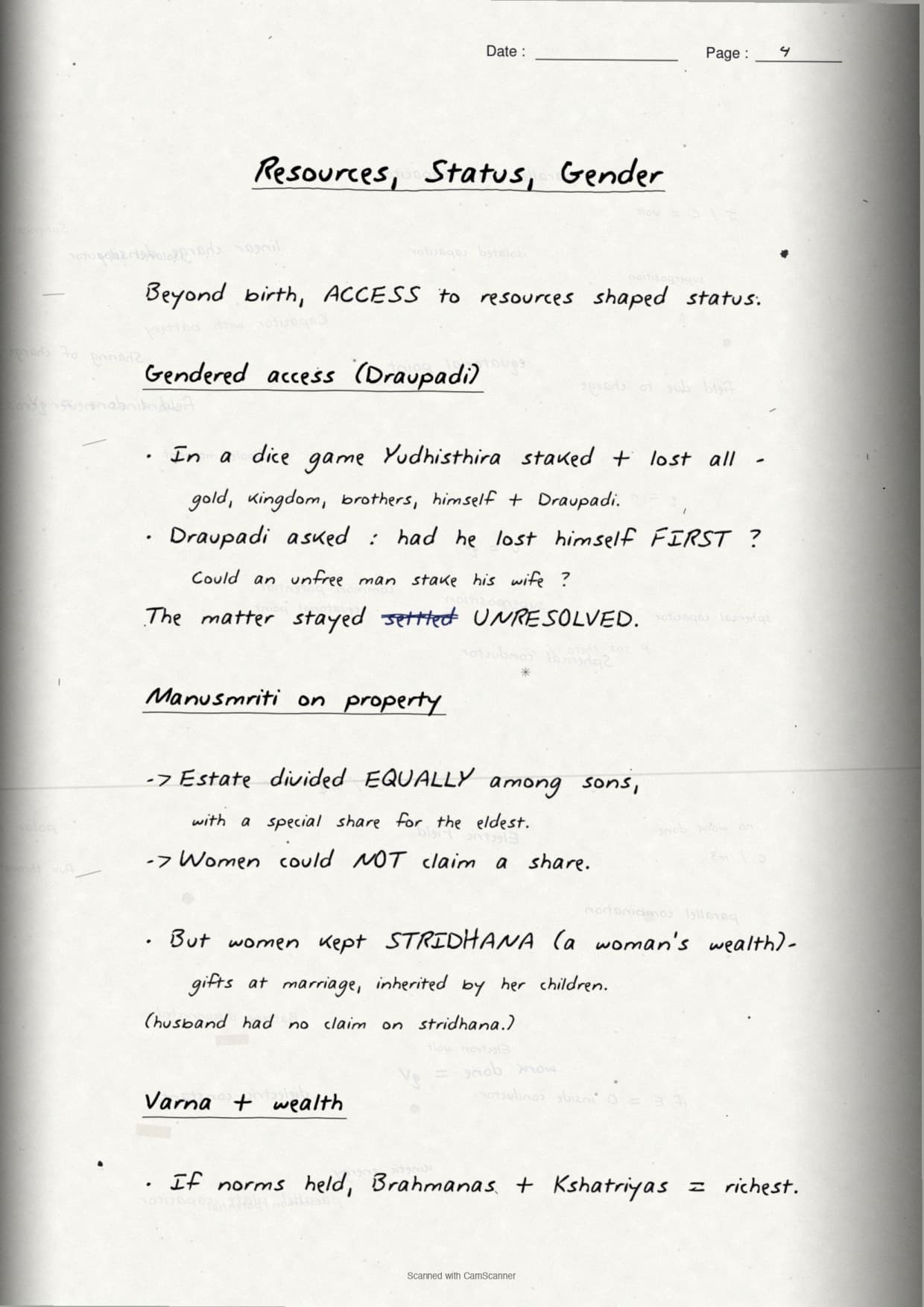
- Property law: the Manusmriti gave the estate to sons; women kept only stridhana.
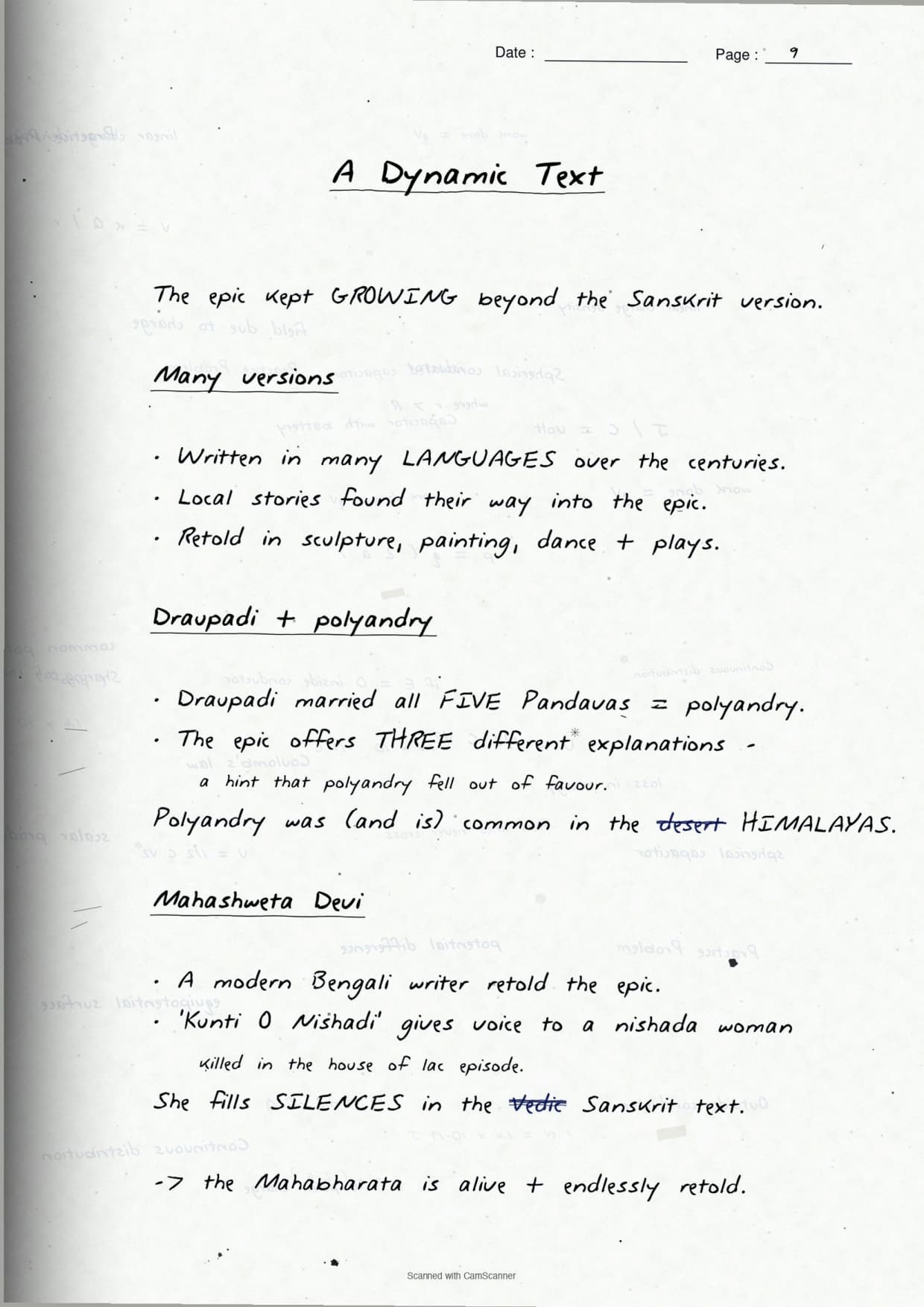
- Draupadi at dice: Yudhisthira staked and lost the common wife, the sharpest image of a woman as property.
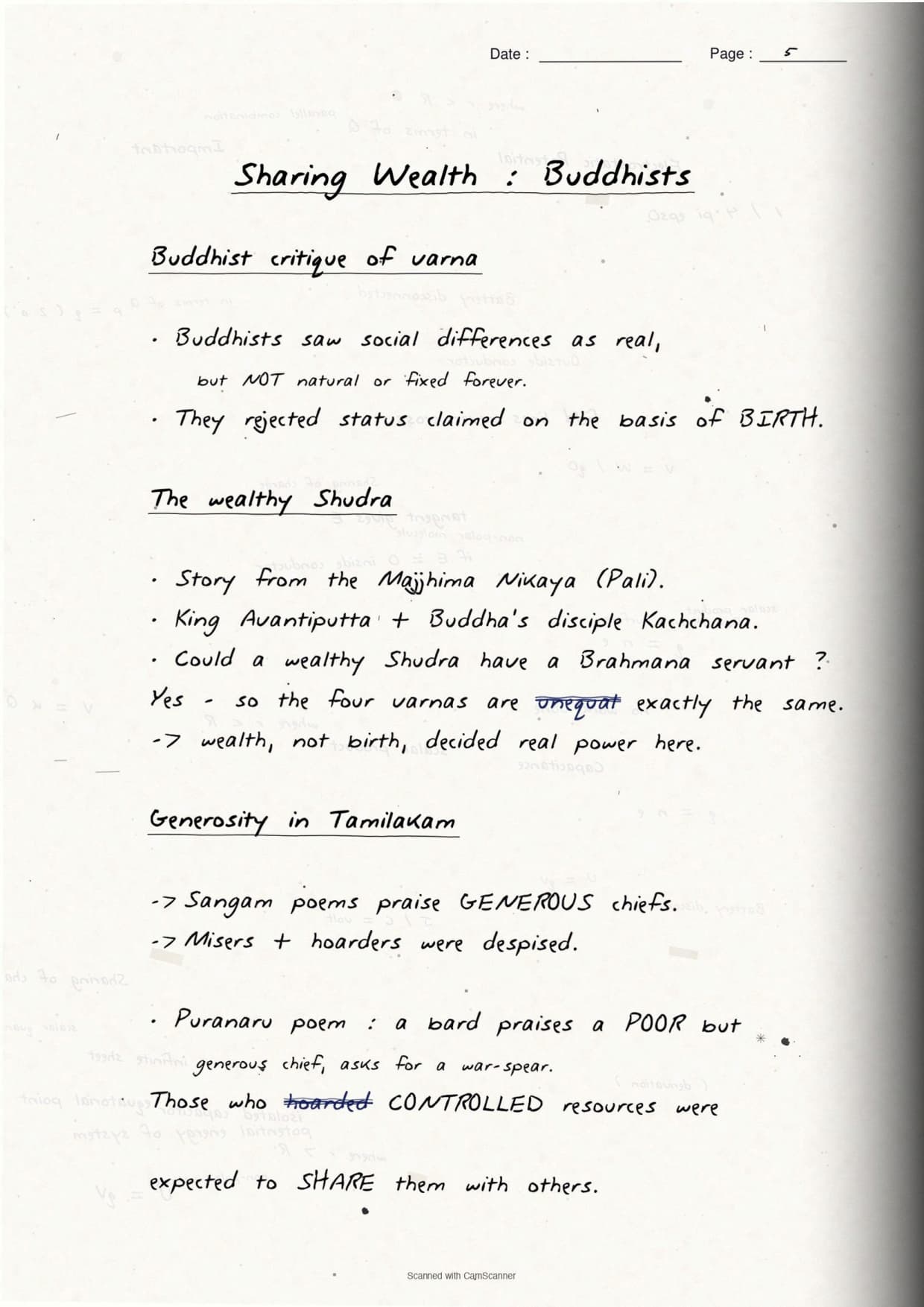
- Two myths: the Purusha sukta makes society divine and fixed; the Buddhist contract makes it a human choice that can change.
The notes underline the honest line: the Purusha sukta makes inequality god-given, while the Buddhist contract makes it man-made and open to reform. A small margin note adds that practice was sometimes softer than the texts, with Prabhavati Gupta and the Satavahana women as the proof, so the gender answer stays balanced.
The Mahabharata as a Dynamic Text Pages
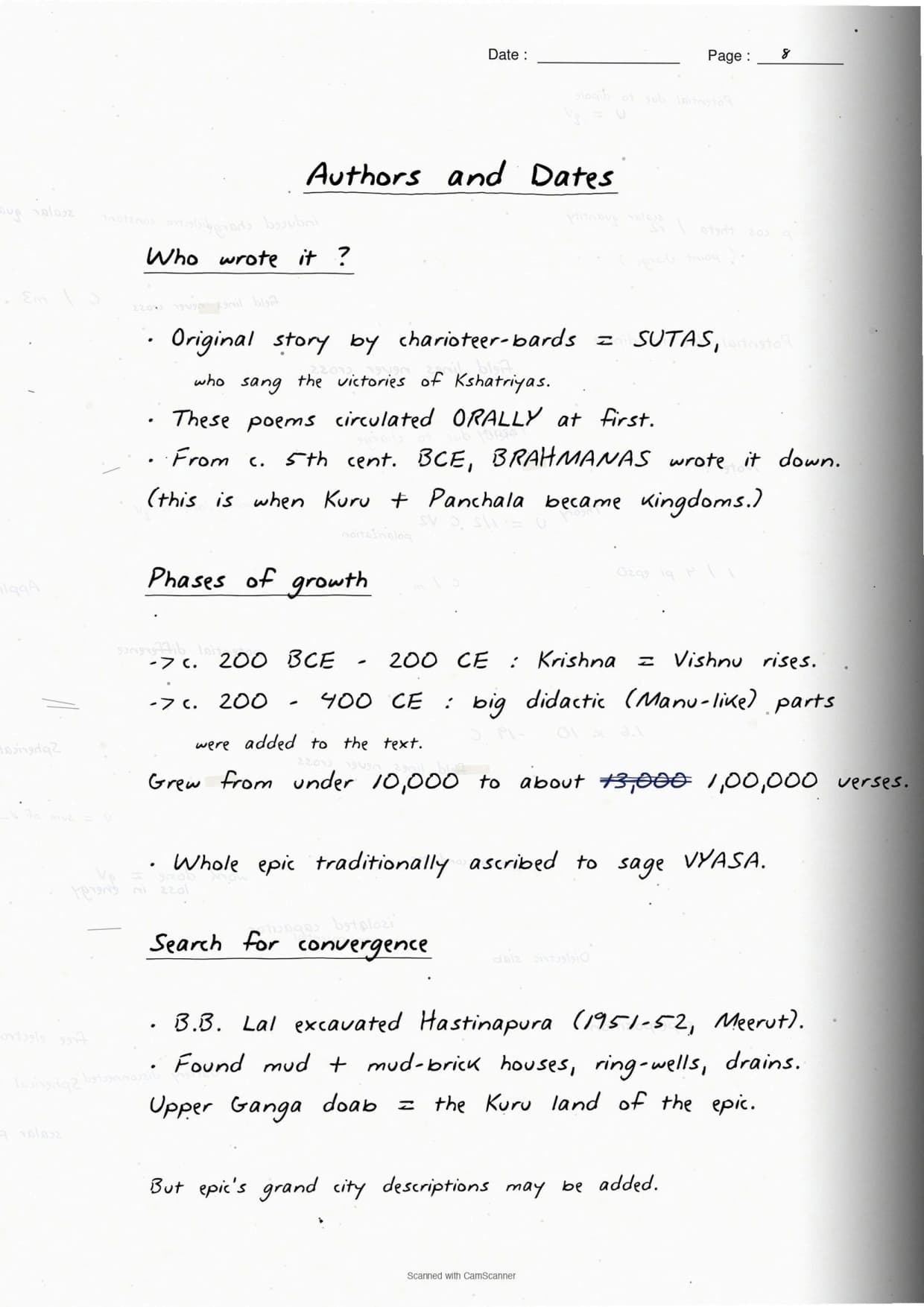
These pages give the epic its own timeline, since the chapter reads society off it. By about a thousand years of growth, the Mahabharata swelled from under 10,000 to about 100,000 verses. Both the single-author debate and Winternitz's "soul of the folk" point are favourites, so the notes keep the phases in one boxed table.
| Phase | What happened |
|---|---|
| c. 500 BCE | Charioteer-bards (sutas) sang of Kshatriya victories; the story spread orally. |
| From 5th c. BCE | Brahmanas took over the story and wrote it down. |
| 200 BCE to 200 CE | Worship of Vishnu grew; Krishna was identified with Vishnu. |
| 200 to 400 CE | Large didactic sections were added; the text reached about 100,000 verses. |
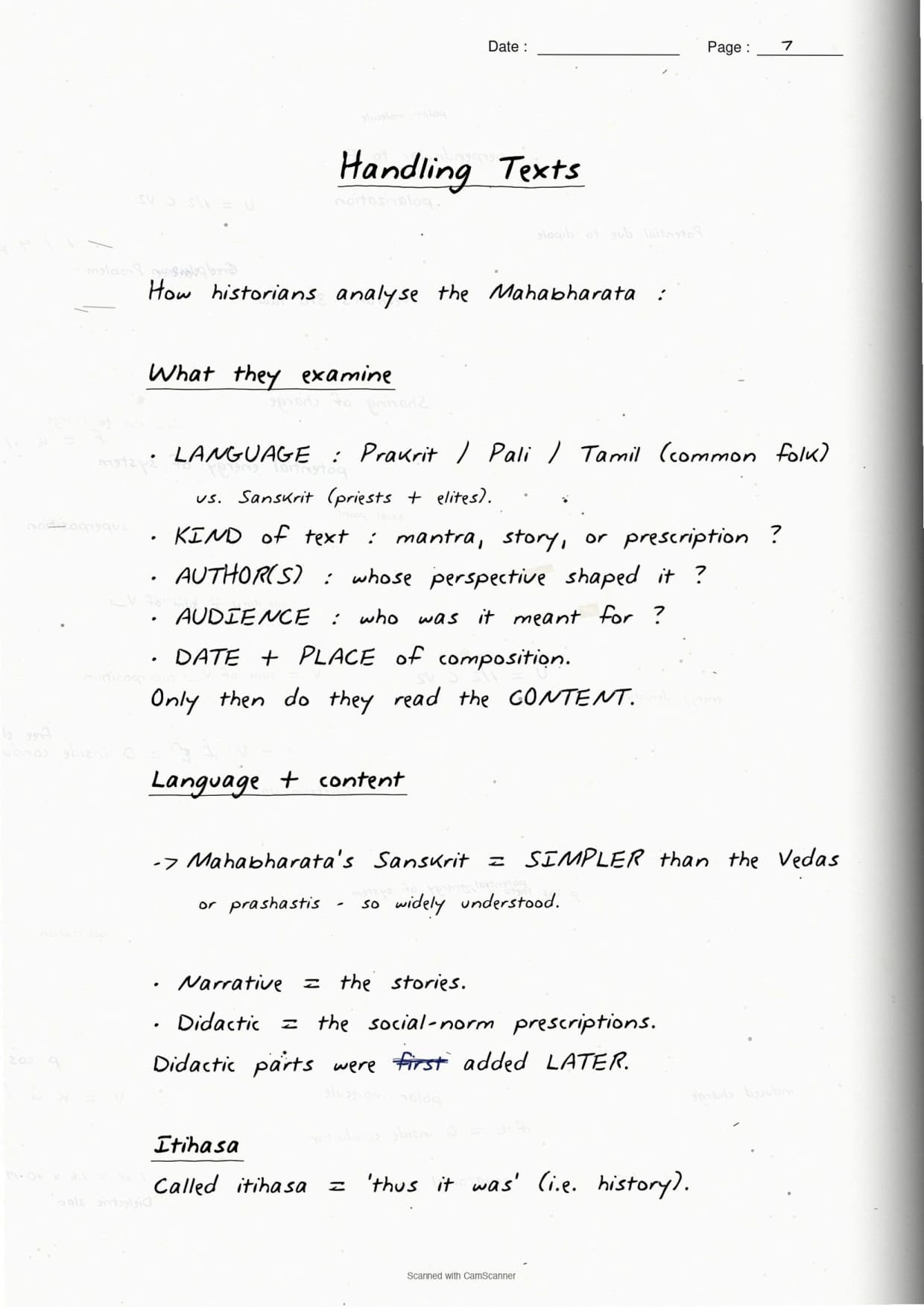
One sharp point the notes box in the margin: Sukthankar's Critical Edition (1919 to 1966) found that over half its 13,000-plus pages are variant readings. So many versions imply many hands. The pages mark the contrast between tradition (Vyasa) and evidence (phased growth and variants) with a linking arrow, so the single-author answer writes itself.
Rule Versus Practice Pages
The chapter's central method is to set the Brahmanical rule against the evidence that it was broken. These pages gather that evidence in one place, since it answers the gotra question and strengthens almost every long answer. The notes underline that inscriptions matter most because they are independent of the Brahmanical texts.
- Women's gotra names: Satavahana queens kept gotra-derived names like Gotami and Vasithi, their fathers' gotras.
- Same-gotra marriage: some of these women shared a gotra yet married, breaking the rule directly.
- Endogamy: the Satavahanas married within the kin group, against the prescribed exogamy.
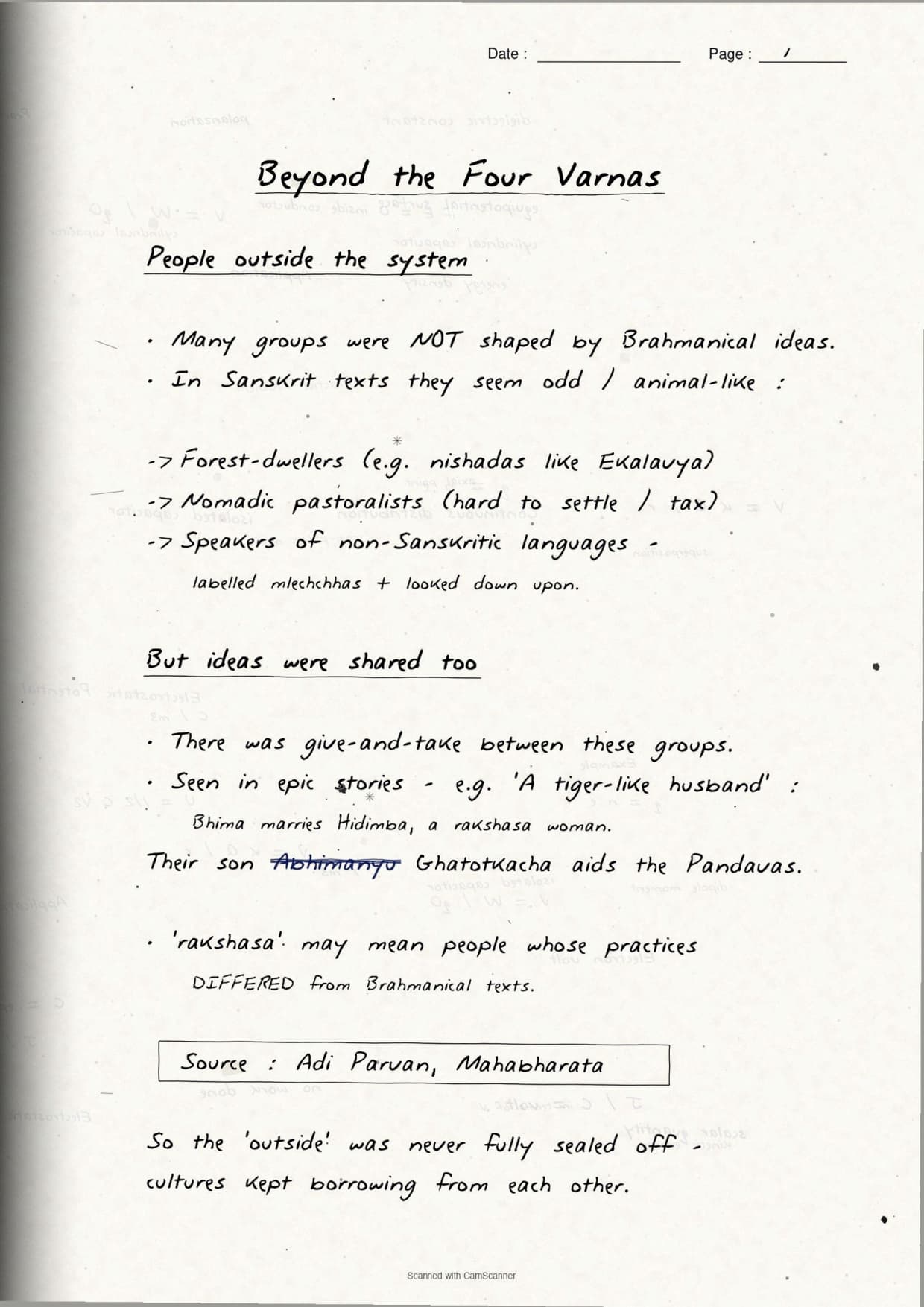
- Polyandry: Draupadi's marriage to the five Pandavas is far from the Brahmanical ideal.
The takeaway boxed at the foot of the page is simple: the prescriptions were authoritative, but were questioned and sometimes simply ignored. A name carved in stone cannot be dismissed as a story, which is why these pages mark the Satavahana inscriptions as the strongest proof for Question 3.9.
How to Use These Handwritten Notes
Handwritten notes work best as a final layer of revision, not as your first read. The plan below helps students get the most out of the kinship, caste and class handwritten notes before the board exam. Follow it once a week in the run-up to the test.
- First pass: read the notes once, following the kinship, caste and class order of pages.
- Active recall: cover the boxed terms and try to write each list from memory.
- Chart practice: redraw the varna chart and the dynasty list without looking.
- Self-test: attempt a short class 12 history chapter 3 mcq drill to check the small facts.
Because the notes come as a downloadable PDF, students can save them on a phone and revise offline on the way to the exam centre. Many students search for class 12 history chapter 3 notes on their phone the night before a test, so a saved PDF means revision is always at hand. Pair these pages with the full solutions to check your written answers against model points.
Common Mistakes These Notes Help You Avoid
A few errors cost marks in this chapter every year. Most come from stating the Brahmanical rule as if it were always obeyed, or from giving only one side of a debate. The notes flag each soft point in the margin so students phrase it safely on the answer sheet.
- Saying kings were always Kshatriyas - name the Mauryas, Shungas, Kanvas, Shakas and Satavahanas.
- Treating the gotra and exogamy rules as universal - the Satavahanas broke them.
- Crediting the whole Mahabharata to Vyasa as fact - that is tradition, not historical proof.
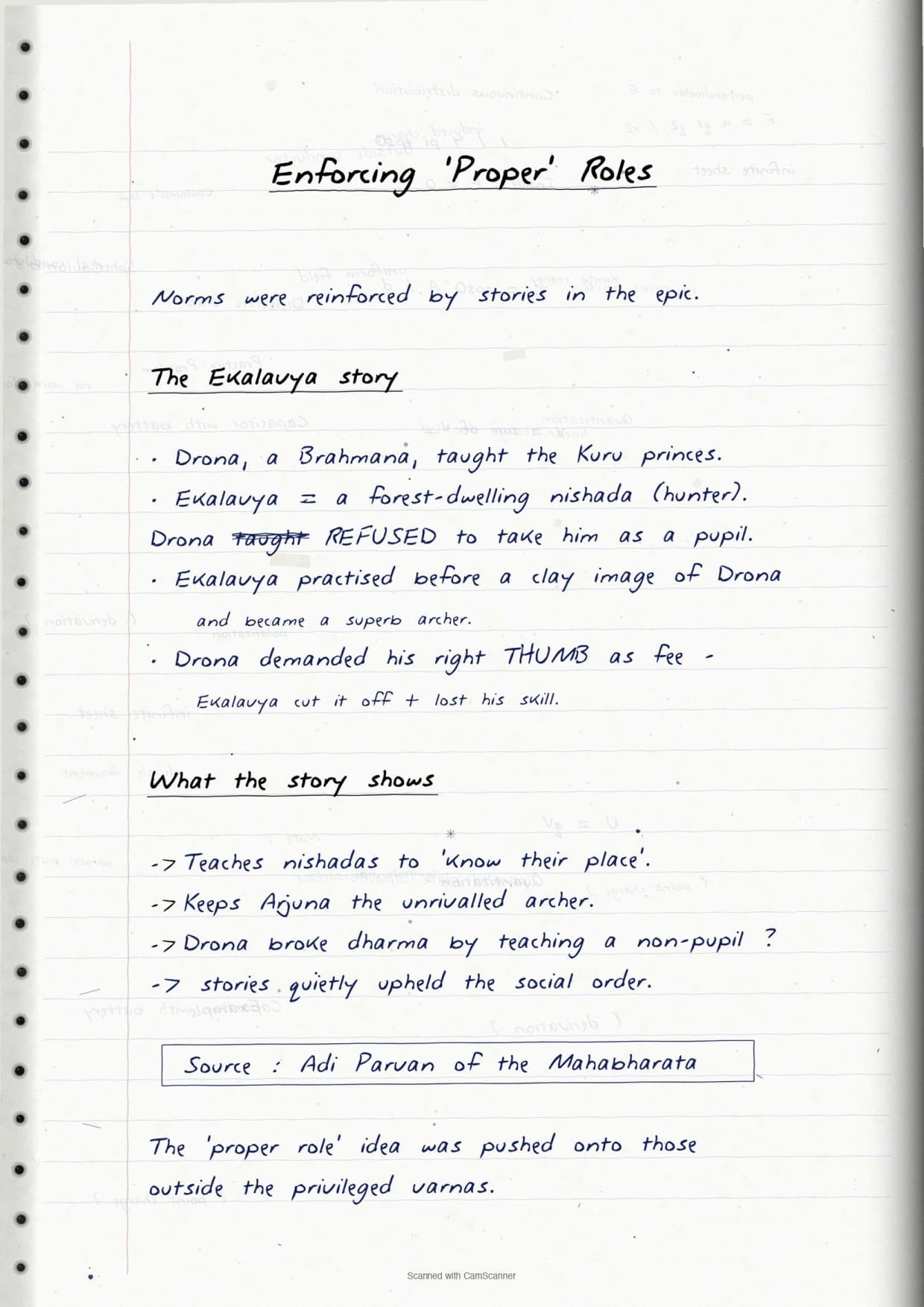
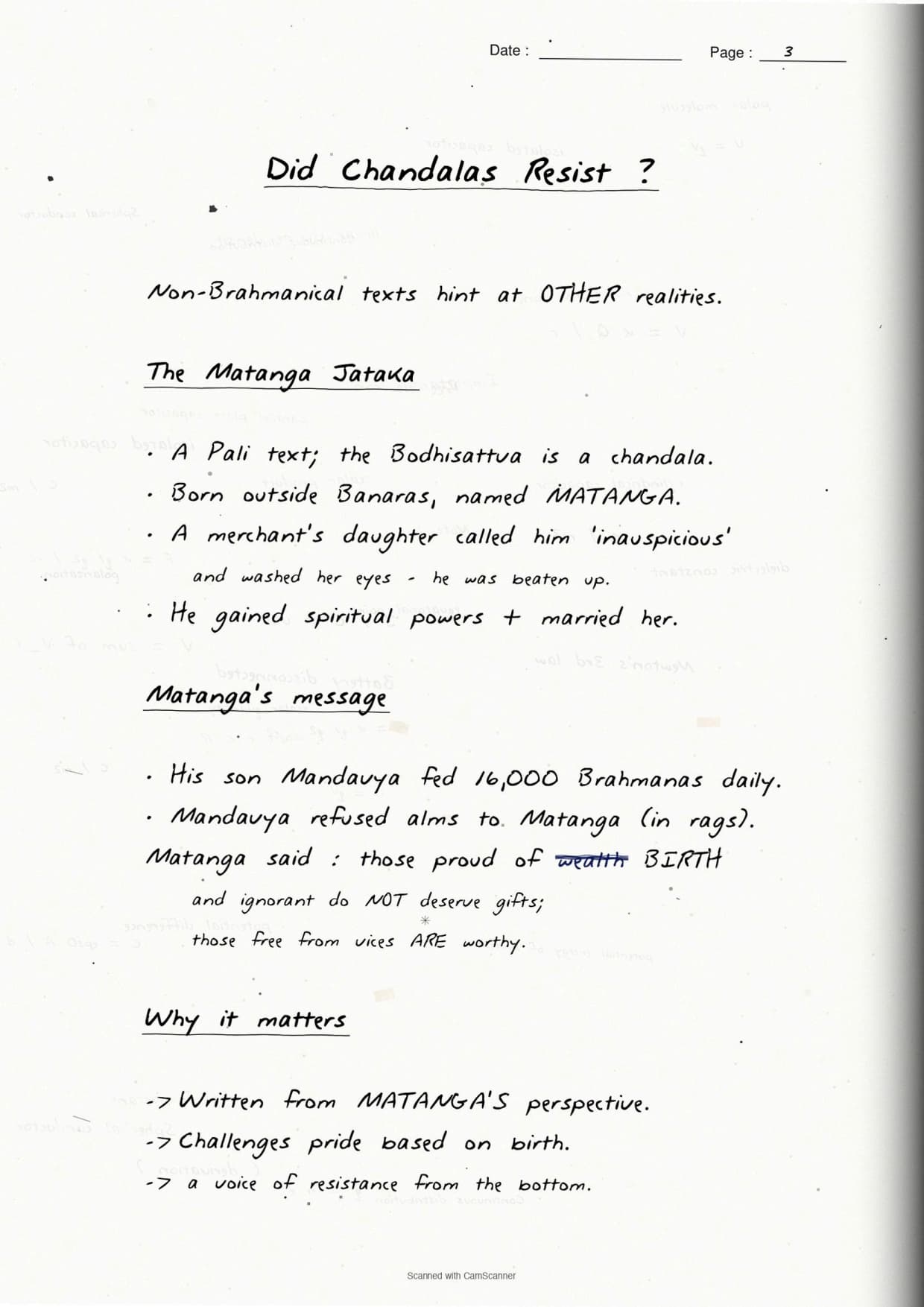
- Forgetting to name the source tradition in the Drona, Hidimba and Matanga comparison.
- Calling gender rules absolute - cases like Prabhavati Gupta show some flexibility.
Students who fix these five points usually move from average to high marks. The exam rewards careful wording, so write "the texts prescribed" and "in practice, however" to separate norm from reality. The handwritten margin notes nudge you to use these soft words in the right places.
How These Notes Pair with the Solutions and Book PDF
These handwritten notes are a revision layer. To prepare fully, students should use them with the other resources for the same chapter, all linked in the table below. Read the notes, then test yourself with the solutions, and open the book PDF for the original text and figures.
| Resource | Best used for |
|---|---|
| Kinship, Caste and Class NCERT Solutions | Step-by-step answers to all 12 back-exercise questions |
| Kinship, Caste and Class Class 12 Notes | Quick chapter summary with all dates, dynasties and source names in one place |
| Kinship, Caste and Class NCERT Book PDF | Reading the original NCERT chapter text and figures |
Tip: use the handwritten charts to memorise the varna order and the dynasty list, then write the full answer in your own words. Drawing the varna chart once from memory fixes the caste answer for good.
All Class 12 History Handwritten Notes by Chapter
The table links the handwritten notes for every chapter in Themes in Indian History so students can move across the book in one click. Chapter 3 is highlighted.
| Chapter | Handwritten Notes |
|---|---|
| Chapter 1 | Bricks, Beads and Bones |
| Chapter 2 | Kings, Farmers and Towns |
| Chapter 3 | Kinship, Caste and Class |
| Chapter 4 | Thinkers, Beliefs and Buildings |
| Chapter 5 | Through the Eyes of Travellers |
| Chapter 6 | Bhakti-Sufi Traditions |
| Chapter 7 | An Imperial Capital Vijayanagara |
| Chapter 8 | Peasants, Zamindars and the State |
| Chapter 9 | Colonialism and the Countryside |
| Chapter 10 | Rebels and the Raj 1857 |
| Chapter 11 | Mahatma Gandhi and the Nationalist Movement |
| Chapter 12 | Framing the Constitution |
FAQs on Kinship, Caste and Class Handwritten Notes
Kinship, Caste and Class Class 12 Handwritten Notes Common Questions
Ques. Where can I download the Kinship, Caste and Class handwritten notes PDF?
Ans. You can download the Kinship, Caste and Class handwritten notes PDF directly from this page. It is free, follows the 2026-27 NCERT, and gives the chapter as clean handwritten pages with boxed terms and labelled charts.
Ques. Are handwritten notes good enough for the class 12 history board exam?
Ans. Yes, for revision. Handwritten notes are best used as a final layer after you have read the chapter and practised the solutions. They make dates, dynasties and the varna order quick to recall in the exam.
Ques. What does the Kinship, Caste and Class chapter cover?
Ans. It covers early Indian society from about 600 BCE to 600 CE, read mainly through the Mahabharata, the Dharmashastras and inscriptions, including patriliny and the gotra, the varna and jati order, non-Kshatriya kings, gender and property, and how the epic was built up over a thousand years.
Ques. Why were kings in early India not always Kshatriyas?
Ans. Because political power went to whoever could gather support and resources, not to Kshatriya birth. The Mauryas were of disputed origin, the Shungas and Kanvas were Brahmanas, the Shakas were outsiders, and the Satavahanas claimed Brahmana status, all against the Shastric rule.
Ques. How should I use these notes for quick revision?
Ans. Read the pages once in the kinship, caste and class order, cover the boxed terms and write each list from memory, redraw the varna chart and dynasty list, then attempt a short class 12 history chapter 3 mcq drill to test the small facts.



Comments